Smart Paradigms and the Predictability and Complexity of Inflectional
Morphology
Gr´egoire D´etrez and Aarne Ranta
Department of Computer Science and Engineering
Chalmers University of Technology and University of Gothenburg
Abstract
Morphological lexica are often imple-mented on top of morphological paradigms, corresponding to different ways of building the full inflection table of a word. Compu-tationally precise lexica may use hundreds of paradigms, and it can be hard for a lex-icographer to choose among them. To au-tomate this task, this paper introduces the notion of asmart paradigm. It is a meta-paradigm, which inspects the base form and tries to infer which low-level paradigm ap-plies. If the result is uncertain, more forms are given for discrimination. The number of forms needed in average is a measure of predictability of an inflection system. The overallcomplexityof the system also has to take into account the code size of the paradigms definition itself. This pa-per evaluates the smart paradigms imple-mented in the open-source GF Resource Grammar Library. Predictability and com-plexity are estimated for four different lan-guages: English, French, Swedish, and Finnish. The main result is that predictabil-ity does not decrease when the complex-ity of morphology grows, which means that smart paradigms provide an efficient tool for the manual construction and/or auto-matically bootstrapping of lexica.
1 Introduction
Paradigmsare a cornerstone of grammars in the European tradition. A classical Latin grammar has five paradigms for nouns (“declensions”) and four for verbs (“conjugations”). The modern ref-erence on French verbs,Bescherelle(Bescherelle, 1997), has 88 paradigms for verbs. Swedish grammars traditionally have, like Latin, five paradigms for nouns and four for verbs, but a modern computational account (Hellberg, 1978),
aiming for more precision, has 235 paradigms for Swedish.
Mathematically, a paradigm is a function that produces inflection tables. Its argument is a word string (either adictionary form or a stem), and its value is ann-tuple of strings (the word forms):
P :String→Stringn
We assume that the exponentnis determined by the language and the part of speech. For instance, English verbs might haven = 5(forsing, sings, sang, sung, singing), whereas for French verbs in Bescherelle, n = 51. We assume the tuples to be ordered, so that for instance the French sec-ond person singular present subjunctive is always found at position 17. In this way, word-paradigm pairs can be easily converted to morphogical lex-ica and to transducers that map form descriptions to surface forms and back. A properly designed set of paradigms permits a compact representation of a lexicon and a user-friendly way to extend it.
Different paradigm systems may have different numbers of paradigms. There are two reasons for this. One is that traditional paradigms often in fact require more arguments than one:
P :Stringm→Stringn
Herem ≤nand the set of arguments is a subset of the set of values. Thus the so-called fourth verb conjugation in Swedish actually needs three forms to work properly, for instancesitta, satt, suttit for the equivalent ofsit, sat, satin English. In Hell-berg (1978), as in the French Bescherelle, each paradigm is defined to take exactly one argument, and hence each vowel alternation pattern must be a different paradigm.
The other factor that affects the number of paradigms is the nature of the string operations
allowed in the function P. In Hellberg (1978), noun paradigms only permit the concatenation of suffixes to a stem. Thus the paradigms are iden-tified with suffix sets. For instance, the inflection patternsbil–bilar(“car–cars”) andnyckel–nycklar (“key–keys”) are traditionally both treated as in-stances of the second declension, with the plural ending ar and the contraction of the unstressed e in the case of nyckel. But in Hellberg, the word nyckel has nyck as its “technical stem”, to which the paradigm numbered 231 adds the sin-gular endingeland the plural endinglar.
The notion of paradigm used in this paper al-lows multiple arguments and powerful string op-erations. In this way, we will be able to reduce the number of paradigms drastically: in fact, each lexical category (noun, adjective, verb), will have justoneparadigm but with a variable number of arguments. Paradigms that follow this design will be called smart paradigms and are introduced in Section 2. Section 3 defines the notions of predictabilityandcomplexityof smart paradigm systems. Section 4 estimates these figures for four different languages of increasing richness in mor-phology: English, Swedish, French, and Finnish. We also evaluate the smart paradigms as a data compression method. Section 5 explores some uses of smart paradigms in lexicon building. Sec-tion 6 compares smart paradigms with related techniques such as morphology guessers and ex-traction tools. Section 7 concludes.
2 Smart paradigms
In this paper, we will assume a notion of paradigm that allows multiple arguments and arbitrary com-putable string operations. As argued in (Ka-plan and Kay, 1994) and amply demonstrated in (Beesley and Karttunen, 2003), no generality is lost if the string operators are restricted to ones computable by finite-state transducers. Thus the examples of paradigms that we will show (only informally), can be converted to matching and re-placements with regular expressions.
For example, a majority of French verbs can be defined by the following paradigm, which analyzes a variable-size suffix of the infinitive form and dispatches to theBescherelleparadigms (identified by a number and an example verb):
mkV:String→String51
mkV(s) =
• conj19finir(s), ifsendsir • conj53rendre(s), ifsendsre • conj14assi´eger(s), ifsends´eger • conj11jeter(s), if s ends eler or
eter
• conj10c´eder(s), ifsends´eder • conj07placer(s), ifsendscer • conj08manger(s), ifsendsger • conj16payer(s), ifsendsyer • conj06parler(s), ifsendser
Notice that the cases must be applied in the given order; for instance, the last case applies only to those verbs ending wither that are not matched by the earlier cases.
Also notice that the above paradigm is just like the more traditional ones, in the sense that we cannot be sure if it really applies to a given verb. For instance, the verb partir ends with ir and would hence receive the same inflection as finir; however, its real conjugation is number 26 in Bescherelle. That mkV uses 19 rather than number 26 has a good reason: a vast majority of irverbs is inflected in this conjugation, and it is also the productive one, to which newirverbs are added.
Even though there is no mathematical differ-ence between the mkV paradigm and the tradi-tional paradigms like those inBescherelle, there is a reason to call mkV asmart paradigm. This name implies two things. First, a smart paradigm implements some “artificial intelligence” to pick the underlying “stupid” paradigm. Second, a smart paradigm uses heuristics (informed guess-ing) if string matching doesn’t decide the matter; the guess is informed by statistics of the distribu-tions of different inflection classes.
One could thus say that smart paradigms are “second-order” or “meta-paradigms”, compared to more traditional ones. They implement a lot of linguistic knowledge and intelligence, and thereby enable tasks such as lexicon building to be performed with less expertise than before. For instance, instead of “07” for foncer and “06” for marcher, the lexicographer can simply write “mkV” for all verbs instead of choosing from 88 numbers.
methods of language teaching, where character-istic formsare used instead of paradigm identi-fiers. For instance, another variant of mkV could use as its second argument the first person plural present indicative to decide whether anirverb is in conjugation 19 or in 26:
mkV:String2 →String51
mkV(s, t) =
• conj26partir(s), if for somex,s=
x+irandt=x+ons
• conj19finir(s), ifsends withir • (all the other cases that can be
rec-ognized by this extra form) • mkV(s) otherwise (fall-back to the
one-argument paradigm)
[image:3.595.301.495.121.217.2]In this way, a series of smart paradigms is built for each part of speech, with more and more ar-guments. The trick is to investigate which new forms have the best discriminating power. For ease of use, the paradigms should be displayed to the user in an easy to understand format, e.g. as a table specifying the possible argument lists:
verb parler
verb parler, parlons
verb parler, parlons, parlera, parla, parl´e noun chien
noun chien, masculine noun chien, chiens, masculine
Notice that, for French nouns, the gender is listed as one of the pieces of information needed for lexicon building. In many cases, it can be ferred from the dictionary form just like the in-flection; for instance, that most nouns ending e are feminine. A gender argument in the smart noun paradigm makes it possible to override this default behaviour.
2.1 Paradigms in GF
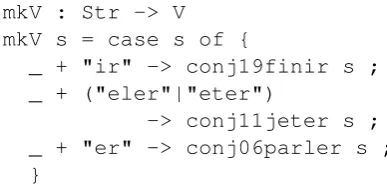
Smart paradigms as used in this paper have been implemented in the GF programming language (Grammatical Framework, (Ranta, 2011)). GF is a functional programming lnguage enriched with regular expressions. For instance, the following function implements a part of the one-argument French verb paradigm shown above. It uses a case expression to pattern match with the arguments; the pattern_matches anything, while+divides a string to two pieces, and|expresses alternation. The functions conj19finir etc. are defined
elsewhere in the library. Function application is expressed without parentheses, by the juxtaposi-tion of the funcjuxtaposi-tion and the argument.
mkV : Str -> V mkV s = case s of {
_ + "ir" -> conj19finir s ; _ + ("eler"|"eter")
-> conj11jeter s ; _ + "er" -> conj06parler s ; }
The GF Resource Grammar Library1 has comprehensive smart paradigms for 18 lan-guages: Amharic, Catalan, Danish, Dutch, En-glish, Finnish, French, German, Hindi, Italian, Nepalese, Norwegian, Romanian, Russian, Span-ish, SwedSpan-ish, TurkSpan-ish, and Urdu. A few other lan-guages have complete sets of ”traditional” inflec-tion paradigms but no smart paradigms.
Six languages in the library have comprehen-sive morphological dictionaries: Bulgarian (53k lemmas), English (42k), Finnish (42k), French (92k), Swedish (43k), and Turkish (23k). They have been extracted from other high-quality re-sources via conversions to GF using the paradigm systems. In Section 4, four of them will be used for estimating the strength of the smart paradigms, that is, the predictability of each language.
3 Cost, predictability, and complexity
Given a languageL, a lexical categoryC, and a set Pof smart paradigms forC, thepredictabilityof the morphology ofCinLbyPdepends inversely on the average number of arguments needed to generate the correct inflection table for a word. The lower the number, the more predictable the system.
Predictability can be estimated from a lexicon that contains such a set of tables. Formally, a smart paradigm is a familyPm of functions
Pm :Stringm→Stringn
wheremranges over some set of integers from 1 ton, but need not contain all those integers. A lexiconLis a finite set of inflection tables,
L={wi :Stringn|i= 1, . . . , ML}
As the nis fixed, this is a lexicon specialized to one part of speech. Awordis an element of the lexicon, that is, an inflection table of sizen.
An application of a smart paradigm Pm to a
wordw ∈ Lis an inflection table resulting from applyingPm to the appropriate subsetσm(w)of
the inflection tablew,
Pm[w] =Pm(σm(w)) :Stringn
Thus we assume that all arguments are existing word forms (rather than e.g. stems), or features such as the gender.
An application iscorrectif
Pm[w] =w
Thecost of a wordwis the minimum number of arguments needed to make the application correct:
cost(w) = argmin
m (Pm[w] =w)
For practical applications, it is useful to require Pmto bemonotonic, in the sense that increasing
mpreserves correctness.
The cost of a lexiconL is the average cost for its words,
cost(L) =
ML
X
i=1
cost(wi)
ML
whereMLis the number of words in the lexicon,
as defined above.
The predictability of a lexicon could be de-fined as a quantity inversely dependent on its cost. For instance, an information-theoretic measure could be defined
predict(L) = 1 1 + logcost(L)
with the intuition that each added argument cor-responds to a choice in a decision tree. However, we will not use this measure in this paper, but just the concrete cost.
The complexity of a paradigm systemis de-fined as the size of its code in a given coding system, following the idea of Kolmogorov com-plexity (Solomonoff, 1964). The notion assumes a coding system, which we fix to be GF source code. As the results are relative to the coding system, they are only usable for comparing def-initions in the same system. However, using GF
source code size rather than e.g. a finite automa-ton size gives in our view a better approximation of the “cognitive load” of the paradigm system, its “learnability”. As a functional programming language, GF permits abstractions comparable to those available for human language learners, who don’t need to learn the repetitive details of a finite automaton.
We define thecode complexity as the size of the abstract syntax tree of the source code. This size is given as the number of nodes in the syntax tree; for instance,
• size(f(x1, . . . , xn)) = 1 + n
X
i=1
size(xi)
• size(s) = 1, for a string literal s
Using the abstract syntax size makes it possible to ignore programmer-specific variation such as identifier size. Measurements of the GF Resource Grammar Library show that code size measured in this way is in average 20% of the size of source files in bytes. Thus a source file of 1 kB has the code complexity around 200 on the average.
Notice that code complexity is defined in a way that makes it into a straightforward generaliza-tion of the cost of a word as expressed in terms of paradigm applications in GF source code. The source code complexity of a paradigm application is
size(Pm[w]) = 1 +m
Thus the complexity for a wordwis its cost plus one; the addition of one comes from the applica-tion node for the funcapplica-tionPmand corresponds to
knowing the part of speech of the word.
4 Experimental results
We conducted experiments in four languages (En-glish, Swedish, French and Finnish2), presented here in order of morphological richness. We used trusted full form lexica (i.e. lexica giving the com-plete inflection table of every word) to compute the predictability, as defined above, in terms of the smart paradigms in GF Resource Grammar Li-brary.
We used a simple algorithm for computing the cost c of a lexicon L with a set Pm of smart
paradigms:
2This choice correspond to the set of language for which
• setc:= 0
• for each wordwiinL,
– for eachm in growing order for which Pmis defined:
ifPm[w] =w, thenc:=c+m, else try
with nextm
• return c
The average cost iscdivided by the size ofL. The procedure presupposes that it is always possible to get the correct inflection table. For this to be true, the smart paradigms must have a “worst case scenario” version that is able to gen-erate all forms. In practice, this was not always the case but we checked that the number of prob-lematic words is so small that it wouldn’t be sta-tistically significant. A typical problem word was the equivalent of the verbbein each language.
Another source of deviation is that a lexicon may have inflection tables with size deviating from the number n that normally defines a lex-ical category. Some words may be “defective”, i.e. lack some forms (e.g. the singular form in “plurale tantum” words), whereas some words may have several variants for a given form (e.g. learned andlearnt in English). We made no ef-fort to predict defective words, but just ignored them. With variant forms, we treated a prediction as correct if it matched any of the variants.
The above algorithm can also be used for help-ing to select the optimal sets of characteristic forms; we used it in this way to select the first form of Swedish verbs and the second form of Finnish nouns.
The results are collected in Table 1. The sec-tions below give more details of the experiment in each language.
4.1 English
As gold standard, we used the electronic version of the Oxford Advanced Learner’s Dictionary of Current English3 which contains about 40,000 root forms (about 70,000 word forms).
Nouns. We considered English nouns as hav-ing only two forms (shav-ingular and plural), exclud-ing the genitive forms which can be considered to be clitics and are completely predictable. About
3available in electronic form athttp://www.eecs. qmul.ac.uk/˜mpurver/software.html
one third of the nouns of the lexicon were not in-cluded in the experiment because one of the form was missing. The vast majority of the remaining 15,000 nouns are very regular, with predictable deviations such askiss - kissesandfly - flieswhich can be easily predicted by the smart paradigm. With the average cost of 1.05, this was the most predictable lexicon in our experiment.
Verbs. Verbs are the most interesting category in English because they present the richest mor-phology. Indeed, as shown by Table 1, the cost for English verbs, 1.21, is similar to what we got for morphologically richer languages.
4.2 Swedish
As gold standard, we used the SALDO lexicon (Borin et al., 2008).
Nouns. The noun inflection tables had 8 forms (singular/plural indefinite/definite nomina-tive/genitive) plus a gender (uter/neuter). Swedish nouns are intrinsically very unpredictable, and there are many examples of homonyms falling un-der different paradigms (e.g.val - val“choice” vs. val -valar“whale”). The cost 1.70 is the highest of all the lexica considered. Of course, there may be room for improving the smart paradigm.
Verbs. The verbs had 20 forms, which in-cluded past participles. We ran two experiments, by choosing either the infinitive or the present in-dicative as the base form. In traditional Swedish grammar, the base form of the verb is considered to be the infinitive, e.g. spela, leka (“play” in two different senses). But this form doesn’t dis-tinguish between the “first” and the “second con-jugation”. However, the present indicative, here spelar, leker, does. Using it gives a predictive power 1.13 as opposed to 1.22 with the infinitive. Some modern dictionaries such as Lexin4 there-fore use the present indicative as the base form.
4.3 French
For French, we used the Morphalou morpholog-ical lexicon (Romary et al., 2004). As stated in the documentation5the current version of the lex-icon (version 2.0) is not complete, and in par-ticular, many entries are missing some or all in-flected forms. So for those experiments we only
4
http://lexin.nada.kth.se/lexin/ 5
http://www.cnrtl.fr/lexiques/
Table 1: Lexicon size and average cost for the nouns (N) and verbs (V) in four languages, with the percentage of words correctly inferred from one and two forma (i.e.m= 1andm≤2, respectively).
Lexicon Forms Entries Cost m= 1 m≤2 Eng N 2 15,029 1.05 95% 100% Eng V 5 5,692 1.21 84% 95% Swe N 9 59,225 1.70 46% 92% Swe V 20 4,789 1.13 97% 97% Fre N 3 42,390 1.25 76% 99% Fre V 51 6,851 1.27 92% 94% Fin N 34 25,365 1.26 87% 97% Fin V 102 10,355 1.09 96% 99%
included entries where all the necessary forms were presents.
Nouns: Nouns in French have two forms (sin-gular and plural) and an intrinsic gender (mascu-line or feminine), which we also considered to be a part of the inflection table. Most of the unpre-dictability comes from the impossibility to guess the gender.
Verbs: The paradigms generate all of the sim-ple (as opposed to compound) tenses given in tra-ditional grammars such as theBescherelle. Also the participles are generated. The auxiliary verb of compound tenses would be impossible to guess from morphological clues, and was left out of consideration.
4.4 Finnish
The Finnish gold standard was the KOTUS lexi-con (Kotimaisten Kielten Tutkimuskeskus, 2006). It has around 90,000 entries tagged with part of speech, 50 noun paradigms, and 30 verb paradigms. Some of these paradigms are rather abstract and powerful; for instance, grade alterna-tion would multiply many of the paradigms by a factor of 10 to 20, if it was treated in a concate-native way. For instance, singular nomiconcate-native- nominative-genitive pairs show alternations such astalo–talon (“house”), katto–katon (“roof”), kanto–kannon (“stub”), rako–raon (“crack”), and sato–sadon (“harvest”). All of these are treated with one and the same paradigm, which makes the KOTUS sys-tem relatively abstract.
The total number of forms of Finnish nouns and verbs is a question of definition. Koskenniemi (Koskenniemi, 1983) reports 2000 for nouns and 12,000 for verbs, but most of these forms result by adding particles and possessive suffixes in an
ag-glutinative way. The traditional number and case count for nouns gives 26, whereas for verbs the count is between 100 and 200, depending on how participles are counted. Notice that the definition of predictability used in this paper doesn’t depend on the number of forms produced (i.e. not onn but only on m); therefore we can simply ignore this question. However, the question is interesting if we think about paradigms as a data compression method (Section 4.5).
Nouns. Compound nouns are a problem for morphology prediction in Finnish, because inflec-tion is sensitive to the vowel harmony and num-ber of syllables, which depend on where the com-pound boundary goes. While many comcom-pounds are marked in KOTUS, we had to remove some compounds with unmarked boundaries. Another peculiarity was that adjectives were included in nouns; this is no problem since the inflection pat-terns are the same, if comparison forms are ig-nored. The figure 1.26 is better than the one re-ported in (Ranta, 2008), which is 1.42; the reason is mainly that the current set of paradigms has a better coverage of three-syllable nouns.
Verbs. Even though more numerous in forms than nouns, Finnish verbs are highly predictable (1.09).
4.5 Complexity and data compression
oth-Table 2: Paradigm complexities for nouns and verbs in the four languages, computed as the syntax tree size of GF code.
language noun verb total English 403 837 991 Swedish 918 1039 1884 French 351 2193 2541 Finnish 4772 3343 6885
ers.
Following the definitions of Section 3, we have counted the the complexity of the smart paradigm definitions for nouns and verbs in the different languages in the GF Resource Grammar Library. Notice that the total complexity of the system is lower than the sum of the parts, because many definitions (such as morphophonological transfor-mations) are reused in different parts of speech. The results are in Table2.
These figures suggest that Finnish indeed has a more complex morphology than French, and En-glish is the simplest. Of course, the paradigms were not implemented with such comparisons in mind, and it may happen that some of the differ-ences come from different coding styles involved in the collaboratively built library. Measuring code syntax trees rather than source code text neu-tralizes some of this variation (Section 3).
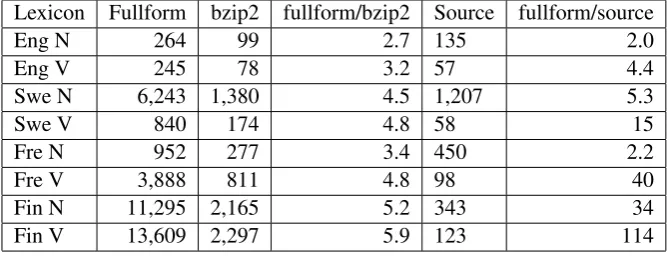
Finally, we can estimate the power of smart paradigms as a data compression function. In a sense, a paradigm is a function designed for the very purpose of compressing a lexicon, and one can expect better compression than with generic tools such as bzip2. Table3 shows the compres-sion rates for the same full-form lexica as used in the predictability experiment (Table 1). The sizes are in kilobytes, where the code size for paradigms is calculated as the number of con-structors multiplied by 5 (Section 3). The source lexicon size is a simple character count, similar to the full-form lexicon.
Unexpectedly, the compression rate of the paradigms improves as the number of forms in the full-form lexicon increases (see Table 1 for these numbers). For English and French nouns, bzip2 is actually better. But of course, unlike the paradigms, it also gives a global compression over all entries in the lexicon. Combining the two methods by applying bzip2 to the source code
gives, for the Finnish verb lexicon, a file of 60 kB, which implies a joint compression rate of 227.
That the compression rates for the code can be higher than the numbers of forms in the full-form lexicon is explained by the fact that the gener-ated forms are longer than the base forms. For instance, the full-form entry of the Finnish verb uida(”swim”) is 850 bytes, which means that the average form size is twice the size of the basic form.
5 Smart paradigms in lexicon building
Building a high-quality lexicon needs a lot of manual work. Traditionally, when one is not writ-ing all the forms by hand (which would be almost impossible in languages with rich morphology), sets of paradigms are used that require the lexi-cographer to specify the base form of the word and an identifier for the paradigm to use. This has several usability problems: one has to remember all the paradigm identifiers and choose correctly from them.
Smart paradigm can make this task easier, even accessible to non-specialist, because of their abil-ity to guess the most probable paradigm from a single base form. As shown by Table 1, this is more often correct than not, except for Swedish nouns. If this information is not enough, only a few more forms are needed, requiring only prac-tical knowledge of the language. Usually (92% to 100% in Table1), adding a second form (m= 2) is enough to cover all words. Then the best prac-tice for lexicon writing might be always to give these two forms instead of just one.
Smart paradigms can also be used for an auto-matic bootstrapping of a list of base forms into a full form lexicon. As again shown by the last col-umn of Table1, one form alone can provide an excellent first approximation in most cases. What is more, it is often the case that uncaught words belong to a limited set of “irregular” words, such as the irregular verbs in many languages. All new words can then be safely inferred from the base form by using smart paradigms.
6 Related work
Table 3: Comparison between using bzip2 and paradigms+lexicon source as a compression method. Sizes in kB.
Lexicon Fullform bzip2 fullform/bzip2 Source fullform/source
Eng N 264 99 2.7 135 2.0
Eng V 245 78 3.2 57 4.4
Swe N 6,243 1,380 4.5 1,207 5.3
Swe V 840 174 4.8 58 15
Fre N 952 277 3.4 450 2.2
Fre V 3,888 811 4.8 98 40
Fin N 11,295 2,165 5.2 343 34
Fin V 13,609 2,297 5.9 123 114
complexity. Also the paradigms for Finnish are improved here (cf. Section 4.4 above).
Even though smart paradigm-like descriptions are common in language text books, there is to our knowledge no computational equivalent to the smart paradigms of GF. Finite state morphology systems often have a function called a guesser, which, given a word form, tries to guess either the paradigm this form belongs to or the dictio-nary form (or both). A typical guesser differs from a smart paradigms in that it does not make it possible to correct the result by giving more forms. Examples of guessers include (Chanod and Tapanainen, 1995) for French, (Hlav´aˇcov´a, 2001) for Czech, and (Nakov et al., 2003) for Ger-man.
Another related domain is the unsupervised learning of morphology where machine learning is used to automatically build a language mor-phology from corpora (Goldsmith, 2006). The main difference is that with the smart paradigms, the paradigms and the guess heuristics are imple-mented manually and with a high certainty; in un-supervised learning of morphology the paradigms are induced from the input forms with much lower certainty. Of particular interest are (Chan, 2006) and (Dreyer and Eisner, 2011), dealing with the automatic extraction of paradigms from text and investigate how good these can become. The main contrast is, again, that our work deals with hand-written paradigms that are correct by design, and we try to see how much information we can drop before losing correctness.
Once given, a set of paradigms can be used in automated lexicon extraction from raw data, as in (Forsberg et al., 2006) and (Cl´ement et al., 2004), by a method that tries to collect a sufficient
num-ber of forms to determine that a word belongs to a certain paradigm. Smart paradigms can then give the method to actually construct the full inflection tables from the characteristic forms.
7 Conclusion
We have introduced the notion of smart paradigms, which implement the linguistic knowledge involved in inferring the inflection of words. We have used the paradigms to estimate the predictability of nouns and verbs in English, Swedish, French, and Finnish. The main result is that, with the paradigms used, less than two forms in average is always enough. In half of the languages and categories, one form is enough to predict more than 90% of forms correctly. This gives a promise for both manual lexicon building and automatic bootstrapping of lexicon from word lists.
To estimate the overall complexity of inflection systems, we have also measured the size of the source code for the paradigm systems. Unsurpris-ingly, Finnish is around seven times as complex as English, and around three times as complex as Swedish and French. But this cost is amortized when big lexica are built.
Finally, we looked at smart paradigms as a data compression method. With simple morphologies, such as English nouns, bzip2 gave a better com-pression of the lexicon than the source code us-ing paradigms. But with Finnish verbs, the com-pression rate was almost 20 times higher with paradigms than with bzip2.
methods. They also suggest a method to assess the complexity and learnability of languages, re-lated to Kolmogorov complexity. The results in the current paper are just preliminary in this re-spect, since they might still tell more about par-ticular implementations of paradigms than about the languages themselves.
Acknowledgements
We are grateful to the anonymous referees for valuable remarks and questions. The research leading to these results has received funding from the European Union’s Seventh Framework Pro-gramme (FP7/2007-2013) under grant agreement no FP7-ICT-247914 (the MOLTO project).
References
[Beesley and Karttunen2003] Kenneth R. Beesley and Lauri Karttunen. 2003. Finite State Morphology. CSLI Publications.
[Bescherelle1997] Bescherelle. 1997. La conjugaison pour tous. Hatier.
[Borin et al.2008] Lars Borin, Markus Forsberg, and Lennart L¨onngren. 2008. Saldo 1.0 (svenskt as-sociationslexikon version 2).Spr˚akbanken, 05. [Chan2006] Erwin Chan. 2006. Learning probabilistic
paradigms for morphology in a latent class model. In Proceedings of the Eighth Meeting of the ACL Special Interest Group on Computational Phonol-ogy and MorpholPhonol-ogy, SIGPHON ’06, pages 69–78, Stroudsburg, PA, USA. Association for Computa-tional Linguistics.
[Chanod and Tapanainen1995] Jean-Pierre Chanod and Pasi Tapanainen. 1995. Creating a tagset, lexicon and guesser for a french tagger. CoRR, cmp-lg/9503004.
[Cl´ement et al.2004] Lionel Cl´ement, Benoˆıt Sagot, and Bernard Lang. 2004. Morphology based au-tomatic acquisition of large-coverage lexica. In
Proceedings of LREC-04, Lisboa, Portugal, pages 1841–1844.
[Dreyer and Eisner2011] Markus Dreyer and Jason Eisner. 2011. Discovering morphological paradigms from plain text using a dirichlet process mixture model. InProceedings of the Conference on Empirical Methods in Natural Language Pro-cessing, EMNLP ’11, pages 616–627, Stroudsburg, PA, USA. Association for Computational Linguis-tics.
[Forsberg et al.2006] Markus Forsberg, Harald Ham-marstr¨om, and Aarne Ranta. 2006. Morpholog-ical Lexicon Extraction from Raw Text Data. In T. Salakoski, editor,FinTAL 2006, volume 4139 of
LNCS/LNAI.
[Goldsmith2006] John Goldsmith. 2006. An Algo-rithm for the Unsupervised Learning of Morphol-ogy. Nat. Lang. Eng., 12(4):353–371.
[Hellberg1978] Staffan Hellberg. 1978. The Morphol-ogy of Present-Day Swedish. Almqvist & Wiksell. [Hlav´aˇcov´a2001] Jaroslava Hlav´aˇcov´a. 2001.
Mor-phological guesser of czech words. In V´aclav Ma-touˇsek, Pavel Mautner, Roman Moucek, and Karel Tauˇser, editors,Text, Speech and Dialogue, volume 2166 ofLecture Notes in Computer Science, pages 70–75. Springer Berlin / Heidelberg.
[Kaplan and Kay1994] R. Kaplan and M. Kay. 1994. Regular Models of Phonological Rule Systems.
Computational Linguistics, 20:331–380.
[Koskenniemi1983] Kimmo Koskenniemi. 1983.
Two-Level Morphology: A General Computational Model for Word-Form Recognition and Production. Ph.D. thesis, University of Helsinki.
[Kotimaisten Kielten Tutkimuskeskus2006]
Kotimaisten Kielten Tutkimuskeskus. 2006. KOTUS Wordlist. http://kaino.kotus.
fi/sanat/nykysuomi.
[Nakov et al.2003] Preslav Nakov, Yury Bonev, and et al. 2003. Guessing morphological classes of un-known german nouns.
[Ranta2008] Aarne Ranta. 2008. How pre-dictable is Finnish morphology? an experi-ment on lexicon construction. In J. Nivre and M. Dahll¨of and B. Megyesi, editor, Resource-ful Language Technology: Festschrift in Honor of Anna S˚agvall Hein, pages 130–148. University of Uppsala.http://publications.uu.se/
abstract.xsql?dbid=8933.
[Ranta2011] Aarne Ranta. 2011.Grammatical Frame-work: Programming with Multilingual Grammars. CSLI Publications, Stanford. ISBN-10: 1-57586-626-9 (Paper), 1-57586-627-7 (Cloth).
[Romary et al.2004] Laurent Romary, Susanne Salmon-Alt, and Gil Francopoulo. 2004. Standards going concrete: from LMF to Morphalou. InThe 20th International Conference on Computational Linguistics - COLING 2004, Gen`eve/Switzerland. coling.