Summarization Based on Embedding Distributions
Hayato Kobayashi Masaki Noguchi
Yahoo Japan Corporation
9-7-1 Akasaka, Minato-ku, Tokyo 107-6211, Japan
{hakobaya, manoguch, tyatsuka}@yahoo-corp.jp Taichi Yatsuka
Abstract
In this study, we consider a summariza-tion method using the document level sim-ilarity based on embeddings, or distributed representations of words, where we as-sume that an embedding of each word can represent its “meaning.” We formalize our task as the problem of maximizing a sub-modular function defined by the negative summation of the nearest neighbors’ dis-tances on embedding distributions, each of which represents a set of word embed-dings in a document. We proved the sub-modularity of our objective function and that our problem is asymptotically related to the KL-divergence between the prob-ability density functions that correspond to a document and its summary in a con-tinuous space. An experiment using a real dataset demonstrated that our method performed better than the existing method based on sentence-level similarity.
1 Introduction
Document summarization aims to rephrase a doc-ument in a short form called a summary while keeping its “meaning.” In the present study, we aim to characterize the meaning of a document us-ing embeddus-ings or distributed representations of words in the document, where an embedding of each word is represented as a real valued vector in a Euclidean space that corresponds to the word (Mikolov et al., 2013a; Mikolov et al., 2013b).
Many previous studies have investigated sum-marization (Lin and Bilmes, 2010; Lin and Bilmes, 2011; Lin and Bilmes, 2012; Sipos et al., 2012; Morita et al., 2013), but to the best of our knowledge, only one (K˚ageb¨ack et al., 2014) con-sidered a direct summarization method using em-beddings, where the summarization problem was
formalized as maximizing a submodular function defined by the summation of cosine similarities based on sentence embeddings. Essentially, this method assumes linear meanings since the objec-tive function is characterized by the summation of sentence-level similarities. However, this assump-tion is not always valid in real documents, and thus there may be a better combination of two other sentences than the best and second best sentences in terms of similarity in a document.
In this study, we consider a summarization method based on document-level similarity, where we assume the non-linearity of meanings. First, we examine an objective function defined by a co-sine similarity based on document embeddings in-stead of sentence embeddings. Unfortunately, in contrast to our intuition, this similarity is not sub-modular, which we disprove later. Thus, we pro-pose a valid submodular function based on em-bedding distributions, each of which represents a set of word embeddings in a document, as the document-level similarity. Our objective func-tion is calculated based on the nearest neighbors’ distances on embedding distributions, which can be proved to be asymptotically related to KL-divergence in a continuous space. Several stud-ies (Lerman and McDonald, 2009; Haghighi and Vanderwende, 2009) have addressed summariza-tion using divergence, but they calculated KL-divergence based on word distributions in a dis-crete space. In other words, our study is the first attempt to summarize by asymptotically estimat-ing KL-divergence based on embeddestimat-ing distribu-tions in a continuous space. In addition, they in-volved the inference of complex models, whereas our method is quite simple but still powerful.
2 Preliminaries
We treat a document as a bag-of-sentences and a sentence as a bag-of-words. Formally, let D be a document, and we refer to an element
s ∈ D of a sentence and w ∈ s of a word. We denote the size of a set S by |S|. Note that D and s are defined as multisets. For example, we can define a document such as D := {s1, s2} with s1 := {just,do,it}
and s2 := {never,say,never}, which
cor-respond to two sentences “Just do it” and “Never say never,” respectively. From the definition, we have|s1|= 3and|s2|= 3.
2.1 Submodularity
Submodularity is a property of set functions, which is similar to the convexity or concavity of continuous functions.
We formally define submodularity as follows.
Definition 1(Submodularity). Given a setX, a set functionf : 2X → Ris calledsubmodularif for any two setsS1 andS2 such thatS1 ⊂ S2 ⊂ X
and elementx∈X\S2,
f(S1∪ {x})−f(S1)≥f(S2∪ {x})−f(S2).
For simplicity, we define fS(x) := f(S ∪
{x})−f(S), which is calledthe marginal value ofxwith respect toS. A set functionf is called monotoneif fS(x) ≥ 0 for any set S ⊂ X and elementx∈X\S.
If a set functionf is monotone submodular, we can approximate the optimal solution efficiently by a simple greedy algorithm, which iteratively selects x∗ = argmax
x∈X\SifSi(x) where ties
are broken arbitrarily, and we substitute Si+1 =
Si ∪ {x∗} in the i-th iteration beginning with S0 = ∅. This algorithm is quite simple but it is
guaranteed to find a near optimal solution within
1−1/e≈0.63(Calinescu et al., 2007).
2.2 Embedding
An embedding or distributed representation of a word is a real valued vector in anm-dimensional Euclidean spaceRm, which expresses the “mean-ing” of the word. We denote an embedding of a wordwby ~w∈Rm. If for any two wordsw1 and w2, the meaning ofw1is similar to that ofw2, then
~w1is expected to be near to ~w2.
A recent study (Mikolov et al., 2013a) showed that a simple log-bilinear model can learn high quality embeddings to obtain a better result than recurrent neural networks, where the concept of embeddings was originally proposed in studies of neural language models (Bengio et al., 2003). In
the present study, we use the CW Vector1 and W2V Vector2which are also used in the previous study (K˚ageb¨ack et al., 2014).
3 Proposed Method
In this study, we focus on a summarization task as sentence selection in a document. The opti-mization framework in our task is the same as in the previous study and formalized in Algorithm 1, wherewsrepresents the pre-defined weight or cost of a sentence s, e.g., sentence length, and r is its scaling factor. This algorithm, called modified greedy, was proposed in (Lin and Bilmes, 2010) and interestingly performed better than the state-of-the-art abstractive approach as shown in (Lin and Bilmes, 2011). Note that we have omitted the notation ofDfromf for simplicity becauseDis fixed in an optimization process.
Algorithm 1:Modified greedy algorithm.
Data: DocumentD, objective functionf, and summary size`.
Result: SummaryC ⊂D. 1 C ← ∅; U ←D; 2 whileU 6=∅do
3 s∗ ←argmaxs∈UfC(s)/(ws)r; 4 if P
s∈Cws+ws
∗ ≤`then C←C∪ {s∗};
5 U ←U\ {s∗};
6 s∗ ←argmaxs∈D:ws≤`f({s});
7 returnC ←argmaxC0∈{C,{s∗}}f(C0);
Similarity Based on Document Embeddings
First, we examine an objective function fCos
de-fined by a cosine similarity based on document embeddings. An embedding of a documentDis defined asvD := Ps∈DPw∈s ~w. We formalize the objective functionfCosas follows.
fCos(C) := vC·vD kvCk kvDk.
Note that the optimal solution does not change, if we use an average embeddingvD/Ps∈D|s| in-stead ofvD. The next theorem shows that a solu-tion offCosby Algorithm 1 is not guaranteed to be
near optimal.
Theorem 1. fCosis not submodular.
1http://metaoptimize.com/projects/
wordreprs
Proof. A simple counterexample is sufficient to prove the theorem. Let us considerD := {s1 := {w1}, s2 := {w2}, s3 := {w3}, s4 := {w4}}
with corresponding vectors ~w1 := (1,1), ~w2 :=
(1,2), ~w3 := (1,−1), and ~w4 := (1,−2),
re-spectively. In this case, the document embedding vD is (4,0). We set C1 := {s1} and C2 := {s1, s2}. Clearly, C1 ⊂ C2. However, we
ob-tain fCos
C1(s4) = fCos({s1, s4}) − fCos({s1}) ≈ 0.187 and fCos
C2(s4) = f
Cos({s
1, s2, s4}) −
fCos({s
1, s2}) ≈ 0.394. Therefore, we have
fCos
C2(s4)> fCCos1(s4).
Similarity Based on Embedding Distributions
We propose a valid submodular objective function fNN based on embedding distributions. The key
observation is that for any two embedding distri-butionsAandB, whenAis similar toB, each em-bedding inA should be near to some embedding inB. In order to formalize this idea, we definethe nearest neighbor of a wordwin a summaryC as n(w, C) := argminv∈s:s∈C, ~w6=~vd(~w,~v), whered is the Euclidian distance in the embedding space, i.e., d(~w,~v) := k~w −~vk. We denote the dis-tance ofw to its nearest neighborn := n(w, C)
byN(w, C) :=d(~w, ~n). Finally, we definefNNas
follows:
fNN(C) :=−X
s∈D
X
w∈s
g(N(w, C)),
wheregis a non-decreasing scaling function. The functionfNN represents the negative value−δ of
dissimilarityδ between a document and summary based on embedding distributions. Note that we can use sentence embeddings instead of word em-beddings as embedding distributions, although we focus on word embeddings in this section.
The next theorem shows the monotone submod-ularity of our objective function, which means that a solution offNNby Algorithm 1 is guaranteed to
be near optimal.
Theorem 2. fNNis monotone submodular.
Proof. (Monotonicity) First, we prove the mono-tonicity. For simplicity, we use the follow-ing two abbreviations: Cs := C ∪ {s} and
PD
w :=
P
s∈D
P
w∈s. For any set C ⊂ D of sentences and sentence s ∈ D \ C, we have fNN
C(s) = fNN(Cs) − fNN(C) =
PD
w (g(N(w, C))−g(N(w, Cs))). Since C ⊂ Cs, obviously N(w, C) ≥ N(w, Cs) holds.
Therefore, we obtain fNN
C (s) ≥ 0 from the non-decreasing property ofg.
(Submodularity) Next, we prove the submodu-larity. For any two sets C1 andC2 of sentences
such thatC1 ⊂C2⊂D, and sentences∈D\C2,
we havefNN
C1(s)−fCNN2(s) =fNN(C1s)−fNN(C1)− (fNN(Cs
2) − fNN(C2)) = PDw(g(N(w, C1)) −
g(N(w, Cs
1)) − g(N(w, C2)) + g(N(w, C2s))).
Let α := g(N(w, C1)) − g(N(w, C1s)) −
g(N(w, C2)) +g(N(w, C2s)).
If n(w, Cs
2) ∈ s, then n(w, C1s) ∈ s holds,
since Cs
1 ⊂ C2s. This means that N(w, C2s) =
N(w, Cs
1) = N(w,{s}). Clearly, N(w, C1) ≥
N(w, C2), sinceC1 ⊂ C2. Therefore, we obtain
α≥0from the non-decreasing property ofg. If n(w, Cs
2) ∈/ s and n(w, C1s) ∈/ s, we
have N(w, Cs
1) = N(w, C1) and N(w, C2s) =
N(w, C2). This indicates thatα= 0.
If n(w, Cs
2) ∈/ s and n(w, C1s) ∈ s, so
sim-ilarly N(w, Cs
1) ≤ N(w, C1) and N(w, C2s) =
N(w, C2)hold. Therefore, we obtainα≥0.
The objective function fNN is simply heuristic
for small documents, but the next theorem shows thatfNNis asymptotically related to an
approxima-tion of KL-divergence in a continuous space, ifg is a logarithmic function. This result implies that we can use mathematical techniques of a contin-uous space for different NLP tasks, by mapping a document into a continuous space based on word embeddings.
Theorem 3. Suppose that we have a documentD and two summariesC1 andC2 such that|C1| = |C2|, which are samples drawn from some proba-bility density functionsp, q, and r, i.e., D ∼ p, C1 ∼ q, and C2 ∼ r, respectively. If the
scal-ing function g of fNN is a logarithmic function,
the order relation of the expectations offNN(C 1)
andfNN(C
2)is asymptotically the same as that of
the KL-divergences DKL(p || r) and DKL(p || q),
i.e., E[fNN(C
1)]−E[fNN(C2)] > 0 ⇔ DKL(p ||
r)− DKL(p||q) > 0,as|D| → ∞, |C1| → ∞,
and|C2| → ∞.
Proof. Let m be the dimension on embeddings. Using a divergence estimator based on nearest neighbor distances in (P´erez-Cruz, 2009; Wang et al., 2009), we can approximate DKL(p || q)
byDbKL(D, C1) := |D|m PDw lnNN((w,Cw,D1))+ ln|D|−|C1|1.
Therefore, we obtainDbKL(D, C2)−DbKL(D, C1)∝
PD
wlnN(w, C2) −
PD
w lnN(w, C1). Since g(x) = ln(x), we havefNN(C
and only ifDbKL(D, C2)−DbKL(D, C1) >0holds.
The fact that E[DbKL(D, C1)] → DKL(p || q) as |C1| → ∞ and |D| → ∞ concludes the theo-rem.
4 Experiments
We compared our two proposed methodsDocEmb
andEmbDist with two state-of-the-art methods
SenEmb and TfIdf. The first two methods
DocEmb and EmbDist represent Algorithm 1 with our proposed objective functions fCos and
fNN, respectively. TfIdfrepresents Algorithm 1
with an objective function based on the sum of co-sine similarities of tf-idf vectors that correspond to sentences, which was proposed in (Lin and Bilmes, 2011). SenEmb uses a cosine similar-ity measure based on embeddings instead of tf-idf vectors in the same framework asTfIdf, which was proposed in (K˚ageb¨ack et al., 2014).
We conducted an experiment with almost the same setting as in the previous study, where they used the Opinosis dataset (Ganesan et al., 2010). This dataset is a collection of user reviews in 51 different topics such as hotels, cars, and products; thus, it is more appropriate for evaluating sum-marization of user-generated content than well-known DUC datasets, which consist of formal news articles. Each topic in the collection com-prises 50–575 sentences and includes four and five gold standard summaries created by human au-thors, each of which comprises 1–3 sentences.
We ran an optimization process to choose sen-tences within 100 words3by setting the summary size and weights as ` = 100 and ws = |s| for any sentence s, respectively. As for TfIdf
andSenEmb, we set a cluster size of k-means as k=|D|/5and chose the best value for a threshold coefficientα, trade-off coefficientλ, and the scal-ing factor r, as in (Lin and Bilmes, 2011). Note that our functions DocEmb and EmbDist have only one parameterr, and we similarly chose the best value ofr. Regarding DocEmb, EmbDist, andSenEmb, we used the best embeddings from the CW Vector and W2V Vector for each method, and created document and sentence embeddings by averaging word embeddings with tf-idf weights since it performed better in this experiment. In the case ofEmbDist, we used a variant offNNbased
3The previous work used a sentence-based constraint as ` = 2and ws = 1, but we changed the setting since the
variation in length has a noticeable impact on ROUGE scores as suggested in (Hong et al., 2014).
R-1 R-2 R-3 R-4
ApxOpt 62.22 21.60 8.71 4.56
EmbDist(lnx) 56.00 16.70 4.93 1.89 EmbDist(x) 55.70 15.73 4.59 1.84
EmbDist(ex) 56.29 15.96 4.43 1.39
DocEmb 55.80 13.59 3.23 0.90
SenEmb 53.96 15.42 3.97 1.10
[image:4.595.307.525.63.172.2]TfIdf 52.97 17.24 5.40 1.49
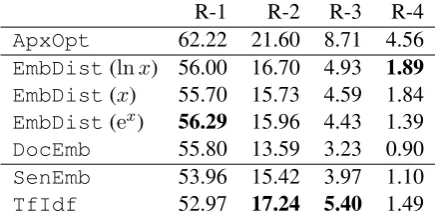
Table 1: ROUGE-N (R-N) metrics of DocEmb,
EmbDist,SenEmb, andTfIdf.
on distributions of sentence embeddings. In ad-dition, we examined three scaling functions: log-arithmic, linear, and exponential functions, i.e.,
lnx,x,ex, respectively.
We calculated the ROUGE-N metric (Lin, 2004)4, which is a widely-used evaluation met-ric for summarization methods. ROUGE-N is based on the co-occurrence statistics of N-grams, and especially ROUGE-1 has been shown to have the highest correlation with human summaries (Lin and Hovy, 2003). ROUGE-N is similar to the BLEU metric for machine translation, but ROUGE-N is a recall-based metric while BLEU is a precision-based metric.
Table 1 shows the results obtained for ROUGE-N (ROUGE-N ≤ 4) usingDocEmb,EmbDist,SenEmb, andTfIdf. ApxOptrepresents the approxima-tion results of the optimal soluapproxima-tion in our prob-lem, where we optimized ROUGE-1 with the gold standard summaries by Algorithm 1. The ob-tained results indicate that our proposed method
EmbDistwith exponential scaling performed the best for ROUGE-1, which is the best metric in terms of correlation with human summaries. The W2V Vector was the best choice for EmbDist. Furthermore, the other proposed methodDocEmb
performed better than the state-of-the-art methods
SenEmb and TfIdf, although DocEmb is not theoretically guaranteed to obtain a near optimal solution. These results imply that our methods based on the document-level similarity can capture more complex meanings than the sentence-level similarity. On the other hand,TfIdfwith tf-idf vectors performed the worst for ROUGE-1. A pos-sible reason is that a wide variety of expressions by users made it difficult to calculate similarities. This also suggests that embedding-based methods
4We used their software ROUGE version 1.5.5 with the
naturally have robustness for user-generated con-tent.
In the case of N≥2,TfIdfperformed the best for ROUGE-2 and ROUGE-3, while EmbDist
with logarithmic scaling is better than TfIdf
for ROUGE-4. According to (Lin and Hovy, 2003), the higher order ROUGE-N is worse than ROUGE-1 since it tends to score grammatical-ity rather than content. Conversely, Rankel et al. (2013) reports that there is a dataset where the higher order ROUGE-N is correlated with human summaries well. We may need to conduct human judgments to decide which metric is the best in this dataset for more accurate comparison. How-ever, it is still important that our simple objective functions can obtain good results competing with the state-of-the-art methods.
5 Conclusion
In this study, we proposed simple but power-ful summarization methods using the document-level similarity based on embeddings, or dis-tributed representations of words. Our experimen-tal results demonstrated that the proposed meth-ods performed better than the existing state-of-the-art methods based on the sentence-level ity. This implies that the document-level similar-ity can capture more complex meanings than the sentence-level similarity.
Recently, Kusner et al. (2015) independently discovered a similar definition to our objective functionfNN through a different approach. They
constructed a dissimilarity measure based on a framework using Earth Mover’s Distance (EMD) developed in the image processing field (Rubner et al., 1998; Rubner et al., 2000). EMD is a con-sistent measure of distance between two distribu-tions of points. Interestingly, their heuristic lower bound of EMD is exactly the same as−fNNwith a
linear scaling function, i.e.,g(x) = x. Moreover, they showed that this bound appears to be tight in real datasets. This suggests that our intuitive framework can theoretically connect the two well-known measures, KL-divergence and EMD, based on the scaling of distance. Note that, to the best of our knowledge, there is currently no known study that considers such a theoretical relationship.
In future research, we will explore other scal-ing functions suitable for our problem or different problems. A promising direction is to consider a relative scaling function to extract a biased
sum-mary of a document. This direction should be use-ful for query-focused summarization tasks.
Acknowledgments
The authors would like to thank the reviewers for their helpful comments, especially about Earth Mover’s Distance.
References
Yoshua Bengio, R´ejean Ducharme, Pascal Vincent, and Christian Janvin. 2003. A Neural Probabilistic Lan-guage Model. Journal of Machine Learning Re-search (JMLR 2003), 3:1532–4435.
Gruia Calinescu, Chandra Chekuri, Martin P´al, and Jan Vondr´ak. 2007. Maximizing a Submodular Set Function Subject to a Matroid Constraint (Extended Abstract). InProceedings of the 12th International Conference on Integer Programming and Combina-torial Optimization (IPCO 2007), pages 182–196. Springer-Verlag.
Kavita Ganesan, ChengXiang Zhai, and Jiawei Han. 2010. Opinosis: A Graph-based Approach to Ab-stractive Summarization of Highly Redundant Opin-ions. In Proceedings of the 23rd International Conference on Computational Linguistics (COLING 2010), pages 340–348. Association for Computa-tional Linguistics.
Aria Haghighi and Lucy Vanderwende. 2009. Explor-ing Content Models for Multi-document Summa-rization. InProceedings of Human Language Tech-nologies: The 2009 Annual Conference of the North American Chapter of the Association for Computa-tional Linguistics (NAACL-HLT 2009), pages 362– 370. Association for Computational Linguistics.
Kai Hong, John Conroy, Benoit Favre, Alex Kulesza, Hui Lin, and Ani Nenkova. 2014. A Repository of State of the Art and Competitive Baseline Sum-maries for Generic News Summarization. In Pro-ceedings of the Ninth International Conference on Language Resources and Evaluation (LREC 2014), pages 26–31. European Language Resources Asso-ciation (ELRA).
Mikael K˚ageb¨ack, Olof Mogren, Nina Tahmasebi, and Devdatt Dubhashi. 2014. Extractive Summariza-tion using Continuous Vector Space Models. In Pro-ceedings of the 2nd Workshop on Continuous Vec-tor Space Models and their Compositionality (CVSC 2014), pages 31–39. Association for Computational Linguistics.
Kevin Lerman and Ryan McDonald. 2009. Contrastive Summarization: An Experiment with Consumer Re-views. In Proceedings of Human Language Tech-nologies: The 2009 Annual Conference of the North American Chapter of the Association for Computa-tional Linguistics (NAACL-HLT 2009), pages 113– 116. Association for Computational Linguistics. Hui Lin and Jeff Bilmes. 2010. Multi-document
Sum-marization via Budgeted Maximization of Submod-ular Functions. InHuman Language Technologies: The 2010 Annual Conference of the North American Chapter of the Association for Computational Lin-guistics (NAACL-HLT 2010), pages 912–920. Asso-ciation for Computational Linguistics.
Hui Lin and Jeff Bilmes. 2011. A Class of Submodu-lar Functions for Document Summarization. In Pro-ceedings of the 49th Annual Meeting of the Asso-ciation for Computational Linguistics (ACL 2011), pages 510–520. Association for Computational Lin-guistics.
Hui Lin and Jeff Bilmes. 2012. Learning Mixtures of Submodular Shells with Application to Document Summarization. InProceedings of the 28th Confer-ence on Uncertainty in Artificial IntelligConfer-ence (UAI 2012), pages 479–490. AUAI.
Chin-Yew Lin and Eduard Hovy. 2003. Auto-matic Evaluation of Summaries Using N-gram Co-Occurrence Statistics. In Proceedings of the 2003 Conference of the North American Chapter of the Association for Computational Linguistics on Hu-man Language Technology (NAACL-HLT 2003). As-sociation for Computational Linguistics.
Chin-Yew Lin. 2004. ROUGE: A Package for Auto-matic Evaluation of summaries. In Proceedings of the Workshop on Text Summarization Branches Out (WAS 2004). Association for Computational Lin-guistics.
Tomas Mikolov, Wen-tau Yih, and Geoffrey Zweig. 2013a. Distributed Representations of Words and Phrases and their Compositionality. In Advances in Neural Information Processing Systems 26 (NIPS 2013), pages 3111–3119. Curran Associates, Inc. Tomas Mikolov, Wen-tau Yih, and Geoffrey Zweig.
2013b. Linguistic Regularities in Continuous Space Word Representations. InProceedings of the 2013 Conference of the North American Chapter of the Association for Computational Linguistics: Human Language Technologies (NAACL-HLT 2013), pages 746–751. Association for Computational Linguis-tics.
Hajime Morita, Ryohei Sasano, Hiroya Takamura, and Manabu Okumura. 2013. Subtree Extractive Sum-marization via Submodular Maximization. In Pro-ceedings of the 51st Annual Meeting of the Asso-ciation for Computational Linguistics (ACL 2013), pages 1023–1032. Association for Computational Linguistics.
Fernando P´erez-Cruz. 2009. Estimation of Infor-mation Theoretic Measures for Continuous Random Variables. InAdvances in Neural Information Pro-cessing Systems 21 (NIPS 2009), pages 1257–1264. Curran Associates, Inc.
Peter A. Rankel, John M. Conroy, Hoa Trang Dang, and Ani Nenkova. 2013. A Decade of Automatic Content Evaluation of News Summaries: Reassess-ing the State of the Art. InProceedings of the 51st Annual Meeting of the Association for Computa-tional Linguistics (ACL 2013), pages 131–136. As-sociation for Computational Linguistics.
Yossi Rubner, Carlo Tomasi, and Leonidas J. Guibas. 1998. A Metric for Distributions with Applications to Image Databases. InProceedings of the Sixth In-ternational Conference on Computer Vision (ICCV 1998), pages 59–66. IEEE Computer Society. Yossi Rubner, Carlo Tomasi, and Leonidas J. Guibas.
2000. The Earth Mover’s Distance as a Metric for Image Retrieval.International Journal of Computer Vision, 40(2):99–121.
Ruben Sipos, Adith Swaminathan, Pannaga Shiv-aswamy, and Thorsten Joachims. 2012. Tempo-ral Corpus Summarization Using Submodular Word Coverage. In Proceedings of the 21st ACM Inter-national Conference on Information and Knowledge Management (CIKM 2012), pages 754–763. ACM. Qing Wang, S.R. Kulkarni, and S. Verdu. 2009.