Exploiting Debate Portals for Semi-Supervised Argumentation Mining
in User-Generated Web Discourse
Ivan Habernal† and Iryna Gurevych†‡
†Ubiquitous Knowledge Processing Lab (UKP-TUDA)
Department of Computer Science, Technische Universit¨at Darmstadt
‡Ubiquitous Knowledge Processing Lab (UKP-DIPF)
German Institute for Educational Research
www.ukp.tu-darmstadt.de
Abstract
Analyzing arguments in user-generated Web discourse has recently gained atten-tion in argumentaatten-tion mining, an evolving field of NLP. Current approaches, which employ fully-supervised machine learn-ing, are usually domain dependent and suffer from the lack of large and diverse annotated corpora. However, annotating arguments in discourse is costly, error-prone, and highly context-dependent. We asked whether leveraging unlabeled data in a semi-supervised manner can boost the performance of argument component identification and to which extent is the approach independent of domain and reg-ister. We propose novel features that ex-ploit clustering of unlabeled data from de-bate portals based on a word embeddings representation. Using these features, we significantly outperform several baselines in the cross-validation, cross-domain, and cross-register evaluation scenarios.
1 Introduction
Argumentation mining, an evolving sub-field of NLP, deals with analyzing argumentation1in
var-ious genres, such as legal cases (Mochales and Moens, 2011), student essays (Stab and Gurevych, 2014a), and medical and scientific articles (Green, 2014; Teufel and Moens, 2002). Recently, the fo-cus of argumentation mining has also shifted to the Web registers (such as comments to articles, forum posts, or blogs) which is motivated by the need of
1Argumentation isa verbal activity for which the goal
consists of convincing the listener or reader of the acceptabil-ity of a standpoint by means of a constellation of propositions justifying or refuting the proposition expressed in the stand-point(van Eemeren et al., 2002) or the art of persuading others to think or act in a definite way, including all writing and speaking which is persuasive in form(Ketcham, 1917).
retrieving and understanding ordinary people’s ar-guments to various contentious topics on the large scale. Applications include passenger rights and protection (Park and Cardie, 2014), hotel reviews (Wachsmuth et al., 2014), and controversies in ed-ucation (Habernal et al., 2014).
Despite the plethora of existing argumentation theories (van Eemeren et al., 2014), the preva-lent view in argumentation mining treats argu-ments as discourse structures consisting of sev-eral argument components, such as claims and premises (Peldszus and Stede, 2013). Current approaches to automatic analysis of argumenta-tion usually follow the fully supervised machine-learning paradigm (Biran and Rambow, 2011; Stab and Gurevych, 2014b; Park and Cardie, 2014) and rely on manually annotated datasets. Only few publicly available argumentation cor-pora exist, as annotations are costly, error-prone, and require skilled human annotators (Stab and Gurevych, 2014a; Habernal et al., 2014).
To overcome the limited scope and size of the existing annotated corpora, semi-supervised meth-ods can be adopted, as they gain performance by exploiting large unlabeled datasets (Settles, 2012). However, unlike in other NLP tasks where data can be cheaply labeled using for example distant supervision, employing such methods in argumen-tation mining is questionable. First, argumenta-tion is an act of persuasion (Nettel and Roque, 2011; Mercier and Sperber, 2011) but not all user-generated texts can be treated as persuasive (Park and Cardie, 2014; Habernal et al., 2014), thus the selection of an appropriate unlabeled dataset rep-resents a problem on its own. Second, argument components (e.g., claimsorpremises) are highly context-dependent and cannot be easily labeled in distant data using predefined patterns. So far, semi-supervised methods for argumentation min-ing remain unexplored.
In this article, we tackle argumentation
ing of user-generated Web data by exploiting de-bate portals—semi-structured discussion websites where members pose contentious questions to the community and allow others to pick a side and provide their opinions and arguments in order to ‘win’ the debate.2 Our first research question
is whether debate portals (which contain noisy user-generated data) can be utilized in a semi-supervised manner for fine-grained identification of argument components. As a second research question, we investigate to what extent our meth-ods are domain independent and evaluate their adaptation across several domains and registers.
Our contribution is three-fold. First, to the best of our knowledge, we present the first successful attempt to semi-supervised argumentation mining in Web data based on exploiting unlabeled exter-nal resources. We leverage these resources and derive features in an unsupervised manner by pro-jecting data from debate portals into a latent argu-ment space using unsupervised word embeddings and clustering. Second, our novel features sig-nificantly outperform state-of-the-art features in all scenarios, namely in validation, cross-domain evaluation, and cross-register evaluation. Third, to ensure full reproducibility of our experi-ments, we provide all data and source codes under free licenses.3
2 Related work
Analysis of argumentation has been an active topic in numerous research areas, such as philosophy (van Eemeren et al., 2014), communication studies (Mercier and Sperber, 2011), and informal logic (Blair, 2004), among others. In this section, we will focus on the most related works on argumen-tation mining techniques in NLP in the first part, with an emphasis on Web data in the second part.
Mochales and Moens (2011) based their work on argumentation schemes (Walton et al., 2008) and experimented with Araucaria and ECHR datasets using supervised models to classify ar-gumentative and non-arar-gumentative sentences (≈ 0.7F1) and their structure. Feng and Hirst (2011)
classified argument schemes on the Araucaria dataset, reaching 0.6-0.9 accuracy. Experiments on this dataset were also conducted by Rooney et al. (2012), who classified sentences to four cate-gories (conclusion, premise, conclusion-premise,
2For instancecreatedebate.comordebate.org 3https://github.com/habernal/emnlp2015
and none) and achieved 0.65 accuracy. These approaches assume the text is already segmented into argument components. Stab and Gurevych (2014b) examined argumentation in persuasive essays and classified argument components into four categories (premise,claim,major claim, non-argumentative) using SVM and achieved 0.73 macro F1 score. They further classified
argu-ment relations (support and attack) and reached 0.72 macro F1 score. The best-performing
fea-tures were structural feafea-tures (such as the location or length ratios), as persuasive essays usually com-ply with a certain structure which can be seen as a potential drawback of this approach.
Regarding user-generated Web data, Biran and Rambow (2011) used naive Bayes for classifying justification of subjective claims from blogs and Wikipedia talk pages, relying on features from RST Treebank and manually-processed n-grams. In similar Web registers, Rosenthal and McK-eown (2012) automatically determined whether a sentence is a claim using logistic regression and various lexical and sentiment-related features and achieved accuracy about 0.66-0.71. Park and Cardie (2014) classified propositions in user comments into three classes (verifiable experi-ential, verifiable non-experiential, and unverifi-able) using SVM and reached 0.69 macro F1
score. Goudas et al. (2014) identifiedpremisesin Greek social media texts using BIO encoding and achieved 0.42F1score with Conditional Random
Fields. The research gaps in the above-mentioned approaches are the following. First, the argumen-tation models are simplified to either claimsor a few types of premises/propositions. Second, the segmentation of discourse into argument compo-nents is ignored (except the work of Goudas et al. (2014)). Recently, Boltuˇzi´c and ˇSnajder (2015) employed hierarchical clustering to cluster argu-ments in online debates using embeddings projec-tion, but in contrast to our work they performed only intrinsic evaluation of the clusters.
Doc #2823 (article comment, public-private-schools): [claim: I agree - Kids can do great in the public school system and parents DO need to be involved.] The more people leave, the worse its going to become. [premise:The public school system lets them deal with real life too, unfortunate that it may be but that is what’s out there in college and the work force too.] [premise:There are still great teachers in the public schools - lets stand behind them.]
Doc #2224 (forumpost, single-sex-education): [. . . .backing:. .I . . . . .went...to ...an ...all...boys ...school ...–] [claim: Can’t say I particularly liked it, I would of much preferred gone to a co-ed.] [premise: It is closer to the ’real world’ that way. Kids should grow up in the company of both sexes... They will be more at ease around the opposite sex when they are older and it just makes sense.] If it is purely education you are concerned about (and not so much behaviour), our year (at a private school) went shockingly bad in OP scores. We were the worst in 12 years and were beaten by LOTS of co-ed and public schools... So you can never tell. In saying that my sister really enjoyed going to an all girls school. Her year went really well too. Ask your daughters what they would prefer... ...[backing:. . . .Btw,..I...work...at..a...co-ed...school...at....the ...moment ....and....the ...kids ...there....get...on...just ...fine.]
Figure 1: Two examples of argument annotation of an article comment and a forum post.
3 Data
As data for training and evaluation of our methods, we use a corpus consisting of 340 English docu-ments (approx. 90k tokens) annotated4with
argu-mentation by Habernal et al. (2014). Compared to other corpora mentioned in the related work, this corpus is the largest one to date that covers dif-ferent domains and spans several registers of user-generated Web content. In particular, the corpus comprises four registers (comments to articles, fo-rum posts, blogs, and argumentative newswire ar-ticles) and covers six domains related to educatio-nal controversies (homeschooling, private vs. pub-lic schools, mainstreaming, single-sex education, prayer in schools, and redshirting).
The argumentation model used in this corpus is based on extended Toulmin’s model (Toulmin, 1958). Each document contains usually one ar-gument, where each argument consists of several argument components. There are five different components in this model, namely, theclaim(the statement about to be established in the argument which conveys author’s stance towards the topic), the premise(s) (propositions that are intended to give reasons of some kind for the claim), the back-ing (additional information used to back-up the argument), the rebuttal (attacks the claim), and the refutation(which attacks the rebuttal). Rela-tions between the argument components are en-coded implicitly in the function of the particular component type, for instance, premises are always attached to the claim. We made two observations in the data: the claim is often implicit (must be inferred by the reader), and some sentences have no argumentative function (thus are not labeled by any argument component).5
4Available atwww.ukp.tu-darmstadt.de/data/ argumentation-mining/
5A publication containing a thorough analysis of the dataset is pending.
Figure 1 depicts two example annotations from the corpus. Argument components were annotated on the token level as non-overlapping annotation spans. We therefore represent the argument anno-tations using BIO encoding. Each token is labeled with one of the 11 categories (5 argument com-ponent types× B or I tag+ one O category for non-argumentative text).
4 Method
We cast the task of identifying argument compo-nents as a sequence tagging problem and employ SVMhmm (Joachims et al., 2009).6 For
linguis-tic annotations and feature engineering, we rely on two UIMA-based frameworks – DKProCore (Eckart de Castilho and Gurevych, 2014) and DKProTC (Daxenberger et al., 2014).
Although the argument component annotations in the corpus are aligned to the token boundaries (token-level annotations), the minimal classifica-tion unit in our sequence tagging approach is set to the sentence level. First, this allows us to cap-ture rich feacap-tures that are available for entire sen-tences as opposed to the token level. Second, by modeling sequences on the token level we would lose the advantage of SVMhmmto estimate
depen-dencies between labels, as the label context is lim-ited due to computational feasibility. On the token level, the label sequences are rather static (long se-quences with the same label), as opposed to the sentence level. Before the classification step, we adjust all annotation boundaries (note that we use 11 BIO labels) so that they are aligned to the sen-tence boundaries and each sensen-tence is then treated as a single classification unit with one label (for example, the first sentence from Figure 1 with token labels Claim-B, Claim-I, Claim-I, ...
be-6Keerthi and Sundararajan (2007) conclude that perfor-mance of SVMhmm is comparable to another widely used
comes Claim-B). After classification, the labels are mapped back to tokens (so that, for example, Claim-B sentence label is transformed to Claim-B, Claim-I, ... token labels). However, all eval-uations are performed on the token level and the performance is always measured against the orig-inal token labels. Using this approximation, we lose only about 10% ofF1 performance.7
4.1 Baseline features
Lexical baseline (FS0) We encode the presence of unigrams, bigrams, and trigrams in the sentence as ‘one-hot’ (binary) features.
Structural and syntactic features (FS1) Since the presence of discourse markers has been shown to be helpful in argument component analysis (e.g, “therefore” and “since” for premises or “think” and “believe” for claims), we encode the first and last three words as binary features. Further-more, we capture the relative position of the sen-tence in the paragraph and the document, the num-ber of part of speech 1-3 grams, maximum de-pendency tree depth, constituency tree produc-tion rules, and number of sub-clauses (Stab and Gurevych, 2014b). We used Stanford POS Tagger (Toutanova et al., 2003), Berkeley parser (Petrov et al., 2006), and Malt parser (Nivre, 2009).
Sentiment and topic features (FS2) We as-sume that claims express sentiment, thus we com-pute five sentiment categories (from very nega-tive to very posinega-tive) using Stanford sentiment an-alyzer (Socher et al., 2013) and use these values directly as features. Furthermore, in order to help detecting off-topic and non-argument sentences, we employ topic model features. In particular, we use features taken from a vector representation of the sentence obtained by using Gibbs sampling on LDA model (Blei et al., 2003; McCallum, 2002) with topics trained on unlabeled data provided as a part of the corpus.8
Semantic and discourse features (FS3) Fea-tures based on semantic frames has been intro-duced in relevant works on stance recognition (Hasan and Ng, 2013). Our features, based on PropBank semantic role labels and obtained from
7In only 1% of the sentences there are two or more argu-ment components in it; we arbitrarily choose the largest one. 8The number of topics was empirically set to 30, therefore for each sentence the topic distribution results into 30 real-valued features.
NLP Semantic Role Labeler (Choi, 2012), ex-tract various semantic information (agent, predi-cate + agent, predipredi-cate + agent + patient + (op-tional) negation, argument type + argument value) and discourse markers. Discourse relations also play an important role in argumentation analysis (Cabrio et al., 2013). We thus employ binary fea-tures (such as the presence of the sentence in a chain, the transition type, the distance to previ-ous/next sentences in the chain, or the number of inter-sentence coreference links) obtained from Stanford Coreference Chain Resolver (Lee et al., 2013). Furthermore, we include features result-ing from a PTDB-style discourse parser (Li et al., 2012), such as the type of discourse relation (ex-plicit, implicit), the presence of discourse connec-tives, and attributions.
4.2 Unsupervised features
We enrich the above-mentioned features by uti-lizing external large unlabeled resources –debate portals. They fulfill several criteria, namely (a) they are ‘argumentative’ (meant as opposed to, for example, prose or encyclopedic genres), (b) they are comprised of user-generated content and (c) and there is at least some overlap with topics from our experimental corpus. On the other hand, they contain noisy texts of questionable quality and they do not provide any specific argumentative structure (in fact, these debates are simple discus-sions to a topic, where each post is only labeled with aproorcontrastance). Nevertheless, we as-sume that the posts from (unlabeled) debate por-tals contain valuable information that will help us with classifying argument components in labeled data. In order to do so, we employ clustering based on latent semantics, which we now formalize as argument spacefeatures.
et al., 2013), or sentiment analysis (Habernal and Brychc´ın, 2013).
We build upon the above-mentioned approach (described by Søgaard (2013) as ‘clusters-as-features’ semi-supervised paradigm) and extend it further. We take both sentences and posts from the unlabeled debate portals, project them into a latent space using word embeddings and cluster them. The motivation is that these clusters will contain similar phrases or (similar ‘arguments’). Centroids of these clusters would then represent a ‘prototypical argument’ (note that the centroids exist only in the latent vector space and thus do not correspond to any existing sentence or post). Then we project each sentence (classification unit) in the labeled data to the latent vector space, com-pute its distance vector to all the cluster cen-troids, and encode this distance vector directly as real-valued features. By contrast to the above-mentioned works using a single cluster label as a feature, the distance vector to cluster centroids resembles a soft labeling where each sentence be-longs to several clusters with a certain ‘weight’. We also use the latent vector space representation of the sentence directly as a feature vector.
As unlabeled data, we use data from two largest debate portals.9 As a pre-processing step we
removed all posts with less than one ‘point’ earned.10 The data were then indexed using the
Lucene framework and the top 100 debates for each of the 6 domains were retrieved which re-sulted into 5,759 posts (≈ 35k sentences) in the unlabeled data in total. Our approach is formal-ized in the following paragraph.
Argument space features (FS4) Let ~e(w) be the embedding vector of word w and tfidf(w) be the TD-IDF value of w. Sentence ~s = (w1, . . . , wn) is then projected into the
embed-ding space E as ~se = Pni=1tfidf(wi)~e(wi)n−1
so dim(~se) = dim(E). Analogically to ~s, we
project the entire post ~a = (w1, . . . , wm) to
the same embedding space E such that ~ae =
Pm
i=1tfidf(wi)~e(wi)m−1.
Let K be the number of sentence clusters in
E and ~ck a centroid vector of cluster k ∈ K.
Then ~sc denotes the distance of sentence ~se to
the sentence cluster centroids such that ~sc =
9createdebate.com and convinceme.net, li-censed under Creative Commons (CC-BY and CC0, resp.)
10‘Points’ is the sum of up-votes/down-votes by other users to the particular post. Zero-point posts were usually noisy and spam-like.
(cos(~se,~c1), . . . ,cos(~se,~ck)) where dim(~sc) =
K andcos(•,•) denotes cosine similarity. Ana-logically, let L be the number of post clusters in E and ~al a centroid vector of cluster l ∈
L. Then ~sa denotes the distance of sentence
~se to the post cluster centroids such that ~sa =
(cos(~se,~a1), . . . ,cos(~se,~al)). We construct the
feature vector by concatenating~se,~scand~sa.
For word embeddings, we use pre-trained skip-gram word vectors11 produced by Mikolov et
al. (2013) (dim(E) = 300). To create clus-ters for the argument space features, we used CLUTO software package12 with Repeated
Bi-section clustering method (Zhao and Karypis, 2002). We clustered the data using different hyper-parameters K and L (we experimented with K = {50,100,500,1000} and L = {50,100,500,1000}).
5 Results
We investigate three evaluation scenarios. First, we report 10-fold cross validation over all 340 documents, where the data are randomly dis-tributed across the folds regardless of the domain or register. In this scenario, the model can bene-fit from domain-dependent features for the testing data, such as lexical knowledge (FS0) or domain-relevant argument space features (FS4). Second, we evaluate the cross-domain performance; the model is always trained on five domains and tested on the sixth one. In this settings, we also re-move all features that exploit distant data relevant to the test set. For instance, if the test domain ismainstreaming, we exclude all debates relevant to this domain before constructing the argument space features (FS4). This evaluates the model’s cross-domain performance without any target do-main data available. Finally, we test cross-register performance in two set-ups: we train the models using comments and forum posts and test on blogs and newswire articles, and then the other way round. We divided the data into these two parts based on similar properties of blogs/articles and comments/forums, such as the length, or the dis-tribution of argumentative and non-argumentative text.
In the evaluation, we focus on F1 scores
achieved onclaims, premises, backing, and non-argumentative text (the ‘O’ class). Although the
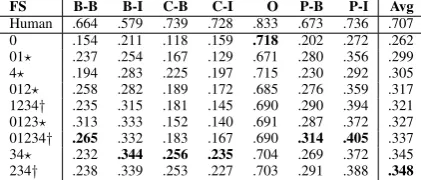
FS B-B B-I C-B C-I O P-B P-I Avg Human .664 .579 .739 .728 .833 .673 .736 .707 0 .154 .211 .118 .159 .718 .202 .272 .262 01? .237 .254 .167 .129 .671 .280 .356 .299 4? .194 .283 .225 .197 .715 .230 .292 .305 012? .258 .282 .189 .172 .685 .276 .359 .317 1234† .235 .315 .181 .145 .690 .290 .394 .321 0123? .313 .333 .152 .140 .691 .287 .372 .327 01234† .265 .332 .183 .167 .690 .314 .405 .337 34? .232 .344 .256 .235 .704 .269 .372 .345 234† .238 .339 .253 .227 .703 .291 .388 .348
Table 1: F1results for the 10-fold cross-validation scenario. Feature set combination (theFScolumn) naming is explained in Section 4.1. Class labels: B-B/I=Backing-B/I,C-B/I= Claim-B/I,O=non-argumentative,P-B/I=Premise-B/I. Star (?) denotes that the row is significantly better than the previ-ous row; dagger (†) means the row is not significantly better than the previous row, but is significantly better than the pre-vious row minus one;p < 0.001using exact Liddell’s test (Liddell, 1983).
classifier is trained and tested on all 11 classes in-cluding rebuttaland refutation, we do not report performance of these two argument components— the results are very poor regardless of the param-eters for two reasons. First, these classes are un-derrepresented in the data (Rebuttal-B, Rebuttal-I, Refutation-B and Refutation-I are present in only about 4% of sentences). Second, the inter-annotator agreement reached on these classes were reported to be very low (Habernal et al., 2014).
Cross validation results Table 1 shows results for the cross-validation scenario. The human base-line in the first row is an average score between three original annotators of the dataset. The base-line features (FS0) perform poorly, yet they beat the random assignment and majority vote (<0.12 F1). The argument space features (FS4) increase
the performance in every combination. The best results for claims are achieved when only dis-course, sentiment, and argument space features are involved (FS3 and FS4), whereaspremisesand backingbenefit from the presence of lexical, syn-tactic, and semantic features (the richest feature set). The overall average best results are obtained from a feature combination with higher level of abstraction, in particular without low-level lexical features from FS0.
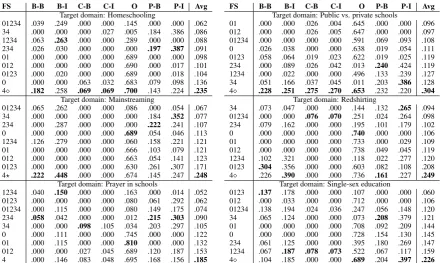
After the cross validation experiments, we also fixed the hyperparameters (using grid search) to K = 1000, L= 100for the cluster sizes andt= 1 ande= 0for the hyperparameters of SVMhmm. Cross-domain results For each domain, the cross-domain results are shown in Table 2. On average, the best results are about 0.10F1 points
worse than in the cross-validation settings (Table
1). In all domains, the best average performance was achieved using only the argument space fea-tures (FS4); in four cases this system significantly outperforms all other systems (p <0.001). More-over, more high-level feature set combinations that also contain argument space features (such as FS2+FS3+F4 or FS3+FS4) yield usually bet-ter results for particular argument components in contrast to features based on lexical or syntactic information (FS0 and FS1). For identifying non-argumentative texts, there is no clear winner with respect to feature set abstraction (in three domains the best results are achieved using FS4 but in other three domains the baseline FS0 performs best).
Cross-register results The argument space fea-tures (FS4) performs best in average also in the cross-register evaluation (see Table 3). In recog-nizingpremises, better results were achieved by a system trained on blogs and articles and tested on comments and forum posts. Recognizing claims exhibits similar behavior. On the other hand, recognizing non-argumentative text performs bet-ter in the opposite direction. On average, the register results are much worse than cross-validation and slightly worse than cross-domain results.
5.1 Error analysis
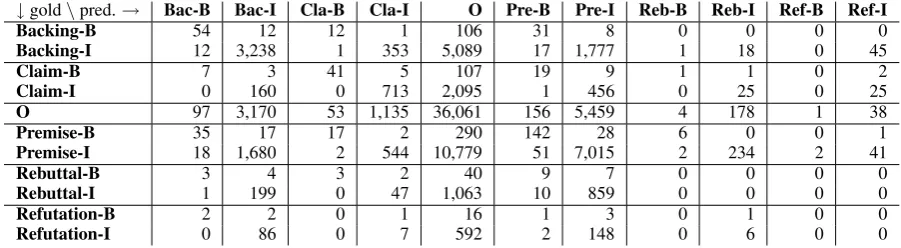
First, we quantitatively investigate errors in the cross-validation scenario. The confusion matrix in Table 4 shows that about 50-60% of errors for each argument component were caused by misclassify-ing it as non-argumentative (the ‘O’ class). The system tends to prefer the ‘O’ predictions because of the high presence of non-argumentative sen-tences in the corpus (about 57%).Backingis often confused withpremises; in particular, Backing-B withPremise-Bin 14%,Backing-IwithPremise-I in 17%. These two argument components have a similar function–to support the claim–so the dif-ferences in the discourse (which are sometimes very subtle) confuse the system. Note that despite the confusion between these classes, the-Iand-B tags mostly remain the same (the system correctly predicts whether the argument component begins or not).13
We also analyzed the errors of the
FS B-B B-I C-B C-I O P-B P-I Avg Target domain: Homeschooling
01234 .039 .249 .000 .000 .145 .000 .000 .062 34 .000 .000 .000 .027 .005 .184 .386 .086 1234 .063 .263 .000 .000 .289 .000 .000 .088 234 .026 .030 .000 .000 .000 .197 .387 .091 01 .000 .000 .000 .000 .689 .000 .000 .098 012 .000 .000 .000 .000 .690 .000 .017 .101 0123 .000 .020 .000 .000 .689 .000 .018 .104 0 .000 .000 .063 .032 .683 .079 .098 .136 4 .182 .258 .069 .069 .700 .143 .224 .235
Target domain: Mainstreaming
01234 .065 .262 .000 .000 .086 .000 .054 .067 34 .000 .000 .000 .000 .000 .184 .352 .077 234 .000 .287 .000 .000 .000 .222 .241 .107 0 .000 .000 .000 .000 .689 .054 .046 .113 1234 .126 .279 .000 .000 .060 .158 .221 .121 01 .000 .000 .000 .000 .666 .103 .079 .121 012 .000 .000 .000 .000 .663 .054 .141 .123 0123 .000 .000 .000 .000 .630 .261 .307 .171 4? .222 .448 .000 .000 .674 .145 .247 .248
Target domain: Prayer in schools
1234 .040 .150 .000 .000 .163 .000 .014 .052 0123 .000 .000 .000 .000 .080 .061 .292 .062 01234 .000 .115 .000 .000 .080 .149 .175 .074 234 .058 .042 .000 .000 .012 .215 .303 .090 34 .000 .000 .098 .105 .034 .203 .297 .105 0 .000 .111 .000 .000 .745 .000 .000 .122 01 .000 .115 .000 .000 .810 .000 .000 .132 012 .000 .000 .027 .045 .689 .120 .187 .153 4 .000 .146 .083 .048 .695 .168 .156 .185
FS B-B B-I C-B C-I O P-B P-I Avg Target domain: Public vs. private schools
01 .000 .000 .026 .004 .645 .000 .000 .096 012 .000 .000 .026 .005 .647 .000 .000 .097 01234 .000 .000 .000 .000 .591 .069 .093 .108 0 .026 .038 .000 .000 .638 .019 .054 .111 0123 .058 .064 .019 .023 .622 .019 .025 .119 234 .000 .089 .026 .042 .013 .240 .424 .119 1234 .000 .022 .000 .000 .496 .133 .239 .127 34 .051 .166 .037 .045 .011 .203 .386 .128 4 .228 .251 .275 .270 .653 .232 .220 .304
Target domain: Redshirting
34 .073 .047 .000 .000 .144 .132 .265 .094 01234 .000 .000 .076 .070 .251 .024 .264 .098 234 .079 .162 .000 .000 .195 .101 .179 .102 0 .000 .000 .000 .000 .740 .000 .000 .106 01 .000 .000 .000 .000 .733 .000 .029 .109 012 .000 .000 .000 .000 .738 .049 .045 .119 1234 .102 .321 .000 .000 .118 .022 .277 .120 0123 .304 .356 .000 .000 .603 .082 .108 .208 4 .226 .390 .000 .000 .736 .161 .227 .249
Target domain: Single-sex education
0123 .137 .178 .000 .000 .107 .000 .000 .060 012 .000 .033 .000 .000 .712 .000 .000 .106 01234 .138 .194 .024 .036 .247 .056 .148 .120 34 .065 .124 .000 .000 .073 .208 .379 .121 01 .000 .000 .000 .000 .708 .092 .209 .144 0 .000 .000 .000 .000 .728 .154 .130 .145 234 .061 .125 .000 .000 .395 .180 .269 .147 1234 .067 .187 .078 .073 .522 .067 .117 .159 4 .104 .185 .000 .000 .689 .204 .397 .226
Table 2: F1results for the cross-domain evaluation scenario ranked by performance. Feature set combination naming (theFS column) is explained in Section 4.1. Class labels: B-B/I=Backing-B/I,C-B/I=Claim-B/I,O=non-argumentative,P-B/I= Premise-B/I. Diamond () in the last (winning) row signals a significant difference between this row and all other rows while star (?) denotes that the row is significantly better than the previous row;p <0.001using exact Liddell’s test (Liddell, 1983).
FS B-B B-I C-B C-I O P-B P-I Avg Train: blogs, articles; Test: comments, forums 01234 .063 .259 .027 .051 .147 .000 .064 .087 012 .000 .000 .000 .000 .643 .000 .000 .092 0 .010 .237 .000 .000 .352 .014 .036 .093 01 .000 .000 .000 .000 .643 .010 .013 .095 0123 .021 .032 .000 .000 .645 .005 .002 .101 1234 .097 .215 .052 .068 .369 .000 .013 .116 234 .042 .068 .065 .068 .534 .093 .168 .148 34 .030 .061 .098 .099 .221 .211 .385 .158 4 .076 .206 .167 .158 .611 .151 .209 .225
[image:7.595.75.517.60.323.2]FS B-B B-I C-B C-I O P-B P-I Avg Train: comments, forums; Test: blogs, articles 34 .052 .130 .036 .037 .057 .000 .000 .045 01234 .000 .008 .000 .000 .003 .080 .301 .056 234 .055 .182 .033 .036 .121 .025 .015 .067 1234 .071 .176 .014 .021 .050 .061 .290 .098 0 .000 .000 .000 .000 .773 .012 .019 .115 01 .000 .000 .051 .058 .720 .025 .043 .128 012 .000 .000 .039 .037 .746 .063 .046 .133 0123 .000 .000 .000 .000 .679 .099 .227 .144 4 .142 .162 .061 .032 .693 .161 .353 .229
Table 3: F1 results for the cross-register evaluation scenario ranked by performance. Feature set combination naming (the
FScolumn) is explained in Section 4.1. Class labels:B-B/I=Backing-B/I,C-B/I=Claim-B/I,O=non-argumentative,P-B/I
=Premise-B/I. Diamond () in the last (winning) row signals a significant difference between this row and all other rows; p <0.001using exact Liddell’s test (Liddell, 1983).
performing cross-domain system in detail.14 We
randomly sampled 40 documents and manually compared the predicted arguments with the gold data. We found that 11 predicted documents were simply wrong or no argument components were predicted at all (e.g., document #1640, #1658, #1021, #5258). Most of these errors occur in blogs, which seem to convey rather complex argumentation structure (#1666, #1197, #4586, #5258). In 8 documents, we identified that only some premises were (correctly) spotted by the sys-tem. This happened mostly in long comments (#452) and blogs (#400, #697, #4583). In 7
inves-14Available also as PDF at https://github.com/ habernal/emnlp2015; we use #ID to point to the par-ticular documents.
tigated documents, we identified errors caused by slightly different boundaries of recognized argu-ment components (#4517, #2447, #2252, #4840) or when multiple segments were merged/split (#1604, #2180, #2310).
↓gold\pred.→ Bac-B Bac-I Cla-B Cla-I O Pre-B Pre-I Reb-B Reb-I Ref-B Ref-I
Backing-B 54 12 12 1 106 31 8 0 0 0 0
Backing-I 12 3,238 1 353 5,089 17 1,777 1 18 0 45
Claim-B 7 3 41 5 107 19 9 1 1 0 2
Claim-I 0 160 0 713 2,095 1 456 0 25 0 25
O 97 3,170 53 1,135 36,061 156 5,459 4 178 1 38
Premise-B 35 17 17 2 290 142 28 6 0 0 1
Premise-I 18 1,680 2 544 10,779 51 7,015 2 234 2 41
Rebuttal-B 3 4 3 2 40 9 7 0 0 0 0
Rebuttal-I 1 199 0 47 1,063 10 859 0 0 0 0
Refutation-B 2 2 0 1 16 1 3 0 1 0 0
[image:8.595.70.521.62.186.2]Refutation-I 0 86 0 7 592 2 148 0 6 0 0
Table 4: Confusion matrix for the best performing configuration in the cross-validation scenario.
schools with onepremisewhy the education was not satisfying, which might be also another valid interpretation. The second example #2180 in Fig-ure 2 shows that the boundaries of the predicted premisesare mixed up (two recognized instead of three), but the longerbackingis also meaningful. These examples demonstrate that argument analy-sis is in some cases ambiguous and allows for dif-ferent valid interpretations.
6 Conclusion
In this article, we proposed a semi-supervised model for argumentation mining of user-generated Web content. We developed new unsupervised features for argument component identification that exploit clustering of unlabeled argumenta-tive data from debate portals based on word em-beddings representation. With the help of these features we significantly improved performance of the argumentation mining system and outper-formed several baselines. While the improvement was decent in cross-validation scenario, we gained almost 100% improvement in cross-domain and cross-register settings.
We evaluated the methods on a publicly avail-able corpus annotated with argumentation that ori-gins from user-generated Web data. By a de-tailed analysis of the errors, we pointed out the strengths (such as domain adaptability) and weak-nesses (such as unsatisfying results for rebuttal and refutation components), as well as the chal-lenges for the argumentation mining task (such as boundary identification issues or ambiguous argu-ments). If we put our results into the context of existing works, the most relevant one by (Goudas et al., 2014) achieved 0.42F1score on identifying
only premises. We get comparable results in the cross-validation settings (F1 0.31-0.40) yet with
more complex argumentation model (five different
components).
Although argumentation mining in user-generated Web discourse has a long way to go (our methods currently achieve only about 50% of human performance), we see a huge potential for various future tasks, such as information seeking for better-informed personal decision making or support for argument quality assessment. To foster the research within the community, we provide all source codes and data required for the experiments under free licenses.
Acknowledgements
This work has been supported by the Volk-swagen Foundation as part of the Lichtenberg-Professorship Program under grant No I/82806
and by the German Institute for Educatio-nal Research (DIPF). Access to the CERIT-SC computing and storage facilities provided under the programme Center CERIT Scientific Cloud, part of the Operational Program Re-search and Development for Innovations, reg. no. CZ. 1.05/3.2.00/08.0144, is greatly appreciated. Lastly, we would like to thank the anonymous re-viewers for their valuable feedback.
References
Or Biran and Owen Rambow. 2011. Identifying jus-tifications in written dialogs by classifying text as argumentative. International Journal of Semantic Computing, 5(4):363–381.
J. Anthony Blair. 2004. Argument and its uses. Infor-mal Logic, 24:137151.
David M. Blei, Andrew Y. Ng, and Michael I. Jordan. 2003. Latent dirichlet allocation. Journal of Ma-chine Learning Research, 3:993–1022, March. Filip Boltuˇzi´c and Jan ˇSnajder. 2015. Identifying
Gold
[premise: I sent my kid to private school so that she could get a better education.] ...[backing:. . . . .She...was ..at..a...public...school . . . .
that ...was ...90% ...hispanic.] [premise: The problem was not their race but the fact that they were way behind in reading langauge and math. This situation was holding my kid and preventing her from excelling in her studies.] Do you think I should of just left my kid in this class? Give me a break!
Predicted
[claim: I sent my kid to private school so that she could get a better education.] She was at a public school that was 90% hispanic. [premise: The problem was not their race but the fact that they were way behind in reading langauge and math.] This situation was holding my kid and preventing her from excelling in her studies. Do you think I should of just left my kid in this class? Give me a break!
(a) Doc #4285 (article comment, public vs. private schools)
Gold
[claim: Personally i’d go co-ed.] . . . .
[backing:. . . .As ...someone...who ...went ...to..a...same...sex ...school . . .
for...8...years, ..I...found...it...lacked ....the...diversity...you...get ...in..a . . . .
co-ed ...environment.] [premise: I found the attitude and behaviour of students in the co ed school to be better, and i attribute that to the influence of the opposite sex.] [premise: There’s no doubt boys behave a little different when girls are watching, and i also found boys were quite good at limiting the bitchyness girls are renowned for. So both kept one another in line, and made for a more positive and dynamic environment.]
[premise: I also think there’s a few extra life lessons and skills children can learn at co ed schools. Dating, relationships, interacting with the opposite sex, i think children at co ed schools tend to have a far better grasp of these skills then students who’ve only attended same sex schools.]
Predicted
. . . .
[backing:. . . .Personally...i’d....go ...co-ed. . . .
As ...someone ...who...went...to..a...same...sex ...school....for...8...years, .I . . . .
found..it...lacked....the...diversity ....you....get...in..a...co-ed...environment. .I . . . .found ....the ...attitude...and...behaviour...of...students ...in ....the ...co...ed . . . .
school ..to....be ...better, ....and.i...attribute ....that...to ....the ...influence ...of ...the . . . .
opposite ...sex.] [premise: There’s no doubt boys behave a little different when girls are watching, and i also found boys were quite good at limiting the bitchyness girls are renowned for.] [premise: So both kept one another in line, and made for a more positive and dynamic environment.
I also think there’s a few extra life lessons and skills children can learn at co ed schools. Dating, relationships, interacting with the opposite sex, i think children at co ed schools tend to have a far better grasp of these skills then students who’ve only attended same sex schools.]
(b) Doc #2180 (forum post, single-sex education)
Figure 2: Examples of gold data annotations (on the left-hand side) and system predictions in the best-performing cross-domain evaluation scenario (on the right-hand side).
Workshop on Argumentation Mining, pages 110– 115, Denver, Colorado. Association for Computa-tional Linguistics.
Elena Cabrio and Serena Villata. 2012. Combining textual entailment and argumentation theory for sup-porting online debates interactions. InProceedings of the 50th Annual Meeting of the Association for Computational Linguistics: Short Papers - Volume 2, ACL ’12, pages 208–212, Jeju Island, Korea. As-sociation for Computational Linguistics.
Elena Cabrio, Sara Tonelli, and Serena Villata. 2013. From discourse analysis to argumentation schemes and back: Relations and differences. In Jo˜ao Leite, Tran Cao Son, Paolo Torroni, Leon Torre, and Stefan Woltran, editors,Proceedings of 14th International Workshop on Computational Logic in Multi-Agent Systems, volume 8143 ofLecture Notes in Computer Science, pages 1–17. Springer Berlin Heidelberg. Jinho D. Choi. 2012. Optimization of Natural
Lan-guage Processing Components for Robustness and Scalability. Ph.D. Thesis, University of Colorado Boulder, Computer Science and Cognitive Science. Johannes Daxenberger, Oliver Ferschke, Iryna
Gurevych, and Torsten Zesch. 2014. DKPro TC: a Java-based framework for supervised learning experiments on textual data. InProceedings of 52nd Annual Meeting of the Association for Computa-tional Linguistics: System Demonstrations, pages 61–66, Baltimore, Maryland, June. Association for Computational Linguistics.
Richard Eckart de Castilho and Iryna Gurevych. 2014. A broad-coverage collection of portable NLP com-ponents for building shareable analysis pipelines. In Nancy Ide and Jens Grivolla, editors, Proceedings of the Workshop on Open Infrastructures and Anal-ysis Frameworks for HLT (OIAF4HLT) at COLING 2014, pages 1–11, Dublin, Ireland. Association for Computational Linguistics and Dublin City Univer-sity.
Vanessa Wei Feng and Graeme Hirst. 2011. Classi-fying arguments by scheme. InProceedings of the 49th Annual Meeting of the Association for Com-putational Linguistics: Human Language Technolo-gies - Volume 1, HLT ’11, pages 987–996, Portland, Oregon. Association for Computational Linguistics.
Swapna Gottipati, Minghui Qiu, Yanchuan Sim, Jing Jiang, and Noah A. Smith. 2013. Learning topics and positions from Debatepedia. InProceedings of the 2013 Conference on Empirical Methods in Natu-ral Language Processing, pages 1858–1868, Seattle, Washington, USA, October. Association for Compu-tational Linguistics.
Nancy L Green. 2014. Argumentation for scientific claims in a biomedical research article. In Elena Cabrio, Serena Villata, and Adam Wyner, editors,
Proceedings of the Workshop on Frontiers and Con-nections between Argumentation Theory and Nat-ural Language Processing, pages 5–10, Bertinoro, Italy, July. CEUR-WS.
Ivan Habernal and Tom´aˇs Brychc´ın. 2013. Semantic spaces for sentiment analysis. In Text, Speech and Dialogue, volume 8082 of Lecture Notes in Com-puter Science, pages 482–489, Berlin Heidelberg. Springer.
Ivan Habernal, Judith Eckle-Kohler, and Iryna Gurevych. 2014. Argumentation mining on the web from information seeking perspective. In Elena Cabrio, Serena Villata, and Adam Wyner, editors,
Proceedings of the Workshop on Frontiers and Con-nections between Argumentation Theory and Natu-ral Language Processing, pages 26–39, Bertinoro, Italy, July. CEUR-WS.
Kazi Saidul Hasan and Vincent Ng. 2013. Stance classification of ideological debates: Data, mod-els, features, and constraints. In Proceedings of the Sixth International Joint Conference on Natural Language Processing, pages 1348–1356, Nagoya, Japan, October. Asian Federation of Natural Lan-guage Processing.
Thorsten Joachims, Thomas Finley, and Chun-Nam John Yu. 2009. Cutting-plane training of structural SVMs. Machine Learning, 77(1):27–59.
Sathiya Keerthi and Sellamanickam Sundararajan. 2007. CRF versus SVM-struct for sequence label-ing. Technical report, Yahoo! Research.
Victor Alvin Ketcham. 1917. The theory and prac-tice of argumentation and debate. Macmillan, New York.
John D. Lafferty, Andrew McCallum, and Fernando C. N. Pereira. 2001. Conditional Random Fields: Probabilistic Models for Segmenting and Label-ing Sequence Data. In Proceedings of the Eigh-teenth International Conference on Machine Learn-ing, ICML ’01, pages 282–289, San Francisco, CA. Morgan Kaufmann Publishers Inc.
Quoc Le and Tomas Mikolov. 2014. Distributed rep-resentations of sentences and documents. In Tony Jebara and Eric P. Xing, editors,Proceedings of the 31st International Conference on Machine Learning (ICML-14), volume 32, pages 1188–1196, Beijing, China. JMLR Workshop and Conference Proceed-ings.
Heeyoung Lee, Angel Chang, Yves Peirsman, Nathanael Chambers, Mihai Surdeanu, and Dan Ju-rafsky. 2013. Deterministic Coreference Resolution Based on Entity-centric, Precision-ranked Rules.
Computational Linguistics, 39(4):885–916.
Lianghao Li, Xiaoming Jin, Sinno Jialin Pan, and Jian-Tao Sun. 2012. Multi-domain active learning for text classification. InProceedings of the 18th ACM SIGKDD International Conference on Knowledge Discovery and Data Mining, KDD ’12, pages 1086– 1094, Beijing, China. ACM.
Douglas Liddell. 1983. Simplified exact analysis of case-referent studies: matched pairs; dichotomous exposure. Journal of Epidemiology & Community Health, 37(1):82–84.
Andrew Kachites McCallum. 2002.
MAL-LET: A Machine Learning for Language Toolkit. http://mallet.cs.umass.edu.
Hugo Mercier and Dan Sperber. 2011. Why do hu-mans reason? Arguments for an argumentative the-ory. The Behavioral and Brain Sciences, 34(2):57– 74; discussion 74–111.
Tomas Mikolov, Ilya Sutskever, Kai Chen, Greg S Cor-rado, and Jeff Dean. 2013. Distributed representa-tions of words and phrases and their composition-ality. In C. J. C. Burges, L. Bottou, M. Welling, Z. Ghahramani, and K. Q. Weinberger, editors, Ad-vances in Neural Information Processing Systems 26, pages 3111–3119. Curran Associates, Inc. Raquel Mochales and Marie-Francine Moens. 2011.
Argumentation mining. Artificial Intelligence and Law, 19(1):1–22, April.
Ana Laura Nettel and Georges Roque. 2011. Persua-sive argumentation versus manipulation. Argumen-tation, 26(1):55–69.
Joakim Nivre. 2009. Non-projective dependency pars-ing in expected linear time. In Proceedings of the Joint Conference of the 47th Annual Meeting of the ACL and the 4th International Joint Conference on Natural Language Processing of the AFNLP: Vol-ume 1, ACL ’09, pages 351–359, Suntec, Singapore. Association for Computational Linguistics.
Olutobi Owoputi, Brendan O’Connor, Chris Dyer, Kevin Gimpel, Nathan Schneider, and Noah A Smith. 2013. Improved Part-of-Speech Tagging for Online Conversational Text with Word Clusters. In
Proceedings of the 2013 Conference of the North American Chapter of the Association for Computa-tional Linguistics: Human Language Technologies, pages 380–390, Atlanta, Georgia. Association for Computational Linguistics.
Joonsuk Park and Claire Cardie. 2014. Identifying appropriate support for propositions in online user comments. In Proceedings of the First Workshop on Argumentation Mining, pages 29–38, Baltimore, Maryland, June. Association for Computational Lin-guistics.
Annotation Workshop and Interoperability with Dis-course, pages 196–204, Sofia, Bulgaria, August. As-sociation for Computational Linguistics.
Slav Petrov, Leon Barrett, Romain Thibaux, and Dan Klein. 2006. Learning accurate, compact, and interpretable tree annotation. In Proceedings of the 21st International Conference on Computational Linguistics and the 44th Annual Meeting of the As-sociation for Computational Linguistics, ACL-44, pages 433–440, Sydney, Australia. Association for Computational Linguistics.
Niall Rooney, Hui Wang, and Fiona Browne. 2012. Applying kernel methods to argumentation min-ing. In Proceedings of the Twenty-Fifth Interna-tional Florida Artificial Intelligence Research Soci-ety Conference, pages 272–275. Association for the Advancement of Artificial Intelligence.
Sara Rosenthal and Kathleen McKeown. 2012. De-tecting opinionated claims in online discussions. In
2012 IEEE Sixth International Conference on Se-mantic Computing, pages 30–37, Palermo, Italy. IEEE.
Burr Settles. 2012. Active Learning. Morgan & Clay-pool Publishers.
Richard Socher, Alex Perelygin, Jean Wu, Jason Chuang, Christopher D. Manning, Andrew Ng, and Christopher Potts. 2013. Recursive deep models for semantic compositionality over a sentiment tree-bank. In Proceedings of the 2013 Conference on Empirical Methods in Natural Language Process-ing, pages 1631–1642, Seattle, Washington, USA, October. Association for Computational Linguistics.
Anders Søgaard. 2013. Semi-Supervised Learning and Domain Adaptation in Natural Language Process-ing. Morgan & Claypool Publishers.
Christian Stab and Iryna Gurevych. 2014a. Annotating argument components and relations in persuasive es-says. InProceedings of COLING 2014, the 25th In-ternational Conference on Computational Linguis-tics: Technical Papers, pages 1501–1510, Dublin, Ireland, August. Dublin City University and Associ-ation for ComputAssoci-ational Linguistics.
Christian Stab and Iryna Gurevych. 2014b. Identify-ing argumentative discourse structures in persuasive essays. InProceedings of the 2014 Conference on Empirical Methods in Natural Language Processing (EMNLP), pages 46–56, Doha, Qatar, October. As-sociation for Computational Linguistics.
Simone Teufel and Marc Moens. 2002. Summariz-ing scientific articles: Experiments with relevance and rhetorical status. Computational Linguistics, 28:409–445.
Stephen E. Toulmin. 1958. The Uses of Argument. Cambridge University Press.
Kristina Toutanova, Dan Klein, Christopher D. Man-ning, and Yoram Singer. 2003. Feature-rich part-of-speech tagging with a cyclic dependency network. InProceedings of the 2003 Conference of the North American Chapter of the Association for Computational Linguistics on Human Language Technology -Volume 1, NAACL ’03, pages 173–180, Edmonton, Canada. Association for Computational Linguistics. Joseph Turian, Lev Ratinov, and Yoshua Bengio. 2010. Word representations: A simple and general method for semi-supervised learning. InProceedings of the 48th Annual Meeting of the Association for Compu-tational Linguistics (ACL), number July, pages 384– 394, Uppsala, Sweden. Association for Computa-tional Linguistics.
Frans H. van Eemeren, R. Grootendorst, and A. F. Snoeck Henkemans. 2002. Argumentation: Anal-ysis, evaluation, presentation. Lawrence Erlbaum, Mahwah, NJ, USA.
Frans H. van Eemeren, Bart Garssen, Erik C. W. Krabbe, A. Francisca Snoeck Henkemans, Bart
Verheij, and Jean H. M. Wagemans. 2014.
Handbook of Argumentation Theory. Springer, Berlin/Heidelberg.
Henning Wachsmuth, Martin Trenkmann, Benno Stein, Gregor Engels, and Tsvetomira Palakarska. 2014. A review corpus for argumentation analysis. In Alexander Gelbukh, editor,15th International Con-ference on Intelligent Text Processing and Compu-tational Linguistics (CICLing 14), pages 115–127, Kathmandu, Nepal. Springer.
Douglas Walton, Christopher Reed, and Fabrizio Macagno. 2008. Argumentation Schemes. Cam-bridge University Press.