Noritaka Shigei
∗, Hiromi Miyajima
∗, Hiroki Morishita
∗, Michiharu Maeda
†Abstract— The wireless sensor network (WSN) technology is a key component for ubiquitous com-puting. In order to achieve the long term operation of WSNs, communication protocols based on clustering have been extensively studied such as LEACH, ACE and HEED. In this paper, we propose two types of clustering methods for WSNs. The first type, which is based on centralized management, employs vector quantization (VQ) for effective clustering. The second type, which is performed in a distributed distributed fashion, takes into account remaining battery level and node density. The proposed methods are com-pared with conventional methods LEACH, HEED and ANTCLUST. The effectiveness of the proposed meth-ods are demonstrated by numerical simulation.
Keywords: wireless sensor network, energy efficient, clustering, vector quantization
1
Introduction
The wireless sensor network (WSN) technology is a key component for ubiquitous computing. A WSN consists of a large number of sensor nodes as shown in Fig.1. Each sensor node senses environmental conditions such as temperature, pressure and light and sends the sensed data to a base station (BS), which is a long way off in general. Since the sensor nodes are powered by limited power batteries, in order to prolong the life time of the network, low energy consumption is important for sensor nodes. In general, radio communication consumes the most amount of energy, which is proportional to the data size and proportional to the square or the fourth power of the distance. In order to reduce the energy consumption, a clustering and data aggregation approach has been ex-tensively studied[7]. In this approach, sensor nodes are divided into clusters, and for each cluster, one represen-tative node, which called cluster head (CH), aggregates all the data within the cluster and sends the data to BS. Since only CH nodes need long distance transmission, the other nodes save the energy consumption.
In order to manage effectively clusters and CHs,
dis-∗Dept. of Electrical and Electronics Engineering, Kagoshima
University, 1-21-40 Korimoto, Kagoshima 890-0065, Japan (corre-sponding author N. Shigei to provide email: [email protected])
†Fukuoka Institute of Technology, Fukuoka 811-0295, Japan
tributed clustering methods have been proposed such as LEACH, HEED, ACE and ANTCLUST[2, 3, 4, 6]. LEACH, which is the most popular method, guaran-tees that every nodes evenly become CHs but does not take into account battery level and the interrelation-ship among nodes[2]. HEED, ACE and ANTCLUST achive better performance than LEACH by taking into account battery level, communication cost, node density, etc. However, they need additional inter-node communi-cations for determining clusters and CHs.
In this paper, we propose two types of clustering meth-ods with less communication overhead for clustering. The first type, which is based on centralized management, employs vector quantization (VQ)[1] for effective cluster-ing. In the centralized method, BS determines clusters and CHs according to battery level and node location. The second type, which is performed in a distributed au-tonomous fashion, takes into account battery level and node density. In the distributed method, clustering is performed by the interaction among proximity nodes. The proposed methods are compared with conventional methods LEACH, HEED and ANTCLUST. The effec-tiveness of the proposed methods are demonstrated by numerical simulation.
2
Wireless Sensor Network
2.1
WSN model
Figure 1: The concept of wireless sensor network.
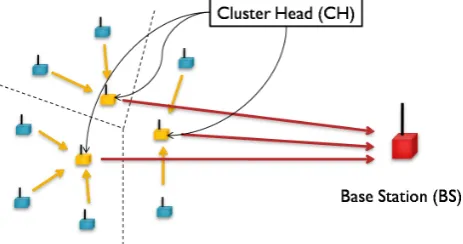
Figure 2: The concept of the clustering approach for WSN.
requirement is guaranteed by using a clock synchroniza-tion method[5].
The radio communication consumes more energy than the data processing on a sensor node. We assume the follow-ing energy consumption model for radio communication. The transmission of a k-bit message with transmission rangedmeters consumesET(k, d) of energy.
ET(k, d) =
{
k(Eelec+εfsd2) ford≤d0
k(Eelec+εmpd4) ford > d0,
(1)
whereEelec is the electronics energy, andεfs andεmp are
the amplifier energy factors for free space and multipath fading channel models, respectively. The reception of a k-bit message consumes ER(k) of energy.
ER(k) =k·Eelec (2)
2.2
Clustering Approach for WSN
[image:2.595.311.545.76.140.2]In order to save the energy consumption of WSN, a clus-tering approach for WSN as shown in Fig.2 has been con-sidered. In the approach, N sensor nodes are divided into clusters, and each cluster has a representative sensor node called cluster head (CH). Each non-CH sensor node sends the sensed data to the CH node in its own cluster, instead of to BS. Each CH node aggregates the received data into smaller size and sends it to BS. This approach has the following advantages: 1) non-CH sensor nodes
Figure 3: The operating cycle in clustering methods.
can save the energy consumption because the nodes can avoid long-distance communication and have only to send data to its own CH being nearby and 2) the amount of data to be sent to BS can be reduced, which also saves the energy consumption.
The operating cycle of clustering methods is shown in Fig.3. Each round consists of consecutive frames. The first frame is for set-up, and the others are for steady-state. In the set-up frame, CH nodes and clusters are determined based on the used clustering algorithm, and each CH assigns a non-CH node to a slot in order to cre-ate time-division multiple-access (TDMA) schedule. In the steady-state frames, each non-CH node sends data to CH at the assigned slot in TDMA fashion, and CHs fuse (compress) the received data and send it to BS.
In order to decide CHs and clusters, clustering algorithms such as LEACH and HEED have been proposed[2, 3]. In LEACH, CHs are determined in a distributed au-tonomous fashion. At each round l, each node v in-dependently decides to be a CH with probability Pv(t)
if the node v has not been a CH in the most recent (lmod (N/k)) rounds.
Pv(l) =
k N−k(lmod N
k)
, (3)
where k is the average number of CHs for each round. This means that each node becomes CH at least once every N/krounds. However, LEACH does not take into account battery level and node distribution.
3
The Proposed Methods
More effective clustering methods than LEACH have been proposed such as HEED, ACE and ANTCLUST[3, 4, 6]. However, they need additional inter-node commu-nications for clustering. In this section, we propose two types of methods with less inter-node communication for clustering. The first method is a centralized method, and the second is a distributed method.
3.1
The Centralized Method
[image:2.595.53.285.230.352.2]weight set so as to minimize the approximation error E = |X1|∑x∈X||x−wι(x,W)||2. Assuming that each
w ∈ W and each x ∈ X are correspond to a CH node and a non-CH node, respectively. This assignment of CHs and clusters will minimize the total energy consumption of intra-cluster communication because the energy con-sumption of transmission is proportional to the squared distance as shown in Eq.(1).
The direct application of VQ will not work because for the same X it always gives a same assignment, which brings specific nodes down quickly. In order to success-fully apply VQ to the clustering of WSN, we propose a VQ method utilizing remaining battery level information. The algorithm is presented as follows:
Algorithm Centralized Clustering Input:
A={All active nodes}.
X ={The coordinate of node vxv|v∈A}.
Step 1: Each active nodev∈Asends its coordinatesxv
and its remaining battery levelev to BS.
Step 2: BS performs the following VQ procedure. (2-1) Initialize the weight set W = {w1,· · · ,wk} by
random numbers andt←0.
(2-2)Select randomly a nodev∈Awith probabilitypv.
pv=
ev ∑
u∈Aeu
(4)
(2-3) Find the nearest wk ∈ W to xv, where ||xv −
wk||= minw∈W ||xv−w||.
(2-4)Update wk as follows.
wk ←wk−α(wk−xv). (5)
(2-5)t←t+ 1. Ift=Tmaxthen go to Step 3. Otherwise
go to (2-2).
Step 3: For each k ∈ {1,· · ·, K}, k-th CH is as-signed to the nearest node v ∈ A to wk ∈ W, where
||xv −wk|| = minu∈A||xu−wk||. Let C = {v ∈ A is
CH.} be the set of CH nodes. Let c(k) ∈C denote the k-th CH node.
Step 4: Eachv∈A\Cis assigned tok-th cluster whose CH is the nearest CH from v, that is ||xv −xc(k)|| =
minj∈{1,···,K}||xv−xc(j)||.
Step 5: BS broadcasts the decided CH and cluster
as-signments. ¤
3.2
The Distributed Method
The second proposed method is performed in a dis-tributed autonomous fashion. In the method, the role of
cess. LEACH has a small communication overhead but is not aware of remaining battery level and node den-sity. HEED and ANTCLUST are aware of remaining battery level and node density but their communication overheads are large.
Unlike our centralized version in the previous section, in our distributed version, each sensor node broadcasts its own existence within its proximity. Based on the proxim-ity information and their own battery level, the CH nodes and the clusters are autonomously determined among sensor nodes. In the process, every nodes broadcast some messages at most twice within a small range of Rinf or
Rcnd radius. The proposed algorithm consists of four
phases which performed in a setup frame. Inl-th round, each node begins each phaseq ∈ {1,2,3,4} at a specific time (l−1)Trnd+
∑q−1
j=1Tj, where Trnd=
∑4
j=1Tj+Tss
andTssis the period of the stead state. The algorithm is
presented as follows:
Algorithm Distributed Clustering
Phase 1: All active nodes broadcast their node IDs withinRinfmeters radius. All nodes count how many IDs
are received. Letmv be the counted number for nodev.
Phase 2: Each nodev broadcasts its candidacy for CH withinRcndmeters radius in descending order of the
fol-lowing evaluation function
f(mv, ev) =mve4v, (6)
provided that a node that receives a candidacy before its broadcasting does not broadcast its candidacy.
Phase 3: The nodes that broadcast the candidacy in Phase 2 become CHs. The other nodes becomes non-CHs. The non-CH nodes sendintentions of participating
to the nearest candidate for CH.
Phase 4: Each CH node creates a TDMA schedule and send it to the non-CH nodes as the registration approval.
¤
Fig.4 shows examples of Phases 1 and 2. In Fig.4.(a) for Phase 1, all the active nodes broadcast their node IDs, and nodes 1, 2, 3 and 4 recognize one, two, two and one neighboring nodes, respectively. In Fig.4.(b) for Phase 2, node 2 has the maximum mv·e4v and broadcasts its
candidacy for CH in the first place. As a result, nodes 1 and 3 give up their candidacy, and node 4 will broadcast its candidacy in time.
In the algorithm, the way to execute the phase 2 is not obvious. Let us explain the phase 2 in detail. The period of “phase 2”T2 consists of the candidacy periodT2c and
(a) Phase 1
[image:4.595.52.291.71.269.2](b) Phase 2
Figure 4: Examples of phases 1 and 2.
T2mis inserted to prevent the effect of unavoidable clock
skew and communication delay. Inl-th round, each node v broadcasts its candidacy for CH at timetcnd(l, mv, ev),
where
tcnd(l, m, e) = (l−1)Trnd+T2c
(
1−m·e
4
α(l) )
, (7)
and α(l) is a decreasing function with roundl such that α(l) < maxv0m0v·e0v4. If mv·ev = maxv0m0v ·e0v4 then
tcnd(l, mv, ev)> tcnd(l, m0v, e0v) for anyv06=v, that is the
first broadcast of candidacy is performed by the node v. If mv · e4v = minv0m0v · e0v4 then tcnd(l, mv, ev) <
tcnd(l, m0v, e0v) for any v0 6= v, that is the last broadcast
of candidacy is performed by the node v. Further, if mv·ev > mv04·e0v4then the nodevbroadcasts earlier than
the nodev0.
4
Numerical Simulation
In this section, the effectiveness of the proposed methods is demonstrated by numerical simulation. The proposed methods are compared with the conventional methods LEACH, HEED and ANTCLUST.
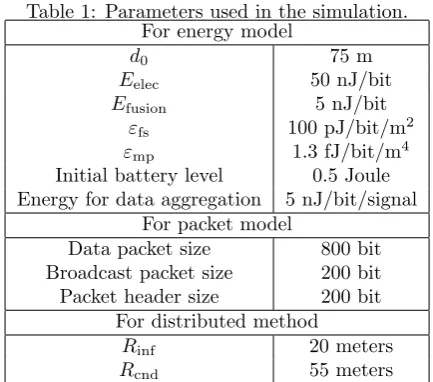
In the simulation, N sensor nodes are randomly dis-tributed in the square region of size 100 m×100 m and the base station is 75 meters away from the center of a side as shown in Fig.5. The parameters used in the simulation is summarized in Table 1. The simulation is performed for N= 100, 300 and 1000.
[image:4.595.306.542.76.146.2]The simulation results for N = 100, 300 and 1000 are shown in Figs. 6, 7 and 8, respectively. In the graphs, “Centralized” and “Distributed” are our proposed meth-ods in subsections 3.1 and 3.2, respectively. ForN = 100 andN= 300, our distributed method is the best and our centralized method is the second best. The difference be-tween our proposed methods for N = 300 is small than
Figure 5: The node arrangement in the simulation.
Table 1: Parameters used in the simulation. For energy model
d0 75 m
Eelec 50 nJ/bit
Efusion 5 nJ/bit
εfs 100 pJ/bit/m2
εmp 1.3 fJ/bit/m4
Initial battery level 0.5 Joule Energy for data aggregation 5 nJ/bit/signal
For packet model
Data packet size 800 bit Broadcast packet size 200 bit Packet header size 200 bit
For distributed method
Rinf 20 meters
Rcnd 55 meters
for N = 100. For N = 1000, our centralized method is the best and our distributed method is the second best. For any N, our proposed methods achive bet-ter performance than the conventional methods LEACH, HEED and ANTCLUST. Our simulation result shows that our centralized and distributed methods are suitable for larger and smaller numbers of sensor nodes, respec-tively.
5
Conclusions and Future Work
[image:4.595.319.536.199.390.2]0 20 40 60
0 500 1000 1500 2000 2500 3000 3500 4000
Number of alive nodes
Round LEACH
[image:5.595.55.292.87.249.2]HEED ANTCLUST Centralized Distributed
Figure 6: The number of alive nodes versus round for N = 100.
0 50 100 150 200 250 300
0 500 1000 1500 2000 2500 3000 3500 4000
Number of alive nodes
Round
[image:5.595.54.289.316.483.2]LEACH HEED ANTCLUST Centralized Distributed
Figure 7: The number of alive nodes versus round for N = 300.
0 200 400 600 800 1000
0 500 1000 1500 2000 2500 3000 3500 4000
Number of alive nodes
Round
LEACH HEED ANTCLUST Centralized Distributed
Figure 8: The number of alive nodes versus round for N = 1000.
References
[1] Linde, Y., Buzo, A., Gray, R.M., “An Algorithm for Vector Quantizer Design.”IEEE Trans on Commu-nications, V28, pp.84-95, 1980.
[2] Heinzelman, W.B., Chandrakasan, A.P., Balakrish-nan, H., “An Application-Specific Protocol Archi-tecture for Wireless Microsensor Networks,” IEEE
Trans on Wireless Communications, V1, N4, pp.
660-670, 2002.
[3] Younis, O., Fahmy, S., “HEED: A Hybrid, Energy-Efficient, Distributed Clustering Approach for Ad Hoc Sensor Networks,”IEEE Trans on Mobile Com-puting, V3, N4, pp. 366-379, 2004.
[4] Chan, H., Perrig, A., “ACE: An Emergent Algo-rithm for Highly Uniform Cluster Formation,”Proc.
1st Euro Workshop Sensor Networks, pp.154-71,
2004.
[5] Sundararaman, B., Buy, U., Kshemkalyani, A.D., “Clock Synchronization for Wireless Sensor Net-works: a Survey,”Ad Hoc Networks, V3, pp.281-323, 2005.
[6] Kamimura, J., Wakamiya, N., Murata, M., “A Distributed Clustering Method for Energy-Efficient Data Gathering in Sensor Networks,” International Journal of Wireless and Mobile Computing, V1, I2, pp.113-120, 2006.
[image:5.595.55.291.550.711.2]