Adaptive Transformation-based Learning for
Improving Dictionary Tagging
Burcu Karagol-Ayan, David Doermann, and Amy Weinberg Institute for Advanced Computer Studies (UMIACS)
University of Maryland College Park, MD 20742
{burcu,doermann,weinberg}@umiacs.umd.edu
Abstract
We present an adaptive technique that en-ables users to produce a high quality dic-tionary parsed into its lexicographic com-ponents (headwords, pronunciations, parts
of speech, translations, etc.) using an
extremely small amount of user provided
training data. We use
transformation-based learning (TBL) as a postprocessor at two points in our system to improve per-formance. The results using two dictio-naries show that the tagging accuracy in-creases from 83% and 91% to 93% and 94% for individual words or “tokens”, and from 64% and 83% to 90% and 93% for contiguous “phrases” such as definitions or examples of usage.
1 Introduction
The availability and use of electronic resources such as electronic dictionaries has increased tre-mendously in recent years and their use in Natural Language Processing (NLP) systems is widespread. For languages with limited electronic resources, i.e. low-density languages, however, we cannot use automated techniques based on par-allel corpora (Gale and Church, 1991; Melamed, 2000; Resnik, 1999; Utsuro et al., 2002), compa-rable corpora (Fung and Yee, 1998), or multilin-gual thesauri (Vossen, 1998). Yet for these low-density languages, printed bilingual dictionaries often offer effective mapping from the low-density language to a high-density language, such as En-glish.
Dictionaries can have different formats and can provide a variety of information. However, they typically have a consistent layout of entries and a
1 Headword 5 Translation 2 POS 6 Example of usage
3 Sense number 7 Example of usage translation 4 Synonym 8 Subcategorization
Figure 1: Sample tagged dictionary entries. Eight tags are identified and tagged in the given entries.
consistent structure within entries. Publishers of dictionaries often use a combination of features to impose this structure including (1) changes in font style, font-size, etc. that make implicit the
lexico-graphic information1, such as headwords,
pronun-ciations, parts of speech (POS), and translations, (2) keywords that provide an explicit interpreta-tion of the lexicographic informainterpreta-tion, and (3) var-ious separators that impose an overall structure on the entry. For example, a boldface font may in-dicate a headword, italics may inin-dicate an exam-ple of usage, keywords may designate the POS, commas may separate different translations, and a numbering system may identify different senses of a word.
We developed an entry tagging system that rec-ognizes, parses, and tags the entries of a printed dictionary to reproduce the representation elec-tronically (Karagol-Ayan et al., 2003). The sys-tem aims to use features as described above and the consistent layout and structure of the
dictio-1
naries to capture and recover the lexicographic
in-formation in the entries. Each token2or group of
tokens (phrase)3in an entry associates with a tag
indicating its lexicographic information in the en-try. Figure 1 shows sample tagged entries in which eight different types of lexicographic information are identified and marked. The system gets for-mat and style inforfor-mation from a document image analyzer module (Ma and Doermann, 2003) and is retargeted at many levels with minimal human assistance.
A major requirement for a human aided dic-tionary tagging application is the need to
mini-mize human generated training data.4 This
re-quirement limits the effectiveness of data driven methods for initial training. We chose rule-based tagging that uses the structure to analyze and tag tokens as our baseline, because it outperformed the baseline results of an HMM tagger. The ap-proach has demonstrated promising results, but we will show its shortcomings can be improved by ap-plying a transformation-based learning (TBL) post processing technique.
TBL (Brill, 1995) is a rule-based machine learn-ing method with some attractive qualities that make it suitable for language related tasks. First, the resulting rules are easily reviewed and under-stood. Second, it is error-driven, thus directly min-imizes the error rate (Florian and Ngai, 2001). Furthermore, TBL can be applied to other annota-tion systems’ output to improve performance. Fi-nally, it makes use of the features of the token and those in the neighborhood surrounding it.
In this paper, we describe an adaptive TBL based technique to improve the performance of the rule-based entry tagger, especially targeting cer-tain shortcomings. We first investigate how using TBL to improve the accurate rendering of tokens’ font style affects the rule-based tagging accuracy. We then apply TBL on tags of the tokens. In our experiments with two dictionaries, the range of font style accuracies is increased from 84%-94% to 97%-98%, and the range of tagging accuracies is increased from 83%-90% to 93%-94% for to-kens, and from 64%-83% to 90%-93% for phrases. Section 2 discusses the rule-based entry tagging
2
Tokenis a set of glyphs (i.e., a visual representation of a set of characters) in the OCRed output. Each punctuation is counted as a token as well.
3
In Figure 1,not on timeis a phrase consisting of 3 tokens.
4For our experiments we required hand tagging of no
more than eight pages that took around three hours of human effort.
method. In Section 3, we briefly describe TBL, and Section 4 recounts how we apply TBL to im-prove the performance of the rule-based method. Section 5 explains the experiments and results, and we conclude with future work.
2 A Rule-based Dictionary Entry Tagger
The rule-based entry tagger (Karagol-Ayan et al., 2003) utilizes the repeating structure of the dic-tionaries to identify and tag the linguistic role of tokens or sets of tokens. Rule-based tagging uses three different types of clues—font style, key-words and separators—to tag the entries in a sys-tematic way. The method accommodates noise in-troduced by the document analyzer by allowing for a relaxed matching of OCRed output to tags. For each dictionary, a human operator must spec-ify the lexicographic information used in that par-ticular dictionary, along with the clues for each tag. This process can be performed in a few hours. The rule-based method alone achieved token accu-racy between 73%-87% and phrase accuaccu-racy be-tween 75%-89% in experiments conducted using
three different dictionaries5.
The rule-based method has demonstrated prom-ising results, but has two shortcomings. First, the method does not consider the relations between different tags in the entries. While not a prob-lem for some dictionaries, for others ordering the relations between tags may be the only informa-tion that will tag a token correctly. Consider the dictionary entries in Figure 1. In this dictionary, the word “a” represents POS when in italic font, and part of a translation if in normal font. How-ever if the font is incorrect (font errors are more likely to happen with short tokens), the only way to mark correctly the tag involves checking the neighboring tokens and tags to determine its rel-ative position within the entry. When the token has an incorrect font or OCR errors exist, and the other clues are ambiguous or inconclusive, the rule-based method may yield incorrect results.
Second, the rule-based method can produce in-correct splitting and/or merging of phrases. An er-roneous merge of two tokens as a phrase may take place either because of a font error in one of the tokens or the lack of a separator, such as a punctu-ation mark. A phrase may split erroneously either
5Using HMMs for entry tagging on the same set of
as a result of a font error or an ambiguous separa-tor. For instance, a comma may be used after an example of usage to separate it from its translation or within it as a normal punctuation mark.
3 TBL
TBL (Brill, 1995), a rule-based machine learning algorithm, has been applied to various NLP tasks. TBL starts with an initial state, and it requires a
correctly annotated training corpus, or truth, for
the learning (or training) process. The iterative learning process acquires an ordered list of rules or transformations that correct the errors in this initial state. At each iteration, the transformation which achieved the largest benefit during appli-cation is selected. During the learning process, the templates of allowable transformations limit the search space for possible transformation rules. The proposed transformations are formed by in-stantiation of the transformation templates in the context of erroneous tags. The learning algorithm stops when no improvement can be made to the current state of the training data or when a pre-specified threshold is reached.
A transformation modifies a tag when its con-text (such as neighboring tags or tokens) matches the context described by the transformation. Two parts comprise a transformation: a rewrite rule— what to replace— and a triggering environment—
when to replace. A typical rewrite rule is:Change
the annotation from aa to ab, and a typical
trig-gering environment is:The preceding word iswa.
The system’s output is the final state of this data after applying all transformations in the order they are produced.
To overcome the lengthy training time
associ-ated with this approach, we usedfnTBL, a fast
ver-sion of TBL that preserves the performance of the algorithm (Ngai and Florian, 2001). Our research contribution shows this method is effective when applied to a miniscule set of training data.
4 Application of TBL to Entry Tagging
In this section, we describe how we used TBL in the context of tagging dictionary entries.
We apply TBL at two points: to render correctly the font style of the tokens and to label correctly
the tags of the tokens6. Although our ultimate goal
6In reality, TBL improves the accuracy of tags and phrase
boundary flags. In this paper, whenever we say “application of TBL to tagging”, we mean tags and phrase boundary flags
!"# %$
!"# '&
!"# '(
!"# ')
[image:3.595.307.527.61.195.2]!"# '*
Figure 2: Phases of TBL application
is improving tagging results, font style plays a cru-cial role in identifying tags. The rule-based entry tagger relies on font style, which can be also incor-rect. Therefore we also investigate whether im-proving font style accuracy will further improve tagging results. We apply TBL in three configu-rations: (1) to improve font style, (2) to improve tagging and (3) to improve both, one after another. Figure 2 shows the phases of TBL application. First we have the rule-based entry tagging results with the font style assigned by document image analysis (Result1), then we apply TBL to tagging using this result (Result2). We also apply TBL to improve the font style accuracy, and we feed these changed font styles to the rule-based method (Re-sult3). We then apply TBL to tagging using this result (Result4). Finally, in order to find the upper bound when we use the manually corrected font styles in the ground truth data, we feed correct font styles to the rule-based method (Result5), and then apply TBL to tagging using this result (Result6).
In the transformation templates, we use the to-kens themselves as features, i.e. the items in the triggering environment, because the token’s con-tent is useful in indicating the role. For instance a comma and a period may have different func-tionalities when tagging the dictionary. However, when transformations are allowed to make
refer-ence to tokens, i.e., whenlexicalized
transforma-tions are allowed, some relevant information may be lost because of sparsity. To overcome the data
sparseness problem, we also assign atypeto each
token that classifies the token’s content. We use eight types: punctuation, symbol, numeric, upper-case, capitalized, lowerupper-case, non-Latin, and other. For TBL on font style, the transformation tem-plates contain three features: the token, the token’s type, and the token’s font. For TBL on tagging, we
use four features: the token, the token’s type, the token’s font style, and the token’s tag.
The initial state annotations for font style are assigned by document image analysis. The rule-based entry tagging method assigns the initial state of the tokens’ tags. The templates for font style ac-curacy improvement consist of those from study-ing the data and all templates usstudy-ing all features within a window of five tokens (i.e., two preced-ing tokens, the current token, and two followpreced-ing tokens). For tagging accuracy improvement, we prepared the transformation templates by studying dictionaries and errors in the entry tagging results. The objective function for evaluating transforma-tions in both cases is the classification accuracy, and the objective is to minimize the number of er-rors.
5 Experiments
We performed our experiments on a Cebuano-English dictionary (Wolff, 1972) consisting of 1163 pages, 4 font styles, and 18 tags, and on an Iraqi Arabic-English dictionary (Woodhead and Beene, 2003) consisting of 507 pages, 3 font styles, and 26 tags. For our experiments, we used a publicly available implementation of TBL’s fast
version, fnTBL7, described in Section 3.
We used eight randomly selected pages from the dictionaries to train TBL, and six additional ran-domly selected pages for testing. The font style and tag of each token on these pages are manually corrected from an initial run. Our goal is to mea-sure the effect of TBL on font style and tagging that have the same noisy input. For the Cebuano dictionary, the training data contains 156 entries, 8370 tokens, and 6691 non-punctuation tokens, and the test data contains 137 entries, 6251 tokens, and 4940 non-punctuation tokens. For the Iraqi Arabic dictionary, the training data contains 232 entries, 6130 tokens, and 4621 non-punctuation tokens, and the test data contains 175 entries, 4708 tokens, 3467 non-punctuation tokens.
For evaluation, we used the percentage of accu-racy for non-punctuation tokens, i.e., the number of correctly identified tags divided by total num-ber of tokens/phrases. The learning phase of TBL took less than one minute for each run, and ap-plication of learned transformations to the whole dictionary less than two minutes.
We report how TBL affects accuracy of tagging
7
http://nlp.cs.jhu.edu/rflorian/fntbl
when applied to font styles, tags, and font styles and tags together. To find the upper bound tag-ging results with correct font styles, we also ran rule-based entry tagger using manually corrected font styles, and applied TBL for tagging accuracy improvement to these results. We should note that feeding the correct font to the rule-based entry tag-ger does not necessarily mean the data is totally correct, it may still contain noise from document image analysis or ambiguity in the entry.
We conducted three sets of experiments to ob-serve the effects of TBL (Section 5.1), the effects of different training data (Section 5.2), and the ef-fects of training data size (Section 5.3).
5.1 TBL on Font Styles and Tags
Cebuano Iraqi Arabic
Original 84.43 94.15 TBL(font) 97.07 98.13
Table 1: Font style accuracy results for non-punctuation tokens
We report the accuracy of font styles on the test data before and after applying TBL to the font style of the non-punctuation tokens in Table 1. The initial font style accuracy of Cebuano dictionary was much less than the Iraqi Arabic dictionary, but applying TBL resulted in similar font style accu-racy for both dictionaries (97% and 98%).
Cebuano Iraqi Arabic
Token Phrase Token Phrase
RB 83.25 64.08 90.89 82.72
[image:4.595.338.492.292.324.2]RB+TBL(tag) 91.44 87.37 94.05 92.33 TBL(font)+RB 87.99 72.44 91.46 83.48 TBL(font)+RB+TBL(tag) 93.06 90.19 94.30 92.58 GT(font)+RB 90.76 74.71 91.74 83.90 GT(font)+RB+TBL(tag) 95.74 92.29 94.54 93.11
Table 2: Tagging accuracy results for non-punctu-ation tokens and phrases for two dictionaries
The results of tagging accuracy experiments
are presented in Table 2. In the tables, RB is
rule-based method, TBL(tag) is the TBL run on tags, TBL(font) is the TBL run on font style, and GT(font) is the ground truth font style. In each case, we begin with font style information pro-vided by document image analysis. We tabulate percentages of tagging accuracy of individual
non-punctuation tokens and phrases8. The results for
8In phrase accuracy, if a group of consequent tokens is
[image:4.595.307.527.475.563.2]token and phrase accuracy are presented for three different sets: The entry tagger using the font style (1) provided by document image analysis, (2) after TBL is applied to font style, and (3) cor-rected manually, i.e. the ground truth. All re-sults reported, except the token accuracies for two cases for the Iraqi Arabic dictionary, namely us-ing TBL(font) vs. GT(font) and usus-ing TBL(font)
and TBL(tag) together vs. using GT(font) and
TBL(tag), are statistically significant within the 95% confidence interval with two-tailed paired t-tests9.
Using TBL(font) instead of initial font styles improved initial accuracy as much as 4.74% for tokens, and 8.36% for phrases in the Cebuano dic-tionary which has a much lower initial font style accuracy than the Iraqi Arabic dictionary. Using the GT(font) further increased the tagging accu-racy by 2.77% for tokens and 2.27% for phrases for the Cebuano dictionary. As for the Iraqi Ara-bic dictionary, using TBL(font) and GT(font) re-sulted in an improvement of 0.57% and 0.85% for tokens and 0.74% and 1.18% for phrases respec-tively. The improvements in these two dictionar-ies differ because the initial font style accuracy for the Iraqi Arabic dictionary is very high while for the Cebuano dictionary potentially very useful font style information (namely, the font style for POS tokens) is often incorrect in the initial run.
Using TBL(tag) alone improved rule-based method results by 8.19% and 3.16% for tokens and by 23.25% and 9.61% for phrases in Cebuano and Iraqi Arabic dictionaries respectively. The last two rows in Table 2 show the upper bound. For the two dictionaries, our results using TBL(font) and TBL(tag) together is 2.68% and 0.24% for token accuracy and 2.10% and 0.53% for phrase accuracy less than the upper bound of using the GT(font) and TBL(tag) together.
Applying TBL to font styles resulted in a higher accuracy than applying TBL to tagging. Since the number of tag types (18 and 26) is much larger than that of font style types (4 and 3), TBL appli-cation on tags requires more training data than the font style to perform as well as TBL application on font style.
In summary, applying TBL using the same tem-plates to two different dictionaries using very lim-ited training data resulted in performance increase,
tokens was assigned the same tag as a phrase in the result.
9
We did the t-tests on the results of individual entries.
and the greatest increases we observed are in phrase accuracy. Applying TBL to font style first increased the accuracy even further.
5.2 Effect of Training Data
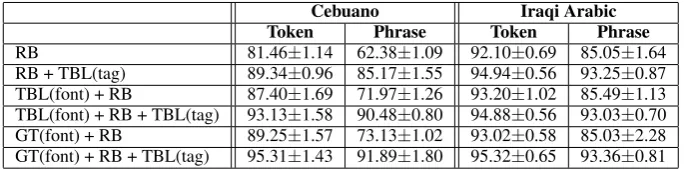
We conducted experiments to measure the robust-ness of our method with different training data. For this purpose, we trained TBL on eight pages randomly selected from the 14 pages for which we have ground truth, for each dictionary. We used the remaining six pages for testing. We did this ten times, and calculated the average accuracy and the standard deviation. Table 3 presents the average accuracy and standard deviation. The accuracy re-sults are consistent with the rere-sults we presented in Table 2, and the standard deviation is between 0.56-2.28. These results suggest that using differ-ent training data does not affect the performance dramatically.
5.3 Effect of Training Data Size
The problem to which we apply TBL has one im-portant challenge and differs from other tasks in which TBL has been applied. Each dictionary has a different structure and different noise patterns, hence, TBL must be trained for each dictionary. This requires preparing ground truth manually for each dictionary before applying TBL. Moreover, although each dictionary has hundreds of pages, it is not feasible to use a significant portion of the dictionary for training. Therefore the training data should be small enough for someone to annotate ground truth in a short amount of time. One of our goals is to calculate the quantity of training data necessary for a reasonable improvement in tagging accuracy. For this purpose, we investigated the effect of the training data size by increasing the training data size for TBL one entry at a time. The entries are added in the order of the number of er-rors they contain, starting with the entry with max-imum errors. We then tested the system trained
with these entries on two test pages10.
Figure 3 shows the number of font style and tag-ging errors for non-punctuation tokens on two test pages as a function of the number of entries in the training data. The tagging results are presented when using font style from document image anal-ysis and font style after TBL. In these graphs, the
10We used two test data pages because if such a method
Cebuano Iraqi Arabic
Token Phrase Token Phrase
[image:6.595.128.472.62.147.2]RB 81.46±1.14 62.38±1.09 92.10±0.69 85.05±1.64 RB + TBL(tag) 89.34±0.96 85.17±1.55 94.94±0.56 93.25±0.87 TBL(font) + RB 87.40±1.69 71.97±1.26 93.20±1.02 85.49±1.13 TBL(font) + RB + TBL(tag) 93.13±1.58 90.48±0.80 94.88±0.56 93.03±0.70 GT(font) + RB 89.25±1.57 73.13±1.02 93.02±0.58 85.03±2.28 GT(font) + RB + TBL(tag) 95.31±1.43 91.89±1.80 95.32±0.65 93.36±0.81
Table 3: Average tagging accuracy results with standard deviation for ten runs using different eight pages for training, and six pages for testing
0 50 100 150 200 250 300
0 20 40 60 80 100 120 140
Number of Errors
Number of Entries in Training Data for Cebuano Dictionary # of Errors in Font Style # of Errors in Tagging with TBL(tag) # of Errors in Tagging with TBL(font)-TBL(tag)
0 20 40 60 80 100 120 140 160
0 20 40 60 80 100 120
Number of Errors in Test Data
[image:6.595.66.538.189.356.2]Number of Entries in Training Data for Iraqi Arabic Dictionary # of Errors in Font Style # of Errors in Tagging with TBL(tag) # of Errors in Tagging with TBL(font)-TBL(tag)
Figure 3: The number of errors in two test pages as a function of the number of entries in the training data for two dictionaries
number of errors declines dramatically with the addition of the first entries. For the tags, the de-cline is not as steep as the dede-cline in font style. The main reason involves the number of tags (18 and 26), which are more than the number of font styles (4 and 3). The method of adding entries to train-ing data one by one, and findtrain-ing the point when the number of errors on selected entries stabilizes, can determine minimum training data size to get a reasonable performance increase. lexicalized
5.4 Example Results
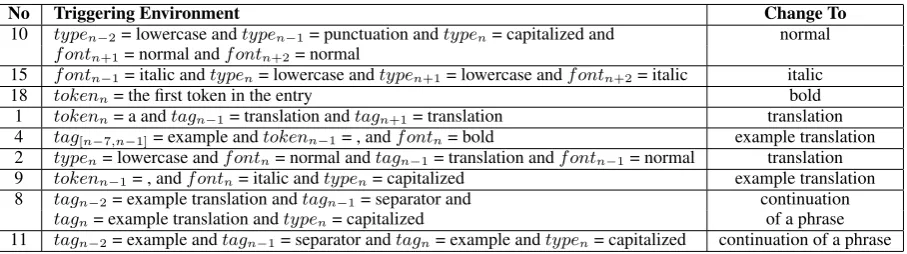
Table 4 presents some learned transformations for
Cebuano dictionary. Table 5 shows how these
transformations change the font style and tags of tokens from Figure 4. The first column gives the tagging results before applying TBL. The con-secutive columns shows how different TBL runs changes these results. The tags with * indicate incorrect tags, the tags with + indicate corrected tags, and the tags with - indicate introduced er-rors. The font style of tokens is also represented.
TheNocolumn in Tables 4 and 5 gives the applied
transformation number.
For these entries, using TBL on font styles and tagging together gives correct results in all cases.
Using TBL only on tagging gives the correct tag-ging only for the last entry.
TBL introduces new errors in some cases. One error we observed occurs when an example of us-age translation is assigned a tag before any exam-ple of usage tag in an entry. This case is illustrated
when applying transformation 9 to the tokenAbaa
because of a misrecognized comma before the to-ken.
6 Conclusion
No Triggering Environment Change To
10 typen−2= lowercase andtypen−1= punctuation andtypen= capitalized and normal f ontn+1= normal andf ontn+2= normal
15 f ontn−1= italic andtypen= lowercase andtypen+1= lowercase andf ontn+2= italic italic 18 tokenn= the first token in the entry bold
1 tokenn= a andtagn−1= translation andtagn+1= translation translation 4 tag[n−7,n−1]= example andtokenn−1= , andf ontn= bold example translation 2 typen= lowercase andf ontn= normal andtagn−1= translation andf ontn−1= normal translation
9 tokenn−1= , andf ontn= italic andtypen= capitalized example translation 8 tagn−2= example translation andtagn−1= separator and continuation
[image:7.595.74.528.62.189.2]tagn= example translation andtypen= capitalized of a phrase 11 tagn−2= example andtagn−1= separator andtagn= example andtypen= capitalized continuation of a phrase
Table 4: Some sample transformations used for Cebuano dictionary entries in Figure 4. Here,
continua-tion of a phraseindicates this token merges with the previous one to form a phrase.
attributed to a low rule-based baseline as a simi-lar, even a slightly lower baseline is obtained from an HMM trained system. Results came from a method used to compensate for extremely lim-ited training data. The similarity of performance across two different dictionaries shows the method as adaptive and able to be applied genericly.
In the future, we plan to investigate the sources of errors introduced by TBL and whether these can be avoided by post-processing TBL results us-ing heuristics. We will also examine the effects of using TBL to increase the training data size in a bootstrapped manner. We will apply TBL to a few pages, then correct these and use them as new training data in another run. Since TBL im-proves accuracy, manually preparing training data will take less time.
Acknowledgements
The partial support of this research under contract MDA-9040-2C-0406 is gratefully acknowledged.
References
Eric Brill. 1995. Transformation-based error-driven learning and natural language processing: A case study in part of speech tagging. Computational Lin-guistics, 4(21):543–565.
Radu Florian and Grace Ngai. 2001.
Multidimen-sional transformational-based learning.
Proceed-ings of the 5th Conference on Computational Nat-ural Language Learning, CoNLL 2001, pages 1–8, July.
Pascale Fung and Lo Yuen Yee. 1998. An IR approach for translating new words from nonparallel, com-parable texts. In Christian Boitet and Pete White-lock, editors,Proceedings of the 36th Annual Meet-ing of the Association for Computational LMeet-inguis- Linguis-tics and 17th International Conference on Compu-tational Linguistics, pages 414–420, San Francisco, California. Morgan Kaufmann Publishers.
William A. Gale and Kenneth W. Church. 1991. A program for aligning sentences in bilingual corpora. In Proceedings of the 29th Annual Meeting of the ACL, pages 177–184, Berkeley, California, June.
Burcu Karagol-Ayan, David Doermann, and Bonnie Dorr. 2003. Acquisition of bilingual MT lexicons
from OCRed dictionaries. In Proceedings of the
9th MT Summit, pages 208–215, New Orleans, LA, September.
Huanfeng Ma and David Doermann. 2003.
Bootstrap-ping structured page segmentation. InProceedings
of SPIE Conference Document Recognition and Re-trieval, Santa Clara, CA, January.
I. Dan Melamed. 2000. Models of translational
equiv-alence among words. Computational Linguistics,
26(2):221–249, June.
Grace Ngai and Radu Florian. 2001. Transformation-based learning in the fast lane. In Proceedings of the 2nd Conference of the North American Chap-ter of the Association for Computational Linguistics (NAACL), pages 40–47, Pittsburgh, PA, June.
Philip Resnik. 1999. Mining the web for bilingual text. InProceedings of the 37th Annual Meeting of the As-sociation for Computational Linguistics (ACL’99), University of Maryland, College Park, Maryland, June.
Takehito Utsuro, Takashi Horiuchi, Yasunobu Chiba,
and Takeshi Hamamoto. 2002. Semi-automatic
compilation of bilingual lexicon entries from cross-lingually relevant news articles on WWW news
sites. In Fifth Conference of the Association for
Machine Translation in the Americas, AMTA-2002, pages 165–176, Tiburon, California.
Piek Vossen. 1998. EuroWordNet: A Multilingual
Database with Lexical Semantic Networks. Kluwer Academic Publishers, Dordrecht.
John U. Wolff. 1972.A Dictionary of Cebuano Visaya. Southeast Asia Program, Cornell University. Ithaca, New York.
D. R. Woodhead and Wayne Beene, editors. 2003.
Figure 4: Cebuano-English dictionary entry samples
RB RB + TBL (tag) TBL (font) + RB TBL (font) + RB + TBL (tag) Tag Token(s) No Tag Token(s) No Tag Token(s) No Tag Token(s)
abaa particle abaa particle 18 +hw abaa hw abaa
*hw indicating *hw indicating +tr particle indicating tr particle indicating
disapproval disapproval disapproval disapproval
*ex Abaa! 9 -ex-tr Abaa! *ex Abaa! Abaa!
*ex Mah´ug ka *ex Mah´ug ka *ex Mah´ug ka 11 +ex Mah´ug ka
gani dih`a! gani dih`a! gani dih`a! gani dih`a!
*ex-tr Stop that! 8 +ex-tr Stop that! *ex-tr Stop that! 8 +ex-tr Stop that!
*ex-tr You might fall! You might fall! *ex-tr You might fall! You might fall!
*tr emit emit a short grunt *tr emit emit a short grunt
*pos a 1 when hitin *pos a 2 when hit in
short grunt when the pit of the short grunt when the pit of the
*tr hitinthe pit +tr stomach or *tr hit in the pit +tr stomach or
of the stomach or when exerting of the stomach or when exerting
when exerting an effort an effort when exerting an effort an effort
*ex Miagunt´u *ex Miagunt´u Miagunt´u Miagunt´u
*al-sp siya *al-sp siya 15 +ex siya ex siya
*ex dihang naig *ex dihang naig dihang naig dihang naig
sa kutukutu, sa kutukutu, sa kutukutu, sa kutukutu,
*al-sp The 4 The 10 The The
*ex-tr basketball court +ex-tr basketball court +ex-tr basketball court ex-tr basketball court
will be asphalted. will be asphalted. will be asphalted. will be asphalted.
hw: headword; tr: translation; al-sp: alternative spelling of headword; pos: POS; ex: example of usage; ex-tr: example of usage translation
Table 5: Illustration of TBL application to the incorrect tags in the sample entries shown in Figure 4.