48
Goal-Oriented End-to-End Conversational Models with Profile Features
in a Real-World Setting
Yichao Lu Manisha Srivastava Jared Kramer
Heba Elfardy Andrea Kahn Song Wang Vikas Bhardwaj Amazon
Seattle, WA, USA
{yichaolu,mansri,jaredkra,helfardy,kahna,sonwang,vikab}
@amazon.com
Abstract
End-to-end neural models for goal-oriented conversational systems have become an in-creasingly active area of research, though re-sults in real-world settings are few. We present real-world results for two issue types in the customer service domain. We train models on historical chat transcripts and test on live contacts using a human-in-the-loop research platform. Additionally, we incorporate cus-tomer profile features to assess their impact on model performance. We experiment with two approaches for response generation: (1) sequence-to-sequence generation and (2) tem-plate ranking. To test our models, a customer service agent handles live contacts and at each turn we present the top four model responses and allow the agent to select (and optionally edit) one of the suggestions or to type their own. We present results for turn acceptance rate, response coverage, and edit rate based on approximately 600 contacts, as well as qual-itative analysis on patterns of turn rejection and edit behavior. Top-4 turn acceptance rate across all models ranges from 63%-80%. Our results suggest that these models are promising for an agent-support application.
1 Introduction
While interest in training conversational models has been steadily increasing, recent research has largely focused on how algorithmic improvements help model performance on fabricated datasets. In this work, we explore how two general approaches to conversational modeling perform on real-world data in a customer service setting, with the goal of developing an application that provides customer service agents with recommended responses to en-able them to help customers more quickly.
Conversational systems are typically divided into two broad categories: chit-chat systems (Zhang et al., 2018b;Du et al., 2018) and
goal-oriented systems, with the latter designed to ac-complish specific tasks such as restaurant reserva-tions (Gupta et al.,2018;Peng et al.,2017). Many of these systems use separate components for di-alog state (belief) tracking and natural language generation (Bordes et al., 2016; Liu and Lane,
2017;Wen et al., 2016), while others are end-to-end.
Recent work in end-to-end approaches can be further categorized into sequence-to-sequence models that generate responses word by word (Vinyals and Le,2015; Serban et al., 2016), and template-based approaches that score pairs of conversation history and candidate response (Liu et al., 2018; Zhou et al., 2018; Kannan et al.,
2016). Sequence-to-sequence models are easily scaled to new domains but tend to generate safe, generic responses that may not be effective in helping the user achieve their goal (Baheti et al.,
2018;Shao et al., 2017; Zhang et al., 2018a; Li et al., 2016). End-to-end templated models are less expensive to develop than belief tracking sys-tems, but still require domain knowledge and may not cover all situations. As a result, some re-search has focused on hybrid approaches (Qiu et al.,2017;Serban et al.,2017).
on using customer profile information to augment textual features in end-to-end conversational mod-els (Zhang et al.,2018b).
In this work, we seek to address these gaps by training task-oriented, multi-turn conversational models for the customer service domain and re-porting results on interactions with real customers. Our use case is an agent-support application that recommends responses, similar to the smart re-ply feature in Gmail (Kannan et al., 2016) and LinkedIn (Pasternack et al., 2017). We incorpo-rate user profile information as features to enable our models to generate relevant, personalized re-sponses. Our research goals are to explore the effect of customer profile features in two differ-ent model formulations, and to presdiffer-ent a practical comparison of these two general approaches in a real-world setting.
In Section2, we describe the training data used to develop these models. In Section 3, we de-scribe the end-to-end models we developed, which include both sequence-to-sequence and template-based models. In Section 4, we introduce a re-search platform for testing our models in a real-world, human-in-the-loop setting, and in Section
5, we report results on conversations with real cus-tomers. In Section 6, we describe the impact of profile features, conduct an analysis of rejected and edited turns, and comment on the performance of each type of model. In Section7, we summarize the conclusions drawn from this work and propose future directions.
2 Data
Our training data consists of historical transcripts from customer service chats handled in English. When a customer begins a chat contact, they are prompted for an initial description of their issue and are then connected to a customer service agent (CSA). We classify these initial utterances into specific customer issues (e.g.,order tracking, pay-ment questions) before connecting the customer to a CSA. These two conversational participants work together to diagnose and resolve the cus-tomer’s issue(s). Throughout this process, the CSA has access to a wide variety of customer in-formation, such as order status, and internal APIs to execute actions such as canceling or refunding an order. For our experiments, we select the cus-tomer issue typescancel order andreturn refund status.
Raw text:
Customer: I want to cancel the shoes I ordered yes-terday.
Agent: Welcome to Customer Service.
Agent: I am here to help you.
Agent: Give me a moment to look into this.
Training Sample:
Input: CUSTOMERI want to cancel the shoes I or-dered yesterday. AGENTWelcome to Customer Ser-vice. AGENTI am here to help you. PROFILE can-cellable, carrier, membership-status.Output: Give me a moment to look into this.
Figure 1: Training sample for generative model with profile features. Given raw text and recorded profile features, the training instance is created by appending the turns and profile features while the label is the next agent turn.
In addition to chat transcripts, we experiment with adding particular pieces of customer profile information to our data for thecancel order exper-iments. These data points are similar to the infor-mation a CSA accesses when handling a contact. For thecancel orderrelated contacts only, we in-corporate data points extracted from a customer’s profile and details about their orders that are rel-evant for order cancellation. Specifically, we in-clude the customer’s membership status, the order fulfillment method, the shipping carrier, whether the order is a single or multi-item order, and whether the order was eligible for cancellation at the time of contact.
3 Approach
3.1 Response Generation Model
Our response generation models use a transformer-based encoder-decoder model (Vaswani et al.,2017) to create responses. When generating a response at thet-th turn, the encoder takes as input the conversation history Ut =
(u1, u2, . . . , ut), whereuk=(w1, w2, . . . , wnk)is the utterancekwithnkwords.
Additionally, since customer profile informa-tion is crucial for correctly diagnosing and solving a customer’s issue, we incorporate profile features for the cancel order response generation model. We do so by appending the profile features to the conversation history and thus the input to the en-coder is of the form[Ut|P], wherePrepresents the
profile features and|is the concatenation operator. Figure1shows an example of how the conver-sation is processed for training. Each turn in the conversation history is prepended by a special to-ken to indicate whether it is an agent or a customer turn, and another token is used to separate profile features from dialogue turns. The embeddings of both words in the turns and customer profile fea-tures as in Figure 1 are used as an input to the transformer encoder. The output of the encoder,
S =(s1, s2, . . . , st) where eachsk is a vector of
size equal to the dimension of the hidden state of the encoder, is then fed as an input to the decoder together with the target sequence shifted by one word.
3.2 Response Ranking Model
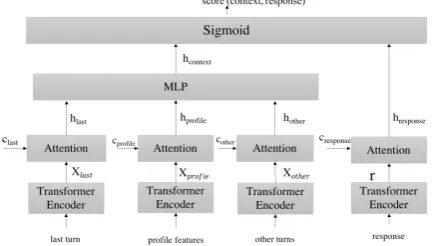
[image:3.595.310.527.68.191.2]For our response ranking models, the input to the model is a pair consisting of the conversation his-tory with customer profile features and a candidate response. The model outputs a probability of how appropriate a candidate response is given the con-versation history. Candidate responses are pulled from a predefined pool of utterances–templates– and ranked based on the probability score. To develop these templates, we use historical chat transcripts between customers and CSAs to come up with a list of approximately 100 templates–50 for each domain–that cover the most common use cases. The advantage of this approach is that it gives us control over how diverse and informative we want our responses to be and allows us to add new templates without having to retrain the model. This approach uses a hierarchical encoder to encode the context and a separate encoder to en-code the response. Each of: (1) last turn, (2)
Figure 2: Response Ranking Model Architecture
profile features and (3) the rest of the conver-sation history are encoded using transformer en-coders. The outputs of the transformer encoders (Xlast,Xprof ile,Xother) are then passed through a
cross attention layer. A separate word context vector (clast, cprof ile, cother) is passed to each of
the cross attention layers. The word context vec-tor can be seen as a high-level representation of a fixed query “What is the informative word?”
(Yang et al., 2016). Each word context vector is randomly initialized and jointly learned during the training process. The final context encoded vec-tor, given in Equation1, is the concatenation of the output of the three attention layers passed through a multilayer perceptron.
hcontext=M LP([hlast;hprof ile;hother]) (1)
Similar to the context, we use a transformer en-coder to encode the candidate response and pass the output through a cross attention layer together with a response context vector cr. The response
context vector is randomly initialized and jointly learned. The classification layer is simply the dot product of the context vector and the response vec-tor followed by a sigmoid activation layer. The output of this layer, given in Equation 2, can be interpreted as how appropriate the candidate re-sponse is given the context.
score=sigmoid(hcontext·hresponse) (2)
To create positive training samples, we pair a conversation history with the next agent response. For negative samples, we randomly pick a differ-ent conversation history and pair it with the same agent response. Figure2shows the architecture of this model.
4 Experimental Setup
Repeat until the contact is resolved:
Every time the customer types into their chat window:
1. E2E model suggests four responses.
CSA may wait for customer if still typing.
2. CSA selects best response & may choose:
• to edit response
•“None of the above”& create custom response
3. CSA sends best response
4. CSA may choose to repeat steps 1-3 to send
multiple responses before the next customer
utter-ance is issued.
Figure 3: Contact Flow
return refund status. Forcancel order we trained both model types with and without profile infor-mation, giving us a total of 6 experiments. Our ex-periments were carried out using a human-in-the-loop research platform that CSAs used to resolve live customer contacts. This platform presents the CSA with the standard chat interface but re-places the CSA’s text box with a list of suggested responses from a given model. Every time the customer or the CSA enters text into their chat window, our model refreshes the top four recom-mended next CSA utterances. Because our goal is to make agents more efficient without degrad-ing the customer experience, we allowed agents to edit suggested turns before sending them. Figure
3shows the conversational flow for each chat con-tact.
5 Results
We describe the results of our experiments in terms of turn acceptance, defined as the percent-age of percent-agent turns for which a model-generated response was accepted by the CSA. We present results for cancel order and return refund status
separately because the issues do not have the same resolution difficulty. Qualitative analysis on rea-sons for turn rejection and patterns of edit behav-ior are included in Section6.
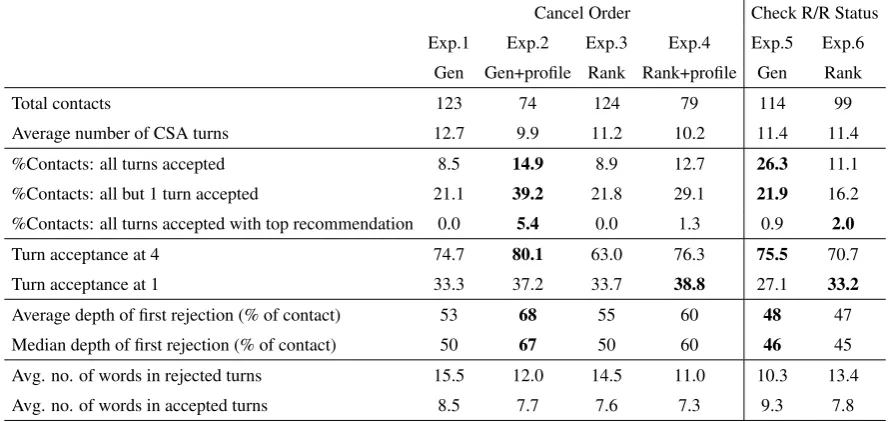
In Table 1, we present results for 613 contacts handled by our models with a human in the loop (approximately 100 contacts per experiment). In each of our experiments, the CSA was shown the top 4 model suggestions at each turn; turn accep-tance at 4 refers to the frequency with which the CSA chose one of the suggestions, and turn ac-ceptance at 1 refers to the frequency with which
the CSA chose the highest ranked suggestion. The average number of CSA turns is roughly equal for all experiments.
Turn acceptance at 4 ranges from 63.0% to 80.1%, with the generative+profile model achiev-ing the best performance forcancel orderand the generative model performing best for return re-fund status. Turn acceptance at 1 ranges from 27.1% to 38.8%, with the ranking+profile model performing best forcancel orderand the ranking model performing best for return refund status. It is possible that turn acceptance at 1 would be higher in a setting where agents were not given 4 choices.
We also look at our models’ ability to handle contacts start to finish and report the percentage of contacts for which all or all but one of the agent turns were model-generated. For these metrics, the top performing models are generative+profile forcancel order(14.9%) and generative forreturn refund status(26.3%). For both issue types, only a very small number of contacts (<10) had the top recommendation selected for all turns. The av-erage depth of the first rejection (the percentage of turns in the conversation that occurred before the first rejection) was also highest for the genera-tive+profile model forcancel order(68%) and the generative model for return refund status(48%). We also found that, on average, accepted turns are 4-5 words shorter than rejected ones, suggesting that longer, more complex turns are less likely to be accepted.
6 Analysis & Discussion
In this section, we describe qualitative analysis on observed patterns in edit behavior and turn rejec-tion for each experiment. We also compare the performance of the generative vs. the ranking models and describe the impact of adding profile features to the models.
6.1 Edited Turns
Cancel Order Check R/R Status
Exp.1 Exp.2 Exp.3 Exp.4 Exp.5 Exp.6
Gen Gen+profile Rank Rank+profile Gen Rank
Total contacts 123 74 124 79 114 99
Average number of CSA turns 12.7 9.9 11.2 10.2 11.4 11.4
%Contacts: all turns accepted 8.5 14.9 8.9 12.7 26.3 11.1
%Contacts: all but 1 turn accepted 21.1 39.2 21.8 29.1 21.9 16.2
%Contacts: all turns accepted with top recommendation 0.0 5.4 0.0 1.3 0.9 2.0
Turn acceptance at 4 74.7 80.1 63.0 76.3 75.5 70.7
Turn acceptance at 1 33.3 37.2 33.7 38.8 27.1 33.2
Average depth of first rejection (% of contact) 53 68 55 60 48 47
Median depth of first rejection (% of contact) 50 67 50 60 46 45
Avg. no. of words in rejected turns 15.5 12.0 14.5 11.0 10.3 13.4
[image:5.595.76.521.64.275.2]Avg. no. of words in accepted turns 8.5 7.7 7.6 7.3 9.3 7.8
Table 1: Results of the different experiments on bothcancel orderandreturn refund statusdomains.
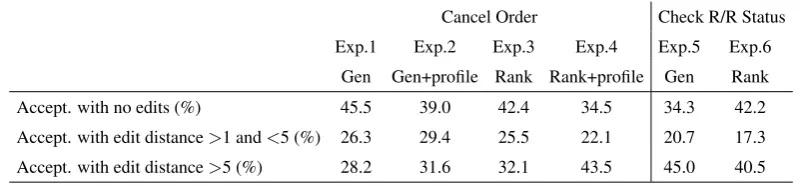
We calculated token-level edit distance1 be-tween suggested and sent turns (see Table2). We then grouped the accepted turns into three buckets with edit distances of 0, 1-5, and>5, respectively, based on observations that edits of length<5 were more often stylistic and edits of length >5 more often changed the fundamental message.
We further analyzed a random sample of 100 turns with edits of length>5 and found that they fell into four broad categories:
1. The CSA replaced a conversation filler with a more informative response. The sugges-tion that was edited would not have derailed the conversation, but it also did not directly progress toward the customer’s goal. This was particularly common for the generative models. We observe a similar trend in the re-jected turns (see Section6.2).
2. The recommended text provided extra infor-mation (which may have been incorrect or re-dundant) that the CSA deleted. This was ob-served only for the ranking models and sug-gests that these models would benefit from shorter templates.
3. The recommended text provided some infor-mation but not all, and the CSA needed to edit it to add something. This was observed only for the generative models.
4. The CSA replaced a conversational filler with a different conversational filler. This was
ob-1We use a token-level version of Levenshtein edit
dis-tance between the two case-normalized strings after stripping punctuation. Additions, deletions, and substitutions are all counted equally.
served across both types of models.
One surprising observation was that the num-ber of accepted turns with no edits was greater for the models that did not incorporate profile infor-mation. This requires deeper analysis.
6.2 Rejected Turns
We performed a manual analysis of 200 rejected turns across all experiments to understand how we can improve the performance of our models. We found that turn rejections were occasionally caused by real-world constraints that our models were not prepared to handle. For example, in 7% of the cases the CSA needed to reject the model’s suggestions in order to send an idle message ask-ing if the customer was still present. In future work, this could be addressed by incorporating idle time as a contextual feature.
Cancel Order Check R/R Status
Exp.1 Exp.2 Exp.3 Exp.4 Exp.5 Exp.6
Gen Gen+profile Rank Rank+profile Gen Rank
Accept. with no edits (%) 45.5 39.0 42.4 34.5 34.3 42.2
Accept. with edit distance>1 and<5 (%) 26.3 29.4 25.5 22.1 20.7 17.3
[image:6.595.98.501.62.155.2]Accept. with edit distance>5 (%) 28.2 31.6 32.1 43.5 45.0 40.5
Table 2: Rate of edit distances between accepted and sent turns
An additional 4% of turn rejections occurred when the contact needed to be transferred to a specialist. Providing additional order-specific profile features could help the model navigate these edge cases.
Agent behavior and training was also a major factor in turn acceptance. We found that 16% of rejected turns occurred when the CSA decided to reject the model suggestions in favor of a stylisti-cally different but semantistylisti-cally similar message. We also found that 34% of the turn rejections could have potentially been avoided if the agent had been willing to take sequential turns. For ex-ample, the models frequently suggest turns such as Thanks, just a moment or I see, which the agent rejected in favor of a more goal-oriented statement. However, accepting one of these sug-gestions would not have interrupted the conversa-tion flow and would have given the model another chance to produce the appropriate suggestion.
6.3 Generative vs. Ranking Models
Across all experiments, the generative models out-performed the ranking models in terms of top-4 turn acceptance rate. The best performing models in terms of per-contact response coverage (all turns accepted and all but 1 turn accepted) and depth of first rejection were also genera-tive models. The ranking models, however, per-formed best in terms of top-1 turn acceptance. A closer analysis of rejected turns from the genera-tive and ranking models showed that the relagenera-tively higher acceptance rate of the generative models came from both greetings/closings and resolution-specific turns. Suggestions from the generative models did lack semantic diversity compared to the ranking models. This is because the genera-tive models perform beam search at the word level as opposed to utterance level for the ranking mod-els. We expected that this would give the ranking models an advantage in turn acceptance rate, but this was not borne out. This may be due to the fact that CSAs seem to reject messages that are
too specific or too long; rejecting the entire mes-sage and writing a new one is more appealing than editing for longer model suggestions.
6.4 Profile Features
Adding profile features improved both top-1 and top-4 turn acceptance rate for both generative and ranking models. As one would expect, we ob-served that these features altered the models’ sug-gested responses. When the membership-status feature was positive, the models consistently sug-gested appropriate greetings such as Thanks for being a member, how can I help you. When the cancel-eligible feature was positive, the model was more likely to suggestSure. I can cancel the or-der for you, and when this feature was negative the model made suggestions such asI am sorry I can-not cancel your order since your order has shipped and entered the shipping process.
6.5 User Feedback
Since our goal is to help agents resolve customers’ issues more efficiently, we asked agents to provide us with their feedback on the system. The feed-back was overwhelmingly positive, with almost all agents reporting that having personalized response recommendations saved them time and that cus-tomers were also impressed by how quickly the agents were able to fix their issues. Some agents also reported that they liked that they did not have to type, which suggests that the proposed system could be used as an accessibility tool.
7 Conclusion & Future Work
cus-tomer chats. Agent feedback on the recommen-dations from these models has been overwhelm-ingly positive, and such an agent-support applica-tion has the potential to improve customers’ ex-perience by enabling agents to assist them more efficiently.
We believe that additional investment in con-textual and profile features would improve perfor-mance for both model types. In addition, we could improve the performance of the ranking models by modifying their template pools, primarily by adding shorter utterances or splitting longer utter-ances. In future work, combining output from the generative and the ranking models in a single sys-tem could improve overall performance.
Lastly, this work highlights the need for a more mature rubric for analysis of turn rejection and edit reasons. We observed CSAs rejecting and edit-ing turns to add and remove information, and to avoid particular conversational fillers. We also ob-served model failures due to real-world constraints like customers going idle and issue-specific edge cases. In future work, we plan to develop a more comprehensive annotation guide for error analysis in real-world goal-oriented systems.
References
Ashutosh Baheti, Alan Ritter, Jiwei Li, and Bill Dolan. 2018. Generating more interesting responses in neural conversation models with distributional con-straints. InProceedings of the 2018 Conference on Empirical Methods in Natural Language Process-ing.
Antoine Bordes, Y-Lan Boureau, and Jason Weston. 2016. Learning end-to-end goal-oriented dialog. In arXiv preprint arXiv:1605.07683.
Jiachen Du, Wenjie Li, Yulan He, Ruifeng Xu, Lidong Bing, and Xuan Wang. 2018. Variational autore-gressive decoder for neural response generation. In Proceedings of the 2018 Conference on Empirical Methods in Natural Language Processing.
Rashmi Gangadharaiah, Balakrishnan
Narayanaswamy, and Charles Elkan. 2018. What we need to learn if we want to do and not just talk. In Proceedings of the 2018 Conference of the North American Chapter of the Association for Computational Linguistics: Human Language Technologies, Volume 3 (Industry Papers), pages 25–32. Association for Computational Linguistics.
Sonal Gupta, Rushin Shah, Mrinal Mohit, Anuj Ku-mar, and Mike Lewis. 2018. Semantic parsing for task oriented dialog using hierarchical representa-tions. In Proceedings of the 2018 Conference on
Empirical Methods in Natural Language Process-ing, pages 2787–2792.
Anjuli Kannan, Karol Kurach, Sujith Ravi, Tobias Kaufmann, Andrew Tomkins, Balint Miklos, Greg Corrado, Laszlo Lukacs, Marina Ganea, Peter Young, et al. 2016. Smart reply: Automated re-sponse suggestion for email. InProceedings of the 22nd ACM SIGKDD International Conference on Knowledge Discovery and Data Mining, pages 955– 964. ACM.
Jiwei Li, Michel Galley, Chris Brockett, Jianfeng Gao, and Bill Dolan. 2016. A diversity-promoting objec-tive function for neural conversation models. In Pro-ceedings of the 2016 Conference of the North Amer-ican Chapter of the Association for Computational Linguistics: Human Language Technologies, pages 110–119.
Bing Liu and Ian Lane. 2017. An end-to-end trainable neural network model with belief tracking for task-oriented dialog. InInterspeech.
Bing Liu, Gokhan Tur, Dilek Hakkani-Tur, Pararth Shah, and Larry Heck. 2018. Dialogue learning with human teaching and feedback in end-to-end train-able task-oriented dialogue systems. In Proceed-ings of the 2018 Conference of the North American Chapter of the Association for Computational Lin-guistics: Human Language Technologies, Volume 1 (Long Papers), pages 2060–2069.
Chia-Wei Liu, Ryan Lowe, Iulian Serban, Mike Nose-worthy, Laurent Charlin, and Joelle Pineau. 2016. How not to evaluate your dialogue system: An em-pirical study of unsupervised evaluation metrics for dialogue response generation. InProceedings of the 2016 Conference on Empirical Methods in Natural Language Processing.
Jekaterina Novikova, Ondˇrej Duˇsek, Amanda Cercas Curry, and Verena Rieser. 2017. Why we need new evaluation metrics for NLG. InProceedings of the 2017 Conference on Empirical Methods in Natural Language Processing, pages 2241–2252.
Kishore Papineni, Salim Roukos, Todd Ward, and Wei-Jing Zhu. 2002. BLEU: a method for automatic evaluation of machine translation. InProceedings of the 40th annual meeting on association for compu-tational linguistics, pages 311–318. Association for Computational Linguistics.
Jeff Pasternack, Nimesh Chakravarthi, Adam Leon, Nandeesh Rajashekar, Birjodh Tiwana, and Bing Zhao. 2017. Building smart replies for member messages.
Minghui Qiu, Feng-Lin Li, Siyu Wang, Xing Gao, Yan Chen, Weipeng Zhao, Haiqing Chen, Jun Huang, and Wei Chu. 2017. Alime chat: A sequence to sequence and rerank based chatbot engine. In Pro-ceedings of the 55th Annual Meeting of the Associa-tion for ComputaAssocia-tional Linguistics (Volume 2: Short Papers), pages 498–503.
Iulian V Serban, Chinnadhurai Sankar, Mathieu Ger-main, Saizheng Zhang, Zhouhan Lin, Sandeep Sub-ramanian, Taesup Kim, Michael Pieper, Sarath Chandar, Nan Rosemary Ke, et al. 2017. A deep reinforcement learning chatbot. arXiv preprint arXiv:1709.02349.
Iulian Vlad Serban, Alessandro Sordoni, Yoshua Ben-gio, Aaron C Courville, and Joelle Pineau. 2016. Building end-to-end dialogue systems using gener-ative hierarchical neural network models. InAAAI, volume 16, pages 3776–3784.
Yuanlong Shao, Stephan Gouws, Denny Britz, Anna Goldie, Brian Strope, and Ray Kurzweil. 2017. Generating high-quality and informative conversa-tion responses with sequence-to-sequence models. In Proceedings of the 2017 Conference on Empiri-cal Methods in Natural Language Processing.
Ashish Vaswani, Noam Shazeer, Niki Parmar, Jakob Uszkoreit, Llion Jones, Aidan N Gomez, Łukasz Kaiser, and Illia Polosukhin. 2017. Attention is all you need. InAdvances in Neural Information Pro-cessing Systems, pages 5998–6008.
Oriol Vinyals and Quoc Le. 2015. A neural conversa-tional model. arXiv preprint arXiv:1506.05869.
Tsung-Hsien Wen, David Vandyke, Nikola Mrksic, Milica Gasic, Lina M. Rojas-Barahona, Pei-Hao Su, Stefan Ultes, and Steve Young. 2016. A network-based end-to-end trainable task-oriented dialogue system. InarXiv preprint arXiv:1604.04562.
Zichao Yang, Diyi Yang, Chris Dyer, Xiaodong He, Alex Smola, and Eduard Hovy. 2016. Hierarchi-cal attention networks for document classification. InProceedings of the 2016 Conference of the North American Chapter of the Association for Computa-tional Linguistics: Human Language Technologies, pages 1480–1489.
Ruqing Zhang, Jiafeng Guo, Yixing Fan, Yanyan Lan, Jun Xu, and Xueqi Cheng. 2018a. Learning to con-trol the specificity in neural response generation. In Proceedings of the 56th Annual Meeting of the As-sociation for Computational Linguistics (Volume 1: Long Papers).
Saizheng Zhang, Emily Dinan, Jack Urbanek, Arthur Szlam, Douwe Kiela, and Jason Weston. 2018b. Personalizing dialogue agents: I have a dog, do you have pets too? InProceedings of the 56th Annual Meeting of the Association for Computational Lin-guistics (Volume 1: Long Papers).