Abstract: Cloud computing now easily tops any list of topics in computer science because of its far reaching involvements in many areas in computing, especially Big Data. Moreover, It is a one of the most emerging technology due to the provision of various computing infrastructure and services. Cloud computing has evolved through a number of phases that include mainframe computing, cluster computing, and grid computing, parallel computing, distributed computing and utility computing. Cloud computing is often considered the successor of grid, cluster and, mainframe computing.Cloud computing is the delivery of many services through the Internet. These resources include tools and applications like databases, infrastructure, platforms, data storage, servers, networking, and software. Many people and businesses use cloud for a number of reasons including cost savings, increased productivity, speed, efficiency, high performance, scalability, high computing power and security. This paper presents the definition of cloud computing, its characteristics, different cloud services and various platforms that are used in cloud computing.
Keywords: Cloud computing, Evolution, Service models and cloud computing platforms.
I. INTRODUCTION
Many people believe that the term cloud computing is just another buzzword, but the term cloud computing has been used over the years to mean a number of technologies, including: grid computing, utility computing, Internet-based applications, software-as-a service (SaaS), peer-to-peer computing and remote processing.In cloud computing, the word "cloud" is used as a symbol of the most popular computer network means "the Internet," so the phrase cloud computing means a type of Internet-based medium, in which different services —including servers, storage and applications — are delivered and made accessible to an organization through the Internet [1][3].
II. HISTORY AND OTHER DEFINITION OF CLOUD COMPUTING
The Cloud Computing concept came into the spotlight in the year 1950 with access via thin/static clients and the implementation of mainframe computers. Then in 1961, John McCarthy delivered a speech at MIT in which he suggested that computing services will be readily available on demand service [4], just as other utility services such as water, electricity, telephone, and gas that computing can be sold like a utility. In the 21st century, this model has been referred to as utility computing or as cloud computing. Using cloud computing you can go with Pay-per-use or Pay-As-u-go Model. In 1999, Salesforce.com became the 1st company to enter the cloud arena, excelling the concept of providing enterprise-level applications to end users through the Internet. Then in 2002, Amazon came up with Amazon Web Services, providing services like computation, storage, and even human intelligence. In 2009, Google Apps, Hadoop, Salesforce.com, Manjra soft Aneka and Microsoft’s Windows Azure also started to provide cloud computing enterprise applications. Other companies like HP and Oracle also joined the stream of cloud computing, for fulfilling the need for greater data storage.
Many definitions have been introduced for the last years to define exactly what “cloud Computing” are: According to Buyya et al. [5] have defined it as follows: “Cloud is a parallel and distributed computing system consisting of a collection of interconnected and virtualized computers that are dynamically provisioned and presented as one or more unified computing resources based on service-level agreements (SLA) established through negotiation between the service provider and consumers.” The National Institute of Standards and Technology (NIST) [6] characterizes cloud computing as “a pay-per-use model for enabling available, convenient, on-demand network access to a shared pool of configurable computing resources (e.g. networks, servers, storage, applications, services) that can be rapidly provisioned and released with minimal management effort or service provider interaction.” Vaquero et al. [7] have stated “clouds are a large pool of easily usable and accessible virtualized resources (such as hardware, development platforms and/or services). These resources can be dynamically reconfigured to adjust to a variable load (scale), allowing also for an optimum resource utilization. This pool of resources is typically exploited by a pay-per-use model in which guarantees are offered by the Infrastructure Provider by means of customized Service Level Agreements.” definition proposed by the U.S. National Institute of Standards and Technology (NIST)[6]:”Cloud computing is a model for enabling ubiquitous, convenient, on-demand network access to a shared pool of configurable computing resources (e.g., networks, servers, storage, applications, and services) that can be rapidly provisioned and released with minimal management effort or service provider interaction”.
III. EXISTING TECHNOLOGY
1) Mainframes: Mainframes were powerful, highly reliable computers specialized for large data movement and massive input/output (I/O) operations. They are mostly used by large organizations for bulk data processing tasks such as online transactions, enterprise resource planning, and other operations involving the processing of significant amounts of data. The main application of mainframes is Batch Processing. The evolved version of application which are still use for transaction processing i.e. airline ticket booking, online banking, government services and supermarkets.
2) Clusters: This technology is faster, more powerful, high availability of resources, high performance and cheap cost than mainframe computers[8].High performance or cluster computing is form by large number of groups that are connected through a LAN so that is act as a single machine. Due to its faster processing speed, better integrity it solve the complex problems more efficiently. It is used for critical applications some are Earthquake Simulation, Weather Forecasting, Google search engine etc.
H. Energy efficiency
I. Increased agility
J. Service orientation
K. Security
L. High performance and reliability
M. Accessible from anywhere
V. MAJOR CATEGORIES OF CLOUD COMPUTING SERVICES
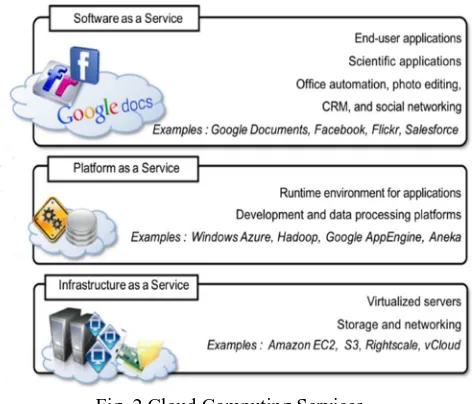
[image:3.612.191.427.331.533.2]The cloud computing is the capability to deliver, on demand, a variety of IT services to users over the internet. Cloud computing service offerings into three major categories: Infrastructure-as-a-Service (IaaS),Platform-as-a-Service (PaaS), and Software-as-a-Service (SaaS)[10].
Fig. 2 Cloud Computing Services
Fig. 3 Iaas Services
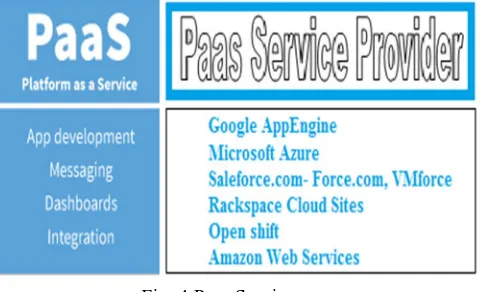
B. Platform as a Service: Paas providers commonly provides a development and deployment environment that allow users to create and run their applications on cloud with little or no trouble to low-level details of the platform. It is the responsibility of the Paas service provider to offer scalability and to manage fault tolerance, while users are requested to focus on the logic of the application developed by the provider’s APIs, programming tools and libraries [11]. Client design their applications and are not concerned with hardware that may be physical or virtual, server, storage, operating systems and other low-level services. The core middleware or hypervisor is in charge of managing the resources and scaling and descending applications on demand or automatically, according to the commitments made with users in SLA. This approach increases the level of abstraction at which cloud computing take advantage but also some restrictions for the user. The user works under a more controlled environment. PaaS providers usually support multiple programming languages in platforms include Python and Java (e.g., Google AppEngine), .NET languages (e.g., Microsoft Azure), and Ruby (e.g. Heroku), force.com or Saleforce.com has made its own programming language (Apex) and an Excel-like query language, which provide higher levels of abstraction to key platform functionalities [12]. The most popular is Microsoft Windows Azure [11], which provides a comprehensive framework for building service-oriented cloud applications on top of the .NET technology, hosted on Microsoft’s data centers.
Fig. 4 Paas Services
[image:4.612.195.435.413.559.2]VI. CLOUD COMPUTING PLATFORMS
1) Amazon web Services (AWS): AWS is mostly known for its compute and storage-on-demand services, namely Elastic Compute Cloud (EC2) and Simple Storage Service (S3). EC2 provides users with customizable virtual hardware that can be used as the base infrastructure for deploying computing systems on the cloud[13]. AWS offers cloud IaaS services ranging from virtual compute, storage, and networking to complete computing stacks. EC2 also provides the capability to save a specific running instance, as an image, thus allowing users to create their own templates for deploying systems.
2) Google App Engine: Google App Engine is a scalable runtime environment, mostly developed to executing Web applications and dynamically scale as user demand varies over the time [15]. App Engine provides services include in-memory caching, scalable data store, job queues, messaging, secure execution environment and a collection of services that simplify the development of scalable and high-performance Web applications. Developers can build and test applications on their own machines using the AppEngine software development kit (SDK), which replicates the production runtime environment and helps test and profile applications.
3) Hadoop: Apache Hadoop is an open-source framework that is suited for processing large data sets on commodity hardware. Hadoop is an implementation of Map Reduce, an application programming model developed by Google, which provides two fundamental operations for data processing: map and reduce. The former transforms and synthesizes the input data provided by the user; the latter aggregates the output obtained by the map operations. Hadoop provides the runtime environment, and developers need only provide the input data and specifies the map and reduce functions that need to be executed[15].Hadoop is an integral part of the Yahoo! Cloud infrastructure and supports several business processes of the company. Currently, Yahoo! manages the largest Hadoop cluster in the world.
4) Microsoft Azure: Microsoft Azure is a cloud operating system and a platform for developing applications in the cloud. It provides a scalable runtime environment for Web applications and distributed applications in general. Applications on Azure are organized around the concept of roles, which identify a distribution unit for applications and embody the application’s logic. There are three types of role: Web role, worker role, and virtual machine role. The Web’s role is designed to host a Web application, the worker role is a more generic container of applications and can be used to perform workload processing, and the virtual machine role provides a virtual environment in which the computing stack can be fully customized, including the operating systems.
5) Force.com and Salesforce.com: Force.com is a cloud computing platform for developing social enterprise applications. The platform is the basis for SalesForce.com, a Software-as-a-Service solution for customer relationship management. Force.com allows developers to create applications by composing ready-to-use blocks; a complete set of components supporting all the activities of an enterprise is available [11]. It is also possible to develop your own components or integrate those available in AppExchange into your applications.
6) Manjrasoft Aneka: It is a cloud application platform for rapid creation of scalable applications and their deployment of various types of clouds in a seamless and elastic manner. It supports a collection of programming abstractions for developing applications and a distributed runtime environment that can be deployed on heterogeneous hardware (clusters, networked desktop computers, and cloud resources). Developers can choose different abstractions to design their application: tasks, distributed threads, and map-reduce. These applications are then executed in the distributed service-oriented runtime environment, which can dynamically integrate additional resource on demand[11].
VII. CONCLUSION
Cloud computing is a one of the most emerging technology and its popularity increasing very rapidly. Many companies providing the various services to the consumer on rent bases like Google, Amazon Services, Oracle, Microsoft etc. Today, IT companies shift their business over the cloud based architecture because it provides physical infrastructure to build an application, the developer deploy their application on virtual environment and user run many software without installing on their personal computers. Moreover, user can store their personal data on cloud as per their requirement. This paper discussed the history, cloud computing services and its various technologies which recently used by IT industries. This technology changes the view point of many companies and they attract towards this technology. Cloud computing received lot of interest from various enterprises and IT professionals.
REFERENCES
[1] Kumar, V., “Brief review on cloud computing”, International Journal of Computer Science and Mobile Computing, Vol. 5, issue 9, pp. 01-05, 2016.
[2] Armbrust M, Fox A, Griffith R, Joseph A, Katz R, Konwinski A, et al. Technical Report No. UCB/ EECS-2009-28 Above the clouds: a berkeley view of cloud computing. USA: University of California at Berkeley; 2009
[3] Buyya R, Venugopal S. The gridbus toolkit for service oriented grid and utility computing: an overview and status report. Proceedings of the first IEEE international workshop on grid economics and business models (GECON 2004). NJ, USA: IEEE Press; 2004.
[4] J. F. Yang and Z. B. Chen, “Cloud Computing Research and Security Issues,” 2010 IEEE International Conference on Computational Intelligence and Software Engineering (CiSE), Wuhan pp. 1-3, DOI= 10-12 Dec. 2010.
[5] R. Buyya, C. S. Yeo, and S Venugopal, Market oriented cloud computing: Vision, hype, and reality for delivering IT services as computing utilities, in Proceedings of the 10th IEEE International Conference on High Performance Computing and Communications (HPCC 2008, IEEE CS Press, Los Alamitos, CA, USA), Dalian, China, September 25 27, 2008.
[6] IST Cloud computing definition, http://csrc.nist.gov/groups/SNS/cloudcompu ting/index.html, 2009
[7] J. van Bon and A. van der Veen, Foundations of IT Service Management based on ITIL, Vol. 3, Van Haren Publishing, Zaltbommel, September 2007. [8] Buyya R. High-performance cluster computing: architecture and systems. Upper Saddle River, NJ, USA: Prentice Hall PTR; 1999.
[9] Foster I, Kesselman C, Tuecke S. The anatomy of the grid: enabling scalable virtual organizations. Int High Perform Comput Appl 2001;15(3).
[10] Rao, C.C., Leelarani, M. and Kumar, Y.R., 2013. Cloud: Computing Services and Deployment Models. International Journal Of Engineering And Computer Science, 2(12), pp.3389-3390.
[11] “Mastering Cloud Computing” book authored by Rajkumar Buyya, Christian Vecchiola and S. Thamarai Selvi.
[12] Lv, C., et al. PaaS: A revolution for information technology platforms. in Educational and Network Technology (ICENT), 2010 International Conference on. 2010. IEEE.
[13] Tanenbaum AS, Van Steen M. Distributed systems: principles and paradigm. Upper Saddle River, NJ, USA: Prentice Hall PTR; 2001.
[14] Harshitha. k. raj, “a survey on cloud computing”, international journal of advanced research in computer science and software engineering,volumeno4,july 2014,ppno352-357.