Wireless Sensor Network using LoRa for Smart
Agriculture
Nomitha Chawla1, Prof. G. Anitha2
1, 2
Department of Computer Science and Engineering, UBDTCE
Abstract: Presently the climatic conditions are not same and not unsurprising. In addition, the Wireless Sensor Network (WSN) cut way in numerous applications. The pertinence of WSN are gigantic. The utility of WSN is for gathering the detected information, putting away or preparing the detected information and the transmitting information to the proper focal station. In WSN, LoRa innovation allows the information correspondence on substantial zones, permitting to dispense with multi-jump information transmission that requires an extremely exact synchronization. Because of these points of interest it is being utilized increasingly more in practical solution. Agriculture is one of the fields which have as of late deflected their examination to WSN. There are numerous manual techniques to develop a solid harvest. In any case, it requires a great deal of labor included which is difficult nowadays. So as to make it keen, straightforward and give right contribution to the yield, here we are structuring a remote sensor arrange for savvy agribusiness. Smart agriculture (or Precision agriculture) is applying right contributions at the correct time to get more development with less power and work. This plan gives genuine contribution as indicated by the environment; one can transmit the continuous information rapidly with in the blink of an eye. The constant information depends on the few attributes of climate like temperature, humidity and so on. This structure utilizes Arduino as the centre part. Here a sensor network is planned; every hub has a gathering of sensors (sensor hub) associated with the Arduino and LoRa (Sender/Base Station).The sensors utilized are dampness and temperature sensors. Humidity sensor senses the soil dampness content and temperature sensor sense the warmth in the air. The values which are estimated by the sensors are transmitted to an incorporated gadget which is LoRa (Receiver/Central Station). After the values are gotten by LoRa, as per those values exact choice will be taken.
Keywords: Arduino, LoRa, WSN and Smart agriculture.
I. INTRODUCTION
India is agriculture-based country where 50% of Indian population has agriculture as their main occupation or side business. Agriculture is the art, science or practice for cultivating crops by using different preparation methods. Farmers cultivate the crops using various engineered methods, techniques and many machines. The traditional farming practices with some conditions which are dependent on the monsoon or climatic changes. By following the traditional methods efficient results are not observed, we can increase the yield by adopting advanced technologies they are also called as modern farming. Modern farming can be achieved by involving new concepts such as such Internet of Things (IoT), Wireless Sensor Networks (WSN) and Precision Agriculture (PA). Precision agriculture is characterizing as the state of art and science of adopting advanced technology to augment the crop cultivation. Agricultural inputs such as spraying, manure, insecticides, etc. are applied in precise quantities as determined by modelling of crop growth arrangements to exaggerate the plant field and to curtail the impact on the environment.
The protection of the crops is very essential. So there is a need for monitoring of the data and that data should be real. In order to provide instant solution to the crops the data should be collected in a smart way but not by manual methods. So to achieve this we have to use wireless sensor network. Currently wireless sensor network is adopted by many applications like water quality management, data collecting, health monitoring etc.
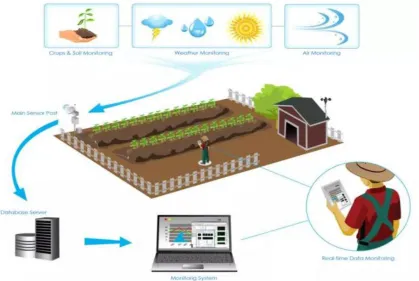
The main objective of this paper is to provide quality crop cultivation procedure in a predefined standard i.e. using LoRa technology. A network contains many nodes and each node will be deployed in a specified and predefined place. In this several nodes, one node acts as the coordinator that is connected to the centralized machine. Each node consists of a processor i.e. Arduino, sensors here we are measuring the following parameters soil moisture, humidity, temperature and light intensity and a LoRa which acts as the end device.
Wireless Sensor Network is an emerging advanced technology that helps the development of precision agriculture. WSN comprises of sensors, RF modules (radio frequency modules), and microcontrollers to process the data, battery or source of powers, base station to transmit the data. Recent trends and advancements in WSN technology have carved the path for the development of less cost. Low consumption of power and multi-functioning sensor nodes. Sensor node deployed at different places senses the different environmental parameters at that place and process the data accordingly. These sensor nodes can be made to communicate with other sensor nodes in the network to exchange the essential data. The various sensors which are used are soil moisture sensor and temperature sensor. There are many other sensors like IR sensors, UV sensors, Proximity sensor, LDR sensor, rain detecting sensors, and flow sensors etc. which are useful for precision agriculture. As India consumes 80% of total available water resources for irrigation purpose, we are in a situation where water consumption must be decreased using advanced scientific techniques to avoid this we can use soil moisture sensor as a solution. The main characteristics of WSN is self-organizing and self-healing. Once the nodes are deployed and a network is formed then, the data will be automatically transmitted without any command or control. If any device in the network collapses, then the network won’t be damaged instead it will take another working path and reaches the destination. So any damages or malfunctioning of a single node doesn’t affect the whole network. With the advanced trends in WSN, it is possible for us to use them in controlling or monitoring the various environmental parameters for precision agriculture.
Fig.2: Sensors Used.
Nowadays the IoT applications are usually oriented on the several low-power wireless technologies and standards. For instance, ZigBee as a platform for multi- hop mesh networks and other systems based on IEEE 802.15.4 standard, which are oriented onto short range communication, Bluetooth Low Energy (BLE) providing higher data rate up to 1 Mbps and larger critical range SIGFOX for implementation a network based on one-hop star topology with coverage distance up to 50 km and the LoRaWAN as a network architecture with a star-of-stars topology. In this project, LoRa devices are used as both base station and central station.
LoRa (Long Range) is a patenteddigital wireless data communication technology. LoRa is a long-range wireless communication protocol that competes against other low-power wide-area network (LPWAN) wireless such as narrowband IoT (NB IoT) or LTE Cat M1. Compared to those, LoRa achieves its extremely long range connectivity, possible 10km+, by trading off data rate. This technology is a rising technology for the transfer of data in implementing sensor network solutions for sensor data collection and transmission from end nodes to base stations.
LoRa uses license-free sub-gigahertz radio frequency bands like 169 MHz, 433 MHz, 868 MHz (Europe) and 915 MHz (North America). LoRa enables long-range transmissions (more than 10 km in rural areas) with low power consumption The technology is presented in two parts: LoRa, the physical layer and LoRaWAN (Long Range Wide Area Network), the upper layers.
A. Motivation
Agriculture system has been around for thousands of years allowing humankind to expand and construct permanent settlements. Environmental factors such as water, temperature, pressure, moisture, rain and many more effect plant growth significantly. Agricultural environments such as open fields and greenhouse allow farmers to produce plants with an emphasis on agriculture yield and productivity. Modern day technology empowers mankind to grow plants in environments previously not suitable for task. The development of wireless communication technology in the last decade has made wireless communication protocols exclusive in the domain of sensor networks. Existing trends have encouraged the use and implementation of many radio based protocols due to fact that short-range the radio transmission is inexpensive, secure and easily available. Short range standards like ZigBee, Bluetooth and Wi-Fi have been on the top of list for short-range communication.
[image:3.612.106.525.435.716.2]II. LITERATURESURVEY
Now-a-days cultivating crops are becoming a very hectic task for the farmers because of the unpredictable climate and expense cost of the seeds. Due to the unpredictable and sudden change of the climate the damage ratio will be high and even the loss rate will be high. So in order to overcome this scenario we have to adopt a design procedure which should be effective. The solution for this problem is by following the techniques of precision agriculture also known as smart agriculture. Precision Agriculture is a process of giving a correct set of inputs to the crops or lands according to the environment changes. Precision Agriculture follows a defined set of rules. They are collecting the data, processing the data, sending the data to the centralized machine and according to the data received the decisions will be taken by the expert [1].
Wireless Sensor Networks (WSN) have developed at a fast pace in recent years and have also been one of the major focuses of research in wireless technology. This rapid development has been facilitated by the evolution of electronics miniaturization, growth in performance, wireless technologies, energy efficiency, and the development of protocols. The sensors that collect environmental information from the surroundings have been miniaturized thanks to the fast performance, optimization, and miniaturization technology of the hardware. The developments of new wireless communication technologies and falling prices have enabled brand-new uses for wireless sensor network devices [2].
The advent of Wireless Sensor Networks (WSNs) spurred a new direction of research in agricultural and farming domain. In recent times, WSNs are widely applied in various agricultural applications. The potential WSN applications are reviewed, and the specific issues and challenges associated with deploying WSNs for improved farming. To focus on the specific requirements, the devices, sensors and communication techniques associated with WSNs in agricultural applications are analyzed comprehensively [3]. LoRa is a long-range, low-power, low-bitrate, wireless telecommunications system, promoted as an infrastructure solution for the Internet of Things: end-devices use LoRa across a single wireless hop to communicate to gateway(s), connected to the Internet and which act as transparent bridges and relay messages between these end-devices and a central network server. An overview of LoRa and an in-depth analysis of its functional components is provided [4].
Low Power Wide Area (LPWA) networks are making spectacular progress from design, standardisation, to commercialisation. At this time of fast-paced adoption, it is of utmost importance to analyse how well these technologies will scale as the number of devices connected to the Internet of Things (IoT) inevitably grows [5].
The last years have seen much interest in Low Power Wide Area (LPWA) technologies, which are gaining unprecedented momentum and commercial interest towards the realisation of the Internet of Things (IoT). There are many candidates that have taken the research community by surprise, actively pursuing standardisation, adoption, and commercial deployments in parallel [5]. Most LPWA networks operate in the unlicensed ISM bands at 169, 433, 868/915 MHz, and 2.4 GHz depending on the region of operation. Some of the most pronounced LPWA candidates are SigFox, LoRa, Weightless, and Ingenu [6]. The focus is on LoRa (Long Range), one of the most promising wide-area IoT technologies proposed by Semtech and further promoted by the LoRa Alliance. At the heart of LoRa’s success is its adaptive data rate chirp modulation technology allowing for flexible long-range communication with low power consumption and low cost design. Essentially, this is achieved via spread spectrum multiple access techniques accommodating multiple users in one channel. LoRa Alliance has defined the higher layers and network architecture on top the LoRa physical layers and termed them LoRaWAN. Together, these features make LoRa attractive to developers who can build complete system solutions on top of it for both geographical and residential/industrial types of IoT networks, thus fast-tracking its market adoption. Despite this success, LoRa has not yet attracted similar levels of attention from the academic and research community with only very few peer-reviewed studies published to date [6], [7], [8].
III.METHODOLOGY
Following are the functional entities observed in the project:
1) Sensors: Are the electronic devices which sense the soil moisture content, temperature and humidity of air and send them to base station.
2) Esp32 Kit: This kit fetches the information form sensors and converts the analogy data to digital; these data gets processed using C language and is uploaded to server using Wi-Fi configured network.
3) Breadboard: This device helps to connect various components and form circuit without soldering, it has grid of interconnected sockets with which we can connect various components required for project.
5) Lora Transceivers: LoRa is a wireless data communication technology that uses a radio modulation technique that can be generated by Semtech LoRa transceiver chips. This modulation technique allows long range communication of small amounts of data (which means a low bandwidth), high immunity to interference, while minimizing power consumption. So, it allows long distance communication with low power requirements.
LoRa uses unlicensed frequencies that are available worldwide. These are the most widely used frequencies:
a) 868 MHz for Europe
b) 915 MHz for North America
c) 433 MHz band for Asia
A. System Perspective
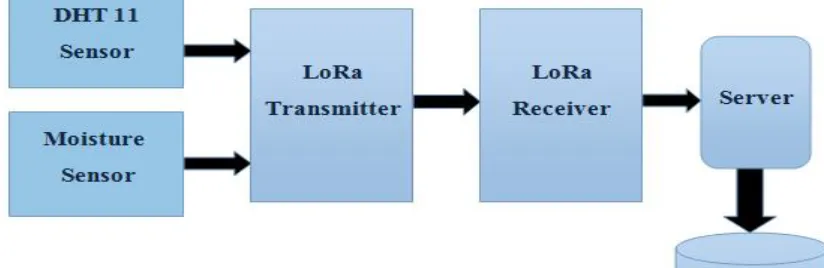
[image:5.612.99.511.272.406.2]The Fig 4 shows the architecture diagram, DHT11 sensor fetches the temperature and humidity values, soil moisture sensor gives the moisture value of soil, these are given to the LoRa sender. This in turn sends the data to LoRa receiver without the help of any network. LoRa devices create a wireless data communication network. Further, a server can be used to dump the data into the database.
Fig 4: Architecture diagram
B. Algorithm
1) Algorithm for LoRa Code
a) Step 1: Configuring the soil moisture sensor for reading values
b) Step 2: Configuring the Temperature/Humidity sensor for reading values
c) Step 3: Configuring the sensors to give data to the sender.
d) Step 4: Establish connection between transmitter and receiver nodes.
e) Step 5: Configuring LoRa sender device.
f) Step 6: Configuring LoRa receiver device.
g) Step 7: Dump values to table making use of server.
h) Step 8: Close connection.
C. Algorithm for ESP32 Code 1) Step 1: Launch Arduino IDE.
2) Step 2: Include all necessary header files.
3) Step 3: Get Blynk authentication key. Define Wi-Fi SSID and password.
4) Step 4: Within setup () method initializes Wi-Fi connection using WiFi_Adatper method; ensure Wi-Fi connection is successful. Initiate Blynk routine.
5) Step 5: Read sensor data from pin 35 of ESP32, define this task in loop method as this method gets called repeatedly
6) Step 6: Using Wi-Fi Client method send sensor data to PHP script hosted at local apache server, use hotspot IP for this purpose.
IV.RESULTS
A. LoRa sending kit which shows the interconnection between LoRa device, ESP 32, DHT11 sensor and soil moisture sensor.
B. LoRa receiving kit which shows LoRa device connected with ESP32 device.
D. Serial monitor screen showing the packets received by LoRa device.
F. Blynk application screen which gets opened up when on clicking the button in Android application.
V. CONCLUSION
The proposed prototype makes use of LoRa technology to share sensor data via wireless network, it finds useful in the field where machine to machine communication by sharing data plays important role. The proposal project reads fields parameters such as soil moisture, temperature, humidity from field and updates all information to base station which is associated with LoRa Transmitter. Further data is sent to the Receiver at 433MHZ frequency by means of encoded packets, these packets are decoded at receiver and populated to database for further decision. Based on the soil parameters, devices such as motors, actuators can be controlled.
VI.FUTUREWORK
This project can further be improved by adding more base stations and developing suitable protocols to read the data. Machine learning algorithms can be used to analyse the various field parameters with respect to type of crops to be cultivated, prediction of yield, etc.
A GSM module can be integrated to establish a communication between the LoRa device and the GSM/GPRS system, which will enable us to know the exact location of LoRa device.
REFERENCES
[1] G. Sahitya, N. Balaji and C. D. Naidu, “Wireless sensor network for smart agriculture,” 2016 2nd International Conference on Applied and Theoretical Computing and Communication Technology (iCATccT), Bangalore, 2016, pp. 488-493.
[2] M. Saari, A. M. bin Baharudin, P. Sillberg, S. Hyrynsalmi and W. Yan, "LoRa — A survey of recent research trends," 2018 41st International Convention on
Information and Communication Technology, Electronics and Microelectronics (MIPRO), Opatija, 2018, pp. 0872-0877.
[3] O. Tamoghna, M. Sudip, R. N. Singh, “Wireless sensor networks for agriculture: The state-of-the-art in practice and future challenges,” Ad Hoc Net., Vol.4,
pp.669-686, November 2006.
[4] Augustin, J. Yi, T. Clausen, W. M. Townsley, “A Study of LoRa: Long Range & Low Power Networks for the Internet of Things,” Sensors (Switzerland),
Vol.16, pp.1-18, September 2016.
[5] O. Georgiou U. Raza "Low Power Wide Area Network Analysis: Can LoRa Scale?" IEEE Wireless Communications Letters vol. 6 no. 2 pp. 162-165 2017.
[6] U. Raza, P. Kulkarni, and M. Sooriyabandara, “Low Power Wide Area Networks: A Survey,” arXiv preprint arXiv:1606.07360, 2016.
[7] G. Margelis, R. Piechocki, D. Kaleshi, and P. Thomas, “Low throughput networks for the IoT: Lessons learned from industrial implementations,” in Internet of
Things (WF-IoT), 2015 IEEE 2nd World Forum on, pp. 181–186, IEEE, 2015.
[8] L. Vangelista, A. Zanella, and M. Zorzi, “Long-Range IoT Technologies: The Dawn of LoRa,” in Future Access Enablers of Ubiquitous and Intelligent
Infrastructures, pp. 51–58, Springer, 2015.