American
Journal
of
Computational
Linguistics
Microfiche 8 2A
MODEL
F O R KNOWLEDGE AND I T SAPPLICATION
T OD I S C O U R S E
A N A L Y S I S
B R I A N P H I L L I P S
University
o f
Illinois
at
Chicago
C i r c l e 6 0 6 8 0C o p y r i g h t @ 1 9 7 9
TABLE OF CONTENTS
I n t r o d u c t i o n .
.
.
.
.
.
.
. . .
.
. . .
.
.
.
.
.
. . .
L . . 4A m o d e l for knowledge
.
Nodes
A r c s
Par a d i g m a t i , ~ relations
Va r ie t y Instance Typical
M a n i f e s t a t i o n
Syn t a g m a t i c r e l a t i o n s D i s c u r s i v e r e l a t i o n s T h e m e t a l i n g u a l r e l a t i o n
S t a t u s r e l a t i o n s N e g a t i o n
I n h e
r
i @ a n c eE p i s o d ic and s y s t e m i c menlory Quantification
Processes in the network
Pa ttl-tracing
Pattern-matching
D i s c o u r s e a n a l y s i s .
. .
.
.
.
.
. . .
. . .
.
.
. . . .
a.
.
4 4Thq st^-IIC t u r e o f c ~ h e r e n t d ~ S C C U ~ S ~ 4 4
Anaphora 4 4
S p a t i a l , t e m p o r a l , and c a u s a l c o h e s i o n 4 5
Thematicity 46
T h e r o l e of t h e e n c y c l o p e d i a 5 2
Anaphora 53
Spatial, temporal. and causal cohesion 5.4
T h e m a t i c i t y 56
I m p l e m e n t a t i o n . .
. .
. .
.
. . .
.
.
. . .
. .
a. . . . .
57
Processes 58
P a r a d i g m a t i c p a t h t r a c i n g 5 8
Causal connectivity conditfon 5 8
D i s c o v e r i n g g e n e r a l and apecif i c p r o p o s i t i o n s 58 ? l e t s l i n g u a l d e c o m p o s i t i s n 6 0
Iletalinp,ual a b s t r a c t i o n 60
Inference o f o m i t t e d d i s c u r s i v e r e l a t i o n s 62
Analysis of some s t o r i e s
. .
.
. . .
.
.
.
.
. . . . .
63Common p a t terns 65
A b o a t c a p s i z i n g 6 7
A f a l l i n t o water 7 0
INTKODUCTTON
An i m p o r t a n t c s n t r i b u t i o n of n a t u r a l Language p r o c e s s i n g h a s been to d i r e c t a ttr:n tion t o tile s t r u c t u r e o f 1 ~ ~ 1 g i ~ a g e a t the d i s c a u ~ . s e
I I
l e v e l , wl-rich hna l e d r 6 n g r e a t e r awareness uE t h e r o t e o f meaning" in
Iangtxage For "A t e x t is best: regarded a s n SEIAhTXG u n i t ; a u n i t n o t a £
form but o f meaningt' ( I l a l l i d a y ct Ilasan, 1976, p. 2 ) . T h i s b e i n g so,
d i s c s u r s c a n a l y s i s
will
d e e p e n u r t l n d c r s t a n d i n g sf meaning andv i c e - v e r s a
In t h i s paper 1: p r e s e n t a rnodel, of nzcaning s t r a n ~ l y inf'l~lencccl h y
Ilays (].969a, 3.969b, 1970, 1973) and s t l o w hob I t; i s a b l e t o ccciptwre tf~c o t g a n i z a t t n n of L ! ~ H C D U ~ S C ~ . I n p a r t i c u l a r T seek t o d e f i n e the or-
g a n i z a t i o n o f c a h e r c n t d i ~ c o u r s t - . and t o slaow l l o w knowledge is u'sed to
i n h e x a c o h e r e n t s t r u c t u r e when, a s u s u a l l y is the case, the s u r f a c e
forrr: i s e l l f ~ 3 t i c . Tt~e h y p a t h e s c s a r c a ~ s e d to b u i L d a n automati-c s y s t e m
tcn t e s t t h e coherence of d ibscnnrsc.
A f hO'fJR1, FOl< IiiJCIE.JX,l? DCJ;
T h e p l ~ i l o s o p f ~ i c s t n r ~ c c -fs taken t h a t u t r r knowlr.dg.,c of ;I c s n c e p is
t h e f~icarling of c t ~ a t concept: : "5arrtcanc w t ~ o knows wi:at tik-t.r means
. .
I s required t o know t h a t w ~ e r c n t y p ~ t a l t i g e r s a r e s t r i p e d " ( F u t n a n r , 1975, p 2 4 9 ) 1E b b r o w , 1968; Colby, 1973;
Raphael,
1968; Winograd, 1W1; etc.)The
present model is raore'in t h e t r a d i t i o n of Klein, Oakley, Suurballe,and
Ziesemer
(1
9 7 2 ) , Q u i l l i a n ( 1 9 6 9 ) , Rumelhar t,
Lindsay, andNormaa
(1972),
Schank
(1975ai, Shapiro (1971), S i m m o n s (1970),and
Wllks( 1 9 7 2 ) , where no p a r t i c u l a r context
is
prescrfbed*It
willbe
apparentthat
a t many p o i n t s t h e present model draws uponthese
e a r l i e rsyatems.
Some
o f thedifferences
between
systems
are probably
differences
i n
notation-
However
nosystem
I sa t
a s t a g e o f c o ~ s t a n e y
or
completenesst h a t makes it worthwhile t o
devote
much effort to e s t a b l i s h i n g theequivalences Although i t wauld be possib1.e t o present only t h e paws
that I believe t o be novel, g i v i n g the whole system
i n
a c o m m o n nota-tion w i l l
easethe
taskof
the reader-The m o d e l ,
hereafter
c a l l e d the encyclopedia, endeavors t ob e
consistent
w i t h a v a i l a b l epsychological
andl i n g u i s t i c
views
of thes t r u c t u r e
oflanguage
and t'hought,f o r
any
automatedlanguage
system must c l o s e l yimitate
the ttorkings ofhuman c o g n i t i o n
to b esuccessful
(Collins
&Q u i l l f a n ,
1972).
The
encyclopedia
encodes common knowledgesf
t h eworld
which mayd i f f e r from s c i e n t i f i c a l l y accurate descriptions. Putnam (1975) c a l l s
such knowledge "stereotypical":
The
f a c t that a feature.
. .
l e , i n c l u d e din
the stereotype as-sociated with a word
X
does not mean t h a t it is an analytic t r u t ht h a t a l l
Xs
have that feature,nor
thatmost
Xtl havethat
f e a t u r e ,
nor t h a t a l l normal Xs have that feature,
nor
that some Xs have t h a t feature..
.
Dtwovering t h a t
our
stereotype
i s basedon
nonnormal or
unrepresentative members of a natural.kind is
n o twe could hardly communicate i f moat o f our stereotypes
weren't
p r e t t y accurate as far a s t h e y g o e ( p p . 250-251)
The encyclopedia is achematized
and
ihplemented
as a directedgraph; i n current p a r l a n c e it i s a network model. Nodes characterize
concepts a n d arcs r e l a t i o n s between conceptsv The most general s t a t e -
ment to make about the model
is
t h a t r e l a t i o n s and aoneept types aret h e necessary system p r i m i t i v e s ;
some
concepts may be primitive, b u tt h e
model
does not depend on the* existence o f p r i m i t i v e conceptsDiscussion
wi2
1 cover the nodes and r e l a t i o n s of t h e model.Attention w i l l a l s o b e given to network processes.
No p s y c h o l ~ g i c a l validity i s claimed
for
thecontent of any of the
s t r u c t u r e s shown; the claim extends only to the r e l a t i o n a l s t t u c t u r e
Questions of content must
be
answered empirically-Nodes
There
are
four types o.f nodes: -9 event Yentit r-
.-
a t t r i b u t e , andmodality.
The
f i r s t three correspond t o simple verb simple noun, and simple modifier, r e s p e c t i v e l y . The fourth t y p e of node is novel I t s r a l e in *he system w i l l become clear after a d e s c r i p t i o n o f arcs * Fort h e meantime i t will, have t o s u f f i c e t o say t h a t i t i s u s e d i n t h e
spatio-temporal causal, b e l i e f , and hiersrchic organization of know-
ledge * Its ancestor
i n
l i n g u i s t i c theoryis "modal"
inthe
model/proposition dichotomy of Fillmore ( 1 9 6 9 ) . S c h ~ b e r t ( 1 9 7 6 ) h a s predicate nodes that are similar in motivation, but
different
in
use
from m o d a l i t y nodes.
Nodes o f t h e encyclopedia are not labeled (Collins & Quillian, 1972). An a r c , termed
-
name, p o i n t s from a node i n t o a d i c t i o n a r y o fp r i n t names. For clarity nodes i n diagrams w i l l be a n n o t a t e d , b u t t h i s
s h o u l d n o t b e taken a s r e p r e s e n t i n g the implementation, which i s a s
shown in F i g u r e 1.
rock
I
DICTIONARY I ENCYCLOPEDIA I
I
1 NAME
person Peter
Adnt
[image:7.720.218.496.241.552.2]Sally I
Figure 1 L a b e l i n g nodes
In
a l l t h e f o l l o w i n g f i g u r e s is an event, e n t i t y or a t t r i b u t e node- Annotations on these nodes are enclosed in1 ,
<>,
and[ I ,
r e s p e c t i v e l y - M o d a l i t y n o d e s appear as
o
and are never annotated.Arcs
propositions, t h e r n e t a l i n g u a l a r c i s u s e d t o a s s o c i a t e a c o n c e p t w i t h a
s t o r y i n n e t w o r k form that defines t h e c o n c e p t , and s t a t u s a r c s charac- terize b e l i e f s and d e s i r e s +
P a r a d i g m a t i c R e l a t i o n s
V a r i e t y . A r e a d i l y observable a s p e c t of human b e h a v i o r is the e x i s t e n c e o f f o l k t a x o ~ ~ o m i e s . These have b e e n s t u d i e d i n detail by
e t t ~ n a s e m a n t l c i s t s i n order t o discover t h e i r c o g n i t i ~ e s i g n i f i c a n c e and
s t r u c t u r e :
Man i s b y nature a classifying animal. His c o n t i n u e d existence d e p e n d s on his a b i l i t y t o r e c o g n i z e s i m i l a r i t i e s a n d d i f f e r e n c e s between o b j e c t s a n d events i n Iris p h y s i c a l u n i v e r s e and t o make known these s i m i l a r i t i e s and differences l i n g u i s t i c a l l y
.
Ifideed,
t h e v e r y development o f t h e human mind seems to have been closely related t o t h e p e r c e p t i o n of d i s c o n t i n u i t i e s i n n a t u r e . In viewof t h i s , t h e s t u d y o f f o l k taxonomic systems, which have r e c e i v e d
a great d e a l o f i n t e r e s t i n recent years, h a s a h i g h s i g n i f i c a n c e i n i n t e r p r e t i n g t h e logical processes going on i n o u r minds, a s
w e l l as in u n d e r s t a n d i n g t h e a p p l i c a t i o n and u t i l i t y of t h e tax-
oncmfc systcms themselves. (Raven, E e r l i n , 6 Breedlove, 1971,
p 8 1210)
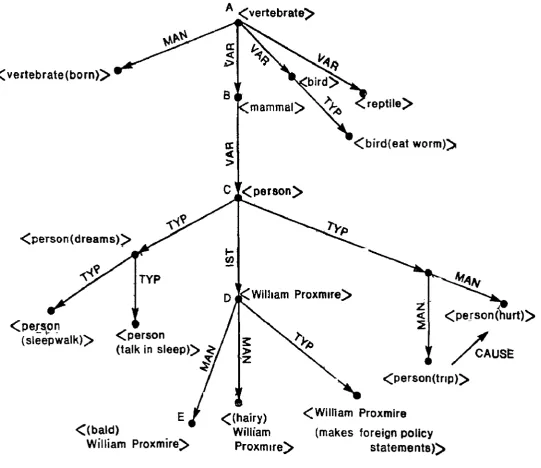
For example, mammal, b i r d , and r e p t i l e might b e classified as k i n d s of
<pecyn
(sleepwalk))
(talk in sleep)) 2
4
'
1rt)>
1 /
CAUSE/ n n r n r r - / * r a m \ \
-
((hairy (William Proxmire
William (makes foreign policy
[image:9.716.82.624.71.539.2]William Proxmire) Proxm ire) statements))
Figure 2
Paradigmatic organization
Varietal
nodesare
seen asrepresenting
concepts at a categqricallevel, hence variety
is
t h e
category-subcategory r e l a t i o n . B e r l i n ,Breedlove,
and
Raven
( 1 9 6 8 )show
the existence
of
covert categories
in
folk
taxonomies,
L e e ,nodes having
s c i e n t i f i c , but n o t f o l k ,names,
I t
say
vertebrate"
in
Figure 2. These categoriesare
revealed by
memory,
Conklin (1962) f o r whom c o n c e p t s must have monolexemic labels. Covert
c a t e g o r i e s e n a b l e Raven e t a l e (1971) t o show a degree o f u n i f o r m i t y i n
taxonomies: about five h i e r a r c h i c l e v e l s with seldom more than f i v e hundred items under o n e node. Berldn e t a l . (1968) c l a i m t h a t items i n
a f o l k taxonomy form n o n - i n t e r s e c t i n g c a t e g o r i e s + i . e . , t h e s t r u c t u r e
i s
s t r i c t l y t r e e - l i k e . T h i s viewi s
n o t h e l d h e r e , f o r a t y p e w r i t e rcan b e c l a s s i f i e d b o t h a s a machine and as a w r i t i n g i n s t r u m e n t .
C o b e q u e n t l y
,
v a r i e t a l s t r u c t u r e s a r e n o t r e s t r i c t e d t o being tree-l i k e . Loops, however, do n o t seem p o s s i b l e . Nor
is
it n e c e s s a r y t h a tA n ~ d e have a name.
Enstance. kogic since A r i s t o t l e has d i s t i n g u i s h e d between c a t e -
gory ( o r t y p e ) and a s p e c i f k member of a c a t e g o r y ( t o k e n ) . T h i s
membership r e l a t i o n is termed i n s t a n c e ( I S T ) . For example, "William
Proxmire" i s an i n s t a n c e of "person", F i g u r e 2. Most i n s t a n c e s are n o t named, t a k h g t h e i r name from t h e i r
v a r i e t a l
p a r e n t , but a major excep-tion i s p e o p l e , ebg., " ~ e t e r " , "Aunt S a l l y " , Figure 1.
Any p a t h through the p a r a d i g m a t i c o r g a n i z a t i o n of knowledge which
f o l l o w s o n l y arcs h a v i n g t h e same d i x e c t i o n a l i t y (termed a p a r a d i g m a t i c
p a t h ) contains a t most one instance
a r c .
T r a v e r s i n g this a r cr e p r e s e n t s a c o g n i t i v e t r a n s i t i o n from t h i n k i n g about c a t e g o r i c a l
c o n c e p t s t o t h i n k i n g about p a r t i c u l a r c o n c e p t s , e .g
.
,
fromthinking
about man t o t h i n k i n g about Abraham L i n c o l n , o r from b l u e n e s s t o t h e
Rumelhart st
a l .
(1972) usean
ISA
r e l a t i d n thatcover8
bothv a r i e t y
and
gnstance, e . 8 ~ ~ ISA(Luigi s , t a v e r n ) andISA(tavern,establishment).
The
p r e s e n tfeeling
is
t h a t a d i s t i n c t i o ndoes e x i s t ; hence t h e two r e l a t i o n s of t h e encyclopedia
T y p i c a l . A t h i r d c o n d i t i o n of
knowledge
needs
t o
b e r e p r e s e n t e d .Concepts have
both
u n i v e r s a l and o c c a s i o n a l p r o p e r t i e s . For example," b i r d s e a t wormst' i s an o c c a s i o n a l , n o t u n i v e r s a l , f a c t about
birds
as
somenever
do, b u tbven
those
t h a t do a r esometlmeg
Iound eating f r u i t ,f i s h ,
or
even n o t e a t i n g , withbut t h e p r o p o s i t i o n being n e c e s s a r i l yf a l s e However, "birds have
wings''
i s expected t o b e t r u ea t
all
timesf o r
a l l
b i r d s ; i t i sa
p a t h o l o g i c a l s i t u a t i o n i fa
counter-exampleis
f oubd. To r e p r e s e p t te arguments of occas2onal p r e d i c a t i o n s , t h e
D i c a l
(TYP)arc
is
used.
Thus the
"blrd"
in
"bfrds
e a t worms"is
asin Figure 2.
It
i s also possible t o use the typical r e l a t i o n t o a t t a c h o c c a s i o n a l proper t i e s t o membersof
c a t e g o r i e s ,i
.e.,t o
i n s t a n c e s .In
Figure 2 i s s h o wthe
r e p r e s e n a t i o n of" W i l l i a m
P r o m i r e makes f o r e i g np o l i c y statements"
where
thisi s
a s t a t e m e n t ofa n
o c c a s i o n a l h a b i tr a t h e r than a
record
a
specific
a c t .No
p o s i t l o ni s
takenon
how noteworthy knowledgei e
recognizedas
suchi n
the development of t h e encyclopediaM a n i f e s t a t i o n .
The
f i n a l paradigmatic r e l a t i o n is manif es-t-ationa s t h e same o b j e e t. For -ampla, W i l l i a m Proxmire b e f o r e apd a f t e r h i s h a i r t r a n s p l a n t i s s t i l l W i l l i a m Proxmire. Also an o b j e c t may par-
t i c i p a t e i n many d i f f e r e n t a c t i o n s but s t i l l p r e s e r v e i t s i d e n t i t y ,
e.g., A l b e r t E i n s t e i n p l a y i n g a v i o l i n and A l b e r t E i n s t e i n
writing
ona
blackboardremains
Albert Einstefn = T I thesystem
each d i f f e t e f i is i t u a t j . 9 ~ i n v o l v e s a d i s t i n c t node. To
a
node d e f i n e d by a n i n s t a n c eare l i n k e d ,
by
m a n i f e s t a t i o narcs,
nodes t h a t correspond t o an o b j e c t i n i t s d i f f e r e n t g u i s e s M a n i f e s t a t i o n s of " W i l l i a m Proxmirettare
shq~ln in
F i g u r e 2. b n i f e s t a t i o n s do n o t ustPally have names d i f f e r e n tfrom that of t h e i r p a r e a t instance; g rare exception tp this i s t h e
Evening S t a r and
the
Morning Star whicha r e
b o t h Venus a t d i f f e r e n ttimes o f t h e day.
M a a l f e s t a t i a n s of v a r i e t a l and typical c o n c e p t s a r e also p o s s i b l e .
The
latter
are used f o r p r o ~ e r t i e s t h a tare
t r u e o f t h e concept b u to n l y
a t
spme p o i n to r period
oftime,
f o r example,"vertebrates
are
horn",
F i g u r e 2. For t y p i c a l a r c s t h i s n o t i o n is redundant a s t y p i c a lembodies s p a t i a l and
temporal
i n d e tgrminancy.
However m a n i f e s t a t i o ndoes h a v e a use with the t y p i c a l a r c in r e p r e s e n t i r r g ~ o r e f e r e n c e . Suppose i t can happen that a p e r s o n can t r i p c a u s i n g him t o b e h u r t .
The Uperaon" i n t h e encoded e v e n t is a t y p i c a l i s e d "person", but i t
must b e t h e same person t h a t t r i p s t h a t i s h u r t . F i g u r e 2 shows
the
u s e o f m a n i f e s t a t i o n
relations
t o i n d i c a t e t h i s i d e n t i t y . More w i l l b eindicated in Figure 2.
If
only t y p i c a l a r c s were u s e d , t h e i n t e r p r e ~ a -tian would
b,e
t h a t anyone t r i p p i n g c o u l d cause literally anyone t o b eh u r t . M u l t i p l e m a n i f e s t a t i o n s can
a l s o
be used w i t h v a r i e t y i f c o r e f e r e n c e n e e d s t o b e marked.[This n e x t paragraph is almost c e r t a i n not t o make sense u n t i l the
I I
r e a d e r has c o m p l e t e d a s f a r as, and i n c l u d i n g , t h e s e c t i o n
Tn-
h e r i t a n c e " , and so he may clloose t o l e a v e i t a n d r e t u r n l a t e r -
Other systems, Q u i l l i a n (1969), Rumelhart e t a l . ( 1 9 7 2 1 , and Schank (1975a), d o n o t u s e m a n i f e s t a t i o n b u t c a p t u r e o b j e c t c o n s t a n c y by having o n e and t h e same n o d e f o r a p a r t i c i p a n t in a l l of i t s
p r o p o s i t i o n s . T h i s
is
a v i a b l e alternative. Nevertheless, i n f o r m a t i o non t h e r e l a t i v e s t a n d i n g of t h e a p p e a r a n c e s o f the p a r t i c i p a n t has t o b e r e p r e s e n t a b l e - I f a s i n g l e n o d e were u s e d i n the e n c y c l o p e d i a , t h e
d i f f e r e n t i a t i o n c o u l d b e made on the m o d a l i t y n o d e s of rile p r o p o s i - t i o n s . This r o u t e was n o t t a k e n a s i t i s more c o n v e n i e n t , f o r example,
t o let t h e nature of t h e inherita'nce b e determined completely i n
p a r a d i g m a t i c o r g a n i z a t i o n , r a t h e r than i n a rnix t u r e o f p a r a d i g m a t i c and d i s c u r s i v e s t r u c t u r e s . For even without m a n i f e s t a t i o n , the v a r i e t a l s t r u c t u r e w i l l r e q u i r e the process of i n h e r i t a d c e .
Of t h e f o u r a r c s , v a r i e t y , t y p i c a l , and m a n i f e s t a t i o n can b e i t e r a t e d ; instance c a n n o t
.
F i g u r e 2- and 3 i l l u s t r a t e i t e r a t i v e ar- rangements o f v a r i e t y and m a n i f e s t a t i o n - T h a t t y p i c a l a l s o h a s t h i st a l k o r
sleep-walk".
None o t these p r o p o s i t i o n s are u n i v e r s a l l ytrue,
but
o n l y o f a r b i t r a r y p e o p l e . F i g u r e 2 c o n t a i n s t h i e s i t u a t i o n .The
above examples p r e s e n t o n l y paradigms o f e n t i t i e s . but e v e n t s and
a t t r i b u t e s also exhibit this kind of o r g a n i z a t i o n .
I f p a r a d i g m a t i c structure i s a loopless directed g r a p h t h e n there w i l l b e o r i g i n
nodes,
t h a t i s , n o d e s w i t h o u t e n t e r i n g arcs. Cana n y t h i n g b e s a i d about t h e number
o r
k i n d s of c o n c e p t s associated w i t ho r i g i n nodes? I t
i s
s p e c u l a t e d that e n t i t i e s can b e d i v i d e d i n t o doma-ins-
of b e i n g each of which has i t s own paradigm. P o s s i b l e domains a r e t h i n g , s o u l , role, t i m e , e t c .Thus
t o r e p r e s e n t Ford a s P r e s i d e n t of t h e USA t h e s t r u c t u r e i n Figure 3 would be used. F i g u r e 3 a l s oshows
how
the t o t a l i t y of John brown ( J B ) and h i s f r a g m e n t s ,a s
i~" ~ o h n Brown's body 1 i e s mouLdering i n t h e g r a v e b u t h i s s o u l goes
Figure
3
Domains of being
To date
scholars
have
o n l ystudied
e n t i t y
paradigmsi n d e t a i l *
Little
i n v e s t i g a t i o n o f
a t t r i b u t e or
eventparadigms has taken place.
V
I t i s
hard to
i n t u i t i v e l y
discern the
hierarchical
ordering
of
these
concepts,
i . e
.,
t o
know
which
concepts
imply
others.
Red,
yellow,
e t c . ,
are
obviously v a r i e t i e s
ofc o l o r , but
doeshaving mass
implyhaving color?--but many
gasesand
g l a s s
have
mass
but
are
colorlesso
Or
does
having
color
imply
having
mass?--but
red
l i g h t ,
blue
jokes,
l a r g e i n t e r s e c t i o n i n
t h e i r
domain of a p p l i c a b i l i t y ? fieseare
a l l
open q u e s t i o n 8i n
the
taxonomyof attributes. The
event
paradigm
is
a l s o
open
t o
much
s p e c u l a t i o n .Syntagmatic R e l a t i o n 8
-
Syntagmatic r e l a t i o n s
connect
n o d e s from d i f f e r e n t paradigms ( w i t ho n e e x c e p t i o n ) .
Relations
o f p a r t i c i p a t i o n ,similar
t dFillmore s
(1969)
case r e l a t i o n s ,connect
e n t i t i e sand
e v e n t s . A r e l a t i o n ofm l i c a t i o a (APL) l i n k $ a t t r i b u t e s * t o e v e n t s o r t o e n t i t i e s rn A
rela-
t i o n of part-whole
(P-W)
c ~ n n e c t sa
unity t oi t s
component^. A syntag-m a t i c a l l y related s t r u c t u r e is termed
a
p r p p o s l l t i o n .-
Four r e l a t i o n s of p a r t i c i p a t i o n
are
d i s t i n g u i s h e d : a g e n t (AGT),i n s t r u m e n t a l (INS),
objective
(ORJ),
and e x p e r i e n c e r (EXP).
Therole
c h a r a c t e r i z e d by
each
i s d e r i v e d
from
dichotomiesanimate/inanimate
and
causal/non-carnal,
a s
given
inTable
1 (Fillmore, 1969).
Animate Inan h a t e
Causal
AGENT
I N S T K W E ~ A LNon-causal EXPER
IENC
ER OBJECTIVETable 1 R e l a t i o n s o f
Participation
'
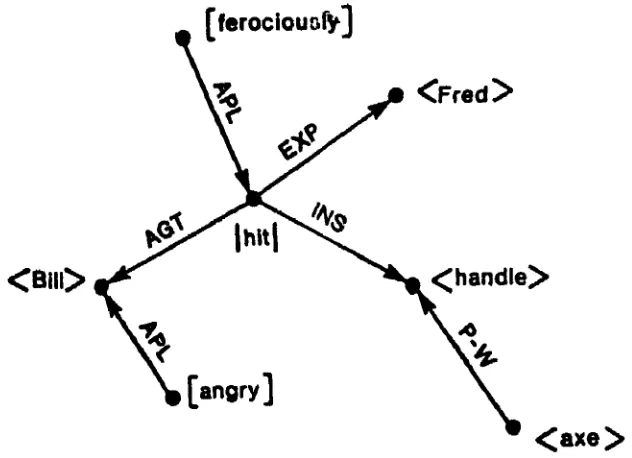
<axe>Figure
4
Syn
tagmatic
o r g a n i z a t i o n
The
set of
caserelatkbns d o e s n o t
include
l o c a t i v e
andtemporal
relations. Sentence
adverb
i a l s
(Chobsky,
1965 )are
not part of
SYntag-matic
strucrare,
butof
the
contextual
structure,
which
fs
here
represented
on
modality
nodes.
Bound adverbial8
are
part
of
syntag-
matic
structure,
e.g.,"ferociously"
above,and
are
related
to
the
event
node
by
a
relation of
application.
A
part-whole
relation
i s usedin
Figure
4
to
show
the
relation
of
"handle"
t o "axe".
This
relation
d i f f e r s
from
other
eyntagmatic
rela-
t i o n s
i nthat
i tconnects
nodes
of
t h e same
type, e m g e , twoentities.
A case
can
b e made
for
t h i s
relation
tob e
considered a
paradigmatic
relation;
for
t h e
present
i thas been
put i n with the
syntagmatic
Discursive
RelatLons
Propositions
do not
occur
in
isolation.
Theyare
t i e dtogether i n
cognition i n
a number
o f ways. Thespatial, temporal,
andcausal
connections
are characterized
by$iclcursive
ares.
I n t u i t i v e l y
t h ~ e
are
relations between whole
propositions
and
i tis
t o f a i l t ocapture
t h i s
feeling i f ,
say, a causerelation d i r e c t l y
link8
t w o eventnodes.
Modality
nodes
are
uaed t orepresent
situations in
Which
the whole
proposition
l ainvolved.
Though
schematically
linked
to
an
eventnode;
conceptually
the modality
belonse
t othe
whole
propoeition. Discursive
arca
relate
the
m o d a l i t i e s o fpropositions.
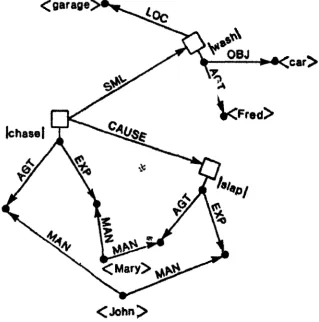
Thus
"Mary
s l a p p e dJohn
[image:18.722.205.524.449.771.2]because
he chased
her"
is
represented
asi n
Figure
5.Figure
5
Discursive
o r g a n i z a t i o n
The one
causal r e l a t i o n ,
cswe,
a d m i t sof
nofiner
distinction.
Others
(Schank,
1975a;Halllday
&Haaan,
1975)distinguish
threekinds
~fcausation:
reason,result,
and purpose.
The
s i n g l e
causer e l a t i o n of
the encyclopedia
models
thef i r s t
tw d i r e c r l y .Purpose
(or
enabling)
causationi s
seen asseparable into
c a u a etogether
wf
th a desirefor
t h e
consequent.
For example,
a
cup
mayfell
causing
i t t obreak.
The
f a l l
could beaccidental
or
i t c o u l dbe
deliberate
withthe purpose
ofbreaking
the
cup.
The
same
causal
relation e x i s t sbetween the actions
in
both
cases, but thea n a l y s i s
of
the
putposive
s i t u a t i o nw i l l
in-lve"desire".
Time
arcs
do permitsubdivision.
Aproposition
may
be
simultaneous
(SML)with
another
proposition:
"Fred
washed the
car
while
John
chased
Mary",
Figure 50 A sequenttal rn ieringof
proposi-t i o n s
isalso
found,
characterized
by
a
sequence (SEQ)
relation.
The
suggestions
made here
for
the
organization of space
are only a working
set
for which
l i t t l ejustification can be offered:
l o c a t i o n
(LOC)--a
neutral
statement
of
position,
contact--in
physical
contact,and
-*
near
far
above below left,
etc.,which
are self-explanatoryo
-# - 9 -9
-*
Figure
5
represents t h e location of "Fred washedthe car" a s
being
tt
The
Me
t a l i n g u a lRelation
-
Speech a c t s do not make u s e o n l y of forms having p h y s i c a l
r e f e r e n c e , e . g . ,
t a b l e ,
John, b l u e . A most important aspectof
language behavior i s a b s t r a c t i o n - Human social, scientific,
and i n t e l - lectual development is dependent on t h e a b i l i t y t o create and controla b s t r a c t concepts- A quick appraisal of t h i 9 paragraph reveals many
such
c o n c e p t s : language,behavior,
b o c i a l , e t c.
A system t h a ts e r i o u s l y hopes t o approach human c a p a b i l i t i e s must have a correspond-
i n g a b i l i t y .
One part of modeling abstraction 5 s representation; but what is t o b e represen tedg AbsOrsc t i o n involves knowing a s i t u a t i o n i n
which the
nbst rac t term a p p l i e s and replacing the sltu~tional d e s c r i p t i o n by t h e
abstract term. An example
is
"tragedy"-The
scene to which i ti s
19
a p p l f c a b l e
is,
say, Someone does a good a c t that:results
i n
his
death".
This
definiens i s encodedin
r i g u r e6.
"Tragedy" names aFigure 6
Metalingual
organization
The
general
propositions
of
the
definiens
are
conjoined
using amodality node linked
to
the
modalYties of the propositions
by
part-
whole
relations.
In
general
there
naybe any
number
o flevels
of
modalities
related
by
part-whole.
Tocomplete
the
association of
the
definiendum
w i t h
i t s
deftniens,
ametallngual (PEL)
arc
l i n k s the
former
t othe
appropriate
modality
in
the
l a t t e r , Figure
6 .
If
any
situation
matches
the d e f i n i e n s , then
the
abstract
term
is
appropriate.The
process
of
matching
will
bediscussed
later.
The definiendum
can
also
be
any
concept,t h e choice
is
fdiosyn-
crattc;
there
i sno reason
whyt h i s
device
cannot
be
used with
ap-
parently
non-abstract
concepts, for example, a
dogcould
be
"man'sb e s t
[image:21.716.145.514.68.329.2]animal" W n - a b s t r a c t d e f i n i t i o n s have the form "genus-specificata".
I n t h e e n c y c l a p e d i a , t h e r e p r e s e n t a t i o n i s
made
up from a node relatedby v a r i e t y t o t h e
genus
(animal),
t o whichare
a t t a c h e d t h e p r o p e r t i e si n t h e s p e c i f i c a t a (canine)
Rumelhart
and Ortony(1976)
u s ea
r e l a t i o nsimilar
tometalingual,
ISWHEN, b u t d o n o t show how p a r t i c i p a n t s
a r e
equated f nthe
definiendum and d e f i n i e n s , n o r t h e p r o c e s s e s t h a t usesuch d e f i n i t i o n s .
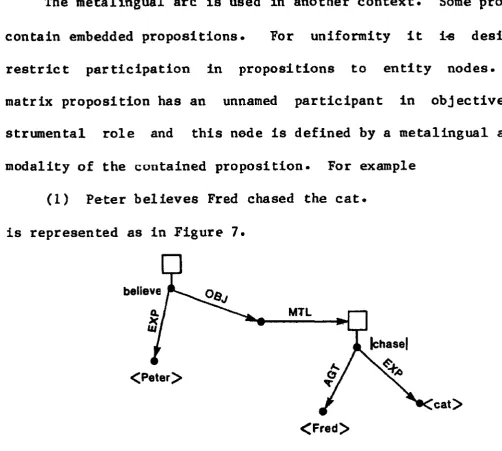
The m e t a l i n g u a l a r c
is
used i n a n o t h e r c o n t e x t * Some p r o p o s i t i o n sc o n t a i n embedded p r o p o s i t i o n s . For u n i f o r m i t y i t
ie
d e s i r a b l e t orestrict p a r t i c i p a t i o n i n p r o p o s i t i o n s t o entity nodes. Thus the
m a t r i x p r o p o s i t i o n
has
a n unnamed p a r t i c i p a n t i n o b j e c t i v eor
in-
s t r u m e n t a l role and t h i s n s d e i s d e f i n e d by a m e t a l i n g u a l arc t o the m o d a l i t y of t h e contained p r o p o s i t i o n o For example
(1) Peter b e l i e v e s
Fred
chased t h e c a t *i s r e p r e s e n t e d a s i n F i g u r e
7.
<Fred>
[image:22.716.67.570.303.754.2]. S t a t u s R e l a t i o n s
Knowledge i n an e n c y c l o p e d i a i s a model of t h e b e l i e f s o f one
p e r s o n . N e v e r t h e l e s s t h e knowledge
i s
n o ta l l
of t h e same s t a t u s .In
a d d i t i o n t o c o n t a i n i n g the p e r s o n s b e l i e f s , i t ~ n c l u d e s r e p r e s e n t c a t i o n
of b e l i e f s a b o u t h i s own d e s i r e s and of h i s b c l i e f s a b o u t t h e beliefs and d e s i r e s o f o t h e r s .
His
p e r s o n a lbeliefs
anddesires
i n t e r p r e t ,c o n t r o l , and direct h i s p e r s o n a l a c t i v i t i e s . The knpwledge about
o t h e r s 1 s t h e b a s i s
for
i n t e r a c t i n g and communicating w i t h them. For example, a c o n v e r s a t i o n w i t h achild
about the s t r u c t u r e of m a t t e r i squite d i f f e r e n t from one with a n u c l e a r p h y s i c l e t because o f d i f f e r e n t
c o n c e p t i o n s a b o u t their levels o f knowledge and hence what can b e taken
for granted. One h a s knowledge a b o u t i n d i v i d u a l s , e - g . , y o u r b r o t h e r ,
Nelson R o c k e f e l l e r , e t c
.,
and a b o u t g r o u p s , e.g., p o l i t i c i a n s , sportswr
l t e r s ,
Russlans,
e t c .A d i s t i - n c t i o n can b e made between s u b c o n s c i o u s and c o n s c i o u s
knowledge. Tbe former i s , f o r example, t h e knowledge of l a n g u a g e u n d e r l y i n g i t s u s e o r ( 2 ) .
( 2 ) The Sun C i r c l e s t h e Farth.
Conscious knowledge is l e a r n t o r communicated knowledge, e .g
-,
what one h a s been t a u g h t a b o u t t h e s o l a r system. hereis
no r e a s o n f o r the twokrnds of knowledge t o b e i n a c c o r d r e g a r d i n g t h e same e n t i t i e s
.
OneSubconscious b e l i e f s of
self
are unmarked i n t h e e n c y c l o p e d i a .Subconscious
beliefs
of a n o t h e rare
i n d i c a t e d by abelieve
arc betweena
node r e p r e s e n t i n g t h ebeliever
and a m o d a l i t y node a o v e r i n g t h enetwork
r e p r e s e n t a i o n ofthe
c o n t e n t o fthe
b e l i e f s .The
subconscious [image:24.716.94.606.83.483.2]belief
of ( 2 ) by "people"is
g i v e n i n F i g u r e 8.Figure 8 Knowledge s t a t u s
Conscious b e l i e f s are represented
as propositionsembedded
within
an
event "beLieve". Anexample
i s
g i v e n i n ( 1 ) w i t h i t s r e p r e s e n t a t i o ni n Figure 7.
It is
not
o n l ypropositions
t h a t have b e l i e f s t a t u s , but a l s os i m p l e c o n c e p t s ,
e
.g.,
ghosts.
To accomodate t h i s i n f o r m a t i o n ,the
placing of m o d a l i t y nodes i s g e n e r a l i z e d . P r e v i o u s l y only proposf t i o n swere
a s s o c i a t e d w i t h m o d a l i t i e s ; now any node can have i t s ownmodality. On this m o d a l i t y i n f o r m a t i o n about a c o n c e p t ' s e x i s t e n c e and
I t i s u n l i k e l y t h a t e a c h node o r p r o p o s i t i o n is immediately linked t o i t s b e l i e v e r .
Using
part-whole r e l a t i o n s and m o d a l i t y nodes,domains o b b e l i e f , which may i n t e r s e c t , c a n b e c r e a t e d a s i n F i g u r e 8
f o r "Hugo"
.
Hendrix (1 975) p a r t i t i o n s s e m a n t i c networks t o d e l i m i t domains of
b e l i e f ; here t h e same e f f e c t
i s
g a i n e d t h r o u g h the u s e o f m o d a l i t ys t r u c t u r e s .
The
desires
o f p e o p l e a r e s i t u a t i o n s t h a t t h e y would l l k e t oe x i s t . The c o n t e n t of t h e s e g o a l s c a n b e r e p r e s e n t e d by a m o d a l i t y
covering (complexes o f ) p r o p o s i t i o n s o r single c o n c e p t s , e - g . , peace- I f t h e goals a r e s u b c o n s c i o u s , a d e s i r e r e l a t i o n l i n k s t h e d e s i r e r t o
t h e modal t y . F o r consczous s t a t e s , t h e m o d a l i t y i s p a r t o f a
m e t a l i a g u a l l y d e f i n e d o b j e c t v e o f a n e v e n t "desire". In modeling
b e h a v i o r , t h e s e g o a l s p r o v i d e t h e s i t u a t i o n s t h a t o t h e r b e h a v i o t a l
a c t i o n s a r e i n t e n d e d t o c o n t r i b u t e towards achieving
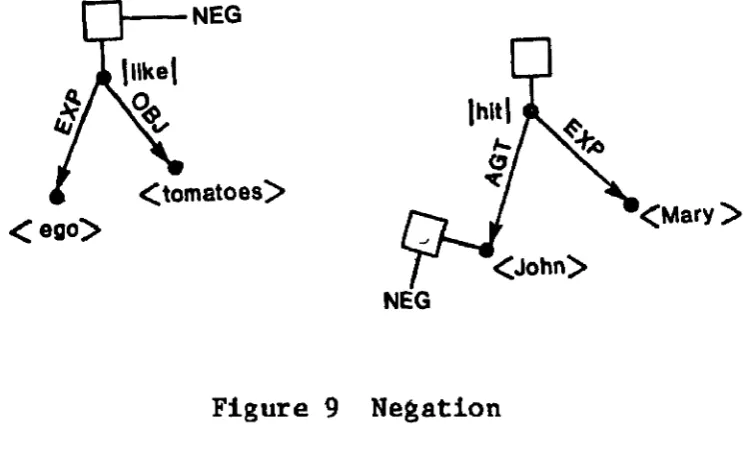
Negation
Negation
is
a
p r o p e r t y t h a t i s marked on 4 m o d a l i t y . The most common s i t e for n e g a t i v e marking i s a p r o p o s : i t i o n a l m o d a l i t y - Thus\like
1
[image:26.716.173.551.72.304.2](tomatoes)
Figure
9
Negation
When
someother
constituent
o fa sentence
i snegated,
sayusing strong
stress,
t h i s
i smarked on
a
correspondingmodality,
so "John d i dnot
hit Mary"
i sencoded
as i n Figure
9.
It
i snot
anticipated,
thatnegation
is
a
common
feature
i n know-
ledge,
f o r "Aperson sometimes
learns a negative f a c t when i tcon-
t'radicts
something
that
might
b einferred by mistake
o rthat i s true
f o r a similar
c o n c e p tBut,
mostnegative f a c t s
are
never
learned''
( C o l l i n s
&Q u i l l i a n ,
1972,
p.
319).
Inheritance
A
node
w i l l i n h e r i t propertiesfrom
nodes
h i g h e rin
i t s paxadig-matic
p a t h *Quillian
(1969)
used
s u p e r s e tr e l a t i o n s f o r
the
samep u r p o s e .
In
Figure
2, Bi n h e r i t s the
properties of A, Cthose
ofB,
Dr e p r e s e n t a t i o n o f p r o p e r t i e s : A p r o p e r t y need
only
a p p e a r a t t h e a n c e s t o rof
concepts
having t h e p r o p e r t y . I n h e r i t a n c eis
i n h i b i t e do n l y i f t h e i n h e r i t a b l e p r o p e r t y
i s
c o n t r a d i c t e d on a lowernode.
Forexample,
although
the p r o p e r t y"fly"
may b e associated w i t h "bird", i tis
prevented from being i n h e r i t e d by "penguin" by having e x p l i c i t l y"penguin n o t f l y " .
The
g e n e r a l i t y of i n h e r i t a n c edepends
on t h e form of r e p r e s e n t a -t i o n o f t h e p r o p e r t y a t t h e a n c e s t o r node. P r o p e r t i e s t h a t
a r e
univer-s a l l y t r u e
a t a l l
t i m e s , e.g., b i r d s havewings, are
a t t a c h e d d i r e c t l yt o a v a r i e t a l node and a r e o b l i g a t o r i l y t r u e o f a l l d e s c e n d e n t s . If a t
any t i m e a b i r d w i t h o u t wings
were
r e p o r t e d , i t would b e c a u s e forf u r t h e r e x p l a n a t i o n .
Some
o t h e r p r o p e r t i e sare
always t r u e b u t o n l ya t
i n t e r m i t t e n t times, e.g., p e o p l e e a t , whose r e p r e s e n t a t i o n i n v o l v e s t h e m a n i f e s t a t i o n r e l a t i o n . It i s n o t odd that a person can b e seen n o t
e a t i n g , but i f you
watched
long enough, i t would b e f u l l y expected t oobeerve t h i s b e h a v i o r sometime F i n a l l y t h e r e a r e o c c a s i o n a l proper-
t i e s that
make use
of t h e t y p i c a l arci n
their
r e p r e s e n t a t i o n . Theseproper t i e s
a r e
not
u n i v e r s a l , being merely noteworthy r e c o l l e c t i o n sabout a c o n c e p t , e.g., The French a r e rude. It would w e l l be p o s s i b l e t o have a complete h i s t o r y of an example of the concept and n o t w i t n e s s
E p i s o d i c andL Sys ternic Memory
T u l v i n g ( I 972 ) d i s t i n g u i s l l e s e p i s o d i c from s e m a n t i c memory.
The
former " r e c e i v e s and s t o r e s i n f o r m a t i o n a b o h t t e m p o r a l l y d a t e d episodes
o r e v e n t s , and t e m p o r a l - s p a t i a l r e l a t i o n s between events" ( p . 385).
T H ~
' l a t t e r i sknowledge a p e r s o n posse s s e s a b o u t words and o t h e r v e r b a l symbols, t l ~ e a r meaning and r e f e r e n t s , a b o u t r e l a t i o n s among them, and about r u l e s , f o r m u l a s , and a l g o r i t h m s f o r t h e m a n i p u l a t i o n of these s y m b o l s , c o n c e p t s
,
and r e l a t i o n s . Sqhan t i c memory d o e s notr e g i s t e r p e r c e p t i b l e p r o p e r t i e s of ~ n p u t s , but r a t h e r c o g n i t l v e r e f e r e f i t s of i n p b t s i g n a l s . ( p . 386)
Abelson (1975 ) d i s t i n g u i s h e s e p i s o d i c from p r o p o s i t i o n a l memory, a n d Woods ( 1 9 7 5 ) c o n t r a s t s i n t e n s i o n s w i t h e x t e n s i o n s a l o n g similar l m e s .
The term I p r e f e r , f o l l o w i n g Hays ( 1 9 7 8 ) , i s s y s t e m i c r a t h e r than
s e m a n t i c , p r o p o s i t i o n a l
,
o r i n t e n s i o n a lT h e l o c a l i z a t i o n i n space and t i m e o f knowledge i s r e p r e s e n t e d . i n
t h e e n c y c l o p e d i a b y s p a t i a l and temporal o r g a n i z a t i o n o f p r o p o s i t i o n s
using t h e a p p r o p r i a t e d & s c u r s i v e r e l a t i o n s . A p r o p e r s u b p a r t of
e p i s o d i c memory i s c o n t a i n e d i n p a r a d i g m a t i c o r g a n i z a t i o n . Nanifesta-
t i o n s of i n s t a n c e s (remember t h e r e a r e a l s o m a n i f e s t a t i o n s of varietal
and t y p i c a l n o d e s , s o i t must b e thus s t a t e d ) r e p r e s e n t s p a t i o -
Q e m p o r a l l y l o c a l i z e d i n f o n n a t i o n a b o u t members of c a t e g o r i e s Conse-
q u e n t l y ' knowledge r e p r e s e n t e d on m a n i f e s t a t i o n s of i n s t a n c e s , o r t h e i r
m a n i f e s t a t i o n s , i s i n e p i s o d i c memory. This i s o n l y p a r t of episodic
memory a s c a t e g o r i c a l knowledge can a l s o b e p r e s e n t . For example, i n
notion of dreams, n o t t o any s p e c i f i c ones.
Nor
i s i t s u f f i c i e n t fora
p r o p o s i t i o n t o have a non-categorical p a r t i c i p a n t t o b e m
episodic
memory f o r "Prior t o the Revolution. Russf an peasants were feudal
s e r f s " c n o t d i n s catpgorical g a r t i c i pants, y e t i s e p i s o ~ i c s
The
totalextent of e p i s o d i c memory i s y l t i m a t e l y d e c i d e d through s p a t i a l and temporal relatiion o f d i s c u r s i v e o r g a n i z a t i ~ n , not b y paradigmatic
structure.
Ouan tif i c a t i o n
para dig ma ti.^
arcs
have
the
c a p a b i l i t y o f capturing theessence
of
q u a n t i f i c a t i o n , .including scope To i l l u s t r a t e the
facility,
cons:ider( 3 ) and
( 4 )
whlchare
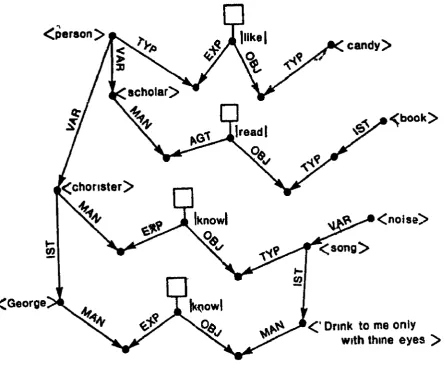
equivalettt t o t h e Iormulae ( 5 ) and ( 6 ) Figure 10 encodes( 3 )
and ( 4 ) .( 3 ) There i s
a
book
t h a t :js read by every scholar,( 4 ) Every c h o r l g t e r knows a song.
Figure 10
Quantification
Xf
for
agiven
c . o r i s t e r
in
( 4 )it
i snecessary
t o determine the songhe
knows,i
b e . , t o evaluatethe
Skolemf u n c t i o n ,
t h e informationis
present
a s apredication
of thatindividual and
should be retrieved
using
his name,
say "George"
andr rink
t ome
only
w i t h
t h i n e eyes" - i nFigure
10.It
i sa l s o
p o s s i b l e t o g i v e d i s t i n o t representation t o unquan- t l f i e dstatements,
such
as ( 7 ) , a s in Figure 10.(7)
A person
l i k e s
candy.
Paradigmatic arcs are
here
achieving reoresentational powerequiv-
a l e n t t o the p a r t i t i o n i n g of networks
by
Hendrix ( 1 9 7 5 ) -The
abovei s
a s y s t e m i c r e n d i t i o n o f" a l l " .
The
q u a n t i f i c a t i o ncan also b e c h a r a c t e r i z e d episodically by every m a n i f e s t a t < o n of a
concept h a v i n g t h e p r o p e r t y . I n t e r p r e t i n g
"all"
(Woods, 1 9 7 5 ) , could c a l l upon e i t h e r s y s t e m i c o r e p i s o d i c f a c t s * A q u e s t i o n containinga
u n i v e r s a l q u a n t i f i e r may b e answered by e i t h e r e x a m i n i n g a v a r i e t a l
n o d e (Are a l l moil-boxes blue?), or b y = examining e v e r y m h i f e s t a t i o n
(Do a11 m a i l - b o ~ e s stand a t street corners?).
It should b e n o t e d t h a t
"all"
r e q u i r e s t h a t the p r e d i c a c r o n betrue only
a tsome
time,
e.g., A l l p e o p l e d i e ; i t d o e s n o t r e q u i r ec o n t i n u i t y i n time, e .g., A l l b i r d s have wings. Thus u n t i v e r s a l quan-
t i f i c a t i o n
i s
a l s otrue
i f t h e p r e d i c a t i o ni s
found for a m a n f f e s t a t i o no f t h e v a r i e t a l node,
os
i sfound
forevery
i n s t a n c e of t h e concept.P r o c e s s e s
--
i n
t h eNetwork
The model
for
knowledge described above is only p a r t o f a systemt o model c o g n i t i v e behavior. Thought i s simulated by processing know-
l e d g e . Different a s p e c t s o f behavior c o r r e s p o n d t o d i f f e r e n t proces-
ses,
but with o n e and the same e n c y c l o p e d i a common t o a l l . A s y s t e mfor
d i s c o u r s e analysis r e q u i r e s processes t h a t u s e t h e e n c y c l o p e d i a t of i n d patterns of o r g a n i z a t i o n i n a d i s c o u r s e . I t would b e p o s s i b l e to describe solely the requirements of d i s c o u r s e analysis, but g r e a t e r o v e r a l l insight i s g a r n e d through a p r e l i m i n a r y g e n e r a l e x a m i n a t i o n and
d i s c o u r s e
a n a l y 4 s
i sseen
nott o
bea
unique process but a s composed of more b a s i c general ones. S i m u l a t i o nof
many asp'ec ts o f c o g n i t i v e b e h a v i o r c a n h e porfomed by complexes o f t h e s e g e n e r a l processes: d i s c o u r s e a n a l y s i si s
justan6
s u c hcomplex
Processes can b e c l a s s i f i e d
i n
v a r i o u s ways: f u n c t i o n a l l y , b y c o m p l e x i t y , o r b y the c l a s s of relation i n v o l v e d .The f t l n c t i o n of some p r o c e s s e s i s e x t e r n a l ; t h e y d e a l w i t h i n p u t and o u t p u t . Some internal processes f i n d r e l a t i o n s between new i n f o r -
mation and
knowledge
already i n t h e e n c y c l o p p d i a , o t h e r s i n v e s t i g a t et h e v a 1 i d i . t ~ of new knowledge, e t c .
P r o c e s s e s a r e of two type oE complexity, e i t h e r p a t h - t r a c i n i
or
p
a
t
t
e
r
n
-
*
.
The
dichdtomy i s j u s t i f i e d by showing t h a t there a r etasks that can o n l y b e done b y p a t t e r n - m a t c h i n g * This t o p i c i.s con-
sidered in d e t a i l l a t e r .
Of the
infinite
numberof
possible ordered s e t s of a r c s , o n l y somed e f i n e s i g n i f i c a n t p a t h s in the network. An example of a r e l e v a n t s e t
of
arcs
i s t h e arcs of a paradigmatic p a t h ; t h i s defines possiblei n h e r i t a n c e s . Other s i g n i f i c a n t s e t s
a r e
c a u s a l c h a i n s , whi-ch a r er e p r e s e n t e d b y a s t r i n g of c a u s e arcs between modalities. T h ~ s sugg-
e s t s t h a t p r o c e s s e s t h a t u s e tile same
kind
of r e l a t i , o n s o r i d e n t i c a l r e l a t i o n s a r e s i g n i f i c a n t .A f u n c t r o n a l c l a s s i f i c a t i o n o f processes d o e s n q t g i v e a deeper