846
©IJRASET: All Rights are Reserved
Survey Paper on Big Data based Isolation Security
by Smartcard Authentication System
Mrs. S. Panimalar1, A. Roshhini Devi2, A. Saranya3, D. Usha4
1
Assistant Professor, 2, 3, 4Student, Department of CSE, Panimalar Institute of Technology, Chennai, India
Abstract: Big data provides users with a good deal of flexibility and convenience. However, massive information conjointly brings terribly serious security issues, particularly for enterprise information security kept within the big data. Once the information is outsourced to a third party, the information privacy has become a significant drawback, like user authentication, the integrity of data. With the addition of security measures to Big Data, strong encounter against cybercrime can be achieved [1]. A mutual authentication scheme based on the virtual smart card using hashing function for large information is proposed to resolve the matter of unlawful user’s access to the big data servers and also the illegal user’s access to the legal cloud servers. This paper conjointly maintains user sensitive information within the big data by using file swapping technique. Once the user accessed the information, the user information will be swapped to completely different servers so that the file can be secured and nobody can hack or theft our information.
Keywords: Data integrity, virtual smart card, illegal cloud server, files swapping.
I. INTRODUCTION
Security analytics applies analytics on varied logs that are obtained at completely different points inside the network to determine attack presence. By investing the massive amounts of logs generated by varied security systems (e.g., Intrusion Detection Systems (IDS), Security in Event Management (SIEM), etc.), applying big data analytics will find attacks that don't seem to be discovered through signature- based or rule-based detection ways[2]. While security analytics removes the requirement for the signature database by using event correlation to find antecedent undiscovered attacks, this can be often not administered in a period and current implementations are non-scalable. So to avoid the misusage of data sets, a classification system is provided [3]. Big data virtualization could be a method that focuses on making virtual structures for large data systems. Enterprises and different parties will enjoy big data virtualization. As a result, it will permit them to use all the information assets they collect to attain varied goals and objectives. Within the IT business, there is a decision for large information virtualization tools to assist handle big data analytics. The business world has developed a complicated set of big data analytics tools, however not all of them support the principle of big data virtualization. Some claim that corporations are slow to tackle big data virtualization. As a result, its implementation is taken into account as a tedious task. However, this might change as service suppliers still craft merchandise and services that corporations need, and skilled IT professionals observe the most effective ways to form changes between however a system is physically founded, and the way it is used through overall software system design.
II. LITREATURE SURVEY
A. T. Mahmood, IEEE and U. Afzal, IEEE
847
©IJRASET: All Rights are Reserved
B. T. F. Yen, ACM, A. Oprea, ACM, K. Onarlioglu, ACM, T. Leetham, ACM, W. Robertson, ACM, A. Juels, ACM and E. Kirda, ACM
As more and more Internet-based attacks arise, organizations are responding by deploying an assortment of security products that generate situational intelligence in the form of logs. These logs often contain high volumes of interesting and useful information about activities in the network, and are among the first data sources that information security specialists consult when they suspect that an attack has taken place. A novel system, Beehive that attacks the problem of automatically mining and extracting knowledge from the dirty log data produced by a wide variety of security products in a large enterprise is presented [2]. Signature based approaches for detecting security incidents and instead identify suspicious host behaviors that Beehive reports as potential security incidents is improved. These incidents can then be further analyzed by incident response teams to determine whether a policy violation or attack has occurred.
C. X. Wang, Y. Yang and Y. Zeng
Android has attracted the eye of malware authors and investigators alike. The amount of types of Android malware is increasing quickly in spite of the considerable range of projected malware analysis systems. By taking benefits of low the false-positive rate of misuse detection and also the ability of anomaly detection to detect zero-day malware, proposal is made on a novel hybrid detection system based on a brand new open source framework [3] . The planned system mainly consists of two parts: anomaly detection engine performing art abnormal apps detection through dynamic analysis; signature detection engine performing art celebrated malware detection and classification with a mix of static and dynamic analysis. Experiments show that the anomaly detection engine with the dynamic analysis is capable of detection zero-day malware with an occasional false negative rate (1.16 %) and acceptable false positive rate (1.30 %) its price noting that our signature detection engine with a hybrid analysis will accurately classify malware samples with a median positive rate 98.94 %. Considering the intensive computing resources needed by the static and dynamic analysis, our projected detection system ought to be deployed off-device, such as within the Cloud. The app store markets and also the normal users will access the detection system for malware detection through cloud service.
D. R. Kschischang, B. J. Frey and H.-A. Loeliger
Algorithms that have to contend with the sophisticated world functions of the many variables typically exploit the way within which the given functions issue as a product of “local” functions, each of which depends on a set of variables. Such a resolving can be envisioned with a bipartite graph called an element graph. A generic message-passing algorithmic program, the product algorithmic program that operates in a very issue graph is presented. Easy procedure rule, the sum-product the algorithm computes either specifically or approximately various marginal performs derived from the world function. A wide variety of algorithms developed in computer science, a signal processor and digital communications are often derived as specific instances of the sum-product algorithmic .Forward/backward algorithmic program, the Viterbi algorithmic program, Pearl’s belief propagation algorithmic program for Bayesian networks, the Kalman filter, and sure quick Fourier transform (FFT) algorithms[4] are followed.
Factor graphs offer a natural graphical description of the factorization of a worldwide function into a product of local functions. Factor graphs are applied in a very wide range of application areas, as we have illustrated with an outsized variety of examples. A major aim is to demonstrate that one algorithm, the sum-product algorithm based on solely easy process rule will comprehend associate enormous style of sensible algorithms. The forward/backward rule, the Viterbi an algorithm, Pearl’s belief propagation rule, the reiterative turbo decryption rule, the Kalman filter, and even bound FFT algorithms was seen. Numerous extensions of those algorithms for example, a Kalman filter operational on a tree-structured system although not treated here, is derived in a very easy the manner by applying the principles enunciated during this paper.
E. Z. Durumeric, ACM, J. Kasten, ACM, D. Adrian, ACM, J. A. Halderman, ACM, M. Bailey, ACM, F. Li, ACM, N. Weaver, ACM, J. Amann, ACM, J. Beekman, ACM and M. Payer, ACM
848
©IJRASET: All Rights are Reserved
hundredth increase in fixing by notified hosts. Drawing upon these analyses, Discussion is made on what went well and what went poorly, in a shot to know how the technical community will respond to a lot of effects to such events within the future. Analysis is made on varied aspects of the recent OpenSSL Heartbleed vulnerability, together with World Health Organization was at the start vulnerable, reparation behavior, and impact on the certificate authority ecosystem. Vulnerability was widespread, and estimated that between 24–55% of HTTPS-enabled servers within the Alexa high one Million were at the start vulnerable, together with forty-four of the Alexa high a hundred. Sites patched heavily within the initial time period . It is discoverd that solely 100 percent of vulnerable sites replaced their certificates compared to seventy-three that patch, and 14% of sites doing, therefore, used a similar personal key, providing no protection. Investigation is made on the attack landscape, finding no proof of large-scale attacks before the general public revealing, however vulnerability scans began at intervals twenty-two hours. It is discovered that post- disclosure attackers using several distinct styles of attacks from 692 sources, many coming from Amazon EC2. Analyses is drawn upon to border what went well and what went poorly in our community’s response, providing view.
F. A.Fattori, A.Lanzi, D. Balzarotti, and E. Kirda
A discussion is made to look and perform implementation of AccessMiner, a system-centric behavioral malware detector.This system is intended to model the overall interactions between benign programs and therefore the underlying software system. AccessMiner is in a position to capture which, and how, OS resources are employed by traditional applications and find abnormal behavior in a period of time. The advantage of this approach is that it doesn't need to be trained on malicious samples, and so its ready to give a general detection answer that may be accustomed protect against each illustrious and unknown malware. To create the system a lot of resilient against meddling from subtle attackers, AccessMiner is enforced as a custom hypervisor that sits below the software system. The technical solutions to optimize the performances and scale back the impact of the system was adopted. These experiments show that in exceedingly stable surroundings AccessMiner will give a high level of protection (around ninetieth detection rate with zero false positives) with an appropriate overhead just like the one that may be knowledgeable in an exceeding state of the art virtual machine environment.
An approach is made to present AccessMiner, a system- centric approach to model the activities of benign programs and use these models to observe the presence of malicious applications. A discussion is made on the overall formula and therefore the implementation of the AccessMiner detector as a custom system hypervisor[6]. A discussion is made on the accuracy of the approach and therefore the overhead introduced by our hypervisor. The results of this experiments show that the system can be deployed during a real setting, with solely a restricted impact on the performance of the system.
G. M. Watson, A. Marnerides, A. Mauthe and D. Hutchison
Cloud services are outstanding among the non-public, public and industrial domains. Many of those services are expected to be always on and have a crucial nature. So, security and resilience are more and more necessary aspects. So as to stay resilient, a cloud has to possess the flexibility to react not solely to better-known threats, however conjointly to new challenges that concentrate on cloud infrastructures.
An idea to introduce and discuss a web cloud anomaly detection approach, comprising dedicated detection parts of our cloud resilience design. An intention to exhibit the relevancy of novelty detection below the one-class Support Vector Machine (SVM) formulation at the hypervisor level, through the use of options, gathered at the system and network levels of a cloud node [7].
A demonstratiol theme will reach a high detection accuracy of over ninetieth while detective work numerous varieties of malware and DoS attacks. This paper shows that the approach to detection using dedicated observation parts per VM is especially applicable to cloud situations and ends up in a versatile detection system capable of detective work new malware strains with no previous data of their practicality or their underlying directions.
An introduction to internet anomaly detection a method that can be applied at the hypervisor level of the cloud infrastructure. These exist as sub modules of the architecture’s Cloud Resilience Managers (CRM), which perform detection at the end-system and within the network severally.
849
©IJRASET: All Rights are Reserved
H. D. Kirat, G. Vigna and C. Kruegel
Dynamic analysis is an efficient approach for analyzing and detective work malware that uses advanced packing and obfuscation techniques. But evasive malware will fingerprint such analysis systems, and, as a result, stop the execution of any malicious activities. Most of the fingerprinting techniques exploit the very fact that dynamic analysis systems are supported by virtualized or emulated environments, which may be detected by many known methods. The final word of thanks to such detection is to analyze malware during a bare-metal atmosphere [8]. This approach has conferred BareCloud, a system for automatically detective work evasive malware by using stratified similarity-based behavioral profile comparison. The profiles are collected by running a malware sample in bare-metal, virtualized, emulated, and hypervisor-based analysis environments. Future work will concentrate on raising the transparency of the bare- metal analysis element and on developing an iSCSI module that may extract high-level, intermediate file system operation, providing a richer file system-level event trace.
The volume and also the sophistication of malware are ceaselessly increasing and evolving. Automatic dynamic malware analysis may be a widely-adopted approach for detective work malicious software package. But several recent malware samples attempt to evade detection by distinguishing the presence of the analysis at atmosphere and refraining from acting malicious actions. Thanks to the sophistication of the techniques employed by the malware authors, so far the analysis and detection of evasive malware has been mostly a manual method. One approach to automatic detection of those evasive malware samples is to execute an equivalent sample in multiple analysis environments, and then compare its behaviors, within the assumption that a deviation within the behavior is proof of an endeavor to evade one or a lot of analysis systems. For this reason, it is important to supply an organization (often known as bare-metal) during which the malware is analyzed while not the use of any detectable element.
I. I. Kiss, IEEE, B. Genge, IEEE, P. Haller, IEEE and G. Sebestyen, IEEE
Modern Networked critical Infrastructures (NCI), are exposed to intelligent cyber attacks targeting the stable operation of those systems. In order to confirm anomaly awareness, the discovered information will be used in accordance with data processing techniques to develop Intrusion Detection Systems (IDS) or Anomaly Detection Systems (ADS). There is a rise within the volume of sensing element information generated by each cyber and physical sensors, therefore there is a desire to apply massive information technologies for a period of time analysis of huge information sets[9]. A proposal is made on a clustering-based approach. Various clustering techniques are explored to settle on the foremost appropriate for clustering the time-series information options, so classifying the states and potential cyber attacks on the physical system. The Hadoop implementation of the MapReduce paradigm is employed to produce a suitable process setting for big datasets. A case study on Associate in Nursing NCI consisting of multiple gas mechanical device stations is presented.
The conferred case study and the results demonstrate that by means of information mining, particularly agglomeration, the cyber attacks targeting physical systems are often expeditiously known. The projected approach needs the planning engineer in understanding the processes of the cyber- physical system. The clear advantage of this approach is that it effectively hardens the overall security of the installation, since identical demand applies to the assailant likewise. Therefore, an aggressor first has to get access to the cyber system and it must stay stealthy for a definite amount of your time so as to find out the specific characteristics of the physical method. This means that the aggressor can have full access to any or all method data and so to perform a whole compromise of the installation. Though not impossible, in such extreme scenarios an aggressor would possibly impersonate all sensors in order to avoid detection that adds another layer of complexity to the attack . Therefore, in such eventualities the probabilities of made attacks become extremely unlikely.
J. J. Dean, ACM and S. Ghemawat, ACM
MapReduce is an associated implementation for process and generating massive datasets that is amenable to a broad style of real-world tasks. Users specify the underlying runtime system mechanically parallelizes the computation across large-scale clusters of machines handle machine failures and schedules inter-machine communication to create economically use of the network and disks. Programmers realize the system easy to use: over ten thousand distinct MapReduce programs are enforced internally at Google over the past four years and a median of one hundred thousand MapReduce jobs are dead on Google’s clusters each day, process a complete of over twenty pet bytes of information per day[10].
850
©IJRASET: All Rights are Reserved
with parallel and distributed systems, since it hides the main points of parallelization, fault tolerance, section improvement, and load equalization. Second, an oversized style of issues is simply describable as MapReduce computations. As an example, MapReduce is employed for the generation of data for Google’s production internet search service, for sorting, data processing, machine learning, and lots of different systems. Third, we have developed an implementation of MapReduce that scales to giant clusters of machines comprising thousands of machines. The implementation makes efficient use of those machine resources and so is appropriate to be used on several of the big procedure issues encountered at Google. By limiting the programming model, we have created it simply to place and distribute computations and to form such computations fault tolerant. Second, network bandwidth could be a scarce resource. A number of optimizations in the system are thus targeted at reducing the amount of information sent across the network: the neighborhood improvement allows North American country to scan knowledge from native disks, and writing one copy of the intermediate knowledge to native disk saves network information measure. Third, redundant execution may be accustomed cut back the impact of slow machines, and to handle machine failures and information loss.
K. J. Friedman, T. Hastie and R. Tibshirani
Quick algorithms for estimation of generalized linear models with biconvex penalties was developed. The models embrace statistical regression, two-class logistical regression, and multinomial regression issues whereas the penalties include l1 (the lasso), l2 (ridge regression) and mixtures of the two (the elastic net). The algorithms use circular coordinate descent, computed on a regularization path. The strategies will handle massive issues and may also deal expeditiously with distributed options [11]. In comparative timings, a tendency that the new algorithms are significantly quicker than competitor strategies was taken.
L. J. Oberheide, E. Cooke and F. Jahanian
Antivirus software is one among the foremost wide used tools for detective work and stopping malicious and unwanted files. However, the future effectiveness of ancient host-based antivirus is questionable. Antivirus software fails to notice several trendy threats and its increasing complexness has resulted in vulnerabilities that area unit being exploited by malware. This paper advocates a brand new model for malware detection on finish hosts based on providing antivirus as associate degree in-cloud network service. This model allows identification of malicious and unwanted code by multiple, heterogeneous detection engines by the term called ‘N-version protection’[12]. This approach provides many necessary edges as well as better detection of malicious code, increased forensics capabilities, retrospective detection, and improved deploy ability and management. To explore this idea , construction and deployment of a production quality in- cloud antivirus system referred to as CloudAV is implemented. CloudAV includes a lightweight, cross-platform host agent and a network service with ten antivirus engines and two activity detection engines. This approach evaluates the performance, measurability, and effectiveness of the system using information from a real-world deployment lasting quite six months and a information of 7220 malware samples covering a one year amount. Using this dataset a discovery is made that CloudAV provides thirty fifth better detection coverage against recent threats compared to one antivirus engine and a ninety eight detection rate across the total dataset. This shows that the typical length of time to notice new threats by an antivirus engine is forty eight days which retrospective detection will greatly minimize the impact of this delay. Finally, this relates two case studies demonstrating however the forensics capabilities of CloudAV were utilized by operators throughout the preparation.
To address the ever-growing sophistication and threat of modern malicious computer code, this approach have planned a brand new model for antivirus preparation by providing antivirus functionality as a network service using N-version protection. This novel paradigm provides important benefits over ancient host-based antivirus as well as better detection of malicious computer code increased forensics capabilities, retrospective detection, and improved deploy ability and management. Employing a production implementation and real-world preparation of the platform, this paper evaluated the effectiveness of the planned architecture and demonstrated how it provides considerably greater protection of finish hosts against fashionable threats.
851
©IJRASET: All Rights are Reserved
III. PROPOSED WORK
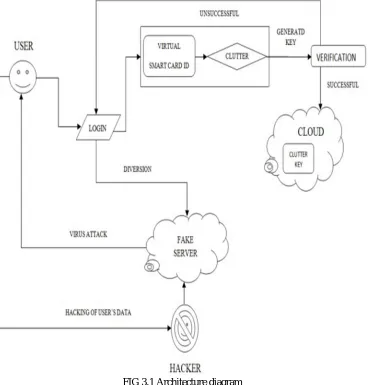
[image:6.612.124.494.208.593.2]This paper proposes a better level of security with the standard technique. Therefore the hackers (or) a third party cannot access our data (or) information from cloud storage. Here Virtual smart card id generation with clutter technique for authentication purposes is employed. It additionally provides security for duplication of storage created by a hacker to grasp our entire details. Using of virtual smart card id generation is a better authentication system then the prevailing ones. Secure Hash Algorithm (SHA-256) is employed. The swapping file system is additionally enclosed in our proposed system to keep up the security level of our storage. Smart cards are safer than their counterparts as they use encryption and authentication technology. This can be safer than previous methods. In the proposed system, the hacker or third party can’t overcome the current authentication technique. The file-swapping could be a safer feature to prevent our file from others or viruses.
FIG 3.1 Architecture diagram
On successful verification, access to cloud is given through clutter key. Diversion from successful verification leads to access of false server. Generated key is obtained from smart card id and clutter key.
IV. CONCLUSION
852
©IJRASET: All Rights are Reserved
REFERENCES
[1] T.Mahmood and U.Afzal, “Security analytics: big data analytics for cybersecurity: a review of trends, techniques and tools,”in Information assurance (ncia), 2013 2nd national conference on.Rawalpindi, Pakistan: IEEE,
[2] 2013, pp. 129–134.
[3] T.F.Yen, A.Oprea, K.Onarlioglu, T. Leetham, W. Robertson,A. Juels, and E. Kirda, “Beehive:Large-scale log analysis for detecting suspicious activity in enterprise networks,” in Proceedings of the 29th Annual Computer Security Applications Conference. New Orleans, Lousiana, USA: ACM, 2013, pp. 199–208.
[4] X.Wang, Y.Yang, Y.Zeng, “Accurate mobile malware detection and classification in the cloud,” SpringerPlus, vol. 4, no. 1, pp.1–23, 2015.
[5] F.R.Kschischang, B.J.Frey, and H.-A. Loeliger, “Factor graphs and the sum-product algorithm,” Information Theory, IEEE Transactions on, vol. 47, no. 2, pp. 498–519,
[6] 2001.
[7] Z Durumeric, J.Kasten, D.Adrian, J.A. Halderman, M.Bailey, F.Li, N.Weaver, J.Amann, J.Beekman, M.Payer et al., “The matter of heartbleed,” in Proceedings of the 2014 Conference on Internet Measurement Conference. Vancouver, BC, Canada: ACM, 2014, pp. 475–488.
[8] A.Fattori, A.Lanzi, D.Balzarotti, and E. Kirda, “Hypervisor based malware protection with accessminer,” Computers & Security,vol. 52, pp. 33– 50,2015.
[9] M.Watson, A.Marnerides, A. Mauthe, D. Hutchison et al., “Malware detection in cloud computing infrastructures,” IEEE Transactions on Dependable and Secure Computing, pp. 192 –205, 2015.
[10] D.Kirat, G.Vigna, and C.Kruegel, “Barecloud: bare-metal analysis-based evasive malware detection,” in 23rd USENIX Security Symposium (USENIX Security 14), San Diego, California, USA, 2014, pp. 287–301.
[11] I.Kiss, B.Genge, P.Haller, and G. Sebestyen,“Data clustering based anomaly detection in industrial control systems,” in Intelligent Computer Communication and Processing (ICCP), 2014 IEEE International Conference on. Cluj-Napoca, Romania: IEEE, 2014, pp. 275–281.
[12] J.Dean and S.Ghemawat, “Mapreduce: simplified data processing on large clusters,” Communications of the ACM, vol. 51, no. 1, pp.107–113, 2008. [13] J.Friedman, T.Hastie, and R.Tibshirani, “Regularization paths for generalized linear models via coordinate descent,” Journal of statistical software,
vol. 33, no. 1, p. 1, 2010.