Abstract—Between 2002 and 2012 the costs of Italian Healthcare Service grew from about 50 billion Euros to over 110 billion, getting no longer sustainable for the Government. Facing specific requests, coming from the Management of some local Hospitals, authors started several research activities focused to improve the efficiency of healthcare internal processes. The case of the sterilization process of surgical tools, topic of this paper, is an emblematic example of the authors’ approach to such kind of problems.
At first, using two Discrete Event Simulation models, a clear picture of process inefficiencies was defined. Then, a costs optimization was achieved by means of a process reengineering. At the end, supposing to share the considered sterilization plant with other healthcare partners, a new strategy to manage the plant was evaluated.
The resulting cost reduction is estimated around a million Euros/year.
Index Terms—Discrete Event Simulation, Healthcare management, Costs reduction, Process reengineering
I. INTRODUCTION
HE subject of this paper is part of a research front regarding Healthcare Management carried on by the authors during last years.
In countries like Italy, in which Healthcare is mostly public, the growing costs of the Healthcare System are heavily weighing on the State profit and loss (in Italy such costs exceed 110 billion € per year). For this reason Sovereign States are forced to adopt cost reduction policies. The only alternative to a policy of “linear cuts” to the medical services is the pursuit of efficiency in every process concerning the Healthcare System. During this phase of research, authors focused on Hospitals because such structures will be the most affected by budget cuts.
The topic of this paper is the reengineering of the sterilization process of surgical instruments in a medium-sized local hospital. This project rose to completion of a previous research in which a new model of surgical patient management was designed. Thanks to that model, the same hospital saved costs for over 1 million Euros per year.
The Discrete Event Simulation (DES) has been used for the reengineering of the sterilization process; the plant
Manuscript received June 24, 2013; revised July 09, 2013.
R. Mosca is with the Department of Mechanical, Energetic, Logistics and Management Engineering (DIME) of University of Genoa, Via all’Opera Pia 15, 16154, Genoa, Italy (Corresponding author: phone: +39.019.219.45127; e-mail: [email protected]).
L. Cassettari, M. Mosca, F. Rolando are with the DIME department of University of Genoa, Via all’Opera Pia 15, 16154, Genoa, Italy (e-mail: [email protected], [email protected],
simulation capabilities provided a clear picture of the “as-is” which was fundamental to identify the causes of inefficiency, and then to re-design the whole process.
Certified savings, ranging from several hundred Euros to over a million, are achievable by implementing the authors’ recommendations, depending on the scenario selected by the Hospital management, each requiring almost negligible investment.
II. LITERATURE REVIEW
During recent years the Healthcare context became more and more a fertile ground for modeling and simulation as turned out by several reviews of literature; Brailsford et al. carried out a research to analyze the frequency of use of modeling approaches in Healthcare along with the specific domain of application and the level of implementation [1].
For what concern DES modeling, by looking at the literature, many different healthcare topics were faced: Günal and Pidd performed a literature review of Discrete Event Simulation (DES) papers with an interest in modeling within hospitals and a considerable diversity in the objectives of such studies came out [2]. In fact, according to Jacobson et al., Discrete Event Simulation became a popular and effective decision making tool in HC systems in order to pursuit the optimal allocation of scarce resources, the minimization of process costs and the increase of patients’ satisfaction [7].
Gibson presented an approach to planning and design of hospitals by using DES [3], Holm et al. built a DES model to analyze the problem of allocating beds among hospital wards in order to reduce the hospital crowding [4], Komashie and Mousavi discussed the application of DES for modeling the operation of an Emergency Department helping the hospital management to understand possible causes of excessive waiting times and to evaluate different what-if scenarios for possible system improvements, both from costs and efficiency points of view [5]. Raunak et al. suggested an architecture for supporting DES in Emergency Departments and indicated how it might be used to reach efficiency improvements [6]. Robinson et al. proposed an idea to conciliate the “Lean” approach, progressively spreading in Healthcare systems, together with DES. The aim of such a combined technique is to improve the impact of both approaches in the optimization of Healthcare processes [8].
Considering the economics issue, which is an awkward aspect for Hospital management in many countries all over the world, Caro et al. sustain that DES should be the preferred technique for health economics evaluation because it can provide accurate estimations without being
An Healthcare Process Reengineering Using
Discrete Event Simulation
Lucia Cassettari, Marco Mosca, Roberto Mosca and Fabio Rolando
computational prohibitive [9].
III. PROCESS DESCRIPTION AND DATA COLLECTION
Subjects of the studied process are the surgical instruments after they are used in a surgical operation. In fact, at the end of every operation, surgical instruments need to go through an accurate sterilization process before being re-used.
In this section authors briefly describe such a process and the data-collection phase which was necessary to set up the analysis.
A.Process overview
The sterilization process in the studied hospital is structured in two main macro-phases, each one decomposable in several activities:
1. Washing phase: organized in a first task of
decontamination of surgical instruments and a second process of washing and drying the tools;
2. Sterilization phase: the first task consists into the
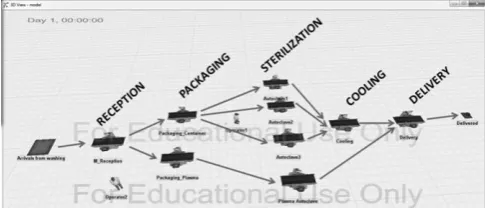
“reception” of the washed surgical instruments coming from the washing area; packaging is the second activity (instruments could be packaged as single pieces or in specific containers), and then a final sterilization and cooling phase (the sterilization could be carried out on a steam machine or a plasma-gas machine, depending on the requested treatment).
[image:2.595.298.555.79.159.2]When the process is complete, the surgical instruments are delivered to the final users (operating theatres).
Fig. 1. Process scheme.
Currently three washing lines are operative: a main line located in the Central Sterilization Department (CSD), and two additional smaller lines in the Central Surgery Structure (CSS). Also the sterilization phase is carried out partly in the CSD, in which there are three steam autoclaves (two main autoclaves and a smaller third one) and one plasma-gas autoclave, and partly in the CSS where two spare lines were established in order to face emergencies.
Table I shows the number of operators running the process in the CSD and their working shifts. The activities carried out in the peripheral sites (CSS) are run by promiscuous operators (e.g. nurses).
TABLEI
NUMBER OF OPERATORS PER SHIFT
WASHING ZONE STERILIZATION
ZONE MORNING
7am – 2 pm
(MON- SAT)
3 2
AFTERNOON
1 pm – 8 pm
(MON- FRI)
3 2
B.Data Collection Phase
In order to get all the essential parameters to run the simulation models, a twelve-days data collection phase in the hospital structure was carried out (for example the cycle times of autoclaves, the processing time for the “reception” task, etc.).
Some of collected data had stochastic nature, in particular process times related to human-performed tasks (such as “reception”), some others, like cycle times of washing machines and autoclaves (pre-set value depending on the desired treatment), were totally deterministic.
A statistical distribution was assigned to each activity which completion was affected by variability. The assignment of such distributions was done by choosing the best probability function fitting with the collected data (see Fig.2).
Fig. 2. Weibull probability function assigned to the “Packing” task.
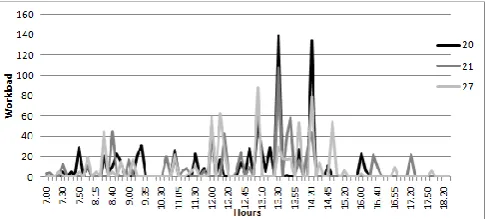
By analyzing the surgery database referred to the considered period, it was possible to calculate the amount of processed surgical instruments, and thus, to estimate the workload affecting the sterilization plant.
[image:2.595.303.552.379.460.2]Fig.3 shows the workload trend during three different sample days; as it can be observed such workload is not equally distributed along the operational time, and some peaks of work are detectable after the end of morning surgical operations.
Fig. 3. The workload of the sterilization plant during three sample days.
[image:2.595.49.290.449.578.2] [image:2.595.307.550.603.712.2]IV. SIMULATION ANALYSIS
Since the 80s authors are carrying on researches on DES models integrated with the design of simulation experiments by means of Response Surface Methodology techniques [19][20].
This is due to the capability of regression meta-models to point out the existing relationship between the target function and the independent variables affecting the system behavior.
However, in the examined case, a classical “what-if” analysis has been preferred. Because the creation of easily-understandable scenarios would have better support the hospital management (usually with medical background) in understanding the benefits of the process reengineering [14]. In order to conduct this study, authors developed two simulation models using Flexsim 5.1.2, which is a DES software widely spread in industrial contexts [13][16][17].
The first model was used to evaluate the “as-is” situation and to identify process inefficiencies, the second one was built after a process reengineering in order to obtain a possible “to-be” configuration, and then to evaluate the robustness threshold (physical workload limit of the plant).
Fig. 4. A model snapshot – The sterilization plant into the Central Sterilization Department.
A.The “AS-IS” model
Starting from the production data referred to the day of maximum workload (801 sterilized pieces: 728 with steam autoclaves, 73 with plasma-gas), a test case was considered in order to:
Evaluate the simulator capability to describe the studied reality;
Obtain the Utilization Indexes of machines and operators under current functioning conditions. Such indexes are necessary for the process reengineering. First step was the statistical validation of the model, which was performed through the calculation of the sample size, that it is necessary to draw, from the statistical distributions in the model, in order to minimize the so-called “simulation error” (calculation of the optimal simulation length)[15]. In other terms, in this phase authors wanted to find out how many replications would have been needed to obtain reliable results [18]. This has been done by studying the Mean Square Pure Error curves (MSPE); in particular the mean
curve (MSPE MED) and standard deviation curve (MSPE STDEV),
related to the four sterilization machines in the CSD (autoclaves), have been calculated. According to the MSPE
technique the optimal duration of the simulation run corresponds to the time in which the last curve got to stabilization [11][12]. As shown in Fig.5 (autoclave #1
curves), both curves reached the stabilization zone only after the 85th replication in which MSPE MED and MSPE STDEV values
[image:3.595.306.550.141.270.2]were very close to zero (8.5·10-3 and 5.5·10-3 respectively). By comparing all autoclaves curves it turned out that 300 was the highest number of simulation runs necessary to reach stabilization (autoclave # 3 value). Thus the sample size (replicated runs) was set to such a value.
Fig. 5. MSPE curves for the steam autoclave #1.
The simulation outputs after 300 replications (for example the one shown in Fig.6) allowed to conduct an effective analysis on the current state of the sterilization plant. Before discussing the results of the analysis it should be observed that the workload of steam autoclaves was actually equally spread among the three machines. Because of its features, the used simulator tended to route the incoming flow according to a "first available machine" rule. That's why, in the following analysis, authors always consider the average value of the three steam autoclaves UI.
Fig. 6. CSD’s autoclaves state charts
As it can be noted by observing the figure above, the three steam autoclaves have an average “processing” state corresponding to the 35% (Utilization Index, UI) of their total capacity, while the plasma-gas autoclave turns out to be utilized for the 60% of the time since it is unique in the whole structure. Moreover it is important to note that during the “scheduled-down” time the steam autoclaves are performing the daily sterilization tests which are necessary to preserve the quality of the process.
[image:3.595.48.291.332.436.2] [image:3.595.305.551.421.579.2]Fig. 7. Washing machines state charts
[image:4.595.48.293.191.363.2]Fig. 8 and Fig. 9 show graphs referred to the state of operators. In this case the UI is represented by the “utilize” section of the pie charts.
[image:4.595.305.552.364.441.2]Fig. 8. Sterilization area operators – state charts (morning shift)
Fig. 9. Sterilization area operators – state charts (afternoon shift)
The operators in the sterilization area had a daily UI that never went over the 40%.
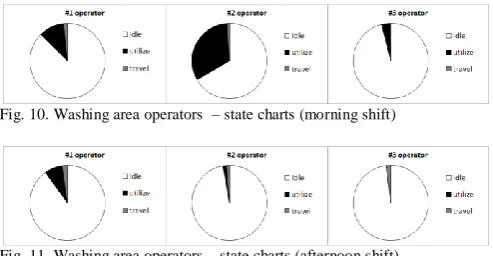
[image:4.595.47.294.459.587.2]For what concerned the washing zone (see Fig. 10 and Fig. 11) the operators average UI in the morning shift equals the 16%, and it decreased in the afternoon when some operating theatres were closed.
Fig. 10. Washing area operators – state charts (morning shift)
Fig. 11. Washing area operators – state charts (afternoon shift)
By analyzing the above presented results a considerable underutilization of machines and operators came to light. Thus, main target of the process reengineering became the growth of Utilization Indexes up to appropriate values for industrial standards. In order to chase this target, the workload (considered as number of surgical instruments to be washed/sterilized) should have been increased. This could happen by closing peripheral sterilization activities in the CSS (two washing stations and two steam autoclaves), and by consequently routing such workload toward the Central Sterilization Department.
A new simulation model was built to evaluate the proposed strategy.
B.The “TO-BE” model
The first aim of the process reengineering was to increase the Utilization Indexes both of machinery and operators. For such a reason, all surgical instruments were routed to the Central Sterilization Department. The instruments coming from surgical wards which are located far from the CSD, should have been transferred by using dedicated containers.
The key points of the proposed reorganization are listed below:
the Central Sterilization Department would have been operative from 7 a.m. until 8 p.m.;
CSD operators would have been organized in two shifts: 7 a.m. to 2 p.m., and 1 p.m. to 8 p.m.;
the two autoclaves and the two washing lines in the CSS would have been eliminated;
the smallest steam autoclave in the CSD (#3 autoclave) and the gas-plasma autoclave would have been 24hr operative in order to face possible emergencies.
Referring to the last point, in case of emergencies occurring out of the CSD working time, CSS operators would have run the CSD autoclaves (as they currently do in emergency cases with the CSS autoclaves).
The obtained benefit from such reorganization was substantial.
Fig. 12. Steam autoclaves 1 and 2 state charts
Referring to steam autoclaves, the average UI grows up to 55% with an increase of 20 percentage points compared to the previous “as-is” scenario. On the other hand, the UI of plasma-gas autoclave isn’t subjected to a significant growth (just 6 percentage points) because the additional workload requesting this kind of treatment was not substantial.
[image:4.595.306.550.565.640.2]The enhanced workload brought the UI of washing machines to 79%, with an increase of 45 percentage points.
Fig. 13. Automatic washing machines state charts
Fig. 14. Sterilization area operators - state charts (morning shift)
Fig. 15. Sterilization area operators - state charts (afternoon shift)
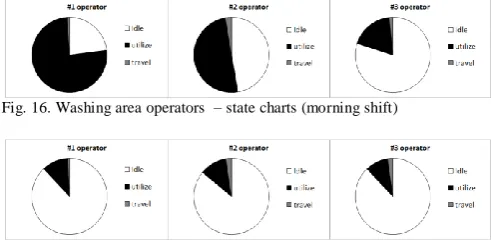
On the contrary, in the washing zone the utilization of operators increased; in the morning the average UI passed from 16% to 46% (+30 percentage points), while in the afternoon, even though it rose up by 8 percentage points, it remained extremely low, due to the decrease of surgical operations.
[image:5.595.304.551.293.344.2]
Fig. 16. Washing area operators – state charts (morning shift)
Fig. 17. Washing area operators – state charts (afternoon shift)
After the presented results were analyzed, the authors proposed to reduce the number of operators in the washing line from 3 to 2 units in both shifts.
In order to test the feasibility of such proposal, a new simulation run was carried out.
[image:5.595.46.292.323.444.2]Fig. 18. Washing area operators – state charts (morning shift)
Fig. 19. Washing area operators – state charts (afternoon shift)
As shown in Fig.18 the average UI increased to 70%, while in the afternoon (Fig. 19) it did not overcome 15%. So it is possible to state that the studied solution allowed to increase considerably the operators workload remaining under the critical thresholds.
C.Robustness analysis
Since with the re-designed process the capacity of the plant was not overfilled, an additional analysis was conducted in order to evaluate the capacity limit of the proposed configuration.
After several test-runs the authors decided to increase the number of incoming surgical tools of 930 units, reaching an overall workload more than double than the current one. Under these conditions the autoclaves average Utilization Index was 77% while, standing the hypothesis 7 a.m.- 8 p.m. working time, a unique gas-plasma autoclave would not have been able to satisfy the incoming demand. On the other hand, if it was possible to spread the workload along all the 24 hours, the average Utilization Index would become about 40%. However, in this case, the purchase of another plasma-gas machine would be appropriate.
For what concerns the operators, it was necessary to increase such resources number by one unit in the morning shift. Under this configuration, the operators average UI is 77%.
Fig. 20. Sterilization area operators – state charts (morning shift)
Since the average value of the operators UI for the afternoon shift was about 67%, there was no need to increase the number of resources in this case.
V. CONCLUSIONS
The presented project is part of a wide cooperation between the authors and the Hospital management which includes other sensitive issues such as the evaluation of the impact of the Emergency Department on the ordinary surgery activities [10] and the re-design of the surgical patient throughput path. Every sub-project is aimed to increase efficiency, optimize processes and reduce overall management costs.
The discussed subject represents an authentic proof of what the authors observed by studying the healthcare processes in Italian hospitals. From the application of the Galileo’s “Scientific Method” it clearly came out that the decision makers are usually oriented to focus on care effectiveness, thus neglecting the related process efficiency. To deal with any management issue in any sector, if not supported by a clear-designed process aimed to conciliate effectiveness with efficiency, it could lead to punctual diseconomies which may provoke a costs growth up to critical levels in the long term.
The sterilization plant problem is ascribable to such context: the existence of a Central Sterilization Department, having an oversized process capacity (more than twice the current workload), and of some peripheral sterilization lines at the same time, indicates a complete lack of integrated vision during the process design phase.
The underutilization of operators points out that any evaluation of process feedback was ever done in the day-by-day process management.
[image:5.595.47.294.531.708.2]out unsatisfactory Utilization Indexes, a re-design process was proposed. Key points of such proposal were:
The elimination of every peripheral sterilization activity;
The centralization of such activities in the Central Sterilization Department with a partial reduction of operators.
The experimentation of the new process configuration, by means of a new simulation model, allowed to achieve significant improvements in Utilization Indexes.
To conclude the analysis, a new experimental campaign was conducted in order to evaluate the potential capacity limit of the existing plant. The obtained results pointed out that the current plant capability would be able to satisfy a demand more than twice the current one. Taking advantage of such an high potential, the authors suggested to the Hospital managers to set up a shared sterilization service with another near public structure. The impact of this last proposal on the management costs would be definitely positive because, with just a negligible additional investment in logistics (to enable the transportation of surgical instruments) and equipment (an additional plasma-gas autoclave) a substantial cost saving (about a million Euros), for both hospitals, could be achieved.
REFERENCES
[1] S.C. Brailsford, P.R. Harper, B. Patel, M. Pitt, “An analysis of the academic literature on simulation and modelling in health care”, in
Journal of Simulation (2009) vol. 3, 2009, pp. 130-140.
[2] M. M. Günal, M. Pidd, "Discrete event simulation for performance modelling in health care: a review of the literature”, in Journal of
Simulation (2010) vol. 4, 2010, pp. 42-51.
[3] I. W. Gibson, “An approach to hospital planning and design using discrete event simulation”, in Proceedings of the 2007 Winter
Simulation Conference, 2007.
[4] L.B. Holm, H. Luras, F. A. Dahl, “Improving hospital bed utilisation through simulation and optimization with application to a 40% increase in patient volume in a Norwegian general hospital”, in International Journal of Medical Informatics, vol.82, 2013, pp. 80-89. [5] A. Komashie, A. Mousavi, “Modeling Emergency Departments using
Discrete Event Simulation techniques”, in Proceedings of the 2005
Winter Simulation Conference, 2005.
[6] M. Raunak, L. Osterweil, A. Wise, L. Clarke, P. Henneman, “Simulating Patient Flow through an Emergency Department Using Process-Driven Discrete Event Simulation”, in SEHC’09
Proceedings, Vancouver, Canada, 2009.
[7] S. H. Jacobson, S. N. Hall, J. R. Swisher, “Discrete-Event Simulation of Health Care Systems”, in Patient Flow: Reducing Delay in Healthcare Delivery, Ed. Randolph W. Hall, 2006, pp. 211-252. [8] S. Robinson, Z. J. Radnor, N. Burgess, C. Worthington, “SimLean:
Utilising simulation in the implementation of lean in healthcare”, in
European Journal of Operational Research, vol. 219, 2012, pp.
188-197.
[9] J. J. Caro, J. Möller, D. Getsios, “Discrete Event Simulation: The Preferred Technique for Health Economic Evaluation?”, in Value in Health, vol. 13, n.8, 2010.
[10] L. Cassettari, J. B. Morrison, R. Mosca, A. Orfeo, R. Revetria, F. Rolando, “A System Dynamics study of an Emergency Department impact on the management of hospital’s surgery activities”, accepted for presentation in SIMULTECH 2013 conference, Reykjavìk, 29-31 July 2013.
[11] L. Cassettari, R. Mosca, R. Revetria, “Monte Carlo Simulation Models Evolving in Replicated Runs: A Methodology to Choose the Optimal Experimental Sample Size”, in Mathematical Problems In
Engineering, Article Number: 463873 DOI: 10.1155/2012/463873
[12] R. Mosca, M. Mosca, L. Cassettari, P.G. Giribone, “The Stochastic analysis of investments in industrial plants by simulation models with control of experimental error: theory and application to a real business case” , in Applied Mathematical Sciences, Vol. 4, 2010, no. 76, pp. 3823 - 3840
[13] L. Cassettari, R. Mosca, R. Revetria, F. Rolando, “Sizing of a 3,000,000t Bulk Cargo Port through Discrete and Stochastic Simulation Integrated with Response Surface Methodology Techniques”, in Proceedings of 11th WSEAS International Conference on Systems Theory And Scientific Computation (ISTASC '11), Florence, Italy, August 23-25;
[14] M.Cagetti, L.Cassettari, R.Mosca, F.Oliva, R.Revetria, “Discrete Event Simulation Applied to an engineering problem in a railway context”, in Proceedings of SCSC ’06, Calgary (Canada) , 31 Luglio-2 Agosto 2006.
[15] R.Mosca, P.Giribone, “Optimal lenght in O.R. simulation experiments of large scale production system” in Proceedings of IASTED
”Modelling, Identification and Control”, Davos (CH), 1982,
pp.78-82.
[16] R.Mosca, L. Cassettari, R. Revetria, G. Magro "Simulation as Support for production planning in Small & Medium Enterprise: A Case Study" in Proceedings of the 2005 Winter Simulation Conference, Vols 1-4, pp. 2443-2448
[17] AG Bruzzone, R.Mosca, C.Briano, M.Brandolini “Models for supporting customer satisfaction in retail chains” in
Proceedings of HMS2000, Portofino, October, 2000
[18] R.Mosca, L.Cassettari, R.Revetria , “Experimental Error Measurement in Monte Carlo Simulation” , Handbook of Research on Discrete Event Simulation Environments: Technologies and
Applications, Chapter 6, ISBN 978-1-60566-774-4 (hardcover), ISBN
978-1-60566-775-1 (ebook), Evon M. O. Abu-Taieh and Asim Abdel Rahman El Sheikh, Information Science Reference, Hershey, New York, USA.
[19] L.Cassettari, R.Mosca, R.Revetria, F.Tonelli, “Discrete and Stochastic Simulation and Response Surface Methodology: An Approach to a varying experimental error”, in Proceedings of 5th
Industrial Conference, ISC 2007, Delft ,The Netherlands, 11-13 June
2007