Abstract—This article studied the general principles of multi-task scheduling and controlling of the logistics equipment, specifically took the AGV as an example, set the three-dimensional models of the equipments through MDT, established the relationships between the downstream equipments and upstream equipments, which also took the equipment layout into account , generated the task command, realized the multi-task scheduling and controlling in the logistics center , finally got the visualization simulation models of a cigarette factory accessories distribution system and the simulation data which will support the further optimization . This article made a meaningful attempt of exploring the multi-task scheduling and controlling simulation method of the AGVS.
Index Terms—AGVS, multi-task scheduling, simulation
I. INTRODUCTION
aser guided AGVS (Automated Guided Vehicle System) is a set of optical, mechanical, electrical, computer high-tech, and also a flexible, highly intelligent transport system. Because of its expensive, planning and design must be analyzed carefully to determine the best solution before requiring companies to purchase AGVS. However, due to AGVS as a complex discrete event system, it is difficult to calculate the theoretical analysis of system performance.
At the same time, The AGV system is one of the core subsystems of the logistics center, which is also one of the most complex subsystems when setting the simulation model, especially for its traffic control and task scheduling [2]. Nowadays there still haven’t got any mature software that can easily realize the simulation of its traffic control and task scheduling. Therefore, this article will fully investigate the AGVS simulation modeling method and in the theoretical study based on the proposed concept of automated simulation modeling to build a cigarette factory accessories distribution system visual simulation model, and get the system
Manuscript received July 23, 2013; revised Aug 13, 2013.
ZHAO Wenjing is currently studying in the Institute of Logistics Engineering,University of Science and Technology Beijing, Beijing, 100083, China for MS Degree. (E-mail: wjzhao1989@ hotmail.com).
CHENG Guoquan is currently working in the Institute of Logistics Engineering, University of Science and Technology Beijing , Beijing , 100083, China as an Associate Professor (E-mail: [email protected]).
LIU Yinhong is currently engaged in Logistics project investment and logistics facilities layout planning at the Shanghai Pharma Keyuan Xinhai Pharmaceutical Co., Ltd.
LI Juan is currently an assistant professor in the Institute of Traffic Engineering, Beijing jiaotong University, Beijing, 100044, China.
simulation data to further optimize the system to provide data support for the multi-task scheduling and controlling simulation method of the AGVS to make a useful attempt.
II. THE GENERAL PRINCIPLES OF THE MULTI-TASKS SCHEDULING AND CONTROLLING SIMULATION IN THE
LOGISTICS CENTER
According to their different location characteristics and operation mode, the logistics equipments can be divided into two kinds, one kind is called fixed equipment or resource equipment; the other one is called executive equipment or sharing equipment. The fixed equipment refers to the equipment whose position is relatively fixed and is responsible for storage, transport, processing, such as shelves, conveyor, stacker, processing center; while the executive equipment refers to the equipment whose position is not fixed, and can be moved in a certain region. This kind of equipment is usually responsible for loading and unloading, handling, such as AGV (Automated Guided Vehicle), forklift truck, manipulator, robot and so on[2].
The realization of the multi-tasks scheduling and controlling simulation means to reproduce the multi-tasks scheduling and controlling strategy of the real time system in the executive equipment which are working in the logistics center simulation system, so that the simulation system can simulate the real time operation condition in a controlled and purposeful manner . The main functions of the realization are, firstly, to simplify all of the various tasks and operations into controlling information, secondly transmit this information through messaging mechanism between different devices, in order to achieve the purpose of across-device control and coordination.
The specific contents of the tasks scheduling and controlling includes setting up the mathematical description of the tasks operation, generating the task command, generating, sending, managing and executing the controlling information, and scheduling vehicles in logistics center.
A.Generate the task command
Specifically, the generation of the task command is divided into three steps:①create the task sequence;②insert specific tasks into the task sequence;③send the task sequence.
This paper puts forward the concept of unitized task. In this concept, all kinds of tasks in the logistics center can abstract into a sequence of standard operating tasks. So we can use basic operation and unitization task to describe the tasks of the equipment system in the logistics center according to this notion.
An ordered combination which consists of a certain number of unit operations can be seen as a task unit. Every ZHAO Wenjing, CHENG Guoquan, LIU Yinhong, LI Juan
The Multi-task Scheduling and Controlling
Simulation Method of the AGVS
task unit can be described as the following formula:
TS= {which equipment need this task, which equipment will provide this task, Pr(priority), Pm(preemption), Task1,
Task2, …} (1) In this formula, the task is one kind of operating commands which ask the executive equipment to execute a single basic operation which include walking, loading, unloading, staying, waiting, sending message and so on. The task command can be described as the following formula:
Task=Tf (parameter1, parameter 2, …) (2) The task sequence is one kind of operating commands which ask the executive equipment to execute a series of basic operation systematically. It includes priority, preempt and one or more than one task command consisting in sequential order. The task sequence command can described as the following formula:
Task Sequence= {Pr (priority), Pm (preemption), Task1,
Task2, Task3,…, Task n} (3) The task sequence list is a queue of task sequences ordered by priority and preemption in the task buffer. The task sequence which has the first priority comes first. If two task sequences share the same priority, the one with higher preemption comes former. If two task sequences share the same priority and preemption, who comes early comes former.
B.Scheduling mechanism
The scheduling mechanism is the way of how to generate, transmit, control and execute the task sequences and control information in the simulation model. It can be divided into three modes according to the difference of the subject who generate, send, receive, control and execute the task sequence: ①independent processing mode: the task sequence is sent by the executive equipment and is executed by itself.
②asking for service mode: the service request is generated by any device, and the task request is sent by this device and received by the certain executive equipment which will not only receive but also control and execute the task. ③
centralized dispatching mode: the service requests are generated by some devices, and gathered by a task dispatcher. Then the task dispatcher will put all these service requests in order to make a task sequence list, and pick the suitable executive equipment to execute the tasks in accordance with the predefined task scheduling rules.
These three modes can be applied in the simulation flexibly. We can just choose the most convenient one or combine all these three modes in the modeling process.
III. THE MULTI-TASKS SCHEDULING AND CONTROLLING
SMULATIONMETHOD OF THE AGVS
The AGVS is one of the core subsystems of the logistics center, which is also one of the most complex subsystems when setting the simulation model, especially for its traffic control and task scheduling [3]. Nowadays there still haven’t got mature software that can easily realize the simulation of its traffic control and task scheduling [4]. So this chapter will discuss the simulation method of the multi-tasks scheduling and controlling of the AGVS
A.The analysis of AGVS’ typical structures
In reality, the AGVS generally constituted by the line (LINE), the vehicle (AGV), the working station (STATION), the charging station (HOME), and the control system (CS). The line is consisted by the node (NODE) and connection (CONNECTION). The AGV travels alone the line to complete the material handling work.
The nodes of S1, S2… S5 marked on the figure1 are the endpoints which are connected the main processing device. They are called the STATION. The node of M is also a STATION which is especially used for intake. The nodes of H1, H2 are the STATION where the AGV can have a rest and get charged, which is called the HOME. The nodes of Na, Nb, Nc are the intersection point of the circuit, and also the traffic control point.
The circuit is consisted of the NODE and the CONNECTION, connected the STATION, the intake STATION, and the HOME all together.
Fig.1 The typical structure if the AGVS
B.The simulation modeling of the AGVS
(1) The structure modeling of AGV
First we used the MDT software to make the three-dimensional model and output the 3DS file. Then we imported the file into the simulation system. The AGV shown in figure 2, for example, is divided into two parts to be shaped, one is the main body of the vehicle, and the other one is the fork-transplanting institution. Then we re-assembled these two parts together.
Fig.2 The comparison of the real AGV and the simulation model
(2) The simulation modeling of site
on. On the other hand, according to the different method of being modeling, the sites can be separated into the active sites and the passive sites
The active site can send the request for service initially. It creates the task sequence itself according to its own needs and sends it to the task dispatcher. It can be described as the following formula:
S= {P, Time, Task} (4) In this formula, P refers to a set of the positional parameters, Time refers to the rules of the time when the handling task starts, and Task refers to command of handling task. The active sites can be treated as processing center in the simulation process. The processing time which is the property of the processing center can simulate how long the handling service takes place. After the processing time, the processing center triggers the need of handling service and generates the task sequence, then sends the task sequence to the corresponding task dispatcher.
The passive site only provide or receive materials passively instead of generate request for handling service initially. These kind of site is relatively easy because it only has one parameter—position. On the other hand, it has various kinds of forms, and mainly functions as the connection with other subsystems, i.e., the buffer, the storage, the transfer or the termination. We can choose ‘parts arrester’, ‘queue’, ‘conveyor’, etc. to simulate it.
Especially, Home is a special passive site in AGVS. It is a place where AGV can have a rest and being charged .It doesn’t have operation demand, but if it is occupied by one AGV already, it will refuse other AGV.
(3) The simulation modeling of circuit
In the circuit simulation, if we connect two circuit nodes together, we can get a two-way line; if we cut off one of the direction, then it forms a one-way line. We have to set the appropriate distance between two AGVs in each section to avoid the conflict in the same circuit. In the intersection of the lines, we set the object of ‘traffic light ’to make the AGVs that have arrived there to obey the ‘First Come First Served (The one first comes can get across the intersection first)’rule. The limitation of the speed of each circuit and the deceleration point are set to control the speed of the AGV, especially in the turning. The traffic control can be seen clearly on figure3.
Fig3 The Traffic Control Schematic
(4) The speed limitation at some local places
We set the speed limitation and the deceleration point to realize the speed control of the AGV vehicles at the turnings. In the figure 4, the node of NN1 is the deceleration point. The
AGV vehicle arrives at the node of NN1 at the normal speed of V0, and then begins to decelerate to the turning speed of Va when it arrives the node of NN2. Next, it will keep travelling at the constant speed of Va, until it arrives the point of NN3. The NN3 is the acceleration point. We will set the suitable acceleration there to make it accelerate to the normal speed of V0. The location of the deceleration point is determined by calculation.
Fig4 The schematic of the speed control at the turnings
C.AGVS scheduling and controlling demand analysis
(1) AGV vehicle scheduling and task management When the command to be executed without too much idle AGV, the host control computer should temporarily save these commands, and then press the gradual completion of a certain order. Various commands will be graded, the high level of priority will be executed, and some commands might be executed immediately, such as charging and so on. Host control computer according to the required tasks, as well as the current position in which the trolley station to optimize the allocation of the vehicle.
(2) AGV traffic management
Each AGV's work is carried out under the supervision of the host system; AGV at any time would like to report their work status. In its run-time system must always apply to the next step will be to walk the route, if the route has been occupied by another AGV, this station AGV will not be moving forward, we must wait until the system permission, that is, the route was "released" before it can continue forward.
(3) AGV automatic charging
Each AGV are subject to their own side of the current capacity of the battery when the battery capacity drops to a low t limit, it will send the signal of charging requirements the system. And after that, the system will send the charging command (This command has absolute priority) to the corresponding AGV. When the AGV reaches the charging station, the system through the I / O interface control surface charging equipment to charge it. When the battery is full, the charging requirements signal disappears. The AGV may continue to accept other tasks.
(4) Idle AGV back Home
D.Creating the standard task commands
The specific application of the concept of task unit to AGVS among all tasks will be carried out.
(1) The operating units of the AGVS
The operating units of the AGVS are walking, loading, unloading, stay, waiting, etc., which is described as shown in Table I.
TABLEI
THE OPERATING UNITS OF THE AGVS AND THEIR MATHEMATICAL DESCRIPTION
Operatin g unit
Mathematical description
Parameter comments or remarks walking TT=(Walk,par1) Par1:terminal position
loading TL=(Load,par1,par2) par1:loading platform Par2:loaded cargo unloadin
g
TU=(Unload,par1, par2)
par1:unloading platform Par2:unloaded cargo stay TS=(Stay,par1) par1:staying time waiting TW=(Wait) Stay until it receives other
operating command (2)AGVS task units
AGVS task units have the following main types:
① Handling tasks TS:
AGV handling tasks in different systems is generally not the same, some systems handling task is relatively simple, some more diverse.
② AGV Charging tasks:
TS0= {TT1,TS2,TW3} (5) Where: TT1 walking from the current position to the charging station (Home), TS2 stay for some time in the charging station (AGV charging time), TW3 AGV in a fully charged battery charging station waiting for a new task, if there is a new task will be terminated immediately wait for the operation, and perform new tasks.
③ Idle AGV Back Home tasks:
TS4= {TT1,TW2} (6) Where: TT1 walking from the current position to the Home, TW2 AGV waiting for a new task in the Home.
Note that the idle AGV back Home is a rather special task command, it is in no other task commands AGV performed in the case, and other tasks can be received during execution of commands, and can terminate the return Home command at any time and perform new tasks immediately.
E. AGVS multi-task s scheduling and controlling simulation
Based on the characteristics of task scheduling mechanism, and considering the basic characteristics of AGVS and task scheduling needs, we propose three scheduling principles AGVS.
(1)AGV maintenance localization
The supervisory control of the AGVS is realized by the local controller instead of the dispatcher. Such as AGV charging and idle AGV Back Home
(2)Traffic control localization
Traffic management adopts the distributed control mode, namely all of the traffic control operations are assigned to the lines and nodes by setting the parameters such as direction, capacity and distance to realize the traffic control strategy. In addition, the managements of the affiliated facilities such as
automatic door equipment are also assigned to the circuit to achieve. We attribute the property of opening-door sensor to the node in front of the line, and the property of closing -door sensor to the node in the end of the line. So When the AGV vehicle arrives, the opening-door node will sends out the command to open the automatic door automatically, and after the AGV vehicle get through the door, the closing-door node will sends out the command to close it
(3)Unifiedly dispatching the handling tasks
The task requests are generated by some devices, and gathered by a task dispatcher. Then the task dispatcher will put all these service requests in order to make a task sequence list, and pick the suitable executive equipment to execute the tasks in accordance with the predefined task scheduling rules. Specifically, the scheduling rules is to find out the idle AGVs according to the state of the devices, measure the walking distances between the current positions of the chosen AGVs and the first destination, choose the AGV who has the smallest distance .
The simulation modeling realization method of the different tasks is described as follows.
(1) The simulative realization of scheduling and controlling of the handling tasks:
Here we use the centralized dispatching mode which means that the service requests are generated by some devices, and gathered by a task dispatcher. Then the task dispatcher will put all these service requests in order to make a task sequence list, and pick the suitable executive equipment to execute the tasks in accordance with the predefined task scheduling rules. It is shown in figure 5.
Fig5 The scheduling mechanism of the handling task
①The scheduling manager:using the “Dispatcher”to simulate the scheduling manager to realize the task scheduling;
②Processing devices:using the “Processor”to simulate the processing devices. We set the "Process Time" parameter to simulate the time of material consumption and waste collection time, and create the task commands which will be sent to the scheduling manager "Dispatcher" by triggering events "On the Process Finish". We will set the priorities of the task commands according to the urgency of each task, and the preemptions to 2. So that when the AGV is executing idle AGV back home task, the task with the preemption of 2 can interrupt the current task and been executed immediately.
③ The management and allocation of the task commands: The scheduling manager "Dispatcher" provides two interfaces for users to code, respectively determine the management principles and the allocation principles of the task commands.
preemption order, according to their types and so on. Ordering by priority is most widely used.
The allocation principles of the task commands: The AGV Vehicles and the “Dispatcher” is connected by the input port and the output port. Each AGV vehicle is given a unique and corresponding number of each output port from the “Dispatcher”. So the allocation principle of the task commands is to determine which output port number should be chosen.
④AGV vehicles dispatching algorithm: The handling tasks should be unifiedly dispatched. And the algorithm is shown in figure6.
(2) The simulative realization of scheduling and controlling of the charging tasks:
Here we use the ‘MTBF’ of the external tools object provided by Flexsim to simulate the electric quality. We can add the record variables to it, and the record variables also can be set that if it achieves a certain value, it will send a message to trigger a mechanism. At the same time, we will
use the same way to trigger the event of generating the charging task whose priority is 10 and preemption is 0. Though the charging task will take precedence over all other tasks, it won’t suspend the current task for its preemption is 0. So the simulation will be the most consistent with the real system.
(3) The simulative realization of scheduling and controlling of the idle AGV getting back to Home task:
We will apply the independent processing mode in this part of simulation. Every time when the AVG get unloaded, it will judge if the AGV is idle. If it is idle, it will generate the command of getting back to home. Both of the priority and preemption of this command is 0. So it can be interrupted by the tasks of accessories distribution and waste collection.
Because most of the AGVSs do have a typical model, and their circuit are usually quite complex, not to mention that setting the traffic control points makes the circuit even more complex. So the simulation modeling process will takes us a lot of time and easily leads to errors. Therefore, we can
…
Y
…
Carry out the
tasks The most
suitable AGV N
Task command
The production order The production order The production order
Handling
Requirement RequirementHandling Requirement Handling
N
Task Command Sequence Handling
tasks Y
Produce
N Handling
tasks Y
Produce
N Handling
tasks Y
Produce
The task sequence is empty
Assig n the tasks
Min(the best route )
The best route of AGV1 The best route of AGV2 The best route of AGVn
The sequence of the idle AGVs
If the AGV is idle or not
N
Y
If the AGV is idle or not
N
Y
If the AGV is idle or not
N
The status sequence of the AGVs
The status of the AGV: 0: idle 1: working
The status of the AGV: 0: idle 1: working
The status of the AGV: 0: idle 1: working …
Station
Central Computer
develop and adopt the automated modeling system of the AGVS to realize its automated simulation modeling to reduce the working time. Practice shows that using the automated modeling system instead of manual modeling to build a moderately complex AGVS simulation model ,the modeling time is shortened from 30 days to 10 days, the efficiency is increased more than 60% [5] - [7].
IV. A REAL SIMULATION EXAMPLE OF ONE CIGARETTE LOGISTICS CENTER
There is a cigarette factory whose annual output of the finished cigarette can be 100 million boxes. The production line in the main plant includes 24 sets of the rolling, joining and packaging unit, 12 sets of the filter tip forming unit and 9 sets of the binning and sealing unit. Besides, the main plant is a two-tier structure. The AS/RS for the accessories, the AS/RS for finished product, the laser-guided AGVS, the related finished product conveying, and the sorting system consist the whole cigarette integrated manufacturing system controlled by computers. Particularly, the AS/RS for the accessories with the total capacity of 5120 has 4 roadways; the stock-in system which consists of the forklift trucks and the conveyors is on the first floor while the stock-out system which consists of the conveyors for the roadway, the shuttles
and the platform is on the second floor; the accessories distribution system is consisted of the laser-guided AGVS.
Generally speaking, the simulation modeling of the logistics equipment includes three steps: structure modeling, behavior realization and movement realization. The FLEXSIM support the secondary development and we can use the OpenGL to realize the visualized modeling. We can realize the parameterization of the models easily in this method, and it only takes few resources. All of the structural parameters, performance parameters and behavior, movement, processing logic of the parametric models which are set based on the OOT (Object-Oriented Technology) are integrated and encapsulated. These virtual entities are corresponding with the logistics equipment in the real system one-to-one [8]-[10].
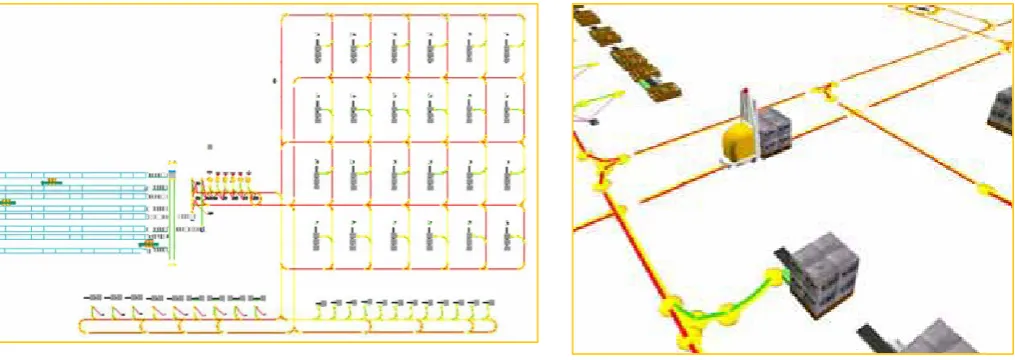
This paper makes the full use of the concept of class and inheritance, build the simulation models of the core subsystems of the cigarette logistics center include the storage system, the sorting system, the conveyor system, the handling system and the automatic classification system. Its planform and the partial view of the AGVS are shown in the figure 7 .
[image:6.595.50.558.397.577.2]Fig7 Left: The vertical view of the simulation model Right: Detail l view——the working AGV
TABLE II: The simulation results of the AGVs
Items
The number of execution
The idle rate
The charging time
The unloading walking time
The loading walking time
The loading
time
The unloading
time
The total load rate
AGV1 178 20.16% 6.59 13.13 46.28 6.92 6.92 79.84%
AGV2 165 22.91% 7.5 12.93 43.83 6.41 6.41 77.09%
AGV3 152 24.67% 7.24 13.28 42.23 6.29 6.29 75.33%
AGV4 159 26.26% 7.82 12.31 41.36 6.13 6.13 73.74%
V. THE ANALYSIS OF THE RESULTS
The simulation result of the system where there are 4 AGV vehicles is shown in the table II.
From table II we can get all of the important data of this model. These data are really important for the further optimization.
VI. CONCLUSION
Based on the real production needs, through researching the general principles of the multi-tasks scheduling and controlling simulation in the logistics center, focusing on the AGVS, this paper set up the simulation models of the equipments and established the relationships between them. Finally we got the visualized models of the accessories distribution system of one cigarettes logistics center, and studied the multi-tasks scheduling and controlling simulation method of the AGVS.
The multi-tasks scheduling and controlling simulation method of the AGVS which is deliberated by this paper is impressively innovative. This article opened up a new researching direction of the simulation modeling technology, and paved the way to the further studies and improvements of the intelligent simulation modeling technologies in the logistics center.
ACKNOWLEDGMENT
ZHAO Wenjing thanks professor Cheng, who is also the second author. He enlightened ZHAO Wenjing with his innovative ideas and spirit. ZHAO Wenjing is also grateful to her parents for supporting and encouraging her for achieving her goals.
REFERENCES
[1] NIE Juan. The qualitative simulation modeling and algorithm research of automated AGV system. Kunming University of Science and Technology (D), 2003
[2] [Alexander Verbraeck, Edwin Valentin. Simulation as a real time logistic control system: AGV control with simple ++. Proceedings of the 2003 Winter Simulation Conference, 2003 [3] ZHANG Chenbeixi, etc .The review of the development of the
automatic guided vehicle (AGV). Manufacture Information Engineering of China, 2010(01)
[4] WANG Yong, etc .Technical Analysis of the AGV system. China Science and Technology Information, 2011(04) [5] XIAO Haining .Real-time multi-attribute dispatching method
for automatic guided vehicle system. Computer integrated manufacturing system, 2012(10)
[6] BAI Shuaifu, etc., Research of Multiple AGV Systems Based on Mixed Regional Control Module. Mechanical and electron, 2012(03)
[7] HU Kewei. Study on Navigation and Obstacle Avoidance Technique for Auto Guided Vehicle (AGV). Ms D Thesis. Zhejiang: Zhejiang University, 2012
[8] XUE Tianran, etc. Research of the flexible manufacturing systems layout based on simulation. Machine building & automation, 2006 (05)
[9] ZHANG Xiaojiao etc. Shallow discussion of the Just-In-Time (JIT) production mode. Guide to Business. 2012