THE REGIONAL DEVELOPMENT
PROGRAMMES OF THE SECOND
GENERATION FOR THE PERIOD 1981-1985
€
COMMISSION
This document has been prepared for use within the Commission. It does not necessarily represent the Commission's official position.
This publication is also available in the following languages DA ISBN 92-825-4765-5
DE ISBN 92-825-4766-3 GR ISBN 92-825-4767-1 FR ISBN 92-825-4769-8 IT ISBN 92-825-4770-1 NL ISBN 92-825-4771-X
Cataloguing data can be found at the end of this publication
Luxembourg: Office for Official Publications of the European Communities, 1985
ISBN 92-825-4768-X
Catalogue number: CB-41-84-862-EN-C
Articles and texts appearing in this document may be reproduced freely in whole or in part providing their source is mentioned.
THE REGIONAL DEVELOPMENT PROGRAWES OF THE SECOND GENERATION
FOR THE PERIOD 1981-1985
I - Introduction 5 II - Rote of the regional development programmes 7
III - Summaries of the regional development programmes 9
- Belgium 11 - Denmark 31 - Federal Republic of Germany 51
- Greece 75 - France 107 - Ireland 135 - Italy 149 - Luxembourg 167
- N e t h e r l a n d s 179 - United Kingdom 193 IV - Comparative a n a l y s i s 227
Annexes
development programmes to the Commission in accordance with Council Regulation (EEC) No 724/75 of 18 March 1975 establishing a European Regional Development Fund (ERDF)1.
In 1977 the Member States submitted the first regional development programmes 2
based on the common outline produced by the Regional Policy Committee . In 1978 this Committee delivered its opinion on th·; programmes, and in 1979
3 4 the Commission gave its opinion and formulated recommendations for the
Member States on the basis of the provisions of Community regional policy. Moreover, the Economic and Social Committee gave its opinion on the programme in 1980 , and the European Parliament forwarded a resolution the same year. In Council Regulation (EEC) No 214/79 of 6 February 1979 the Commission is required to examine those programmes with regard to Community
objectives, and in addition, the Council Resolution of 6 February 1979
Q
concerning the guidelines for Community regional policy , stipulates that regional development programmes constitute the most appropriate framework for the practical implementation of proper coordination of national regional policies and of Community regional policy. Having examined the new regional 9 development programmes in this context the Commission made known its opinion .
1. O.J. L 73 of 21.3.1975
2. O.J. C 69 of 24.3.1976 (see Annex I) 3. O.J. L 143 of 12.6.1979
4. O.J. L 143 of 12.6.1979 5. O.J. C 205 of 11.8.1980 6. O.J. C 265 of 13.10.1980 7. 0..]. L 35 of 9.2.1979 8. O.J. C 36 of 9.2.1979
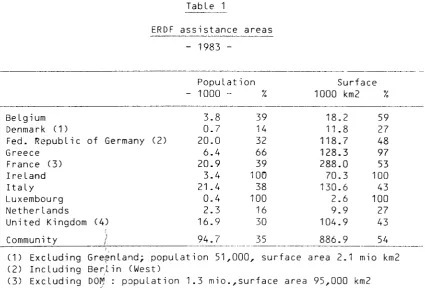
the regions assisted by the ERDF, covering about 55% of the area of the Community and 35% of its population. They cover, with a few exceptions, the period 1981-85.
Regional development programmes are, from a Community point of view, the reference tool for assessing projects submitted for ERDF assistance and the most appropriate framework for the coordination of the national regional policies and the Community regional policy. In a market
economy such programmes are of an indicative nature; they must be updated regularly.
The ERDF Regulation stipulates that, in order to benefit from the Fund's assistance, investments must 'fall within the framework of a regional development programme'. This means that the programme should justify the projects, though these do not necessarily have to be listed explicitly. The programmes must also show the need for ERDF assistance to infrastructure projects contributing to the development of the region concerned.
The role of the programmes in administering the ERDF is easily understood if one bears in mind that between 1975 and 1982 more than 17 000 projects received assistance. The more detailed and precise the content of the programmes, the easier it will be for the
Fund to assess whether projects fall within the framework of the programmes. The effectiveness of ERDF assistance is closely linked to the quality of the regional development programmes.
As regards the ERDF regions, the regional development programmes are also the reference framework for using other Community financial instruments, allowing greater consistency to be achieved between the various forms of Community financial assistance in the regions concerned.
As stated in the Council Resolution of 6 February 1979(1), the programmes also constitute the most appropriate framework for coordinating national and Community regional policies. Such coordination must be achieved through more precise information on regional policy and regional planning in the various Member States and through comparison of the objectives set and the resources deployed, identifying the points of convergence
and divergence, so that a balanced distribution of economic activities in the Community can be progressively achieved. Such examinations could relate to such matters as the cost and effectiveness of the various types of aid, the concept and assessment of infrastructure requirements, programmes for frontier regions, and study of the regional impact of public expenditure. In this connection, an important role is played by the Regional Policy Committee, attached to the Council and the Commission, which was set up with a view to contributing to the coordination of the regional policies of the Member States.
In addition, the guidelines and priorities established on the basis of the periodic report on social and economic trends in the regions of the
Community, which the Commission presented to the Council in July 1981(2) as provided for in the Council Decisions and Resolution of 6 February 1979, helps to define the Community criteria for such coordination.
Finally, the regional development programmes must allow the Community authoi— ities to take account of the regional impact of Community policies and the effects of measures they adopt, particularly as regards the areas in which such Community policies are most strongly established (common agricultural policy, trade policy). If they contain sufficiently precise information on this field, the regional development programmes will make it possible to carry out this task more effectively.
The Commission has examined the second generation programmes sent by the Member States in close collaboration with the national authorities, particularly withir the context of the Regional Policy Committee, which delivered its opinion on these programmes in accordance with Regulation No 724/75. In many cases, the programmes were supplemented during the examination procedure. In its opinion (see Annex II), the Commission made reference to the common outline (see Annex D and its recommendations on the programmes(3).
(1) O.J. C 36 of 9.2.1979 (2) C0M(81) 152final
(3) O.J. L 143 of 12.6.1979
In the following pages, the regional development programmes of the various Member States have been summarized in the following order : Belgium
Denmark, including Greenland Federal Republic of Germany Greece
France Ireland Italy Luxembourg Netherlands United Kingdom
Summary of the regional development programme
Belgium Flanders 1981-1985 Wallonie 1982-1985
Wallonia in 1982. Those programmes were prepared by the regional authorities concerned. Flanders
1. Social and economic analyses
Programmes have been worked out for three development blocks - Limburg-Kempen, West-Hoek and Middengebied (East Flanders). These blocks include the development areas which are eligible for ERDF assistance under the EEC decision of 26 April 1972(1). In 1980 the total population of Flanders was 5,619,00'" m d coral working population 2,369,000. In the period 1975-80 the working population increased by 100,000 persons in Flanders, while in the perioa 1974-79 total employment increased by 20,000;
employment in the industrial sector fell by about. 100,000 while in the tertiary sector the number of jobs increased by about 120,000. Total unemployment increased from 51,000 in 1974 to 186,000 in 1980, or from 4% to 12%. The per capita GDP at current prices in Flanders moved closer to the national average, reaching 99% in 1977
(96% in 1970).
In the Limburg-Kempen development bloc total employment increased by 19,000 in the period 1974-79, to 228,000, but in spite of this unemployment 'increased to about 17% in 1980. The high level of unemployment is mainly due to the high female unemployment rate (about 3 0 % ) . The area still has the lowest per capita income in Flanders
-about 12% under the level of Flanders as a whole.
The Westhoek development bloc experienced an increase in total employment of about 5,000 in the period 1974679 to 61,500, but his was inadequate, however, to meet the growing demand for jobs, and unemployment rose to a level well above the average for Flanders in 1980. Average per capita income is still among the lowest in
Belgium.
The Central area (East Flanders) experienced a decline of 2,500 in total employment to 41,000, due to the monostructural character of industry. Unemployment more than trebled in the period 1974680, and the average per capita income is still 10%
under the national average (1979).
The most important imbalances besetting Flanders are unemployment, a very Low economic growth rate, an unfavourable trend in investments, a sharp rise in the labour supply and a very pronounced dependence on other count: ies ¿s a result of foreign investments in flanders and 3 very high exportation rate.
14
During the period 1978-80, investments worth BFf; 40,600 million were aided under the legislation on regional expansion in the development blocs in Flanders, with 7,800 new jobs being created. The cost to the State of this legislation during this period was BFR 6,000 million.
Limburg Kempen :
Aided investments : BFR 30,400 million Cost to the State : BFR 4,400 million Jobs created : 5,600
Westhoek :
Aided investments : BFR 4,800 m i l l i o n Cost to the State : BFR 800 m i l l i o n Jobs created : 1,400
Middengebied (East Flanders)
Aided investments : BFR 5,400 m i l l i o n Cost t o the State : BFR 800 m i l l i o n Jobs created : 800.
Investments in Flanders on major i n f r a s t r u c t u r e works i n t h e - p e r i o d 1976-80 were as f o l l o w s ( i n BFR m i l l i o n , , current p r i c e s ) :
Roads Ports Waterways BuiIdings A i r p o r t s
Urban t r a n s p o r t
Railways : 45,700 45,400 21,000 10,400 6,200
: 13,100 15,100
The total population of Flanders is expected to increase by 51,000 persons in the period 1980-85 and the working population by 116,500 due essentially to an expected sharp increase in the female participation rate. Total
employment in Flanders is expected to remain virtually constant over the period 1980-85: A decrease in primary (9,400) and secondary sectors (54,600)
2. Development objectives
The main objective is the creation of new jobs by a positive employment policy, by improvement in the economic structure and by a standing adaptation of the economic and social infrastructure. In the period 1981-85 more than 230,000 supplementary jobs will be needed. The working population is expected to increase by 1169500 persons, the present structural unemployment is 120,000 persons and ^ota*. employment is expected to increase by 4,600 persons (employ»; Ή trend). The working population of Flanders in 1980 was 2,368,000.
For agriculture the main aims are to safeguard the food supply and to secure incomes in the sector in line with the average level in other sectors.
It is aimed to promote the development of industrial activities by restruct uring of sectors and firms seriously hit by the crises, by diversifying activity towards products with higher added value and high technological content.
In the service sector the main aim is to expand and develop the support services for agriculture and industry.
The general aims of transport policy is to gain control of the pattern of movements, in particular passenger traffic, by a better distribution of traffic against time and a shift toward public transport. As far as investments are concerned priority will be given to sections forming marked bottlenecks.
Other priority sectors are ports, waterways and railways.
The development blocs
In the three development blocs about 115,000 supplementary jobs will be needed in the period 1981-85:
Limburg-Kempen Middengebied Westhoek Total
Increase in working population
45,600 4,600 5,700 55,900
Employment trend
2,000 - 600 - 200
1,200
Structural unemploy ment
16
Industrial estates remain an important instrument of regional policy. Priority will be given to improvement of the existing estates, to the redevelopment of vacant sites resulting from closures in recent years and to the construction of service roads and better access by public transport.
As to transport infrastructure it is the overall aim to improve the links between the development blocs and the main growth poles of the country.
3. Development measures
Together with job promotion in the public service sector, three schemes are available for temporary employment in the public sector: employment of jobless persons, short-term work for people under 30 and a special temporary scheme for unemployed. A total of about 40,000 persons will be concerned by the scheme in the period 198"\-&r
The following measures are designed to promote employment in the private sector:
- Like government services, firms with 50 or more employees are obliged to hire jobless under 30 years on short-term basis.
- Grants are available for firms which introduce the 38 hour week and engage extra staff.
- Employment grants are available to SMEs which create new jobs without new investment.
- A statutory bridging pension is available to men of 60 and women of 55; the employer of a person applying for a bridging pension must in replacement hire a jobless person under 30.
- Contributions are provided towards wages of unemployed termed "difficult to place" and for employment of handicapped persons.
Measures for industrial development concern the macroeconomi c policy, which has as its main purpose the reduction of the costs of firms. They also
concern general policy measures with emphasis on adaptation of taxation, social security contributions and direction of government investments towards
investment which can contribute to diversifying the activities in the industrial sectors. Specific industrial policy measures concern export promotion and research and development activities.
18
Two special agencies have been set up to further the aims in the five-year plan for the textile and clothing industries.
The major infrastructure programmes, which are national, concern the further development of the ports of Antwerp, Zeebrugge and Ghent, selective adjust-ment of the waterway system to cope with the increasing size of vessels, completion of the present motorway and road programme, removal of bottle-necks on the interprovincial routes and improvements in the quality of the railroad network.
The development blocs
Under the Expansion Law of 30 December 1970, which is applicable only in the development areas, regional aid is available in respect of measures that contribute to the establishment, extension, conversion and modernis-ation of industrial and artisanal undertakings, public services or any undertakings engaged in commercial or tourist activities or active in management or organisational techniques, engineering and research and development. The most important form of aid is an interest subsidy of not more than 5 - 7 % available over five years in respect of three-quarters of the investment; this subsidy may be replaced by a capital grant of equal value where firms finance investment out of own resources.
Tax concessions are also granted, including exemption from property tax and accelerated depreciation, and, moreover, guarantees for loans can be given.
If no significant amendments are made to the regional expansion acts in the programme period,a job-creation of about 4,000 per year can be expected.
Lastly,the law governs provisions of regional infrastructure for firms in industry, the crafts and the services sector, with priority for the development of industrial estates.
The allowance granted for industrial estates varies according to the status of the area : areas of national interest receive up to 80% or more, whilst areas of regional interest receive less than 80%. In addition to industrial estates and smaller estates for tertiary support activity with priority for promotion of existing estates, particular attention will be given to
indirectly be an important factor for expansion in the development blocks, and the same is the case for the investments in the waterway system.
In the area of physical and town planning policies of urban renewal and of protection and - where possible - extension of wooded and natural areas will have priority.
As regards environmental protection, priority w' I I be given to collection and processing of solid waste and to an increase in the biological water purification capacity from 47% at present to 80% in 1985 (and 100% in 1990).
The ERDF contributions in the period 1981-85 will be used for industrial estates, individual industrial projects and for tourism/recreation, vocational training, environment, water supply and energy conservation. Topping-up for industrial projects may be considered in the case of
20
4. Financial resources
The 1981-85 investment programme has an indicative character; it is assumed that each investment item will remain constant in volume but adapted to price development.
Under the national budget is financed major infrastructure projects linked to traffic and transport (ports, motorways, waterways, railways, air
transport, metros, etc.) and categories linked to health (drainage, water production, environmental protection, research hospitals etc.) and schools.
Estimated total investment costs (national budget) in Belgium 1981-85 in million BFR, current prices is :
Public works Communications Health
Education Total
341.700 127.000 26.400 89.800 584.900
The total yearly investment costs (current prices) are expected to increase fror 99,800 million BFR in 1981 to 137,000 million BFR in 1985.
Moreover, the restructuring programmes for industries of national importance (textiles, steel for instance) will be financed by national means.
Under the Flemish Community budget is financed public works (industrial estates, roads, urban renewal, social housing etc.), health (water purification, waste, hospitals etc.), cultural matters (cultural and sports infrastructure and tourism), and agricultural infrastructure. Estimated total investment costs (Community budget) in Flanders 1981-85 in million BFR, current prices, is:
Public works Health
Agriculture Total
113.000 51.200 8.200 172.400
The programme whose main features are set out above forms the basis for a national and regional five-year plan.
The five-year programme sets out :
(a) the general aims and the policy established to achieve them; (b) prospects in the field of budgeting and financing;
(c) investment plans at the level of the economic regions.
The plan is presented for advisory opinion to the Regional Economic Councils (GER), the Central Council for Industry, the National Labour Council and the National Committee for Economic Expansion.
When the National Plan has been approved by both Chambers, and the Flemish Plan has been approved by the Flemish Council they are binding on the Government. Firms receiving support from the State are contractually obliged to implement the plan in return for the arrangement; for the rest, the plan is indicative.
The special Act of 8 August 1980, on institutional reform, defines the powers and competence of decentralised authority.
Under this special act, a Flemish Council and a Flemish Executive have been set up for the Flemish Community.
The powers of this Flemish level of authority fall into three categories and may be summarised as follows:
(1) Cultural matters defined in Article 59 bis, section 2 (1), of the Constituí ion.
(2) Matters related to persons defined in Article 59 bis, section 2 bis, of the Constitution.
22
The overall institutional structure is hence as follows :
(i) local decision-making bodies (municipalities, provinces) with legal authority but limited financial resources;
(ii) local bodies with the status of mixed (i.e. public and private)
associations with authority to examine, propose and execute projects; (iii) the central authority (national or regional) which holds the power
1. Social and economie analyses
The programmes have been worked out for the development areas accepted by the Commission in its Decision of 22 July 1982. Moreover, a distinction is made between two homogenous parts inside these development areas - the industrial basin Haine-Sambre-Meuse and the rural South-East.
In 1981 the total population of Wallonia was 3,218,000. In the period 1977-80 the active population increased by about 15,000 persons, while in the same period the total employment decreased by 13,000 persons. Total unemployment rose from 89,000 in 1977 to 130,000 (17%) in 1981. The income per inhabitant was still about 5% under the national level in 1979.
In the industrial basin Haine-Sambre-Meuse, which had a total population of 1,520,000 in 1982, total employment fell by about 40,000 persons (8%) in
the period 1974-80 and unemployment increased to about 90,000 persons or 20% in 1982. Income per inhabitant is considerably below the level for Wallonia in all parts of this region.
In the rural South-East region total employment increased by 10% in the period 1974-80 and unemployment increased reaching about 17% in 1982. The income per inhabitant is 10% or more under the level of Wallonia in all parts of this region.
In the period 1978-81 total investments of about 53.000 million FB were
aided in Wallonia (Law of 30.12.1970) with about 10.000 new jobs being created, The costs to the State was about 9.000 million FB.
Haine-Sambre-Meuse region:» Law of 30.12.1970:
-Aided investment: 36.900 million FB Costs to the State: 6.300
Jobs created : 6.200.
-Law of 04.08.78 concerning the SME (1979-81): Aided investment: 12.100 million FB
Costs to the State: 950
24 South-East region :
- Law of 30.12.1970 :
Aided investment: 5,700 million FB Costs to the State: 1,200 " " Jobs created: 1,700 " " - Law of 04.08.78 :
Aided investment: 10,000 million FB Costs to the State: 830 " " Jobs created: 2,900
Investments in Wallonia on major infrastructure in the period 1978-80: Roads: 39,200 million FB
Ports, waterways: 8,400 " " Railways: 6,100 " " Urban transport 19,700 " " (1) Airports: 330 " "
In the period 1978-81 the total budget for vocational training activities was about 5,800 million FB and in the same period about 2,100 million FB was used for tourism purposes.
In the period 1980-85 the active population is expected to increase by about 40,000 persons, while the employment is expected to decrease by 90,000 jobs,thereby increasing the job deficit by about 130,000.
2. Development objectives
The main objective is to maintain as much employment as possible as a
forecast shows the total number of jobs in Wallonia to diminish Sy
about 90,000 in the period 1980-85 and a job deficit of about 330,000
in 1985. The working population of Wallonia in 1980 was 1,280,000.
The objectives are expressed in two main strategies:
- A renovation of the industrial structure with the double purpose of
meeting the demand for quality products in the developed countries
and of satisfying the demands of the developing countries.
- An optimal utilisation of the existing and potential demand in Wallonia
•itself in order to consolidate the production structure in the frame of
the European integration.
The eligible zones
In the two development zones about 190,000 supplementary jobs will be
needed in the period 1981-85.
Active population 1985
Employment 1985 ■
Deficit 1985
Industrial basin (Haine-Sambre-Meuse)
The South East
Total
637,000
178,000
015,000
498,000 139,000
127,000 51,000
625,000 190,000
In the eligible zones a total investment aid of 12.3 billion BF is foreseen
in the programme period with the aim of maintaining and/or creating 26,000
26
3. Development measures
The measures concerning job promotion in the public and private sectors and the regional aid scheme described in the Flemish programme are in existence in Wallonia too.
The specific development measures can be presented under four main headings:
A. Renovation of the industrial structure. Under this heading four different sets of measures are foreseen:
- Restructuration of the steel, textile and glass industries: The main measures will be a competititve adjustment of the production range, an improvement in the level of productivity up to the level of the best European competitors, a rationalisation of production installations, distribution networks and organisations, a selective investment policy, a pursuit of cooperation and international agreements and a gradual decrease in public aid.
- Reconversion of activities! The idea is to develop new activities based on the existing industries. Specific programmes exist for microelectronics, aeronautics, aid to management and information for the SMEs, the development of a policy for the reception of new investors.
- A coordinated research to promote access to new technologies through innovation. Specific projects are foreseen for innovation in the steel basins, development of the activities of research centres, a coordination of research activities and the industrial transposition of new technologies and research results.
itself. Under this heading ten different sets of activities are foreseen:
- Agriculture and the agro-food industries: Promotion of high value-added products, ensurance of a further processing of agricultural products in the agricultural regions, creation of the means to give producers better access to the local markets and the promotion of energy saving in the sector.
- Slaughter-houses: Improvement of the public slaughter-houses and development of those situated close to the consumer zones and in general encouragement of activities connected to meat transformation.
- Forestry and timber: Promotion of the economic utilisation of this resource in all relevant sectors.
- Housing policy: The rehabilitation of the exiting housing stock wi 11 have priority.
- Physical planning: Apart from traditional subsidised works, priority will be given to the renovation of derelict sites and urban and
rural renovation.
- Energy: A policy of research/development and of coordination will be pursued as well as a promotion of big projects such as urban heating and geothermics.
- Water: Based on hydrographie units, programmes concerning production/ distribution and purification of water and agricultural hydraulics wi11 be carried out.
- Solid waste: A centralisation of the collection and treatment of solid waste and a policy of recycling of waste will be carried out.
- Tourism: Apart from the establishment of tourist centres, a policy of small-scale tourism will be carried out.
28
C. T r a n s p o r t s .
- Railways: Priority to electrification of lines and to putting certain lines back into service.
- Urgan and interurban transport: Here first priority is given to the networksof Charleroi and Liège.
- Transport in the rural areas: A special fund will be created with the purpose of carrying out a coordinated transport policy.
- Roads: Priority will be given to the construction of by-passes, the completion of national and international roads based on cost-benefit analyses, roads connecting the secondary centres with their periphery and bicycle lanes.
- Channels: Of importance are the continuation of works on main channels and development of the ports of Charleroi and Liège.
- Airports: Priority to investments in the airports at Charleroi and Liège.
D. Actions concerning unemployment and vocational training.
Five different lines of action are foreseen under this heading:
- A revision and amplification of the existing job promotion schemes. - A reduction in the hours of work and job sharing.
- A control of the penetration of new technology in the production processes.
- Aid to new experiments and individual initiatives.
4. Financial resources
The development measures to be carried out in WaLlonia will be financed either by the national budgets or by the budgets of the Wallonia Region (or the budget of the French community).
Under the national budget are financed major infrastructure projects in the sectors of transports and communications, in pubLic health and education.
In the period 1982-85 (the figures for 1983 are budget proposal figures and for 1984-85 budget estimates) the estimated total investment costs for Belgium as a whole are 461 billion BFR. In the Walloon Plan 1983-85 total investment costs in the three years amounts to about 40 billion BF, the dominant sectors being housing, water and environment and physical planning. A total investment aid of 12.3 billion BF is foreseen in the programme period.
30
5. Implementing the programme
The programme forms the basis for a national and regional five-year plan.
The five-year programme sets out:
(a) the general aims and the policy established to achieve them;
(b) prospects in the field of budgeting and financing;
(c) investment plans at the level of the economic regions.
The plan is presented for advisory opinion to the Regional Economic Councils,
the Central Council for Industry, the National Labour Council and the
National Committee for Economic Expansion. ι
When the National Plan has been approved by both Chambers, and the Walloon
Plan has been approved by the WalLoon Council, they are binding on the
Government. Firms receiving support from the State are contractually
obliged to implement the plan in return for the arrangement; for the rest,
the plan is indicative.
The Special Act of 8 August 1980, on institutional reform, defines the
powers and competence of decentralised authority.
Under the Special Act, a Walloon Council and an Executive have been set
up for the Walloon Community.
The powers of this level of authority fall into three categories
(see under Flanders).
Lately two new important institutions under the Walloon Executive have
been created: the "Société Régionale d'Investissement de Wallonie" (SRIW)
and the "Cellule de Gestion des Contrats Technologiques (CGCT).
The first is responsible for the carrying out of regional development in
general, while the second is responsible for a policy of research and
Summary of the regional development programme
A. Denmark
1. Social and economic analyses
The programme covers the following special assisted and ordinary assisted areas (in accordance with the Commission Decision on the delimitation of the assisted areas of 22 July 1982):
- the county of Nordjylland
- the Thisted area in Viborg county
- the special and ordinary assisted areas of SonderjyI Land county - the county of Bornholm.
In the period 1977-80 the total population was almost unchanged, while the labour force increased by about 170,000 persons.Total unemployment increased from 164,000 (6.5%) in 1977 to 243,000 (9.2%) in 1981.
Appropriations for regional development assistance (loans and grants)
amounted to 1,120 million DKR in the period 1977-80 of which 483 Million DKR to the four regions covered by the ERDF.
County of North Jutland
In the period 1977-80 total population increased by 1.4%, but the labour force increased much more (18,000 people or 8.2% in the period 1975-78). Total employment increased by about 20,000 people in the period 1975-80, the unempLoyment was almost unchanged in this period, but the county still has the highest level of unemployment in the country (in 1981 about 17%).
Income per head increased more in the county than in the country as a whole in the period 1976-78, but it is stilL considerably below the national average.
In 1977-80 a totaL of 354 million DKR was given as Loans and grants in the county creating about 3,500 new jobs. Important infrastructure investments in the period were ports (about 61 million DKR), railways (34 million DKR), airport (25 million DKR), University (96 milLion DKR) and roads
(175 mi Ilion DKR).
The Thisted area/Viborg county
The total population remained stable in the period 1977-80, while the labour force increased (2,000 people or 6% in the period 1975-80). Unemployment rose by 600 persons or 30% in the period 1975-80 to a level of 13%. In 1978 the average taxable income was 16% below the national average.
In 1977-80 total regional development assistance amounted to 46 million DKR, creating about 550 new jobs.
Important infrastructure investments carried out in the period 1977-80 were Hansthol harbour (6 million DKR), Sallingsund bridge (total 220 million DKR) and highways (340 million DKR).
In the period 1980-85 total population is expected to increase by about 700 people and the labour force by 1,200 people.
Regional development areas of SonderjyI land county
In 1975-79 total population increased by about 5,000 people (4%) while total employ-ment increased by 3,500 or 7%. In 1979 the total number of unemployed was 4,400 persons. The average taxable income was 10-15% below the national average in the regional development areas.
Regional development assistance amounted to 56 million DKR in the period 1977-80 creating about 500 new jobs.
Regional infrastructures of importance comprised a dyke at the North Sea coast (116 million DKR) and the motorway (329 million DKR, until 1981).
In the period 1978-85 the population is expected to increase by about 5,000 people and the labour force by 4,300 people.
County of Bornholm
Total population increased slightly (about 600 people) in the period 1977-80,
while the labour force increased by 1,700 in the period 1975-78 alone. Unemployment rose to about 1,700 persons or 12% in 1981. In 1978 the average taxable income in the county was 13% under the national average.
Regional development assistance in the period 1977-80 amounted to 27 million DKR creating about 330 new jobs.
Important infrastructure investments in the period 1977-80 were Ronne and Nexo habours, electric cable to Sweden (83 milLion DKR) and the airport (10.5 million DKR).
2. Development objectives
The main objective for the national regional policy is a better and more equal regionaL distribution of population, employment and income. In recent years there has been a marked shift in population and employ-ment from the metropolitan region - and to a lesser degree from the bigger provincial towns - to the rest of the country. It is the aim uj maintain this trend by expanding a network of viable regional ar,,. area centres all over the country, by regional aid and by infrastructure investments. Another important aim is to safeguard as yet undeveloped coastal regions by locating future tourist development elsewhere.
The regions
In Nordjylland county the workforce is expected to increase by 14,000 persons in the period 1980-85 and the total number of jobs by 9,000; as unemployment in 1980 was at 14,000 there will be arequirement of about 19,000 new jobs net. The total workforce in 1980 was 242,000 persons. Therefore increased employment is an important target, with a special emphasis on the weaker parts of the county. It is the aim to create the best possible conditions for agriculture, fishery and industry. Morever, it is the aim to strengthen the regional centre and to develop 15 area centres, with special emphasis on smaller centres in the weaker parts of the county and thereby to ensure that the population in all parts of the county has a reasonable accessibility to work and service facilities. It is the aim to develop tourism,but outside the present developed areas at the coast.
In the Thisted area/Viborg county the workforce is expected to increase by 1,200 persons in the period 1981-85; the unemployment was at 2,600 in 1980, and this means that about 4,000 new jobs will be necessary in the period 1981-85.
36
In the regional development areas of Sonderj;ylland county the labour force is expected to increase by 4,300 persons in the period 1979-85 and moreover 4,400 were unemployed in 1979. This means a need for about 9,000 new jobs in the period 1980-85. The total workforce in 1979 was 58,000 persons. It is the aim to increase employment and to improve the service facilities, in particular in the western and central parts of the country, i.e. the regional development areas. The two area centres in this part of thecounty shall be further developed, and in the central part of the county it is th aim to build up area centre functions.
In the county of Bornholm unemployment in 1980 was at about 1,000 persons, and it is expected that the workforce will increase by 1,000 persons from 1981-85; therefore at least 2,000 new jobs will be needed in this period. Total workforce in 1980 was 23,000 persons.
It is the aim to increase the average level of income from about 87% of th national average in 1980 to 95% in 1985. Other targets are an improvement in private and public services and to establish the best possible condition for the different sectors - agriculture, fishery, industry, tourism, etc. 3. Development measures
In the regional development areas,and the ERDF areas are all regional devel development areas, assistance can be granted by way of loans, subsidies anc guarantees for loans:
- Loans at reduced rates of interest (7.5%) can be given to industrial and service undertakings to cover capital expenditure for establishment, expan rationalisation etc. The repayment period is 20 years maximum.
- Loans at reduced rate of interest (7%) can be granted to municipalities for the construction of buildings, which are later sold or leased to private industrial or commercial companies. It is a condition that thes> are found in advance. Repayment period is 25 years.
- Subsidies can be granted to industrial or service activities for establis ment, expansion, rationalisation etc. in the special development areas up to a maximum of 25% of the capital expenditure.
The State finances a large part of the expenses met by counties and municipal-ities by the way of a series of subsidy, reimbursement and equalisation arrangements; in addition there are equalisation arrangements between local authorities.
There are four types of subsidy arrangements:
- Subsidy according to objective expenditure - need criteria (block subsidy). - Fiscally based subsidy.
- Local authority equalisation.
- Subsidy for particularly disadvantaged municpalities.
38
The regions
In the county of Nordjylland the most important infrastructure investments will be :
- Expansion of the state ports of Frederikshavn,Skagen and Hirtshals, new port installations on the island ofLaesd and enlargement of the navigation channel at the port of Aalborg.
- Extension and modernisation of the airport at Aalborg. - Extensions and improvements of the highway network.
- Further extension of the University of Aalborg, extensions of technical schools and completion of the North Sea Centre at Hirtshals.
In the regional physical planning a series of regulations are laid down concerning industrial zones, including sewage plants, power supply and transport systems, land use to protect the interests of agriculture and technical installations in general. Moreover, special regulations are laid
down concerning the localisation of industry and services in the different centre categories.
In the Thisted area the important infrastructure investments will be expansion of the port of Hanstholm, extension of the highway system, a new comprehensive and commercial school at Nykøbing as well as new social institutions.
In the regional physical plan provisions are laid down concerning industrial zones (a new zone planned near Hanstholm), land use and localisation of industry and service activities.
In the regional development areas of Sonderjylland county, apart from the national, regional aid scheme, there exists two special funds - South
Jutland Loan Fund and South Jutland Investment Fund - which grant assistance to private enterprise.
The important infrastructure investments in the programme period will be expansion of the ports at Aabenraa and Rtím<ó, construction the last part of the motorway in the county and extensions of the highway system, a natural gas network, new telephone exchanges, extension of technical schools as well
ation of housing, industry and service activities.
The most important infrastructure investments in the county of Bornholm in the programme period are extension of the ports of Rdhne and Tejn,extension of RoVine airport and extension of comprehensive and vocational training
40
4. Financial resources
In 1982 a total of 349 million D.Kr. (including an EIB global loan of 50 million D.Kr.) will be available for national regional assistance. For the years 1983-85 it is expected that appropriations will be fixed based on the principle of maintaining the same real value as in 1982.
The regions
County of Nordjylland Investment costs 1981-84 :
- The state harbours Frederikshavn, Skagen and Hirtshals : 162.2 million D.Kr, - The harbours at Aalborg and on LaesaS : 84 million D.Kr.
- The airport at Aalborg (State) : 37.1 million D.Kr.
- Post offices in Aalborg, HjoVring and Bjerringbro : 198.6 million D.Kr. - Highways : 105.0 million D.Kr.
- Schools and university : 204.0 million D.Kr.
- The North Sea Centre (1980-84) : 142.8 million D.Kr.
The Thisted area
Investment costs 1981-84 :
- The state harbour Hanstholm : 10.1 million D.Kr.
- School (comprehensive/technical) at Nykdbing : 68 million D.Kr. - Social institutions : 13.3 million D.Kr.
- Highways : 45.0 million D.Kr.
Regional development areas of the county of SonderjyHand Investment costs 1981-84 :
- The harbours of Aabenraa and on ReSmeS : 36.8 million D.Kr. - Motorway and highways (whole county : 203.7 million D.Kr.
County of Bornholm
Investment costs 1981-84 :
42
5. Implementing the programme
The Minister of the Environment is responsible for the execution of comprehensive, physical, national planning. He approves regional planning proposals after consultation with the Ministers whole fields of responsibility are affected by the regional planning. The county
council shall each second year provide the Minister of the Environment with an account of the regional development, including the planning carried out, and an assessment of whether this development and planning are in correspondence with or have an effect upon regional planning.
The county council may prepare supplements to a regional plan before a new regional plan is considered necessary. Similarly, the Minister of the Environment may order the county council to prepare such supplements. The planning activities of county councils and local authorities and the carrying out of capital investment may not be in conflict with the
1. Social and economic analyses
The programme covers the whole territory of Greenland, as this is accepted as eligibLe for ERDF assistance.
In the period 1978-80 the total population increased by about 1,500 persons of which almost half were born outside Greenland.
problems within the cod fishing in recent years and reductions in the level of pubLic investment as welL as cut-backs in the public institutions have had negative effects on the employment, but in spite of this total unemployment fell in 1979-80.
Average taxable income reached a leveL of 53,000 DKR in 1979 - 37,400 for persons born in Greenland and 135,200 for persons born outside.
The net expenditure by the Government on operations and investments in Greenland increased from 1,040 milLion DKR in 1975 to 1,600 miLlion DKR in 1980, of which about two-thirds is current spending.
House building is t radi tionalLy the largest investment item. In 1980 it amounted to DKR 191 milLion, or 36% of investment handled by the GT0. In the same year DKR 96 million was devoted to communications (including telecommunications) and transport, DKR 85 milLion was devoted to
electricity, water and heating and DKR 47 milLion to the health service.
2. Development objectives
The labour market is characterised by the conspicuous role of public sector employment, an important foreign element in the workforce, and the one-sidedness of production, with fisheries providing the bulk of industrial production.
It is, therefore, the main objective to create a more diversified economy and to replace the foreign (Danish) workforce as far as possible by local (Greenlandic) personnel.
3. Measures for development
Advantageous long-term Loans and guarantees for Loans in private credit institutions can be granted to private enterprise (industry, commerce, crafts and animal husbandry) for construction, extension, rationalisation etc. and for purchase of fishing vessels. Moreover, instalment- and interest-free Loans can be granted in certain cases. Finally, interest
relief can be given to state guaranteed loans in private credit institutions.
Development plans for infrastructure :
Some 98% of Greenland's energy requirements are today met by imported oil, and the energy consumption is expected to increase by 50% in the next 20 years. It is regarded as a realistic estimate that 50% of the energy requirements coutd be met by hydroelectric power and close to 30% by coal in the year 2000, Leaving only about 20% of requirements to be met by oil. The main investments under this pLan will be hydroelectric power
stations in the vicinity of :;iany towns, and, where this is not possible, coal fired steam power stations for the combined production of electricity and heat.
The first airport for fixed-wing aircraft opened in Godthåb in 1979, the second, in Jacobshavn, is under construction. These are the first airports under the plan of gradual transition to the use of fixed-wing aircraft wherever possible, which was introduced because of increased operating costs associated with the coastal vessels and the helicopter service and of the increased passenger traffic. It is the intention to construct landing strips at a number of other towns in West Greenland. In recent years the telecommunication system ha? been almost completely modernised; however, there are still consideraole investments to be carried out in the programme period.
A number of settlements have as yet no direct access to the telephone network, but over the next five to ten years channels are to be established in the Greenland UHF network giving people in these settlements telephone connections to the rest of Greenland. The hiring service is also to be extended, providing facsimile services and radio and TV programme transmission equipment for the Greenland Post Office, Greenland Radio, and the public in general. The
46
The rationalisation of radio services for shipping and aircraft, including safety services, is continuing and a number of remote-controlled coastal VHF stations will have to be installed in order to fill gaps in the coverage provided by the existing stations.
Other infrastructure categories for which considerable investments are foreseen are warehouses, harbours and urban infrastructure.
A great emphasis is placed on the need to transfer as many as possible of the basic vocational training courses to Greenland. In recent years there has been a considerable increase in the range of courses offered in Greenland. Any further development will depend on the ability to find qualified teachers and on the availability of school buildings and student boarding facilities. If all married couples and more than half the single persons over 20 are to have their own dwelling, there is at present a shortage of about 1,600 dwellings in Greenland. Moreover, the number of Greenlanders over 20 will be growing fast up to 1990, requring 400 new dwellings a year in the 1980s.
Very large subsidies are needed to ensure a proper supply of housing, as the cost of housing per square metre in Greenland is about twice as high as in Denmark, while the level of income is low. State assistance to lower the cost of housing is given partly in the form of low-interest loans and partly through a complicated system of general and individual grants.
For the purpose of encouraging the development of sheep farming in the south of Greenland, Council Regulation No. 1821/80 of 24 June 1980 gave authority for a development programme which may be regarded as a joint undertaking pursuant to Article 6 of Council Regulation No. 729/70 of 21 April 1970 relating to the financing of the Common Agricultural Policy. A development programme of this kind has been formulated, and it is planned to implement this programme over a ten-year period, beginning with detailed planning in the course of 1981.
4. Financial resources
By far the greatest part of the available public financial measures are State allocations, but they include two grants from the EEC Regional Development Fund and Social Fund.
Expected government transfers to Greenland 1981-84 (January 1981 prices)
Dkr mi I Lion
Central government current spending
Central government capitaL spending
Block grants to home rule and Local authorities
TotaL
1981* 381.1 501.3 545.2
1 428.3
1982 369.9 603.4 589.2
1 562.5 1 1983 377.8 570.1 592.8
540.7 1 1984 377.8 570.1 592.8
540.7
Of total capitaL spending ERDF assistance amounts to DKr 54.5 milLion in 1981 and Dkr 84.8 Million in 1982. In the estimated figures for the 1983 and 1984 budgets ERDF assistance of about Dkr 50 million has been entered provisionally, but this is only a tentative, notional figure. The present capitai, programme has been worked out assuming a total of ERDF grants and EIB loans of the order of Dkr 100 milLion a year in 1983 and 1984.
48
Dkr mi I lion
(January 1981 price level) ROYAL GREENLAND TRADE DEPARTMENT
Fisheries
Warehouses etc.
Storage tank facilities PUBLIC INSTITUTIONS
Police, justice health service HOUSING
Housing for rent
Loans for house purchase etc. LOCAL AUTHORITY ENGINEERING ETC.
Roads, water, sewerage
PUBLIC WORKS AND TECHNICAL SERVICES Elect ri city
Water Docks
COMMUNICATIONS AND TRANSPORT Telecommuni cat ions
Ports Ai rports
AIDS TO INDUSTRY
1982 budget 22.6 15.8 22.9 8.2 68.2 103.8 117.8 29.0 27.3 7.1 17.9 30.0 18.8 41.5 33.0 1983 budget 17.6 93.1 11.6 4.4 37.4 115.6 110.0 21.6 29.3 4.7 5.6 6.8 9.3 28.6 33.0 1984 budget 15.5 51.2 6.5 1.2 27.1 130.7 109.2 22.2 50.3 10.2 14.6 5.3 5.4 32.7 33.0
5. Implementing the programme
Central government investment in Greenland (including Community-financed projects) and other projects financed by the home rule authorities are governed by a revolving five-year plan which is extended for two years every second year.
The Ministry of Greenland coordinates the various applications for investment, and drafts the revolving pLan, in cooperation with the home rule authorities: the district authorities draw up priority lists of the work which should be carried out in the two years following the current planning period.
The Ministry of Greenland, the Ministry of Justice and the Greenlandic Executive then study the district authorities' proposals. After study
by the Ministry of Greenland and the Landsting's administrative secretariat, the Landsting receives a draft for discussion.
The Landsting and the Ministry agree on the main guidelines for assigning priorities to the different investments, within the economic constraints expected. The more detailed investment plan proposals are then settled with the individual district authorities.
Summary of the regional development programme
Federal Republic of Germany
1. Social and economic analyses
A total of 18 regional development programmes have been worked out covering the assisted areas as delimited in the 10th Outline Plan. This new delimitation has been notified to the Commission. Moreover, a programme for Berlin has been worked out.
In Annex A are given structural data on the 18 regions covered by a regional development programme. For each of the 18 regional deve!'· ,z programmes, a brief outline is given beLow of the major disequi lib J ano potential and conditions for the development of the relevant area.
Schleswig
The structural weakness of this RDP area is due to its remoteness from the main transport links, the above-average importance of agriculture, the high unemploy-ment rate and the very high level of winter unemployunemploy-ment in the coastal areas. The aim is to bring about a lasting increase in the number and quality of ind-ustrial jobs by means of specific sectoral assistance measures, so as to
counter the draft of people away from the area. Other assistance measures wilt be aimed at safeguarding existing jobs and extendi _. the tourist season.
Ho Istein-Untereibe
The major part of this RDP area lies within the "Zonenrandgebiet", so that there is a lack of markets on which to sell new products. Shipyards account for some 11% of industrial empLoyment, and roughly the same proportion of industrial jobs is dependent on the shipyards. Agriculture, which is still important in the rural areas, will see a continued decline in its wor -ce.
The assistance measures are primarily intended to bring about diversification and to create jobs in small and medium-sized firms. In addition, greater assistance is to be provided for rationalization schemes, technical innovation and conversion and for the tourist industry. Along the Lower Elbe (Bruns-buttel),. the work begun in attracting primary industries is to be continued. Niedersachisehe Nordseekuste
54
Restructuring is to be continued, so as to create as broadly based a suppl of jobs as possible. In the tourist areas, local tourist facilities are t be improved and extended; in addition, the conditions for positive economi development are to be created by improving regional and supra-regional infrastructure.
Bremerhaven
Bremerhaven has been experiencing substantial net migration losses since 1975, and its unemployment rate is 36% above the average for the Federal Republic as a whole. Employment in industry is declining, with the
problems of the shipbuilding and fishing industries combining their effect Dependence on single industries is to be eased by establishing new industr and by switching production in existing onces; the development of industri sites accessible to seagoing vessels has an important role to play.
Ems-Mittelweser
The situation of this RDP area is characterised by reliance on single industries (e.g. the textile industry in Nordhorn), shrinking employment in agriculture, a decline in the demand for labour in industries such as textiles and clothing, a relatively high birth rate and above-average levels of unemployment.
The assistance is intended to create a broadly based supply of jobs, particularly high-grade jobs, and to maintain existing jobs through rationalisation and modernisation. Regional and supra-regioná infra-structure and local tourist facilities are to be improved and extended.
Heide-Elbufer
Niedersächsisches Bergland
The problems of these two RDP areas are due to their extreme peripheral position ("Zonenrandgebiet"), reliance on single industries (e.g. the car industry in Wolfsburg), shrinking employment in agriculture, above-average unemployment rates and, in some cases, very low population density.
This RDP area is marked by a sharp decline in jobs in the textile industry,
agriculture and coal mining; it includes areas having an unduly onesided
economic structure, and the female activity rate is below the Federal
average and the average for the Land.
Because ofthe particular structural sensitivity of th'· κjp area, efforts
are to be focused on diversifying singleindustry structures by estabtIsning
new industries with future growth potential.
Nordei felMönc heng ladbachHeinsberg
The North Eifel area is placed at a disadvantage by its rather isolated
geographic position in the frontier area, and the MönchengladbachHeinsberg
area shows signs of weakness in manufacturing industry.
So as to strengthen the economy of the region, additional jobs are to be
created and the tourist industry is to be assisted in the areas that are
less suitable as a Location for new industries.
SoestBri lonHöxter
This RDP covers areas in which agriculture and forestry are still very promin
ent but provide a sharply reduced number of jobs.
In addition to the establishment of industrial firms with a good c:^nge of
withstanding the crisis, job creation is also to be encouraged in the
tourist industry.
'lessisches Fordergebiet
This RDP area is partly agricultural in structure with only a small degree of
industrialisation. The more industrialised area around Kassel is marked by
an unduly onesided industrial structure.
In order to reduce the high level of unemployment and the population drift
away from the area (particularly in the "Zonenrandgebiet") industrial jobs
are to be created, with preference being given to jobs for women and jobs
requring a high level of skills. In the key points, infrastructure of immed
iate relevance to industry is to be developed (e.g. improved natural gas
supplies), while in the tourist areas the modernisation of available
56 Mittelrhein-Lahn-Sieg
The below-average economic strength of this RDP area (situated in the Lander of Hesse and Rhineland-Palatinat) is attributable to its low
degree of industrialization, to topographical and climatic disadvantages, to the fact that farms are largely smallholdings and to the high degree of fragmentation of agricultural ownership.
New jobs are to be created by promoting the establishment of new under-takings and the extension of existing ones. Local tourist infrastructure is also to be developed so as to help improve the economic strength of this RDP area.
Eifel-Hunsrück
The economic strength of this RDP area is considerably below the Federal average. This is due to the fact that these are frontier areas, to out-migration, to the unbalanced development of communications, to topo-graphical and climatic problems.
New undertakings are to be attracted and existing undertakings extended so as to create high-grade jobs. Tourism is to be developed.
Saar Iand-Westpfalz
The economic weakness of this RDP area, which consists of the whole of the Saar and part of the Land of Rhineland-Palatinat, is attributable to the following causes: the fact is that it is a frontier area, the fact that farms are largely smallholdings and the pronounced fragmentation of agricultural ownership, reliance on single industries in the south-western part of the areas (footwear industry), out-migration, and the effects of the changing structure of the Saar coal and steel industry. New,di versi fied manufacturing undertakings are to be encouraged and existing undertakings extended or rationalised so as to cover the consid-erable need for new jobs and safeguard those threatened. The economic strength of this RDP area is to be further strengthened by developing transport infrastructure. Tourism is to be developed in the Palatinat
Neckar-Odenwald
This RDP area, consisting of the labour market region of Buchen i„0., has an unfavourable industrial structure and is largely rural.
New undertakings are to be encouraged to set up and industrial undertakings extended, and local infrastructure (including tourist facilities) are to be developed so as to help reduce the job shortage.
Nordbayerisches Fördergebiet
Peripheral, economically weak areas predominate in the Lower Franconia
subregion. Industry is concentrated in a few places and lacks diversification. Upper Franconia has an above-average degree of industrial density; the textile, clothing, leather, ceramics and glass industries are characterized on the one hand by high labour intensity and on the other by a low level of productivity. Conditions are favourable for further development of tourism.
In lower Franconia, the main effort is aimed at creating new jobs, while in Upper Franconia the aim is to create and maintain jobs. In the industrial areas, industrial structures are to be diversified, while in the rural areas industrialization is to be continued. Tourism is to be further developed and the necessary facilities created or extended.
Westbayerisches Fördergebiet
Much of this RDP area is mainly agricultural (smallholdings). The success achieved, in industrialization in recent years has not been sufficient >: ; absorb all the labour available.
The low population density, together with the fairly large distances involved, makes it necessary to create jobs near residential areas. Tourism and
regional and supra-regional infrastructure are to be developed. Ostbayerisches Fördergebiet
58
The aim is to create as broad a range of jobs as possible, with importane! attaching primarily to the quality of such jobs, so as to counter the tendency towards out-migration in some parts of the area. In addition, the tourist industry and regional and supra-regional infrastructure are to be developed and extended.
Südbayerisches Fördergebiet
Because of its position, the southern part of this RDP is dominated by the tourist industry. The northern part is largely agricultural. In the south, appropriate assistance measures are to be taken in order to maintain the competitiveness of the tourist industry, while in the north industrial jobs are to be created and maintained.
2. Development objectives
For each of the 18 regional development programmes are g
for the creation of new jobs and maintenance of existing
planned investment for the period 198185.
iven objectives
jobs and for
N ö r d l i c h e s Ruh r g e b i e t N i e d e r r h e i r r W e s t m ü n s t e r l a n d
9 .
1 0 .
11 .
1 2 .
1 3 .
1 4 .
1 5 .
1 6 .
1 7 .
1 8 .
N o r d e i f e l M ö n c h e n g l a d b a c h H e i n s b e r g
S o e s t B r i l o n H ö x t e r
H e s s i s c h e s F ö r d e r g e b i e t
Mi t t e l r h e i n L a h n S i e g
Ei f e l H u n s b r ü c k
S a a r l a n d W e s t p f a t ζ
N e c k a r O d e n w a l d
N o r d b a y e r i s c h e s F ö r d e r g e b i e t
W e s t b a y e r i s c h e s F ö r d e r g e b i e t
O s t b a y e r i s c h e s F ö r d e r g e b i e t
S ü d b a y e r i s c h e s F ö r d e r g e b i e t
T o t a l
Total employment in the regions covered by regional development programmes
was about 11,800,000 persons (1980).
In each of the regional development programmes a number of key points have
been selected for special development, and in which therefore regional aid
under the joint task "Improvement of regional economic structures" shall be
concentrated. A total of 269 key points nave been selected. Moreover,
60
SPECIAL LIMITED PROGRAMME FOR THE SAARLAND-WESTPFALZ
Under this special programme, which was adopted in 1978 and was scheduled to run until 31 December 1981, 17 300 jobs were to be created outside the iron and stell industry (Saar : 15 570, Rhineland-Palatinate : 1 730).
STEEL LOCALITIES PROGRAMME
Under this special programme, covering the period 1982~85, the following aims are set up :
37,600 new jobs will be created within the area of the labour market regions Bochum, Dortmund and Duisburg and outside the iron and steel industry.
Assistance to industry normally consists of the Investment premium amounting to 8.75% (or 10% in the "Zonenrandgebiet" (ZRG) along the country's eastern border) of the investment costs, and a Joint Task grant may bridge the gap between the investment premium and the relevant maximum rate of assistance.
The main possible types of assistance and maximum rates of assistance may be summarized as folLows :
;ey points
•iority key points the ZRG) &
;ey points in the I (in the
immed-e vicinity of thimmed-e der)
:ey points
iority key points side the ZRG ey points
side of points
Maximum rate of assistance in % for Establishment of undertakings 25 20 15 10 (15(D) Extension of undertakings 20 (25(*)) 15 (20(*)) 10 (15(*)) 10 Conversion, rational i sat ion
10 10 10 10 I Tourist undertakings Establishment! Extension 15 (25(D) 15 15 (25(D) 15 (25(D) 10 (15(*)) 10 (15(*)) 10 (15(*)) 10 (15(*))
In the "Zonenrandgebiet", if there are particularly strong structural effects. Change of maximum rate, in force since Nov. 1st 1982.
Under certain conditions, a special investment grant may also be made for the creation of new highgrade jobs in research, development and management.
Special investment grant may be made per job
in
A and E key points Β key points
C key points and outside of key point areas
I
Amount of special invest ment grant (DM)
15 000 12 000
9 000
Possible combination with other JT assistance may not exceed the foLLowing percentage of the investment costs ci the high-grade jobs :
50 % 40 %
30 %
62
Joint Task funds may be combined to only a limited extent with the invest-ment premium for research and developinvest-ment investinvest-ment.
Infrastructure extension may receive Joint Task assistance if this is necess for the development of industry.
Only the following measures are eligible for such assistance : (a) the development of industrial sites;
(b) the extension of transport links;
(c) power and water supply lines and distribution systems; (d) plants for sewage and waste disposal or purification;
(e) creation of sites for tourism and of public facilities for tourism; (f) the establishment or extension of training, further training and
retraining centres.
4. Financial resources
In the period 1981-85 a total of 6,273 million DM is available for aid to industry and tourism in alL regional development programme areas, and total investments planned to be aided amounts to 53,817 milLion DM.
In the same period aid to infrastructure will amount to 796.6 million DM and total planned investments to be aided to 1,717 million r .
Details are given in Annex B.
In the following table the aid foreseen in each of the 18 regional develop-ment programme areas in the period 1981-85 are given:
Regional Development Programmine Aid - Investment premium and Joint Task Grants
1. Schleswig
2. Holstein-Unterelbe
3. Niedersáchsísche-Nordseeküste 4. Ems-Mittelweser
5. Heide-Elbufer
6. Nieder sächsisches Bergland
7. Nördliches Ruhrgebiet-Niederrhein-Westmünster land
8. Nordei feL-Möncheng ladbach-Heinsberg 9. Soest-Brilon-Höxter
10. Hessisches Fördergebiet 11. MitteLrhein-Lahn-Sieg 12. Eifel-Hunsrück
13. Saarland-Westpfalz 14. Neckar-Odenwald
15. Nordbayerisches Fördergebiet 16. Westbayerisches Fördergebiet 17. Ostbayerisches Fördergebiet 18. Südbayerisches Fördergebiet
Industry/ touri sm 135.8 ( D M
597.7 327.5 232.6 252.9 776.9 648.0 338.0 107.4 531.3 241.0 194.8 610.2 66.1 446.8 127.9 553.8 95.8 Infrastructure million)20_8
64
Under the special programme for the "SAARLAND-WESTPFALZ" a total of 200 million DM was available, of which half was paid by SAARLAND and RHINELAND-PALATINATE and half by the Federal Government. Under the special Steel Localities Programme (1982-85) a total of 74 million DM is availabl