GDPR Data Interoperability Model
Harshvardhan J. Pandit, Declan O’Sullivan, Dave Lewis
ADAPT Centre, Trinity College Dublin, Dublin, Ireland
{ harshvardhan.pandit | declan.osullivan | dave.lewis } @adaptcentre.ie
Abstract: Laws such as the General Data Protection Regulation (GDPR) specify information to be shared, provided, or communicated between entities as part of its operation and compliance. Its compliance additionally requires provision of information between the entities to follow the requirements and procedures outlined in the text. GDPR also provides explicit cases of data interoperability such as that provided by the right of a data subject to move their personal data between different data controllers. In this paper, we explore the interoperability of information between the various entities mentioned within GDPR. We identify various procedures outlined for information flows which also contain explicit requirements such as presence of structured data or specific data formats being used and provide a discussion of existing standards by evaluating the state of the art with respect to the standards provided by the World Wide Web Consortium (W3C) for representing information.
Keywords: GDPR, Interoperability, Data Sharing
Introduction
Businesses are increasingly using personal data to provide services, especially online, in various forms such as personalisation of provided services and targeted advertisements. Such services need to adhere to data protection laws governing the collection and subsequent usage and sharing of personal data. Previously, the Data Protection Directive in European Union regulated the processing of personal data. This has been superseded by the General Data Protection Regulation, abbreviated as GDPR, which is the new European data protection legislation that enters into force on 25th May 2018 (European Union, 2016). It is an important legislation in terms of changes to the organisational measures required for compliance. In particular, GDPR focuses on the use of consent and personal data and provides the data subject with several rights. These new changes have spurred innovation within the community that targets compliance with the various obligations of the GDPR.
Along with providing several explicit constraints and procedures over the use and sharing of personal data, the GDPR also provides statements about the way information is shared or communicated between various entities. Compared to its predecessor, GDPR stipulates larger transparency and accountability of data being shared, as well as the responsibilities of all parties involved. For e.g. a Data Processor under the GDPR is an entity that can only process the data under the provided instructions from another Data Processor or Data Controller. An agreement between a Data Controller and Data Processor is expected to state the specific responsibilities of the Data Processor, as well as the mechanisms under which the Data Controller can verify or audit the accountability of this process as provided by the GDPR.
supervisory authorities in the form of complaints and their resolutions. We explore such information flows in this paper and explore how they can benefit from interoperability based on the requirements of the GDPR. This follows from our previous work on the creation of the GDPRtEXT (Pandit, Fatema, OSullivan, & Lewis, in-press) resource which provides a linked data version of GDPR text along with a thesauri of concepts.
In particular, we focus on identifying the nature of such information flows to create a data model for interoperability. Our aim in undertaking this project, and in presenting this paper is to present this model and explore how interoperability can benefit the various entities both externally as well as internally, and in doing so, to explore existing standards for adoption towards interoperability. In the following paper, we identify entities and information flows associated between them to identify the categories of information in the context of the GDPR. We then present our discussion on how these can be used to achieve interoperability and its advantages towards compliance as well as providing benefits to the operations of an organisation. We finally conclude the paper with an evaluation of existing standards with a focus on those provided by the World Wide Web Consortium (W3C) due to the prevalence of online services, and discuss how they can be combined towards the objectives of this work.
Entities and Information
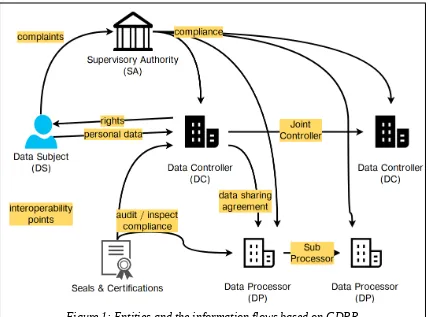
[image:2.595.85.513.453.770.2]An overview of the data interoperability model for GDPR can be seen in Fig. 1 which depicts the different entities along with the possible interoperability points between them along with examples of information and processes associated with each such point. Any interaction between two entities, even of the same type, can be considered as an interoperability point if it involves communication of specific information or structured data between them. Understanding the requirements of such communication and the associated information is a good step towards exploring the opportunities for standardisation.
Categorisation of Entities
For entities and the interoperability between them, we use the following abbreviations or denominations. A Data Subject (DS) is an individual or entity in the context of personal data. They are the user or recipient of a system or a service, and provide the consent for activities. Data Controller(s) or ‘Controller’ (DC) is an entity that determines the purposes and means of the processing of personal data. They can act jointly, in which case they are called Joint Controllers. A Data Processor (DP) is an entity that processes personal data on behalf of the controller. The relationship between controllers and processors is many-to-many, i.e. either can be associated with multiple entities of the other type. A sub-processor is a processor acting under another processor. They are bound by the same rules of agreement as the processor they are under with its controller. The Supervisory Authority (SA) or Data Protection Authority (DPA) is a public institution responsible for monitoring the application of data protection laws. These are the entities we consider to be within the scope of this paper. In addition, there are other entities mentioned in the GDPR such as - Representative of Controller, Processor, Data Subject, as well as the Regulatory Authority, and Certification Bodies.
Interoperability between Entities
There are several possible cases of interoperability between these entities as reflected by the model in Fig. 1. In this, each point of interaction between two entities is considered to be a point for interoperability between the two entities. Taking the entities under consideration as DS, DC, DP, and SA, we have a set of 6 possible points for interoperability without considering the direction of interaction. Additionally, since controllers and processors can interact with other controllers and processors respectively, and supervisory authorities can interact with other supervisory authorities, this brings the total count of possible points to 9. These are shown in the figure as well as listed in Table. 1 along with examples of information associated between the two entities.
The entities depicted in the model are taken from the text of the GDPR. Since only the type of entity is required for understanding and modelling the interaction, their size (large, medium, small, or individual) or nature (commercial, governmental, or not-for-profit) has no bearing on the interoperability point. Additional information may need to be exchanged based on specific requirements, though this requires a deeper review of the law and clarification through legal experts. We therefore do not consider such additional requirements to be within the scope of this paper. For entities such as governmental institutions and organisations that are in a position where information communication needs to be made available for dissemination to the public, we consider this as motivation to explore the requirements of sharing such data in an ‘open’ and ‘consistent’ manner. Where entities are commercial entities, interoperability is more concerned with consistency, structure, and correctness of information being exchanged.
secure forms of communications which may also require security in the information structuring itself, such as through encryption or establishment of secure channels. Any warning or ruling by the SA that can be considered public information, as in made available to the public, would need to be also published in an appropriate manner. The current norm for this is for the SA to publish details of use-cases along with their rulings or decisions on its website. Such information in the future might be collated in a registry or dataset using appropriate formats and structuring.
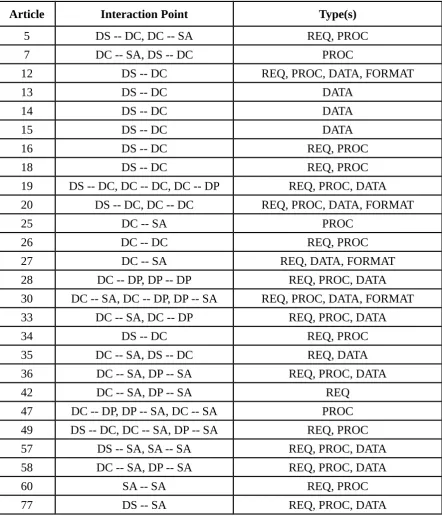
Table 1. Interaction points between entities in GDPR with type of statement.
Article Interaction Point Type(s)
5 DS -- DC, DC -- SA REQ, PROC
7 DC -- SA, DS -- DC PROC
12 DS -- DC REQ, PROC, DATA, FORMAT
13 DS -- DC DATA
14 DS -- DC DATA
15 DS -- DC DATA
16 DS -- DC REQ, PROC
18 DS -- DC REQ, PROC
19 DS -- DC, DC -- DC, DC -- DP REQ, PROC, DATA
20 DS -- DC, DC -- DC REQ, PROC, DATA, FORMAT
25 DC -- SA PROC
26 DC -- DC REQ, PROC
27 DC -- SA REQ, DATA, FORMAT
28 DC -- DP, DP -- DP REQ, PROC, DATA
30 DC -- SA, DC -- DP, DP -- SA REQ, PROC, DATA, FORMAT
33 DC -- SA, DC -- DP REQ, PROC, DATA
34 DS -- DC REQ, PROC
35 DC -- SA, DS -- DC REQ, DATA
36 DC -- SA, DP -- SA REQ, PROC, DATA
42 DC -- SA, DP -- SA REQ
47 DC -- DP, DP -- SA, DC -- SA PROC
49 DS -- DC, DC -- SA, DP -- SA REQ, PROC
57 DS -- SA, SA -- SA REQ, PROC, DATA
58 DC -- SA, DP -- SA REQ, PROC, DATA
60 SA -- SA REQ, PROC
77 DS -- SA REQ, PROC, DATA
However, DS also provide consent to the DC, which needs to follow certain guidelines stipulated by the GDPR regarding compliance which can affect the way consent is collected and stored. Though this puts no restriction on how the DC obtains this consent from the DS, the onus is on the DC to ensure that the obtained consent satisfied the obligations of the GDPR for demonstrating the validity of such consent. Therefore, it would be prudent for DC to obtain or convert the consent in a form that makes this process of compliance easier.
The interaction from DC to DS includes the provision of information regarding services and rights as mandated by GDPR. DC also has to provide information for rights such as right to data portability which allows DS to receive a copy of their personal data upon request. GDPR has particular clauses regarding the provision of this data, and its structure or format. Additionally, GDPR also provides for DS to get their personal data transferred from one DC to another, which requires both controllers should have some form of interoperability mechanism to send as well as accept the data in a manner that is mutually understandable.
For interactions between DC and DP, or DC and DC, or DP and DP, these points already have some interoperability as part of an organisation’s business practice. However, under GDPR, certain additional information may need to be shared in the operation of such services. This provides an opportunity for exploring whether a structured or a common format might provide advantages to existing practices. An approach suggesting an entirely new form of interoperability model would be difficult to uptake due to existing infrastructures. Alternatively, an approach that only considers the information necessary for compliance can be proposed as a solution that augments existing services rather than replaces them.
Interoperability as part of GDPR compliance is primarily outlined by the interactions between the Supervisory Authority and Controllers/Processors. The compliance information reflects the data required to demonstrate and determine the organisation’s compliance, which legally can be in any form as long as it contains the correct and sufficient information. For organisations, the process of maintaining, sharing, and demonstrating compliance using this information is a challenge that warrants looking at alternate approaches that can help with these activities. One avenue of possibility is provided in the case where this information is linked to information such as those related to processing activities that are also involved in compliance. Taking advantage of this relation, one can use a structured approach that provides an efficient and effective way for the storage, management, and querying of such related information.
Information flows
Each interaction point can have multiple GDPR clauses that affect the information as well as the processes associated with the information. This is presented in Table. 1 which presents a summary of the relevant articles in GDPR and their relation to interoperability, and is intended to present the GDPR clauses governing the data interoperability between different entities. While the table only shows a summarisation of the information, we have made available the full table online which contains annotations referenced with individual points within Articles and includes additional comments regarding interactions.
exchange of information, and are annotated as PROC in the table. Where information is categorically mentioned and has form or category, the abbreviation DATA is used to identify such statements in the table. Where additional information about category or type of data is specified, this is annotated with FORMAT which specifies an explicit data format mentioned in text or some guidelines governing the choice of formats which need to be enforced.
[image:6.595.80.522.331.496.2]While requirements and processes might not have a direct bearing on the data and specific formats used to carry out a particular activity, these are an important point of discussion as they present an abstract concept of the associated data. These form the background of the requirements gathering process for any such communication where the compliance of a requirement or the implementation of a process might guide the available standards for representing the data involved. For example, in Article 30 (1), the statement requires controllers to maintain logs or records of processing activities. While this statement refers to the abstract information associated with processing activities, it can also be used to interpret and formulate records of activities into more structured information which would be useful to discuss standardisation of such records. In this section, we identify and explore such types or categories of abstract information from the selected articles outlined in Table. 1.
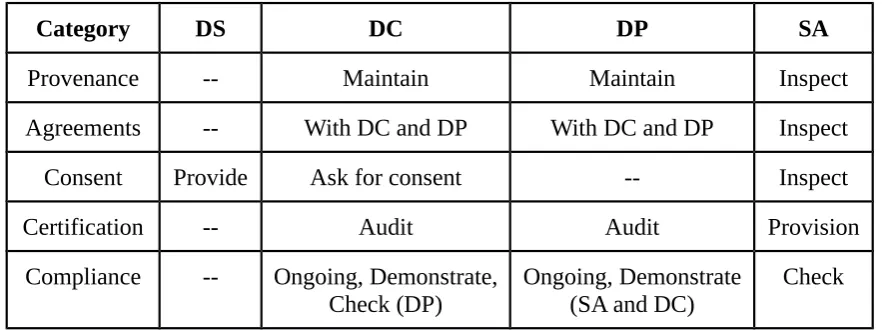
Table 2. Describing the relation between information categories and entities
Category DS DC DP SA
Provenance -- Maintain Maintain Inspect
Agreements -- With DC and DP With DC and DP Inspect
Consent Provide Ask for consent -- Inspect
Certification -- Audit Audit Provision
Compliance -- Ongoing, Demonstrate,
Check (DP) Ongoing, Demonstrate(SA and DC) Check
Categorising Information Flows
For the current paper, we only consider certain information categories and explore them in more detail. These are - provenance, agreements, consent, certification, and compliance. The entities and interactions involving these information categories are listed out in Table. 2 which describes the information associated with each information category and the entities involved.
Provenance
consent tracking its creation (obtaining), use within different activities, how it is stored, and finally its deletion (invalidation). Compliance then becomes a matter of introspection such provenance logs to see whether the activities recorded the correct and compliant behaviour. A deeper example is that of checking whether a consent was validly given, which requires that the consent be freely given, specific, and unambiguous. Since detecting is not possible without manual oversight, the artefacts and processes involved in the obtaining of provenance can be useful in capturing the state of things as present when obtaining the specific consent. Depending on the manner of representing provenance, the lifecycle of consent can then be traced with sufficient granularity and abstraction to link it with activities that depend on it, thereby making it possible to also determine whether the consent was used as intended by the terms of the GDPR.
As provenance information potentially encompasses all artefacts and processes requiring compliance, it can be argued that having interoperability with relation to sharing and evaluating provenance information would greatly benefit the compliance operations for both the organisation as well as the authorities. Additionally, as compliance itself involves several activities and the creation of artefacts such as compliance reports, this information can also be defined using a common provenance format for reuse and dissemination. Such forms of interoperability can be used in any interactions where provenance information needs to be shared or evaluated, such as is also the case with controllers and processors where there is a need to define activities that need to take place, or to maintain a joint or collaborative record of activities undertaken that involve both entities. This is especially useful when information needs to be shared that involves lifecyles of artefacts such as consent and personal data need to be tracked or charted across activities. Provenance defined in such manner has led to approaches in the existing corpora of work to create a privacy impact assessment template (Reuben et al., 2016) and creating components based on activities (Mense & Blobel, 2017).
Data Sharing Agreements
Consent
Consent in the context of the GDPR refers to the assent or agreement by the data subject in relation to their personal data for the proposed processing activities associated with one or more entities. Given consent refers specifically to the form of consent given by the data subject in relation to their personal data and the proposed usage by activities (Ross, 2017). Consent can be considered to be an agreement between the data subject and the data controller (or other entity), and can therefore benefit from the same approach for implementing the data sharing agreements. This provides consistency in technology as well as encourages adoption of uniform standards and interoperability in dealing with similar use-cases.
GDPR specifies certain requirements which guide the acquisition and demonstration of consent for it to be deemed to be valid (Mittal 2017). These include the stipulation that consent must be freely given, must be informed, specific, and voluntary. Of these, only the specificity of consent can be gauged from a given consent in a form such as an agreement. Given consent contains the terms which have been accepted by the user, which can be used to gauge the specificity of the agreement, and therefore decide on whether the consent itself was specific or broad under the GDPR. For other stipulations related to valid consent, it is essential to refer to the process and artefacts used to acquire the consent to understand the conditions under which the consent agreement was provided to the data subject and how it was accepted or given or agreed.
For example, in cases where the consent is acquired through a web-form (Fatema et al., 2017), the entire web-page may need to be preserved to demonstrate that the consent acquisition process was in accordance with the conditions under the GDPR. Therefore, while the given consent may be represented in any form, it also has to somehow be linked to the processes responsible for acquiring the consent. Additionally, any revision of consent data such as when updating or revoking consent also needs to be stored in a way that can be linked to the processes involved in the change as well as linked to the original consent. This is important as a matter of compliance as GDPR enforcement may require demonstration that a change in consent was carried out correctly, which is only possible through an introspection of what the original and changed versions of the consent are. This also introduces the dependency-like relation between data processes and consent where consent should be inherently linked to the processes that depend on it. For example, if the process of using personal data to send emails is dependant on the consent obtained from the user at the time of registration, then it is vital to show that the two are linked together, i.e. the emails are only sent based on the given consent. Such a system must also be able to demonstrate that updated consent has immediate effect on the processes that depend on consent.
These requirements show the inherent dependency of consent and personal data along with the processes involved which presents a strong argument for representing them together using the same method of provenance. Such a method capturing the various stages of consent and personal data as lifecycles involving processes and artefacts would enable documentation representing the model of the system as a whole. The individual records or logs of activities can then be instantiated based on the model to capture user or event specific information.
Compliance
practices and processes regarding evaluation of compliance from the design stage at the earliest. Such processes ensure that a new service or change in an existing service are compliant before they begin the operation. Several people might be involved in design and operation of the system, but the responsibility of ensuring the compliance falls on the management or on Data Protection Officer (DPO) if appointed. In any case, such checks of compliance are integral to audits by the organisation itself or a third-party hired by the organisation for ensuring proper legal requirements are met by their activities. A record of such activities and its outcome is therefore an essential outcome of such audits or compliance processes and forms part of the compliance information maintained by the organisation. Such information would prove to be helpful for supervisory authorities who might wish to inspect the activities of an organisation and determine responsibility in cases where multiple entities are involved.
Such information of compliance related activities can be represented as provenance though the processes and artefacts involved in this case are different from those related to the consent and personal data lifecycles. To a certain extent, depending on the structuring of compliance activities, it is possible to consider the compliance related activities as part of a compliance lifecycle where the outputs of activities such as various reports can be mapped along a timeline using provenance methods similar to those previously outlined. There might be additional requirements of ensuring the security and integrity of such records, though this probably would not have any bearing on the depiction of the information itself. Instead, any concerns related to the data being tampered or accessed without proper authorisation can be mitigated through proper storage and handling of this information. This also allows the provenance representation required for compliance lifecycles to be consistent in its purported use-case with those related to provenance of consent and personal data lifecycles.
Certifications
GDPR has provisions for seals and certifications which can help organisations with a measure of compliance as well as good practices. These have a maximum validity of three years and have certain conditions or criterion for the creation and issuing of seals and certifications pertaining to GDPR compliance. The seal or certification does not reduce or impact the responsibility of the controller or processor for compliance with the GDPR, but acts as a method of displaying or providing information regarding compliance. The exact nature of such seals and certifications and their role with respect of demonstration of compliance to the authorities is still under consideration.
An existing example of such a mechanism is EuroPriSe (European Privacy Seal, n.d.) which carries out an audit of an organisation before providing a seal which is accompanied by a public report published on its website describing the process. The document describes the processes and their compliance with respect to GDPR obligations. While the document itself may be sufficient to demonstrate certain facts regarding the organisation’s processes, the fact that it is not published in a format that can be reused by the organisation restricts its usage. The organisation who was the subject of the report has only the option to refer to the report through a legal form of citation.
accompanying report having a validity of a maximum three years requires the controller and processor to investigate their respective agreements at the end of this report. Agreements therefore needs to consider this process as a requirement which hinders the automatic resolution of agreements between the two parties. One way to mitigate this is to keep this requirement out of the automation, in which case the agreements would continue to operate even when the report validity has lapsed. Another case is where processes change and the processor must renew its certification. If it is able to demonstrate the changes in its processes, the reports can possibly be linked to the version or iteration of process it evaluated, thereby also providing a way for agreements to view and use this information. Even without use in automated agreements, the structuring of such information may provide a strong use within the organisation of compliance related information by cross-linking or cross-referencing the information in documentation that can be continuously updated.
Identifying opportunities for commonality and interoperability
As seen from the previous descriptions of various information categories, provenance forms a strong underlying structure for all categories where processes or data artefacts can be captured and represented for various use cases. Similarly, the dependence between the different information types also demonstrates the advantages of linking them together to create more efficient systems capable of automation and better documentation. This provides an opportunity to combine the approach towards representing the different types information into a cohesive model that operatives at a higher and more abstract level to represent the entire system’s information model. It also highlights the points of interoperability internally within an organisation. While it is still possible to pick and choose which information or category should be represented individually, we think the overall benefits afforded by a cohesive model are better suited for the functioning of the service and its compliance.
We mainly identify the use of lifecycles for representing the processes and artefacts, whether internal or external to the organisation, as forms of documentation. This provenance information forms the basis of other information categories as it involves documenting the use of consent and personal data, formation of data sharing agreements, and recording compliance audits and provision of produced reports. This information is also required to be shared with other entities such as where processors are required to outline their processes to the controllers, and authorities may request to review processes for compliance. The use of provenance also allows recording the occurrence of events such as archival and deletion of consent and personal data which can be vital in the demonstration of compliance.
W3C Standards
In this section, we explore existing standards and their suitability towards interoperability of information specific to the requirements set forth in the previous analysis of the GDPR. We consider all approaches - including research and academia, commercial, bodies involved in maintaining standards - with the caveat of the standard being open and non-proprietary. We argue that the use of such open standards fosters better community participation and adoption. For the scope of this paper, we restrict our exploration of standards to those published by the World Wide Web Consortium (W3C) as it is the main standards body responsible for information exchange on the internet. As the exchange of information is most likely supported and occurs through the medium of the web, these standards can be readily integrated into mediums such as websites and web services which form the backbone of interoperability for many organisations, both commercial as well as public institutions.
W3C standards undergo various stages of development starting from “Working Draft (WD)” to “Candidate Recommendation (CR)” which are then moved to the “Proposed Recommendation (PR)” stage before being set as a “W3C Recommendation (REC)”. It is usually considered that standards at stages PR and REC are sufficiently matured to be adopted into usage as they rarely have any significant changes. We therefore consider only those standards which fall in either stages as being suitable for recommendation in this paper.
For representing provenance, we have the Provenance Data Model i.e. PROV-DM (PROV-O: The PROV Ontology, n.d.), which is a W3C recommendation since 30th April 2013 and provides definitions for interchange of provenance information. Using PROV, we can define entities and the various relations and operations between them such as generated by, derived from, and attributions. PROV has been successfully utilised in several domains and applications including encapsulation of scientific workflows and provenance repositories. PROV was designed to be generic and domain independent, and needs to be extended to address the requirements to represent workflow templates and executions. There are existing approaches in academia that utilise PROV in approaches specific to the representation of provenance information related to GDPR (Pandit & Lewis, 2017).
The Open Digital Rights Language, abbreviated as ODRL (ODRL Information Model 2.2, n.d.), is a proposed recommendation policy expression language that provides a flexible and interoperable information model, vocabulary, and encoding mechanisms for representing statements about the usage of content and services. The ODRL Information Model describes the underlying concepts, entities, and relationships that form the foundational basis for the semantics of the ODRL policies. Policies are used to represent permitted and prohibited actions over a certain asset, as well as the obligations required to be meet by stakeholders. In addition, policies may be limited by constraints (e.g., temporal or spatial constraints) and duties (e.g. payments) may be imposed on permissions. ODRL can be utilised for representing agreements, which can include both data sharing agreements as well as the representation of consent.
that in RDF. Reusing such standards provides a form of interoperability in the form of underlying technology utilised to create, store, and query the information. Therefore, any additional standards or formats developed for application-specific approaches should be based on existing forms of standards in order to take advantage of existing practices and adoption of technologies. This line of argument is line with the recent uptake of open-data publishing by the European Publications Office using mechanisms based on RDF and open data formats. Additionally, these existing standards can be used to provide data related to the right of data portability accorded by the GDPR that requires organisations to provide a copy of personal data in a format that is structured, commonly used and machine-readable.
CEN / CENELEC / ETSI
The European Committee for Standardization (CEN) is a public standards organization consisting of thirty four national members that work together to develop European Standards (ENs) in various sectors. CEN is officially recognised as a European standards body by the European Union. The other official European standards bodies are the European Committee for Electrotechnical Standardization (CENELEC) and the European Telecommunications Standards Institute (ETSI). Together, these standardisation bodies provide a large framework of interoperable standards that aim to foster free trade and public benefit. Previously, there was a significant overlap and between the CEN and ISO standards, with some of them presenting potentially conflicting resolutions. This was rectified by the Vienna Agreement where CEN and ISO agreed to avoid duplication of standards. This has resulted in CEN adopting a number of ISO standards which have superseded or replaced existing CEN standards.
ISA²
The Interoperability solutions for public administrations, businesses and citizens (ISA²) programme develops and provides digital solutions that enable public administrations, businesses and citizens in Europe to benefit from interoperable cross-border and cross-sector public services. The programme was adopted in November 2015 by the European Parliament and the Council of European Union. ISA² is the follow-up programme to ISA, and aims to ensure interoperability activities are well coordinated at EU level through a structured plan consisting of a revision to the European Interoperability Framework (EIF) and the European Interoperability Strategy (EIS), along with development of the European Interoperability Reference Architecture (EIRA) and European Interoperability Cartography (EIC) solutions.
Conclusion
Through this paper we have explored the information flows influenced by the General Data Protection Regulation (GDPR) with a goal towards a data model for interoperability. We identified the various entities involved in such information flows and the nature of their relationships with respect to information interoperability. This was done using an analysis of the text of the GDPR where relevant article for each entity and their associated information flow were identified and published in this paper. This was then used to categorise the relevant articles in GDPR based on their effect on each interaction point. We explored five information categories in this paper, which were provenance, data sharing agreements, consent, certification, and compliance along with the dependencies between them. We presented ideas and motivations for exploiting the commonality in these information categories with a view towards interoperability at both internal and external levels for organisations. For representing this information, we evaluated W3C standards based on maturity and recommendation for the identified information categories.
Through this work, we hope to have presented a sufficient motivation for further exploring the interoperability model and the relation of information flows between different entities. We also would like to further work on information categories such as consent and compliance which have not seen much exploration in terms of interoperability and standardised representation. While there is no legal requirement to adopt standards for exchange of data, doing so has several benefits for the involved entities. Primarily, it allows a common language for exchange of data, which reduces the burden for developing targeted solutions for different organisations. A common technological base can help in the creation and adoption of community-wide frameworks that foster interoperability. Additionally, such commonality in data would also help the supervisory authorities as well as data subjects in understanding and acting on given data.
Acknowledgements
This paper is supported by the ADAPT Centre for Digital Content Technology, which is funded under the SFI Research Centres Programme (Grant 13/RC/2106) and is co-funded under the European Regional Development Fund.
References
European privacy seal. https://www.european-privacy-seal.eu/ . (Accessed: 2018-03-26)
Fatema, K., Hadziselimovic, E., Pandit, H. J., Debruyne, C., Lewis, D., & O’Sullivan, D. (2017). Compliance through informed consent: Semantic based consent permission and data management model. In 5th workshop on society, privacy and the semantic web - policy and technology (PrivOn 2017). Retrieved from http://ceur-ws.org/Vol-1951/#paper-05
Mense, A., & Blobel, B. (2017). Hl7 standards and components to support implementation of the European general data protection regulation. European Journal for Biomedical Informatics, 13 (1), 27–33.
Mittal, S. (2017). The role of consent in legitimising the processing of personal data under the current EU data protection framework.
ODRL information model 2.2. https://www.w3.org/TR/odrl-model/ (Accessed: 2018-03-26)
Pandit, H. J., Fatema, K., OSullivan, D., & Lewis, D. (in-press). GDPRtEXT – GDPR as a linked data resource. The Semantic Web - 15th International Conference, ESWC 2018, Crete, Greece, June 3 - June 7, 2018. https://2018.eswc-conferences.org/wp-content/uploads/2018/02/ESWC2018_paper_135.pdf
Pandit, H. J., & Lewis, D. (2017). Modelling provenance for gdpr compliance using linked open data vocabularies. In 5th workshop on society, privacy and the semantic web -policy and technology (privon2017) (privon). http://ceur-ws.org/Vol-1951/#paper-06
PROV-O: The PROV ontology. https://www.w3.org/TR/prov-o/ (Accessed: 2018-03-26)
Regulation (EU) 2016/679 of the European Parliament and of the Council of 27 April 2016 on the protection of natural persons with regard to the processing of personal data and on the free movement of such data, and repealing Directive 95/46/EC (General Data Protection Regulation). (2016, May 4). Official Journal of the European Union, L119, 1–88. Retrieved from http://eur-lex.europa.eu/legal-content/EN/TXT/?uri=OJ:L:2016:119:TOC
Reuben, J., Martucci, L. A., Fischer-H ubner, S., Packer, H. S., Hedbom, H., & Moreau, L. ̈
(2016). Privacy impact assessment template for provenance. In Availability, reliability and security (ares), 2016 11th international conference on (pp. 653–660).
Ross, H. (2017). Data subject consent: How will the general data protection regulation affect this? Journal of Data Protection & Privacy, 1 (2), 146–155.