LSDSem 2017: Exploring Data Generation Methods for
the Story Cloze Test
Michael Bugert∗, Yevgeniy Puzikov∗, Andreas R¨uckl´e∗, Judith Eckle-Kohler∗, Teresa Martin†, Eugenio Mart´ınez-C´amara∗,
Daniil Sorokin∗, Maxime Peyrard†and Iryna Gurevych∗ ∗Ubiquitous Knowledge Processing Lab (UKP-TUDA) Department of Computer Science, Technische Universit¨at Darmstadt
www.ukp.tu-darmstadt.de
†Research Training Group AIPHES
Department of Computer Science, Technische Universit¨at Darmstadt
www.aiphes.tu-darmstadt.de
Abstract
The Story Cloze test (Mostafazadeh et al., 2016) is a recent effort in providing a com-mon test scenario for text understanding systems. As part of the LSDSem 2017 shared task, we present a system based on a deep learning architecture combined with a rich set of manually-crafted linguistic fea-tures. The system outperforms all known baselines for the task, suggesting that the chosen approach is promising. We addi-tionally present two methods for generat-ing further traingenerat-ing data based on stories from the ROCStories corpus. Our system and generated data are publicly available on GitHub1.
1 Introduction
The goal of the Story Cloze test is to provide a com-mon ground for the evaluation of systems on lan-guage understanding (Mostafazadeh et al., 2016). Given four sentences of a story on everyday life events, a system has to identify the correct ending from a set of two predefined ending sentences. The “correct” ending in this case is the one which most humans would choose as the closing sentence for the story context.
We first report the discoveries we made while ex-ploring the provided datasets (Section 2) followed by a description of our system (Section 3). We present and discuss its results (Sections 4 and 5) and come to a close in the conclusion (Section 6). 2 Dataset Exploration
Mostafazadeh et al. (2016) provide a validation and
1github.com/UKPLab/lsdsem2017-story-cloze
a test set for the Story Cloze test, both of which contain around1800stories2. Each of those stories consists of four context sentences and two end-ings to choose from. Additionally, twoROCStories datasets were made available with close to100 000 stories in total. Stories from these datasets also cover everyday life events but consist of a fixed number of five sentences without ending candi-dates.
To gain an overview of the task, we categorized two hundred stories from the validation set based on how their correct ending can be identified.
We noticed that a large set of stories can indeed be solved via text understanding and logical infer-ence. This includes stories where the correct end-ing is more likely accordend-ing to script knowledge3 (Schank and Abelson, 1977), where the topic of the wrong ending doesn’t match the story context4 or where the wrong ending contradicts the story context5.
For some stories, the correct ending cannot be identified rationally, but rather according to com-monly accepted moral values6 or based on the reader’s expectation of a positive mood in a story7. Regarding sentiments, we generally noticed a bias towards stories with “happy endings”, i. e. stories where the sentiment expressed in the correct ending is more positive than for the wrong ending.
We infer from these observations that an ap-proach focusing exclusively on text understanding
2As of Feb. 2017, see cs.rochester.edu/nlp/rocstories 3See story 52dbbfda-5b42-4ace-8d59-55cee3eb30c0 in the
Story Cloze validation set.
4See f8ff777f-de4d-4e3a-91bd-b197ed13f78e ibid. 5See a11cf506-7d19-4ab9-b0ac-a0fd85a9bd38 ibid. 6See 195a43c7-d43e-48e4-845b-fd6c75609df2 ibid. 7See 80b6447f-4c37-4194-9862-3785e5075463 ibid.
should perform well. However, the dataset suggests that an approach which (additionally) exploits how humans write and perceive stories could also lead to respectable results, albeit not in the way origi-nally intended for the Story Cloze test.
3 System Description
We interpret the Story Cloze test as a fully super-vised learning problem, meaning we train and test our approach on instances consisting of four con-text sentences and two ending candidates (i. e. the format of the Story Cloze datasets). This stands in contrast to the systems reported by Mostafazadeh et al. (2016) which were trained on five-sentence stories (the ROCStories dataset).
Our approach builds around recent advances of deep learning methods and conventional feature engineering techniques.
The core of the system is a Bidirectional Recur-rent Neural Network (BiRNN) (Schuster and Pali-wal, 1997) with Long Short-Term Memory (LSTM) units (Hochreiter and Schmidhuber, 1997), which computes a feature representation of all given sen-tences. This representation is enriched by feature vectors computed over both ending candidates. To predict the correct ending of a story, we execute our neural network twice to obtain a score for each ending. These scores are compared to make a final decision. The feature vectors ensure that informa-tion on the respective other ending is available to the network during both executions.
Note that we could have instead learned ending embeddings jointly by feeding the network with both endings at the same time. In order to train a network to distinguish between correct and wrong endings, we would have had to feed the same pair another time, but with the endings swapped and the label set to its binary counterpart. However, we were concerned that such a system would eventu-ally learn the position of the correct ending instead of its meaning. Hence, we decided against such a joint learning approach.
The following sections cover the features and neural network architecture in greater detail.
3.1 Features
We defined a set of linguistic features in order to profit from the discoveries of our dataset explo-ration (see Section 2). The features are:
NGramOverlap: The number of overlapping n-grams between an ending and a story context
s1 s2 s3 s4 e1 e2
Embed. Lookup
≡ ≡ ≡ ≡
vc
≡
veBiLSTM
ic ie
Feat. Extr.
if
H
[image:2.595.326.504.60.268.2]O
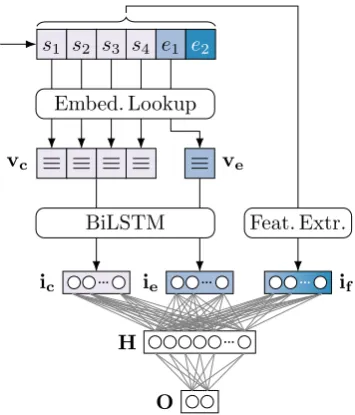
Figure 1: Neural network architecture. Depicted is the execution for obtaining a score for endinge1.
forn={1,2,3}. We filtered out bigrams and trigrams using a linguistically motivated list of stopwords.
EndingLength: The token count of an ending. Negation: The presence of words indicating
nega-tion (none,never, etc.) in an ending.
PronounContrast: The presence of pronoun mis-matches between a story context and an end-ing. This helps to detect cases where the wrong ending is written in first person al-though the story context is written in third person.
SentiContrast: Disagreement in the sentiment value between the third and fourth sentences of a context and an ending. The sentiment value was computed based on a sentiment word list manually extracted from the ROC-Stories dataset.
For each of the features listed above, an addi-tional feature was added to model the feature value difference between the two endings of a story. All features were extracted using the DKPro TC Frame-work (Daxenberger et al., 2014).
3.2 Neural Network
The overall architecture of our neural network model is shown in Figure 1.
First, the tokens of the context sentences s1, . . . , s4 and of endinge1 are looked up in the
those of the ending form vectorve.vcandveare
fed separately to a pair of RNN networks (forward and backward) with LSTM units. This BiLSTM module encodes the meaning of context and ending in two separate vectors,icandie. Given the vector
of feature valuesif, extracted externally on the four
context sentences and both endings, we concate-nateic,ieandif and feed them to the dense hidden
layerH. The output ofHis fed to the output layer,
O. Afterwards, the softmax function is applied on the output ofOto obtain a score representing the probability of endinge1being correct.
The same procedure is applied for ending e2
in place of endinge1. Then, the highest-scoring
ending is chosen as the correct ending of the story. Due to time constraints and system complexity we decided against hyper-parameter optimization and chose parameter values we deemed reasonable: We used pretrained 100-dimensional GloVe embed-dings (Pennington et al., 2014)8. Following previ-ous work on using BiLSTMs in NLP tasks (Tan et al., 2015; Tan et al., 2016; dos Santos et al., 2016), we chose a dimensionality of141for the LSTM output vectors and hidden layerH.
We employ zero padding for sentences longer than 20 tokens. The network was trained in batches (size 40) for 30 epochs with the Adam optimizer (Kingma and Ba, 2014), starting with a learning rate of10−4. We apply dropout (p= 0.3)
after computing the BiLSTM output. Finally, ReLu (Glorot et al., 2011) is used as an activa-tion funcactiva-tion in layerH. The system was imple-mented using the TensorFlow library (Abadi et al., 2016).
3.3 Intermediate Results
We performed an intermediate evaluation of the previously described system on the Story Cloze val-idation set. To this end, we partitioned the dataset into a training and development split (85 %and 15 %, respectively). We compared the following systems:
BiLSTM-V: Our proposed system, trained on the 85 %training split without making use of the feature set described in Section 3.1.
BiLSTM-VF: Same as BiLSTM-V, but including the feature set.
Happy: Motivated by our dataset exploration, this baseline always picks the happier ending (the ending with the more positive sentiment). We
8nlp.stanford.edu/data/glove.6B.zip
employed the state-of-the-art sentiment anno-tator by Socher et al. (2013) for this purpose. This system does not take the story context into account.
The happy ending baseline reached an accuracy of0.616on the development split which is substan-tially higher than random guessing. BiLSTM-V scored 0.708 whereas BiLSTM-VF reached a slightly higher accuracy of0.712.
3.4 Dataset Augmentation
Because our presented approach conducts super-vised learning, it requires training data in the same form as testing data. Up to this point, the only dataset available in this form is the Story Cloze validation set which consists of comparably few instances for training. We experimented with ways to automatically create larger training datasets. 3.4.1 Related Work in Data Augmentation Methods for automatic training data augmenta-tion using unlabeled data are investigated in semi-supervised learning and have been successfully ap-plied in many NLP tasks, for example in word sense disambiguation (Pham et al., 2005), semantic role labeling (F¨urstenau and Lapata, 2012; Woodsend and Lapata, 2014) and textual entailment (Zanzotto and Pennacchiotti, 2010). Another example, which is similar to the Story Cloze test, is the task of selecting the correct answer to a question from a pool of answer candidates. To train models for this task, Feng et al. (2015) have extended a corpus of question-answer pairs by automatically adding negative answers to each pair.
We draw our inspiration from the aforemen-tioned work and propose two methods for augment-ing the ROCStories dataset in order to use it for supervised learning.
3.4.2 Shuffling
Given a ROCStory, shuffle the four context sen-tences, then randomly swap the fifth sentence with one of the first four. The resulting story is per-ceived as wrong by humans since the shuffling breaks causal and temporal relationships between the sentences. This method resembles the data quality evaluation conducted by Mostafazadeh et al. (2016).
3.4.3 KDE Sampling
Story ID Story Context Correct Ending Gen. Wrong Ending 3447901e-6f57
-4810-9d3c -92d72b6c0b42
A swan swam gracefully through the water. It was beautiful and white. It had a long orange beak. The crowd gathered and observed it.
It was a beautiful
crea-ture. A large blue whalebreached the water be-fore Kathy’s eyes. 0dd3e2c3-3ea4
-450a-97c4 -42a54c426018
Jane had recently gotten a new job. She was nervous about her first day of work. On the first day of work, Jane overslept. Jane arrived at work an hour late.
Jane did not make a good impression at her new job.
[image:4.595.311.515.181.314.2]She told her husband that she was going all out this year.
Table 1: ROCStories with wrong endings as generated by the KDE sampling technique
from a pool of sentences. The pool can be chosen arbitrarily but for the sake of simplicity, we de-cided to use the existing set of ROCStory endings themselves.
Given four ROCStory context sentences, we measure the similarity between this context and each sentence from the pool (excluding the original ending). To ensure that endings match the topic and narrative of their context, our similarity measure is based on word embeddings of content words and a bag-of-words vector of occurring pronouns.
Instead of directly choosing whichever ending sentence scores the highest similarity, we attempt to replicate the characteristics of the Story Cloze datasets as close as possible. Therefore, we ob-serve the distribution of similarity values present between each story context and its wrong ending in the validation set. Using kernel density estimation, we obtain the probability density function (PDF) of these similarity values.
To choose an ending for a ROCStory context, we then sample a similarity value from this PDF and identify the sentence in the pool whose similarity is closest to the sampled value. In a final step, we replace proper nouns occurring in the ending sentence with random proper nouns from the story context, based on POS-tags.
Table 1 shows two exemplary story endings gen-erated using this method.
3.4.4 Comparison
We constructed two training datasets, one for each of the two augmentation methods. We then trained our BiLSTM approach (without features) for each dataset and compared their performance on the full Story Cloze validation set. The BiLSTM using the shuffled ROCStories reached an accuracy of 0.615, compared to the one using the KDE sam-pling method with0.630.
From looking at the accuracies, the difference in quality between the two methods is slim. How-ever, the quality of the shuffled stories is inferior to those of the KDE sampling method from a human
0 510 25 35 50 65 75 90 100 0
20 40 60 80
70
.
8
66
.
2
65
.
5
59
.
8
59
.
8
59
.
8
61
.
6
61
.
2
62
.
6
63
.
3
% of all generated stories used
Accuracy
(%)
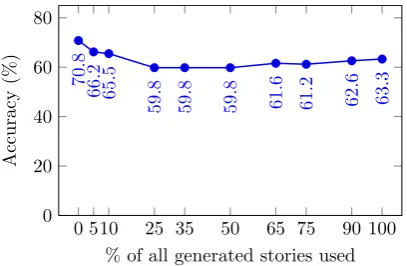
Figure 2: Accuracies on the validation set devel-opment split for BiLSTM systems trained on the training split plus a varying amount of all98 166 generated stories.
point of view. For this reason, we conduct all sub-sequent data augmentation experiments using the KDE sampling method.
4 Results
Following our motivation for data augmentation, we trained several BiLSTM systems on the train-ing split of the Story Cloze validation set, aug-mented by a varying amount of stories generated by KDE sampling. Figure 2 shows the accuracy of these systems evaluated on the15 %development split of the validation set. As can be seen, in all our experiments with augmentation there occurs a decrease in performance compared to the results of BiLSTM-V/BiLSTM-VF on the same data (see Section 3.3). We discuss possible reasons for this result in Section 5.
For the final evaluation, we compare the follow-ing approaches:
DSSM: The best performing baseline reported by Mostafazadeh et al. (2016).
Happy, BiLSTM-V, BiLSTM-VF: The systems previously explained in Section 3.3.
Approach Validation Test Dev Full
DSSM – 0.604 0.585
[image:5.595.98.266.65.193.2]Happy 0.616 0.590 0.602 BiLSTM-V 0.708 – 0.701* BiLSTM-VF 0.712 – 0.717* BiLSTM-T 0.637 – 0.560 BiLSTM-TF 0.634 – 0.584
Table 2: System accuracies on the Story Cloze datasets. Results marked by * are statistically significant according to McNemar’s test with a
p-value≤0.05.
generated wrong endings.
BiLSTM-TF: Same as BiLSTM-T, but including the feature set.
Table 2 shows the performance of the systems on the Story Cloze test set and (if applicable) on the full validation set or its development split. It can be seen that our happy ending baseline performs comparably to the more elaborate DSSM baseline. BiLSTM-V/VF outperform the two baselines sig-nificantly. BiLSTM-T/TF fall short in accuracy compared to the ones trained on the validation set alone. The addition of features leads to improve-ments except for BiLSTM-T/TF when evaluated on the development split of the validation set.
5 Discussion
We manually examined several stories which were misclassified by BiLSTM-VF to identify its weak-nesses. In the majority of cases, misclassified sto-ries were sparse in sentiment or relied heavily on logical inference for identifying the correct end-ing. This appears plausible to us, since neither the BiLSTM nor the feature set were explicitly de-signed to perform advanced logical inference.
The proposed features increase the performance of our BiLSTM system. The data properties they capture are different from the distributional similar-ities of word embeddings and thus serve as an ad-ditional supervising signal for the neural network.
Given Figure 2 and the disparity between the results of BiLSTM-T/TF and BiLSTM-V/VF, we have to conclude that the training data augmenta-tion did not work as well as we expected.
While the KDE sampling method creates sto-ries resembling the ones found in the Story Cloze
validation and test datasets, it does not reproduce the characteristics of these original stories well enough to produce truly valuable training data. As an example, the method does not take sentiment into account, although we demonstrated that the Story Cloze datasets are biased towards happy end-ings. Incorporating further characteristics into the method would amount to redefining the utilized similarity measure (no modifications would be nec-essary for the core idea of sampling a probability distribution).
6 Conclusion
We showed that using a sentiment-based baseline, it is trivial to reach 60 % accuracy on the Story Cloze test set without relying on text understand-ing. However, more sophisticated techniques are required for reaching better results. Using a deep learning architecture enriched with a set of linguis-tically motivated features, we surpass all previously published baselines on the task and reach71.7% accuracy on the test set.
We proposed two methods which generate ad-ditional training data for conducting supervised learning on the Story Cloze test. To our surprise, the systems trained on generated training data per-formed worse than those trained on conventional training data. This could be due to our data genera-tion not reproducing the characteristics of the origi-nal Story Cloze datasets well enough. Nonetheless, we consider the presented methods to be a valuable contribution related to the task.
Acknowledgments
We thank the anonymous reviewers for their valu-able comments and insights.
This work has been supported by the German Re-search Foundation as part of the ReRe-search Training Group “Adaptive Preparation of Information from Heterogeneous Sources” (AIPHES) under grant No. GRK 1994/1, as part of the German-Israeli Project Cooperation (DIP, grant No. DA 1600/1-1 and grant No. GU 798/17-1), and as part of the QA-EduInf project (grant No. GU 798/18-1 and grant No. RI 803/12-1).
References
Sherry Moore, Derek G. Murray, Benoit Steiner, Paul Tucker, Vijay Vasudevan, Pete Warden, Martin Wicke, Yuan Yu, and Xiaoqiang Zheng. 2016. Ten-sorFlow: A System for Large-Scale Machine Learn-ing. In12th USENIX Symposium on Operating Sys-tems Design and Implementation (OSDI 16), pages 265–283, GA. USENIX Association.
Johannes Daxenberger, Oliver Ferschke, Iryna Gurevych, and Torsten Zesch. 2014. DKPro TC: A Java-based Framework for Supervised Learning Experiments on Textual Data. In Proceedings of 52nd Annual Meeting of the Association for Compu-tational Linguistics: System Demonstrations, pages 61–66. Association for Computational Linguistics. C´ıcero Nogueira dos Santos, Ming Tan, Bing Xiang,
and Bowen Zhou. 2016. Attentive Pooling Networks. CoRR, abs/1602.03609.
Minwei Feng, Bing Xiang, Michael R. Glass, Lidan Wang, and Bowen Zhou. 2015. Applying deep learn-ing to answer selection: A study and an open task. In 2015 IEEE Workshop on Automatic Speech Recogni-tion and Understanding (ASRU), pages 813–820. Hagen F¨urstenau and Mirella Lapata. 2012.
Semi-Supervised Semantic Role Labeling via Structural Alignment.Computational Linguistics, 38:135–171. Xavier Glorot, Antoine Bordes, and Yoshua Bengio. 2011. Deep sparse rectifier neural networks. In AISTATS, volume 15, page 275.
Sepp Hochreiter and J¨urgen Schmidhuber. 1997. Long Short-Term Memory. Neural Computation, 9:1735– 1780.
Diederik P. Kingma and Jimmy Ba. 2014. Adam: A Method for Stochastic Optimization. CoRR, abs/1412.6980.
Nasrin Mostafazadeh, Nathanael Chambers, Xiaodong He, Devi Parikh, Dhruv Batra, Lucy Vanderwende, Pushmeet Kohli, and James Allen. 2016. A Corpus and Cloze Evaluation for Deeper Understanding of Commonsense Stories. InProceedings of the 2016 Conference of the North American Chapter of the Association for Computational Linguistics: Human Language Technologies, pages 839–849, San Diego, California. Association for Computational Linguis-tics.
Jeffrey Pennington, Richard Socher, and Christopher Manning. 2014. GloVe: Global Vectors for Word Representation. InProceedings of the 2014 Confer-ence on Empirical Methods in Natural Language Pro-cessing (EMNLP), pages 1532–1543, Doha, Qatar. Association for Computational Linguistics.
Thanh Phong Pham, Hwee Tou Ng, and Wee Sun Lee. 2005. Word Sense Disambiguation with Semi-supervised Learning. InProceedings of the 20th Na-tional Conference on Artificial Intelligence - Volume 3, AAAI’05, pages 1093–1098, Pittsburgh, Pennsyl-vania. AAAI Press.
Roger C. Schank and Robert P. Abelson. 1977.Scripts, Plans, Goals, and Understanding: An Inquiry Into Human Knowledge Structures. The Artificial Intelli-gence Series. Lawrence Erlbaum Associates. Mike Schuster and Kuldip K. Paliwal. 1997.
Bidirec-tional recurrent neural networks. IEEE Trans. Signal Processing, 45:2673–2681.
Richard Socher, Alex Perelygin, Jean Wu, Jason Chuang, Christopher D. Manning, Andrew Ng, and Christopher Potts. 2013. Recursive Deep Models for Semantic Compositionality Over a Sentiment Tree-bank. In Proceedings of the 2013 Conference on Empirical Methods in Natural Language Processing, pages 1631–1642, Seattle, Washington, USA. Asso-ciation for Computational Linguistics.
Ming Tan, Bing Xiang, and Bowen Zhou. 2015. LSTM-based Deep Learning Models for non-factoid answer selection. CoRR, abs/1511.04108.
Ming Tan, Cicero dos Santos, Bing Xiang, and Bowen Zhou. 2016. Improved Representation Learning for Question Answer Matching. InProceedings of the 54th Annual Meeting of the Association for Compu-tational Linguistics (Volume 1: Long Papers), pages 464–473, Berlin, Germany. Association for Compu-tational Linguistics.
Kristian Woodsend and Mirella Lapata. 2014. Text Rewriting Improves Semantic Role Labeling. Jour-nal of Artificial Intelligence Research, 51:133–164. Fabio Massimo Zanzotto and Marco Pennacchiotti.