Proceedings of the Thirteenth Workshop on Innovative Use of NLP for Building Educational Applications, pages 159–165
LaSTUS/TALN at Complex Word Identification (CWI) 2018 Shared Task
Ahmed AbuRa’ed Universitat Pompeu Fabra Large Scale Text Understanding
Systems Lab TALN / DTIC Barcelona, Spain
Horacio Saggion Universitat Pompeu Fabra Large Scale Text Understanding
Systems Lab TALN / DTIC Barcelona, Spain
Abstract
This paper presents the participation of the LaSTUS/TALN team in the Complex Word Identification (CWI) Shared Task 2018 in the English monolingual track . The purpose of the task was to determine if a word in a given sentence can be judged as complex or not by a certain target audience. For the English track, task organizers provided a training and a development datasets of 27,299 and 3,328 words respectively together with the sentence in which each word occurs. The words were judged as complex or not by 20 human evalu-ators; ten of whom are natives. We submitted two systems: one system modeled each word to evaluate as a numeric vector populated with a set of lexical, semantic and contextual fea-tures while the other system relies on a word embedding representation and a distance met-ric. We trained two separate classifiers to au-tomatically decide if each word is complex or not. We submitted six runs, two for each of the three subsets of the English monolingual CWI track.
1 Introduction
Automatic identification of complex words is a core component in several language-related ar-eas of research, including Text Simplification (Saggion, 2017), Lexical Simplification (Bott et al.,2012), andReadability Assessment( Collins-Thompson,2014).
The Complex Word Identification (CWI) Shared Task 2018 proposes a shared platform for evaluating complex word identification systems under four different tracks: English, Spanish and German monolingual CWI in addition to a multilingual French CWI track with only a test set; the three previously mentioned languages can be used as training for this specific track. The task has two subtasks: binary classification task; to determine if a word is complex or not, and a
probabilistic classification task; the probability of how complex a word is.
In this paper we describe our work for the bi-nary classification task under the English mono-lingual CWI track in which task participants were provided with a set of sentences to assess. For each sentence, one or more words have been rated as complex or not by 20 human evaluators (ten of which were native speakers).
An example sentence from this dataset is: A lieutenant who had defected was also killed in the clashes.
In this sentence, the words ’lieutenant’ and ’de-fected’ were classified as complex by at least one out of the 20 evaluators, unlike e.g. ’killed’, which did not received this label by any of them.
In our participation we cast the identification of complex words as a binary classification problem in which each word is evaluated as complex or not, given the sentence in which it occurs. We designed two systems, the first system modeled each word by a set of lexical, semantic and contex-tual features and evaluated distinct binary classifi-cation algorithms. This system participated from the (CWI) Shared Task 2016 at SemEval (Ronzano et al., 2016) achieving very good performance. The second system modeled each word with its context through a word embedding representation. Our approaches obtained reasonable performance in general but not in comparison with the other participating systems. For evaluation details, the reader is referred to (Yimam et al.,2018).
In Section2we provide an overview of relevant research related to Complex Word Identification. Section 3 and 4 respectively introduce the CWI Shared Task 2018 dataset and present the text anal-ysis tools and resources we exploited to character-ize complex words. In Section5 we describe the features we used to build our complex word
sifiers (they have been also reported in (Ronzano et al.,2016)). In Section6we present and discuss the performance of our Task 11 system. Finally, in Section 7we formulate our conclusions and out-line future venues of research.
2 Related Work
The identification of complex words constitutes a key aspect of Text Simplification (Saggion,
2017) and more specifically of Lexical Simplifi-cation (Bott et al., 2012). It can be defined as the problem of changing complex words by their simpler synonyms taking into account the spe-cific context in which each word is used. Sev-eral techniques have been applied so far to iden-tify complex words. In the context of the PSET Project (Devlin and Tait,1998), people with apha-sia were the target of the first lexical simplifi-cation system for English. The system relies on a word difficulty assessment based on psy-cholinguistic evidence (Quinlan, 1992) in order to decide whether to simplify a word. Recent work compared a corpora of original documents (e.g. English Wikipedia) and their ’simplified’ ver-sions (e.g. Simple English Wikipedia pages) to prompt measures which can be used to compare and rank ’quasi-synonymic’ word pairs (Yatskar et al.,2010).
Besides lexical simplification, the identification of complex words constitutes a core component of readability assessment (Collins-Thompson,
2014), the problem of quantifying the readabil-ity of a given text. The more complex words a text has, the harder it becomes to read it. Lists of easy words (Dale and Chall,1948), word char-acteristics (Kincaid et al., 1975; Gunning, 1952;
Mc Laughlin,1969), or word use in context (e.g. language models) (Si and Callan, 2001) are all techniques or resources which have been used to support the assessment of text readability: these approaches could also be used to evaluate word complexity.
The CWI Shared Task 2018 is a follow up of the CWI shared task at SemEval 2016 - Task 11
1 reported by (Paetzold and Specia, 2016a) with
the complementary evaluation paper by (Zampieri et al., 2017). 21 teams participated in the task submitting the total of 42 systems. The results concluded that word frequencies are the most re-liable predictor of word complexity, also
high-1http://alt.qcri.org/semeval2016/task11/
lighted the effectiveness of Decision Trees and En-semble methods for the task as well.
The best system by (Paetzold and Specia,
2016b) used a voting approach with threshold and machine learning-based classifiers trained on mor-phological, lexical, and semantic features. TALN (Ronzano et al., 2016) used a Random Forest al-gorithm over a set of lexical, morphological, se-mantic and syntactic features.
3 Dataset
The organizers of CWI Shared Task 2018 released a training set and a development set of 27,299 and 3,328 words respectively, together with the sentence in which each word occurs. For each word, the binary complexity judgments of 20 hu-man evaluators were provided (complex word or not complex word); ten of whom where native speakers. Similarly, CWI 2018 task testing dataset consisted of 4,252 words together with the sen-tence in which each word occurs.
The datasets used in the shared task are de-scribed in (Yimam et al., 2017b) and (Yimam et al., 2017a) including the ones for the other tracks in this task.
4 Resources and Tools
In order to identify complex words, we charac-terize each word by means of a set of lexical, semantic and contextual features, in addition to Word2Vec representations. To this purpose, we analyze both the word and the sentence in which it occurs by means of the language resources and text analysis tools described in what follows.
4.1 Language Resources
To put the word embedding system in use we uti-lized a pre-trained word2vec model with 300 di-mensions representing each vector in the vector space 2. For the system using engineered
fea-tures, information about word frequency is impor-tant. Therefore, in our complex word identifica-tion approach we exploit the word frequency data of two large corpora: (i) a 2014 English Wikipedia Dump and (ii) the British National Corpus (Leech and Rayson,2014). We also use WordNet (Miller,
1995) to model semantic word features by relying on word senses and synset relations (e.g. hyper-nymy). Moreover, we use the Dale & Chall list of
3,000 simple words (Dale and Chall,1948) in or-der to incorporate the text readability dimension, as this list contains words which 4th grade stu-dents considered understandable.
4.2 Text Analysis Tools
We analyze the sentences in which a word to eval-uate occurs by means of the Mate dependency parser (Bohnet, 2010). As a result, we obtain a lemmatized and Part-Of-Speech (POS) tagged ver-sion of the sentence, along with its syntactic de-pendencies. Both POS tags and dependency in-formation are used to compute several features as described in the following Section.
We also processed each sentence by the UKB graph-based Word Sense Disambiguation algo-rithm (Agirre and Soroa, 2009). Specifically, we benefited from the UKB implementation in-tegrated in the Freeling workbench (Padr´o and Stanilovsky, 2012). In this way, we may disam-biguate single or multiword expressions against WordNet 3.0.
5 Method
In order to evaluate the complexity of a word, we designed two systems, each system had different word and sentence representations.
5.1 Word Embedding (WE) System
We utilized word embeddings and modeled each sentence as a Word2Vec representation from a pre-trained model of Google News with 300 dimen-sions the binary classifier was trained on a set of features.
The set of features is described in the remainder of this Section:
5.1.1 Word and Context representation
Each sentence were handled by calculating the centroid of dimensions of the context before the target word, the target word and the context af-ter the target word, generating a total of 900 fea-tures in which each 300 dimensions represent one of the three parts of the sentence. The context sur-rounding the target word were handled by remov-ing any stop words and only calculatremov-ing the aver-age of all the tokens that exists in the Google News pre-trained model. Finally, in cases in which there is no context before or after the word a 300 dimen-sions of zeros were assigned.
5.1.2 Word and Context distance
We generated two extra features to represent the distance between the target word and the context before and after it respectively. The cosine simi-larity was used to calculate the distance between each pair of vectors in the vector space.
5.2 Lexical, Semantic and Contextual (LSC) features System
We modeled each word as a numeric features vector populated with a set of lexical, semantic and contextual features. In the remainder of this Section we describe the set of word features we used, and motivate their relevance with respect to the characterization of complex words. The ap-proach taken is the same as followed in (Ronzano et al.,2016) which we explain here for the sake of completness. When presenting word features, we group subsets of related features in the same sub-section (Shallow features, Dependency Tree fea-tures, etc.). It is important to note that some of the word features presented are computed by consid-ering, besides the target word, also context words in a[−3,3]window, where position 0 refers to the target word. If the context word at a specific posi-tion cannot be determined, the value of the related feature is set toundefined.
5.2.1 Shallow Features
We exploited the following set of shallow word features:
• Word length: the length of the target word
(number of characters).
• Position of the word: the position of the
tar-get word in the sentence. The value of this feature is normalized in the interval[0,1]by dividing the the position of the target word in the sentence by the length of the same sen-tence (number of words). The position of the first word of a sentence is 0.
• Words in sentence: the number of tokens in
the sentence.
5.2.2 Dependency Tree Features
The following set of features is derived by pro-cessing the dependency tree of the sentences that include the word to evaluate:
of the target word (position equal to 0), the three previous words and the three following words.
• Parent word length: the length (number of characters) of the parent of the current (tar-get) word in the dependency tree.
5.2.3 Corpus-based Features
Word frequency data derived from the British Na-tional Corpus and the 2014 English Wikipedia was used to compute the following set of features:
• British National Corpus frequency: we
considered the BNC frequency3 of the target
word lemma (position equal to 0), the three previous word lemmas and the three follow-ing word lemmas.
• English Wikipedia frequency: we
consid-ered the 2014 English Wikipedia frequency of the target word (position equal to 0), the three previous words and the three following words. Word frequencies are computed by to-kenizing and lower-casing English Wikipedia contents.
• Simple word list: a binary feature to point
out the presence of the target word in the Dale & Chall list.
5.2.4 WordNet features
We used WordNet 3.0 to compute the following features. Given a target word, we refer as target-word-synsetsthe set of synsets that have the same POS of the target word and include the target word among their lexicalizations (all the senses of the target word). Note that this set of features is com-puted without relying on Word Sense Disambigua-tion.
• Number of Synsets: the number of synsets intarget-word-synsets(i.e. number of senses of the target word).
• Number of Senses: the sum of the number
of word senses (i.e. the number of lexicaliza-tions) of eachtarget-word-synset.
• Depth in the hypernym tree: the average depth in the WordNet hypernym hierarchy among all thetarget-word-synsets.
3http://ucrel.lancs.ac.uk/bncfreq/lists/1 1 all fullalpha.txt.Z
• Number of Lemmas: the average number of synset lexicalizations among all the target-word-synsets.
• Gloss length(WNGloss): the average length of synset Glosses among all the target-word-synsets, in terms of number of tokens.
• Number of relations(WNRelation): the
av-erage number of semantic relations among all thetarget-word-synsets.
• Number of Distinct POSs
(WNDistinct-POS): the number of distinct POS repre-sented by at least onetarget-word-synset.
• Part of Speech(WNPOS- 4 features): for each WordNet POS (POS equal to Noun, Verb, Adjective and Adverb) we counted the number of synsets with that POS among the target-word-synsets, thus generating four fea-tures.
5.2.5 WordNet and corpus frequency features
The following set of features was computed by combining WordNet data, the word frequencies of the British National Corpus (BNC) and the re-sults of the UKB WordNet-based Word Sense Dis-ambiguation algorithm applied to the sentences where complex words appear. Thanks to the UKB algorithm, we identify the WordNet 3.0 synset that characterizes the sense of each target word (WSD-synset). Besides the target word, eachWSD-synset usually has other lexicalizations, i.e. other syn-onyms. We retrieve the BNC frequency of all the lexicalizations of thetarget-word-WSD-synsetand compute the following features:
• Percentage of lexicalizations with higher / lower frequency than target word: the per-centage of the lexicalizations of the WSD-synsetwith a BNC frequency higher / lower than the target word BNC frequency.
We also computed the previous set of 4 features without relying on the results of the UKB Word Sense Disambiguation algorithm: we considered for each target word all the lexicalizations of all the synsets that represent possible senses and have the same POS of the same target word. Similarly to the UKB based features.
With the total of 902 features for the word em-bedding system and 60 features before applying any filtering to the lexical, semantic and contextual features System, we enabled the training and eval-uation of distinct binary classification algorithms tailored to determine whether a word is complex or not. To this end, we relied on the Weka machine learning framework (Witten and Frank,2000).
6 Results
We evaluated the performance of five classifica-tion algorithms: Support Vector Machine (with linear and radial basis function kernels), Na¨ıve Bayes, Logistic Regression, Random Tree and Random Forest. We applied 10 fold-cross val-idation over the training data, based on the ob-tained reults we decided to build the classifiers using Random Forest for both systems since they performed best over the whole dataset. The results of the Random Forest system in 10-fold cross val-idation experiments over the training data can be seen in Table1.
Table 1: 10-fold cross validation over the training datasets
System Dataset P R F
WE
News 0.810 0.811 0.810
WikiNews 0.741 0.742 0.736 Wikipedia 0.708 0.703 0.694 all 0.803 0.803 0.803
LSC
News 0.796 0.793 0.787 WikiNews 0.747 0.745 0.738
Wikipedia 0.769 0.768 0.766
all 0.785 0.783 0.778
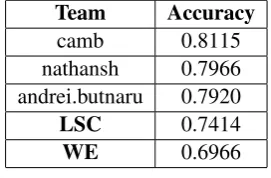
Tables 2, 3 and 4 presents the top 3 systems participating in the evaluation together with our results. We have obtained mixed results: in the English News our Word Embedding (WE) system outperformed the system based on human engi-neered features (LSC) – eleventh position in the ranking. While the LSC system performed better on WikiNews and Wikipedia, placing the team in the tenth position in the ranking.
Table 2: Comparison with the top three teams for the English News submissions
Team Accuracy
camb 0.8792 dirkdh 0.8721 TMU 0.8706
WE 0.8172
LSC 0.7785
Table 3: Comparison with the top three teams for the English WikiNews submissions
Team Accuracy
camb 0.8430 ajason08 0.8368 nathansh 0.8329
LSC 0.7615
[image:5.595.348.484.351.440.2]WE 0.7374
Table 4: Comparison with the top three teams for the English Wikipedia submissions
Team Accuracy
camb 0.8115
nathansh 0.7966 andrei.butnaru 0.7920
LSC 0.7414
WE 0.6966
7 Conclusion
In conclusion, we tried to approach the problem of identifying complex words at the CWI shared task 2018 by designing two systems based on bi-nary classifiers, one represents the context as word embedding vectors and the other use a set of lex-ical, semantic and contextual features. The WE system performed better in the English News part and the LSC system excelled for Wikinews and Wikipedia. For future work we are planning on better analyzing our set of features by applying some feature selection methods e.g. info gain. Afterwards, we will attempt deep-learning neural networks to create our classifiers.
Acknowledgments
References
Eneko Agirre and Aitor Soroa. 2009. Personalizing pagerank for word sense disambiguation. In Pro-ceedings of the 12th Conference of the European Chapter of the Association for Computational Lin-guistics, pages 33–41. Association for Computa-tional Linguistics.
Bernd Bohnet. 2010. Very high accuracy and fast de-pendency parsing is not a contradiction. In Proceed-ings of the 23rd International Conference on Com-putational Linguistics (Coling 2010), pages 89–97, Beijing, China. Coling 2010 Organizing Committee. Stefan Bott, Luz Rello, Biljana Drndarevic, and Hora-cio Saggion. 2012. Can Spanish Be Simpler? Lex-SiS: Lexical Simplification for Spanish. In Proceed-ings of the 24th International Conference on Com-putational Linguistics (CoLing 2012).
Kevyn Collins-Thompson. 2014. Computational as-sessment of text readability. a survey of current and future research. ITL - International Journal of Ap-plied Linguistics 165:2, 165(2):97–135.
Edgar Dale and Jeanne S. Chall. 1948. The concept of readability.Elementary English, 23(24).
Siobhan Devlin and John Tait. 1998. The use of a psy-cholinguistic database in the simplification of text for aphasic readers. Linguistic Databases, pages 161–173.
Robert Gunning. 1952. The Technique of Clear Writ-ing. McGraw-Hill.
J. Peter Kincaid, Robert P. Fishburne Jr., Richard L. Rogers, and Brad S. Chissom. 1975. Derivation of New Readability Formulas (Automated Readabil-ity Index, Fog Count and Flesch Reading Ease For-mula) for Navy Enlisted Personnel. Technical re-port, Naval Technical Training Command.
Geoffrey Leech and Paul Rayson. 2014. Word frequen-cies in written and spoken English: Based on the British National Corpus. Routledge.
G. Harry Mc Laughlin. 1969. SMOG grading - a new readability formula. Journal of Reading, pages 639– 646.
George A. Miller. 1995. Wordnet: a lexical database for english. Communications of the ACM, 38(11):39–41.
Lluis Padr´o and Evgeny Stanilovsky. 2012. Freeling 3.0: Towards wider multilinguality. InProceedings of the Language Resources and Evaluation Confer-ence (LREC 2012), Istanbul, Turkey. ELRA. Gustavo Paetzold and Lucia Specia. 2016a. SemEval
2016 Task 11: Complex Word Identification. In
Proceedings of the 10th International Workshop on Semantic Evaluation (SemEval-2016), pages 560– 569, San Diego, California. Association for Com-putational Linguistics.
Gustavo Paetzold and Lucia Specia. 2016b. Sv000gg at semeval-2016 task 11: Heavy gauge complex word identification with system voting. InProceedings of the 10th International Workshop on Semantic Eval-uation (SemEval-2016), pages 969–974, San Diego, California. Association for Computational Linguis-tics.
Philip T. Quinlan. 1992. The Oxford Psycholinguistic Database. Oxford University Press.
Francesco Ronzano, Ahmed Abura’ed, Luis Es-pinosa Anke, and Horacio Saggion. 2016. Taln at semeval-2016 task 11: Modelling complex words by contextual, lexical and semantic features. In
Proceedings of the 10th International Workshop on Semantic Evaluation (SemEval-2016), pages 1011– 1016, San Diego, California. Association for Com-putational Linguistics.
Horacio Saggion. 2017. Automatic Text Simplification. Synthesis Lectures on Human Language Technolo-gies. Morgan & Claypool Publishers.
Luo Si and Jamie Callan. 2001. A statistical model for scientific readability. InProceedings of the Tenth In-ternational Conference on Information and Knowl-edge Management, CIKM ’01, pages 574–576, New York, NY, USA. ACM.
Ian H. Witten and Eibe Frank. 2000. Data Min-ing: Practical Machine Learning Tools and Tech-niques with Java Implementations. Morgan Kauf-mann Publishers Inc., San Francisco, CA, USA.
Mark Yatskar, Bo Pang, Cristian Danescu-Niculescu-Mizil, and Lillian Lee. 2010. For the sake of sim-plicity: Unsupervised extraction of lexical simplifi-cations from Wikipedia. InProceedings of the Pro-ceedings of the 49th Annual Meeting of the Associa-tion for ComputaAssocia-tional Linguistics, pages 365–368.
Seid Muhie Yimam, Chris Biemann, Shervin Mal-masi, Gustavo Paetzold, Lucia Specia, Sanja ˇStajner, Ana¨ıs Tack, and Marcos Zampieri. 2018. A Report on the Complex Word Identification Shared Task 2018. InProceedings of the 13th Workshop on In-novative Use of NLP for Building Educational Ap-plications, New Orleans, United States. Association for Computational Linguistics.
Seid Muhie Yimam, Sanja ˇStajner, Martin Riedl, and Chris Biemann. 2017a. CWIG3G2 - Complex Word Identification Task across Three Text Genres and Two User Groups. InProceedings of the Eighth In-ternational Joint Conference on Natural Language Processing (Volume 2: Short Papers), pages 401– 407, Taipei, Taiwan. Asian Federation of Natural Language Processing.
2017, pages 813–822, Varna, Bulgaria. INCOMA Ltd.