Review Article
Effects of long-term non-invasive ventilation in
stable chronic obstructive pulmonary disease: a
systematic review of 16 randomized controlled trials
Guodi Shen1, Xuhui Shen2, Jiantong Shen2, Lifang He2, Yongqiang Xu3, Rui Liu2
1Intensive Care Unit of Huzhou Central Hospital, Huzhou 313000, Zhejiang Province, China; 2Medical School of
Huzhou University, Huzhou 313000, Zhejiang Province, China; 3Huzhou First People’s Hospital, Huzhou 313000,
Zhejiang Province, China
Received August 13, 2015; Accepted December 19, 2015; Epub February 15, 2016; Published February 29, 2016
Abstract: Background: The benefits of non-invasive ventilation (NIV) in chronic obstructive pulmonary disease (COPD) have been debated for many years due to the conflicting results observed in these patients. The aim of this meta-analysis was to assess the long-term effects of NIV in stable patients with COPD. Methods: The Cochrane Central Register of Controlled Trials, MEDLINE, EMBASE, and CINAHL databases were searched. Randomized, controlled tri-als and crossover studies were included. Mortality, hospitalization, gas exchange, exercise tolerance, heath-related quality of life (HRQoL), lung function and sleep efficiency were used as outcome measurements. These outcomes were pooled to yield mean differences (MDs), standardized mean differences (SMDs) and risk differences (RDs). Results: Fourteen randomized controlled trials and two crossover studies were included. Compared with the control group, NIV significantly affected partial pressure of oxygen in the blood (MDshort term 4.72, [2.66, 6.78]; MDlong term 2.34, [1.21, 3.47]) and partial pressure of carbon dioxide in the blood in long time (MDlong term -4.55, [-7.49, -1.62]). Compared to control group, the risk difference of mortality in long term group of NIV was -0.06 [-0.12, -0.01]. Three of the six long-term studies exerted significant effects during hospitalization, whereas one of the short-term stud-ies demonstrated no significant effects. Two of the four short-term studstud-ies and all three long-term studstud-ies demon-strated no significant effects on HRQoL. Conclusion: NIV exerted no clinically or statistically significant effects on gas exchange, exercise tolerance, HRQoL, death, lung function or sleep efficiency in patients with stable COPD when utilized for less than 3 months. It might significantly improve blood gases, exercise tolerance and lung function after six months. However, long term NIV efficacy for stable COPD remains uncertain in terms of mortality and readmis-sion. Long-term follow-up data of such patients is needed to reconfirm the benefits of NPPV.
Keywords: Non-invasive ventilation, chronic obstructive pulmonary disease, systematic review
Introduction
According to World Health Statistics 2014,
chronic obstructive pulmonary disease (COPD)
was a leading cause of years of life lost (YLL)
worldwide as of 2012 [1]. COPD has been asso -ciated with declining lung function, sleep-disor-dered breathing and nocturnal hypoventilation [2], which increased the risks of death, disabil-ity and hospitalization [3, 4]. There are several
treatments available to patients with COPD
[5-9], including pharmacotherapy, surgery, and lung transplantation. However, only long-term
oxygen therapy (LTOT) has been recommended as a routine treatment for COPD patients [10, 11]. Non-invasive ventilation (NIV) allows over
-loaded respiratory muscles to rest, improves gas exchange, and resets the central respirato-ry drive in patients with hypercapnia, without invading the airway [12, 13]. Strong evidence
exists that illustrates the benefits of NIV in
treating acute respiratory failure [14, 15];
how-ever, the benefits of NIV in the setting of stable COPD have been unclear due to the conflicting
results noted by various studies [16, 17]. Some randomized controlled trials have described
the beneficial effects of NIV with regard to dys -pnea, partial pressure of carbon dioxide in the
blood (PaCO2) and health-related quality of life (HRQoL) [18-22]. However, one systematic
effects in patients with stable COPD [23]. Although there is insufficient evidence to rec
-ommend NIV for routine use in patients with stable COPD, there is a consensus that patients with COPD are most likely to benefit from NIV
[24]. Because several new studies have been published, providing an up-to-date systematic review of this new treatment approach is nec-essary. We hoped that our research would
pro-vide new epro-vidence regarding NIV in the setting of COPD.
Materials and methods
Studies inclusion criteria for this review
Randomized controlled trials (RCTs) and
ran-domized crossover studies comparing NIV with
other therapeutic approaches to treating
patients with stable COPD were included. Participants in the NIV group received NIV,
which was administered via nasal cannula or facemask for more than 3 weeks, although these patients also had the option of receiving more conventional forms of management. Patients in the control group received the same
treatment as the NIV group, but did not receive NIV. Primary outcomes included death, hospi
-talization, PaCO2, partial pressure of oxygen in
the blood (PaO2), six-minute walking distance (6MWD), and HRQoL. Secondary outcomes included forced expiratory volume in one
sec-ond (FEV1), forced vital capacity (FVC), maximal
inspiratory pressure (PImax), maximal expira-
tory pressure (PEmax), sleep efficiency and
dyspnea.
Studies exclusion criteria for this review
A study will be excluded if patients in
exacerba-tions of COPD or with respiratory failure. We also excluded studies if NPPV was used in
intensive care unit or during walking or physical training.
Literature search
The Cochrane Central Register of Controlled Trials (CENTRAL), MEDLINE, EMBASE, and CINAHL were systematically searched. We se- arched all of the databases, beginning with the database’s inception and ending on March 27, 2014 (we update search strategy on March 1, 2015). We also searched clinicaltrials.gov to
find registered clinical trials. The search strate -gy was included in the supplement.
Selection of studies
Two of the review authors (HLF, LR) indepen-dently assessed all of the abstracts. Full papers were retrieved and read in detail if the abstracts were selected by both review authors, and dis-agreements were resolved via discussion with a third review author (SJT).
Risk of bias assessment
Two of the review authors (SJT and SGD) inde-pendently assessed the risk of bias of each study. We used the Cochrane Collaboration tool provided in the Cochrane Handbook for Systematic Reviews of Interventions [25] to assess the risk of bias in RCTs. We considered random sequence generation, allocation con-cealment, blinding of participants, personnel and outcome measurements, incomplete out-come data, selective outout-come reporting, and other sources of bias, such as the prognostic balance between the treatment groups. We judged each domain as having a ‘high’, ‘low’ or ‘unclear’ risk of bias. Disagreements were re- solved via discussion. If ten or more studies were included to perform meta-analyses for one outcome, funnel plots were inspected.
Data collection
Two of the review authors (HLF and SJT) col-lected information from eligible trials on stud-ies characteristics (study design, sample size, arms, length of follow-up, funding sources),
patient characteristics (sex, age, FEV1, PaCO2,
and BMI), interventions, NIV setting, outcomes,
and numbers of patients included for analyses in each arm. We collated all of the data into one study when many reports appear to be related to the same trial. If outcome data were report-ed at different follow-up time points, we collat-ed the results from the article utilizing the lon-gest follow-up period. The differences in mean changes between the test and control groups
were defined as treatment effects. If changes
from baseline (change score) were not
avail-able, final values were used as effect
measu-rements.
Statistical analysis
unless there were carryover effects from one period to another. The generic inverse variance method [26] was used to perform meta-analy-sis that combed parallel and two-period cross-over trials. A random-effects model was used
for high heterogeneity, whereas a fixed effect
model was used for low heterogeneity. The χ2
test and the I2 test were used to assess
hetero-geneity among the studies. We reported mean
treatment effects and associated 95% confi -dence intervals. P<0.05 was considered
statis-tically significant. Subgroup analyses were
us-ed to rus-educe heterogeneity, and we
hypothe-sized that patient received NIV for a long time
or more, higher levels of IPAP (inspiratory air-way pressure) or patients with more
hypercap-nia might receive greater benefits. We used
Review Manager 5.1 to combine the date. We reported the results according to the Preferred Reporting Items for Systematic reviews and Meta-Analyses statement (PRISMA).
Results
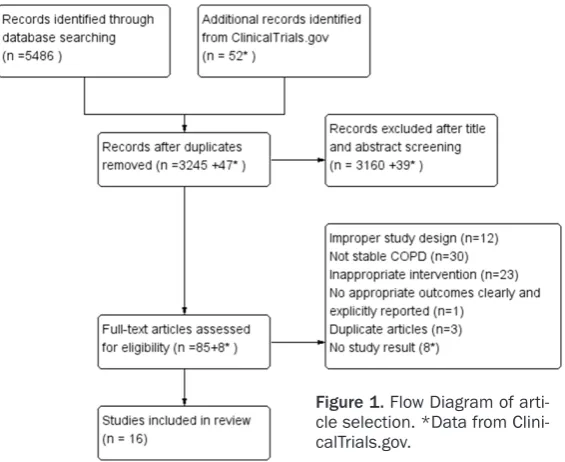
Our search yielded 3245 relevant articles and
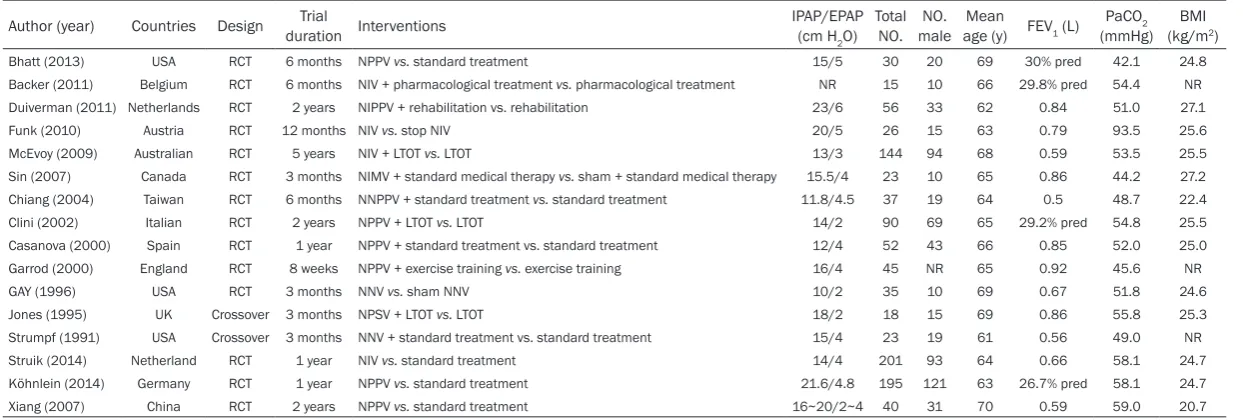
52 registered clinical trials. After screening the titles and abstracts, we selected 85 articles and 8 trials for full text selection. Sixteen stud-ies were included following the full text screen-ing (Figure 1). The characteristics of the includ-ed studies were includinclud-ed in Table 1. Fourteen studies were parallel RCTs, and two studies had crossover designs.
es in PaCO2 from baseline [31, 33] were includ-ed in the meta-analysis. The meta-analysis
demonstrated differences in PaCO2 between
the NIV and standard care groups within 3
months (MD 0.81 mmHg, 95% CI -3.18 to 4.81)
that were not statistically significant, as shown
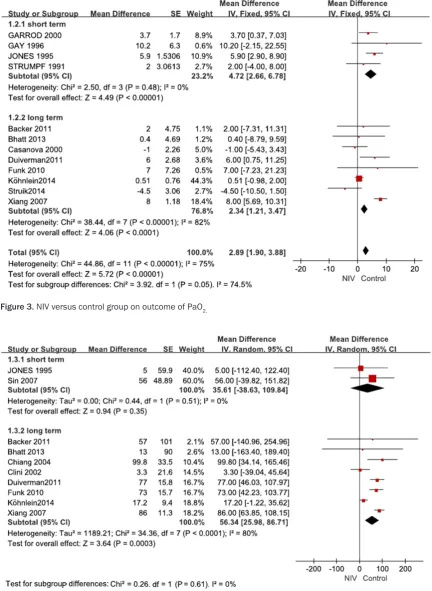
in Figure 2. As shown in Figure 3, two studies
reporting final PaO2 values [32, 35] and two
additional studies reporting changes in PaO2
from baseline [31, 33] were included in the
meta-analysis, demonstrating significant im-provements in the NIV group (MD 4.72 mmHg,
95% CI 2.66 to 6.78).
For long-term follow-up, eight studies reporting
final PaCO2 values [18-20, 22, 27-29, 36] and three studies [30, 37, 38] reporting changes in
PaCO2 were combined in the meta-analysis (Figure 2). There were significant differences between the NIV and standard care groups (MD
-4.55 mmHg, 95% CI -7.49 to -1.62). As shown in Figure 3, eight studies [18, 22, 27, 28, 30,
36-38] measuring PaO2 values were included in the meta-analysis, noting improvements in
PaO2 in the NIV group compared with the stan -dard care group (MD 2.34 mmHg, 95% CI 1.21 to 3.47, I2=82%). However, there were no signifi
-cant if the study Xiang 2007 were excluded (MD 0.56 mmHg, 95% CI -0.74 to 1.86), and hetero-geneity were reduced by 55% (I2=27%).
Six-minute walking distance
For short-term follow-up, two studies [33, 34] involving 49 patients were combined, and
dif-Figure 1. Flow Diagram of arti-cle selection. *Data from Clini-calTrials.gov.
Five studies lasted for perio- ds of less than three months
and were classified as ‘short
term’, whereas eleven studies
were classified as ‘long term’,
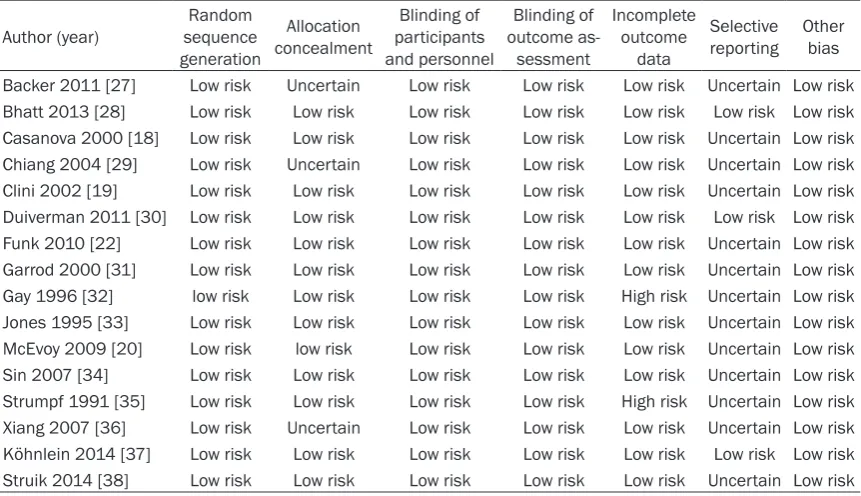
because their durations were longer than six months. Twe- lve studies were funded by public foundations [18-22, 29-34, 37, 38], whereas two studies [28, 35] were funded by industrial companies. The risks of bias for the included studies are included in Table 2.
Arterial blood gas tension
For short-term follow-up, th-
[image:3.629.102.385.80.311.2]chang-Table 1. Characteristics of included studies
Author (year) Countries Design duration InterventionsTrial IPAP/EPAP (cm H
2O) Total
NO. maleNO. age (y)Mean FEV1 (L)
PaCO2
(mmHg) (kg/mBMI 2)
Bhatt (2013) USA RCT 6 months NPPV vs. standard treatment 15/5 30 20 69 30% pred 42.1 24.8 Backer (2011) Belgium RCT 6 months NIV + pharmacological treatment vs. pharmacological treatment NR 15 10 66 29.8% pred 54.4 NR Duiverman (2011) Netherlands RCT 2 years NIPPV + rehabilitation vs. rehabilitation 23/6 56 33 62 0.84 51.0 27.1 Funk (2010) Austria RCT 12 months NIV vs. stop NIV 20/5 26 15 63 0.79 93.5 25.6 McEvoy (2009) Australian RCT 5 years NIV + LTOT vs. LTOT 13/3 144 94 68 0.59 53.5 25.5 Sin (2007) Canada RCT 3 months NIMV + standard medical therapy vs. sham + standard medical therapy 15.5/4 23 10 65 0.86 44.2 27.2 Chiang (2004) Taiwan RCT 6 months NNPPV + standard treatment vs. standard treatment 11.8/4.5 37 19 64 0.5 48.7 22.4 Clini (2002) Italian RCT 2 years NPPV + LTOT vs. LTOT 14/2 90 69 65 29.2% pred 54.8 25.5 Casanova (2000) Spain RCT 1 year NPPV + standard treatment vs. standard treatment 12/4 52 43 66 0.85 52.0 25.0 Garrod (2000) England RCT 8 weeks NPPV + exercise training vs. exercise training 16/4 45 NR 65 0.92 45.6 NR GAY (1996) USA RCT 3 months NNV vs. sham NNV 10/2 35 10 69 0.67 51.8 24.6 Jones (1995) UK Crossover 3 months NPSV + LTOT vs. LTOT 18/2 18 15 69 0.86 55.8 25.3 Strumpf (1991) USA Crossover 3 months NNV + standard treatment vs. standard treatment 15/4 23 19 61 0.56 49.0 NR Struik (2014) Netherland RCT 1 year NIV vs. standard treatment 14/4 201 93 64 0.66 58.1 24.7 Köhnlein (2014) Germany RCT 1 year NPPV vs. standard treatment 21.6/4.8 195 121 63 26.7% pred 58.1 24.7 Xiang (2007) China RCT 2 years NPPV vs. standard treatment 16~20/2~4 40 31 70 0.59 59.0 20.7
[image:4.809.97.719.93.303.2]ferences in 6MWD that were not statistically
[image:5.629.100.531.93.341.2]significant were noted (MD 35.61 m, 95% CI -38.63 to 109.84) (Gay involving ten patients also reported no sta-Figure 4). Another study by Table 2. Quality assessment of included studies
Author (year) sequence Random generation
Allocation concealment
Blinding of participants and personnel
Blinding of outcome as-sessment
Incomplete outcome
data
[image:5.629.101.532.317.647.2]Selective reporting Other bias Backer 2011 [27] Low risk Uncertain Low risk Low risk Low risk Uncertain Low risk Bhatt 2013 [28] Low risk Low risk Low risk Low risk Low risk Low risk Low risk Casanova 2000 [18] Low risk Low risk Low risk Low risk Low risk Uncertain Low risk Chiang 2004 [29] Low risk Uncertain Low risk Low risk Low risk Uncertain Low risk Clini 2002 [19] Low risk Low risk Low risk Low risk Low risk Uncertain Low risk Duiverman 2011 [30] Low risk Low risk Low risk Low risk Low risk Low risk Low risk Funk 2010 [22] Low risk Low risk Low risk Low risk Low risk Uncertain Low risk Garrod 2000 [31] Low risk Low risk Low risk Low risk Low risk Uncertain Low risk Gay 1996 [32] low risk Low risk Low risk Low risk High risk Uncertain Low risk Jones 1995 [33] Low risk Low risk Low risk Low risk Low risk Uncertain Low risk McEvoy 2009 [20] Low risk low risk Low risk Low risk Low risk Uncertain Low risk Sin 2007 [34] Low risk Low risk Low risk Low risk Low risk Uncertain Low risk Strumpf 1991 [35] Low risk Low risk Low risk Low risk High risk Uncertain Low risk Xiang 2007 [36] Low risk Uncertain Low risk Low risk Low risk Uncertain Low risk Köhnlein 2014 [37] Low risk Low risk Low risk Low risk Low risk Low risk Low risk Struik 2014 [38] Low risk Low risk Low risk Low risk Low risk Uncertain Low risk
tistically significant effects on 6MWD (MD 7.5
feet, 95% CI -811.54 to 826.54). For long-term follow-up, eight studies [19, 22, 27-30, 36, 37] were included in a
[image:6.629.98.531.83.675.2]meta-analy-Figure 3. NIV versus control group on outcome of PaO2.
[image:6.629.98.527.85.379.2]sis that demonstrated moderate treatment effects on 6MWD (MD 56.34 m, 95% CI 25.98 to 86.71).
Death
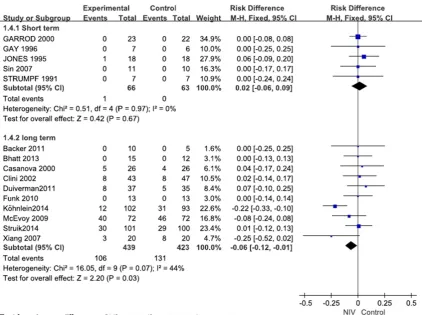
For short-term follow-up, five studies [31-35]
were included in a meta-analysis, and only one
patient died in the NIV group (RD 0.02, 95% CI
-0.06 to 0.09), as shown in Figure 5.
[image:7.629.104.527.79.394.2]For long-term follow-up, ten studies [18-20, 22, 27, 28, 30, 36-38] provided data regarding death and demonstrated a little differences (RD -0.06, 95% CI -0.12 to -0.01). Excluding study by Köhnlein, there were no statistically
Figure 5. NIV versus control group on death.
Table 3. Hospitalizations in NIV and control groups
Author (year) Outcomes Experimental group Control group P
McEvoy 2009 Rates 0.032 0.031 P>0.05
Chiang 2004 Δnumber -2 0.7 P<0.05
Δtotal stay (days) -29.4 16 P<0.05
Clini 2002 Δtimes -45% + 27% P<0.05
Days spent in hospital -6.3 + 0.8 P<0.05
Xiang 2007 Δtimes/year -2.3 + 0.3 P<0.05
Strumpf 1991 Number 1 1 P>0.05
Struik 2014 Readmission 56% 57% P>0.05
Days spent in hospital 7.0 3.5 P>0.05
[image:7.629.99.535.461.610.2]significant (RD -0.02, 95% CI -0.08 to 0.05) and
the heterogeneity were reduced by 44%.
Hospitalization
For short-term follow-up, one crossover study [35] demonstrated that one patient required two brief hospitalizations: one during the
con-trol phase and another during the NIV phase.
For long-term follow-up, four studies [20, 35, 37, 38] demonstrated that hospitalization rates
were not different between the NIV and control
groups. As shown in Table 3, three studies [19,
29, 36] demonstrated the beneficial effects of NIV.
Health status
As shown in Table 4, it was impossible to perform a meta-analysis for different scales. Two studies in the short-term subgroup and six studies in long-term subgroup measured HRQoL using seven different questionnaires.
Table 4. Health status in NIV and control groups
Author (year) Scales NIV group Control group P
Garrod 2000 ΔCRDQ 24.1 11.8 <0.05
Jones 1995 SGRQ The symptom score during NPSV-plus oxygen period was significantly better than oxygen-alone <0.05
Clini 2002 ΔSGRQ -5% -4% >0.05
ΔMRF-28 The MRF-28 total score significantly improved in the NPPV group compared to the LTOT group <0.05 Duiverman 2011 ΔCRQ -3.6 -2.3 >0.05
ΔMRF-28 3.8 17.2 <0.05
Funk 2010 SGRQ 57 53 >0.05
Struik 2014 ΔCRQ 0.7 0.7 >0.05
ΔCCQ -0.5 -0.5 >0.05
ΔMRF-28 -7.3 -5.8 >0.05
ΔSRI 7.0 2.2 >0.05
Köhnlein 2014 ΔSRI Changes in the SRI summary scale score were in favour of the NPPV group (5.6 points, 95% CI 0.1-11.1) <0.05
ΔSF-36 SF-36 score did not differ significantly between treatment group >0.05
[image:8.629.101.537.92.279.2]ΔSGRQ SGRQ summary score improved more (6.2 points, 95% CI 0.7-11.8) in the NIV group <0.05 McEvoy 2009 SGRQ SGRQ was not different between the NIV + LTOT and LTOT alone groups >0.05
Table 5. Dyspnea in NIV and control groups
Author (year) Scales NIV group Control group P
Strumpf 1991 ΔTDI No improvements were observed in perform tasks or in functional activity >0.05
Garrod 2000 ΔDyspnea 4.9 1.7 >0.05
Bhatt 2013 ΔTDI 0.9 -0.5 >0.05
Clini 2002 ΔMRC Significantly improved in the NPPV group and better than in the LTOT group <0.05
Casanova 2000 ΔBORG -1.0 0.0 <0.05
ΔMRC -1.0 0.0 <0.05
Duiverman 2011 ΔMRC 0.2 0.6 <0.05
Struik 2014 ΔMRC -0.4 -0.3 >0.05
Xiang 2007 MRC 2.4 3.9 <0.05
[image:8.629.111.528.299.570.2]There were trends toward a benefit noted in the NIV group, although three of the six long term studies demonstrated no significant differenc -es. Three studies [19, 30, 37] demonstrated contradictory results using different scales.
Two short term studies demonstrated that NIV significantly improve health state.
Dyspnea
Because different dyspnea scales were used in the RCTs, it was impossible to combine the out-come data (Table 5).
For short-term follow-up, one study [35], using the Transitional Dyspnea Index (TDI) to mea-sure dyspnea, noted that no improvements were observed in the patients’ abilities to
per-form tasks or to undertake functional activities
after receiving NIV. Another study [31] demon
-strated that there were no significant differenc
-es in dyspnea chang-es between the NPPV + ET
and ET groups (MD 3.29, 95% CI -1.26 to 7.84). For long-term follow-up, six studies provided data regarding dyspnea [18, 19, 28, 30, 36,
38]. Four studies demonstrated that significant improvements occurred in the NIV group com -pared with the control group, whereas two stud-ies [28, 38] demonstrated no differences be-
tween the NIV and control groups.
Lung function
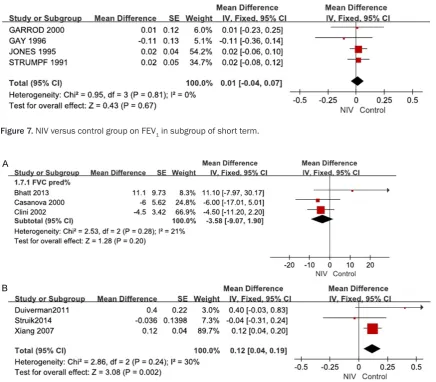
For short-term follow-up, three studies [31, 33,
35] reporting FVC values and four studies
[31-Figure 7. NIV versus control group on FEV1 in subgroup of short term.
[image:9.629.98.535.80.462.2]33, 35] reporting FEV1 values were included to perform meta-analyses, which demonstrated
no significant differences in FVC or FEV1 between the NIV and standard care groups
(MDFVC 0.09 L, 95% CI -0.05 to 0.22; MDFEV1
0.01, 95% CI -0.04 to 0.07), as shown in Figures 6 and 7.
[image:10.629.98.529.77.334.2]For long-term follow-up, three studies [18, 19, 28] involving 157 patients demonstrated no
Figure 9. A. NIV versus control group on FEV1 in subgroup of long term (pred%). B. NIV versus control group on FEV1 in subgroup.
[image:10.629.106.527.393.625.2]significant differences in predicted FVC (%) between the NIV and standard care groups (MD
-3.58, 95% CI -9.07 to 1.90) (Figure 8A). Three studies [30, 36, 38] involving 190 patients
demonstrated limited treatment effects on FVC and FEV1 (MDFVC 0.12 L, 95% CI 0.04 to 0.19;
MDFEV1 0.08 L, 95% CI 0.04 to 0.13) (Figures 8B, 9B). Six studies [18-20, 22, 27, 28] involv-ing 283 patients were included in the
meta-analysis, which demonstrated no significant
effects (MD -1.10, 95% CI -3.12 to 0.93) in
pre-dicted FEV1 (%) values (Figure9A).
Respiratory muscle function
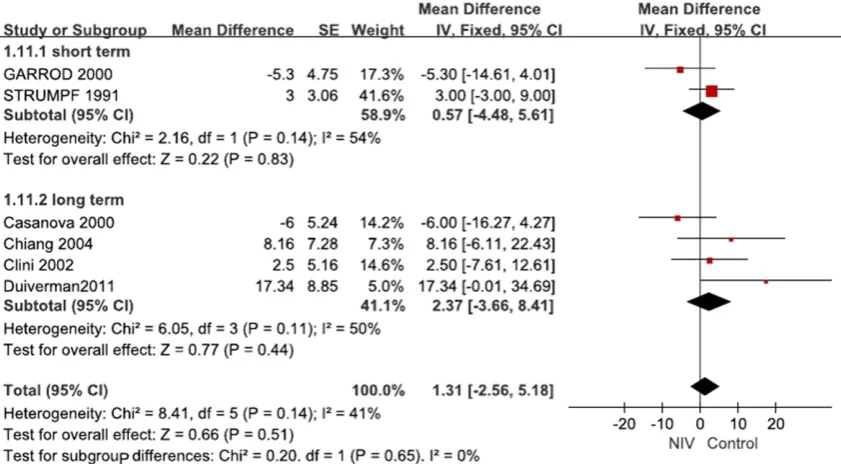
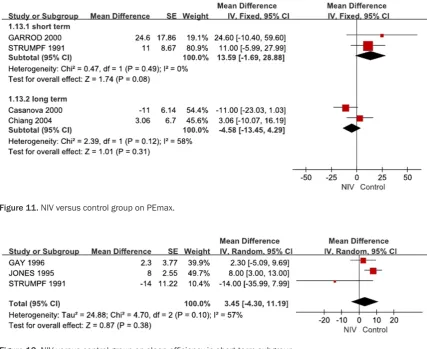
For short-term follow up, two studies provided data regarding PImax and PEmax values [31, 35]. The improvements in PImax were not
sta-tistically significant (MD 0.57 cm H2O, 95% CI
-4.48 to 5.61). PEmax demonstrated small
improvements following short-term NIV (MD
13.59 cm H2O, 95% CI -1.69 to 28.88), as
shown in Figures 10 and 11.
For long-term follow-up, four studies provided data regarding PImax [18, 19, 29, 30], and two studies provided data regarding PEmax [18, 29]. The differences in PImax and PEmax were
not statistically significant (PImax MD 2.37 cm
H2O, 95% CI -3.66 to 8.41; PEmax MD -4.58 cm
H2O, 95% CI -13.45 to 4.29). Sleep efficiency and sleep quality
For short-term follow-up, three studies provided
data regarding sleep efficiency [32, 33, 35]
that demonstrating small negative effects after three months (MD 3.45, 95% CI -4.30 to 11.19). These effects were characterized by substan-tial heterogeneity (I2=57%) (Figure 12).
For long-term follow-up, a study evaluated sleep
efficiency by measuring time sleep as a per -centage of total time in bed [20], but it obtained
follow-up measurements only in the NIV group.
Another study [19] noted that sleep quality
scores have not significantly change over time
[image:11.629.99.527.81.430.2]Figure 11. NIV versus control group on PEmax.
in either group, although sleep scores improved
slightly for patients who received NIV. A third
study [28] measured sleep quality that using the Pittsburgh Sleep Quality Index (PSQI) and found that there were no changes in the quality of sleep. No meta-analyses were performed.
Discussion
Main findings
In this meta-analysis, we found that NIV im-proved gas exchange significantly only in the
long-term group. However, if we excluded the
er sample sizes should clarify the role of this treatment.
The mortality due to COPD was low in the
short-term group; however, it was high in the
long-term follow-up group. The benefits of NIV were
not demonstrated in the meta-analysis if a
par-ticular study [37] was excluded. Because COPD
is a common disease which has a long natural history, a meta-analysis based on RCTs might
[image:12.629.102.455.73.548.2]not be sufficient to evaluate the benefits of sur -vival and mortality; a cohort study or case-con-trol study with a long follow-up period might be more appropriate. Köhnlein’s study showed
Figure 13. Funnel plot of PaCO2.
Figure 14. Funnel plot of PaO2.
Chinese study [36], we deter-mined that there was no
sig-nificant improvement in PaO2
in the long-term subgroup. Compared with the control
group, there was a significant decrease in PaCO2 in the
long-term subgroup of the NIV
group. However, the heteroge-neity was high (Chi2=142.94,
P<0.00001; I2=93%) which
might have been the result of the varying treatment peri-ods, inspiratory pressure
lev-els and baseline of PaCO2. If two of the Chinese studies [29, 36] were excluded, the heterogeneity was reduced by 36% in the long-term sub-group. The improvement in the 6MWD was not
statisti-cally significant, however, it
was indicative of a positive trend in the meta-analysis. The pooled result of the meta-analysis reached the clinically minimal important difference of 26 m [39]. Compared with the short-term subgroup, the patients in the long-term gro- up might have experienced greater improvements in the 6MWD among those patients
who received NIV. We were
[image:12.629.99.384.78.285.2]larg-substantial improvement in survival (12% in the
NIV and 33% in the control group) which was conflict to previous studies. Compared with pre -vious studies, Köhnlein’s study included more homogenous, higher concentration of
hyper-capnia, stable COPD cohort, and higher NIV
doses than previous studies [40]. The study by
Plant demonstrated that NIV could reduce COPD patients’ treatment cost and mortality [41]. The benefit of NIV in PaCO2 could be increased by ventilation strategy with higher
inflation pressures and backup rate [42]. However, long term NIV efficacy for stable COPD
remains uncertain in terms of hard outcomes [43]. Some cohort studies suggest that mortal-ity or readmission rates of patients who were
treated by NIV dependent upon the varieties of COPD patients [44, 45]. NIV is more effective in obese COPD patients, and unlikely to be benefi
-cial if PaCO2 is lower than 7 kPa [44, 46].
Outcomes such as HRQoL, dyspnea, and hospi -talization were not combined due to differenc-es in their measurements. Eight studidifferenc-es mea-sured HRQoL with seven different scales, and seven studies measured dyspnea with four dif-ferent scales. Difdif-ferent scales are character-ized by different reliability and validity. In the
assessment of COPD’s HRQoL, the SRI per -formed slightly better than the CCQ, CRQ, and MRF-28 [47]. Hospitalization data were report-ed in seven studies, however, these data were measured as rates, numbers, visits or lengths of stay, depending upon the study in question.
might have influenced their true outcomes. All
of the outcomes that listed in the articles’ methods sections were reported; however, the original protocols were not available, with the exception of the three studies [28, 30, 37]. We were not able to determine whether all of the
pre-specified outcomes were reported, there -fore, the risk of reporting bias was unclear. We excluded two studies due to their short treat-ment periods [48, 49]. We estimated standard deviations according to the Cochrane Handbook
when we were unable to find the corresponding
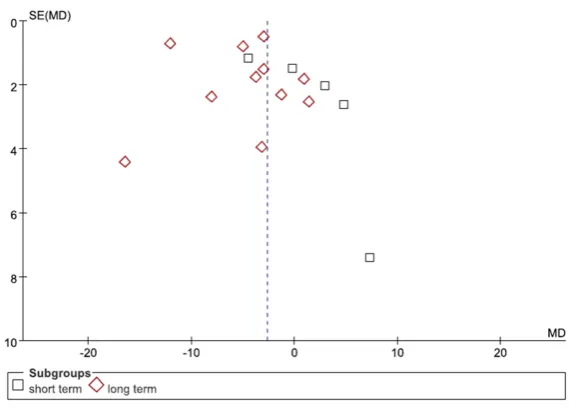
data within the published articles, which might have affected the precision of our evaluations of these studies’ outcomes. The funnel plots were asymmetric, therefore, there were publi-cation bias (Figures 13-15).
Comparison with other studies
Three systematic reviews have assessed the
effectiveness of NIV for patients with stable COPD [23, 50, 51]. The systematic review
by Kolodziej pooled six RCTs and nine
non-RCTs, determined that bi-level NIPPV improved
gas exchange and reduced both lung
hyperin-flation and the diaphragmatic work of breath -ing. However, the heterogeneity of the pooled results was high. Another systematic review by
Chen included five RCTs and one crossover study, reported that NIPPV improved gas
[image:13.629.98.384.78.277.2]exchange, dyspnea and sleep quality. This sys-tematic review might have missed some stud-ies [22, 29, 34, 35].
Figure 15. Funnel plot of death.
Strengths and limitations
All of the included studies had low risk for bias of either ran-domization or allocation con-cealment, with the exception of three studies [27, 29, 36] which did not describe me- thods of allocation conceal-ment. We determined that all of the studies were at low risk for blinding bias because the- ir outcomes were not likely
to have been influenced by a
lack of blinding.
Those reviews didn’t perform subgroup analy-ses based on treatment periods. A recent Cochrane Systematic Review (CSR) included
five RCTs and two crossover studies that involv
-ing 245 patients, and it found that home NIPPV,
administered over a period of three months in
patients with stable COPD, resulted in no sig
-nificant improvements in gas exchange, exer -cise tolerance, HRQoL, lung function,
respira-tory muscle strength or sleep efficiency.
Al-though the CSR represents the highest form evidence with which to make decisions, due to its rigorous methodology, this CSR did not include some of the studies [22, 29, 31]. Compared with these three systematic reviews, our study included studies missed by the other
reviews and also included other five newly pub -lished articles [27, 28, 30, 37, 38] which could provide clinicians with additional important in- formation with which to evaluate the
useful-ness of NIV in COPD. The outcomes of
short-term subgroup were consistent with those of the CSR but they were different from those of two other reviews. At the same time, the out-comes of the long-term subgroup were differ-ent from those of the CSR and consistdiffer-ent with those of the two other reviews.
Although there were several reviews assessing the topic with the included studies in the past, they all had the same conclusions. However, recent data suggested that there are different results in the literature with regard to the under-lying ventilator strategy. Previous studies using low inspiratory pressure levels gained no posi-tive results, whereas studies using higher pres-sure levels got it, which has been shown in sev-eral papers [52-54]. The most recent study
[37] significantly reducing PaCO2 was a positive study with regard to survival using higher
pres-sure levels. PaCO2 reduction is a significant pre -dictor of mortality, but it only makes a small
contribution to the overall benefit of NPPV [40].
Whether this association has a causal effect needs discussion and long-term follow-up data
of such patients to reconfirm the benefits of NPPV.
Conclusion
NIV administered to patients with stable COPD
over periods of less than three months exert-
ed no clinically or statistically significant effects
on gas exchange, exercise tolerance, HRQoL,
death, lung function or sleep efficiency. Blood
gases, exercise tolerance and lung function
were significantly improved following more than six months of NIV. However, long term NIV effi
-cacy for stable COPD remains uncertain in
terms of mortality and readmission. Long-term follow-up data of such patients is needed to
reconfirm the benefits of NPPV.
Acknowledgements
This study was funded by science and technol-ogy plans of health and family planning com-mission of Zhejiang province. (Promotion and
development of Non-invasive Ventilation, Grant
2012zhb019). The funder did not participate in study design, data collection and analysis, pub-lishing decision, or manuscript preparation. Disclosure of conflict of interest
None.
Address correspondence to: Dr. Jiantong Shen, Me-
dical School of Huzhou University, Huzhou 313000, Zhejiang Province, China. Tel: 86-1356795192; E-mail: [email protected]
References
[1] World Health Organization. World health statis-tics 2014. Geneva: WHO Press. Available from http://www.who.int/gho/publications/world_ health_statistics/2014/en/.
[2] Wouters EF, Creutzberg EC and Schols AM. Systemic effects in COPD. Chest 2002; 121: 127S-130S.
[3] Seemungal TA, Donaldson GC, Paul EA, Bestall JC, Jeffries DJ and Wedzicha JA. Effect of exac-erbation on quality of life in patients with chronic obstructive pulmonary disease. Am J Respir Crit Care Med 1998; 157: 1418-1422. [4] Gore JM, Brophy CJ and Greenstone MA.
How well do we care for patients with end stage chronic obstructive pulmonary disease (COPD)? A comparison of palliative care and quality of life in COPD and lung cancer. Thorax 2000; 55: 1000-1006.
[5] Mills EJ, Druyts E, Ghement I and Puhan MA. Pharmacotherapies for chronic obstructive pulmonary disease: a multiple treatment com-parison meta-analysis. Clin Epidemiol 2011; 3: 107-129.
[7] Slebos DJ, Klooster K, Ernst A, Herth FJ and Kerstjens HA. Bronchoscopic lung volume re-duction coil treatment of patients with severe heterogeneous emphysema. Chest 2012; 142: 574-582.
[8] Lacasse Y, Goldstein R, Lasserson TJ and Martin S. Pulmonary rehabilitation for chro- nic obstructive pulmonary disease. Cochrane Database Syst Rev 2006; 18: CD003793. [9] Orens JB, Estenne M, Arcasoy S, Conte JV,
Corris P, Egan JJ, Egan T, Keshavjee S, Knoop C, Kotloff R, Martinez FJ, Nathan S, Palmer S, Patterson A, Singer L, Snell G, Studer S, Vachiery JL, Glanville AR. Pulmonary Scientific Council of the International Society for Heart and Lung Transplantation. International gui- delines for the selection of lung transplant candidates: 2006 update-a consensus report from the Pulmonary Scientific Council of the International Society for Heart and Lung Trans- plantation. J Heart Lung Transplant 2006; 25: 745-755.
[10] Medical Research Council Working Party. Long-term domiciliary oxygen therapy in chronic hy-poxic cor pulmonale complicating chronic bronchitis or emphysema. Lancet 1981; 1: 681-686.
[11] Crockett AJ, Cranston JM, Moss JR and Alpers JH. A review of long-term oxygen therapy for chronic obstructive pulmonary disease. Respir Med 2001; 95: 437-443.
[12] Koechlin C, Maltais F, Saey D, Michaud A, LeBlanc P, Hayot M and Préfaut C. Hypoxaemia enhances peripheral muscle oxidative stress in chronic obstructive pulmonary disease. Thorax 2005; 60: 834-841.
[13] Díaz O, Bégin P, Torrealba B, Jover E and Lisboa C. Effects of noninvasive ventilation on lung hyperinflation in stable hypercapnic COPD. Eur Respir J 2002; 20: 1490-1498.
[14] Lim WJ, Mohammed Akram R, Carson KV, Mysore S, Labiszewski NA, Wedzicha JA, Rowe BH and Smith BJ. Non-invasive positive pres-sure ventilation for treatment of respiratory failure due to exacerbations of chronic ob-structive pulmonary disease. Cochrane Data- base Syst Rev 2012; 12: CD004360.
[15] Plant PK, Owen JL and Elliott MW. Early use of non-invasive ventilation for acute exacer-bations of chronic obstructive pulmonary dis-ease on general respiratory wards: a multicen-tre randomised controlled trial. Lancet 2000; 355: 1931-1935.
[16] Hill NS. Noninvasive ventilation has been shown to be ineffective in stable COPD. Am J Respir Crit Care Med 2000; 161: 689-690. [17] Rossi A. Noninvasive ventilation has not been
shown to be ineffective in stable COPD. Am J Respir Crit Care Med 2000; 161: 688-689.
[18] Casanova C, Celli BR, Tost L, Soriano E, Abreu J, Velasco V and Santolaria F. Long-term con-trolled trial of nocturnal nasal positive pres-sure ventilation in patients with severe COPD. Chest 2000; 118: 1582-1590.
[19] Clini E, Sturani C, Rossi A, Viaggi S, Corrado A, Donner CF and Ambrosino N. The Italian multi-centre study on noninvasive ventilation in chronic obstructive pulmonary disease pa-tients. Eur Respir J 2002; 20: 529-538. [20] McEvoy RD, Pierce RJ, Hillman D, Esterman A,
Ellis EE, Catcheside PG, O’Donoghue FJ, Barnes DJ and Grunstein RR. Nocturnal non-invasive nasal ventilation in stable hypercap-nic COPD: a randomised controlled trial. Thorax 2009; 64: 561-566.
[21] Duiverman ML, Wempe JB, Bladder G, Jansen DF, Kerstjens HA, Zijlstra JG and Wijkstra PJ. Nocturnal non-invasive ventilation in addition to rehabilitation in hypercapnic patients with COPD. Thorax 2008; 63: 1052-1057.
[22] Funk GC, Breyer MK, Burghuber OC, Kink E, Kirchheiner K, Kohansal R, Schmidt I and Hartl S. Long-term non-invasive ventilation in COPD after acute-on-chronic respiratory failure. Res- pir Med 2011; 105: 427-434.
[23] Struik FM, Lacasse Y, Goldstein R, Kerstjens HM and Wijkstra PJ. Nocturnal non-invasive positive pressure ventilation for stable chronic obstructive pulmonary disease. Cochrane Da- tabase Syst Rev 2013; 6: CD002878.
[24] Hill NS. Noninvasive ventilation for chronic ob-structive pulmonary disease. Respiratory Care 2004; 49: 72-87.
[25] Higgins JPT, Green S (editors). Cochrane Hand- book for Systematic Reviews of Interventions Version 5.1.0 [updated March 2011]. The Cochrane Collaboration. Available from WWW. COCHRANE-HANDBOOK.ORG.
[26] Elbourne DR, Altman DG, Higgins JP, Curtin F, Worthington HV and Vail A. Meta-analyses in-volving cross-over trials: methodological is-sues. Int J Epidemiol 2002; 31: 140-149. [27] De Backer L, Vos W, Dieriks B, Daems D,
Verhulst S, Vinchurkar S, Ides K, De Backer J, Germonpre P and De Backer W. The effects of long-term noninvasive ventilation in hypercap-nic COPD patients: a randomized controlled pilot study. Int J Chron Obstruct Pulmon Dis 2011; 6: 615-624.
[28] Bhatt SP, Peterson MW, Wilson JS and Durairaj L. Noninvasive positive pressure ventilation in subjects with stable COPD: a randomized trial. Int J Chron Obstruct Pulmon Dis 2013; 8: 581-589.
patients with severe obstructive lung diseases. Chang Gung Med J 2004; 27: 98-106.
[30] Duiverman ML, Wempe JB, Bladder G, Vonk JM, Zijlstra JG, Kerstjens HA and Wijkstra PJ. Two-year home-based nocturnal noninvasive ventilation added to rehabilitation in chronic obstructive pulmonary disease patients: a ran-domized controlled trial. Respir Res 2011; 12: 112.
[31] Garrod R, Mikelsons C, Paul EA and Wedzicha JA. Randomized controlled trial of domiciliary noninvasive positive pressure ventilation and physical training in severe chronic obstructive pulmonary disease. Am J Respir Crit Care Med 2000; 162: 1335-1341.
[32] Gay PC, Hubmayr RD and Stroetz RW. Efficacy of nocturnal nasal ventilation in stable, severe chronic obstructive pulmonary disease during a 3-month controlled trial. Mayo Clin Proc 1996; 71: 533-542.
[33] Meecham Jones DJ, Paul EA, Jones PW and Wedzicha JA. Nasal pressure support ventila-tion plus oxygen compared with oxygen thera-py alone in hypercapnic COPD. Am J Respir Crit Care Med 1995; 152: 538-544.
[34] Sin DD, Wong E, Mayers I, Lien DC, Feeny D, Cheung H, Gan WQ and Man SF. Effects of noc-turnal noninvasive mechanical ventilation on heart rate variability of patients with advanced COPD. Chest 2007; 131: 156-163.
[35] Strumpf DA, Millman RP, Carlisle CC, Grattan LM, Ryan SM, Erickson AD and Hill NS. Nocturnal positive-pressure ventilation via na-sal mask in patients with severe chronic ob-structive pulmonary disease. Am Rev Respir Dis 1991; 144: 1234-1239.
[36] Xiang PC, Zhang X, Yang JN, Zhang EM, Guo WA, Ju LX, Zhang S, Zhu WJ, Lei T and Cheng XS. The efficacy and safety of long term home noninvasive positive pressure ventilation in pa-tients with stable severe chronic obstructive pulmonary disease. Zhonghua Jie He He Hu Xi Za Zhi 2007; 30: 746-750.
[37] Kohnlein T, Windisch W, Kohler D, Drabik A, Geiseler J, Hartl S, Karg O, Laier-Groeneveld G, Nava S, Schonhofer B, Schucher B, Wegscheider K, Criee CP and Welte T. Non-invasive positive pressure ventilation for the treatment of severe stable chronic obstructive pulmonary disease: a prospective, multicen-tre, randomised, controlled clinical trial. Lancet Respir Med 2014; 2: 698-705.
[38] Struik FM, Sprooten RT, Kerstjens HA, Bladder G, Zijnen M, Asin J, Cobben NA, Vonk JM and Wijkstra PJ. Nocturnal non-invasive ventilation in COPD patients with prolonged hypercapnia after ventilatory support for acute respiratory failure: a randomised, controlled, parallel-group study. Thorax 2014; 69: 826-834.
[39] Puhan MA, Chandra D, Mosenifar Z, Ries A, Make B, Hansel NN, Wise RA and Sciurba F. The minimal important difference of exercise tests in severe COPD. Eur Respir J 2011; 37: 784-790.
[40] Köhnlein T, Windisch W, Wegscheider K and Welte T. Non-invasive positive pressure ventila-tion for severe COPD-Authors’ reply. Lancet Respir Med 2014; 2: e19.
[41] Plant PK, Owen JL, Parrott S and Elliott MW. Cost effectiveness of ward based non-invasive ventilation for acute exacerbations of chronic obstructive pulmonary disease: economic analysis of randomised controlled trial. BMJ 2003; 326: 956.
[42] Lobato SD and Alises SM. Non-invasive po- sitive pressure ventilation for severe COPD. Lancet Respir Med 2014; 2: e17-18.
[43] Borel JC, Pison C, Timsit JF and Pepin JL. Domiciliary long-term non-invasive ventilation in COPD: Should we select subgroups with a better likelihood to respond to NIV in subse-quent randomised controlled trials? Thorax 2014; 69: 1143.
[44] Borel JC, Pepin JL, Pison C, Vesin A, Gonzalez-Bermejo J, Court-Fortune I and Timsit JF. Long term adherence with non-invasive ventilation improves prognosis in obese COPD patients. Respirology 2014; 19: 857-865.
[45] Carrillo A, Ferrer M, Gonzalez-Diaz G, Lopez-Martinez A, Llamas N, Alcazar M, Capilla L and Torres A. Noninvasive ventilation in acute hy-percapnic respiratory failure caused by obesity hypoventilation syndrome and chronic obstruc-tive pulmonary disease. Am J Respir Crit Care Med 2012; 186: 1279-1285.
[46] Elliott M. Domiciliary NIV for COPD: where are we now? Lancet Respir Med 2014; 2: 672-673.
[47] Struik FM, Kerstjens HA, Bladder G, Sprooten R, Zijnen M, Asin J, van der Molen T and Wijkstra PJ. The Severe Respiratory Insuffici- ency Questionnaire scored best in the assess-ment of health-related quality of life in chronic obstructive pulmonary disease. J Clin Epide- miol 2013; 66: 1166-1174.
[48] Lin CC. Comparison between nocturnal nasal positive pressure ventilation combined with oxygen therapy and oxygen monotherapy in pa-tients with severe COPD. Am J Respir Crit Care Med 1996; 154: 353-358.
[49] Renston JP, DiMarco AF and Supinski GS. Respiratory muscle rest using nasal BiPAP ven-tilation in patients with stable severe COPD. Chest 1994; 105: 1053-1060.
[51] Chen H, Liang BM, Xu ZB, Tang YJ, Wang K, Xiao J, Yi Q, Sun J and Feng YL. Long-term non-invasive positive pressure ventilation in severe stable chronic obstructive pulmonary disease: a meta-analysis. Chin Med J (Engl) 2011; 124: 4063-4070.
[52] Dreher M, Storre JH, Schmoor C and Windisch W. High-intensity versus low-intensity non-inva-sive ventilation in patients with stable hyper-capnic COPD: a randomised crossover trial. Thorax 2010; 65: 303-308.
[53] Dreher M, Ekkernkamp E, Walterspacher S, Walker D, Schmoor C, Storre JH and Windisch W. Noninvasive ventilation in COPD: impact of inspiratory pressure levels on sleep quality. Chest 2011; 140: 939-945.