acute exacerbations of chronic obstructive pulmonary disease: economic analysis of
randomised controlled trial
.
White Rose Research Online URL for this paper:
http://eprints.whiterose.ac.uk/129/
Article:
Plant, P.K., Owen, J.L., Parrott, S. orcid.org/0000-0002-0165-1150 et al. (1 more author)
(2003) Cost effectiveness of ward based non-invasive ventilation for acute exacerbations
of chronic obstructive pulmonary disease: economic analysis of randomised controlled
trial. British medical journal. pp. 956-960. ISSN 0959-535X
https://doi.org/10.1136/bmj.326.7396.956
[email protected]
https://eprints.whiterose.ac.uk/
Reuse
Items deposited in White Rose Research Online are protected by copyright, with all rights reserved unless
indicated otherwise. They may be downloaded and/or printed for private study, or other acts as permitted by
national copyright laws. The publisher or other rights holders may allow further reproduction and re-use of
the full text version. This is indicated by the licence information on the White Rose Research Online record
for the item.
Takedown
If you consider content in White Rose Research Online to be in breach of UK law, please notify us by
doi:10.1136/bmj.326.7396.956
2003;326;956-
BMJ
P K Plant, J L Owen, S Parrott and M W Elliott
analysis of randomised controlled trial
obstructive pulmonary disease: economic
ventilation for acute exacerbations of chronic
Cost effectiveness of ward based non-invasive
http://bmj.com/cgi/content/full/326/7396/956
Updated information and services can be found at:
These include:
References
http://bmj.com/cgi/content/full/326/7396/956#otherarticles
6 online articles that cite this article can be accessed at:
http://bmj.com/cgi/content/full/326/7396/956#BIBL
This article cites 9 articles, 5 of which can be accessed free at:
Rapid responses
http://bmj.com/cgi/eletter-submit/326/7396/956
You can respond to this article at:
http://bmj.com/cgi/content/full/326/7396/956#responses
free at:
2 rapid responses have been posted to this article, which you can access for
service
Email alerting
box at the top right corner of the article
Receive free email alerts when new articles cite this article - sign up in the
Topic collections
(285 articles)
Health Economics
•
Chronic Obstructive Airways Disease
(298 articles)
•
Other respiratory medicine
(777 articles)
•
Articles on similar topics can be found in the following collections
Notes
http://bmj.bmjjournals.com/cgi/reprintform
To order reprints of this article go to:
go to:
BMJ
Papers
Cost effectiveness of ward based non-invasive ventilation
for acute exacerbations of chronic obstructive pulmonary
disease: economic analysis of randomised controlled trial
P K Plant, J L Owen, S Parrott, M W Elliott
Abstract
ObjectiveTo evaluate the cost effectiveness of standard treatment with and without the addition of ward based non-invasive ventilation in patients admitted to hospital with an acute exacerbation of chronic obstructive pulmonary disease.
DesignIncremental cost effectiveness analysis of a randomised controlled trial.
SettingMedical wards in 14 hospitals in the United Kingdom.
ParticipantsThe trial comprised 236 patients admitted to hospital with an acute exacerbation of chronic obstructive pulmonary disease and mild to moderate acidosis (pH 7.25-7.35) secondary to respiratory failure. The economic analysis compared the costs of treatment that these patients received after randomisation.
Main outcome measureIncremental cost per in-hospital death.
Results24/118 died in the group receiving standard treatment and 12/118 in the group receiving non-invasive ventilation (P=0.05). Allocation to the group receiving non-invasive ventilation was associated with a reduction in costs of £49 362 ($78 741;€73 109), mainly through reduced use of
intensive care units. The incremental cost effectiveness ratio was−£645 per death avoided (95% confidence interval −£2310 to £386), indicating a dominant (more effective and less costly) strategy. Modelling of these data indicates that a typical UK hospital providing a non-invasive ventilation service will avoid six deaths and three to nine admissions to intensive care units per year, with an associated cost reduction of £12 000-53 000 per year.
ConclusionsNon-invasive ventilation is a highly cost effective treatment that both reduced total costs and improved mortality in hospital.
Introduction
Non-invasive ventilation in the intensive care unit has been shown to reduce the need for intubation and the in-hospital mortality associated with severe exacerba-tions of chronic obstructive pulmonary disease.1–4It is
also feasible and effective in the ward environment for patients who are less severely ill. In a randomised
con-trolled trial with 14 participating centres we have shown that non-invasive ventilation reduces the need for intubation by 44% and in-hospital mortality by 50%.5
These results were, however, obtained at a price that included the training of staff, the provision of equipment, and the consumption of additional nursing time.6
For non-invasive ventilation to be implemented widely it is necessary to show that the technique is cost effective in the context of the trial and also to model costs in a real life scenario. We report a health economic analysis of the randomised controlled trial, which models the costs and effects of providing a non-invasive ventilation service in a typical hospital in the United Kingdom for patients with chronic obstructive pulmonary disease and mild to moderate respiratory acidosis.
Subjects and methods
The economic analysis was an incremental cost effectiveness analysis,7
performed alongside a 14 centre randomised controlled trial (figure), which com-pared standard medical treatment (see box) with standard treatment plus non-invasive ventilation (see box) in patients admitted to hospital with an exacerba-tion of chronic obstructive pulmonary disease, respira-tory acidosis (pH 7.25-7.35), and a respirarespira-tory rate greater than 23 breaths per minute.5 The nurses
administered non-invasive ventilation according to a predefined protocol until the morning of a patient’s fourth day. The principal clinical outcomes were the need for intubation, using predefined criteria (pH < 7.20; pH 7.20-7.25 on two occasions 1 hour apart; hypercapnic coma; Pao
2 < 6 kPa despite
maximum tolerated Fio
2; cardiorespiratory arrest) and
in-hospital mortality.5Once a patient met the criterion
“need for intubation,” the attending doctor was free to offer ventilatory support (invasively or non-invasively) at his or her discretion. The primary outcome measure for the economic analysis was mortality in hospital. We conducted the economic evaluation from the perspec-tive of the NHS and hence included only direct costs to the hospitals providing acute care.
Costs
We identified and valued three categories of costs—for wards, non-invasive ventilation, and intensive care
Department of Respiratory Medicine, St James’s University Hospital, Leeds LS9 7TF P K Plant consultant physician in respiratory medicine J L Owen respiratory nurse specialist M W Elliott consultant in respiratory medicine
Centre for Health Economics, University of York, York YO10 5DD S Parrott lecturer in halth economics
Correspondence to: P K Plant paul.plant@ leedsth.nhs.uk
bmj.com 2003;326:956
page 1 of 5
units. We estimated the valuations used for the financial year 1997-8 and derived them from the units participating in the study, using a bottom up approach.
Ward costs—Ward costs consisted of costs for nursing staff, pharmacy, and overheads such as heating, lighting, and costs of buildings. Nursing staff provided non-invasive ventilation for the first three days of the admission. We identified additional nursing time that was attributable to non-invasive ventilation by using a log kept at the end of the bed for the first five days of the admission, on which duration of activity and the seniority (grade) of the nurse were recorded. We calculated the cost of nursing by using the cost of a bed day on each ward, multiplied by the length of stay, and by adding the extra cost of nursing that we identi-fied from the log. We derived pharmacy costs from the standard treatment protocol and allocated these in relation to length of stay and valued from the British National Formulary(March 1997). Each finance depart-ment provided daily overhead costs and allocated these in relation to length of stay. In this incremental analysis we assumed costs for investigations and wards to be equal in the two study groups.
Costs of non-invasive ventilation—The costs of non-invasive ventilation included the cost of the initial purchase of the ventilator and selection of masks, replacement of consumables, annual servicing, and training of staff. We treated the initial purchase as a capi-tal purchase with three year and two year life spans for the ventilators and masks, respectively. We applied a
dis-count rate of 5%.8
Masks, tubing, connectors, and head-gear were replaced after 10 patients. We obtained the costs of cleaning and annual servicing from one centre and applied these to all. We recorded and valued all training, assuming that 50% of the training was given by a specialist registrar in the middle of the incremental pay scale and 50% by a F grade nurse specialist.
Costs of intensive care units—Each hospital provided the cost of a bed day in intensive care. We apportioned the cost in relation to length of stay, rounding up stays of less than one day to one day.
Statistical analysis
Results are given as means (standard deviations) for normally distributed data and as medians with ranges for non-normally distributed variables. All tests and P values are two tailed and were analysed on an intention to treat basis. We used ttests to compare the group means and the Mann-Whitney U test to compare the medians. We applied Bonferroni’s correction to multi-ple comparisons. We used Fisher’s exact test to analyse two by two tables. We generated Kaplan-Meier curves for time data and used the log rank test to compare them. We used SPSS version 9 for our analyses. We applied non-parametric bootstrap techniques to the cost data for deaths avoided. We report the mean costs for 1000 bootstrap replications and assessed the significance of negative cost effectiveness ratios by using cost effectiveness acceptability curves.
Results
Clinical outcomes
One hundred and eighteen patients were randomised to non-invasive ventilation and 118 to standard treatment. The two groups had similar characteristics on admission.5
Of the group receiving standard treatment, 32/118 (27% (SD 8%)) met the primary clinical end point, “need for intubation,” compared with 18/118 (15% (SD 6.5%)) in the group receiving non-invasive ventilation (P < 0.02).
Of the 32 patients receiving standard treatment who met the failure criteria, only 75% (24) received ventilatory support either invasively or non-invasively (non-invasive ventilation alone 38% (12), non-invasive ventilation followed by invasive mechanical ventilation 9% (3), invasive mechanical ventilation alone 28% (9)). Eighteen patients in the non-invasive ventilation group met the failure criteria, of whom 7 (39%) received inva-sive mechanical ventilation. Of the standard group 24/118 (20% (SD 7.3%)) died, compared with 12/118 (10% (SD 5.5%) in the non-invasive ventilation group (P=0.046).5We found no statistical difference in need
for intubation or mortality between the centres. Median length of stay in hospital was similar between the two groups, at 10 days (range: standard group 2-119 days, non-invasive ventilation group 4-137 days, P=0.27).
Cost data
Ward costs—Twenty five wards in 14 hospitals participated in this study. The ratios of nurses to patients ranged from 1:2.6 to 1:13, with a median of 1:11. Nine out of 14 centres provided detailed ward and overhead costs, which accounted for 85% of the patients recruited. The median cost of a bed day was £108 (range £77 to £214). The median value was
Patients randomised (n=236)
Died (n=24) Survived
(n=94)
Patients allocated to standard treatment (n=118)
Patients allocated to non-invasive treatment (n=118)
Died (n=12) Survived
(n=106)
Profile of randomised controlled trial of 236 patients in 14 centres in the United Kingdom
Interventions
Standard medical treatment (118 patients)
Controlled oxygen to maintain Spo2at 85-90%
Nebulised salbutamol 5 mg 4-6 hourly
Nebulised ipratropium bromide 500g 6 hourly
Prednisolone 30 mg once a day for a minimum of 5 days
Antibiotic agent
Non-invasive ventilation (118 patients)*
Bilevel positive pressure ventilation through a face or nasal mask
Inspiratory pressure initially 10 cm H2O, increased to
20 cm H2O
Expiratory pressure 5 cm H2O
Target duration first day 24 hours, second day 16 hours, third day 8 hours, fourth day discontinued Oxygen in the circuit to maintain Spo
2at 85-90%
*Non-invasive ventilation was given in addition to standard treatment.
applied to centres not providing full financial data. Non-invasive ventilation was associated with a modest increase in nursing workload of 26 minutes in the first eight hours of the admission (table 1). No difference became apparent after the first eight hours. The cost of this additional workload was £4.45 per patient receiving non-invasive ventilation.
Costs of intensive care centres—Ten centres admitted patients to intensive care. The mean cost of a bed day in intensive care was £1228 (95% confidence interval £1052 to £1404, n=8). The median length of stay in intensive care was similar between the standard group (5 days, range 1 to 53 days) and the non-invasive venti-lation group (6 days, range 2 to 15 days, P=0.38). In intensive care, the standard group (n=12) consumed 116 bed days and the non-invasive ventilation group (n=7) 43 bed days.
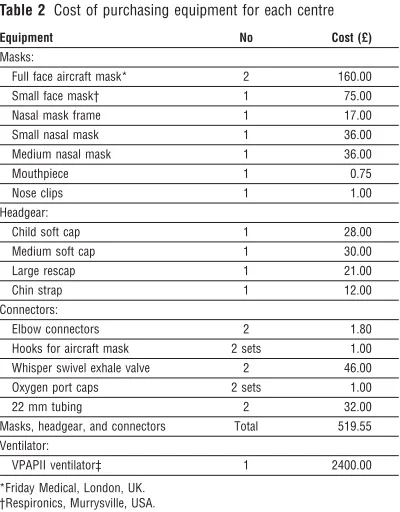
Costs of non-invasive ventilation—Table 2 shows the equipment purchased to set up the service. Allowing a three year lifespan for the ventilator and a two year lifespan for the consumables generates an equivalent annual cost of £839 and £266, respectively, at a discount rate of 5%.8The annual servicing cost was £26
per ventilator.
The mean amount of formal training given in the first three months of opening a ward was 7.6 (SD 3.6) hours. Thereafter each centre received 0.9 (SD 0.82) hours per month. The cost of providing training was £11-67 per hour.
The initial costs for equipment and the need for training are fixed costs that are independent of the number of patients treated in a centre. Additional costs were incurred by treating an individual patient. This included cleaning of equipment and replacement of masks and connectors after 10 patients (£11-75 per patient).
Where patients in the standard group were given non-invasive ventilation after standard treatment had
failed, we assumed this treatment to have cost a 118th of the total study costs of non-invasive ventilation (equipment, training, and additional nursing time).
Cost effectiveness
Table 3 shows the total hospital costs in relation to in-hospital mortality, the primary outcome for the health economic analysis. Non-invasive ventilation was associated with a £49 362 reduction in costs and a 50% reduction in mortality, with an additional 12 patients being discharged.
The main area of cost saving was in the use of intensive care units. The cost per patient in each group was skewed because of the high cost of patients admit-ted to intensive care. We therefore applied non-parametric bootstrapping to the cost data for deaths avoided. We performed 1000 bootstrap replications, and the mean costs were £2800 (95% confidence inter-val £1896 to £4388) for the group receiving standard treatment and £2155 (£1742 to £2966) for the non-invasive ventilation group. The mean cost difference between the treatments shows a saving of £645 per patient receiving non-invasive ventilation (−£2310 to £386). The results indicate that non-invasive ventilation is a dominant strategy (more effec-tive and less costly). However, the magnitude of negative incremental cost effectiveness ratios is not informative, and several problems are associated with such confidence intervals. We generated a cost effectiveness acceptability curve, which is used to incorporate the uncertainty around the estimates of mean costs and outcomes and the maximum (or ceiling) incremental cost effectiveness ratio that the decision maker would consider acceptable. The curve showed an 80% probability that non-invasive ventila-tion has a negative cost effectiveness ratio, meaning that it is cheaper and more effective. At a ceiling cost of £5000 per death prevented, the probability is 95% that non-invasive ventilation is more cost effective than standard treatment.
Table 1 Minutes of direct nursing care per patient per time period. Values are medians (ranges)
Type of care
Time period from randomisation
0-1 hours* 1-8 hours* 8-24 hours 24-48 hours Standard 25 (5-84) 54 (11-130) 84 (21-262) 106 (34-385) Non-invasive ventilation 35 (7-95) 70 (19-179) 103 (32-228) 127 (30-251)
*P<0.05.
Table 3Cost effectiveness of ward based non-invasive ventilation in reducing mortality in hospital in two groups of patients (n=236)
Standard treatment (n=118)
Non-invasive ventilation (n=118) Costs (£):
Ward 127 355 139 243
Non-invasive ventilation 3 390* 26 664 Additional non-invasive ventilation nursing 67* 525 Intensive care unit 142 576 52 981
Total 337 435 288 073
Effectiveness of intervention:
No of deaths 24 12
No discharged 98 108
Saving with non-invasive ventilation (£) — 49 362 Deaths avoided with non-invasive ventilation — 12
[image:5.595.57.257.346.602.2]*Cost due to the use of non-invasive ventilation after meeting failure criteria. Table 2 Cost of purchasing equipment for each centre
Equipment No Cost (£)
Masks:
Full face aircraft mask* 2 160.00
Small face mask† 1 75.00
Nasal mask frame 1 17.00
Small nasal mask 1 36.00
Medium nasal mask 1 36.00
Mouthpiece 1 0.75
Nose clips 1 1.00
Headgear:
Child soft cap 1 28.00
Medium soft cap 1 30.00
Large rescap 1 21.00
Chin strap 1 12.00
Connectors:
Elbow connectors 2 1.80
Hooks for aircraft mask 2 sets 1.00 Whisper swivel exhale valve 2 46.00 Oxygen port caps 2 sets 1.00
22 mm tubing 2 32.00
Masks, headgear, and connectors Total 519.55 Ventilator:
VPAPII ventilator‡ 1 2400.00
*Friday Medical, London, UK. †Respironics, Murrysville, USA. ‡Resmed (UK) Limited, Abingdon, UK.
Papers
page 3 of 5
Modelling
Because most costs for non-invasive ventilation are related to fixed costs the analyses may be sensitive to the number of patients treated in a centre. Hence we modelled the costs and effects of providing and not providing non-invasive ventilation in a typical hospital in the United Kingdom (population 250 000, standard-ised death rate for chronic obstructive pulmonary dis-ease 100). A typical hospital will admit 72 patients per year with respiratory acidosis (pH < 7.35 and Paco
2< 6
kPa) after immediate management.9Fifty six will have a
pH between 7.25 and 7.35. When a three day duration of non-invasive ventilation is assumed two ventilators will meet the demand for these 56 patients on 99% of days (calculated by using Poisson distribution).10
The box shows a comparison of the annual costs and effects of providing a non-invasive ventilation service for these 56 patients in a typical UK hospital compared with a standard service. We modelled two intubation rates in the standard group. In the randomised controlled trial 75% (24) of patients failing in the standard group received ventilatory support; 38% (12) received non-invasive ventilation alone; and 38% (12) received invasive mechanical ventilation before or after non-invasive ventilation. Where no non-invasive ventilation service exists only invasive mechanical ventilation will be available; the expected rate of invasive mechanical ventilation in a UK hospital without non-invasive ventilation could therefore fluctuate between 38% and 75%. The provision of a non-invasive ventilation service generates a saving of £12 351 per year in the setting of low rates of intubation and £53 078 in the setting with higher rates of intubation. This is achieved through preventing three and nine admissions to intensive care, respec-tively. From the hospital’s perspective the provision of non-invasive ventilation would incur costs only if the use of intensive care units fell by 55%.
Discussion
The health economic analysis of the randomised con-trolled trial showed that non-invasive ventilation is a dominant strategy from the hospital’s perspective for patients with chronic obstructive pulmonary disease who have mild to moderate acidosis. The procedure reduced overall costs and reduced in-hospital mor-tality. Dominant strategies generate negative cost effec-tiveness ratios, which can be difficult to interpret. For example, if an intervention generates a £1000 saving for 10 lives (£100 saving per life saved), doubling the effectiveness generates a figure of a £50 saving per life saved. This seems financially less attractive but in real-ity is a superior outcome. We therefore generated a cost effectiveness acceptability curve to overcome the problems of a negative cost effectiveness ratio and the ratio’s 95% confidence interval. This indicated an 80% probability that the non-invasive ventilation will gener-ate a saving per life saved and a 95% probability that each life saved will cost less than £5000.
A notable proprtion of the costs of non-invasive ventilation are fixed costs are and therefore influenced by throughput. We therefore modelled the analysis to the annual needs of a typical hospital in the United Kingdom. When we used this different method of analysis and the 95% confidence interval for clinical
outcomes rather than the costs, non-invasive ventila-tion was still associated with savings and a superior clinical outcome. From the hospital’s perspective the provision of non-invasive ventilation would incur costs only if the use of intensive care units fell by 55%. Inter-nationally, intubation rates in the United Kingdom are considered low, and a further reduction to such low levels is clinically unrealistic and would almost certainly be associated with a higher mortality. Moreover such a change in practice is unlikely because of international standardisation and the development of international and global guidelines. Although these analyses show a saving to the hospital as a whole, costs are increased on the respiratory wards and this should be considered by clinicians and managers who are set-ting up non-invasive ventilation services. However, this cost was more than offset by the savings in costs of intensive care units.
Cost effectiveness
The bootstrapping analyses and the modelling indicate that our conclusions are robust and that non-invasive ventilation is a highly cost effective intervention. We are unaware of any similar prospective cost effectiveness analysis of non-invasive ventilation in the ward setting. However, in the intensive care setting non-invasive
Costs and effects of providing a non-invasive ventilation service in a typical UK hospital treating 56 patients per year
Non-invasive ventilation service
Ventilator and consumables: £2262 Replacement masks: £658 Training: £139
Additional nursing: £249 Annual cost: £3308
Patients admitted to intensive care unit for invasive mechanical ventilation:
No (95% CI): 3 (2 to 5)
Cost (95% CI) of intensive care unit: £21 959 (£12 671 to £31 246)
Total cost per year with non-invasive ventilation service: £25 267
Standard service
Low rate (38%) of invasive mechanical ventilation in intensive care unit:
No of patients admitted: 6 Cost of intensive care unit: £37 618
High rate (75%) of invasive mechanical ventilation in intensive care unit:
No of patients admitted: 12 Cost of intensive care unit: £78 345
Cost saving achieved by non-invasive mechanical ventilation
Low rate (38%): £12 351 (plus 3 admissions to intensive care unit)
High rate (75%): £53 078 (plus 9 admissions to intensive care)
Note: Category “Ventilator and consumables” assumes three year lifespan for ventilators and a two year lifespan for initial consumables. Category “Replacement masks” assumes that masks, headgear, and connectors were replaced after 10 patients. Category “Cost of intensive care unit” applies the median cost of an admission to intensive care (£6610).
ventilation has been shown consistently to reduce the need for intubation by between 52% and 87%,1–4
and in the largest study of intensive care units it has also been shown to reduce mortality by 65%.1 By using
predefined criteria our randomised controlled trial shows a 44% reduction in the need for intubation and a 50% reduction in in-hospital mortality,5
which confirms the assumption of Bott et al that ward based non-invasive ventilation can reduce mortality.11In view
of this level of effectiveness and the large difference in cost between care on a ward and in an intensive care unit, it is not surprising that ward based non-invasive ventilation has been found to be highly cost effective. Keenan et al have conducted an economic evaluation of non-invasive ventilation for severe acute exacerba-tions of chronic obstructive pulmonary disease on the basis of a theoretical model.12 This model involved
decision tree analysis constructed from a meta-analysis of published randomised controlled trials. They too concluded that non-invasive ventilation was a domi-nant strategy for severe exacerbations of chronic obstructive pulmonary disease.
International perspective
Our study must, however, be put into an international perspective. In many European countries and in North America non-invasive ventilation would not be consid-ered an appropriate treatment on the ward. In the United Kingdom, however, intensive care beds are in short supply, and if patients with chronic obstructive pulmonary disease are to be offered non-invasive ven-tilation this must usually happen on the ward. Availability of intensive care beds also explains the low intubation rates and higher mortality found in this and other studies from the United Kingdom.11The features
of the UK setting may reduce both the generalisability of the mortality data and the cost effectiveness analysis to countries with better provision of intensive care units. However, for the United Kingdom, non-invasive ventilation for patients with mild to moderate acidosis due to decompensated chronic obstructive pulmonary disease is a highly effective technique that improves clinical outcomes, reduces demand for intensive care, and, from the hospital’s perspective, reduces costs.
We thank Professor Christine Godfrey, Centre for Health Economics at the University of York, for advice on methods; Amanda Farrin and Vicky Allgar for statistical advice; ResMed (UK) for the loan of the ventilators; and the consultants, junior doctors, nursing staff, and physiotherapists at all 14 centres for help in conducting the trial.
Contributors: PKP and MWE were responsible for the study design, analysis, and writing of the paper. PKP and JLO were responsible for the education of staff and conduct of the trial. PKP was responsible for the statistical analysis and PKP and SP for the health economic analysis. PKP is guarantor for the study. Funding: Northern and Yorkshire NHS Executive. Ventilators loaned by ResMed (UK).
Competing interests: MWE receives research funding from ResMed (UK).
Ethical approval: The study was approved by the multicentre research ethics committee South West Thames and the local research ethics committees from the centres.
1 Brochard L, Mancebo J, Wysocki M, Lofaso F, Conti G, Rauss A, et al. Non-invasive ventilation for acute exacerbations of chronic obstructive pulmonary disease.N Engl J Med1995;333:817-22.
2 Kramer N, Meyer TJ, Meharg J, Cece RD, Hill NS. Randomised, prospec-tive trial of noninvasive posiprospec-tive pressure ventilation in acute respiratory failure.Am J Respir Crit Care Med1995;151:1799-806.
3 Martin TJ, Hovis JD, Costantino JP, Bierman MI, Donahue MP, Rogers RM, et al. A randomised prospective evaluation of non-invasive ventilation for acute respiratory failure. Am JRespir Crit Care Med 2000;161:807-13.
4 Celikel T, Sungur M, Ceyhan B, Karakurt S. Comparison of non-invasive positive pressure ventilation with standard medical therapy in hypercap-nic acute respiratory failure.Chest1998;114:1636-42.
5 Plant PK, Owen JL, Elliott MW. Early use of non-invasive ventilation for acute exacerbations of chronic obstructive pulmonary disease on general respiratory wards: a multicentre randomised controlled trial.Lancet 2000;355:1931-5
6 Kollef MH. Non-invasive ventilation for chronic obstructive pulmonary disease.Lancet2000; 356:956-7.
7 Drummond MF, Stoddart GL, Torrance GW. Cost-effectiveness analysis. In:Methods for the economic evaluation of health care programmes. 1st ed. Oxford: Oxford University Press, 1987:74-111.
8 Drummond MF, Stoddart GL, Torrance GW. Cost Analysis. In:Methods for the economic evaluation of health care programmes. 1st ed. Oxford: Oxford University Press, 1987:39-74.
9 Plant PK, Owen JL, Elliott MW. One-year period prevalence study of res-piratory acidosis in acute exacerbations of COPD; implications for the provision of non-invasive ventilation and oxygen administration.Thorax 2000; 55:550-4
10 Altman DG. Theoretical distributions. In:Practical statistics for medical research. London: Chapman and Hall, 1991:48-73.
11 Bott J, Carroll MP, Conway JH, Keilty SEJ, Ward EM, Brown AM, et al. Randomised controlled trial of nasal ventilation in acute ventilatory fail-ure due to chronic obstructive airways disease.Lancet1993;341:1555-7. 12 Keenan SP, Gregor J, Sibbald WJ, Cook D, Gafni A. Noninvasive positive
pressure ventilation in the setting of acute exacerbations of chronic obstructive pulmonary disease: more effective and less expensive.Crit Care Med2000;28:2094-102.
(Accepted 6 March 2003)
What is already known on this topic
Non-invasive ventilation reduces the need for intubation and mortality in hospital in patients with acute exacerbations of chronic obstructive pulmonary disease and acute respiratory failure
The procedure is feasible in the ward or intensive care environment
What this study adds
Non-invasive ventilation given on wards reduces the need for intubation by 44% and halves mortality in hospital in patients with chronic obstructive pulmonary disease and mild to moderate acidosis
The early use of non-invasive ventilation on the ward reduces costs and improves outcomes compared with traditional medical treatment
The main cost saving is in preventing the use of intensive care facilities
Papers
page 5 of 5