REVIEW ARTICLE
A STUDY ON PERIODIC AND OSCILLATORY PROBLEMS USING SINGLE
HAAR WAVELET SERIES
1
Sekar, S* and
2Paramanathan
1
Department of Mathematics, A.V.C. College (Autonomous), Mannampandal,
Mayiladuthurai – 609 305, Tamil Nadu, India.
2
Department of Science and Humanities, A.V.C. College of Engineering, Mannampandal,
Mayiladuthurai – 609 305, Tamil Nadu,
ARTICLE INFO ABSTRACT
In this paper, the Single
study the periodic and oscillatory problems. R STHW and classical fourth order Runge
compared with the exact solutions of the periodic and oscillatory problems. The results obtained using
to the exact solutions of these problems. STHW is superior when compared to RK method. obtained results
highlight the efficienc
implemented in a digital computer and the solution any length of time.
INTRODUCTION
Runge–Kutta (RK) methods are being applied to determine numerical solutions for the problems, which are modeled as Initial Value Problems (IVP’s) involving differential equations that arise in the fields of science and engineering by Alexander and Coyle (1990), Evans (1991), Evans and Yaakub (1998), Lambert (1991), Murugesan et al. (2004), Shampine (1994) and Yaakub and Evans (1999).
*Corresponding author: [email protected]
Though the RK method had been introduced at the turn of the 20
very active and its applications are enormous. This is because of its nature of extending accuracy in the determination of approximate solutions and its flexibility.
very popular, bo well
by Shampine
Runge about the year 1894 and extended by Kutta a few years later. They developed algorithms to solve differential equations
the equivalent of approximating the exact solutions
ISSN:
0975-833X
Available online at http://www.journalcra.com
International Journal of Current Research Vol.2, Issue, 1, pp. 097-105
Key words:
STHW
Runge-Kutta (RK)
periodic and oscillatory problems Single Term Haar Wavelet series (STHW)
Article History:
Received 5th October, 2010 Received in revised form 18th December, 2010 Accepted 28th December, 2010 Published online 6th January, 2011
ARTICLE
A STUDY ON PERIODIC AND OSCILLATORY PROBLEMS USING SINGLE-TERM
HAAR WAVELET SERIES
Paramanathan, E.
Department of Mathematics, A.V.C. College (Autonomous), Mannampandal,
609 305, Tamil Nadu, India.
Department of Science and Humanities, A.V.C. College of Engineering, Mannampandal,
609 305, Tamil Nadu, India.
, the Single-Term Haar Wavelet series (STHW) is used to study the periodic and oscillatory problems. Results obtained using and classical fourth order Runge-Kutta (RK) methods are compared with the exact solutions of the periodic and oscillatory . The results obtained using STHW are found to be very closer to the exact solutions of these problems. Further, it is found that the is superior when compared to RK method. Error graphs for the and exact solutions are presented in a graphical form to the efficiency of this method. This STHW can be easily implemented in a digital computer and the solution may be obtained for any length of time.
Though the RK method had been introduced at the turn of the 20th century, research in this area is still very active and its applications are enormous. This is because of its nature of extending accuracy in the determination of approximate solutions and its flexibility. Runge-Kutta methods have become very popular, both as computational techniques as well as subject for research, which were discussed by Shampine (1994). This method was derived by Runge about the year 1894 and extended by Kutta a few years later. They developed algorithms to solve differential equations efficiently and yet are the equivalent of approximating the exact solutions
Available online at http://www.journalcra.com
ternational Journal of Current Research 105, January, 2011
INTERNATIONAL JOURNAL OF CURRENT RESEARCH
by matching ‘n’ terms of the Taylor series expansion. Runge –Kutta (RK) algorithms have always been considered superb tools for the numerical integration of Ordinary Differential Equations (ODE’s). The fact that RK methods are self-starting, easy to program, and show extreme accuracy and versatility in ODE problems has led to their continuous analysis and use in simulation of mathematical research. One of the most exciting developments in RK usage has been the discoveries that by judicious re-arrangement of interim values of the RK predictor’s one can obtain a second predictor of one order less. These two equations are generally referred to as an RK pair. Fehlberg (1970) was among the first to suggest on theoretical grounds that the difference between the two predictors would be directly proportional to the Local Truncation Error (LTE).
The unusual success of the Fehlberg approach was addressed in the popular text by Forsythe et al. (1977) and cited as the “state of the art” of RK code. The LTE is then used as a test to see whether a step has been successful, and if not, the step size is reduced (usually halved) until the LTE passes the tolerance requirement. The beauty of the RK pair is that it requires no extra function evaluations, which is the most time consuming aspect of all ODE solvers. This breakthrough initiated a search for RK algorithms of higher and higher order for better error estimates. Nandhakumar et al. (2009) introduce Haar Wavelet Series to numerical investigation of an industrial robot arm control problem. Sekar et al. (2009a; 2009b) introduced the STHW to study the nonlinear singular systems and second order mechanical vibratory systems. In this paper, we introduce the STHW to study the periodic and oscillatory problems with more accuracy for stability, convergence and error analysis. This paper is organized as follows: In Section 2, we describe the STHW. Section 3 is presented to oscillatory problems taken from the real world applications and the results of oscillatory problems are presented using STHW.
2. STHW Technique
The orthogonal set of Haar wavelets
h
i
t
is agroup of square waves with magnitude of
1
insome intervals and zeros elsewhere Sekar et al. (2009a; 2009b).
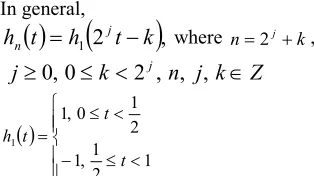
In general,
t
h
1
2
t
k
,
h
jn
where n kj
2 ,
Z
k
j
n
k
j
0
,
0
2
j,
,
,
1 2 1 , 1 2 1 0 , 1 1 t t t hNamely, each Haar wavelet contains one and just one square wave, and is zero elsewhere. Just these zeros make Haar wavelets to be local and very useful in solving stiff systems. Any function y(t), which is square integrable in the interval [0,1]. Can be expanded in a Haar series with an infinite number of terms
(
)
,
2
,
0
k
i
t
h
c
t
y
j i ii
…………...(1)
where
i
2
j
k
,
0
,
1
,
,
,
2
0
,
0
k
n
j
t
j
jwhere the Haar coefficients
1 0)
(
2
y
t
h
t
dt
c
i j iare determined such that the following integral square error
is minimized:
1 0 2 1 0,
dt
t
h
c
t
y
m i i i
where
N
j
m
2
j,
0
Usually, the series expansion Eq. (1) contains an infinite number of terms for a smooth y(t). If y(t) is a piecewise constant or may be approximated as a piecewise constant, then the sum in Eq. (1) will be terminated after m terms, that is
(
)
,
0
,
1
1 0
t
t
h
c
t
h
c
t
y
Tm mm
i i i
0 1...
1
,
T m
m
t
c
c
c
c
(2)
0
1...
1
,
T m
m
t
h
t
h
t
h
t
[image:2.504.261.418.90.178.2]h
Table 1. Results for the inhomogeneous equation at various values of “
S.No Time
Results Exact
Solutions RK Solutions
where “T” indicates transposition, the subscript m in the parantheses denotes their dimensions. The integration of Haar wavelets can be expandable into Haar series with Haar coefficient matrix P[3].
h
m
d
P
mmh
mt
,
t
0
,
1
Table 3. Results for an orbit problem at various values of
S.No Time
Results for Exact
Solutions RK Solutions 1 0 1.0000000 1.0000000 2 0.1 0.9950091 0.9950092 3 0.2 0.9800864 0.9800865
where the m-square matrix P is called the operational matrix of integration and single-term
2
1
1 1
P
. Let us define from Sekar et al. (2009a;2009b).
t
h
t
M
t
h
m Tm
mm ,(3)
and
M
11
t
h
0
t
.
Eq.(3) satisfies
t
c
C
h
t
,
M
mm m
mm mTable 5. Results for an orbit problem at various values of “
S.No Time
Results for Exact
Solutions RK Solutions 1 0 1.0000000 1.0000000
where
c
m is defined in Eq.(2)and
C
11
c
0.3. Numerical simulation of periodic and oscillatory problems
In this section, we introduce the STHW to four problems discussed by Simos and Aguiar (2001).
Table 7. Results for two-body problem at various values of “
S.No Time
Results for Exact
Solutions RK Solutions
RK Error 1 0 0.0000000 0.0000000 2 0.1 0.0998334 0.0998334
Fig. 1. Error graph for “x” at various time intervals
[image:6.504.37.242.309.430.2]Fig. 2. Error graph for “x” at various time intervals
Fig. 3. Error graph for “u” at various time intervals (orbit problem)
Fig. 4. Error graph for “v” at various time intervals (orbit problem)
0 0.0002 0.0004 0.0006 0.0008 0.001 0.0012 0.0014 0.0016 0.0018 0.002
E
rror
RK Error STHW Error
Time
0 0.1 0.2 0.3 0.4 0.5 0.6 0.7 0.8 0.9 1 1.1 1.2
1.3 1.4 1.5 1.6 1.7 1.8 1.9 2
0 0.0002 0.0004 0.0006 0.0008 0.001 0.0012 0.0014 0.0016 0.0018
E
rr
o
r
RK Error STHW Error
Time
0 1 2 3 4 5 6 7 8 9 10 11 12 13 14
15 16 17 18 19 20
0 0.0000002 0.0000004 0.0000006 0.0000008 0.000001 0.0000012
E
rr
o
r
RK Error STHW Error
Time
0 0.1 0.3 0.3 0.4 0.5 0.6 0.7 0.8 0.9 1 1.1 1.2
1.3 1.4 1.5 1.6 1.7 1.8 1.9 2
0 0.0000002 0.0000004 0.0000006 0.0000008 0.000001 0.0000012
E
rror
RK Error STHW Error
Time
0 0.1 0.2 0.3 0.4 0.5 0.6 0.7 0.8 0.9 1 1.1 1.2
[image:6.504.39.240.475.595.2]Fig. 5. Error graph for “z” at various time intervals
Fig. 6. Error graph for “y” at various time intervals
Fig. 7. Error graph for “z” at various time intervals
The first one is an inhomogeneous problem, the second is the nonlinear undamped Duffing’s equation, the third is the ‘almost’ periodic orbit problem and finally the fourth one is the well-known two-body problem.
3.1. Inhomogeneous equation.
Consider the following problem
x
y
y
100
99
sin
with initial condition
0
1
y
andy
0
11
(4) Whose analytical solution is
x
cos
10
x
sin
10
x
sin
x
.
y
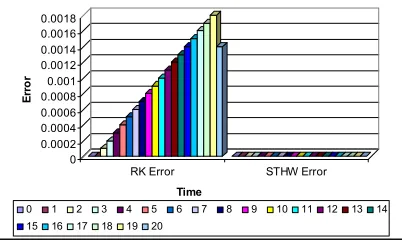
(5)Equation (4) has been solved numerically using the RK method and STHW and the obtained results (with step size time = 0.1) along with the exact solutions (from equation (5)) are presented in Table-1 along with absolute errors calculated between them. A graphical representation is shown for the inhomogeneous equation in Figure 1, using three-dimensional effects. This result reveals the superiority of the STHW with less complexity in implementation and at the same time the error reduction is 1000 times less than the RK method.
3.2. Duffing’s equation.
Consider the nonlinear undamped Duffing equation
x
B
y
y
y
3
cos
(6) Where B = 0.002 and
1
.
01
. The analytical solution of the above equation is given by
3 0 12
cos
2
1
i
i
i
x
A
x
y
(7)where
A
1
0
.
2001794775
36
,
,
10
246946143
.
0
3 3
A
65
0
.
304016
10
A
andA
7
0
.
374
10
9.
Equation (5) has been solved numerically with boundary conditions of the form
0
A
1A
3A
5A
7,
y
y
0
0
The results obtained (with step size time = 1) using the STHW and the RK methods along with exact solutions(from eqn (7)) and absolute errors between them are calculated and are presented in Table-2. A graphical representation is given for Duffing’s equation in Figure 2, using three-dimensional effect. It is inferred that, the STHW gives better solution for the non-linear undamped Duffing’s equation when compared to RK method. 3.3. An orbit problem.
0 0.0000001 0.0000002 0.0000003 0.0000004 0.0000005 0.0000006 0.0000007 0.0000008 0.0000009 0.000001 Error
RK Error STHW Error
Time
0 0.1 0.2 0.3 0.4 0.5 0.6 0.7 0.8 0.9 1 1.1 1.2
1.3 1.4 1.5 1.6 1.7 1.8 1.9 2
0 0.0000001 0.0000002 0.0000003 0.0000004 0.0000005 0.0000006 0.0000007 0.0000008 0.0000009 0.000001 Error
RK Error STHW Error
Time
0 0.1 0.2 0.3 0.4 0.5 0.6 0.7 0.8 0.9 1 1.1 1.2
1.3 1.4 1.5 1.6 1.7 1.8 1.9 2
0 0.00000005 0.0000001 0.00000015 0.0000002 0.00000025 0.0000003 Error
RK Error STHW Error
Time
0 0.1 0.2 0.3 0.4 0.5 0.6 0.7 0.8 0.9 1 1.1 1.2
1.3 1.4 1.5 1.6 1.7 1.8 1.9 2
[image:7.504.39.245.384.514.2]
Consider the following ‘almost’ periodic orbit problem studied by Stiefel and Bettis (1969).
,
001
.
0
e
ixz
z
z
0
1
,
0
0
.
9995
i
,
z
z
C
,
(8)Whose analytical solution is given by
x
u
x
iv
x
,
z
u
,
v
R
x
cos
x
0
.
0005
x
sin
x
,
u
x
sin
x
0
.
0005
x
cos
x
.
v
(9)The true solution in equation (9) represents the motion on a perturbation of a circular orbit in the complex plane. Re-writing the equation (8) in the following equivalent form
,
cos
001
.
0
x
u
u
u
0
1
,
u
0
0
,
,
sin
001
.
0
x
v
v
v
0
0
,
0
0
.
9995
,
v
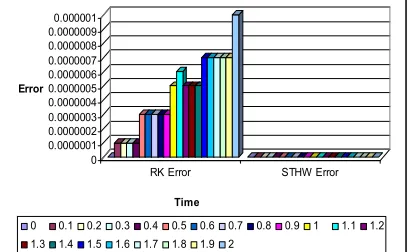
(10)Equation (10) has been solved numerically using the RK method and the STHW. The obtained results (with step size time = 0.1) along with exact solutions (from equation (9)) and the absolute errors between them are calculated and are presented in Table-3. A graphical representation is presented for the orbit problem in figures 3-5, using three-dimensional effect. From Tables 3-5 and the error graphs 3-5 reveals that STHW works well (with out any error) when compared to RK method, which yields a little error.
3.4. Two-body problem.
Consider the system of coupled differential equations, which is well known as two-body problem
2 2
3/2,
z
y
y
y
2 2
3/2,z y z z
0
1
,
y
y
0
0
,
z
0
0
,
z
0
1
(11) whose analytical solution is given by
x
cos
x
,
y
z
x
sin
x
(12)The above system of equation (11) has been solved numerically using the RK method and STHW. The obtained results (with step size time = 0.1) along with exact solutions (from equation
(12)) and absolute errors between them are calculated and are presented in Table-6 and 7. A graphical representation is given for the two-body problem in figures 6 and 7, using three-dimensional effect.
Conclusion
The obtained results of the periodic and oscillatory problems using STHW is very closer to these exact solutions of the problem when compared to the RK method. From the tables 1-7, one can observe that for most of the time intervals, the absolute error is less in STHW when compared to the RK method which yields a little error, along with the exact solutions. From figures 1-7, one can predict that the error is very less in STHW when compared to the RK method and especially STHW works well for the orbit problem and the two body problem. Hence, the STHW is more suitable for studying the periodic and oscillatory problems and especially it is recommended for the problems of orbit and two-body problems.
REFERENCES
Alexander, R. K. and Coyle, J. J. 1990. Runge-Kutta methods for differential- algebric systems,SIAM J. of Numer. Anal., 27 (3): 736-752.
Evans, D. J. 1991. A new fourth Order Runge-Kutta method for initial value problems with error control, Intern. J. Comp. Math., 139: 217-227.
Evans, D. J. and Yaakub, A. R. 1998. Weighted fifth order Runge-Kutta formulas for second order differential equations. Intern. J. Comp. Math., 70: 233-239.
Fehlberg, E. 1970. Klassische Runge-Kutta-Formeln vierter und niedriger Ordnung mit Schrittweitenkontolle und ihre Anwendung auf Warmeleitungsprobleme, Computing. 6: 61-71. Forsythe, G. E., Malcolm, M. A. and Moler, C. D.
1977. Computer Methods for Mathematical Computations, Englewood Cliffs. NJ: Prentice-Hall, U.S.A.
Lambert, J. D. 1991. Numerical Methods for Ordinary Differential Systems. The Initial Value Problem, John Wiley & Sons, Chichester, U.K.
Murugesan, K., Sekar, S., Murugesh, V. and Park, J.Y. 2004. Numerical solution of an industrial robot arm control problem using the RK-Butcher algorithm. Intern. J. Comp. Appl. in Tech., 19(2): 132-138.
Nandhakumar, S., Selladurai, V. and Sekar, S. 2009. Numerical investigation of an Industrial robot arm control problem using Haar Wavelet Series. Amer. J. of Engg. App. Sci., 2: 584-589. Sekar, S. and Manonmani, A. 2009a. A Study On
Time-Varying Singular Nonlinear Systems Via Single-Term Haar Wavelet Series. Intern. Rev. of Pure and App. Math., 5: 435-441.
Sekar, S. and Manonmani, A. 2009b. A Study On Second Order Mechanical Vibratory Systems Using Single-Term Haar Wavelet Series. Intern. J. of Log. Based Intel. Sys., 3:197-202.
Shampine, L. F. 1994. Numerical Solution of Ordinary Differential Equations, Chapman & Hall, New York, U.S.A.
Simos, T. E. and Aguiar, J. V. 2001. A modified Runge-kutta method with phase-lag of order infinity for the numerical solution of the SchrÖdinger equation and related problems. Comp. and Chem., 25: 275-281.
Stiefel, E. and Bettis, D. G. 1969. Stabilization of Cowell’s method. Numer. Math., 13: 154-175. Yaakub, A. R. and Evans, D. J. 1999. A fourth
order Runge-Kutta RK (4, 4) method with error control. Intern. J. Comp. Math., 71: 383-411.
*******