PERFORMANCE EVALUATION OF EDGE DETECTION TECHNIQUES FOR SQUARE PIXEL AND
1,*
Keshav Thakur,
1,*
M.Tech Final Year Student, Dep
2Assoc. Prof, Dep
3
Prof, Departmen
ARTICLE INFO ABSTRACT
In today’s world all the imaging data or information is processed and stored in a digital form. The digital imaging used in many applications like forensic imaging, medical imaging and computer graphics etc. The image is first ca
stored in memory device. The digital images are represented and stored in the form of square pixel. The square pixel image is formed by using the average of square area of smaller square pixel
form to digitize an image is hexagonal pixel. The hexagonal pixel structure is preferred over the square pixel structure, due to its advantages like angular resolution, higher quantization error and less aliasing effect. In this paper, firstly pi
reviewed. Another contribution in this paper is comparison between various edge detection techniques on square pixel structure, hexagon
Gaussian filter. The experimental result shows that the image edge detection significantly reduces the amount of data and
Copyright © 2014 Keshav Thakuret al.This is an open access article distributed under the distribution, and reproduction in any medium, provided the original work is properly cited.
INTRODUCTION
A digital image represents the real world which contains thousand of pixels in the form of square pixel structure. The square pixels have many advantages like picture symmetry, less calculation, easy to store and to implement. But due to its disadvantages like aliasing effect, quantization error, connectivity between the pixels with respect to the central pixel, less angular resolution and less symmetry, the square pixel structure in less advantageous. He
representation posses special computation features like higher degree of circular symmetry, uniform connectivity, reduced need of storage, greater angular resolution that are patent to the human visual system. It is an alternate tessellation
which have been proven a better efficiency and l
effect, (Mersereau et al., 1979). The hexagonal pixel structure
matches with the natural occurrences such as bee hives and the structure of simple eye unit called ‘ommatidia’ present in th hard shielded animal such as crab are also in the shape of
hexagon (Buschbeck et al., 1999). Due to these occurrences,
hexagonal pixel structure would provide better quality than the square structure. Golay (1969), proposed a parallel computer
based on hexagonal modules which require fewer
interconnections as compared to a similar square based architecture.
*Corresponding author: Keshav Thakur,M.Tech Department of ECE, MMU Ambala, Haryana, India.
ISSN: 0975-833X
Vol. 6, Issue, 11, pp.1009
Article History: Received 07th August, 2014
Received in revised form 23rd September, 2014
Accepted 07th October, 2014 Published online 30th November,2014
Key words:
Square pixel, Hexagon pixel, Spiral architecture, Spiral addressing, Edge detection operators.
RESEARCH ARTICLE
PERFORMANCE EVALUATION OF EDGE DETECTION TECHNIQUES FOR SQUARE PIXEL AND
HEXAGON PIXEL IMAGES
Keshav Thakur,
2Er Pooja Gupta
and
3Dr.Kuldip Pahwa
Final Year Student, Department of ECE, MMU Ambala, Haryana, India
, Department of ECE, MMEC Ambala, Haryana, India
artment of ECE, MMEC Ambala, Haryana, India
ABSTRACT
In today’s world all the imaging data or information is processed and stored in a digital form. The digital imaging used in many applications like forensic imaging, medical imaging and computer graphics etc. The image is first captured by the hardware and then converted into digital form and stored in memory device. The digital images are represented and stored in the form of square pixel. The square pixel image is formed by using the average of square area of smaller square pixel
form to digitize an image is hexagonal pixel. The hexagonal pixel structure is preferred over the square pixel structure, due to its advantages like angular resolution, higher quantization error and less aliasing effect. In this paper, firstly picture quality of image using hexagonal pixel structure is reviewed. Another contribution in this paper is comparison between various edge detection techniques on square pixel structure, hexagonal pixel structure and enhanced hexagonal pixel structure using Gaussian filter. The experimental result shows that the image edge detection significantly reduces the amount of data and filters out useless information.
is an open access article distributed under the Creative Commons Attribution License, which distribution, and reproduction in any medium, provided the original work is properly cited.
A digital image represents the real world which contains thousand of pixels in the form of square pixel structure. The square pixels have many advantages like picture symmetry, store and to implement. But due to its disadvantages like aliasing effect, quantization error, connectivity between the pixels with respect to the central pixel, less angular resolution and less symmetry, the square Hexagonal image representation posses special computation features like higher degree of circular symmetry, uniform connectivity, reduced need of storage, greater angular resolution that are patent to the human visual system. It is an alternate tessellation scheme which have been proven a better efficiency and less aliasing . The hexagonal pixel structure matches with the natural occurrences such as bee hives and the structure of simple eye unit called ‘ommatidia’ present in the hard shielded animal such as crab are also in the shape of Due to these occurrences, hexagonal pixel structure would provide better quality than the proposed a parallel computer
exagonal modules which require fewer
interconnections as compared to a similar square based
M.Tech Final Year Student, Ambala, Haryana, India.
The main reasons for using a hexagonal coordinate system for image processing are hexagon's consistent connection with their neighbors and the ease of representing natural shapes
using hexagons (Mersereau et al
1999; Golay et al., 1969). In a normal square
pixel’s neighbors have two different levels of connectivity they are either 1 pixel away, or
coordinate system means that each neighbor is exactly 1 pixel away, and so algorithms can
natural representation of curves in hexagonal coordinate systems allows many visual operations to be performed more easily; examples are edge detection and shape extraction. main problem that limits the use of hexagonal im
is believed due to lack of hardware for capturing and displaying hexagonal-based images. In the past years, there have been various attempts to simulate a hexagonal grid on a regular rectangular grid device. The simulation schemes include those approaches using rectangular pixels
1986), pseudo hexagonal pixels
mimic hexagonal pixels (He et al
pixels (Hintz, He et al., 2000)
set of seven hexagons and the image pixels are closer to each other in hexagonal image thus making the edges more clear and sharp as compared to square (or rectangular) image whose architecture uses the set of 3x3 vision u
Figure.1 below Edge is a basic feature of image. Edge detection refers to the process of identifying and locating sharp International Journal of Current Research
Vol. 6, Issue, 11, pp.10098-10104, November,2014
PERFORMANCE EVALUATION OF EDGE DETECTION TECHNIQUES FOR SQUARE PIXEL AND
Dr.Kuldip Pahwa
Ambala, Haryana, India
Ambala, Haryana, India
Ambala, Haryana, India
In today’s world all the imaging data or information is processed and stored in a digital form. The digital imaging used in many applications like forensic imaging, medical imaging and computer ptured by the hardware and then converted into digital form and stored in memory device. The digital images are represented and stored in the form of square pixel. The square pixel image is formed by using the average of square area of smaller square pixel. Another form to digitize an image is hexagonal pixel. The hexagonal pixel structure is preferred over the square pixel structure, due to its advantages like angular resolution, higher quantization error and less cture quality of image using hexagonal pixel structure is reviewed. Another contribution in this paper is comparison between various edge detection techniques pixel structure and enhanced hexagonal pixel structure using Gaussian filter. The experimental result shows that the image edge detection significantly reduces the
ribution License, which permits unrestricted use,
The main reasons for using a hexagonal coordinate system for image processing are hexagon's consistent connection with their neighbors and the ease of representing natural shapes et al., 1979; Buschbeck et al., . In a normal square-pixel system, a pixel’s neighbors have two different levels of connectivity - they are either 1 pixel away, or √2 pixels. Using a hexagonal coordinate system means that each neighbor is exactly 1 pixel away, and so algorithms can treat them all the same. The natural representation of curves in hexagonal coordinate systems allows many visual operations to be performed more easily; examples are edge detection and shape extraction. The main problem that limits the use of hexagonal image structure is believed due to lack of hardware for capturing and based images. In the past years, there have been various attempts to simulate a hexagonal grid on a regular rectangular grid device. The simulation schemes
se approaches using rectangular pixels (Horn et al.,
, pseudo hexagonal pixels (Wuthrich, Stucki et al., 1991),
et al., 1999) and virtual hexagonal In hexagonal grid each unit is a set of seven hexagons and the image pixels are closer to each other in hexagonal image thus making the edges more clear and sharp as compared to square (or rectangular) image whose architecture uses the set of 3x3 vision unit as shown below in a Edge is a basic feature of image. Edge detection refers to the process of identifying and locating sharp
discontinuities in an image. The shape of edges in image depends on many parameters such as geometrical and optical properties of the object, the illumination conditions, and the
noise level in the images (Buschbeck et al., 1999). Edge
detection depends upon the relation of pixel with its neighbor, extracts and localizes the pixels so that a large change in image brightness takes place. A pixel is said to be unsuitable in terms of edge if the brightness around a pixel is similar (or close). Otherwise, the pixel may represent an edge. Many edge detection algorithms have been proposed and implemented. These algorithms differ from each other in many aspects such
as computational cost, performance and hardware
implementation feasibility.
(a)
(b)
Fig. 1.(a) Square Pixel Image (b) Hexagon Pixel Image
In the hexagonal pixel structure, edge detection plays a important role for detecting meaningful discontinuities in gray level. An edge is defined as ‘a set of connected pixels that lie on the boundary between two regions’, edge is a ‘local’
concept (Woods, Gonzalez et al., 2002). In hexagonal pixel
structure, the edge detection operations were performed on the
hexagonally sampled image (Buschbeck et al., 1999), which is
[image:2.595.359.509.213.403.2]collected by converting rectangular pixel structure to the hexagonal pixel structure. Image edge detection is operated on a 3 X 3 pattern grid, so it is efficient and easy to implement. In hexagonal pixel structure uses hexagonal masked operators for edge detection. These hexagonal masks are applied on the images which is represented using spiral addressing scheme. The implemented work methodology is as shown below in Figure 2.
Fig.2. Work methodology
Construction of hexagonal pixels from square pixels
For the construction of hexagonal pixel each square pixel is firstly separated into 7x7 smaller pixels called sub-pixels (He,
Hintz, Wu, Wang, Jia, et al., 2006). Each sub-pixel has same
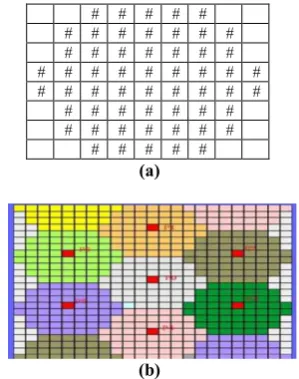
light intensity as that of a pixel from which the sub-pixels are separated. A hexagonal pixel is called ‘hyperpel’ and each virtual hexagon pixel is formed by 56- different sub-pixels forming the hexagonal structure as shown in figure below.
The size of each hexagon constructed pixel is given as: 56-46/56 = 12.5 %.
This means, the number of hexagonal pixels is 12.5% less than the number of square pixels to cover up an image and each constructed pixel is 12.5% bigger than the each square pixel.
# # # # #
# # # # # # #
# # # # # # #
# # # # # # # # #
# # # # # # # # #
# # # # # # #
# # # # # # #
# # # # #
(a)
(b)
Fig. 3(a) Structure of Single Hexagonal Pixel (b) Structure of Hexagonal Pixels
Hexagonal image representation
Image re-sampling is the technique used for converting a
square lattice to a hexagonal lattice (He, Hintz et al., 2006).
Due to many problems such as equal distance from the centre pixel, lack of hardware for capturing and displaying hexagonal images limits the use of hexagonal pixel structure, that affects the advance research on hexagonal pixel architecture (Wang,
Hintz, et al., 2005). There have been several techniques to
represent a hexagonal grid in place of square (rectangular) grid. In this paper, spiral addressing is used to represent hexagonal pixel structure.
Spiral Addressing
In order to properly address and store hexagonal images data, one-dimensional addressing scheme for a hexagonal structure, together with the definitions of two operations, Spiral Addition and Spiral Multiplication is proposed by Sheridan (Sheridan,
Hintz, Alexander, et al., 2000).This hexagonal structure is
[image:2.595.109.221.216.414.2] [image:2.595.39.291.623.714.2](a)
(b)
(c)
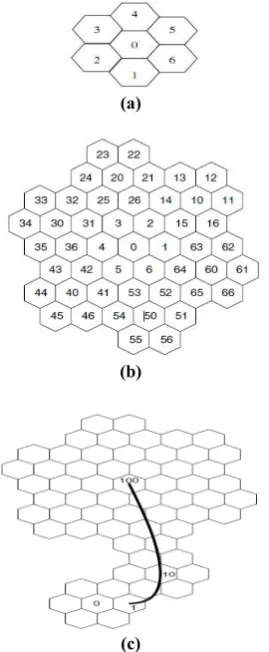
Fig.4. (a) A collection of seven hexagonal pixels with unique address (b) Spiral architecture and spiral addressing with unique address
(c) Spiral rotating direction through 1, 10, and 100
The spiral structure is frame to place six additional collections of seven hexagons about the addressed hexagons and multiply each address by 10. For each new collection of seven hexagons, the central address for the first seven hexagons is labeled as hexagon. The repetition of these steps allows to form a collection of hexagons with the powers of seven with uniquely assigned addresses. This pattern generates the Spiral architecture. The spiral rotation direction is followed through 1, 10 and 100 as shown in Figure 4.(b), in which the location of hexagon pixel with a given spiral address starting from the central pixel of address 0 (Horn, 1986). For example, to find the location of the pixel with spiral address 443, we need only know the locations of the pixels with spiral addresses 400, 40 and 3. The example of spiral addressing on an image is as shown below in Figure 5.
[image:3.595.98.233.56.383.2]
Square pixel image Hexagonal addressed image
Fig. 5. Example of spiral addressing
Edge detection operators
Sobel Edge Detector
The sobel edge detector method detects the edges by taking the maximum and minimum in the first derivative of the gray level
gradiant in the spatial domain (Sobel et al., 1978). The sobel
edge detectors have no smoothing fsilter, and they are only based on a discrete differential operator (Gonzalez and Woods, 1992). This method performs 2-D spatial gradient measurement on an image and so emphasizes regions of high spatial frequency that correspond to edges. It consists of a pair of 3×3 convolution mask which contains kernels and each kernel is simply the other rotated by 90°.
Prewitt Edge Detector
The Prewitt edge detector is a gradient based edge detector and very similar to the sobel operator. Prewitt edge detector is a correct way to estimate the magnitude and orientation of the
edge (Gonzalez, Woods et al., 1992). These kernels are
designed to respond maximally to the edges running at 45° to the pixel grid. The operator detects the edges in both horizontal and vertical directions, and then combines the information into a single matrix. The detector is considered to be poor due to its bad approximation to the gradient operator. However, the ease of implementation and low computational cost overcome these disadvantages.
Robert’s Edge Detector
Robert’s edge operator performs 2-D spatial gradient measurement on an image and provides best results with binary images. The operator consists of a pair of 2×2 convolution kernels. One kernel is simply the other rotated by 90° (Roberts et al., 1965) and applied separately to the input image, to produce separate measurements of the gradient component in each orientation. It returns edges at those points where the gradient of the image is maximum which means it highlights the regions of high spatial frequency which often correspond to edges.
Laplacian of Gaussian Edge Detector
The Laplacian is a 2-D isotropic detector and performs 2nd
spatial derivative measurement on an image. The Laplacian of an image highlights regions of rapid intensity change and is therefore often used for edge detection. The operator normally takes a single gray level image as input and produces another gray level image as output.
Canny edge detector
Canny edge detection operator is the most powerful edge detector. The canny edge detector detects the edges by isolating noise from the image without affecting the features of the edges in the image and then applying the tendency to find the
edges and the critical value for the threshold (Canny et al.,
[image:3.595.43.286.616.728.2]1986). The magnitude, or edge strength, of the gradient is then approximated using the formula:
EXPERIMENTAL RESULTS
Experiment No.1
S.No. Edge detection
operators
Square pixel Image
Hexagonal pixel Image
Hexagonal Pixel Enhanced image by Gaussian filter
01 Images
02 Sobel
03 Prewitt
04 Roberts
05
Laplacian of Gaussian
06 Canny
Experiment No.2
S.No Edge Detection Operators
Square Pixel image
Hexagonal pixel Image
Hexagonal Pixel Enhanced image by Gaussian filter
01 Images
02 Sobel
03 Prewitt
04 Roberts
05
Laplacian of Gaussian
06 Canny
Experiment No.3
S.no Edge Detection Operators Square Pixel
image
Hexagonal pixel Image
Hexagon enhanced image by Gabor filter
01
Images
02
Sobel
03
Prewitt
05 Laplacian of Gaussian
Experiment No.4
S.No Edge Detection Operators Square Pixel image
Hexagonal pixel Image
Hexagon enhanced image by Gabor filter
01 Images
02 Sobel
03 Prewitt
04 Roberts
05
Laplacian of Gaussian
06 Canny
Result of Example.1
S.No Operators Square Pixel Image Hexagonal Pixel Image Hexagonal Enhance Pixel Image By Gaussian Filter
MSE PSNR MSE PSNR MSE PSNR
01 Sobel 0.3590 52.5796 0.3328 52.9091 0.3200 53.0794
02 Prewitt 0.3589 52.5808 0.3330 52.9064 0.3199 53.0801
03 Roberts 0.3518 52.6679 0.3317 52.9231 0.3141 53.1607
04 Gaussian 0.3460 52.7400 0.3307 52.9460 0.3068 53.2624
06 Canny 0.3518 52.6681 0.3304 52.9308 0.3140 53.1611
Result of Example.2
S.No Operators Square Pixel Image Hexagonal Pixel Image Hexagonal Enhance Pixel Image By Gaussian Filter
MSE PSNR MSE PSNR MSE PSNR
01 Sobel 0.4294 51.8024 0.4174 51.9253 0.3979 52.1326
02 Prewitt 0.4291 51.8056 0.4172 51.9269 0.3980 52.1322
03 Roberts 0.4306 51.7900 0.4187 51.9115 0.3915 52.2034
04 Gaussian 0.4206 51.8917 0.4138 51.9625 0.3899 52.2218
Conclusion
In this paper evaluation of various edge detection techiniques that are Sobel, Robert, Prewitt, Laplacian of Gaussian and Canny are applied on the square pixel, hexagon pixel and enhance hexagon pixel image by gaussian filter. From the above results, it has been shown clearly that the Sobel, Prewitt, Roberts, Canny provide low quality edge maps as compared to Laplician of gaussian. Comparison is done on the basis of two parameters PSNR and MSE. For an effective edge detection, PSNR value should be high and MSE should be low. Among the investigated method, the Laplacian of gaussian method detects both strong and weak edges of hexagonal pixel and enhanced hexagonal pixel as compare to square pixel.
REFERENCES
Brannock, E. and Weeks, M. 2008. “A synopsis of recent work in edge detection using the DWT”, Proc. IEEE South east con, pp. 515-520.
Buschbeck, E., Ehmer, B. and Hoy, R., 1999. “Chunk versus point sampling: visual imaging in a small insect”. Vol.286, pp.1178-1180.
Canny, J. F. 1986. “A Computational Approach To Edge Detection”, IEEE Trams. Pattern Analysis and Machine Intelligence, Vol.8, pp.679-714.
Golay, M. 1969. “Hexagonal Parallel Pattern
Transformation”, IEEE Transactions on Computers,
Vol.18, pp.733-740.
Gonzalez, R. and Woods, R.E. 1992. “Digital Image
Processing”, Addision- Wesley Publishing Co. Inc.
He, X. 1999. “2-D Object Recognition with Spiral
Architecture”, PhD Thesis, University of Technology, Sydney.
He, X., Hintz, T., Wu, Q., Wang, H. and Jia, W. 2006. “A New Simulation of Spiral Architecture”, Proceedings
of International Conference on Image Processing, Computer Vision and Pattern Recognition (IPCV06), Vol.224 pp.570-575.
He, X., Hintz, T., Wu, Q., Wang, H. and Jia, W., 2006. “A New Simulation of Spiral Architecture, Proceedings of International Conference on Image Processing”, Computer Vision and Pattern Recognition (IPCV06), Vol.14, pp. 570–575.
Hintz, T. and He, X. 2000. “Virtual Spiral Architecture”, Proceedings of the International Conference on Parallel and Distributed Processing Techniques and Applications, Vol.1, pp. 399-405.
Horn, B.K.P. 1986. “Robot vision”, MIT press, Cambridge, MA and McGrwa hill, New York.
Mersereau, R. M. 1979. “The processing of Hexagonally Sampled Two-Dimensional Signals”, Proceedings of the IEEE, Vol.67, pp. 930-949.
Roberts, L. G. 1965. “Machine Perception of 3-D solids”, Optical and Electro-optical Information Processing, MIT, Press.
Sheridan, P., Hintz, T. and Alexander, D. 2000. "Pseudo-invariant Image Transformations on a Hexagonal Lattice" Image and Vision Computing, Vol. 18, pp. 907-917. Sobel, I. 1978. “Neighborhood coding of binary images fast
contour following and general array binary processing”, Elsevier Computer Graphics and Image Processing, Vol. 8, Iss.1, pp.127-135.
Wang, H., Wang, M. and Hintz, T., 2005. “Hexagonal structure for intelligent vision”.
Woods, R.E. and Gonzalez, R.C. 2002. “Digital image processing”, New Jersey: Prentice Hall.
Wuthrich, C. A. and Stucki, P. 1991. “An algorithmic comparison between square- and hexagonal-based grids’’, CVGIP: Graphical Models and Image Processing, Vol.53 (4), pp.324-339.
*******
Result of Example.3
S.No. Operators Hexagonal Pixel Image Hexagonal Pixel Image Hexagonal Enhance Pixel Image By Gaussian Filter
MSE PSNR MSE PSNR MSE PSNR
01 Sobel 0.3086 53.2367 0.3005 53.3527 0.2362 54.4005
02 Prewitt 0.3092 53.2286 0.3010 53.3458 0.2361 54.3989
03 Roberts 0.3106 53.2088 0.2909 53.4927 0.2365 54.3926
04 Gaussian 0.2713 53.7959 0.2608 53.9675 0.2286 54.5409
06 canny 0.2958 53.4202 0.2882 53.5342 0.2373 54.3782
Result of Example.4
S.No. Operators Hexagonal Pixel Image Hexagonal Pixel Image Hexagonal Enhance Pixel Image By Gaussian Filter
MSE PSNR MSE PSNR MSE PSNR
01 Sobel 0.5487 50.7376 0.5396 50.8104 0.4903 51.2259
02 Prewitt 0.5482 50.6394 0.5316 50.3458 0.4902 51.2264
03 Roberts 0.5567 50.6745 0.5394 50.8114 0.4984 51.1553
04 Gaussian 0.5288 50.8982 0.5154 51.0091 0.4768 51.3474