Demonstration of three dopamine molecules bound
to α-synuclein: Implication of oligomerization at the
initial stage
Sakurako Shimotakahara1*, Yuuki Shiroyama2, Takashi Fujimoto3, Mai Akai1, Takaya Onoue1,
Hiroko Seki4, Sayaka Kado4, Tomoya Machinami3, Yoichi Shibusawa1, Kenji Uéda5,
Mitsuru Tashiro3
1School of Pharmacy, Tokyo University of Pharmacy and Life Science, Tokyo, Japan; *Corresponding Author: [email protected]
2School of Life Science, Tokyo University of Pharmacy and Life Science, Tokyo, Japan
3Department of Chemistry, School of Sciences and Engineering, Meisei University, Tokyo, Japan 4Chemical Analysis Center, Chiba University, Chiba, Japan
5Department of Dementia and Higher Brain Function, Tokyo Metropolitan Institute of Medical Science, Tokyo, Japan
Received 6 January 2012; revised 25 January 2012; accepted 17 February 2012
ABSTRACT
α-Synuclein is the major component of the fila- mentous Lewy bodies and Lewy neurites that define neuropathological features and dementia with Lewy bodies. To investigate the role of do- pamine (DA) in α-synuclein fibrillation, the stru- ctural propensities to form oligomers at the ini- tial stage fibrillation were studied using size ex- clusion chromatography and various biophysical techniques. Interactions with DA were observed for wild-type α-synuclein and its mutants, A30P, E46K and A53T, using electrospray ionization mass spectrometry (ESI-MS). The results of ESI- MS indicate that an intact α-synuclein, which was not oxidized, had an ability to bind with three molecules of DA at the initial stage. Furthermore, upon binding to DA, α-synuclein oligomerizes to higher molecular weight species. These oligo- mers are structurally different from amyloid fibrils, as confirmed by thioflavin T and CD analysis.
Keywords: α-Synuclein; Dopamine; Fibrillation; Oligomerization; Mass Spectrometry
1. INTRODUCTION
α-Synuclein is a 140-amino acid protein characterized by an acidic C-terminal region and seven imperfect re-peats (consensus KTKEGV) distributed throughout most of the N-terminal half of the polypeptide [1]. α-Synuclein is a highly soluble, heat-stable andnatively unfolded pro- tein [2,3] predominantly expressed inthe neurons of the
central nervous system. It is localized at presynaptic ter- minals in close proximity to synaptic vesicles [1,4-6], as well as in the neuronal nuclei [7]. Threedifferent mis- sense mutations in the α-synuclein gene, A53T [8], A30P [9], and E46K [10], were identified in the confirmed fa- milial cases of autosomal-dominantly inherited, early-onset Parkinson’s disease (PD) and dementia with Lewy bodies. It has been observed that α-synuclein accumulatedin Lewy bodies and Lewy-related neurites mainly forms fibrils in PD [11]. The previous studies [12-17] indicated that the hydrophobicrepeat region between residues 65 and 95 within the non-Aβ component of Alzheimer’s disease amyloid (NAC) region and the negative charges atthe C-terminal region played a key role in forming fibril structures. Molecular species that were relatively compact but still unfoldedwere also found to be involved in the fibril formation.
suggested [24]. In order to investigate the detailed oligo- mer association mechanism of α-synuclein at the initial stage, interactions between α-synuclein and DA have been studied using various biochemical and biophysical techniques. The measurements using an electrospray ioni- zation mass spectrometry (ESI-MS), size exclusion chro- matography, fluorescence and CD have been carried out for the wild-type α-synuclein and three mutants, A30P, E46K and A53T, to evaluate the effect of these mutations in oligomerization. Although mechanisms that govern the formation of α-synuclein aggregates and oligomers are not well understood, they are considered to be a central event in the pathogenesis of PD. Moreover, we consider DA to be a one of the critical factors for aggregation or oligomerization event. Hence, elucidation of structural features of α-synuclein oligomerization with DA is ex-pected to provide significantly important clues for the molecular mechanism of PD.
2. MATERIALS AND METHODS
2.1. Preparation of Oligomers and ThT Measurements
The wild-type α-synuclein and three mutants, A30P, E46K and A53T, were cloned, expressed and purified as described previously [23]. α-Synuclein (ca. 2.0 mg/ml) was assembled into oligomers and/or fibrils in the absence and presence of DA (0.1 - 10 mM) by incubating in10 mM ammonium acetate (pH 7.5) at 30˚C with continuous stirring at 450 rpm. Thioflavin-T (ThT) fluorescence intensities were measured every 15 min at 482 nm with excitationat 450 nm and 100 scans on a microplate reader SH-9000Lab (Corona Electric).
2.2. CD Spectroscopy
CD spectra wererecorded using a 1-mm cuvette, scan- ning from 190 to 250 nm with a step sizeof 0.1 nm and scanning speed of 50 nm/min on a Jasco J-720 spectro- photometer. For all spectra, an average of eight scans was obtained every 24 hours. CD samples were prepared by diluting 10 μL of the above protein sample (2.0 mg/ml) at various incubation times into 400 μL CD buffer (10 mM sodium phosphate, pH 7.5), resulting in a final protein concentration of 0.05 mg/ml.
2.3. MS Spectrometry
Measurements of FT-MS were carried out for A30P using a LTQ-Orbitrap XL FT-mass spectrometer (Thermo Scientific). The experimental conditions were as follows: desolvation temperature, 200˚C; sample flow rate, 20 μL/min; R = 15000. ESI-MS measurements were carried out for the wild-type, E46K and A53T α-synucleins using a time-of-flight mass spectrometer (JEOL JMS-T100).
The experimental conditions were as follows: accelera- tion voltage, 2.0 kV; needle voltage, 2600 V; orifice voltage, 65 V; desolvation temperature, 100˚C; sample flow rate, 5.0 μL/min. All spectra were obtained via infusion of the sample solutions in the positive ionization mode.
2.4. Size Exclusion Chromatography
The incubated sample solutions were filtrated through a membrane filter Dismic-03 (pore size, 0.45 μm; Toyo Roshi), and then applied onto a TSKgel G3000SWXL gel
filtration column (7.8 mm I.D. × 300 mm; Tosoh Biosci- ence) with 50 mM sodium phosphate buffer, pH 7.5, con- taining 100 mM NaCl. The flow rate was 0.4 mL/min.
3. RESULTS AND DISCUSSION
3.1. Effects of Dopamine in Amyloid Fibril Formation
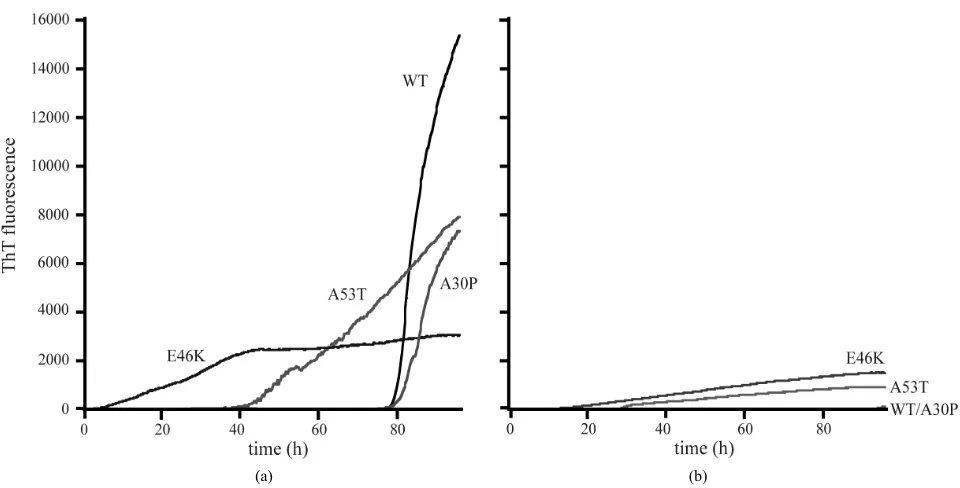
In order to observe the effects of DA in amyloid fibril formation of α-synucleins, an accumulation of amyloid was monitored by fluorescence spectroscopy using a ThT binding assay. This method is commonly used to observe an amyloid fibril formation of proteins. In general, an increase in ThT fluorescence intensity is considered to be a good indication of filament accumulations [25]. The time-dependent changes of ThT fluorescence intensity in the presence and absence of DA are shown in Figure 1. The striking decreases of ThT fluorescence intensities in the presence of 1 mM DA were observed for the wild- type, A30P and A53T α-synucleins. The ThT fluores-cence intensities of E46K in the presence of 1 mM DA were decreased more than 50% of those in the absence of DA. These results indicate that DA significantly inhibited the amyloid fibril formation of the wild-type α-synuclein and its three mutants. Almost no fibril was observed in the wild-type and A30P α-synucleins up to the incubation time of 100 hours (Figure 1(B)).
3.2. β-Sheet Contents; Characterization by CD
Figure 2 shows the time courses of changes in molar
(a) (b)
Figure 1. Amyloid fibril formation of the wild-type, A30P, E46K and A53T mutant α-synucleins in the (a) absence; and (b) presence of 1 mM DA as monitored by ThT fluorescence at 482 nm.
(a) (b)
Figure 2. The plot of time courses for the molar ellipticitiesat wavelength 218 nm for the wild-type (circle), A30P (square), E46K (diamond) and A53T (triangle) mutant α-synucleins in the (a) absence and (b) presence of 1 mM DA.
3.3. Oligomerization of α-Synuclein
in the presence of 1 mM DA as indicated by the ThT binding assay (Figure 1(b)), it can be concluded that DA bound α-synuclein transforms into non-amyloidogenic β-sheet-rich conformation. One of the most probable can-didates for this conformation is α-synuclein oligomers. In the previous study, our group monitored oligomerization of α-synuclein comprising heptamer at the early stage fib-rillation using the time-dependent SAXS [24]. Recently, it has been proposed that the reactive intermediates of α-synuclein interacting with DA induce its oligomeriza-tion such as trimers [19,20].
[image:3.595.99.494.362.552.2]
(a) (b) (c)
(d) (e) (f)
(g) (h) (i)
[image:4.595.110.489.83.565.2]
(j) (k) (l)
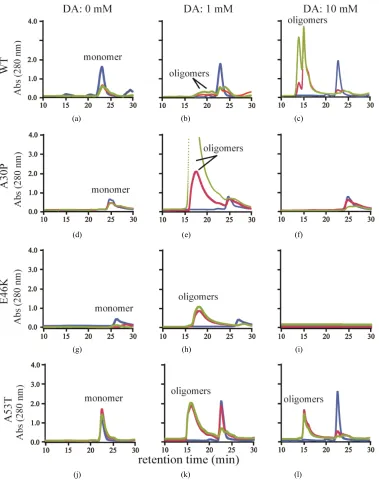
Figure 3. Size exclusion chromatography of (a)-(c) the wild-type, (d)-(f) A30P, (g)-(i) E46K and (j)-(l) A53T mutant -synucleins in the absence and presence of 1 and 10 mM DA at the incubation times of 0 h (blue), 72 h (red) and 120 h (green). The monomer peaks are labeled in each chromatogram obtained in the absence of DA, and the oligomer peaks are labeled in other chromatograms obtained in the presence of DA.
to the fact that the monomeric wild-type and mutants are more extended or unstructured than those standard pro-teins used for preparation of the calibration curve. The difference in retention times among the wild-type and mutants can be attributed to the deterioration of pre- column used for separation. In the chromatograms of the wild-type α-synuclein, several high molecular weight oli- gomers with retention times from 18 min to 22 min were observed in the presence of 1 mM DA at 72 and 120 hour
presence of 1 mM DA (Figures 3(e) and (h)), while these oligomers disappeared in the presence of 10 mM
DA (Figures 3(f) and (i)). During the process of fibrilla-
tion, we have monitored protein samples using SDS- PAGE and observed that the excess amount of DA pro-moted a fast degradation of α-synuclein. Although a similar tendency was observed for A53T, both monomer and oligomers were still detected in the presence of 10 mM DA (Figure 3(l)). This could be attributed to the differences in the initial amount of monomer protein subjected to the fibrillation. It is as if degradation of pro-teins and formation of oligomers were competing events. Nonetheless, the results of size exclusion chromatogra-phy unambiguously indicate that the various molecular weight oligomers were induced for the wild-type α- synuclein and its three mutants in the presence of 1 mM DA. In the singular value decomposition (SVD) analysis using the time-dependent SAXS data, it was suggested that heptamers were formed in the transient intermediate state [24]. The molecular weight of heptamer is ca. 100 kDa, which is in the range of the molecular weight of oligomers estimated by a size exclusion chromatography. In the analysis by Rekas et al., it was shown that the wild-type α-synuclein formed various species of oli-gomers, such as dimmer, trimmer and high molecular weight oligomers [20]. The sedimentation velocity ana- lysis for the eluted fraction of size exclusion
chromatog-raphy indicated that DA-treated wild-type α-synuclein could have formed the maximum of 26-mers [20]. The distributions of the molecular weight of DA-induced oli- gomers observed in the present study are consistent with those reported by Rekas et al. [20].
3.4. Complex Formation of Dopamine and α-Synuclein
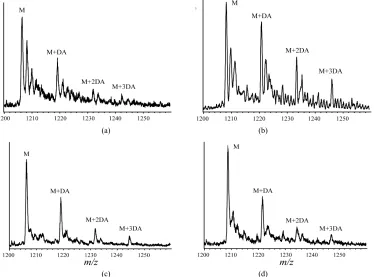
In order to clarify the detailed interactions between α-synuclein and DA at the initial stage of fibrillation, the same samples used for chromatography analysis were also subjected to MS spectrometry. Envelopes of ions for the wild-type α-synuclein between m/z 852 and 2412, corresponding to +17 through +6 charged states mono- mer, were observed (data not shown). The expanded spectra between m/z 1200 and 1260 for all α-synuclein species are shown in Figure 4. The envelopes of ion peaks between m/z 1206 and 1210 corresponded to the monomeric wild-type α-synuclein (mw = 14460) with +12 charged state (Figure 4(a)). In this envelope, the ion peaks consisted of the free α-synuclein [M+12H]12+, and its
sodium adducts [M+11H+Na]12+ and [M+10H+ 2Na]12+.
In the presence of DA, the ion peaks corre- sponding to the complexes of α-synuclein and DA were observed for the wild-type α-synuclein (Figure 4(a)) and its mutants
(Figure 4(b)-(d)). The maximum of three DA molecules
(a) (b)
[image:5.595.113.487.419.696.2]
(c) (d)
were detected to bind with one molecule of α-synuclein. The ion peaks of the complexes comprising α-synuclein and DA (MW = 153) were identified using the sample solutions without any incubation. This implies that there is a strong affinity between an intact α-synuclein and DA. Although several groups reported observations of oli- gomers comprising α-synuclein with four oxidized Met [19-21], here we have shown that non-oxidazed form of α-synucleins had an ability to non-covalently associate with DA. These results suggest that there could be multi- ple pathways in oligomerization of α-synuclein including DA. In the further study, it is necessary to clarify whether the complexes identified in our ESI-MS study is the ini- tial compound leading to oligomers.
In the size exclusion chromatography experiments, an extinction coefficient of DA at 280 nm was turned out to be much larger than that of α-synuclein. As can be seen from Figure 3, the absorbance of oligomeric species was much larger than that of monomers. This might indicate the fact that oligomers observed in these experiments were actually complexed with several DA molecules. In a working model of the fibrillization pathway of α-sy- nuclein, disordered monomeric α-synuclein oligomerizes to form a heterogeneous population of β-sheet rich pro-tofibrils, which consist of pore-like structures [26]. Since current dogma suggests that oligomeric α-synuclein in-termediates may represent the most toxic species [27], the formation of oligomeric α-synuclein species needs to be characterized in further detail. The present results are expected to provide clues for identification of α-synu- clein oligomers.
4. CONCLUSION
In the present study, propensities to form oligomers at the initial stage fibrillation were studied using size ex-clusion chromatography and various biophysical tech-niques, and interactions between α-synuclein and DA were observed using ESI-MS. In the analysis using size exclusion chromatography, it was shown that α-synuclein oligomerizes to higher molecular weight species in the presence of DA. These oligomers are structurally differ-ent from amyloid fibrils, as confirmed by thioflavin T and CD analysis. The results of ESI-MS indicate that an intact α-synuclein had an ability to bind with three molecules of DA at the initial stage. Based on these ob-servations, it can be considered that formation of com-plexes comprising an α-synuclein and three molecules of DA could be a critical for triggering oligomerization.
5. ACKNOWLEDGEMENTS
This study was supported by a Grant-in-Aid for Scientific Research (No. 17550085 for S.S and 21550092 for M.T.) from the Ministry of
Education, Culture, Sports, Science, and Technology.
REFERENCES
[1] Uéda, K., Fukushima, H., Masliah, E., Xia, Y., Iwai, A., Yoshimoto, M., Otero, D.A., Kondo, J., Ihara, Y. and Saitoh, T. (1993) Molecular cloning of cDNA encoding an unrec- ognized component of amyloid in Alzheimer disease. Pro- ceedings of the National Academy of Sciences, 90, 11282- 11286. doi:10.1073/pnas.90.23.11282
[2] Weinreb, P.H., Zhen, W., Poon, A.W., Conway, K.A. and Lansbury, P.T. (1996) NACP, a protein implicated in Alz- heimer’s disease and learning, is natively unfolded. Bio- chemistry, 35, 13709-13715. doi:10.1021/bi961799n
[3] Davidson, W.S., Jonas, A., Clayton, D.F. and George, J.M. (1998) Stabilization of α-synuclein secondary structure upon binding to synthetic membranes. Journal of Biologi- cal Chemistry, 273, 9443-9449.
doi:10.1074/jbc.273.16.9443
[4] George, J.M., Jin, H., Woods, W.S. and Clayton, D.F. (1995) Characterization of a novel protein regulated dur-ing the critical period for song learndur-ing in the zebra finch.
Neuron, 15, 361-372.
doi:10.1016/0896-6273(95)90040-3
[5] Iwai, A., Masliah, E., Yoshimoto, M., Ge, N., Flanagan, L., De Silva, H.A., Kittel, A. and Saitoh, T. (1995) The pre- cursor protein of non-A beta component of Alzheimer’s di- sease amyloid is a presynaptic protein of the central ner- vous system. Neuron, 14, 467-475.
doi:10.1016/0896-6273(95)90302-X
[6] Ma, Q.L., Chan, P., Yoshii, M. and Uéda, K. (2003)
α-synuclein aggregation and neurodegenerative diseases.
Journal of Alzheimer’s Disease, 5, 139-148.
[7] Yu, S., Li, X., Liu, G., Han, J., Zhang, C., Li, Y., Xu, S., Liu, C., Gao, Y., Yang, H., Uéda, K. and Chan, P. (2007) Extensive nuclear localization of α-synuclein in normal rat brain neurons revealed by a novel monoclonal anti-body. Neuroscience, 145, 539-555.
doi:10.1016/j.neuroscience.2006.12.028
[8] Polymeropoulos, M.H., Lavedan, C., Leroy, E., Ide, S.E., Dehejia, A., Dutra, A., Pike, B., Root, H., Rubenstein, J., Boyer, R., Stenroos, E.S., Chandrasekharappa, S., Athanas-siadou, A., Papapetropoulos, T., Johnson, W.G., Lazzarini, A.M., Duvoisin, R.C., Di Iorio, G., Golbe, L.I. and Nuss-baum, R.L. (1997) Mutation in the α-synuclein gene identi-fied in families with Parkinson’s disease. Science, 276, 2045-2047. doi:10.1126/science.276.5321.2045
[9] Kruger, R., Kuhn, W., Muller, T., Woitalla, D., Graeber, M., Kosel, S., Przuntek, H., Epplen, J.T., Schols, L. and Riess, O. (1998) Ala30Pro mutation in the gene encoding alpha-synuclein in Parkinson’s disease. Nature Genetics,
18, 106-108.
doi:10.1002/ana.10795
[11] Arima, K., Uéda, K., Sunohara, N., Hirai, S., Izumiyama, Y., Tonozuka-Uehara, H. and Kawai, M. (1998) Immu- noelectron-microscopic demonstration of NACP/α-synu- clein-epitopes on the filamentous component of Lewy bodies in Parkinson’s disease and in dementia with Lewy bodies.
Brain Research, 808, 93-100.
doi:10.1016/S0006-8993(98)00734-3
[12] Uversky, V.N., Li, J. and Fink, A.L. (2001) Evidence for a partially folded intermediate in α-synuclein fibril formation.
Journal of Biological Chemistry, 276, 10737-10744.
doi:10.1074/jbc.M010907200
[13] Uversky, V.N. and Fink, A.L. (2004) Conformational con- straints for amyloid fibrillation: The importance of being unfolded. Biochimica et Biophysica Acta, 1698, 131-153. [14] Uversky, V.N. (2003) A protein-chameleon: Conforma-
tional plasticity of α-synuclein, a disordered protein invol- ved in neurodegenerative disorders. Journal of Biomolecu- lar Structure & Dynamics, 21, 211-234.
[15] Giasson, B.I., Murray, I.V., Trojanowski, J.Q. and Lee, V.M. (2001) A hydrophobic stretch of 12 amino acid residues in the middle of α-synuclein is essential for filament assembly.
Journal of Biological Chemistry, 276, 2380-2386.
doi:10.1074/jbc.M008919200
[16] Miake, H., Mizusawa, H., Iwatsubo, T. and Hasegawa, M. (2002) Biochemical characterization of the core structure of α-synuclein filaments. Journal of Biological Chemistry,
277, 19213-19219. doi:10.1074/jbc.M110551200
[17] Hoyer, W., Cherny, D., Subramaniam, V. and Jovin, T.M. (2004) Impact of the acidic C-terminal region comprising amino acids 109-140 on α-synuclein aggregation in vitro.
Biochemistry, 43, 16233-16242.
doi:10.1021/bi048453u
[18] Conway, K.A., Rochet, J.C., Bieganski, R.M. and Lansbury, P.T. Jr. (2001) Kinetic stabilization of the α-synuclein pro-tofibril by a dopamine-α-synuclein adduct. Science, 294, 1346-1349. doi:10.1126/science.1063522
[19] Pham, C.L.L., Leong, S.L., Ali, F.E., Kenche, V.B., Hill, A.F., Gras, S.L., Barnham, K.J. and Cappai, R. (2009) Dopamine and the dopamine oxidation product 5,6-dihydroxylindole promote distinct on-pathway and off-pathway aggregation of
α-synuclein in a pH-dependent manner. Journal of Mo- lecular Biology, 387, 771-785.
doi:10.1016/j.jmb.2009.02.007
[20] Rekas, A., Knott, R.B., Sokolova, A., Barnham, K.J., Perez, K.A., Masters, C.L., Drew, S.C., Cappai, R., Cur-tain, C.C. and Pham, C.L.L. (2010) The structure of do-pamine induced α-synuclein oligomers. European Bio-physics Journal,39, 1407-1419.
doi:10.1007/s00249-010-0595-x
[21] Bisaglia, M., Tosatto, L., Munari, F., Tessari, I., de Laureto, P.P., Mammi, S. and Bubacco, L. (2010) Dopamine quin- ones interact with α-synuclein to form unstructured adducts.
Biochemical and Biophysical Research Communications,
394, 424-428. doi:10.1016/j.bbrc.2010.03.044
[22] Lee, H.J., Baek, S.M., Ho, D.H., Suk, J.E., Cho, E.D. and Lee, S.J. (2011) Dopamine promotes formation and secre- tion of non-fibrillar α-synuclein oligomers. Experimental and Molecular Medicine, 43, 216-222.
doi:10.3858/emm.2011.43.4.026
[23] Kamiyoshihara, T., Kojima, M., Uéda, K., Tashiro, M. and Shimotakahara, S. (2007) Observation of multiple interme- diates in α-synuclein fibril formation by singular value de- composition analysis. Biochemical and Biophysical Resear- ch Communications, 355, 398-403.
doi:10.1016/j.bbrc.2007.01.162
[24] Tashiro, M., Kojima, M., Kihara, H., Kasai, K., Kamiyo- shihara, T., Uéda, K. and Shimotakahara, S. (2008) Char- acterization of fibrillation process of α-synuclein at the ini- tial stage. Biochemical and Biophysical Research Commu- nications, 369, 910-914. doi:10.1016/j.bbrc.2008.02.127
[25] Choi, W., Zibaee, S., Jakes, R., Serpell, L.C., Davletov, B., Crowther, R.A. and Goedert, M. (2004) Mutation E46K increases phospholipid binding and assembly into fila- ments of human α-synuclein. FEBS Letters, 576, 363-368.
doi:10.1016/j.febslet.2004.09.038
[26] Volles, M.J. and Lansbury, P.T. Jr. (2003) Zeroing in on the pathogenic form of α-synuclein and its mechanism of neurotoxicity in Parkinson’s disease. Biochemistry, 42, 7871-7878. doi:10.1021/bi030086j
[27] Tetzlaff, J.E., Putcha, P., Outeiro, T.F., Ivanov, A., Bere- zovska, O., Hyman, B.T. and McLean, P.J. (2008) CHIP targets toxic α-synuclein oligomers for degradation. Jour- nal of Biological Chemistry, 283, 17962-17968.