POINTS
B. JACKSON, V. E. KASZANITZKY, AND A. NIXON
Abstract. We develop a rigidity theory for graphs whose vertices are constrained to lie on a cylinder and in which two given vertices are coincident. We apply our result to show that the vertex splitting operation preserves the global rigidity of generic frameworks on the cylinder, whenever it satisfies the necessary condition that the deletion of the edge joining the split vertices preserves generic rigidity.
1. Introduction
A framework (G, p) inRd is the combination of a finite, simple graph G= (V, E) and a mapp:V →Rd. It isrigidif every edge-length preserving continuous motion of the vertices arises as a congruence of Rd (see, for example, [14] for basic definitions and background). The theory of generic rigidity aims to characterise the graphsGfor which (G, p) is rigid for all generic choices ofp. This was accomplished by Laman [8] ford= 2, but is a long-standing open problem ford≥3.
We are interested in frameworks in R3 whose vertices are constrained to lie on a fixed surface. Generic rigidity in this context was characterised for graphs on the cylinder and various other surfaces in [10, 11]. In this paper we consider frameworks on the cylinder in which two of the vertices are coincident, but are otherwise generic. For such frameworks we give the following combinatorial characterisation of rigidity. Given two vertices u, v of a graphG we use G−uv to denote the graph formed from Gby deleting the edge uv if it exists andG/uv to denote the graph which arises fromGby contracting the verticesu and
v (and deleting any loops and replacing any parallel edges by single edges). We say thatG
is uv-rigid on a cylinder Y if there exists a realisation p of G on Y such that p(u) =p(v),
p|V−v is generic on Y, and (G, p) is rigid on Y.
Theorem 1.1. Let G be a graph and u, v be distinct vertices of G. Then G isuv-rigid on a cylinder Y if and only if G−uv and G/uv are both rigid on Y.
Our proof technique extends that used by Fekete, Jord´an and Kaszanitzky [4] to obtain an analogous result for frameworks inR2.
We apply our result to show that the vertex splitting operation preserves the global rigidity of generic frameworks on the cylinder, whenever it satisfies the necessary condition that the deletion of the edge joining the split vertices preserves generic rigidity. This is a key step in the recent characterisation of generic global rigidity on the cylinder given in [7]. Special position arguments are commonly used to prove that graph operations preserve generic rigidity properties and it is conceivable that our characterisation of generic uv -rigidity on the cylinder may have other such applications.
An outline of the paper is as follows. In Section 2 we provide background for frameworks on a cylinder. In Section 3 we define a count matroid Muv(G) on a graph G with two distinguished vertices uand v. In Section 4 we derive an inductive construction for graphs
Date: October 27, 2018.
whose edge set is independent in Muv(G). We then use this construction to prove our characterisation of rigidity on a cylinder for frameworks in which u and v are coincident but are otherwise generic. In Section 5 we discuss global rigidity and apply our coincident vertex result to prove that the vertex splitting operation preserves global rigidity for generic frameworks on a cylinder if and only if deletion of the new edge preserves generic rigidity. Finally, in Section 6 we comment on extensions to other surfaces.
2. Frameworks on concentric cylinders
Throughout this paper we will only consider graphs without loops or parallel edges, as loops and parallel edges give rise to trivial distance constraints. Let G= (V, E) be a graph withV ={v1, . . . , vn}. We will consider realisations ofGon a family of concentric cylinders Y =Y1∪ Y2∪ · · · ∪ Yk whereYi ={(x, y, z)∈R3 :x2+y2 =ri} and r = (r1, . . . , rk) is a
vector of positive real numbers.1 A framework (G, p) on Y is an ordered pair consisting of a graphG and a realisationp such thatp(vi)∈ Y for all vi∈V.
Two frameworks (G, p) and (G, q) on Y areequivalent ifkp(vi)−p(vj)k=kq(vi)−q(vj)k
for all edgesvivj ∈E. Moreover (G, p) and (G, q) on Y arecongruent ifkp(vi)−p(vj)k= kq(vi)−q(vj)kfor all pairs of verticesvi, vj ∈V. The framework (G, p) isrigid onY if there
exists an >0 such that every framework (G, q) onY which is equivalent to (G, p), and has
kp(vi)−q(vi)k< for all 1 ≤i≤n, is congruent to (G, p). Moreover (G, p) is minimally rigid on Y if (G, p) is rigid on Y but (G−e, p) is not for any e∈E. The framework (G, p) is generic on Y if td[Q(r, p) :Q(r)] = 2n, where td[L, K] denotes the transcendence degree of the field extension [L : K] i.e. the size of a maximal set of elements of L which are algebraically independent over K.
It was shown in [10] that a generic framework (G, p) on a family of concentric cylinders
Y is rigid if and only if it is infinitesimally rigid in the following sense. An infinitesimal flex s of (G, p) on Y is a maps:V →R3 such that s(v
i) is tangential toY atp(vi) for all vi ∈ V and (p(vj)−p(vi))·(s(vj)−s(vi)) = 0 for all vjvi ∈ E. The framework (G, p) is infinitesimally rigid on Y if every infinitesimal flex is an infinitesimal isometry of R3, i.e. an infinitesimal flex corresponding to a combination of translations and rotations of R3.
The rigidity matrix RY(G, p) is the (|E|+|V|)×3|V|matrix
RY(G, p) =
R3(G, p) S(G, p)
where: R3(G, p) has rows indexed by E and 3-tuples of columns indexed by V in which,
for e = vivj ∈ E, the submatrices in row e and columns vi and vj are p(vi)−p(vj) and p(vj)−p(vi), respectively, and all other entries are zero;S(G, p) has rows indexed byV and
3-tuples of columns indexed byV in which, forvi ∈V, the submatrix in rowvi and column vi is ¯p(vi) = (xi, yi,0) when p(vi) = (xi, yi, zi). Therigidity matroid RY(G) is the matroid
on E in which a set F ⊆E is independent if and only if the rows of RY(G, p) indexed by
F ∪V are linearly independent for any generic p. Equivalently RY(G) is the matroid we get from the row matroid ofRY(G, p) by contracting each element ofV. We will userY to denote the rank function of RY(G, p).
A graphG= (V, E) is (k, `)-sparseif|E0| ≤k|V0| −`for all subgraphs (V0, E0) ofGwith
at least one edge. Moreover Gis (k, `)-tight ifG is (k, `)-sparse and |E|=k|V| −`. The following characterisation of generic rigidity on Y was proved in [10].
Theorem 2.1. Let (G, p) be a generic framework on a family of concentric cylinders Y. Then (G, p) is minimally rigid on Y if and only if G is a complete graph on at most three vertices or G is (2,2)-tight.
2.1. Coincident realisations on concentric cylinders. LetG= (V, E) be a graph and
u, v∈V. A framework (G, p) onY isuv-coincident ifp(u) =p(v). A genericuv-coincident framework is a uv-coincident framework (G, p) for which (G−u, p|V−u) is generic. We
denote theuv-coincident cylinder rigidity matroid by RYuv(G) (this is the matroid on E in which a setF ⊆E is independent if and only if the rows ofRY(G, p) indexed byF∪V are linearly independent for any generic uv-coincident realisation p.). Note that the matroid depends on G but not on the choice of generic uv-coincident realisation. That is, for any two generic uv-coincident realisations (G, p) and (G, p0) on Y, we get the same matroid. We also use rYuv to denote the rank function of RYuv(G). We say that G is uv-rigid on Y
if ruvY (G) = 2|V| −2 and that G is minimally uv-rigid on Y if G is uv-rigid on Y and
|E|= 2|V| −2.
Note that the terms ‘rigid on Y’ and ‘uv-rigid on Y’, and the notations rY and ruvY
appear to depend on Y. Theorems 1.1 and 2.1 imply that this is not the case since the characterisations ofRY(G) andRY
uv(G) given by these results depend only on the graphG
and not the family of concentric cylindersY.
3. A count matroid
In this section we define a count matroid Muv(G) on the edge set of a graphGwith two
distinguished vertices u and v. Our approach follows that given in [4]. We will show that
Muv(G) is equal toRYuv(G) in Section 4.
Let G = (V, E) be a graph. For X ⊆ V let NG(X) be the set of neighbours of X in V \X and put NG(x) = NG(X) when X = {x}. Let G[X] denote the subgraph of G
induced by X and let EG(X) be the set of edges of G[X]. Thus iG(X) = |EG(X)|. For a
family S = {S1, S2, . . . , Sk}, whereSi ⊆V for all i= 1, . . . , k, we define V(S) =Ski=1Si, EG(S) =
Sk
i=1EG(Si) and put iG(S) = |EG(S)|. We also define cov(S) = {xy : x, y ∈ V,{x, y} ⊆Si for some 1 ≤i≤k}.We say that S coversa set F ⊆E ifF ⊆cov(S). The
degree of a vertexwis denoted bydG(w). We may omit the subscripts referring toGif the
graph is clear from the context.
Let G = (V, E) be a graph and u, v ∈ V be two distinct vertices of G. Let H =
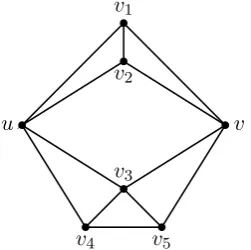
{H1, ..., Hk} be a family with Hi ⊆ V, 1 ≤ i ≤ k. We say that H is uv-compatible if u, v ∈ Hi and |Hi| ≥ 3 hold for all 1 ≤ i ≤ k. See Figure 1 for an example. We define
the value of subsets ofV and of uv-compatible families as follows. For a nonempty subset
H ⊆V, we let
val(H) = 2|H| −tH,
where tH = 4 if H ={u, v},tH = 3 if H 6={u, v} and |H| ∈ {2,3}, and tH = 2 otherwise.
We will often denotetHi by ti for short. For auv-compatible family H={H1, H2, . . . , Hk}
we let
val(H) =
k
X
i=1
val(Hi)
!
−2(k−1) =
k
X
i=1
(2|Hi| −tHi −2) + 2.
Note that if H = {H} is a uv-compatible family containing only one set then the two definitions agree, i.e. val(H) = val(H) holds.
We say that G isuv-sparse if for allH ⊆V with |H| ≥ 2 we haveiG(H)≤val(H) and
H = {H1, . . . , Hk}) is called tight if iG(H) = val(H) (resp. iG(H) = val(H)) holds. We
will show that the edge sets of the uv-sparse subgraphs of Gform the independent sets of a matroid Muv(G).
The following lemmas will enable us to ‘uncross’ tight sets and tightuv-compatible fam-ilies in a sparse graph. The first result follows immediately from the definition of thei- and val- functions.
Lemma 3.1. Let X, Y ⊆V be distinct vertex sets in G. Then (a) i(X) +i(Y)≤i(X∪Y) +i(X∩Y) and
(b) if X∩Y 6=∅, thenval(X) + val(Y) +tX+tY = val(X∪Y) + val(X∩Y) +tX∪Y +tX∩Y.
Lemma 3.2. Let H={H1, . . . , Hk} be a uv-compatible family in G.
(a) Suppose |Hi∩Hj| ≥ 3 for some pair 1 ≤ i < j ≤ k. Then there is a uv-compatible family H0 with cov(H)⊆cov(H0) andval(H0)<val(H).
(b) Suppose G is uv-sparse and His tight. Then Hi∩Hj ={u, v} for all 1≤i≤k.
Proof. (a) We may assume that i=k−1, j =k. Let H0 ={H1, . . . , Hk−2, Hk−1∪Hk}.
Using Lemma 3.1(b) we have val(Hk−1) + val(Hk) ≥ val(Hk−1 ∪Hk) + val(Hk−1∩Hk).
Hence
val(H) =
k
X
l=1
val(Hl)−2(k−1) = k−2
X
l=1
val(Hl)−2((k−1)−1) + val(Hk−1) + val(Hk)−2
≥ k−2
X
l=1
val(Hl) + val(Hk−1∪Hk)−2((k−1)−1) + val(Hk−1∩Hk)−2>val(H0).
Clearly, we have cov(H)⊆cov(H0).
(b) Since H is tight, if |Hi ∩Hj| ≥ 3 for some pair 1 ≤ i < j ≤ k then, by (a), we
have val(H0) < val(H) = i(H) ≤ i(H0). This contradicts the uv-sparsity of G. Hence
Hi∩Hj ={u, v} for all 1≤i≤k.
Lemma 3.3. Let H ={H1, . . . , Hk} be a uv-compatible family with Hi∩Hj ={u, v} for all 1≤i < j ≤k and|Hk| ≥4. Then H0 ={H1, . . . , Hk−2, Hk−1∪Hk} is a uv-compatible family with cov(H) ⊂ cov(H0) and for which val(H0) ≤ val(H) + 1 with equality only if |Hk−1|= 3. Furthermore, if G isuv-sparse,H is tight and |Hk−1| ≥4, then H0 is tight.
Proof. Using Lemma 3.1(b) and the facts thattk=tHk−1∪Hk = 2 andtHk−1∩Hk = 4 we have
val(Hk−1)+val(Hk) = val(Hk−1∪Hk)+val(Hk−1∩Hk)+4−tk−1= val(Hk−1∪Hk)+4−tk−1.
Hence
val(H) =
k
X
l=1
val(Hl)−2(k−1) = k−2
X
l=1
val(Hl)−2((k−1)−1) + val(Hk−1) + val(Hk)−2
=
k−2
X
l=1
val(Hl) + val(Hk−1∪Hk)−2((k−1)−1) + 2−tk−1
= val(H0) + 2−tk−1.
Thus val(H0) ≤ val(H) + 1 with equality only if |Hk−1| = 3. Clearly, we have cov(H) ⊂
cov(H0).
Now supposeGisuv-sparse,His tight and|Hk−1| ≥4. Then val(H0)≤val(H) =i(H) =
Lemma 3.4. Let G = (V, E) be uv-sparse and let X, Y ⊆ V be tight sets in G with X∩Y 6=∅ and |X|,|Y| ≥4. Then |X∩Y| 6∈ {2,3} and X∪Y andX∩Y are both tight.
Proof. We have
2|X| −2 + 2|Y| −2 =i(X) +i(Y)≤i(X∪Y) +i(X∩Y)
≤2|X∪Y| −tX∪Y + 2|X∩Y| −tX∩Y = 2|X|+ 2|Y| −2−tX∩Y.
This implies that tX∩Y = 2 and equality holds throughout. Thus X∪Y and X ∩Y are
both tight and either |X∩Y| ≥4 or|X∩Y|= 1.
Lemma 3.5. LetH={H1, . . . , Hk}be auv-compatible family withHj∩Hl ={u, v}for all
1≤j < l≤k, and letY ⊆V be a set of vertices with|Y| ≥4, and|Y∩{u, v}| ≤1. Suppose that for some 1≤i≤k either |Y ∩Hi| ≥2, or |Y ∩Hi|= 1 and |Hi| ≥4. Then there is a uv-compatible family H0 withcov(H)∪cov(Y)⊆cov(H0) and val(H0)≤val(H) + val(Y). Furthermore, if G is uv-sparse and H and Y are both tight then H0 and Y ∩Hi are also tight.
Proof. LetS ={Hi∈ H : |Y ∩Hi| ≥2 or |Y ∩Hi|= 1 and|Hi| ≥4}. Renumbering the
sets ofH, if necessary, we may assume thatS={Hi ∈ H : j ≤i≤k}, for somej≤k. Let X =Y ∪(Sk
i=jHi) and H
0 ={H1, . . . , H
j−1, X}. Then cov(H)∪cov(Y)⊆cov(H0) and
|X|=
k
X
i=j
|Hi|+|Y| −2(k−j)− k
X
i=j
|Hi∩Y|+|Y ∩ {u, v}|(k−j).
This gives
val(H) + val(Y) =
k
X
i=1
val(Hi)−2(k−1) + val(Y)
=
j−1
X
i=1
val(Hi)−2(j−1) + k
X
i=j
(2|Hi| −ti)−2(k−j) + (2|Y| −2)
=
j−1
X
i=1
val(Hi) + (2|X| −2)−2(j−1) + 4(k−j)− k
X
i=j tHi
+2
k
X
i=j
|Y ∩Hi| −2(k−j)−2|Y ∩ {u, v}|(k−j)
≥ j−1
X
i=1
val(Hi) + val(X)−2(j−1) + k
X
i=j
(2|Y ∩Hi| −tHi).
If|Y∩Hi| ≥2 then val(Y∩Hi) = 2|Y∩Hi| −tY∩Hi ≤2|Y∩Hi| −tHi. On the other hand, if
|Y∩Hi|= 1 and |Hi| ≥4, then tY∩Hi = 2 =tHi and we have val(Y∩Hi) = 2|Y∩Hi| −tHi.
Thus, in both cases,
val(H) + val(Y)≥val(H0) +
k
X
i=j
val(Y ∩Hi)
Now, suppose that Gis uv-sparse andH andY are tight. Then we have
i(H0) +
k
X
i=j
i(Y ∩Hi)≥i(H) +i(Y) = val(H) + val(Y)≥
≥val(H0) +
k
X
i=j
val(Y ∩Hi)≥i(H0) + k
X
i=j
i(Y ∩Hi),
where the first inequality follows from the fact that edges spanned byH orY are spanned by H0 and if some edge is spanned by both H and Y then it is spanned by Y ∩Hi for
somei. The equality holds becauseHand Y are tight, and the second inequality holds by our calculations above. The last inequality holds because G is uv-sparse. Hence equality must hold everywhere, which implies that H0 is tight and that Y ∩Hi is also tight for all
j≤i≤k.
Lemma 3.6. Let H ={H1, . . . , Hk} be a uv-compatible family with Hi∩Hj ={u, v} for all 1 ≤ i < j ≤ k, and let Y ⊆ V be a set of vertices with |Y| ≥ 4, Y ∩ {u, v} = ∅ and |Y ∩Hi| ≤ 1 for all 1 ≤ i ≤ k. Suppose that |Y ∩Hi| = |Y ∩Hj| = 1 for some pair
1 ≤i < j ≤ k. Then there is a uv-compatible family H0 with cov(H)∪cov(Y) ⊆cov(H0)
for whichval(H0)≤val(H) + val(Y). Furthermore, ifGis uv-sparse and HandY are both tight, then H0 is tight and |H
i|=|Hj|= 3.
Proof. We may assume thati=k−1 andj=k. LetH0 ={H
1, . . . , Hk−2, Hk−1∪Hk∪Y}.
We have cov(H)∪cov(Y)⊆cov(H0) and
val(H) + val(Y) =
k
X
i=1
val(Hi)−2(k−1) + val(Y)
=
k−2
X
i=1
val(Hi)−2((k−1)−1)−2 + val(Hk−1) + val(Hk) + val(Y).
Using Lemma 3.1(b) twice and the fact that |Hk−1∩(Hk∪Y)|= 3 we obtain
val(Hk−1) + val(Hk) + val(Y) = val(Hk−1) + val(Hk∪Y) + 2−tHk
= val(Hk−1∪Hk∪Y) + 8−tHk−1 −tHk
≥ val(Hk−1∪Hk∪Y) + 2,
with equality only if |Hk−1|=|Hk|= 3. Thus val(H0)≤val(H) + val(Y) as claimed.
Now suppose thatG isuv-sparse. and Hand Y are both tight. Then we have
i(H) +i(Y) = val(H) + val(Y)≥val(H0)≥i(H0)≥i(H) +i(Y)
where the last inequality follows since |Y ∩Hk−1|=|Y ∩Hk|= 1 and |Y ∩Hi| ≤1 for all
1≤i≤k. Hence equality must hold throughout. ThusH0 is tight and|Hk−1|=|Hk|= 3.
Lemma 3.7. Let G= (V, E) be uv-sparse and suppose that there is a tight uv-compatible family in G. Then there is a unique tight uv-compatible family Hmax in G for which
cov(H) ⊆ cov(Hmax) for all tight uv-compatible families H of G. In addition, if Hmax =
{H1, H2, . . . , Hk} and |H1| ≥ |H2| ≥. . .≥ |Hk|, then: (a) Hi∩Hj ={u, v} for all 1≤i < j≤k;
Furthermore, if Y ⊆ V is tight, |Y| ≥ 4, cov(Y) 6⊆cov(Hmax), and Y ∩Hi 6= ∅ for some
1≤i≤k, then |Y ∩Hi|= 1, |Hi|= 3, Y ∩ {u, v}=∅, and Y ∩Hj =∅ for all j6=i.
Proof. LetH1 ={H1, H2, . . . , Hk}be a tightuv-compatible family inGlabeled such that |H1| ≥ |H2| ≥ . . .≥ |Hk| and suppose that cov(H1) is maximal with respect to inclusion. Then Lemmas 3.2 and 3.3 imply that Hi ∩Hj = {u, v} holds for all 1 ≤ i < j ≤ k and |Hi|= 3 for all 2≤i≤k. Suppose for a contradiction that H2={J1, J2, . . . , Jl} is another
tight uv-compatible family whose cover is maximal, labeled so that|J1| ≥ |J2| ≥. . .≥ |Jl|.
We will use the notation Hi = {u, v, xi} for 2 ≤ i≤ k and Jj = {u, v, yi} for 2 ≤ j ≤l.
Without loss of generality we can assume that if|H1|=|J1|= 3 thenH16=J1.
We define twouv-compatible families as follows: let
H∩ ={Z ⊆V :|Z| ≥3 andHi∩Jj =Z for someHi∈ H1,Jj ∈ H2};
let
H∪ ={H1∪J1} ∪ {Hi: 2≤i≤kand xi 6∈H1∪J1} ∪ {Jj : 2≤j ≤land yj 6∈H1∪J1}
if|H1∩J1| ≥3, and
H∪ ={H1} ∪ {J1} ∪ {Hi: 2≤i≤kand xi6∈H1∪J1} ∪ {Jj : 2≤j ≤l andyj 6∈H1∪J1}
if|H1∩J1|= 2.
It is easy to see that H∪ and H∩ are both uv-compatible. For convenience we rename
the families as H∪ = {A1, . . . , Ap} and H∩ = {B1, . . . , Bq}, where A1 = H1 ∪J1 and B1 =H1∩J1 if |H1∩J1| ≥ 3, andA1 =H1 and A2 =J1 if|H1∩J1|= 2. It follows from
their construction that |Ai|= 3 for all 3≤i≤p and |Bj|= 3 for all 2≤j ≤q and also at
least one of |A2|= 3,|B1|= 3 holds. It can be seen easily thatp+q =k+l. We also have
i(H1) +i(H2) ≤i(H∪) +i(H∩), since the family H∪ spans all the edges spanned byH1 or H2 andH∩ spans all the edges spanned by bothH1 and H2. Thus
val(H1) + 3(k−1)−2(k−1) + val(J1) + 3(l−1)−2(l−1) = val(H1) + val(H2)
=i(H1) +i(H2)≤i(H∪) +i(H∩)≤val(H∪) + val(H∩)
= val(A1) + max{val(A2),val(B1)}+ 3(p−1)−2(p−1) + 3(q−1)−2(q−1).
We will show that equality occurs at both ends of the above inequality. Sincek−1+l−1 =
p−1 +q−1, it will suffice to show that val(H1) + val(J1)≥val(A1) + max{val(A2),val(B1)}.
This is immediate if |H1∩J1|= 2 and follows from Lemma 3.1(b) when|H1∩J1| ≥3. Hence equality must hold throughout the displayed inequality. In particular,H∪ andH∩
are both tight. Since cov(H1)∪cov(H2)⊆cov(H∪), the maximality of the covers implies
that cov(H1) = cov(H2) which in turn givesH1 =H2.
We have now shown that H1 = Hmax is unique and that properties (a) and (b) hold.
To see that (c) holds choose x ∈ N(u, v) and suppose that x 6∈ V(Hmax). Let H0 =
Hmax+{u, v, x}. Theni(H0)≥i(Hmax) + 1 and val(H0) = val(Hmax) + 1, soH0 is tight and
hence contradicts the maximality of Hmax.
To complete the proof we suppose that Y ⊆ V is tight, |Y| ≥ 4, cov(Y) 6⊆ cov(Hmax), and Y ∩Hi 6=∅for some 1≤i≤k. If{u, v} ⊆Y thenH={Y}would be auv-compatible
family with cov(H) 6⊆ cov(Hmax). This would contradict the maximality of Hmax and hence {u, v} 6⊆ Y. If |Y ∩Hi| ≥2 or |Y ∩Hi| = 1 and |Hi| ≥ 4 then Lemma 3.5 would
imply that there exists a uv-compatible family H0 with cov(Hmax)∪cov(Y) ⊆ cov(H0). Hence |Y ∩Hi| ≤ 1 and |Hi| = 3. This tells us that |Y ∩Hj| ≤ 1 for all j and hence
cov(Y)∩cov(Hmax) = ∅. If Y ∩ {u, v} 6= ∅ then putting H0 = Hmax∪ {Y ∪ {u, v}} we
have i(H0)≥i(H) + 2|Y| −2 and val(H0) = val(H) + 2|Y| −2, so H0 would contradict the
now gives us a tight uv-compatible family H0 with cov(H
max)∪cov(Y) ⊆cov(H0). Hence
Y ∩Hj =∅for all j6=i.
Note that Lemma 3.7 tells us in particular that ifGisuv-sparse and Y ⊆V is tight with
{u, v} ∩Y 6=∅, thenY ⊆Hi for someHi ∈ Hmax.
3.1. The matroid and its rank function. It is well known that the edge sets of the (2,2)-sparse subgraphs of a graph G = (V, E) are the independent sets of a matroid on
E called the simple (2,2)-sparse matroid for G. Theorem 2.1 implies that this matroid is identical to the cylindrical rigidity matroid RY(G). It follows that the rank function of
RY(G) can be defined in terms of ‘thin covers’ where a cover of any F ⊆ E is a system
K = {H1, . . . , Hk} of subsets of V, of cardinality at least 2, such that each edge in F is induced by at least one set inK. This cover isthin if|Hi∩Hj| ≤1 for all pairs 1≤i, j≤k
with equality only if |Hi|= 2 or |Hj|= 2. We may use Theorem 2.1 and a classical result
of Edmonds on matroids induced by submodular functions [3] to deduce that the rank ofF
inRY(G) is given by
(3.1) rY(F) = min
K
( X
H∈K
(2|H| −2−sH)
)
wheresH = 1 if|H|= 2 or 3 and sH = 0 if|H|>3 and the minimum is taken over all thin
covers K of F.
We next define the count matroidMuv(G). Let G= (V, E) be a graph and u, v∈V be distinct vertices ofG. We will prove that the family of sets
(3.2) IG ={F :F ⊆E and (V, F) is uv-sparse}
is the family of independent sets of a matroid Muv(G) on E and characterise the rank
function of this matroid. We need the following definition.
Let H = {X1, . . . , Xt} be a uv-compatible family and let H1, . . . , Hk be subsets of V
of size at least two. The system K = {H, H1, . . . , Hk} is a uv-cover of F ⊆ E if F ⊆
cov(H)∪cov({H1, . . . , Hk}). It isthin if
(i) {H1, . . . , Hk} is thin,
(ii)Xi∩Xj ={u, v}for all pairs 1≤i, j≤t, and
(iii) |Hi∩Xj| ≤1 for all 1≤i≤k, 1≤j≤t.
The value of the systemK is given by val(K) = val(H) +Pk
i=1val(Hi).
Theorem 3.8. Let G = (V, E) be a graph and u, v ∈ V be distinct vertices of G. Then Muv(G) = (E,IG) is a matroid on E, where IG is defined by (3.2). The rank of a set F ⊆E in Muv(G) is given by
(3.3) ruv(F) = min{val(K) :K is either a thin cover or a thin uv-cover of F}.
Proof. Let I = IG, let E0 ⊆ E and let F ⊆ E0 be a maximal subset of E0 in I. Since
F ∈ I we have|F| ≤val(K) wheneverK is a cover or auv-cover ofE0. We shall prove that there is a thin cover or uv-cover K of E0 with |F|= val(K), from which the theorem will follow.
LetJ = (V, F) denote the subgraph defined by the edge setF. First suppose that there is no tight uv-compatible family inJ and consider the following cover of F:
K1 ={H1, H2, . . . , Hk},
whereH1, H2, . . . , Ht are the maximal tight sets with size at least four in J for somet≤k
u v v1
v2
v3
[image:9.595.219.345.122.247.2]v4 v5
Figure 1. An example of a (2,2)-tight graphG= (V, E) which is not
inde-pendent inMuv(G). It is not difficult to see thatGis (2,2)-sparse, and hence
E is independent in the simple (2,2)-sparse matroid. We will show that E
is not independent inMuv(G). Consider the following sets: H1 ={u, v, v1}, H2 ={u, v, v2} and H3 ={u, v, v3, v4, v5}. Then H={H1, H2, H3} is auv
-compatible family of Gwith val(H) = val(H1) + val(H2) + val(H3)−2·2 = (2·3−3) + (2·3−3) + (2·5−2)−4 = 10 and cov(H) =E−v1v2. Hence iG(H) = 11>val(H) so E is dependent in Muv(G).
K1 is a cover ofF. It is thin by Lemma 3.4. Thus
|F|=
k
X
j=1
|EJ(Hj)|= k
X
j=1
(2|Hj| −tj) = val(K1)
follows. We claim that K1 is a cover ofE0. To see this consider an edge ab=e∈E0−F.
Since F is a maximal subset of E0 in I we have F +e6∈ I. By our assumption there is no tight uv-compatible family in J, and hence there must be a tight setX inJ witha, b∈X. Hence X ⊆Hi for some 1≤i≤twhich implies that K1 covers e. (Recall that our graphs
do not contain parallel edges so eis not parallel to any edge inF.)
Next suppose that there is a tight uv-compatible family inJ and consider the following
uv-cover ofF:
K2={Hmax, H1, H2, . . . , Hk},
where: Hmax={X1, X2, . . . , Xl}is the tightuv-compatible family ofGfor which cov(Hmax)
is maximal (given by Lemma 3.7); H1, H2, . . . , Ht are the maximal tight sets with size at
least four ofJ0 = (V, F−E(Hmax)); andHt+1, . . . , Hkare the pairs of end vertices of edges
inJ00= (V, F −E(Hmax)−Sit=1E(Hi)). ThenK2 is auv-cover ofF. By Lemmas 3.4 and
3.7, theuv-cover K2 is thin, and hence
|F|=
l
X
i=1
|EJ(Xi)|+ k
X
j=1
|EJ(Hj)|= l
X
i=1
(2|Xi| −ti)−2(l−1) + k
X
j=1
(2|Hj| −tj) = val(K2).
We claim that K2 is a uv-cover of E0. As above, let ab =e∈E0−F be an edge. By the maximality of F we have F +e 6∈ I. Thus either there is a tight set X ⊆ V in J with
a, b∈cov(X) or there is a tight uv-compatible family H0={Y1, . . . , Yt}inJ with a, b∈Yi
for some 1≤i≤t.
In the latter case Lemma 3.7 implies that cov(H0) ⊆cov(Hmax) and hence e is covered
edges, e = ab would be an edge of F. Lemma 3.7 now gives |X ∩Sl
i=1Xi| ≤ 1. Then E(X) ⊆ E(J0) and hence X ⊆ Hi for some 1 ≤ i ≤ k, since every edge of J0 induces a
tight set and every tight set is contained in a maximal tight set. Thus e is covered byK2,
as claimed.
4. Characterisation of the uv-coincident cylinder rigidity matroid
Our aim is to show that the uv-coincident cylinder rigidity matroid RYuv(G) of a graph
G = (V, E) is equal to the count matroid Muv(G). To simplify terminology we will say thatGis independent inRYuv, respectivelyMuv, ifE is independent inRYuv(G), respectively Muv(G).
We first show that independence inRYuv implies independence inMuv. Recall thatG/uv
denotes the graph obtained from G by contracting the vertex pair u, v into a new vertex which we denote as zuv. Given a uv-coincident realisation (G, p) of G on Y we obtain a
realisation (G/uv, puv) of G/uv on Y by puttingpuv(zuv) =p(u) =p(v) and puv(x) =p(x)
for all x∈V \ {u, v}. Furthermore, each vector in the kernel of RY(G/uv, puv) determines
a vector in the kernel of RY(G, p) in a natural way. It follows that dim KerRY(G, p) ≥
dim KerRY(G/uv, puv) and hence
(4.1) rankRY(G, p)≤rankRY(G/uv, puv) + 3.
We can use this fact to prove that independence in RYuv implies independence inMuv.
Lemma 4.1. Let G = (V, E) be a graph and let u, v ∈ V be distinct vertices. If G is independent in RY
uv then G is independent inMuv.
Proof. Let (G, p) be a genericuv-coincident realisation ofGonY. SinceGis independent in RY
uv the rows of RY(G, p) are independent. Since p(u) = p(v), this gives uv /∈ E.
Furthermore if X⊆V and {u, v} 6⊆X then (G[X], p|X) is a generic realisation of G[X] on Y and hence i(X) ≤val(X) by Theorem 2.1. It remains to show that iG(H) ≤val(H) for
all uv-compatible families H in G. (Note that the case when X ⊆V and {u, v} ⊆ X will be included by taking H={X}.)
Let H = {X1, . . . , Xk} be a uv-compatible family and consider the subgraph H =
(Sk
i=1Xi,
Sk
i=1E(Xi)). By contracting the vertex pairu, vinH we obtain the graphH/uv.
We have Huv ={X1/uv, . . . , Xk/uv} is a cover of H where Xi/uv denotes the set that we
get from Xi by identifying u and v. Let U =Ski=1Xi and F =Ski=1E(Xi). By (3.1) we
have
rankRY(H/uv, puv) =rY(F) +|U| −1 ≤ k
X
i=1
(2|Xi/uv| −2−sXi/uv) +|U| −1
=
k
X
i=1
(2|Xi| −2−ti) +|U| −1.
Using (4.1) and the fact that RY(G, p) has linearly independent rows, we have
|F|+|U|= rankRY(H, p) ≤ rankRY(H/uv, puv) + 3≤ k
X
i=1
(2|Xi| −2−ti) + 2 +|U|
=
k
X
i=1
Hence iG(H) =|F| ≤val(H). Thus Gis independent inMuv, as claimed.
We next define operations onuv-sparse graphs and use them to show that independence inMuv implies independence inRY
uv.
The (two-dimensional versions of) the well-known Henneberg operations are as follows. Let G = (V, E) be a graph. The 0-extension operation (on a pair of distinct vertices
a, b ∈ V) adds a new vertex z and two edges za, zb toG. The 1-extension operation (on edge ab∈E and vertexc∈V \ {a, b}) deletes the edge ab, adds a new vertex z and edges
za, zb, zc.
We shall need the following specialized versions. Let u, v ∈ V be two distinct vertices. The uv-0-extension operation is a 0-extension on a paira, b with {a, b} 6={u, v}. The uv-1-extension operation is a 1-extension on some edge aband vertexcfor which {u, v}is not a subset of {a, b, c}. The inverse operations are called uv-0-reduction and uv-1-reduction, respectively.
We will also need two further moves. The vertex-to-K4 move deletes a vertex w and substitutes in a copy ofK4withV(K4)∩V(G) ={w}and with an arbitrary replacement of
edgesxwby edgesxy withy∈V(K4). The inverse operation is known as aK4-contraction. A vertex-to-4-cycle move takes a vertex w with neighbours v1, v2, . . . , vk for any k ≥ 2,
splits w into two new vertices w, w0 with w0 ∈/ V(G), adds edges wv1, w0v1, wv2, w0v2 and then arbitrarily replaces edges xw with edges xy where x ∈ {v3, . . . , vk} and y ∈ {w, w0}. The inverse move is known as a 4-cycle-contraction. The only difference in the specialised versions of these moves are that we require|V(K4)∩ {u, v}| ≤1 in auv-K4-contraction and similarly|V(C4)∩ {u, v}| ≤1 in a uv-4-cycle-contraction.
We first consider the 0-extension and 1-extension operations. It was shown in [10] that these operations preserve independence in RY. The same arguments can be used to verify
analogous results for RYuv.
Lemma 4.2. Let G= (V, E) be independent in RYuv and suppose thatG0 is obtained from G by a 0-uv-extension or auv-1-extension Then G0 is independent inRY
uv.
In the case of 0-extensions we will also need the following result.
Lemma 4.3. Let (G, p) be a generic realisation of a graph G= (V, E) on Y and v ∈ V. Suppose that RY(G, p) has linearly independent rows. Let G0 be obtained by performing a 0-extension which adds a new vertex u to G which is not adjacent to v. Put p0(a) = p(a)
for all a∈V, and put p0(u) =p(v). Then RY(G0, p0) has linearly independent rows.
Proof. The 0-extension adds 3 rows and 3 columns to RY(G, p), the 3 columns being 0
everywhere except the 3 new rows. The genericness of p and the fact that uv /∈E implies the new 3×3 block is invertible. HenceRY(G0, p0) has linearly independent rows so G0 is
independent in RYuv.
We next consider the vertex-to-4-cycle operation. It was shown in [11] that this operation preserves independence inRY. A similar argument would yield the analogous result forRYuv
but we will need a stronger result that a vertex-to-4-cycle move which creates two coincident vertices preserves independence in RY.
p0(a) =p(a) for all a∈V −w and putp0(w) =p0(w0) =p(w). Then RY(G0, p0) has linearly independent rows.
Proof. We will constructRY(G0, p0) fromRY(G, p) by a series of simple matrix operations that preserve the independence of the rows.
We first add three zero columns corresponding to w0. We then add three rows corre-sponding to the edges w0v1, w0v2 and the vertex w0. Adding these rows increases the rank by 3 since p(w)−p(v1), p(w)−p(v2) and ¯p(w) are linearly independent so the 3×3 matrix formed by the entries in the columns corresponding to w0 and the rows corresponding to
w0v1, w0v2, w0 is non-singular and the rest of the entries in these columns are zero. The matrixM we obtain by this modification has the following form:
w
z }| {
w0
z }| { (wv1) p(w)−p(v1) 0 ?
(wv2) p(w)−p(v2) 0 ?
..
. ... ...
(wvi) p(w)−p(vi) 0 ?
..
. ... ...
(w0v1) 0 p(w)−p(v1) ?
(w0v2) 0 p(w)−p(v2) ?
..
. ... ...
w p¯(w) 0 0
w0 0 p¯(w) 0
..
. ... ...
=M
To obtainRY(G0, p0) fromM we need to modify some of the rows inM corresponding to edges (wvi) into the form of rows corresponding to edges (w0vi), i.e. we need to move the
entries in the columns of w to the columns ofw0 and replace them with zeros. We will do this one by one.
Since (p(w)−p(v1)), (p(w)−p(v2)) and ¯p(w) are linearly independent, for every 3≤i≤k
there exist unique values α, β, γ such that α(p(w)−p(v1)) +β(p(w)−p(v2)) +γp¯(w) = (p(w)−p(vi)). Now subtract the row of (wv1) multiplied byα, the row of (wv2) multiplied
by β and the row of w multiplied by γ from the row of (wvi) in M. Then add the row of
(w0v1) multiplied byα, the row of (w0v2) multiplied byβ and the row of w0 multiplied by
γ to the same row (and change its label from (wvi) to (w0vi)) for every neighbourvi of w0
inG0 to obtain RY(G0, p0). These operations also preserve independence, thus we conclude that the rows ofRY(G0, p0) are independent.
Corollary 4.5. Let Gbe independent in RYuv and suppose that G0 is obtained from G by a vertex-to-4-cycle operation. Then G0 is independent inRY
uv.
Proof. We choose a genericuv-coincident realisation (G, p). Then (G, p) satisfies the hy-potheses of Lemma 4.4. HenceG0has auv-coincident realisation (G0, p0) such thatRY(G0, p0) has linearly independent rows. It follows that every generic uv-coincident realisation is
We next consider a generalisation of the vertex-to-K4 operation which replacesK4 with
an arbitrary minimally rigid subgraph. It was shown in [10] that this operation preserves independence in RY. We will need an analogous result foruv-coincident realisations.
Lemma 4.6. Let G = (V, E) be a graph with |E|= 2|V| −2 and let u, v ∈ V be distinct vertices. Suppose H ⊂G is chosen so that either:
(a) u, v∈V(H), H is minimally uv-rigid on Y and G/H is minimally rigid on Y, or (b) |{u, v} ∩V(H)| ≤1, H is minimally rigid onY andG/H is minimally uv-rigid on Y. (Takinguorvto be the vertex ofG/H obtained by contractingH when{u, v}∩V(H) ={u} or {u, v} ∩V(H) ={v}, respectively.)
Then G isuv-rigid on Y.
Proof. (a) Let |V| = n, |V(H)| = r and consider RY(G, p) where (G, p) is a generic uv-coincident framework on Y and p = (p(v1), p(v2), . . . , p(vn)). By reordering rows and
columns if necessary we can writeRY(G, p) in the form
RY(H, p|H) 0 M1(p) M2(p)
where M2(p) is a square matrix with 3(n−r) rows.
Suppose, for a contradiction, that G is not uv-rigid. Then there exists a vector m ∈
kerRY(G, p) which is not an infinitesimal isometry ofY. Since (H, p|H) isuv-rigid we may
suppose that m = (0, . . . ,0, mr+1, . . . , mn). Consider the realisation (G, p0) where p0 =
(p(vr), p(vr), . . . , p(vr), p(vr+1), . . . , p(vn)) and define the realisation (G/H, p∗) by setting p∗ = (p(vr), p(vr+1), . . . , p(vn)). Since p∗ is generic, (G/H, p∗) is infinitesimally rigid on Y
by assumption.
Now, M2(p) is square with the nonzero vector (mr+1, . . . , mn) ∈ kerM2(p). Hence
rankM2(p) < 3(n− r). Since p is generic, we also have rankM2(p0) < 3(n− r) and
hence there exists a nonzero vectorm0 ∈kerM2(p0). Therefore we have
RY(G/H, p∗)
0
m0
=
p(vr) 0 ? M2(p0)
0
m0
= 0,
contradicting the infinitesimal rigidity of (G/H, p∗).
(b) A similar proof holds. We choose a genericuv-coincident framework (G, p), a vector
m∈kerRY(G, p) which is not an infinitesimal isometry ofR3, anduv-coincident realisations (G, p0) and (G/H, p∗) as above. We then use the facts that H is rigid on Y and G/H is
uv-rigid onY to obtain a contradiction.
We next consider the uv-0-reduction, uv-1-reduction, uv-K4-contraction and uv-4-cycle contraction operations.
Lemma 4.7. Let G= (V, E) be a graph and let u, v∈V be distinct vertices. Suppose that |E|= 2|V| −2, G is independent in Muv, and d(w) ≥3 for all w∈ V. Then either there is a vertex z ∈V \ {u, v} withd(z) = 3and |N(z)∩ {u, v}| ≤1 or there is a 4-cycle in G which contains both u and v.
Proof. Since |E|= 2|V| −2 and d(w) ≥ 3 for all w∈ V, there are at least 4 vertices of degree 3. SinceGis independent inMuv,Ghas at most two vertices which are adjacent to
bothuandv. Hence, if there is no vertexz∈V\{u, v}withd(z) = 3 and|N(z)∩{u, v}| ≤1, then the vertices of degree 3 must induce a C4 inG which contains bothu and v.
Then the uv-4-cycle contraction which merges u and v results in a simple graph G0 which is (2,2)-sparse.
Proof. The independence ofG inMuv implies that there is no vertex other thana, bthat
is adjacent with both u and v. Thus G0 is simple. Suppose G0 is not (2,2)-sparse. Then there exists a (2,2)-tight set X inG that contains u, v and exactly one of a and b, say a. Let {X,{u, v, b}} = H. Then i(H) = 2|X| −2 + 2 and val(H) = 2|X| −2 + 3−2 which
contradicts the independence of GinMuv.
Lemma 4.9. LetG= (V, E)be a graph and letu, v∈V be distinct vertices. Suppose thatG is independent inMuvand letz∈V\{u, v}withN(z) ={v1, v2, v3}and|N(z)∩{u, v}| ≤1. Then either:
(a) there is a 1-reduction at z which leads to a graph which is independent in Muv, or (b) z and its neighbours induce a copy of K4 in G, or
(c)vi ∈ {u, v}andvjvk∈E for some {i, j, k}={1,2,3}, and there is a tightuv-compatible family {X1, X2, . . . , Xk} in G such that X1 =N(z)∪ {u, v, z} and i(X1)≥2|X1| −4.
Proof. Suppose (a) does not occur. Then, for all 1≤i < j ≤3, either vivj ∈E, or there
exists a tightuv-compatible familyHij inG−zwithvivj ∈cov(Hij) or there exists a tight
set Xij in G−z with {vi, vj} ⊂ Xij and {u, v} 6⊂ Xij. If the second alternative occurs
we may assume that Hij has been chosen to be the unique tight uv-compatible family in G−z with maximal cover. If G[v1, v2, v3]∼=K3 then (b) occurs. So we may assume that v1v2 ∈/E.
We first show that
(4.2) vivj ∈/ E and thatHij exists for some 1≤i < j≤3.
Suppose H12 does not exist. Then X12 exists. If v3 ∈ X12 then X12 +z contradicts
the independence of G in Muv. Hence v3 ∈/ X12. If v1v3, v2v3 ∈ E then X12∪ {v3, z}
contradicts the independence of G in Muv. Hence suppose that v1v3 ∈/ E. If X13 exists,
then X12∪X13∪ {z} contradicts the independence of G inMuv. HenceH13 exists. This
proves (4.2).
Relabeling if necessary we assume that H12 = {X1, X2, . . . , Xk} exists. Since v1v2 ∈
cov(H12) we have v1, v2 ∈ Xi for some 1 ≤ i ≤ k. If v3 ∈ Xi then |Xi| ≥ 4, since |N(z)∩ {u, v}| ≤ 1, and the uv-compatible family obtained from H12 by replacing Xi by Xi+z will contradict the independence ofG inMuv. Hence v36∈Xi.
Suppose that{v1, v2}∩{u, v}=∅. Then|Xi| ≥4. Sincev3 ∈/ Xi, neitherv1v3norv2v3are
covered byH12. The maximality of cov(H12) now implies thatH13andH23do not exist. If
v1v3, v2v3 ∈E, then theuv-compatible family obtained fromH12by replacingXibyXi+v3
would be tight and hence would contradict the maximality of cov(H12), since the new family would cover v1v3 and v2v3. Relabeling if necessary, we may suppose that v1v3 ∈/ E, and
hence X13 exists. Then Xi∩X136=∅,|Xi| ≥4,|X13| ≥4 and v1v3 ∈cov(X13)\cov(H12).
This contradicts the final part of Lemma 3.7. Hence {v1, v2} ∩ {u, v} 6= ∅ and we may
assume, without loss of generality, that u=v1.
If v3 6∈ V(H12), then Lemma 3.7(c) implies that v1v3 6∈ E and hence X13 exists. This
contradicts the final part of Lemma 3.7 since u ∈ X13 ∩Xi. Hence v3 ∈ Xj for some Xj ∈ H12−Xi. The final part of Lemma 3.7 now implies thatX23does not exist and hence v2v3 ∈E.
LetX =Xi∪Xj∪ {z}and H= (H12\ {Xi, Xj})∪ {X}. We haveiG(H)≥iG(H12) + 4
since zv1, zv2, zv3, v2v3 ∈ E(X) and val(H) = val(H12) +tx1 +tx2 −tX ≤ val(H12) + 4
is tight now imply that |Xi| = 3 =|Xj| (so X =N(z)∪ {u, v, z}), and that H is a tight
uv-compatible family inG withi(X)≥2|X| −4.
Lemma 4.10. LetG= (V, E)be a graph and let u, v∈V be distinct vertices. Suppose that G is independent in Muv, H={X1, X2, . . . , Xk} is a tight uv-compatible family in G and that H −Xi is not tight for all 1≤i≤k. Then either:
(a) k= 1 andX1 is tight;
(b) k= 2, |X1|=|X2|= 3 and i(X1) =i(X2) = 2;
(c) k= 2, |X1| ≥4,i(X1) = 2|X1| −3, |X2|= 3 and i(X2) = 2; or (d) k= 2, |Xi| ≥4 and i(Xi) = 2|Xi| −3 for alli∈ {1,2}.
Proof. We have i(H −Xi) =i(H)−i(Xi) and val(H −Xi) = val(H)−(2|Xi| −2−ti).
Since i(H −Xi)<val(H −Xi) this givesi(Xi)≥2|Xi| −2−ti and hence i(Xi)≥2|Xi| −3
if |Xi| ≥4 and i(Xi) = 2 if |Xi|= 3. In both cases we have i(Xi) ≥val(Xi)−1. Since G
is independent in Muv we have i(H)≤val(H) =Pki=1(val(Xi)−2) + 2. This proves that k= 1 ork= 2. The assertion thatX1 is tight in (a) and the assertions on i(X1) andi(X2)
in (b), (c) and (d) now follow from the hypothesis that His tight.
Note that if alternative (d) holds then X1∪X2 is tight so we can reduce to alternative (a).
Lemma 4.11. LetG= (V, E)be a graph and let u, v∈V be distinct vertices. Suppose that G is independent inMuv and that there exists a subgraph H of G isomorphic to K4. Then either:
(a) there is a vertex x∈V \V(H) such that |N(x)∩V(H)|= 2, (b) |V(H)∩ {u, v}|= 1 =|N(V(H))∩ {u, v}|,
(c) there is a tight uv-compatible family {X1, X2, . . . , Xk} in G such that X1 = V(H)∪ {u, v}, |X1|= 6 and i(X1) = 8,
(d) there is a tight uv-compatible family {X1, X2, . . . , Xk} in G such that X1 = V(H)∪ {u, v, a} for somea∈V \(V(H)∪ {u, v}), |X1|= 6 and i(X1) = 8, or
(e) the contraction of H gives a graph G0 which is independent in Muv.
Proof. Since G is independent in Muv, uv /∈E and hence |V(H)∩ {u, v}| ≤1. Suppose
that (a), (b) and (e) fail. Since (a) fails, no vertex ofV\V(H) is adjacent to two vertices of
H and hence the graph G0 obtained by contracting H has no parallel edges. We label the new vertex obtained by contracting H asw (taking w =u if u ∈V(H) and w =v if v if
v∈V(H)). It is easy to check thatG0is (2,2)-sparse. Since (b) fails,uv /∈E(G0). Since (e) fails, there is a uv-compatible family H0 = {X0
1, X20, . . . , Xk0} for which val(H0) < iG0(H0) and w ∈V(H0). Without loss of generality we may assume w ∈ X10. If |X10| ≥4 then we get a contradiction as the uv-compatible familyH={(X10 −w)∪V(H), X20, . . . , Xk0}of G
violates independence. If |X0
1| = 3 and V(H)∩ {u, v} = ∅ then H is the uv-compatible
family described in (c). Finally if |X10|= 3 and |V(H)∩ {u, v}|= 1 thenX10 ={u, v, a} for somea∈V\(V(H)∪ {u, v}) andH00={V(H)∪ {u, v, a}, X
2, . . . , Xk}is theuv-compatible
family described in (d).
Proof. SupposeG0 is not independent inMuv. SinceG0 =G−z+v1x andxv1 ∈/E, there
exists either a tight uv-compatible family Hin G−z withxv1 ∈cov(H), or a tight setX
inG−z with{x, v1} ⊂X. SetY ={z, v1, v2, v3, x}. Then Y is tight inG.
SupposeX exists. ThenX∪Y andX∩Y are tight by Lemma 3.4. Since{v1, x} ⊆X∩Y
and no proper subset of Y containingv1 and x is tight, we haveX∩Y =Y. This implies that z∈X contradicting the choice ofX. Hence H={X1, X2, . . . , Xk}exists.
Since xv1 ∈ cov(H), we may assume, without loss of generality, that x, v1 ∈ X1. Then
x, v1∈X1∩Y. Since|{u, v} ∩Y| ≤1 by the hypotheses of the lemma, Lemma 3.5 implies
that X1∩Y is tight. Since no proper subset of Y containing v1 and x is tight we have
X1∩Y =Y. This implies thatz∈X1 and contradicts the choice ofH.
We can now show that RY
uv(Kn) = Muv(Kn) for all complete graphs Kn with n ≥ 2.
We do this by proving that, for all G ⊆ Kn, G is independent in RYuv if and only if G is independent in Muv. Necessity will follow from Lemma 4.1. We prove sufficiency inductively. We show that a graph G which is independent in Muv can be reduced to a
smaller such graph by the operations of uv-0-extension, uv-1-extension, vertex-to-4-cycle and vertex-to-K4and its generalisation. We then apply induction to deduce that the smaller graph is independent inRY
uv. This will imply thatGis independent inRYuvsince the inverse
operations preserve independence inRYuv.
Theorem 4.13. Let G= (V, E) be a graph and let u, v∈V be distinct vertices. Then Gis independent in RY
uv if and only if Gis independent in Muv.
Proof. Necessity follows from Lemma 4.1. Now suppose that G is independent in Muv. We prove that Gis independent inRYuv by induction on|V|. It is straightforward to check that G is independent in RY
uv when |V| ≤ 4. Hence we may assume that |V| ≥ 5. By
extending|E|to a base ofMuv(K|V|) if necessary, we may also assume that|E|= 2|V| −2.
Case 1. G contains a vertex of degree 2. First suppose that u has degree 2. Then
G−u is (2,2)-sparse. Hence, by Theorem 2.1,RY(G−u, p) has linearly independent rows
for any generic p. We can now use Lemma 4.3 to show thatGis independent in RYuv. Now, suppose that there is a vertex w ∈V \ {u, v} with d(w) = 2. Let N(w) ={a, b}. Clearly,a6=bholds. If{a, b}={u, v}then letH={{u, v, w},{V−w}}, where|V−w| ≥4. We have
2|V| −2 =|E|=iE(H)≤val(H) = 2·3−3 + 2(|V| −1)−2−2 = 2|V| −3,
a contradiction. Hence{a, b} 6={u, v}, which implies that the 0-uv-reduction operation can be applied atwto obtain a graphG0 = (V−w, E0) that is independent inMuvand satisfies |E0|= 2|V −w| −2. By induction,G0 is independent inRYuv. Now Lemma 4.2 implies that
G is independent inRY uv.
Case 2. There is a 4-cycle in G containing u and v. By Lemma 4.8, we may apply a uv-4-cycle-contraction (contracting u and v) to obtain a graph H which is simple and (2,2)-sparse. Theorem 2.1 implies that any generic realisation (H, p) on Y is infinitesimally rigid. Now we can use Lemma 4.4 to show thatG is independent inRYuv.
Henceforth we assume that Cases 1 and 2 do not occur.
Case 3. There is a proper tight set X containing u and v. Since Case 1 does not occur, we may suppose X is a maximal proper tight set (where proper meansX 6=V and maximal means there is no vertexw∈V\X with more than one neighbour inX). Now by the maximality ofX,G/X is simple and|V \X| ≥3. HenceG/X is (2,2)-tight. Theorem 2.1 implies that any generic framework (G/X1, p) onY is infinitesimally rigid. We may now
Henceforth we may assume that Case 3 does not occur.
Case 4. There is a degree three vertex z in Gwhich is contained in a subgraph H ∼=K4, and a vertex x ∈V \V(H) such that |V(H)∩N(x)| = 2. If {u, v} 6⊂ V(H)∪ {x} then we may apply Lemma 4.12 to find a graph G0 which is independent in
Muv. We can now use Corollary 4.5 to show thatGis independent in RY
uv. Thus we may
suppose that{u, v} ⊂V(H)∪ {x}. ThenH∪ {x}is tight. This contradicts the assumption that Case 1 (if H∪ {x}=V) or Case 3 (ifH∪ {x} 6=V) do not occur.
A vertexz of degree 3 in Gisbad if either
• z∈ {u, v}, or
• zis adjacent to both u and v, or
• z satisfies alternative (c) of Lemma 4.9 with X1 = N(z)∪ {u, v, z} and i(X1) ≥
2|X1| −3, or
• zbelongs to a subgraph H∼=K4 satisfying alternative (b) of Lemma 4.11.
Otherwise we say thatz is good.
Case 5. All degree three vertices are bad. We may use Lemma 4.7 and the fact that Case 2 does not occur to deduce there exists a degree three vertex v1 ∈ V \ {u, v} with |N(v1)∩ {u, v}| ≤1. Sincev1 is bad either
(i) v1 satisfies alternative (c) of Lemma 4.9 with X1 =N(v1)∪ {u, v, v1}and i(X1)≥
2|X1| −3, or
(ii) v1 belongs to a subgraph H∼=K4 satisfying alternative (b) of Lemma 4.11.
If (i) occurs then the fact thatGis independent inMuvimplies thati(X1)≤2|X1| −2 = 8
and the fact that Case 2 does not occur tells us equality cannot hold. Hence i(X1) =
2|X1| −3 = 7. It follows that we may interchange the labels ofuandvand also ofv2 andv3
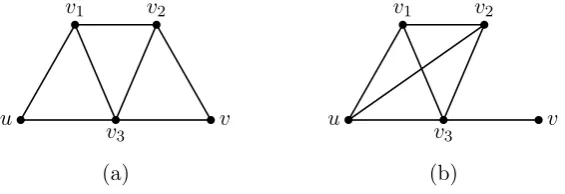
such that L=G[N(v1)∪ {u, v, v1}] is the graph in Figure 2(a) if (i) occurs and the graph in Figure 2(b) if (ii) occurs.
u
v3
v1 v2
v
(a)
u
v3
v1 v2
v
[image:17.595.141.424.478.575.2](b)
Figure 2. The two alternatives for L.
The fact thatGis (2,2)-sparse implies that, in both cases, there exists a (necessarily bad) degree three vertexv4 ∈V \V(L). Since Case 2 does not occur, v4 is not adjacent to both
u andv. We may now repeat the argument from the previous paragraph to deduce thatv4
also belongs to a subgraph L0 which is isomorphic to one of the graphs shown in Figure 2. LetV(L0) ={v4, u0, v0, v20, v30}where{u0, v0}={u, v}. Since Case 2 does not occur,v0
3=v3.
If v1 ∈ V(L0) then we must have v1 = v20. Since v4 ∈ N(v02) = N(v1) ⊆ V(L) this would contradict the fact that v4 ∈V \V(L). Hence v1 ∈/V(L0) and {u, v, v3} ⊆V(L)∩V(L0)⊆ {u, v, v2, v3}.
We first consider the case whenV(L)∩V(L0) ={u, v, v2, v3}. Since Case 2 does not occur
We next consider the case whenV(L)∩V(L0) ={u, v, v3}. SinceGis (2,2)-sparseL∪L0
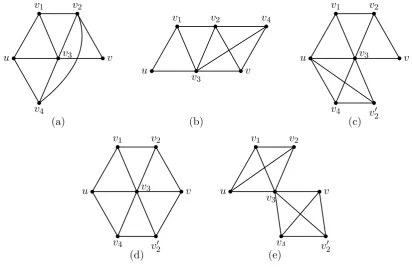
is as shown in Figure 3(c), (d) and (e) up to a relabeling of u andv.
Since all five graphs in Figure 3 are tight, we may use the fact that Case 3 does not occur to deduce that G=L∪L0. The fact that Case 1 does not occur now tells us that Gis not the graph in Figure 3(a), (b) or (c). The graph in Figure 3(d) cannot be equal to G since
X1=N(v1)∪ {u, v, v1}does not belong to a tightuv-compatible family (sov1 is not bad).
Hence Gis as shown in Figure 3(e).
u
v1 v2
v
v4 v3
(a)
u
v3
v1 v2
v v4
(b)
u
v1 v2
v
v4 v0
2 v3
(c)
u
v1 v2
v
v4 v0
2 v3
(d)
u
v1 v2
v
v4 v0
2 v3
[image:18.595.74.487.226.493.2](e)
Figure 3. The five alternatives forG.
We will complete the discussion of this case by showing that Gis minimallyuv-rigid on
Y. Let (G, p) be a generic uv-coincident realisation of G on Y and m be an infinitesimal motion of (G, p) with m(u) = 0. Since K4 is rigid, m(w) = 0 for all w ∈ V(L)−v. In
particular m(v3) = 0 and hencem(w) = 0 for all w∈V.
Case 6. None of the previous cases occur. Letz1, z2, . . . , zk be the good degree three
vertices in G. If the edge set of some 1-reduction ofGatzi is independent inMuv then we
may apply induction to the reduced graph and then apply Lemma 4.2 to deduce that Gis independent in RYuv. Hence we may assume that alternative (b) or (c) of Lemma 4.9 holds forzi.
Suppose alternative (b) of Lemma 4.9 holds forzi. If the contraction of theK4-subgraph Hi which contains zi results in a graph which is independent in Muv, then we may apply
induction to the reduced graph and then apply Lemma 4.6 to deduce thatGis independent in RYuv. (Note that the contracted graph is minimally rigid since Case 4 does not hold and since zi is good, zi is adjacent to at most one of {u, v} so |{u, v} ∩V(Hi)| ≤1. Thus
(G, Hi) satisfies the hypotheses of Lemma 4.6(b).) Hence the contraction of Hi in G is
good. Hence there exists a tight uv-compatible familyHi satisfying alternatives (c) or (d) of Lemma 4.11.
In summary we have shown that for every good vertex zi either alternatives (c) or (d)
of Lemma 4.11 or alternative (c) of Lemma 4.9 hold. We assume that the first alternative holds for all 1 ≤i ≤l and that the second alternative holds for l+ 1 ≤i≤k. Let Xi be
the element of Hi which contains V(Hi) for 1 ≤i≤l, whereHi and Hi are as defined in
the previous paragraph. In addition for alll+ 1≤i≤kalternative (c) of Lemma 4.9 holds so there exists a tight uv-compatible family Hi such that Xi = {zi, u, v} ∪N(zi) belongs
to Hi. With these definitions we have i(Xi) = 2|Xi| −4 for all 1 ≤ i ≤ k. (This follows
from Lemma 4.11 when 1 ≤i≤l and from Lemma 4.9 and the fact that zi is good when l+ 1≤i≤k.)
Let X = Sk
i=1Xi. We will show by induction that i(X) ≥2|X| −4. Suppose that we
have i(X0) ≥ 2|X0| −4 for some X0 = Ss
i=1Xi and some 1 ≤ s ≤ k. If i(X0 ∪Xs+1) ≤
2|X0∪Xs+1|−5, then Lemma 3.1(a) implies thati(X0∩Xs+1)≥2|X0∩Xs+1|−3, this would
contradict the fact thatGis independent inMuvsince theuv-compatible familyH0
s+1which
we get from Hs+1 by replacing Xs+1 by X0 ∩Xs+1 would satisfy i(H0s+1)−val(H0s+1) > i(Hs+1)−val(Hs+1) = 0.
We may apply Lemma 4.10 to a minimal tight uv-compatible subfamily of Hi for all
1≤i≤k, and use the facts that Cases 2 and 3 do not occur to deduce that alternatives (a) and (b) of Lemma 4.10 cannot hold for this family. In addition the remark after Lemma 4.10 implies that (d) cannot hold either so (c) must hold for this minimal subfamily. Hence there exist sets Yi and {u, v, yi} in Hi with i(Yi) = 2|Yi| −3 and i({u, v, yi}) = 2. Note
that neither set can be equal to Xi since |Xi|> 3 and i(Xi) = 2|Xi| −4. Lemma 3.2(b)
implies that Yi∩Xi = {u, v} =Yi ∩ {u, v, yi} for all 1 ≤i ≤k. The fact that we are not
in Case 2 also implies thatyi =yj =y, say, for all 1≤i≤j≤k. Let Y =Tki=1Yi. Then Y ∩X ={u, v}and y6∈Y. We can now use Lemma 3.1(a) and the fact thatGcontains no proper tight subset containing u and v (since Case 3 does not occur) to prove inductively that i(Y) = 2|Y| −3.
LetW =V\X. Sincei(W)≤2|W|−2 there is an integertfor whichi(W) = 2|W|−2−t. Since i(Y) = 2|Y| −3 and G is (2,2)-sparse, there are at least 3 edges from Y \ {u, v} to
{u, v}. SinceY \ {u, v} ⊆W,y∈W \Y and there are two edges fromy to{u, v}, we have at least five edges between {u, v} and W. Note that the definition of X tells us that all degree 3 vertices in W are bad.
Suppose that every (bad) degree three vertex in W is adjacent to both u and v. Since Case 2 does not occur we have at most one degree three vertex inW. Sincei(X)≥2|X|−4, we have |E| − |E(X)| − |E(W)| ≤2|V| −2−(2|X| −4)−(2|W| −2−t) = 4 +t. Hence the sum of the degrees of the vertices in W is at most 2(2|W| −2−t) + 4 +t= 4|W| −t. Since there is at most one degree three vertex in W, t≤1. If t= 0, then W is tight and
W +u+v violates sparsity since there are at least 5 edges betweenW and {u, v}. Hence
t= 1 and W +u+v is a proper tight set which contradicts the fact that Case 3 does not occur.
Now consider the case when there is a (bad) degree three vertex z ∈ W which is not adjacent to both u and v. Since z is bad there is either a set Z ⊆ V which satisfies alternative (c) of Lemma 4.9 and hasi(Z)≥2|Z| −3, orz belongs to a subgraphH ∼=K4
that satisfies alternative (b) of Lemma 4.11. We can now deduce, as in Case 5, that
J =G[N(z)∪ {u, v, z}] is isomorphic to one of the graphs shown in Figure 2, withv1 =z. The vertex labelledv3in Figure 2 must be equal toybecause Case 2 does not hold. The fact
and noU ⊆V(J)−y, with{u, v} ⊂U, hasi(U) = 2|U|−3 implies thatY∩V(J)6=Y. Hence
Y ∩V(J) is a proper subset of bothY and V(J) and hencei(Y ∩V(J))≤2|Y ∩V(J)| −4. Lemma 3.1(a) now implies that Y ∪V(J) is tight. Since Y ∪V(J) 6= V, this contradicts
the fact that Case 3 does not occur.
We can now prove the deletion-contraction characterisation of uv-rigidity stated in the introduction.
Proof of Theorem 1.1. Necessity follows from the fact that an infinitesimally rigid uv -coincident realisation of G on Y is an infinitesimally rigid realisation of G−uv, and also gives rise to an infinitesimally rigid realisation ofG/uv by (4.1).
To prove sufficiency, suppose, for a contradiction, that G−uv and G/uv are both rigid on Y but G is not uv-rigid on Y. By Theorems 3.8 and 4.13 this implies that there is a thin cover K of G−uv with val(K) ≤ 2|V| −3. If K consists of subsets of V only, then
rY(G−uv)≤2|V| −3 follows, which contradicts the fact that G−uv is rigid onY. Hence K = {H, H1, . . . , Hk}, where H = {X1, . . . , Xl} is a uv-compatible family.
Con-tract the vertex pair u, vinG into a new vertexzuv. This gives rise to a cover
K0={X10, . . . , Xl0, H1, . . . , Hk}
of G/uv, where Xj0 is obtained from Xj by replacing u, v by zuv, for 1 ≤j ≤ l. Then we
obtain
k
X
i=1
(2|Hi| −tHi) +
l
X
j=1
(2|Xj0| −t(Xj0))≤ k
X
i=1
(2|Hi| −tHi)+
+
l
X
j=1
(2|Xj| −t(Xj))−2l= val(K)−2≤2|V| −3−2 = 2(|V| −1)−3,
which implies that G/uv is not rigid on Y, a contradiction. This completes the proof.
A similar proof can be used to verify the following more general result:
Theorem 4.14. Let G = (V, E) be a graph and let u, v ∈ V be distinct vertices. Then rYuv(G) = min{rY(G−uv), rY(G/uv) + 2}.
Theorems 2.1 and 4.14 show that the polynomial-time algorithms for computing the rank of a count matroid (see e.g. [1, 9]) can be used to test whether Gisuv-rigid onY, or more generally, to computerYuv(G).
5. Vertex splitting and global rigidity
SupposeG= (V, E) is a graph withV ={v1, v2. . . . , vn}and (G, p) is a realisation ofG
on a family of (not necessarily distinct) concentric cylindersY =Y1∪ Y2∪. . .∪ Ynsuch that
p(vi)∈ Yi for 1 ≤i≤n. We say that (G, p) isglobally rigid if every equivalent framework
(G, q) onY, with q(vi)∈ Yi for all 1≤i≤n, is congruent to (G, p).
Let G = (V, E) be a graph and v1 be a vertex of G with neighbours v2, v3, . . . , vt.
A vertex split of G at v1 is a graph ˆG which is obtained from G by deleting the edges
v1v2, v1v3, . . . , v1vkand adding a new vertexv0 and new edgesv0v1, v0v2, . . . , v0vk, for some
2≤k≤t. We will refer to the new edge v0v1 as the bridging edge of the vertex split. We will show in this section that a vertex splitting operation preserves generic global rigidity on the cylinder if and only if the bridging edge is redundant.
Given a map p : V → R3n, there is a unique family of concentric cylinders Y with p(vi)∈ Yi for all 1≤i≤n as long as p(vi) does not lie on the z-axis for all 1≤i≤n. We
Connelly and Whiteley [2, Theorem 13] showed that if a framework (G, p) in Rd is both infinitesimally rigid and globally rigid then all frameworks (G, q) sufficiently close to (G, p) are also infinitesimally rigid and globally rigid. We will adapt their proof technique to obtain an analogous result for the cylinder.
Lemma 5.1. If (G, p) is infinitesimally rigid and globally rigid on Y, then there exists an open neighbourhood Np of p on Y such that for any q ∈ Np the framework (G, q) is infinitesimally rigid and globally rigid on Y.
Proof. Suppose |V| ≥ 5 and that for any open neighbourhood Np, there is a p∗ ∈ Np
such that the framework (G, p∗) is not globally rigid on Y. Then there is a convergent sequence (G, pk) of non-globally rigid frameworks converging to (G, p). For each framework (G, pk), let (G, qk) be an equivalent but non-congruent realisation on Y. We may assume that (G, pk) and (G, qk) are in standard position (that is pk(v1) = qk(v1) = (0,1,0) as-suming, without loss of generality, that r1 = 1). By the compactness of R3|V|, there is a convergent subsequence (G, qm) converging to a limiting framework (G, q). As the limits of the respective sequences, (G, q) must be equivalent to (G, p).
If (G, q) is not congruent to (G, p) then we contradict the global rigidity of (G, p). So (G, p) and (G, q) are congruent, i.e. we can transform q to p by a reflection in the plane
x = 0, a reflection in the plane z = 0 or a combination of the two. We apply this same congruence to all the (G, qm) to obtain a sequence (G, rm) converging to (G, p) with (G, rm) being equivalent but not congruent to (G, pm) for eachm.
We next show thatpm−rm gives an infinitesimal motion of (G,pm+rm
2 ) onY
pm+rm 2 . For
each edgevivj we have
pm(vi) +rm(vi)
2 −
pm(vj) +rm(vj)
2
·((pm(vi)−rm(vi))−(pm(vj)−rm(vj)))
= 1 2((p
m(v
i)−pm(vj)) + (rm(vi)−rm(vj)))·((pm(vi)−pm(vj))−(rm(vi)−rm(vj)))
= 1 2 (p
m(v
i)−pm(vj))2−(rm(vi)−rm(vj))2
= 0.
Recall that ¯pm(vi) and ¯rm(vi) denote the projections of pm(vi) and rm(vi) onto the plane z = 0. Since pm(vi) and rm(vi) both lie on Yi, we have ¯pm(vi)·p¯m(vi) = ¯rm(vi)·¯rm(vi).
Hence for each vertexvi,
(¯pm(vi) + ¯rm(vi))·(¯pm(vi)−r¯m(vi)) = 0.
Since pm and rm are not congruent, pm−rm is a nontrivial infinitesimal motion. This means that the rank of the rigidity matrix for each framework (G,pm+2rm) is less than maximal. Since both pm and rm converge top, so does pm+2rm. Thus (G, p) is a limit of a sequence of infinitesimally flexible frameworks and hence itself is infinitesimally flexible, a contradiction. (The fact that (G, p) is infinitesimally rigid implies that the rank ofRYq(G, p)
is maximum for all q∈R3|V|sufficiently close top.)
We can use this lemma and our main result to show that vertex splitting preserves global rigidity onY under the additional assumption that the new edge is redundant.
Proof. Since ( ˆG/v0v1, p) = (G, p) is globally rigid on Y and p is generic, ˆG/v0v1 is rigid on Y. Since G−v0v1 is also rigid on Y, Theorem 1.1 implies that ˆGhas a v0v1-coincident generic rigid realisation ( ˆG,pˆ), where ˆp(v) =p(v) for all v 6= v0 and ˆp(v0) = p(v1). Since
(G, p) is globally rigid onY, ( ˆG,pˆ) is also globally rigid on Y. We can now use Lemma 5.1 to deduce that ( ˆG, q) is globally rigid onY for all q sufficiently close to ˆp.
SupposeGis a graph which has a generic globally rigid realisation onY. It was shown in [5] thatG−eis rigid onY for alle∈E(G). This result and Theorem 5.2 immediately imply that ˆG, a vertex split of Gwith bridging edgee, has a generic globally rigid realisation on
Y if and only if ˆG−eis rigid onY.
6. Concluding remarks
Similarly to our definition of a framework (G, p) on Y we can define a framework on a family of concentric spheresS=S1∪ S2∪ · · · ∪ SkwhereSi ={(x, y, z)∈R3:x2+y2+z2=
ri}andr = (r1, . . . , rk) is a vector of positive real numbers. We can project a framework on Sto a framework on the unit sphere by mappingp(v) to kpp((vv))k without changing infinitesimal rigidity. We can then map the framework on the unit sphere to a framework on the (affine) plane by central projection. In [12, 13] this process was shown to preserve infinitesimal rigidity for frameworks on the unit sphere. Since the projection also preserves the property thatuanvare coincident, the problem of characterising generic rigidity for frameworks with two coincident points on concentric spheres is equivalent to the problem of characterising generic rigidity for frameworks with two coincident points in the plane. We can now use the characterisation of genericuv-rigidity in the plane [4] to give the following result.
Theorem 6.1. Let G= (V, E) be a graph and let u, v∈V be distinct vertices. Then Gis uv-rigid on a family of concentric spheres S if and only if G−uv andG/uv are both rigid on S.
Note that a graph G = (V, E) is rigid on S if and only if it has rank 2|V| −3 in the (2,3)-sparse matroid by [10, Theorem 5.1].
We can also replace Y with other surfaces. In particular if we choose a surface with 1 ambient rigid motion (such as the cone, hyperboloid or torus) then the analogue of Theorem 2.1 requires the graph to be (2,1)-tight [11]. In theuv-coincident case we would define the value as val(H) = 2|H| −tH where tH = 3 if |H| ∈ {2,3} and H 6= {u, v}, tH = 2 if |H| ∈ {0,4}orH ={u, v} andtH = 1 if|H| ≥5. We expect that, using similar techniques
to Section 3, the appropriate count matroid can be established. However we do not know how to prove an analogue of Theorem 4.13. To make a start on this problem would require dealing with the case when the only vertices of degree less than 4 are uand v.
7. Acknowledgements
The second author was supported by the EPSRC First Grant EP/M013642/1 and by the Hungarian Scientific Research Fund (OTKA, grant number K109240). We would like to thank an anonymous referee whose detailed comments substantially improved the presen-tation of this paper.
References
[2] R. Connelly and W. Whiteley, Global rigidity: the effect of coning, Discrete and computational geometry43 (2010), 717–735.
[3] J. Edmonds,Submodular functions, matroids, and certain polyhedra, inCombinatorial Structures and their Applications, eds. R. Guy, H. Hanani, N. Sauer, and J. Sch¨onheim, Gordon and Breach, New York, 1970, 69–87.
[4] Zs. Fekete, T. Jord´an and V. E. Kaszanitzky, Rigid two-dimensional frameworks with two coin-cident points,Graphs and Combinatorics31 (2014), no. 3, 585–599.
[5] B. Jackson, T. McCourt and A. Nixon, Necessary conditions for the generic global rigidity of frameworks on surfaces,Discrete and computational geometry52 (2014), no. 2, 344–360.
[6] B. Jackson and A. Nixon, Stress matrices and generic global rigidity of frameworks on surfaces, Discrete and computational geometry54 (2015), no. 3, 586–609.
[7] B. Jackson and A. Nixon, Global rigidity of generic frameworks on the cylinder, preprint arXiv 1610.07755.
[8] G. Laman, On graphs and rigidity of plane skeletal structures,J. Engineering Math.4 (1970), 331–340. [9] A. Lee and I. Streinu, Pebble game algorithms and sparse graphs,Discrete Mathematics308 (2008),
no.8, 1425–1437.
[10] A. Nixon, J. Owen and S. Power, Rigidity of frameworks supported on surfaces,SIAM Journal on Discrete Mathematics26 (2012), no. 4, 1733–1757.
[11] A. Nixon, J. Owen and S. Power, A characterization of generically rigid frameworks on surfaces of revolution,SIAM Journal on Discrete Mathematics28 (2014), no. 4, 2008–2028.
[12] F. Saliola, W. Whiteley, Some notes on the equivalence of first-order rigidity in various geometries, Preprint (2007) arXiv:0709.3354.
[13] B. Schulze, W. Whiteley Coning, symmetry and spherical frameworks, Discrete Compu. Geom., Vol. 48, (2012)., 622–657
[14] W. Whiteley, Some matroids from discrete applied geometry, in Matroid Theory, J. E. Bonin, J. G. Oxley, and B. Servatius, Eds. American Mathematical Society, Contemporary Mathematics, 1996, vol. 197, pp 171–313.
School of Mathematical Sciences, Queen Mary, University of London, E1 4NS, U.K. E-mail address:[email protected]
Department of Computer Science and Information Theory, Budapest University of Tech-nology and Economics, Budapest, 1117, Magyar tud´osok k¨or´utja 2., Hungary, and the De-partment of Mathematics and Statistics, Lancaster University, LA1 4YF, U.K.
E-mail address:[email protected]