Scottish Gaelic
Claire Nance
Lancaster University [email protected]
Roibeard Ó Maolalaigh University of Glasgow
Scottish Gaelic
Introduction
Scottish Gaelic is a minority language of Scotland spoken by approximately 58,000 people, or 1% of the Scottish population (Census 2011). Here, we refer to the language as ‘Gaelic’, pronounced in British English as /ɡalɪk/, as is customary within the Gaelic-speaking
community. In Gaelic, the language is referred to as Gàidhlig /kaːlɪc/. Gaelic is a Celtic language, closely related to Irish (MacAulay 1992, Ní Chasaide 1999, Gillies 2009). Although Gaelic was widely spoken across much of Scotland in medieval times (Withers 1984, Clancy 2009), the language has recently declined in traditional areas such as the western seaboard and western islands of Scotland and is now considered ‘definitely
endangered’ by UNESCO classification (Moseley 2010). Analysis of the location of Gaelic speakers in Scotland and maps from the most recent Census in 2011 can be found in National Records of Scotland (2015). Figure 1 shows the location of Gaelic speakers in Scotland as a percentage of the inhabitants aged over three in each Civil Parish who reported being able to speak Gaelic in the 2011 Census.
<INSERT FIGURE 1 ABOUT HERE>
A dialect of Gaelic in East Sutherland was once described as a prototypical case of language obsolescence (Dorian 1981) but the language is now undergoing significant revitalisation measures (e.g. McLeod 2006). These include the introduction of nursery,
created as a result of the 2005 Gaelic Language Act (Scotland). The language act states that Gaelic holds the same legal status as English in Scotland.
The speaker in the speech samples associated with this contribution is a male in his fifties. He was born and raised in Ness, a Gaelic-speaking community in the north of the Isle of Lewis, and is currently working at the University of Glasgow. Lewis is the most northerly island in the chain of islands known as the Outer Hebrides, or the Western Isles. It is the part of Scotland where the densest concentration of Gaelic speakers resides (52% Gaelic-speaking, 2011 Census). His speech can be considered representative of the middle-aged generation of fluent traditional Lewis Gaelic speakers, with some more levelled features due to his time in Glasgow among speakers of other dialects. We have noted where his Lewis dialect diverges significantly from other Hebridean dialects. The recordings were made onto a laptop
computer in the noise-attenuated sound studio at the University of Glasgow using a
Beyerdynamic Opus 55 headset and a Sound Devices USBPre2 pre-amplifier and analogue-to-digital converter.
Consonants
‘Broad’ and ‘Slender’
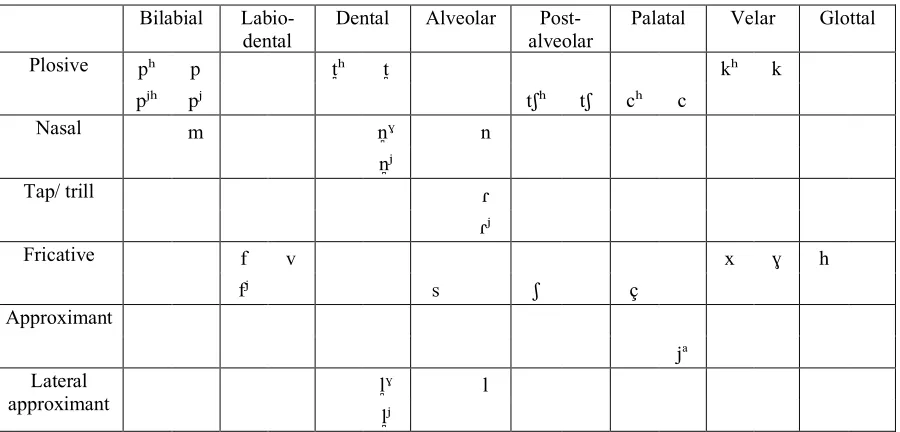
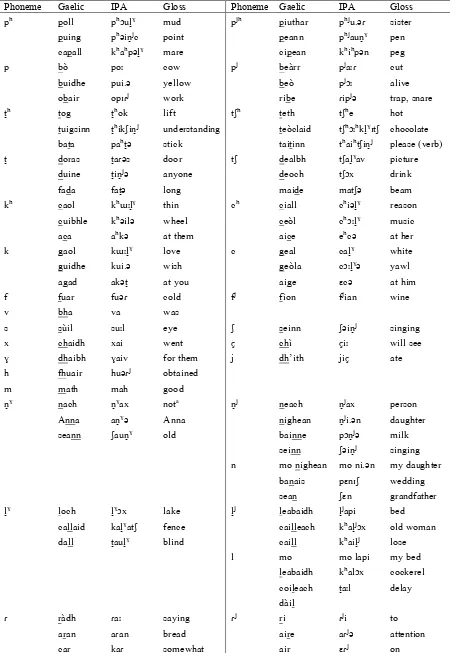
Table 1 we have shown the non-palatalised series on the top row of each cell, and the palatalised series below where possible. Laterals, rhotics and alveolar/dental nasals are discussed separately below. Sample words are shown in Table 2.
<INSERT TABLE 1 ABOUT HERE> <INSERT TABLE 2 ABOUT HERE>
The only sounds with actively velarised counterparts are laterals and dental/alveolar nasals, which are discussed separately below. Some accounts of Irish have suggested that some other non-palatalised sounds are velarised, specifically /pˠ bˠ fˠ mˠ t̪ˠ d̪ˠ sˠ/
(Ní Chasaide 1999:35). This has not been reported for Gaelic, see Borgstrøm (1940:17), Gillies (2009:239), Ladefoged et al. (1998:3), Ternes (2006:18), Bosch (2010:268–269). Ní Chiosáin & Padgett (2012:174) state that in Irish, the contrast is manifested as palatalised vs. non-palatalised before back vowels and palatalised vs. velarised before front vowels. In Irish, the example most commonly used is the contrast between buí ‘yellow’ /bˠi/ and bí ‘be!’
/bʲi/ (see Ní Chasaide 1999 for audio recordings). The analogous context in Gaelic is not
produced with velarisation e.g. puing ‘point’ [pʰəin̪ʲc]; buidhe ‘yellow’ [pui.ə]; tuigsinn
‘understanding’ [t̪ʰikʃĩ]; duine ‘anyone’ [tin̪ʲə]; ̪ muinntir ‘people’ [məin̪ʲtʃʰəð]; suidhe ‘sit’
[sui.ə].
palatalised counterparts to /kʰ/ and /k/ are produced as palatal stops /cʰ/ and /c/ respectively
(e.g. Borgstrøm 1940:17). /x/ and /ç/ are a broad and slender pair respectively, as are /ɣ/ and
/j/.
Initial consonant mutations
A feature common to all the Celtic languages is the existence of initial consonant mutations, a system of consonantal alternations under certain morphophonological conditions. The most common mutation in Gaelic, and the only one recognised in orthography, is lenition. This mutation occurs in contexts such as feminine singular nominative nouns after the definite article, feminine attributive adjectives, the dative case with the definite article, and the vocative of proper nouns. For full details about the contexts where lenition occurs see Ó Maolalaigh (1996) and Byrne (2002). Examples of lenition are show in Table 3. This table shows the broad transcription of lenited consonants; Archangeli et al. (2014) note there may be phonetic differences between lenited and ‘underlying’ consonants i.e. incomplete
neutralisation (see also Welby et al. 2017 for incomplete neutralisation in Irish).
A second initial consonant mutation, not shown in orthography, and not realised in all dialects, is known as nasalisation or eclipsis. The phenomenon in Gaelic is somewhat
different from the Irish phenomenon of eclipsis, which is recognised in orthography (Ó Maolalaigh 1996). In Gaelic, there is some dialectal variation in the realisation of eclipsis and its realisation is not obligatory. For details see Gillies (2009:251–252) and Ó Maolalaigh (1996). Eclipsis occurs after closely grammatically related items such as the definite article and noun or adjectives ending in a nasal consonant and noun.
Aspiration
In word initial position, stops are either voiceless unaspirated or voiceless post-aspirated. In word-medial and word-final position, the stop series are either voiceless unaspirated or voiceless pre-aspirated (Borgstrøm 1940, Oftedal 1956, Ladefoged et al. 1998, Ó Maolalaigh 2010, Nance & Stuart-Smith 2013). Pre-aspiration is typically longest in velar/palatal stops and shortest in bilabials. The realisation of preaspiration varies from dialect to dialect. In Lewis it is typically a voiceless [h], but preaspiration can be more [x]-like especially
preceding velar stops in dialects such as Barra (see Ó Murchú 1985). Instrumental evidence in Nance & Stuart-Smith (2013) suggest very little or no closure voicing even in word-medial stops which are orthographically b d g. For this reason we follow Ladefoged et al. (1998) in stating that the contrast is one of aspiration rather than voicing and use the transcriptions /pʰ/
and /p/ etc.
Laterals, Nasals and Rhotics
(see Ternes 2006:19 for details). We refer to the three sounds as ‘palatalised’, ‘velarised’ and ‘alveolar’ as shorthand for their full descriptions.
Laterals
The laterals in modern Gaelic are a velarised dental lateral, a palatalised dental lateral, and an alveolar lateral. Following static palatographic work in Shuken (1980) and Ladefoged et al. (1998), and descriptions in Borgstrøm (1940) and Oftedal (1956), we consider the palatalised lateral as palatalised, rather than palatal. Acoustically, the velarised lateral is characterised by low F2 and high F1, the palatalised lateral by high F2 and low F1, and the alveolar lateral lies in between these two extremes (Shuken 1980, Ladefoged et al. 1998, Nance 2013, 2014).
In word-initial position, our speaker produces three laterals: the velarised and
palatalised laterals differ substantially e.g. loch ‘lake’ /l̪ˠɔx/ and leabaidh ‘bed’ /l̪ʲapi/. Very few lexical items, excluding recent borrowings, begin with the alveolar lateral, but this can be derived through the lenition initial consonant mutation. Generally speaking, the velarised and palatalised laterals, nasals and rhotics lose their secondary articulations in lenition conditions. For example, the lenited palatalised lateral becomes alveolar e.g. leabaidh, ‘bed’ /l̪ʲapi/ but
mo leabaidh ‘my bed’ /mo lapi/. It has been reported that a lenited velarised lateral will become alveolar, but our speaker did not make this distinction. In word-medial position, there is a straightforward three-way contrast e.g. callaid ‘fence’ /kʰal̪ˠatʃ/, coileach ‘cockerel’
/kʰalɔx/, cailleach ‘old woman’ /kʰal̪ʲɔx/. Similarly, there is a three-way contrast in
Nasals
Descriptions in Borgstrøm (1940) and static palatography in Shuken (1980) describe the articulation of the three (dental/alveolar) nasals as /n̪ˠ/, /n/ and /n̪ʲ/. Velar and palatal variants
of these sounds occur in the context of /k/ and /c/, for example long ‘ship’ [l̪ˠãũŋk], and taing
‘thanks’ [t̪ʰãĩɲc]. As these are the only contexts where [ŋ] and [ɲ] occur we consider them as
allophones of /n̪ˠ/ and /n̪ʲ/ respectively (see also Borgstrøm 1940:77).
In word-initial position, there is a contrast between velarised and palatalised nasals, e.g. nach ‘not’ /n̪ˠax/, and neach ‘person’ /n̪ʲax/. Very few lexical items begin with alveolar nasal, but this can be derived through lenition. The lenitied palatalised nasal becomes alveolar e.g. nighean ‘daughter’ /n̪ʲi.ən/, mo nighean ‘my daughter’ /mo ni.ən/. Theoretically, the lenited velarised also becomes alveolar, but our speaker did not make this distinction. In word-medial position, there is a three-way contrast e.g. Anna ‘Anna’ /an̪ˠə/, banais ‘wedding’
/bɛnɪʃ/, bainne ‘milk’ /bɔn̪ʲə/. In word-final position, there is a three-way contrast e.g. seann
‘old’ /ʃaun̪ˠ/ (produced here as [ʃãũn̪ˠ] with a very short final nasal), sean ‘grandfather’ /ʃɛn/,
seinn ‘singing’ /ʃəin̪ʲ/.
Rhotics
rhorics as taps or approximants, and trills are very rare in contemporary production
(Ó Dochartaigh 1997, Nance et al. 2016). The palatalised rhotic is often produced as a dental fricative [ð] in Lewis and in other dialects. There is, however, substantial variation across dialects in the production of this sound, with many dialects and individuals producing some kind of tap or fricated tap (Ó Dochartaigh 1997). We have represented the current two-way contrast as a distinction between /ɾ/ and /ɾʲ/ but it should be noted that there is substantial variation in the production of these sounds.
In word-initial position, the palatalised variant is almost non-existent so the contrast is effectively neutralised. The preposition ri ‘to’ /ɾʲi/ is reported to use the palatalised variant, but our speaker did not produce this rhotic substantially different to the rhotic in, for example, ràdh ‘saying’ /ɾaː/. In word-medial position, there is a two-way contrast e.g. aran ‘bread’
/aɾan/, aire ‘attention’ /aɾʲə/ (produced as [aðə]). In word-final position there is also a
two-way contrast e.g. car ‘somewhat’ /kʰaɾ/, air ‘on’ /ɛɾʲ/ (produced as [ɛð]).
In the dialect presented here, clusters with rhotics, dental/alveolar stops, laterals, and nasals tend to be produced as retroflex, and the rhotic as a retroflex approximant; for example, thuirt ‘said’ [hʉɽʈ]. In -rs clusters, the rhotic and sibilant are often produced as retroflex; e.g.
carson ‘why’ [kʰaɽʂɔn]. In the vast majority of other Gaelic dialects, an audible [ʃ] or [ʂ]
Vowels
Monophthongs
Gaelic has nine oral monophthongs, which can be long or short, these are shown in Figure 2 (acoustic data from the recording samples in this illustration). For acoustic analysis of a larger dataset focussing on the high back vowels, see Nance (2011). Sample words are given in Table 4. Long vowels are indicated by an accent grave in orthography. Generally, the long vowels are of similar acoustic quality to the short vowels, although they tend to be slightly more peripheral. The ‘high back’ vowels /ɤ ɯ/ are acoustically more central, or even front in the dialect represented here (Nance 2011). Borgstrøm (1940:11) describes these vowels as phonologically, rather than phonetically, back. The two previous dialect descriptions of Lewis Gaelic, Borgstrøm and Oftedal, do not use the modern IPA. We follow Ladefoged et al. (1998) in interpreting their symbols as /ɤ/ and /ɯ/. The vowel /u/ has two allophones, back
[u̠] occurring in the environment of velarised sonorants, and central [ʉ] occurring elsewhere;
for example sùil ‘eye’ [sʉːl], but ubhal ‘apple’ [u̠.əl̪ˠ]. The formant distribution of these two
allophones is strikingly different; see Ladefoged et al. (1998) and Nance (2011). Similarly, /a/
is auditorily [ɑ] in the environment of velarised sonorants; for example latha ‘day’ [l̪ˠɑ.ə], but
leat ‘at you’ [laʰt]. Long /ɛː/ is not common and has merged with /eː/ for some speakers, including our participant. In Lewis, a group of words containing orthographic ea before g are pronounced with /ɤ/, but /ɛ/ or /e/ in other dialects; e.g. beag ‘small’, eaglais ‘church’.
<INSERT VOWEL QUADRILATERAL ABOUT HERE> <INSERT FIGURE 2 ABOUT HERE>
Nasal monophthongs
There are disagreements in the literature with reference to the number of nasal vowels in Gaelic, and their nature. Borgstrøm (1940:13) reports five short nasal vowel phonemes, and six long nasal vowel phonemes. Oftedal (1956:40), who was reporting on a dialect on the eastern side of Lewis, describes nine short and seven long nasal vowel phonemes. It is also important to note that Borgstrøm and Oftedal recorded participants born in the 1880s and before, and this may not represent the contemporary situation. Even from these recordings, Oftedal notes that nasality in vowels in ‘one of the most elusive features’ of the phonemics of the dialect under investigation (1956:40), and suggests that nasality has ‘little distinctive value’, referring to its very low functional load. Similarly, Borgstrøm (1940:13) states that nasality has ‘not a great functional value’. The degree of nasality appears to vary from dialect to dialect and is also to some extent speaker-specific. Oftedal (1956:41) notes that even between two of his participants, who were from the same village and married, there was great variation as to the degree of nasality among their vowels. One person, he claimed, had nasal vowels perceptibly similar to nasal vowels in French, whereas the other speaker has nasal vowels similar to a speaker of General American (see also Ó Curnáin 2009 for analysis of individuals in Irish). When listening to our sample sound files, there appears to be variable amounts of nasality on different words, shown in Table 5. See Warner et al. (2015) and Morrison (2015) for analysis of nasal airflow data. The quality of the nasal vowels is similar to that of their oral counterparts so they are not repeated in a figure here.
fricative in words such as tàmh is also nasalised (Borgstrøm 1940, Ternes 2006), but
aerodynamic work suggests that this is not the case phonetically (in Warner et al.’s 2015 work on Skye, but see also Morrison 2015), and it has been suggested that these are unlikely in articulatory terms (Ohala 1975:300).
<INSERT TABLE 5 ABOUT HERE>
Diphthongs
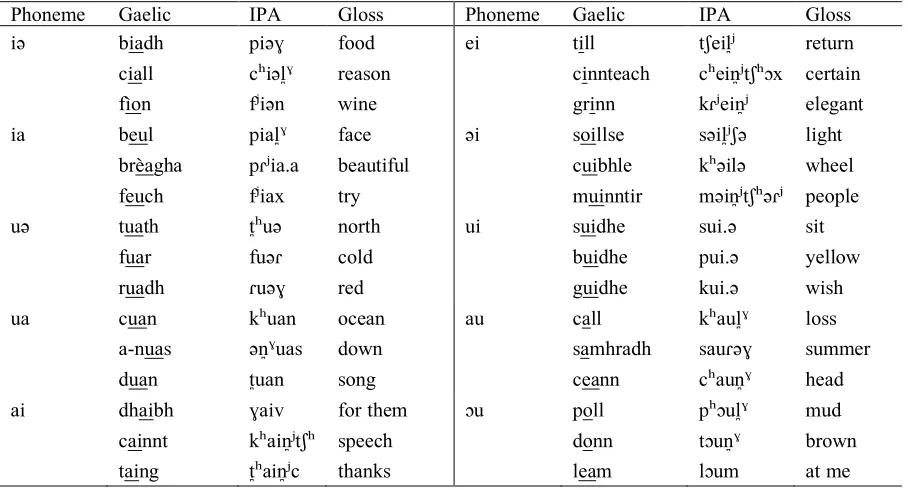
Gaelic has a rich diphthongal system. Borgstrøm (1940:37) describes 14 phonemic
diphthongs /ai ɛi ei ui ɤi au ɛu ɔu iə ia iɛ uə ua uɛ/, and Oftedal (1956:44) describes 10 /ei ui
əi ai ɔu au iə ia uə ua/. We find that Oftedal’s account best describes contemporary Gaelic.
These two previous descriptions do not specifically mention whether nasality in diphthongs should be considered a phonemic aspect or not. However, both give examples of nasal diphthongs. We asked our speaker to produce a large number of words listed by Borgstrøm and Oftedal as containing nasal diphthongs, but these were not consistently audibly nasal. We consider the contemporary situation to be that some words contain diphthongs with
nasalisation, but nasalised diphthongs are not phonemic in the language. Sample words are given in Table 6.
Prosody
Syllables, svarabhakti and hiatus
Gaelic syllable structure has been described as typically VC rather than the typologically much more common CV (Clements 1986, Bosch 1998, Smith 1999). See Ní Chiosáin et al. (2012) for experimental work on syllabification in Irish and similar discussion. Two classes of Gaelic words will be described in more detail here, as they behave unusually within Gaelic phonology: words containing a svarabhakti vowel, and ‘hiatus’ words. Certain consonant sequences in Gaelic are broken up by a svarabhakti vowel, which is not represented in the orthography; for example, arm ‘army’ [aɾam], ainm ‘name’ [anam], balg ‘belly’ [pal̪ˠak],
dorcha ‘dark’ [t̪ɔɾɔxə], Alba ‘Scotland’ [al̪ˠapə]. Usually the svarabhakti vowel is a copy of the preceding vowel (Borgstrøm 1940, Clements 1986, Bosch & de Jong 1997, Hall 2006). Svarabhakti vowels in Gaelic occur where (1) The consonant preceding the svarabhakti vowel is a sonorant, (2) The preceding vowel is short, (3) The consonant cluster is non-homorganic, and (4) The second consonant is not a pre-aspirated plosive. Previous descriptions state that svarabhakti vowels do not contribute to the syllable count of a word; for example, falbh ‘going’ [fal̪ˠav] is monosyllabic, but falamh ‘empty’ [fal̪ˠ.u] is disyllabic (Borgstrøm 1940, Oftedal 1956, Bosch 1998). Recent experimental work (Hammond et al. 2014) suggests that speaker perceptions are more complex: they found that words such as falbh were perceived as not quite monosyllabic, but not quite disyllabic either. The svarabhakti vowels are described as stressed, which is unusual for stress-initial Gaelic and also typologically (Borgstrøm 1937:77; Bosch & de Jong 1997).
‘Hiatus’ words in most cases refer to a class of words in which historic intervocalic consonants are no longer pronounced; for example, leabhar ‘book’ [l̪ʲɔ.əɾ] compared to gu
accent system of (Lewis) Gaelic (see below), words with a svarabhakti vowel such as falbh ‘going’ [fal̪ˠav] are produced with the accent for monosyllabic words and words with hiatus
such as leabhar ‘book’ [l̪ʲɔ.əɾ] are produced with the accent for polysyllabic words. In other dialects, hiatus is produced with an inserted glide, a period of creaky voice or a glottal stop (Holmer 1938, Jones 2000, Ternes 2006:138).
Tone, intonation and stress
The Lewis dialect of Gaelic, along with north-west mainland dialects such as Applecross, is described as having contrastive word accents (Borgstrøm 1940, Oftedal 1956, Dorian 1978, Bosch & de Jong 1997, Ladefoged et al. 1998, Ternes 2006, Iosad 2015, Nance 2015a, Morrison forthcoming). Southern Hebridean and other mainland dialects are not reported to use this prosodic feature (see Ternes 2006:138 for details). Ternes (2006) provides the most complete extensive of the Lewis Gaelic system. In this account, word accents correspond to differences in syllabicity: monosyllabic words have a rising or level low pitch, whereas polysyllabic words have a level high pitch, falling pitch, rising-falling pitch. This is
schematised in Figure 3. In general, speakers are often not consciously aware that their dialect uses pitch contrastively. When Gaelic is taught, the dialects of Skye or Uist are more often used as models, so tone is rarely, if ever, explicitly taught. Example pairs of words illustrating the contrast are in Table 7, and spectrograms of the contrast between falbh ‘going’ [fal̪ˠav]
and falamh ‘empty’ [fal̪ˠ.u] are shown in Figure 4. Analysis of the word accent system from a corpus of spontaneous speech is presented in Nance (2013, 2015a).
<INSERT FIGURE 3 ABOUT HERE>
<INSERT FIGURE 4 ABOUT HERE>
In terms of sentence intonation, the default pattern in declaratives is a fall in pitch (Oftedal 1956:36, Dorian 1978:37, MacAulay 1979). Borgstrøm (1940:53) additionally states that if the last syllable has a (lexical) rising word accent, the rise is often very reduced. MacAulay’s descriptive account of common pitch patterns in Lewis intonation suggests that interrogatives may be realised with rising pitch.
In the vast majority of Gaelic words, the word-initial syllable is stressed. Exceptions are generally borrowings such as buntàta [punˈt̪ʰaːʰt̪] ‘potatoes’ and some adverbs such as
an-diugh ‘today’ [ənˈtʃʉ] and days of the week e.g. Didòmhnaich ‘Sunday’ [tʃiˈtõː.niç]. Words containing a svarabhakti vowel (see above) are unusual in terms of stress and it has been claimed that both vowels bear stress (Bosch & de Jong 1997).
Airstream mechanisms
A final notable feature of Gaelic prosody is the extensive use of the ingressive airstream mechanism, especially in the last word of a phrase and discourse markers expressing agreement (Lamb 2003, Thom 2005, Eklund 2008). This use of ingressives is informally referred to as the ‘Gaelic gasp’.
Sociolinguistic variation
variety of Gaelic described here. For example, nasal vowels are rare in the speech of
younger speakers (see also Ó Curnáin 2009:333 for Irish). The word accent system described above is not used by younger speakers from any background (Nance 2015a, Nance 2015b). Some younger speakers do not produce the three-way lateral contrast (Nance 2014, Nance 2019).
Transcription of recorded passage
va ə ɣɯː ə t̪ʰuə akəs ə ɣɾʲiən ə tʃɛspət kʰoː aʰkə ə pu t̪ ̪ʰɾɛsə n̪ˠuəɾʲ ə n̪ˠɔxk n̪ʲax ʃu.əl ə va ɛɾʲ ə
xoː̃t̪əx aun̪ˠ ən kʰloːʰkə pl̪ˠaː ‖ ɣɯːn̪ˠt̪ʰɪç iət kə pɾʲi kʰoː ə vɛɾʲəɣ ɛɾʲ ən n̪ʲax ʃu.əl ə xloːʰkə ə ̪
xuɾ je ən̪ˠ t̪ʰɔʃɔx kəɾ i ə viɣ ka mɛs na pə t̪ʰɾɛsə na ən tʃʰeː elə ‖ ən uəɾʲ ʃɪn heːtʃ ə ɣɯː ə t̪ʰuə
xɔ l̪ˠaːtʃɪɾʲ s ə purɪn̪ʲ ji ax maɾ ə pə võ.ə ə heːtʃ i paun̪ˠ na pə tʃʰen̪ʲə ə façkəɣ ə n̪ʲax ʃu.əl ə
xloːʰkə tʃʰimɪçəl̪ˠ ɛɾʲ heːn ɤkəs mu jɛɾʲəɣ lec ə ɣɯː ə t̪ʰuə ʃaxət ən ɤɾʲʰpʲ ‖ ən uəɾʲ ʃɪn jaːrs ə ̪
ɣɾʲiən əmax kə pl̪ˠaː ɤkəs sə vat̪ xuɾʲ ə n̪ʲax ʃu.əl je ə xloːʰkə ‖ ɤkəs maɾ ʃɔn peːt̪əɾ t̪ɔn ɣɯːi ə
t̪ʰuə atʃɔxəɣ kəm pi ə ɣɾʲian ə pə t̪ʰɾɛsə jɛn tʃi.iʃ aʰkə ‖
Orthographic version
ghrian a-mach gu blàth agus sa bhad chuir an neach-siubhail dheth a chleòca. Agus mar sin, b’fheudar don ghaoith a tuath aideachadh gum b’ i a’ ghrian a bu treasa den dithis aca.
Acknowledgements
References
Archangeli, Diana, Sam Johnston, Jae-Hyun Sung, Murial Fisher, Michael Hammond & Andrew Carnie. 2014. Articulation and neutralization: A preliminary study of lenition in Scottish Gaelic. Proceedings of the Annual Conference of the International Speech Communication Association, INTERSPEECH. 1683–1687.
Ball, Martin & Nicole Müller (eds.). 2009. The Celtic languages. London: Routledge, 2nd edn.
Bauer, Michael. 2011. Blas na Gàidhlig: The practical guide to Gaelic pronunciation. Glasgow: Akerbeltz.
Borgstrøm, Carl. 1937. The dialect of Barra in the Outer Hebrides. Norsk Tidsskrift for Sprogvidenskap 7, 71–242.
Borgstrøm, Carl. 1940. The dialects of the Outer Hebrides, vol. 1. Olso: Norsk Tidsskrift for Sprogvidenskap.
Bosch, Anna. 1998. The syllable in Scottish Gaelic dialect studies. Scottish Gaelic Studies 18, 1–22.
Bosch, Anna. 2010. Phonology in modern Gaelic. In Moray Watson & Michelle Macleod (eds.) The Edinburgh companion to the Gaelic language, 262–282, Edinburgh: Edinburgh University Press.
Bosch, Anna & Kenneth de Jong. 1997. The prosody of Barra Gaelic epenthetic vowels. Studies in the Linguistic Sciences 27(1), 1–16.
Bruce, Gösta. 1977. Swedish word accents in sentence perspective. Lund: Gleerup. Byrne, Michel. 2002. Gràmar na Gàidhlig. Stòrlann-Acair: Isle of Lewis.
Clements, George, N. 1986. Syllabification and epenthesis in the Barra dialect of Gaelic. In Koen Bogers & Harry Van der Holst (eds.) The phonological representation of suprasegmentals, 317–336, Dordrecht: Foris.
Dorian, Nancy. 1978. East Sutherland Gaelic: The dialect of the Brora, Golspie, and Embo fishing communities. Dublin: Dublin Institute for Advanced Studies.
Dorian, Nancy. 1981. Language death: The life cycle of a Scottish Gaelic dialect. Philadelphia: University of Pennsylvania Press.
Eklund, Robert. 2008. Pulmonic ingressive phonation: Diachronic and synchronic
characteristics, distribution and function in animal and human sound production and in human speech. Journal of the International Phonetic Association 38, 235–324.
Gillies, William. 2009. Scottish Gaelic. In Martin Ball & Nicole Müller (eds.) The Celtic languages, 230–305, London: Routledge, 2nd edn.
Hall, Nancy. 2006. Cross-linguistic patterns of vowel intrusion. Phonology 23, 387–429. Hammond, Michael, Natasha Warner, Andréa Davis, Andrew Carnie, Diana Archangeli &
Muriel Fisher. 2014. Vowel insertion in Scottish Gaelic. Phonology 31, 123–151. Holmer, Nils M. 1938. Studies on Argyllshire Gaelic. Skrifter utgivna av Kungliga
Humanistiska Vetenskapssamfundet i Uppsala 31. Uppsala: Almqvist & Wiksell. Iosad, Pavel. 2015. ‘Pitch accent’ and prosodic structure in Scottish Gaelic: Reassessing the
role of contact. In Martin Hilpert, Janet Duke, Christine Mertzlufft, Jan-Ola Östman & Michael Rießler (eds.) Advances in Nordic linguistics, 28–54, Berlin: Mouton de Gruyter.
Ladefoged, Peter, Jenny Ladefoged, Alice Turk, Kevin Hind & St. John Skilton. 1998. Phonetic structures of Scottish Gaelic. Journal of the International Phonetic Association 28, 1–41.
Lamb, Will. 2003. Scottish Gaelic. Munich: Lincom Europa.
MacAulay, Donald. 1968. Palatization of labials in Scottish Gaelic and some related problems in phonology. Scottish Gaelic Studies 11, 72–84.
MacAulay, Donald. 1979. Some functional and distributional aspects of intonation in Scottish Gaelic: A preliminary study of tones. In Dónall Ó Baoill (ed.) Papers in Celtic
phonology, 27–38, Coleraine: New University of Ulster.
MacAulay, Donald. 1992. The Celtic languages. Cambridge: Cambridge University Press. McLeod, Wilson. 2006. Revitalising Gaelic in Scotland: Policy, planning and public
discourse. Edinburgh: Dunedin Academic Press.
Morrison, Donald. 2015. Vowel nasalisation in Scottish Gaelic. Unpublished BA thesis, University of Manchester, Manchester.
Morrison, Donald. Forthcoming. Metrical structure in Scottish Gaelic: Tonal accent, glottalisation and overlength. Phonology.
Moseley, Christopher (ed.). 2010. Atlas of the world’s languages in danger. Paris: UNESCO Publishing. 3rd edn. Online version:
http://www.unesco.org/culture/en/endangeredlanguages/atlas
Nance, Claire. 2011. High back vowels in Scottish Gaelic. In Proceedings of the 17th International Congress of the Phonetic Sciences, Hong Kong: City University Hong Kong.
Nance, Claire & Jane Stuart-Smith. 2013. Pre-aspiration and post-aspiration in Scottish Gaelic stop consonants. Journal of the International Phonetic Association 43(2), 129– 152.
Nance, Claire. 2014. Phonetic variation in Scottish Gaelic laterals. Journal of Phonetics 47, 1–17.
Nance, Claire. 2015a. Intonational variation and change in Scottish Gaelic. Lingua 160, 1–19. Nance, Claire. 2015b. ‘New’ Scottish Gaelic speakers in Glasgow: A phonetic study of
language revitalisation. Language in Society 44, 553–579.
Nance, Claire. 2019. Bilingual language exposure and the peer group: Acquiring phonetics and phonology in Gaelic Medium Education. International Journal of Bilingualism. Online first.
Nance, Claire, Wilson McLeod, Bernadette O’Rourke and Stuart Dunmore. 2016. Identity, accent aim, and motivation in second language users: New Scottish Gaelic speakers’ use of phonetic variation. Journal of Sociolinguistics 20(2), 164–191.
National Records of Scotland. 2015. Scotland’s Census 2011: Gaelic report (part 1). Edinburgh: Official Statistics publications for Scotland. Available at:
http://www.scotlandscensus.gov.uk/documents/analytical_reports/Report_part_1.pdf Ní Chasaide, Ailbhe. 1979. Laterals of Gaoth-Dobhair Irish and of Hiberno English. In Dónall
Ó Baoill (ed.) Papers in Celtic phonology, 54–78, Coleraine: New University of Ulster.
Ní Chasaide, Ailbhe. 1999. Irish. In Handbook of the International Phonetic Association, Cambridge: Cambridge University Press.
Ní Chiosáin, Máire, Pauline Welby & Robert Espesser. 2012. Is the syllabification of Irish a typological exception? An experimental study. Speech Communication 54, 68–91. Ó Curnáin, Brian. 2007. The Irish of Iorras Aithneach, County Galway. Dublin: Dublin
Institute for Advanced Studies.
Ó Dochartaigh, Cathair (ed.). 1997. Survey of the Gaelic dialects of Scotland. Dublin: Dublin Institute for Advanced Studies.
Ohala, John. 1975. Phonetic explanations for nasal sound patterns. In Nasálfest: papers from a symposium on nasals and nasalization, Charles A. Ferguson, Larry M. Hyman & John J. Ohala (eds.) 289–316. Stanford: Language Universals Project.
Ó Maolalaigh, Roibeard. 1996. The development of eclipsis in Gaelic. Scottish Language 14, 158–173.
Ó Maolalaigh, Roibeard. 2003. Processes in nasalization and related issues. Ériu 53, 109–132. Ó Maolalaigh, Roibeard. 2010. The sound of silence: Some structural observations on
pre-aspiration in Scottish Gaelic. In Wilson. McLeod, A. Burnveat, D. Stiubhart, Thomas Clancy & Roibeard Ó Maolalaigh (eds.) Bile ós Chrannaibh: A festschrift for William Gillies, Ceann Drochaid: Clann Tuirc.
Ó Maolalaigh, Roibeard & Iain MacAonghuis. 2008. Scottish Gaelic in twelve weeks. Edinburgh: Birlinn.
Ó Murchú, Máirtín. 1985. Devoicing and pre-aspiration in varieties of Scots Gaelic. Ériu 36, 195–198.
Oftedal, Magnus. 1956. A linguistic survey of the Gaelic dialects of Scotland. Vol III: The Gaelic of Leurbost, Isle of Lewis. Oslo: Norsk Tidsskrift for Sprogvidenskap.
Oftedal, Magnus. 1965. On ‘palatalized’ labials in Scottish Gaelic. Scottish Gaelic Studies 10, 71–81.
Shuken, Cynthia. 1980. An instrumental investigation of some Scottish Gaelic consonants. Ph.D. thesis, University of Edinburgh, Edinburgh.
Smith, Norval. 1999. A preliminary account of some aspects of Leurbost Gaelic syllable structure. In Harry Van der Hulst & Elizabeth Ritter (eds.) The Syllable: Views and facts, 577–630, Berlin: Mouton de Gruyter.
Ternes, Elmar. 2006. The phonemic analysis of Scottish Gaelic. Dublin: Dublin Institute for Advanced Studies, 3rd edn.
Thom, Eleanor. 2008. The Gaelic Gasp and its North Atlantic cousins: A study of ingressive pulmonic speech in Scotland. Unpublished MA thesis, University College London. Warner, Natasha, Daniel Brenner, Jessamyn Schertz, Andrew Carnie, Muriel Fisher &
Michael Hammond. 2015. The aerodynamic puzzle of nasalized fricatives:
Aerodynamic and perceptual evidence from Scottish Gaelic. Laboratory Phonology 6, 197–241.
Watson, Seosamh. 1990. On the development of the group -rt in Scottish Gaelic. Celtica, 21, 664–669.
Welby, Pauline, Máire Ní Chiosáin & Brian Ó Raghallaigh. 2017. Total eclipse of the heart? The production of eclipsis in two speaking styles of Irish. Journal of the International Phonetic Association, 47, 125–153.
Footnotes
There are three footnotes in this illustration.
The first footnote is in the caption to Figure 1. This footnote is currently in captions document.
ɤː
ɤ
o
i
ː
i
ɛ
ɛː
e
ː
e
a
a
ː
ɯː
u
u
ː
ɔ ɔː
o
ː
i
a
u
ɔ
ə
ɤː
a
ː
a
ɛ
o
ː
ɔː
ɔ
o
ɯː
u
ɛː
ɤ
eː
e
ɯ
3
4
5
6
8
10
12
14
F2 (Bark)
F
1
(Ba
Time
f0
Time
f0
Time
f0
Time
f0
Time
f0
M
onos
yl
la
bi
P
ol
ys
yl
la
bi
-1 0 1
0 0.1 0.2 0.3 0.4 0.5 0.6
A
m
pl
itu
de
(P
50 100 150
f0
(H
z)
0 0.1 0.2 0.3 0.4 0.5 0.6
A
m
pl
itu
de
(P -1 0 1
0 0.1 0.2 0.3 0.4 0.5
50 100 150
f0
(H
z)
0 0.1 0.2 0.3 0.4 0.5
l̪ˠ
f a a v f a l̪ˠ u
‘going’
‘empty’
2011 Census (colour online).i
Figure 2: Formant measurements of the Gaelic monophthongs (Bark).
Figure 3: Schematised pitch traces for Gaelic word accents.
Figure 4: Spectrograms and pitch traces illustrating the word accent contrast between falbh 'going' (monosyllabic) vs. falamh ‘empty’ (polysyllabic).
iAttribution: SkateTier.
(https://commons.wikimedia.org/wiki/File:Scots_Gaelic_speakers_in_the_2011_census.png), “Scots Gaelic speakers in the 2011 census”, https://creativecommons.org/licenses/by-sa/3.0/legalcode.
cell, and palatalised below.
Bilabial
Labio-dental Dental Alveolar alveolar Post- Palatal Velar Glottal Plosive pʰ p t̪ʰ t̪ kʰ k
pʲʰ pʲ tʃʰ tʃ cʰ c
Nasal m n̪ˠ n n̪ʲ
Tap/ trill ɾ ɾʲ
Fricative f v x ɣ h
fʲ s ʃ ç
Approximant
ja Lateral
approximant l̪ˠ l l̪ʲ
aOftedal (1956:113) additionally reports a distinction in some speakers from the east coast of Lewis between /j/ and /ʝ/, for example in ionnsaich ‘teach, learn!’ /jɛ̃ũsɪç/ and dh’ionnsaich ‘taught, learned’ /ʝɛ̃ũsɪç/. Our
[image:32.595.75.525.135.351.2]Phoneme Gaelic IPA Gloss Phoneme Gaelic IPA Gloss pʰ poll
puing capall pʰɔul̪ˠ pʰəin̪ʲc kʰaʰpəl̪ˠ mud point mare
pʲʰ piuthar peann cipean pʰʲu.əɾ pʰʲaun̪ˠ kʰiʰpən sister pen peg
p bò
buidhe obair poː pui.ə opɪɾʲ cow yellow work
pʲ beàrr beò ribe pʲaːɾ pʲɔː ɾipʲə cut alive trap, snare t̪ʰ tog
tuigsinn bata t̪ʰok t̪ʰikʃin̪ʲ paʰt̪ə lift understanding stick
tʃʰ teth teòclaid taitinn tʃʰe tʃʰɔːʰkl̪ˠɪtʃ tʰaiʰtʃin̪ʲ hot chocolate please (verb) t̪ doras
duine fada
taɾəs ̪ tin̪ʲə ̪ fat̪ə
door anyone long
tʃ dealbh deoch maide tʃal̪ˠav tʃɔx matʃə picture drink beam kʰ caol
cuibhle aca kʰɯːl̪ˠ kʰəilə aʰkə thin wheel at them
cʰ ciall ceòl aice cʰiəl̪ˠ cʰɔːl̪ˠ eʰcə reason music at her
k gaol
guidhe agad kɯːl̪ˠ kui.ə akət̪ love wish at you
c geal geòla aige cal̪ˠ cɔːl̪ˠə ɛcə white yawl at him
f fuar fuəɾ cold fʲ fìon fʲian wine
v bha va was
s sùil suːl eye ʃ seinn ʃəin̪ʲ singing
x chaidh xai went ç chì çiː will see
ɣ dhaibh ɣaiv for them j dh’ith jiç ate
h fhuair huəɾʲ obtained
m math mah good
n̪ˠ nach Anna seann n̪ˠax an̪ˠə ʃaun̪ˠ nota Anna old
n̪ʲ neach nighean bainne seinn n̪ʲax n̪ʲi.ən pɔn̪ʲə ʃəin̪ʲ person daughter milk singing n mo nighean
banais sean mo ni.ən pɛnɪʃ ʃɛn my daughter wedding grandfather l̪ˠ loch
callaid dall
l̪ˠɔx kal̪ˠatʃ taul̪ˠ ̪
lake fence blind
l̪ʲ leabaidh cailleach caill l̪ʲapi kʰal̪ʲɔx kʰail̪ʲ bed old woman lose
l mo
leabaidh coileach dàil
mo lapi kʰalɔx taːl ̪
my bed cockerel delay
ɾ ràdh
aran car ɾaː aɾan kaɾ saying bread somewhat
[image:33.595.73.525.99.752.2]broad and slender consonants, these are shown. Where not, the mutated variants are the same
as those shown. The prefix mo means ‘my’ and causes lenition.
Phoneme Lenited Gaelic unlenited IPA Gaelic lenited IPA Gloss
ph f pòg pʰok mo phòg mo foːk (my) kiss
p v bò poː mo bhò mo voː (my) cow
th ̪ tʃh h h taigh tìde t̪ʰəi tʃʰiːtʃə mo thaigh mo thìde mo həi mo hiːtʃə (my) house (my) time t̪ tʃ ɣ j dachaigh dealbh
taxi ̪ tʃalav mo dhachaigh mo dhealbh mo ɣaxi mo jalav (my) home (my) picture kh ch x ç cat ceòl kʰaʰt̪ cʰoːl̪ˠ mo chat mo cheòl
mo xaht mo çoːl̪ˠ
(my) cat (my) music k c ɣ j gaol geòla kɯːl̪ˠ coːl̪ˠə mo ghaol mo gheòla
mo ɣɯːl̪ˠ mo joːl̪ˠə
(my) love (my) yawl
m v muc mũʰk mo mhuc mo vũʰk (my) pig
[image:35.595.78.524.153.414.2]Phoneme Gaelic IPA Gloss Phoneme Gaelic IPA Gloss
i ri ɾʲi to iː chì çiː will see
e teth tʃʰe hot eː tè tʃʰeː woman
ɛ bean pɛn wife ɛː Gàidheal kɛː.əl̪ˠ Gael
a bata paʰt̪ə stick aː bàta paːʰt̪ə boat
ɔ boc pɔʰk goat ɔː bòc pɔːʰk swell
o bog pok soft oː bò poː cow
u cur kuɾ put uː ùr uːɾ new
ɯ turadh t̪ʰɯɾəɣ dry weather ɯː caol kʰɯːl̪ˠ thin
[image:36.595.71.526.98.252.2]Phoneme Gaelic IPA Gloss Phoneme Gaelic IPA Gloss ĩ ceangal kʰĩ.al̪ˠ connection iː̃ innse ĩːʃə telling ẽ am faic əm fẽʰk will see eː̃ chan e xan̪ʲ ẽː it is not ɛ̃ teanga tʃʰɛ̃kə tongue ɛː̃ sèimh ʃɛ̃ːv gentle ã abhainn ãvin̪ʲ river aː̃ tàmh t̪ʰãːv rest,
quiet ɔ̃ cnoc kɾɔ̃ʰk hill ɔː̃ Dòmhnall t̪ɔ̃ː.əl̪ˠ Donald õ mothachadh mõ.əxəɣ perceiving oː̃ Didòmhnaich tʃiˈtõː.niç Sunday
ũ muc mũʰk pig uː̃ unnsa ũːsə ounce
[image:37.595.73.526.98.271.2]Phoneme Gaelic IPA Gloss Phoneme Gaelic IPA Gloss iə biadh
ciall fìon piəɣ cʰiəl̪ˠ fʲiən food reason wine
ei till cinnteach grinn tʃeil̪ʲ cʰein̪ʲtʃʰɔx kɾʲein̪ʲ return certain elegant ia beul
brèagha feuch pial̪ˠ pɾʲia.a fʲiax face beautiful try
əi soillse cuibhle muinntir səil̪ʲʃə kʰəilə məin̪ʲtʃʰəɾʲ light wheel people uə tuath
fuar ruadh t̪ʰuə fuəɾ ɾuəɣ north cold red
ui suidhe buidhe guidhe sui.ə pui.ə kui.ə sit yellow wish
ua cuan
a-nuas duan
kʰuan ən̪ˠuas tuan ̪
ocean down song
au call samhradh ceann kʰaul̪ˠ sauɾəɣ cʰaun̪ˠ loss summer head ai dhaibh
cainnt taing ɣaiv kʰain̪ʲtʃʰ t̪ʰain̪ʲc for them speech thanks
[image:38.595.72.526.99.344.2]Monosyllabic words are to the left, polysyllabic comparison words to the right.
[image:39.595.80.525.128.268.2]