An Efficient Approach towards Assessment of Zero-day
Attacks
Muhammad Inzimam
Taiyuan University of Technology, Taiyuan China
Chen Yongle
Taiyuan University of Technology, Taiyuan China
Zhuangzhuang Zhang
Taiyuan University of Technology, Taiyuan China
ABSTRACT
The biggest threat to the security of any organization is a zero-day attack, a large portion of the most significant organizations don't have a clue or notice the attack and thus, the contamination spread quicker before they can even respond. Zero-day attacks/threats are known as the most dangerous attack on the particular organization since they are startling. Though, the vast majority of the organizations previously set themselves up for known dangers and, zero-day attacks happen out of nowhere and are regularly occur by unknown intruders. Zero-day attacks cannot be detected from regular signature-based protections and thus represented a significant danger to corporate systems. It cannot be noticed until particular vulnerabilities are distinguished and detailed. It’s very challenging to protect against zero-day attack yet sometime defense can’t distinguish because of unknown signature and it performs action. Ensuring systems, applications, and frameworks from zero-day attacks are the overwhelming undertaking for an association's security. This method dissected the examination endeavors in connection to the recognition of zero-day attacks. The principal restrictions of existing methodologies are the signature-based of complicated operations and the false disturbing pace of unusual conduct. In order to fight this threat, the method proposed in this paper is to procedure framework for zero-day attack investigation and recognition. The framework detects the association's system and screens the conduct action of zero-day misuse at every single phase of their life cycle. The methodology in this paper gives a self-learning-based structure to detect arrange traffic that recognizes atypical conduct of the system to distinguish the nearness of zero-day exploitation. This structure utilizes administered arrangement plans for evaluation of known classes with the flexibility of self-characterization to recognize the new dimension of analysis.
General Terms
Security, Vulnerabilities, IDS, IPS, TA, logs, bugs, detection, Malware, Signatures, ClamAV
Keywords
Security, Vulnerabilities, Zero-day attack
1.
INTRODUCTION
Security persists one of the critical worries of information Systems. The extending availability of applications over the Internet, the emerging extensibility, and the uncontrolled development of the multifaceted nature of structures that have made System security a more significant issue now than before. Besides, it is a business imperious to ensure an association's cyber resources satisfactorily by building up a complete and organized way to deal with protections from the risks an association may face [1]. A zero-day attack considered an attack that exploits a vulnerability that has not
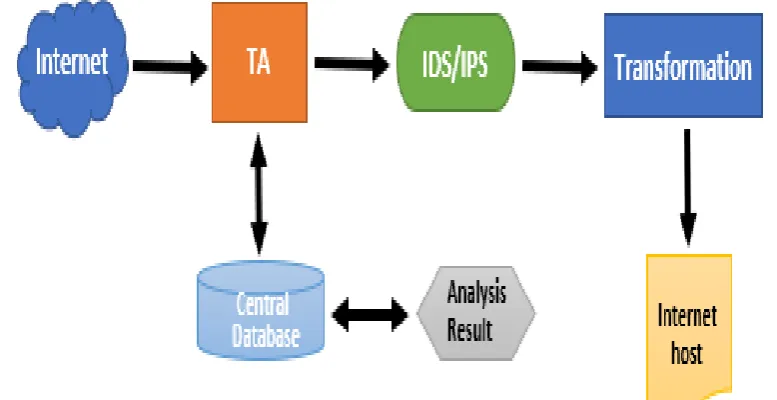
measures (e.g., dissecting patches and loopholes) or the after the attack the examination of independent terms, furthermore, they don't uncover conclusion into the term, transcendence, and attributes of zero-day attacks. These vulnerabilities are presumed to be used generally for doing concentrated on attacks, as a result of the after attacks, an assessment of the vulnerabilities that security specialists have Related to zero-day attacks [8]. In any case, past research has focused in the general window of presenting to vulnerabilities, which remains until each and every vulnerability has fixed and Which spreads attacks started after the weakness revealed. For instance, an examination of three exploits records revealed that 15% of those endeavors made before the disclosure of comparative vulnerabilities the past issues. In this way, to address the former issues, This paper propose a methodology that can help us avoid zero-day attacks. To keep up the Detection log and the technique for the restriction is Polymorphic malware. moreover, Anticipating the movement of the framework to predict the upcoming conduct of the framework system to contradict the irregular behavior. In addition, Monitoring the system network flow. The proposed structure is imagined as a security framework that monitors the system and choosing whether it is vindictive or not, In Behavior set up together, the recognizable proof strategies are depended on the ability to expect the movement of framework traffic. They will probably predict the future conduct of the framework structure in order to contradict the abnormal traffic. Intrusion detection IDS and intrusion prevention IPS marks whether it's the threat or not. The data captured via traffic analyzer (TA) which parses packets and requests having a place with a comparable stream. This module is subject to make overall level features identified with this flow. The IDS/IPS module performs significant profound packets evaluation and names the stream whether it has a spot with some risk.
2.
LITERATURE REVIEW
Zero-day vulnerabilities exploits the system with no signature [9]. It exploits malware before a fix has been made. That implies, for zero-day vulnerability, no fix is promptly available, additionally, it exploits infrastructure before the vendor could possibly know about it. A zero-day attack exploits the vulnerability that has not been uncovered publicly, including the vendor of programming, in this manner, no barrier instrument accessible against zero-day attack. The antivirus can't recognize the attack through signature-based checking and in light of the fact that the vulnerability is obscure, the influenced programming can't be fixed. These unpatched vulnerabilities are allowed to go for aggressors to any objective they want to target [10][11]. According to research [11] The most perilous assaults that are more earnestly to identify are polymorphic worms which show unmistakable practices and worms represent a genuine danger to Internet security. These worms quickly spread and progressively compromise the Internet and benefits by abusing obscure vulnerabilities likewise they can change their very own portrayals on each new virus. The equivalent has numerous marks thus their fingerprinting production is very difficult.[12] Broke down the log documents utilizing log connection to recognize the zero-day attacks utilizing the vulnerability diagram. In any case, naturally of the zero-day attack, they can't be anticipated and consequently, healing measures can't be arranged ahead of time. In the field of vulnerability arrangement assesses a portion of the conspicuous scientific classifications, this appraisal is useful for appropriate order of vulnerabilities displays in organize framework condition and proposed a five-dimensional
methodology for vulnerabilities classification with attack vector, protection, approach utilized for vulnerabilities misuse, effect of weakness on to the framework, and the objective of attack [13].
Figure-1 Vulnerabilities Identified so far
It clearly shows in above figure that the increasing in vulnerabilities so far in history. The vulnerabilities increasing dramatically on peak.
There are numerous weakness scanners accessible for recognizable proof and evaluation of vulnerabilities. Determination of these vulnerabilities scanners assumes a significant job in organizing security management. Notwithstanding, these weakness scanners couldn't recognize zero-day assaults because of less unsurprising behavior of zero-day attacks. As Zhichun [14] proposed a quick, noise-tolerant and attack versatile system based computerized signature age framework Hamsa, for polymorphic worms; which permitted to make scientific attack strength ensures for the mark analyze calculation.
Figure-2 Approach for vulnerability assessment. From Vulnerability disclosure to deploying patch.
The critical or vulnerable zero-day exploits comes by downloads, in which an exploited Web page results in malware attack in the framework. These sorts of attacks exploit the Web program's vulnerabilities or outsider program modules. Up until now, probably the most perilous zero-day attack that played significant role focused on threats such as Hydraq Trojan [15], Stuxnet [16], Duqu [17] and Flamer [18]. Hydraq Trojan intended to take data from a few organizations. Stuxnet, in 2010 the atomc power of iran, contained four zero-day exploits at no other time seen. This was considered as the most dangerous threat of the century and the U.S. what's
Vulnerability Exploitation Attack
Awareness Build Patch Distribute
more, Israeli government offices are associated with having made Stuxnet. Duqu, distinguished as the most modern malware ever observed, showed up in 2012, utilized against the security firm and numerous different targets around the world. An obscure significant-level programming language used to build up some part of Duqu malware and it exploits zero-day Windows piece vulnerabilities. Fire malware found by Kaspersky Lab in 2012, misuses zero-day vulnerabilities in Microsoft Windows. These zero-day assaults are generally hard to shield on the grounds that after assault just the information get accessible for investigation.
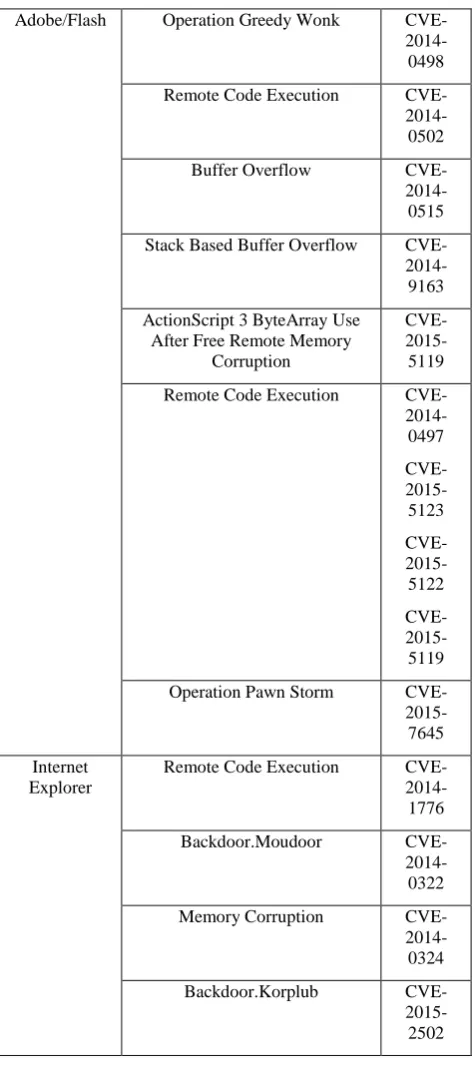
Table 1: Well-known Zero-day attack vulnerabilities
Adobe/Flash Operation Greedy Wonk CVE- 2014-0498
Remote Code Execution CVE- 2014-0502
Buffer Overflow
CVE- 2014-0515
Stack Based Buffer Overflow CVE- 2014-9163
ActionScript 3 ByteArray Use After Free Remote Memory
Corruption
CVE- 2015-5119
Remote Code Execution CVE- 2014-0497 CVE- 2015-5123
CVE- 2015-5122
CVE- 2015-5119
Operation Pawn Storm CVE- 2015-7645
Internet Explorer
Remote Code Execution CVE- 2014-1776
Backdoor.Moudoor
CVE- 2014-0322
Memory Corruption CVE- 2014-0324
Backdoor.Korplub
CVE- 2015-2502
Estimation given to these vulnerablities, it's not usual that a open world has advanced to satisfy the need. Truth be told, as soon as zero-day vulnerability are being known, they may turn into a different product shape [19].
3.
METHODOLOGY & TECHNIQUES
Zero-day attacks take place with the passing of time when a bug is misused and software vendors begin to build a patch. The duration of the incident is difficult to measure, because when the malfunction occurred first, it is hard to decide. However, the provider doesn't even have any idea from time to time whether the vulnerability is being used if it is fixed. Though, the vulnerability can be longer for a considerable amount of time. A zero-day attack may continue 310 days in a row, as indicated by FireEye.
3.1
Techniques uses traditionally
Those security strategies are in reality known to avoid zero-day attacks. Any web-related group threatens to target on zero days on a regular basis. The reasons for this attack are detection of private data, objective observation, breakdown of business data and disruption of the framework. The examination efforts to prevent the zero-day attack have broken down in this field. Protection systems ' fundamental goal is to detect as close an effort as possible to the time of misuse and to prevent or limit the damage done by the attack. [1].
3.1.1
Statistical-based
Currently known statistically derived discovery approaches keep track of past attacks. This log is used to generate new parameters for detection of attacks. The usual activities are determined by this process. In fact, the actions to be restricted are recognized. The longer this approach is used for any system, the more accurate a training or decision on standard activities is as the log is updated by regular activities [20]. Measurable dependent techniques construct verifiable data vulnerability profiles that are static in nature; they are therefore unable to implement the adaptive behavior. Such tools cannot therefore be used constantly for the detection of malware.
3.1.2
Signature-based
Signature based approaches are used to classify their new characteristics on each new malware in order to discover polymorphic worms. There are basically three classes of location systems based on signatures [1]: Content-based marks, semantic-based marks and marks driven by vulnerability. Such systems are often used by suppliers of virus software, who order different malware signatures from a library. The newly recognized signatures of the recently exploited vulnerabilities are always revised in these books. Within virus programming packs, signature-based approaches are routinely used to avoid dangerous payloads from malware to worms.
3.1.3
Behavior-based
progressively the presence of a zero-day attack and prevent harm and repetition of the zero-day attack.
3.1.4 Hybrid-based
A protection mechanism that tracks process flow and decides whether it is vulnerable or not is included in the proposed structure. The proposed architecture system contains six important components: information securing module, an interruption identification framework, data assortment, include extraction and change, directed classifier, and a UI (customer machine/have/server machine) entrance.
A traffic analyser (TA) (Figure-3) which monitors and analyses packets is the module which collects information having a place with the equivalent flow. This module is liable for creating all the relevant flow. The IDS / IPS module performs an exhaustive analysis of deep packets and determines flows whether there is a threat. The data storage
[image:4.595.105.494.257.457.2]where all flow highlights and their corresponding class names are stored. The extraction module function distinguishes statistical highlights on each flux and the element change module becomes increasingly active highlights which are used to create classifiers to classify a malicious flow. Classifiers which are installed offline and transmitted to approaching process flow. The reporting interface is used to monitor the development of a new suspected process flow. The aim of the proposed system is to distinguish and separate malicious stream from system traffic and further characterize it as a certain type of known malware. The proposed method use a malware recognition and grouping framework based on the machine learning to achieve this by detecting network traffic features as an association. With the versatility to self-learn new malware identification, the proposed structure involves precise controlled grouping of known groups.
Fig 3: Protection Mechanism Table-2 Comparison with Traditional system
Techniques →
Features ↓
Traditional System Proposed System
Known Attack Detection
Snort in honeywall log and report known attacks
Snort in inline mode and VirusTotal is used to keep
check on known attacks
Zero-day Attack Detection
The unknown traffic is redirected to honeypots to
monitor interactions between the attacker and
honeypot
Utilized machine learning algorithm, 1-class SVM to detect unknown attacks that deviate from the good network
traffic profile
Obfuscation Detection The obfuscated binary is allowed to run on honeypot with Sebek to
track commands
Detect obfuscation in SAE and later the binary is allowed to
[image:4.595.131.465.507.739.2]Attack Analysis Analysis is only done manually
Automated analysis: static, dynamic.
Signature Generation No Yes in ClamAV format
Response Time Manual analysis takes time to analyze the behavior of
malicious binary
Layered architecture does detection and analysis in parallel. Further, SAE and DAE
provides detailed and useful information for manual analysis
(if required). Hence reducing response time.
Figure-3 Showing Time Phase
Following figure will show time phase that were used for target discovery, scanning, result Analysis and Reporting.
4.
CONCLUSION & FUTURE WORK
In this paper, the identification of zero-day attacks and exam frameworks are discussed. The system suggested is a combination of anomaly-based detection, a position based on behavior and a discovery based on signatures. In zero-day attack findings and inquiries, the proposed methodology discusses issues with current methodologies and attempts to give a complete answer to the whole question. As such, it is arranged in a row, where each layer is used for lonely use and works parallel for better performance. The examination layer in the frame captures both the static and dynamic output of pernicious doubles in the position layer. The software stub introduces static and dynamic malware testing to a segment-based design in which any component can be subsequently substituted as a solitary device. To order to profile the malignant double and dynamic analyzing engine, the static analytics software includes critical information to capture the runtime behavior in an emulator. Therefore, the system generates a ClamAV signature.
Different standard tests have tested the proposed system. In research, it has been shown that approximately 98percent with 0.02 false positive detection levels have the best frame. In fact, the Honeynet model comparison shows that in zero-day attack discovery and analysis the proposed architecture would restrict reaction time, all considerations. In future work it aims at (1) making the frame flexible and improving its efficiency by recognizing and dissecting various zero-day parallels.
(2) To analyze programs like copy and to investigate various ways of conducting malware investigation anti-analysis steps.
(3) Generate a stronger and ever more accurate signature in Snort shape for the muddled zero-day mutation.
5.
REFERENCES
[1] S. Shah and B. M. Mehtre, “An overview of vulnerability assessment and penetration testing techniques,” J. Comput. Virol. Hacking Tech., vol. 11, no. 1, pp. 27–49, 2015.
[2] A. Greenberg, “Shopping For Zero-Days: A Price List For Hackers’ Secret Software Exploits.”
[3] A. Shaout and C. Smyth, “Fuzzy zero day exploits detector system,” Int. J. Adv. Comput. Res., vol. 7, no. 31, pp. 154–163, 2017.
[4] D. Hammarberg, “Information Security Reading Room The Best Defenses Against Zero-day Exploits for
Various-sized Organizations
______________________________,” 2019.
[5] “A. Lelli. The Trojan.Hydraq incident: Analysis of the Aurora 0-day exploit.”
[6] “R. McMillan. RSA spearphish attack may have hit US defense organizations. PC World, 8 September 2011.”
[7] “U. Rivner. Anatomy of an attack, 1 April 2011.” [8] “Symantec Corporation. Symantec Internet security
threat report, volume 17.”
[9] A. Aleroud and G. Karabatis, “Toward zero-day attack identification using linear data transformation techniques,” Proc. - 7th Int. Conf. Softw. Secur. Reliab. SERE 2013, pp. 159–168, 2013.
[10] L. Bilge and T. Dumitras, “Before we knew it: An empirical study of zero-day attacks in the real world,” Proc. ACM Conf. Comput. Commun. Secur., pp. 833– 844, 2012.
[11] U. K. Singh, C. Joshi, and S. K. Singh, “Zero day Attacks Defense Technique for Protecting System against Unknown Vulnerabilities,” no. 1, pp. 13–18, 2017.
[12] C. Joshi and U. Kumar Singh, “ADMIT- A Five Dimensional Approach towards Standardization of Network and Computer Attack Taxonomies,” Int. J. Comput. Appl., vol. 100, no. 5, pp. 30–36, 2014.
reasoning systems,” Adv. Intell. Syst. Comput., vol. 857, pp. 1083–1102, 2019.
[14] Z. Li, M. Sanghi, Y. Chen, M. Y. Kao, and B. Chavez, “Hamsa: Fast signature generation for zero-day polymorphic worms with provable attack resilience,” Proc. - IEEE Symp. Secur. Priv., vol. 2006, pp. 32–46, 2006.
[15] A. Lelli., “(2010, Jan.) The trojan. hydraq incident: Analysis of the aurora 0-day exploit, Available.”
[16] and E. C. N. Falliere, L. O. Murchu, “Chien.(2011, Feb.) W32.stuxnet dossier, Available:”
[17] A. Symantec. (2011, Nov.) W32.duqu the precursor to the next stuxnet, “No Title.”
[18] R. Goyal, S. Sharma, S. Bevinakoppa, and P. Watters, “Obfuscation of Stuxnet and Flame Malware,” Wseas.Us, pp. 150–154, 2013.
[19] D. Hammarberg, “―The Best Defenses against Zero-day Exploits for Various-sized Organizations‖, SANS Institute InfoSec Reading Room, September 21st 2014.”
[20] M. Albanese, S. Jajodia, and S. Noel, “―A time-efficient approach to cost-effective network hardening using attack graphs,‖ in Proceedings of DSN’12, 2012, pp. 1– 12.”