© 2019, IRJET | Impact Factor value: 7.211 | ISO 9001:2008 Certified Journal | Page 1812
Experimental Analysis of the Effect of EGR on Performance of CI Engine
using Cotton Seed Oil & Its Blends
Mr. Nikam S.M
1, Dr. Hole J.A.
21
M.E.Student, Department of Mechanical Engineering, JSPM’s COER, SPPU, Pune, India
2Professor, Department of Mechanical Engineering, JSPM’s COER, SPPU, Pune, India
---***---Abstract
- the global consumption of fossil fuels isincreasing rapidly, and it affects the environment through greenhouse gases inflicting health issues. Biodiesel encompasses a nice potential to cut back environmental pollution and additionally as an alternate fuel for diesel engines. Cotton Seed oil (Ceiba Pentandra) is one various which will be used as a substitution fuel. There are many benefits of exploitation Cotton Seed oil as a substitute fuel that are turn out a low level of waste, secure availability, may be used for diesel engines with less or no modification and insure mixes will increase engine lubrication that should increase engine life. A methyl ester of cottonseed oil was prepared and blended with diesel in four different compositions varying from 5% to 20%.Tests were conducted in a single cylinder variable compression ratio diesel engine at a constant speed of 1500 rpm. Highest brake thermal efficiency and lowest specific fuel consumption were observed for 5% biodiesel blend for compression ratio of 15 and 17 and 20% biodiesel blend for compression ratio of 19. It is observed that B20 blend may replace diesel fuel without modifying engines to produce cleaner exhaust emissions. Exhaust gas recirculation (EGR) is one of the useful technologies to reduce the NOx emission of a diesel engine. As higher NOx emission and higher brake specific fuel consumption are main challenges for effective utilization of biodiesel fuel in a diesel engine, there is alarming need to find out the long term solution to reduce NOx emission for better utilization of biodiesel fuel in a diesel engine. Exhaust gas recirculation (EGR) is one amongst the helpful technologies to scale back the Nox emission of a diesel engine. However, CO and HC emissions slightly raised with exhaust gas recirculation.
Key Words: Biodiesel Cotton Seed oil, Blending, Diesel
engine, Engine performance, EGR,Transesterification etc
1. INTRODUCTION
With recent increases in petroleum prices, there is renewed interest in vegetable oil and their derivatives as alternative fuels for diesel engines. There are more than 350 oil-bearing crops identified, among which only sunflower, safflower, soybean, cottonseed, rapeseed and peanut oils are considered. The major problem associated with the use of pure vegetable oils as fuels, for Diesel engines are caused by high fuel viscosity in compression ignition and resulting injector fouling and other engine problems. The
disadvantages of vegetable oils as diesel fuel are: (a) higher viscosity, (b) higher pour point, (c) higher flash point, (d) higher cloud point, (e) higher density as potential alternative fuels for diesel engines [1]. The viscosity of vegetable oil is about ten time’s higher than that of diesel. Therefore, the vegetable oil cause poor fuel atomization, incomplete combustion and carbon deposition on the injector and valve seats resulting in serious engine fouling [2].
The ethanol and biodiesel are the two liquid bio fuels which will replace/substitute gasoline /diesel severally. Production and utilization of the bio fuel would generate the of recent economic opportunities in term of creation of job opportunities in rural areas additionally to the protection of the environment [3].Biodiesel and ethanol derived from biomass feed stocks will offer different substitute of petro diesel and gasoline severally. The current paper are restricted only to the biodiesel diesel substitute. Biodiesel will be obtained from variety of edible and non-edible oil resources and major thrust is given for the use of non-edible seed plant. The oil from these plants will be transesterified by appropriate technique depending on its FFA content for the assembly of biodiesel which will be accustomed operate a CI engine. The current paper attempts to review the work on the performance of diesel engine using biodiesel-diesel blends as well as blend of diesel with various oils [4]
© 2019, IRJET | Impact Factor value: 7.211 | ISO 9001:2008 Certified Journal | Page 1813
one of the most efficient methods or techniques for reducingemissions and particulate matter (PM) effluents from diesel automobiles, particularly nitrogen dioxide (NOX), carbon monoxide (CO), and hydrocarbons (HC).[6]The potential techniques available for the reduction of NOx from diesel engines using EGR. The effect of EGR are depletion of oxygen in the intake charge, increased intake temperature due to mixing with EGR, increased specific heat of intake charge, recycling of unburned hydrocarbons (opportunity for re-burn). EGR controls the NOx because it lowers oxygen concentration and flame temperature of the working fluid in the combustion chamber. The recirculated exhaust gas displaces fresh air entering the combustion chamber with carbon dioxide and water vapor present in engine exhaust. As a consequence of this air displacement, lower amount of oxygen in the intake mixture is available for combustion. Reduced oxygen available for combustion lowers air fuel ratio [7]
Nomenclature
BD biodiesel CSO cotton seed oil CO carbon monoxide NOx oxides of nitrogen CO2 carbon dioxide HC hydro carbon
EGR exhaust gas recirculation BTE bake thermal efficiency VCR variable compression ratio FFA Free Fatty Acids
COME Cottonseed oil methyl ester
1.1 Exhaust gas recirculation
There are various ways in which in which the emissions from the exhaust of associate engine is reduced. The fuel that's being handled is Biodiesel. A method of reducing Nox is by utilization of Exhaust Gas Recirculation (EGR) wherever exhaust gas coming back from engine exhaust manifold is given to inlet manifold in order to reduce Nox. Once a part of this exhaust is recirculation then it works as diluents to combustion mixture. Attributable to high specific heat of exhaust gas than fresh air, it will increase the temperature of intake fresh charge as a result it decreases the temperature rise for the similar. So the pollutants like HC, CO andCO2 aren't formed however traces of HC and COare shaped due to the burning of lubricating oil within the combustion chamber. Then the most pollutant formed from the biodiesel operated engine is Nox. The most supply for the formation of Nox is peak combustion temperature within the combustion chamber, the provision of oxygen and the continuance. [3,8] Exhaust gas-largely carbon dioxide and water vapor—has a higher specific heat than air, will Serve to lower peak combustion temperatures. However, adding EGR to a diesel reduces the specific heat ratio of the combustion gases in the power stroke. This reduces the amount of power which will
be extracted by the piston. EGR also tends to reduce the amount of fuel burned within the power stroke. This is evident by the increase in particulate emissions that corresponds to an increase in EGR. Particulate matter (mainly carbon) that's not burned within the power stroke is wasted energy stricter regulations on Particulate Matter (PM) call for further emission controls to be introduced to compensate for the PM emissions introduced by EGR.
2. METHODOLOGY
[image:2.595.321.547.273.350.2]2.1 The raw cotton seed oil was extracted by mechanical
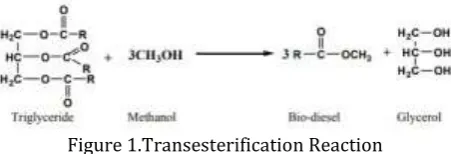
expeller during which little traces of organic matter, water and different impurities were present.Figure 1.Transesterification Reaction
Transesterification may be a most typical and well established chemical reaction within which alcohol reacts with triglycerides of fatty acids (vegetable Oil) in presence of catalyst to make glycerol and esters. The reaction is shown in Figure-1.Experiments were conducted in a laboratory setup consisting of heating mantle, reaction flask (made of glass), separating funnel and mechanical stirrer. A spherical bottom flask of two liters was used as laboratory scale reactor for the current analysis. It consisted of three necks. One for stirrer, the others for condenser and inlet of reactants, similarly as for placing the thermocouple junction to observe the reaction temperature. The flask has stopcock at the bottom for collection of the final product. The progress of the reaction was observed by measurement the acid value. Within the course of the test, it was observed that the suitable quality of bio- diesel may be made from cotton seed oil in both acid catalyst esterification and alkaline catalyst esterification.
2.2 Esterification procedure
© 2019, IRJET | Impact Factor value: 7.211 | ISO 9001:2008 Certified Journal | Page 1814
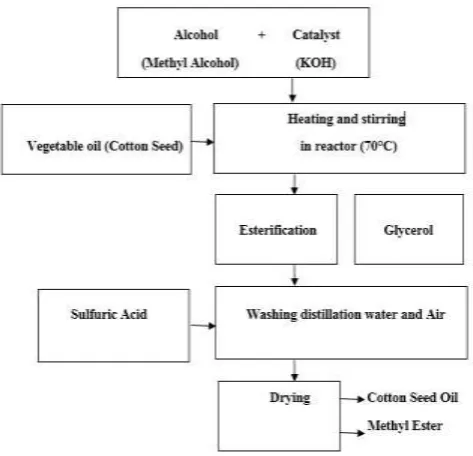
within the acid-catalyst pretreatment. Through an [image:3.595.322.553.303.444.2]experiment it's optimized that 1 chronicles by volume of the sulphuric acid and a molar ratio of 6:1 gives the maximum conversion efficiency. The products of the first stage are used as input for alkaline method. A molar ratio of 9:1 and 1.5% by weight of NaOH is found to give the maximum ester yield. With the completion of the reaction, the products were allowed to separate in to 2 layers. The lower layers contained impurities and glycerol. The top ester layer is separated and refined by using H2O (10% by volume). Hot H2O is sprayed over the ester, stirred gently and allowed to settle within the separating funnel. after washing, the final product was heated up to 70°Cfor 15 min under vacuum condition resulting in a clear amber light yellow liquid with a viscosity similar to diesel and then stored for further use The summary of esterification process, settling and washing is illustrated in Figure-2.[9-10]
Figure 2. Esterification procedure
2.3 Characterization of cotton seed oil
The supply of cottonseed oil is cottonseed that may be a crop by product. it's essentially a triglyceride ester with variety of branched chains of 8-18 carbon atoms. It contains 85.3% fatty acids. Fatty acid composition of the oil is important to determine the number of reactants and the catalyst. FFA (Free Fatty Acids) is determined from the acid value. It’s been stated that the acid value of the vegetable oil should be less than one for a base catalyzed transesterification method from earlier studies. The many properties of cotton seed oil are found throughout this investigation. The result indicates that, transesterification has improved the necessary fuel properties like specific gravity; viscosity; flash point; and acid value. The viscosity considerably got reduced.
The result indicates that, transesterification has improved the necessary fuel properties like specific gravity; viscosity; flash point; and acid value. The viscosity considerably got reduced from a value of 50 to4.2 mm 2/s (approximately one 11th of initial value). The calorific value of methyl ester is less than that of diesel because of its oxygen content. The flash point temperature of CSO and come is higher than the pure diesel fuel. The high flash point temperature of come is a useful characteristic, because the fuel is safely stored and transported at the room temperature. The cetane number (CN) of come prohibits its direct use because the various fuel in diesel engines, however it may well be employed in blends with the pure diesel fuel, because most of the determined properties of the a COME-diesel blended fuels were terribly close to the diesel oil. The ultimate structure beside formula, exact mass, molecular weight and elemental analysis is given by CHEMOFFICE software as shown in Figure-3. [9-10]
Figure-3 Schematic diagram showing molecular structure raw cotton seed oil.
3. EXPERIMENTAL SET- UP
Engine specifications
Item Specification
Make
Model
[image:3.595.45.282.312.540.2]© 2019, IRJET | Impact Factor value: 7.211 | ISO 9001:2008 Certified Journal | Page 1815
No.of CylinderNo of Stroke Fuel
Power
1 4 Diesel
3.5 KW at 15000 R.P.M. Stroke Lenth
Bore 110 mm 87.5 mm Compression Ratio 12 to 18:1 Volume 661 c.c.
3.1 Properties of Cotton Seed Oil
Properties Diesel Cotton seed oil Kinematic
viscosity at
40 °c (cst) 2.68 55.61
Density at 15 °c
(kg/m3 ) 828 912
Flash point (°c) 56 207
Calorific value
(kj/kg) 43000 40,000
Sp.gravity 0.835 0.850
© 2019, IRJET | Impact Factor value: 7.211 | ISO 9001:2008 Certified Journal | Page 1817
5. CONCLUSIONS
I. From Graph 1, it is observed that The Brake specific fuel consumption for diesel,B2,B10,B100 decreases because of complete combustion of fuel and for B5,B15 firstly it decreases and then increases. It can also be seen that B.S.F.C for blend B2 is less as compared to the diesel, biodiesel and other blends and also the B.S.F.C. for blend B10, B100 is higher than diesel.
II. From Graph 2, itis observed that with implementation of EGR technique. The Brake specific fuel consumption for diesel,B2,B5,B10,B15, and B100 decreases because it can found the higher thermal efficiency at low B.S.F.C. from the Graph 4 and also the B.S.F.C. with EGR is greater than B.S.F.C. in case of conventional system due to dilution of the charge. Upon sending exhaust gas along with the intake air, the amount of intake air will be decreased, and lead to high fuel consumption III. From Graph 3, it is observed that the brake thermal
efficiency improved with increasing concentration of Bio-Diesel in blend due to improved thermal efficiency observed with oxygenated fuel. All Bio-Diesel blends have higher thermal efficiency than base line data Diesel. It can also be seen that the brake thermal efficiency for blend B2 is higher than other biodiesel blends and for pure biodiesel B100 it is less compare to the diesel since it has low calorific value as compare to diesel and other blends.
IV. From Graph 4, it is observed that at low EGR flow the brake thermal efficiency found to be higher with EGR technique.
V. From Graph 5 , It is observed that there is slight variation in the mechanical efficiency of biodiesel and Bio-Diesel blend as compared to diesel as a fuel also the mechanical efficiency for blend B2,B5 is slightly higher than other blends and diesel VI. From Graph 6, it is observed that the mechanical
efficiency of diesel, biodiesel and biodiesel blend is not much affected by the EGR technique
VII. From Graph 7, it is observed that the brake power of various fuels increases with the increasing load. VIII. From Graph 8, it is observed that with implementation of EGR Technique the brake power of various fuels also increases with increasing load but the brake power produced by the engine at output shaft of engine is less in EGR technique as compared to without EGR technique due to the dilution of the fresh charge with the exhaust gas which results in lower flame velocity and hence deterioration of the combustion.
IX. From Graph 9, it is observed that the percentage of NOx produced by the diesel without EGR technique is less as compared to the biodiesel and various biodiesel blends. Also drastic reduction of
NOx was found with implantation of EGR technique due to the reduced peak combustion
pressures and temperature (i.e. below 1200 ) X. From Graph 10, it is observed that the percentage of
HC produced by the diesel without EGR technique is less as compared to the biodiesel and various biodiesel blends. Also it can be seen that there is increment of HC with implantation of EGR technique due to the presence of exhaust gas impedes the burning rate.
XI. From Graph 11, it is observed that the percentage of CO produced by the diesel without EGR technique is less as compared to the biodiesel and various biodiesel blends. Also it can be seen that there is increment of CO with implantation of EGR technique due to the lower excess of oxygen available for combustion.
6. REFERENCES
[1] Ayhan Demirbas, “Studies on cottonseed oil biodiesel preparedin non-catalytic SCF conditions” Sila Science, and Energy, Renewable Energy Resources, P.K. 216, TR-61035 Trabzon, Turkey.2008, Science Direct Bioresource Technology 99 (2008) pp1125–1130
[2] A.S. Ramadhas*, S. Jayaraj, C. Muraleedharan, “Biodiesel production from high FFA rubber seed oil” Science Direct Fuel 84 (2005) pp 335–340
[3] Nitin M. Sakharea, Pankaj S. Shelkea, Subhash Lahane, “Experimental Investigation of Effect of Exhaust Gas Recirculation and Cottonseed B20 Biodiesel Fuel on Diesel Engine” Science Direct Procedia Technology 25 (2016) pp 869 – 876
[4] Gaurav Dwivedi , Siddharth Jain , M.P. Sharma,“Diesel engine performance and emission analysis using biodiesel from various oil sources – Review” J. Mater. Environ. Sci. 4 (4) (2013)pp CODEN: JMESCN 434-447
[5] Pratthosh Ravi*, Suresh Govindan,” Effect Of Exhaust Gas Recirculation On Emission Characteristics Of
Compression Ignition Engine With Cottonseed Biodiesel”, Vol 6, Issue 1, (2018) Pp2347-1573
[6] Maroa Semakul and Prof. Freddie Inambao,” The Effects of Exhaust Gas Recirculation on the Performance and Emission Characteristics of a Diesel Engine – A Critical Review”, innovare journal of engineering and technology International Journal of Applied Engineering Research ISSN 0973-4562 Volume 12, Number 23 (2017) pp. 13677-13689
© 2019, IRJET | Impact Factor value: 7.211 | ISO 9001:2008 Certified Journal | Page 1818
Diesel Engine using Rice Bran Biodiesel”, EngineeringScience and Technology, an International Journal 21 (2015) pp 2321-0613
[8] N. Saravanan_, G. Nagarajan, K.M. Kalaiselvan, C. Dhanasekaran,” An experimental investigation on hydrogen as a dual fuel for diesel engine system with exhaust gas recirculation technique”, Journal of Mechanical Engineering Research and Developments (JMERD) 41(3) (2008) pp 422– 427
[9] R. Anand, G. R. Kannan, K. Rajasekhar Reddy and S. Velmathi,” The performance and emissions of a variable compression ratio diesel engine fuelled with bio-diesel from cotton seed oil”, Applied Thermal Engineering 29 (2009) pp 1819-6608