Rp- hplc facilitated quantitative analysis of tectorigenin in the different species of
evaluation of its invitro anticancer potential
Sajad H. Wani, Asif amin, Shahnawaz N
Qazi Parvaiz Hassan
1
Department of Biotechnology, University of Kashmir
2
Indian Institute of Integrative Medicine (CSIR) Sanat Nagar,
ARTICLE INFO ABSTRACT
A simple HPLC species of genus
Kashmir valley. The analysis was performed by using Chromolith RP
mm) at isocratic elution of methanol and water (30:70, v/v) with diode array detection at 265nm. The calibration curve showed good lineari
method was successfully applied for the analysis of tectorigenin in 12 samples of five species of from different eco
ranging from 1.08% to 8.84% with a maximum in
valley. The method established in this paper is simple and reliable and could easily be used for the qua analysis of tectorigenin in
tectorigenin were tested against colon cancer cell line, Caco showed a promine
concentration of 100µM.
INTRODUCTION
Iris is the largest and most complicated genus of Iridaceae having variety of plants with showy flowers ranging in colour from gold or yellow to white, blue, lavender and purple. There are more than 60 species found in China [1], 37 in Turkey [2], 16 in Pakistan [3, 4], 12 in India [5], 3 in Egypt [6]. Iris species have gained a great popularity due to their sweet violet fragrance interested in the perfume and cosmetic industries [7]. Many members of the ge
been used as traditional folk medicine for the treatment of various diseases. Its rhizomes are commonly used in Chinese folk medicine for clearing heat and detoxifying, eliminating phlegm, swelling, and pain in the throat [8]. The peeled and dried rhizomes of collectively known as rhizome iridis enjoyed popularity due to their emetic, cathartic, stimulant, expectorant and errhine properties (9). Rhizomes of this plant are used for fever [10] and roots are used for kidney infections [11]. Iris species have been used for the treatment of inflammation, bacterial infection, or cancer [12, 13]. phytochemistry of this genus has been the subject of extensive investigation and found to be a rich source of flavones, isoflavones [14, 15] and quinones [16]. These classes of compounds have attracted considerable attention because of their antioxidan
cytotoxic [18], anti-microbial, anti-inflammatory and
phytoesterogenic properties [19-21]. The preventive role of isoflavones in cancer, cardiovascular diseases, osteoporosis, and menopausal symptoms is well documented [22, 23, 24]. In traditional Chinese medicine, it was used as a bitter medicine to treat disorders described as Zheng Jia Jie Ju, which are similar to modern descriptions of tumors [25-26].
*Corresponding author:[email protected]
ISSN: 0975-833X
Article History:
Received 14th November, 2012
Received in revised form 24th December, 2012
Accepted 20th January, 2013
Published online 14th February, 2013
Key words: Iris, HPLC-UV-DAD, Tectorigenin, MTT assay.
RESEARCH ARTICLE
hplc facilitated quantitative analysis of tectorigenin in the different species of
evaluation of its invitro anticancer potential
Shahnawaz N. Sofi, Taseem A. Mokhdomi,
Qazi Parvaiz Hassan and Raies A. Qadri
Department of Biotechnology, University of Kashmir
Indian Institute of Integrative Medicine (CSIR) Sanat Nagar, Srinagar
ABSTRACT
A simple HPLC-UV-DAD method was developed for rapid identification and quantitation of tectorigenin in five species of genus Iris viz Iris crocea, Iris ensata, Iris germanica, Iris kashmeriana and Iris spuria
Kashmir valley. The analysis was performed by using Chromolith RP-18e analytical column (5 μm; 4.6 mm mm) at isocratic elution of methanol and water (30:70, v/v) with diode array detection at 265nm. The calibration curve showed good linearity (r2 > 0.998) within test ranges and recoveries were 98.2 to 101.2%. The optimized
method was successfully applied for the analysis of tectorigenin in 12 samples of five species of
from different eco-geographical zones. The tectorigenin content in investigated samples was greatly variant ranging from 1.08% to 8.84% with a maximum in Irisgermanica collected from Gulmarg region of Kashmir valley. The method established in this paper is simple and reliable and could easily be used for the qua analysis of tectorigenin in Iris species. Furthermore, to evaluate anti-cancer properties, different concentrations of tectorigenin were tested against colon cancer cell line, Caco-2 using MTT cell proliferation assay. The results showed a prominent growth inhibition in a concentration dependent manner with maximum inhibition at a concentration of 100µM.
Copy Right, IJCR, 2013, Academic Journals
is the largest and most complicated genus of Iridaceae having variety of plants with showy flowers ranging in colour from gold or yellow to white, blue, lavender and purple. There are more than 60 cies found in China [1], 37 in Turkey [2], 16 in Pakistan [3, 4], 12 species have gained a great popularity due to their sweet violet fragrance interested in the perfume and cosmetic industries [7]. Many members of the genus Iris have also been used as traditional folk medicine for the treatment of various diseases. Its rhizomes are commonly used in Chinese folk medicine for clearing heat and detoxifying, eliminating phlegm, swelling, and and dried rhizomes of Iris
collectively known as rhizome iridis enjoyed popularity due to their emetic, cathartic, stimulant, expectorant and errhine properties (9). Rhizomes of this plant are used for fever [10] and roots are used for species have been used for the treatment of inflammation, bacterial infection, or cancer [12, 13]. The phytochemistry of this genus has been the subject of extensive investigation and found to be a rich source of flavones, isoflavones [14, 15] and quinones [16]. These classes of compounds have attracted considerable attention because of their antioxidant [17],
inflammatory and
21]. The preventive role of isoflavones in cancer, cardiovascular diseases, osteoporosis, and menopausal symptoms is well documented [22, 23, 24]. In traditional Chinese medicine, it was used as a bitter medicine to treat disorders , which are similar to modern
ersity.ac.in
Phytochemistry of Iris species is dominated by the presence of polyphenols especially isoflavones [27]. Tectorigenin, one of the most important isoflavone isolated from different
diverse pharmacological properties [28,29]. The present work describes the qualitative, quantitative as well as Bioevaluation analysis of this magic molecule in some selected species of genus growing wild in Kashmir valley. The analys
HPLC coupled with diode array detection. The present work is the first report of its kind in which tectorigenin was quantified in five species of Iris growing in Kashmir. Further the effects of tectorigenin were tested against colon cancer cell line, Caco
proliferation assay.
RESULTS AND DISCUSSION
Optimization of HPLC conditions
The optimization of HPLC conditions was performed using the standard solution of tectorigenin first and then solution of IC sample. Peak resolutions were tested and compared using different solvent systems (acetonitrile-methanol, acetonitrile
methanol-water) in varying proportions. The separation of tectorigenin was achieved on a RP
(30:70; v/v) at a flow rate of 0.6 ml/min with a runtime of 55 minutes. Photodiode array detector (DAD) was used in HPLC analysis and the optimum monitor wavelength at 265nm was selected from the full range spectra.
Calibration curves and recovery
Methanol stock solution of the standard reference compound tectorigenin was prepared and diluted to appropriate concentrations for the construction of calibration curve. At least four concentrations International Journal of Current Research
Vol. 5, Issue, 02, pp. 206-211, February, 2013
INTERNATIONAL
hplc facilitated quantitative analysis of tectorigenin in the different species of
iris
plant and
Taseem A. Mokhdomi,
1Shoiab Bukhari,
Srinagar
DAD method was developed for rapid identification and quantitation of tectorigenin in five Iris crocea, Iris ensata, Iris germanica, Iris kashmeriana and Iris spuria growing wild in 18e analytical column (5 μm; 4.6 mm × 100 mm) at isocratic elution of methanol and water (30:70, v/v) with diode array detection at 265nm. The calibration > 0.998) within test ranges and recoveries were 98.2 to 101.2%. The optimized method was successfully applied for the analysis of tectorigenin in 12 samples of five species of Iris collected ntent in investigated samples was greatly variant collected from Gulmarg region of Kashmir valley. The method established in this paper is simple and reliable and could easily be used for the qualitative cancer properties, different concentrations of 2 using MTT cell proliferation assay. The results nt growth inhibition in a concentration dependent manner with maximum inhibition at a
, Academic Journals. All rights reserved.
species is dominated by the presence of polyphenols especially isoflavones [27]. Tectorigenin, one of the most important isoflavone isolated from different Iris species has got diverse pharmacological properties [28,29]. The present work describes the qualitative, quantitative as well as Bioevaluation analysis of this magic molecule in some selected species of genus Iris
growing wild in Kashmir valley. The analysis was performed using HPLC coupled with diode array detection. The present work is the first report of its kind in which tectorigenin was quantified in five growing in Kashmir. Further the effects of tectorigenin cancer cell line, Caco-2 using MTT cell
RESULTS AND DISCUSSION
Optimization of HPLC conditions
The optimization of HPLC conditions was performed using the standard solution of tectorigenin first and then solution of IC-3 Peak resolutions were tested and compared using different methanol, acetonitrile-water, and water) in varying proportions. The separation of tectorigenin was achieved on a RP-18e column using methanol-water v) at a flow rate of 0.6 ml/min with a runtime of 55 minutes. Photodiode array detector (DAD) was used in HPLC analysis and the optimum monitor wavelength at 265nm was selected from the full
Calibration curves and recovery
olution of the standard reference compound tectorigenin was prepared and diluted to appropriate concentrations for the construction of calibration curve. At least four concentrations
of tectorigenin were injected in the concentration range of 0.08μg/ml to 0.96μg/μl. The calibration curve was constructed by plotting the peak area versus the concentration of each analyte with detector wavelength set at 265 nm. Excellent calibration curve was obtained for the standard within the concentration range of 0.08 μg to 0.96 μg/μl (r2 = curve coefficients > 0.998). The recovery study was within the concentration range of the calibration curve. The recovery of the method was estimated by spiking IK-1 sample with 2.0 μg/3.8 mg of the standard tectorigenin. The data from the recovery studies revealed that the recovery of the method was in the range of 98.2 to 101.2% evaluating the accuracy of the method.
Quantification of tectorigenin in five different species of Iris
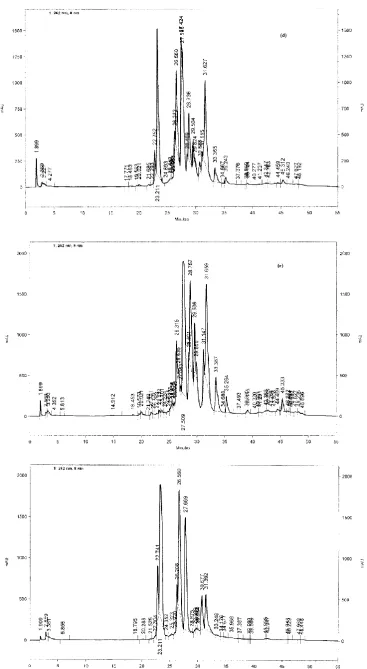
Tectorigenin was separated in all the samples using the developed HPLC method. Typical chromatograms of the different extracts and the mixed standard are shown in Fig. 2. The identification of the investigated compound was carried out by comparison of retention times and UV spectra with those obtained by injecting standards in the same conditions.
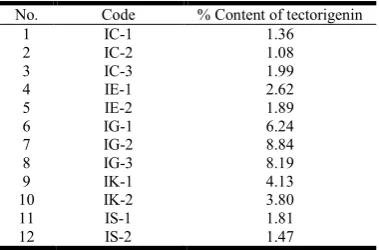
[image:2.595.43.281.351.440.2]The developed HPLC method was applied to analyse tectorigenin in twelve samples of five species of Iris. The data are summarized in Table 2. The results showed that the content of tectorigenin was greatly variant in the rhizomes of five different Iris species (Fig. 2) and the content also varied in samples from different eco-geographical zones.The concentration of tectorigenin ranged from 1.08 mg/g in IC-2 sample (collected from IIIM field in June) to 8.84 mg/g in IG-IC-2 sample (collected from Gulmarg in June 2010).
Table 2. Content of tectorigenin in different tested samples of Iris on plant
dry weight basis
No. Code % Content of tectorigenin
1 IC-1 1.36
2 IC-2 1.08
3 IC-3 1.99
4 IE-1 2.62
5 IE-2 1.89
6 IG-1 6.24
7 IG-2 8.84
8 IG-3 8.19
9 IK-1 4.13
10 IK-2 3.80
11 IS-1 1.81
12 IS-2 1.47
Antiproliferative Effects
The effect of different concentrations of tectoregenin on the proliferation of Caco-2 cells was seen to be dose dependent. The results demonstrate that percentage of growth inhibition increased with increasing concentration of tectoregenin from 15 µM to 100 µM. Tectorigenin exhibited maximum antiproliferative potential at a concentration of 100 µM and lowest at 15 µM.
Experimental
Chemicals and reagents
Methanol and water were of HPLC grade and were purchased from Merck (Mumbai, India). Tectorigenin purchased from Sigma Aldrich, India was used as an external standard for HPLC in the current study.
Plant materials
The raw plant materials of five Iris species were collected from different eco-geographical zones of Kashmir valley (Table 1) and after proper identification the specimens were deposited in the Herbarium of the institute under voucher specimens (No. I001/2010-I005/2010).
Sample preparation for HPLC
Stock solutions of extracts and the standard were obtained by dissolving 5 mg of each of the extract in 1.0 ml MeOH and 1.0 mg of the standard in 1.0 ml MeOH respectively. The resulting solutions were filtered through 0.45μm filter membrane. Working solutions of appropriate concentrations were prepared by diluting stock solutions. The stability of stock as well as working solutions was monitored and no change in concentration was observed.
HPLC conditions for quantitative analysis
Quantitative HPLC analysis was performed on a Schimadzu Class VP HPLC system equipped with a binary pump (LC-10AT), an autosampler (SIL-10AD), a column oven (CTO-10AS), a Diode array detector (SPD-M10A), vacuum membrane degasser (DGU-14A) and a system integrator (SCL-10A) controlled by a Class VP software
which was used for data analysis and processing. Separation was carried out on a Chromolith RP-18e column (5 μm; 4.6 mm × 100 mm) with column oven temperature of 30 oC using an isocratic solvent system consisting of methanol and water (30:70; v/v). Elution was performed at a flow rate of 0.6 ml/min and the injection volume was 5.0 μl. The analytes were monitored at 265 nm.
Cell lines and cell culture conditions
[image:2.595.109.484.492.616.2]Caco-2 (Colon adenocarcinoma) cell line was kindly provided by Hybridoma Laboratory, National Institute of Immunology, India. Cells were grown in DMEM (Invitrogen, USA) supplemented with 10% FBS (Invitrogen, USA) under standard culture conditions at 37% in 5% Co2 in a humidified incubator. 2 × 10⁴ cells were plated per well in a 96 well plate. The media was also supplemented with 250 IU/ml penicillin (invitrogen, USA)
Table 1. Summary for the tested samples of Iris
No. Code Samples Sources Collection date
1 IC-1 Iris croceae Sonamarg, Kashmir, India May, 2010
2 IC-2 Iris croceae IIIM field, Srinagar, Kashmir, India April, 2010
3 IC-3 Iris croceae Gulmarg, Kashmir, India June, 2010
4 IE-1 Iris ensata Naranag, Kashmir, India May, 2010
5 IE-2 Iris ensata IIIM field, Srinagar, Kashmir, India April, 2010
6 IG-1 Iris germanica IIIM field, Srinagar, Kashmir, India April, 2010
7 IG-2 Iris germanica Gulmarg, Kashmir, India June, 2010
8 IG-3 Iris germanica Sonamarg, Kashmir, India May, 2010
9 IK-1 Iris kashmiriana Local graveyard, Srinagar, Kashmir India April, 2010
10 IK-2 Iris kashmiriana Naranag, Kashmir, India May, 2010
11 IS-1 Iris spuria Gulmarg, Kashmir, India June, 2010
[image:2.595.69.259.647.772.2]0 1 2 3 4 5 6 7 8 9 10
IC-1 IC-2 IC-3 IE-1 IE-2 IG-1 IG-2 IG-3 IK-1 IK-2 IS-1 IS-2
P
er
ce
n
ta
g
e
co
n
te
n
t
(m
g
/g
)
Fig.3. Effect of Tectorigenin on Caco2 cell line. The Values represent percentage inhibition of Caco2 cell lines compared to control ± SD (N=3)
Proliferation assay
The effect of tectorigenin on Caco2 cells was evaluated using MTT cell proliferation assay. The assay is based on the ability of mitochondrial succinate-tetrazolium reductase system to convert yellow tetrazolium salt MTT (sigma Aldrich, USA) to purple formazan dye that reflects the cell viability. Cell suspension (200ul) containing 2×10⁴ cells per well was seeded into a 96 well microtiter plate. After 24 hours of seeding, different concentration of compound dissolved in DMSO (100µM, 60µM, 30µM, 15µM) were added. Controls consisted of either cells alone or cells treated with DMSO (solvent control). MTT solution was added to the cells at 0.1mg/ml concentration followed by incubation for 4h in 37oC in dark. The supernatant was removed and an equal volume of DMSO was added to dissolve the formazan crystals. The absorbance was measured at 565 nm (EPOCH Microplate Reader, Bio-Tek Instruments, USA).
Acknowledgement
This study was supported jointly by Department of Biotechnology, University of Kashmir, Srinagar and Indian Institute of Integrative Medicine (CSIR), Srinagar. We are also thankful to Dr. Ayub Qadri from National Institute of Immunology, New Delhi for providing the Caco-2 cell line.
REFERENCES
[1] Delectis Florae Reipublicae Popularis Sinicae Agendae Academiae Sinicae Edita. In Flora Reipublicae Popularis Sinicae; Science Press: Beijing, Vol. 16[1985], pp. 133-134. [2] P. H Davis, Flora of Turkey and the East Aegean Islands, VIII,
University Press: Edinburgh, 1984.
[3] The Wealth of India 1959, A dictionary of Indian raw materials and industrial products, Council of Scientific and Industrial Research: New Delhi, 1959.
[4] S. I Ali,; B.Mathew. S.I. Ali, In Flora of Pakistan . Department of Botany, University of Karachi: Pakistan, Vol. 202 (1993) pp. 4-29.
[5] S. K Bhattacharjee, Handbook of Medicinal Plants, Pointer Publisher: Jaipur India, 1998.
[6] E. I Hadidi, M. N.Fayed, In Taeckholmia. Giza 12613; Cairo University Herbarium: Egypt, 1998; Vol. 15, pp. 189
[7] I. Orhan, S. Nasim, B. Sener, F.Ayanoglu, M. Ozguven, M. I. Choudhary, A.U. Rahman, Two isoflavones and bioactivity spectrum of the crude extracts of Iris germanica rhizomes. Phytother. Res. VOL.17 (2003) 575-577.
[8] G.P. Zhao, S. Dai, and R.S. Chen, in Zhongyao Da Cidian (The Dictionary of Chinese Crude Drugs), edited by Nanjing University of Chinese Medicine (Shanghai Science and Technology Press, Shanghai. (2006) p. 1027.
[9] E .Steinegger, R. Hansel, Lehrbuch der pharmakognosie and phytopharmazie, 4. Ed Springer Veralag, 1988
[10] Anon, 1959. The Wealth of India, Raw Materials, CSIR, New Delhi, Vol. p. 255.
[11] S.K. Bhattacharjee, Handbook of Medicinal Plants. Pointer Publisher, Jaipur, India. 1998 pp. 192-193.
[12] C.R. Andrighetti-Fröhner, T.C.Sincero, A.C da Silva, L.A Savi, C.M. Gaido, J.M.Bettega, M.Mancini, M.T . de Almeida, R.A. Barbosa Farias, M.R. Antiviral evaluation of plants from Brazilian Atlantic Tropical Forest. Fitoterapia VOL.76 (2005) 374-378.
http://dx.doi.org/10.1016/j.fitote.2005.03.010 PMid:15890472 [13] P. Bermejo, M.J. Abad., A.M. Díaz, L. Fernández, J. De Santos,
S. Sanchez, L. Villaescusa, L.Carrasco, A. Irurzun: Antiviral activity of seven iridoids, threesaikosaponins and one phenylpropanoid glycoside extracted from Bupleurum rigidum and Scrophularia scorodonia. Planta Med. Vol 68 (2002) 106-110. http://dx.doi.org/10.1055/s-2002-20238 PMid:11859457 [14] A.S.Shawl, T. Kumar, Isoflavonoids from Iris croceae.
Phytochemistry. VOL 31(1992) 1399–1401.
http://dx.doi.org/10.1016/0031-9422(92)80300-4
[15] A. S. Shawl, Vishwapaul, A. Zaman, A. K. Kalla, Isoflavones of Iris spuria. Phytochemistry VOL 23 (1984) 2405–2406. http:// dx. doi.org/10.1016/S0031-9422(00)80573-7
[16] S. M. Wong, J.M. Pezzuto, H.S. Fong, N.R. Fransworth. Isolation, structure elucidation, and synthesis of 2-hydroxy-3-octadecyl- 5-methoxy-1,4-benzoquinone(irisoquin), a cytotoxic constituent of Iris missouriensis. J. Pharm. Sci. VOL 74 (1985) 1114–1116. http://dx.doi.org/10.1002/jps.2600741023
[17] P. G. Pietta, Flavonoids as antioxidants. J. Nat. Prod. VOL 63 (2000) 1035–1042. http://dx.doi.org/10.1021/np9904509 [18] J. A. Hadfield, A.T. McGowan, J. Butler, A high-yielding
synthesis of naturally occurring antitumour agent Iris quinone. Molecules . VOL 5 (2000) 82–88.
[19] E Wolleweber J. F. Stevens, K. Klimo, J. Knauft, N. Frank and C. Gerhauser. Cancer chemoprevetive in-vitro activities of isoflavones isolated from Iris germanica. Planta Med. Vol 69 (2003) 15-20 PMid:12567273
[20] Atta-ur-Rahman, S. Nasim, I. Baig, S . Jalil, I. Orhan, B . Sener and M. I. Choudhary. Anti-inflammatory isoflavonoids from the rhizomes of Iris germanica. J. Ethnopharmacol. Vol 69 (2003) 15-20
[21] H. Adiercreutz. Phyto-oestrogene and cancer. The Lancet Oncol. Vol 3 (2002) 364-373 http://dx.doi.org/10.1016/S1470-2045(02)00777-5
[22] D. S. Jang, M. Cuended, A.D. Parolus, L.B.S. Kardono, K. Kawanishi, and N.R. Farnswort Phytochemistry. Vol 65 (2004) 345
[23] Y. Takada and B. B. Aggrawal, J. Biol. Chem.Vol 279 (2004) 4750 http://dx.doi.org/10.1074/jbc.M304546200 PMid: 14630 924
[24] E. Wollenweber, J.F. Stevens, K. Klimo, J. Knauft, N. Frank, and C. Gerhauser, Planta Med. Vol 69 (2003), 15. http://dx.doi.org/10.1055/s-2003-37030 PMid:12567273 [25] R. Fang,P.J. Houghton, P.J. Hylands. Cytotoxic effects of
compounds from Iris tectorum on human cancer cell lines. J of
Ethnopharmacology, Vol 118(2) (2008) 257-263.
http://dx.doi.org/10.1016/j.jep.2008.04.006 PMid:18508214 [26] R. Fang, P. J. Houghton, C. Luo et al. Isolation and structure
determination of triterpenes from Iris tectorum. Phytochemistry, Vol 68(9) (2007) 1242-1247. http://dx.doi.org/10.1016/ j.phytochem.2007. 02.018 PMid:17408706
[28] Pan, C.H., Kim, E.S., Jung, S.H., Nho, C.W., Lee, J.K., Tectorigenin inhibits IFN-gamma/LPS-induced inflammatory responses in murine macrophage RAW 264.7 cells. Archives of
Pharmacal Research Vol 31, (2008) 1447–1456
http://dx.doi.org/10.1007/s12272-001-2129-7 PMid:19023541
[29] Thelen, P., Scharf, J.G., Burfeind, P., Hemmerlein, B., Wuttke, W., Spengler, B., Christoffel, V., Ringert, R.H., Seidlova-Wuttke, D., Tectorigenin and other phytochemicals extracted from leopard lily Belamcanda chinensis affect new and established targets for therapies in prostate cancer. Carcinogenesis Vol 26, (2005) 1360–1367 http://dx.doi.org/ 10.1093/carcin/bgi092 PMid:15845653