Social Computing and User Generated Content potential
Pros and Cons: A Review
Durga Shankar Shukla
M.Tech Scholar
Department of Computer Science & Engineering Integral University, Lucknow
Mohammadi Akheela Khanum, PhD
Associate Professor
Department of Computer Science & Engineering Integral University, Lucknow
ABSTRACT
Social Computing has gained multidisplinary key research areas from academicians to professionals and to researchers. In couple of past decades several implementations, framework and research theories had been proposed and justified in such regards. Moreover Knowledge Extraction (KE) is a trending and emerging domain that addresses various proven techniques for extracting knowledge out of heavy and resilient social data. In this paper we have presented our literature review for novel approach of data intensive social computing for the purpose of knowledge extraction in social ties. Social Computing is a trending fuzzy term that act as a super set of Social Network Analysis, crowd management, crowd sourcing and many more. And as bigger population in involved in social computing therefore it becomes very crucial to cater overall monitoring functionality on such huge user generated data.
Keywords
Social Computing, Social Media, Knowledge Extraction, Computational Intelligence
1.
INTRODUCTION
Social Computing platforms are quickly emerging as new technology that add new dimension to Internet. Social Computing is a process of user collaboration and internet based communities. There are number of social applications and services that facilitate collective actions, social interactions with rich interchange of multimedia and aggregate knowledge that have come up with domination on the web. This phenomenal advancement has shown diversified research areas for theoretical connections that maps social engagements with technical aspects. It is due to the wide availability of broadband connectivity and more powerful personal computers that social
14 Figure 1: Layered Architecture of Social Computing
We expect that social computing scope will definitely continue to grow and its applications to expand rigorously. From both theoretical and technological perspectives, social computing technologies are moving beyond social information processing toward emphasizing social intelligence. As we will discuss, the move from social informatics to social intelligence can be achieved by modeling and analyzing social behavior, by capturing human social dynamics, and by creating artificial social agents and generating and managing actionable social knowledge1.
2. SOCIAL MEDIA
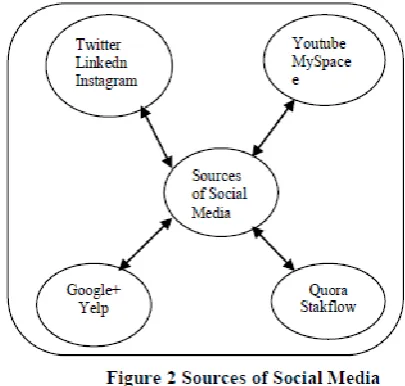
In the late 1999, world-wide social Interactions that coined the term Web 2.0 [1], leads numerous many unfolded multidimensional research areas un-attempted and need to be dealt carefully yet. Kaplan and Haenlein (2010) define social media applications as “a group of Internet-based applications that build on the ideological and technological foundations of Web 2.0*, and that allow the creation and exchange of user-generated content” which still is untapped and needs severe attention from social physiological grounds too. We can easily describe social media starting with a definition itself being produced by social media source Wkipedia5. It defines social media as “media designed to be disseminated through social interaction, created using highly accessible and scalable publishing techniques. Social media uses Internet and web-based technologies to transform broadcast media monologues (one to many) into social media dialogues (many to many). It supports the democratization of knowledge and information, transforming people from content consumers into content producers.” ”Social media offers companies and Organizations a variety of attractive business opportunities and benefits. As a result, the use of social media has expanded rapidly over the past several years. Social media combines use of interactive web site like blogs, flickr, Yelp, YouTube, wikis etc. It is basically the use of internet based tools for purpose of sharing user generated contents. Social media
Different sources of Social Media- There are variety of social media available through Blogs, Wikis, Podcasts, Forums, Micro-blogging, Social Information Processing tools, Social Networking Sites, and Social Network Analysis etc. Basically User contribution is in the form of data which is either in three
of the given form, (i) Structured Data:- Data that can be easily represented in row column format such as Traditional Databases (ii) Semi-Structured:- Data that may not have fixed column ids such as JSONS, CVS files, POJOs etc (iii) Unstructured Data:- Data that is highly scattered such as Users Dashboard, Users Storyline, where data is combination of Audio, Video, Animation etc. Most of the platforms allowed varied form data submission and these platforms have gained many attentions to not only researchers from academy but from different Policy makers and stake holders too.
Table-1 Brief Category of Social Media
Sr. No
Category Web Applications
1 Wikis Wikipedia, Wikihow,
EventMaps,Infoplease, Scholarpedia.
2 Social Networking sites
Orkut, Facebook.
3 Social News Digg, Slashshot 4 Photo and video
sharing
Flickr, Google photos,YouTube. 5 Blogs Bloggers, LiveJournal,
Wordpress
6 Microblogs Twitter, GoogleBuzz 7 Opinion Mining Yelp, Yahoo Answers 8 Social
Benchmarking
Delicious, StumbleUpon
If we compare it with conventional media like radio, TV ad newspaper where communication was one way This many-to-many media environment is significantly changing the way individual or business communicate within their social ties.
3. SOCIAL COMPUTING
TOOLS/PLATFORMS
Blogs are the first and foremost noticeable evidence of social computing ingenuity. They have started in ‘90s, and now are matured enough to be qualified as online journals, which may be published either at individual level or in small group. Blog server such as blogger.com being offered by Google and Typepad an open source blogging tool allow such services and lot more functionality of enhancing the other noticeable feature of the published document.
Wikipedia is yet another online open source Encarta created and aggregated by well known wiki, which are easily manageable tools of collaborative authoring of hypertext based contents.
File sharing network such as Napster, eDonkey and Gnutella led the growth of peer to peer networks. It should be noted that these given networks demonstrated technical attributes like the robustness, scalability and ability to use any bandwidth links to move high amounts of information, as well as social characteristics like altruistic behavior, formation of communities, and rapid growth of networks.
Skype which too is a peer to peer and is best known for voice over internet protocol and video communication service which represents social cooperation. A massive amount user gets benefited with that.
Flickr and YouTube are also one of the best known for internet based social software platforms. It has noticed that there are above 110 million user in flickr who share their photos on daily basis. Around one and half billion user uses the video content at YouTube server. YouTube is growing massively day by day one can navigate in a total of 77 different languages almost covering 95 percent of Internet population. MySpace, another social computing site, overtook Google as the site with most hits in July of 2006. Targeted primarily at
the teen market, MySpace allows users to easily build, launch and share their multimedia Web presence, and invite friends who may be tagged at various levels – “hero” for example- to form social networks. Social networking sites similar to MySpace and targeting the same markets include FaceBook and Bebo. MySpace was preceded by FriendSter, a network whose limited scalability and lack of multimedia capabilities meant it was unable to sustain the early success. Open-source computing tools. Examples would be tools such as Ajax, Python, Perl, Ruby on Rails, and MySQL. Tagging System such as del.icio.us, CiteLike and flickr Tagging has already attracted the professionals and researchers of the Artificial Intelligence and Information System researchers community, while the primary focus was to facilitates users organize and manage their documents under document classification system with the hope that it will eventually fulfill the promse of the semantic web2.
All these different platforms gives glimpse of what today’s user are immensely contributing to the web. Some of the potential characteristics of social computing data can be summarized as in Table-2, given below:-
Table-2 Various Design Issues in Social Computing
Characterist ic/ Attributes Conventional / Organization al Social Computi ng Design Issues
Scalability Moderate Very High Scalable Functional Infrastructure User Identity Limited
Mobile
Mobile Must be Highly Mobile
Scope of Content
Rigid Boundary
Versatile Must be overlapped with other stake holders
Portability/ Interoperabil ity
Limited Very High Platform independent Architectures. Trust/ Motivation & Participation
Based on Organizationa l Goodwill
Cooperati on and altruism based
Understanding contributor’s motivations or rewards like attention
Reputation, Virtual points. Quality/
Quantity or participation
Limited to organization Level
Limited to highly involved users
Incentivizing users to increase participation.
4. BENEFITS AND OPPORTUNITIES OF
APPLYING SOCIAL COMPUTING
16 system must the proper measure of user generate content to
ensure that it has sufficient motivational value that can e offered to participants for active and quality input for system. Identity and Sociability could be a potential factor for Social Computing, Directing, Monitoring and Controlling Quality is yet another factor for applying social computing, Crowd Sourcing also helps in getting solution from varied professional such as Amazon Mechanical Turk which is a crowd sourcing internet market place that enables individual and business to coordinate the use social machines.
There is no doubt that the new digital technologies with massive user’s collaboration have given detail insight in the learning styles and strategies. On the other side, the Social Computing tools facilitated a paradigm shift in the use of technologies, especially with new mobile devices that are now become available for all people everywhere. Along with this change of lifestyle, cognitive processes and knowledge acquisition patterns have appeared. Integrating the Social Computing applications has one of these patterns because this integration has many benefits for professionals and researchers. Rudd et al. (2006) mentioned that the Social Computing technologies offer opportunities for flexible learning, which provides the learners with extra opportunities to engage in learning in diverse conditions and environments outside of the institutional sites. These tools lower the barrier to entry for individual users into application development and participation, as well as for small businesses into markets dominated by large software vendors. Social Computing simulates rather face to face interactions without space, time and location constraints moreover helps user to exchange and share knowledge effectively hence it supports human creativity (Coenen 2006).
The educational and social research increases understanding of the learning Processes and how they depend on networking, collaboration and connected properties (Rudd et al., 2006). As per the summery offered by Rudd et al. (2006), the following are some of the research results:
1. The construction of knowledge occurs between learners and experts.
2. The progress in learning increases greatly when problem-solving occurs between learners in collaborative work.
3. When individuals become active participants in collaborative communities, they learn easily, and learning occurs best when they share mutual interests and exchange resources to resolve problems or to understand issues.
Rudd et al. (2006) emphasize that the voice of the learner should be heard, and his/her role should be changed by putting him/her in the centre of the education process.
There are two possible types of user generated contents implicit and explicit. In implicit user generated content user itself is unaware that he is contributing data as in case of web browsing history and the statistics uses are sending to the web, whereas in case of explicit user generated content user willingly participate in Q&A forums and on several platforms due to number tangible and intangible rewards.
Therefore we can conclude that there exist many benefits and opportunities in allying social computing.
5. DESIGN ISSUES/CHALLENGES IN
SOCIAL COMPUTING
The world of business is waking up to the opportunities and challenges offered by social computing. There are some potential challenges associated with Social Computing; therefore proper attentions are needed in such regards. Digital traces of user’s social interactions can now be seen and found in a wide veracity of on-line settings, and this has really made them richest sources of input/data for large-scale studies of social networks and therefore becomes the favorite area for masquerading with it and hence we can say that whole total social capital will be at greater risk. We are basically focusing on three considerations regarding challenging issues with respect to social computing: Privacy breaches, data anonymization and user anonymization. It has been seen due to high user collaboration several publicly available social network providers are interested in private information of an individual which possibly may leak in anonymized user and data. Moreover bad effect may ranging from misaligned methodological incentives, evaluation expectations, double standards, and relevance compared to industry.
Various aspects of social computing can have negative consequences as well2, as social environments are developed for internet, many of social phenomena from physical world also marked their presence in online world. Several social computing risks include i Fraud ii. Intellectual Property Loss iii. Privacy violations. iv. Brand Damage vi. Non-Compliance As the scale and ubiquity of unstructured, content-based data continue to grow so will the need for analytical tools and technologies to process and mitigate such events. There could many more challenges like collection biases one more challenge associated with social computing is encouraging user for quality content and their continuous engagements to contribute. Encourage the involvement of social commuting provider. Social computing research may struggle to succeed in SIGCHI. Some challenges relate to our research questions: interesting social innovations may not be interesting technically, and may be meaningless to social scientists without proof. In response, we laid out the Social/Technical yardstick for valuing research claims. Social computing systems research now needs to forge its identity between traditional academic approaches and industry. Systems research is used to being ahead of the curve, using new technology to push the limits of what is possible. But in the age of the social computing, academic research often depends on access to industry platforms. Further, more emphasis should be given to forward looking research, which seeks to outline potential new business models and trends or to find solutions for existing problems.
6. EXPERIMENTAL SETUP
pushed in the platforms Bot get automatically fired and tries to detect the hate speeches after being equipped with the Deep machine learning algorithms to detect the hate speeches. AntiSocioSpyBot is an open source tool that will help social platform policy maker and stake holder in managing such online radicalizations. These messages are always pushed in the market through some virtual identities therefore it is a potential attribute to corner fake users or future banned users who have high tendencies of uploading such messages.
7. CONCLUSIONS
In conclusion we can state that there is a high potential for research in social computing domain. Social computing platforms also have opened an exhilarating that add new dimension to the web5. A variety of collections of social network, theories, evolution of communities, collaborative efforts of engineers and scientist, reciprocity and altruism may be brought up in case of research on social computing. An experimental research gap can be found with this. Social instincts in alternative realities where rewards are virtual and can improve understanding of behavior and sustainability of reputation-based governance structures that can be investigated. Research issues in social computing are immensely across wide variety of disciplines such as organization science, cognitive science, computer science, sociology. It’s a very high time when information system research grows to its maximum domains so as to take lead in social computing. We should be motivated for creating such tool that will allow individual or group of users to create, share and evolve a new generation of open moreover interacting social machines. Therefore we seek a revolutionary and more powerful platform that realize us that every contributor is also a member of overlapping communities or collaborations. The architecture of the future Web must be designed to allow the virtually unlimited interaction of the Web of people15. The disruptive potential of social computing holds opportunities for both research and business related to information technology.
8. ACKNOWLEDGEMENT
Our sincere thanks to Dr Nadeem Aktar Director Research & Planning, Integral University for his consistent and undivided help and support.
9. REFERENCES
[1] Andreas M. Kaplan & Michael Haenlein, Users of the world, unite! The challenges and opportunities of Social Media, Business Horizons 53(1), Jan-Feb 2010, pp. 59-68.
[2] Parameswaran, M., A. Susarla, and A. B. Whinston. (2001). “P2P Networking: An Information-Sharing Alternative,” Computer. (34)7, pp.31 – 38.
[3] Dr. K. Chandra, Md Abdul Muqsit Khan, “Towards Metrics for Social Comuting” Proceedings of World Academy of Science, Engineering and Technology Voloume 37 January 2009 ISSN 2070-3740.
[4] Parameswaran, M., W.B. Andrew, “Research issues in Social Computing” Journal of the Association for Information System Volume 8, Issue 6, Article 1, pp.336-350, June 2007.
[5] A book “Social Network Data Analytics” by Charu C. Agrawal Springer publication.
[6] Khaled A. Hussein “ A Framework for implementing Social Computing in Higher Education in the Gulf States” Ph.D -20113 thesis in School of the Built Environment University of Salford, Manchester, UK
[7] Abramson, A. (2005), Digital Phoenix: Why the Information Economy Collapsed and How It Will Rise Again, Boston: MIT press.
[8] Benkler, Y(2006), The Wealth of Networks: How Social Production Transforms Markets and Freedom, (January 2007) http://www.benkler.org.
[9] F Y Wang and Z Daniel “Social Computing: from Social Informatics to Social Intelligence” published by IEEE Society in April 2007
[10]Berman, F., and H. Brady (2005) “Final Report: NSF SBE-CISE Workshop on Cyber infrastructure and the Social Sciences”, NSF SBE San Diego Supercomputer Center,
[11]T. Berners-Lee et al., “Creating a Science of the Web,” Sciences, vol. 313, no. 11, 2006, pp. 769–771. 27. [12]R. Popp et al., “Assessing Nation-State Instability and
Failure,” Proc. 2006 IEEE Aerospace Conf., CD-ROM, IEEE Press, 2006.
[13]R. Breiger, K. Carley, and P. Pattison, Dynamic Social Network Modeling and Analysis: Workshop Summary and Papers, Nat’l Academies Press, 2003. 29. R. Dai, Science of Social Intelligence, Shanghai Jiao Tong Univ. Press, 2006.