Optimisation of a Bus Network Configuration and
Frequency Considering the Common Lines Problem
Hiroshi Shimamoto1, Jan-Dirk Schmöcker1, Fumitaka Kurauchi2
1Department of Urban Management, Kyoto University, Kyoto, Japan 2Department of Civil Engineering, Gifu University, Gifu, Japan
Email: {shimamoto, schmoecker}@trans.kuciv.kyoto-u.ac.jp, [email protected]
Received May 6,2012; revised June 10, 2012; accepted June 25, 2012
ABSTRACT
Public transportation network reorganisation can be a key measure in designing more efficient networks and increasing the number of passengers. To date, several authors have proposed models for the “transit route network design prob-lem” (TRNDP), and many of them use a transit assignment model as one component. However, not all models have considered the “common lines problem,” which is an essential feature in transit network assignment and is based on the concept that the fastest way to get to a destination is to take the first vehicle arriving among an “attractive” set of lines. Thus, we sought to reveal the features of considering the common lines problem by comparing results with and without considering the problem in a transit assignment model. For comparison, a model similar to a previous one was used, formulated as a bi-level optimisation problem, the upper problem of which is described as a multi-objective problem. As a result, although the solutions with and without considering the common lines showed almost the same Pareto front, we confirmed that a more direct service is provided if the common lines problem is considered whereas a less direct service is provided if it is not. With a small network case study, we found that considering the common lines problem in the TRNDP is important as it allows operators to provide more direct services.
Keywords: Transit Network Configuration and Frequency Design; Bi-Level Optimisation Formulation; Transit
Assignment Model; Common Lines Problem
1. Introduction
To entice travellers to shift from private cars to public transportation, many public transport operators have ta- ken measures such as reducing off-peak fares. Several researchers have proposed models for determining opti-mal fares [1,2] or optiopti-mal transit frequencies [3]. Another measure could be to make the network configuration more efficient because there are many inefficient bus networks worldwide. Therefore, an optimal public trans-portation route configuration is necessary as a benchmark to determine the design of a new public transportation route configuration. The problem of designing such a network is referred to as the “transit route network design problem” (TRNDP); it focuses on the optimisation of bus routes or frequencies in order to optimise a number of objectives representing the efficiency of public transpor-tation networks (such as minimising passengers’ cost or maximising profit) under operational and resource con-straints such as the number and length of public trans-portation routes, allowable service frequencies, and the number of available buses [4].
Several researchers have proposed models for the TRNDP. For example, [5] also proposed a bus network
which is, generally, more complex than a railway net-work optimisation problem.
The literature review has so far revealed that many re-searchers do not describe passenger route choice behav-iour accurately. Thus, several papers include a transit assignment model within the TRNDP to consider the passenger route and transfer choice behaviour. [8] com-bined a line planning model and a traffic assignment model, and demonstrated a solution algorithm based on a column generation method. However, their assignment model was very similar to the traditional assignment model and did not consider the “common lines problem”, which is an essential feature in a transit network assign-ment and is based on the concept that the fastest way to get to a destination is to take the first vehicle arriving among an “attractive” set of lines (the “attractive” set of lines is referred to as the “hyperpath”). [6] demonstrated a model framework for combining the TRNDP and a transit assignment model considering the common lines problem. [9] extended their model to determine the allo-cation of a limited number of environmentally friendly vehicles and applied the model to a real-size network (although the details of the transit assignment model are not described in either paper). [10] expanded the model of [2] to optimise both the routes and frequencies of pub-lic transportation, and they applied their model to a real network.
As described so far, some TRNDPs have considered the common lines problem, while others have not. Con-sidering the common lines problem implies that passen-gers can consider the complex route set perfectly, which so far was almost impossible in dense networks. How-ever, due to personalised information technology, such as smart phones, passengers can nowadays obtain better knowledge of the complex route set. Also, passengers will tend to use common lines if transit agencies aggre-gate separate bus stops. Therefore, it is important for transit agencies to know how the optimal network con-figuration differs if passengers come to know the com-plex route set. Thus, in this study, we explore the impor-tance of the common lines problem in the TRNDP by comparing results with and without considering common lines. The model used in this study is similar to that of [10], which is formulated as a bi-level optimisation problem, the decision variables of which are the route and frequency of each line, but the following aspects were modified:
The assumption of a fixed origin/destination for each bus line was relaxed by introducing a dummy origin and destination node.
Vehicle number constraints were considered more accurately by combining a vehicle assignment proce-dure and a frequency setting proceproce-dure in the solution algorithm.
Capacity constraint conditions were not considered in this paper to save computational costs ([10] con-firmed that capacity constraint conditions did not af-fect the output of the TRNDP in a real network). The remainder of the paper is organised as follows. Section 2 describes briefly the minimum cost hyperpath searching problem that is one component of the transit assignment model proposed by [11]. Section 3 describes a mathematical formulation of the bus network optimisa-tion model, and Secoptimisa-tion 4 shows the soluoptimisa-tion algorithm. Section 5 illustrates a case study with a simple network, comparing the model with and without considering the common lines problem. Finally, Section 6 provides con-clusions and identifies future research.
2. Minimum Cost Hyperpath Searching
Problem
In this chapter, the minimum cost hyperpath searching problem, one component of a transit assignment model [11] that is used in the lower problem of the proposed model, is presented briefly.
2.1. Network Representation
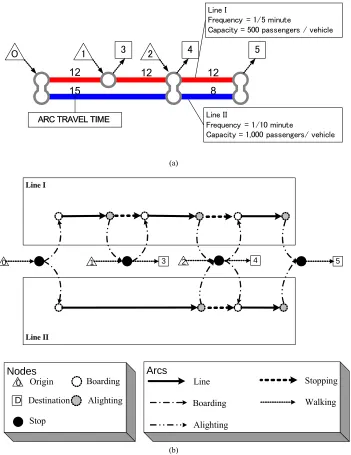
To consider the capacities of transit lines together with the common lines problem, the transit network shown in
Figure 1(a) was transformed into the graph model shown
in Figure 1(b). An origin node represents a trip start
node. A destination node represents a trip end node. A stop node represents a platform at a station. Any transit lines stopping at the same platform are connected via boarding arcs and failure nodes. At stop nodes, passen-gers can either take a bus or walk to neighbourhood bus stops, and if they take a bus, they are assigned to any of the attractive lines in proportion to the arc transition probabilities. A boarding node is a line-specific node at the platform where passengers board. An alighting node is a line-specific node at the platform where passengers alight. Note that boarding and alighting node are se- paretely defined in order to allow consideration of dwell time and capacity constraints. line arc represents a transit line connecting two stations. A boarding arc denotes an arc connecting a stop node to a boarding node. An alighting arc denotes an arc from an alighting node to a stop node. A stopping arc denotes a transit line stopping on a platform after the passengers alight and before new passengers board; this arc is created to express the available capacity on the transit line explicitly. A walking arc connects an origin to a platform (access), a platform to a destination (egress), and neighboring platforms (walk to neighboring platforms).
models because of the many arcs and nodes. However, this may be less of a problem considering recent progress in computer technology. Moreover, because the compo-nents of the graph network are simple, it is possible to convert automatically from Figure 1(a) to Figure 1(b).
The minimum cost hyperpath searching problem is now described. If the common lines problem is not considered, it is easy to obtain a minimum cost path by applying a shortest path searching algorithm, such as the Dijkstra method, with the graph network shown in Figure 1(b).
2.2. Notation
We use the following notation regarding the transit
as-signment model. Other notation will be shown as appro-priate.
Ap: Set of arcs on hyperpath p; L:Set of line arcs;
Ll: Set of line arcs on line l; Ul: Set of platforms on transit line l; WA:Set of walking arcs;
BA:Set of boarding arcs;
Sp: Set of stop nodes on hyperpath p; Vp: Set of elementary paths on hyperpath p;
OUTp(i): Set of arcs that lead out of node i on
hyper-path p;
wkl: Stopping arc of line l on platform k;
O 1 3 2 4 5
Line I
Frequency = 1/5 minute
Capacity = 500 passengers / vehicle
Line II
Frequency = 1/10 minute
Capacity = 1,000 passengers/ vehicle
12 12 12
15 8
ARC TRAVEL TIME
(a)
Nodes 0
D Origin
Destination
Stop
Boarding
Alighting
Arcs
Line
Boarding
Alighting
Stopping
Walking Line II
Line I
4
2 5
3 1
0
[image:3.595.124.475.257.712.2](b)
bkl: Boarding arc of line l on platform k;
;
;
lows satisfying flow con-se
cluded in l, ot
2.3. Assum
lowing assumptions regarding the
es
ading out of nodes on a
τap: Arc split probability on hyperpath p; l(a): A transit line that is included in arc a gp:Cost of hyperpath p;
; ca: Arc cost on arc a A ta: Travel time on arc a A
ξ: On-board value of time; ;
ζ: Value of time for walking
η: Value of time for waiting; Ω: Set of feasible hyperpath f rvation;
λlp: Probability of choosing any particular elementary
path l of hyperpath p;
αap: Probability that traffic traverses arc a;
βip: Probability that traffic traverses node i;
δal: Dummy variable, equal to 1 if arc a is in
herwise 0;
εil: Equal to 1 if elementary path l traverses node i,
otherwise 0;
Y: Vector of hyperpath flows; X: Vector of arc flow;
/min). fl: Frequency of line l (1
ptions
We adopted the fol
common lines problem, similar to previous studies (See, [11,12]):
All bus lines operate with given exponentially dis-tributed headways, and a mean equal to the inverse of the line frequency. The distributions of the lines are assumed to be independent of each other.
Passengers arrive randomly at every stop node and decide whether to take a bus or walk. If they take a bus, they always board the first arriving vehicle of their choice set.
2.4. Arc Split Probabiliti
Where there are several arcs le
[image:4.595.352.536.290.476.2]hyperpath, traffic is split according to τap. As shown in
Figure 1, passengers may be split at stop, failure, or
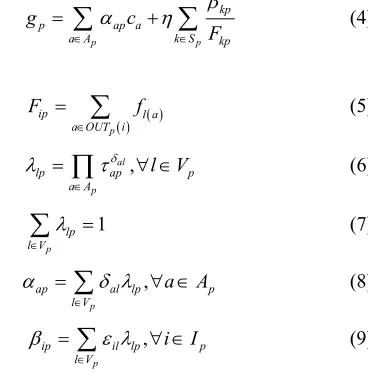
alighting nodes. At stop nodes, because passengers can-not simultaneously choose between taking a bus and walking to other platforms, the arc split probability is defined with boarding arcs and walking arcs separately, as shown in Equation (1). If boarding arcs are included in hyperpaths, the arc spilt probability is proportional to the line frequency,
( ) , 1l a ip p
ap p
p
f F
a OUT i BA
i S
a OUT i WA
(1)
(2)
2.5. Cost of Hyperpaths
In this paper, the cost of a hyperpa
generalised cost that consists of three elements: the time, the monetary value of
th is represented as a
p
ip l a
a OUT i
F f
monetary value of the travel
the expected waiting time, and the implicit cost associ-ated with the risk of failing to board. We admit that pas-sengers may walk to another bus stop by creating a walking arc between all stop nodes. Thus, the cost for each arc, ca, is defined as:
0
a
a a
t a L
c t a WA
(3)
else
Using the cost of arc a, ca, the generalised cost of
hy-perpath p, gp, can be written as follows:
p p
p ap a
a A k S kp
g c kp
F
(4)where
p
ip l a
a OUT i
F f
(5),
al
p
lp ap p
a A
l V
(6)1 p lp l V
(7)
,
p
ap al lp p
l V
a A
(8),
p
ip il lp p
l V
i I
(9)The first term of Equation (4) represents the “moving cost,” which consists of the mon
in-vehicle time and the walking co represen
3.1. Outline of the Model
olders, the
op ed to wish to
and movement cost. Addi-he operator knows tAddi-he pas-etary value of the st. The second term t the monetary value of the expected waiting time. Note that αap and βip in Equation (4) represent the
probability that passengers traverse arc a and node k, respectively, both of which are derived from the prob-ability that the elementary path l within hyperpath p is chosen. As Equation (4) can be separated by the subse-quent node, Bellman’s principle can be applied to find the minimum cost hyperpath. For simplicity, we treat ta
and fl as constants.
3. Bus Network Configuration and
Frequency Optimisation Model
In the proposed model, we consider two stakeh erator and passengers, and both are assum minimise the total travel time
sengers’ route choice norm (i.e., minimising the move-ment cost) and that the operator can influence, but not control, passenger route-choice behaviour, then the pro-posed model can be formulated as a Stackelberg game or a bi-level optimisation problem, where the operator is the leader and the passengers are followers. If the transit operator tries to minimise the total travel time, the level of service will decrease, causing an increase in passenger cost; thus, the objectives of the stakeholders often con-flict. Thus, the upper problem is formulated as a multiple objective optimisation problem. In addition to the as-sumptions shown in Section 2.3, we make the following assumptions in the proposed model.
First, regarding the bus operation service:
The position of bus stops is given and fixed, but not all the bus stops have to be used.
Express service is not considered (i.e., all buses stop
xed.
ement:
rpath for a ey can walk origin or intermediate ion of
each line, denoted as r = (r1,
, f|L|), respectively. The
pro-: at all stops they pass en-route).
Travel time between bus stops is constant.
The maximum number of lines is fi
Dwell time is not considered. Second, regarding passenger mov
Passengers choose the minimum cost hype given bus network configuration, and th to a different bus stop from an
bus stop if it is cheaper (see the definit path cost in Equation (4)).
The OD demand is fixed regardless of the bus net-work configuration.
3.2. Model Formulation
The decision variables in the proposed model are the route and frequency of
r2, ···, r|L|) and f = (f1, f2, ···
posed model is formulated as
,
min m , , , 1, 2,
r f y r f m M (10)
such that
*
,
0 otherwise
rs p rs
p r
y p
s (11)
d g m
H
1 L
l l l l f C r NV
(12) whereM: Number of objective functions in the upper prob-lem;
|L|: Number of lines (fixed);
Minimum cost from the origin of the hyperpath (r) to
Travel demand between OD pair rs; ime on line l;
esents the objective function,
de-fin e case where
all the choose the
sh
hort-est
mrs*:
the destination (s); drs:
max l
C : Upper value of travel t NV: Number of available vehicles. Equation (10) repr
ed later, and Equation (11) describes th passengers between each OD pair ortest hyperpath. Passengers are assigned to the s
hyperpath based on Markov Chain assignments (see [11]). Equation (12) concerns vehicle number constraints. The number of vehicles required to operate a certain line is assumed to be proportional to the line length and fre-quency, implicitly neglecting turning time or waiting time at the depot. The objective function of the operator is to minimise total operational costs (ψ1), and the
objec-tive function of the passengers is to minimise total movement cost (ψ2), formulated as:
21 , 1 ( )
L l l l l
r f f C r
(13)
2 y r f, , rs W p Hrsy g y( )
* p p (14)where
W: Set of OD pairs;
Set of hyperpaths between OD pair rs.
Equation (13) represents the total travel time for the r because the left-hand side of Equation (12)
re f vehicles required to operate line
l.
the upper problem of a multi-objective optimisation problem, we use the elitist ic algorithm (NSGA-II) pro-
n the figure, two types of genes are de-hicles (A genes) and genes
een neighbourhood lines (B *
rs h :
operato
presents the number o
4. Solution Algorithm
As shown in Section 3, the proposed model is formulated as
problem. To solve the upper non-dominated sorting genet
posed by [13], which is an expanded genetic algorithm (GA) that requires fewer parameters than other methods. In this section, only a solution algorithm within one ge- neration is described, which consists of “Vehicle As-signment”, “Route Design”, and “Frequency Setting”. A frequency for each line is determined by combining a “Vehicle Assignment” procedure and a “Frequency Set-ting” procedure.
4.1. Vehicle Assignment
Figure 2 illustrates the chromosome for vehicle
assign-ment. As shown i
fined: genes representing ve representing boundaries betw
genes). The number of A and B genes are equivalent to the number of available vehicles and maximum number of operated lines, respectively. Using these genes, the number of vehicles for each line is equivalent to the number of A genes sandwiched between two B genes.
Figure 2 illustrates an example of vehicle assignment. In
… …
Number of Vehicles (Number of Lines)-1
… …
Line 1: 2 Vehicles
Line 2: 3 Vehicles
[image:6.595.68.270.84.241.2]Line 3: 0 Vehicle
Figure 2. Chromosome illustration for vehicle assignment.
4.2. Route Design Although m
g
me shortcomings for solving the erating indirect routes. In this
sec-from the ge
an that of creating route
0-o each line and Then, the frequency of each
any researchers examining the TRNDP use a enetic algorithm (GA) as a solution algorithm, the original GA has so
TRNDP, such as gen
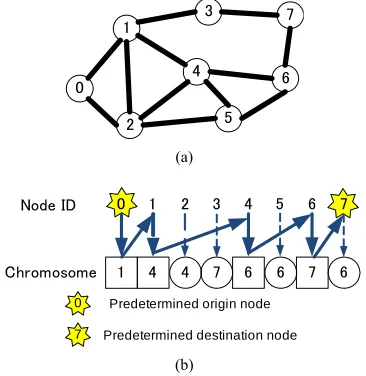
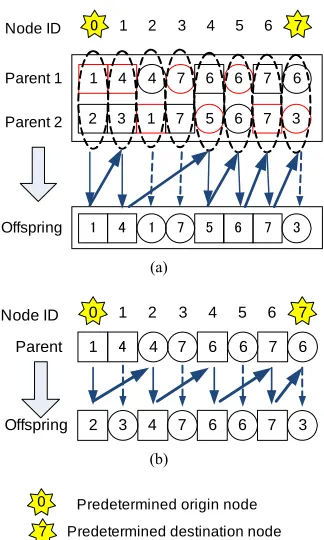
tion, a modification of the GA procedure for route search under fixed origin and destination nodes is described following Inagaki et al. [14], using the example network shown in Figure 3(a). In the modified GA procedure, the
number of genes in a chromosome is the same as the number of nodes in a network N. Each gene m can only take the values of the nodes to which direct links from the node m exist; that is, a link connecting nodes m and n is represented by assigning node ID n to the mth gene.
Thus, the alignment of the genes in a chromosome can provide the ID of nodes that make up a route, if one keeps moving (“jumping”) from gene m to gene n (in
Figure 3(b), these are the genes with a square).
Thus, the chromosome defined here consists of two types of genes, those contributing to the representation of the route and those not. The Proposition in the Appendix 1 shows that we can always obtain a valid route
nes that contribute to the route description, unless a cyclic route is obtained, which occurs if the same node ID appears in at least two of these genes. Figure 3(b)
represents the route (0 → 1 → 4 → 6 → 7), with predete- mined origin and destination nodes as 0 and 7, respec-tively. For the genes that are not needed for the route description, a random node ID among the available node IDs is selected. With this chromosome definition, one can trace a unique route from the origin to destination nodes. There are also the well-known elements of cross-over and mutation within GA optimisation, as described in (14) (See, Appendix 2).
Note that the modified GA procedure might not create all the possible routes with equal probability. For exam-ple in Figure 3(a), the probability of creating route
0-1-3-7 would be higher th
1-4-6-7 because with above definition, the probability of connecting from node 3 to 7 equals to one (there is only one arc connecting nodes 3 and 7) whereas the probability of connecting node 4 to 6 is 0.33. However, the latter route overlaps also with a number of would have a route with higher overlapping rate (e.g. 0-1- 4-5-6-7) than the former route. Therefore, since the modified GA procedure implicitly generates routes that overlap less with higher probability, this procedure is expected to create more variety of routes.
4.3. Frequency Setting
As a result of vehicle assignment and route design pro-cedures, the number of vehicles assigned t
the line length are known. line is defined as:
2
l l
l V f
T
(15)
where
Tl: Travel time of line l;
Vl: Number of vehicles assigned to
Different from [10], who chose the frequency of each four options, the proposed procedures,
com-bi ent and frequency setting, can
co re accurately.
at and was generated at each n bus stops was 4 min by
line l.
line from
ning vehicle assignm
nsider vehicle number constraints mo
5. Numerical Example
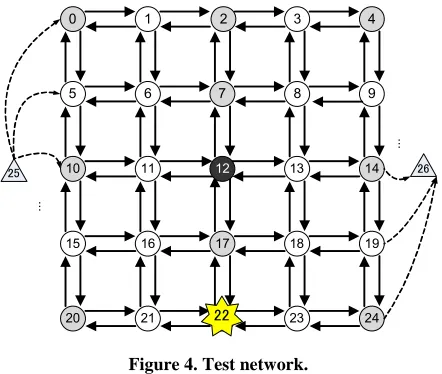
The proposed model was applied to the simple network shown in Figure 4. Bus stops were assumed to exist
each node, and passenger dem node. The travel time betwee
bus and 12.5 min by walking, and the value of time pa-rameters were 13 yen/min (about 0.1 €/min), 26 yen/min,
0
1 3
4
7
6
5 2
(a)
4 7 6 6
1 4 6 7
0 1 2 3 4 5 6 7
Node ID
Chromosome
0
7
Predetermined origin node
Predetermined destination node
(b)
[image:6.595.331.514.517.705.2]and 50 yen/min, respectively, for boarding time, waiting time, and walking time based on the SP-mode choice
survey of [15]. Also, to r he
origin and destination of ea us line is fixed, a dummy
ks with zero cost
nodes in Figure 4,
tions with and 77 solutions without considering the
comm n line roblem ere obtained. ss er
cost he u r left lution lowe herea he
operator cost hose tions higher is rel
n-ship tween two eholde is rev for
-tions own i he low ght of figure. he
ss and the print of each line was proportional to
elax the assum ch b
ption that t
origin node (Node 25) is introduced, which is an origin of all lines of buses. Further, dummy lin
connect the dummy origin node to all of the bus stops. Similarly, a dummy destination node (Node 26) and zero-cost dummy links connecting all the bus stops with the dummy destination node are added.
With this network, all the demands were assumed to be generated from node 22, with destinations spread to all the other nodes. The demand volume was generated with a uniform random number, taking the value from 0 to 1; 200, 100, and 50 times the random number was de-fined as the demand to node 12, the grey
and other nodes, respectively. As a result, the demand pattern shown in Table 1 was obtained. Also, the number
of available vehicles and maximum number of operated lines were set as 30 and 10, respectively. Note that al-though the proposed model can be applied to a real net-work [10], we assume above demand distribution on a small grid network in order to better understand the ef-fect of considering the common lines in TRNDP.
Figure 5 shows the Pareto solutions with and without
considering the common lines problem. In total, 96 solu-
1 2 3 4
5 6 7 8 9
10 11 13 14
15 16 17 18 19
20 21 22 23 24
0
12
25 26
…
…
[image:7.595.63.284.411.598.2]22
[image:7.595.57.285.627.736.2]Figure 4. Test network.
Table 1. Assumed OD volume (Origin node is 22). Destination Demand Destination Demand Destination Demand
0 66 8 44 16 43
1 37 48
2 30 10 19 18 3 9 5 17
3 27 11 8 19 10 4 97 12 130 20 32 5 41 13 3 21 23 6 42 14 4 23 17 7 93 15 21 24 7
o s p w The pa eng
for t ppe so s is r, w s t
of t solu is . Th atio
be the stak rs ersed solu
sh n t er ri side the T
extreme case is a solution with zero operator cost, where the operator does not provide any bus services and all the passengers have to walk to their destination. Furthermore, contrary to expectations, solutions with and without con-sidering the common lines problems showed almost the same Pareto front. We suspect that this is due to a fairly low number in GA iterations (1000 iterations with 100 individuals) exploring only a very small range of the possible solutions. Nevetheless we find some interesting differences in the network structures as described in the following. The reason for the fairly low number in GA iterations is due to the computational cost of the lower problem. Especially when considering common lines is the lower problem becomes computationally relatively expensive.
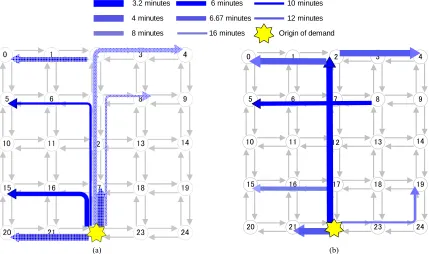
Because it is impractical to show the results of all the Pareto solutions, we compared the results when the oper- ator’s cost = 40. Figure 6 illustrates the line configure-
tion and headways (inverse of frequency) from the output with and without considering the common lines problem. The thickne
the operational frequency, as shown in the figure. When considering the common lines problem, many lines were concentrated in the centre of the network (22-17-12-7-2), a “trunk with feeders” network, whereas only one line ran in the centre of the network, a “trunk and branch” network when not considering the common lines problem. The reason for such a difference is that a “trunk with feeders” network brings benefit to those who consider the common lines problem because they can take a line coming first among the bundle. On the other hand, a “trunk with feeders” network does not bring benefit to those who do not consider the common lines problem, because they stick to a single line. Instead, a “trunk with branch” network is more attractive to them because they have more chance to transfer to a branch line from the feeder line. As a result, many direct ser-vices from node 22 to node 2 are provided if considering the common lines problem whereas only one direct ser-vice from node 22 to node 2 is provided and many pas-sengers are forced to transfer if it is not considered. A transfer penalty was not considered in this study; a dif-ferent result might have been obtained if we had con- sidered one.
6. Conclusions
0 20 40 60 80 100 120 140 160 180 200
0 500000 1000000 1500000 2000000
O p e ra to r' s C o st
Passengers' Cost
[image:8.595.160.441.81.273.2]W/O Common Lines With Common Lines
Figure 5. Pareto solutions and the corresponding Pareto front (With/without considering the common lines problem).
3.2 minutes 6 minutes 10 minutes
4 minutes 6.67 minutes 12 minutes
8 minutes 16 minutes Origin of demand
4
5 8 9
11 13
15 18 19
20
0 1 2 3
6 7
14
10 12
16 17
21 22 23 24
(a) (b)
Figure 6. Bus routes and headways (Solution at operator’s cost = 40).(a) Considering the common lines problem; (b) Without considering the common lines problem.
s ones, formulated s a bi-level optimisation problem, the upper problem of
lem is considered. This has implications for transit plan-ners and the design of bus stops. Our results suggests that, lines problem in the transit route network design problem
(TRNDP). A similar model to previou
more direct service is optimal if the common lines
prob-a
which was described as a multi-objective problem, was used, but several assumptions were relaxed. The lower problem of the model is a passenger assignment model and the output of the TRNDP with and without consid-ering the common lines problem in passengers’ route choice was compared. The output of the TRNDP in a simple network was compared with and without consid-ering the common lines problem. It was confirmed that a
if bus stops for several lines are arranged in such a way as to make it easy for passengers to interchange between lines, this could result in very different network struc-tures, possibly reducing operator as well as passenger costs.
[image:8.595.82.511.307.561.2]computational efficient algorithms are future research topics, especially in connection with further applications to larger networks.
pp. 105-124. doi:10.1002/atr.5670350204
REFERENCES
[1] J. Zhou, and W. H. K. Lam., “A Bi-Level Programming Approach—Optimal Transit Fare under Line Capacity Constraints,” Journal of Advanced Transportation, Vol. 35, No. 2, 2000,
[2] H. Shimamoto ublic Transit
for Transit Syste , et al., “Evaluation of P
gestion Mitigation Measures Using Passenger Assign-ment Model,” Journal of Eastern Asia Transportation Studies, Vol. 6, 2005, pp. 2076-2091.
[3] Z. Y. Gao, et al., “A Continuous Equilibrium Network
Design Model and Algorithm ms,”
Transportation Research Part B, Vol. 38, No. 3, 2004, pp. 235-250. doi:10.1016/S0191-2615(03)00011-0
[4] K. Kepaptsoglou and M. Karlaftis, “Transit Route Net-work Design Problem: Review,” Journal of Transporta-tion Engineering-ASCE, Vol. 135, No. 8, 2009, pp. 491- 505. doi:10.1061/(ASCE)0733-947X(2009)135:8(491) [5] Z. Yang, et al., “A Parallel Ant Colony Algorithm for
Bus Network Optimization,” Journal of Computer-Aided Civil and Infrastructure Engineering, Vol. 22, No. 1, 2007, pp. 44-55. doi:10.1111/j.1467-8667.2006.00469.x [6] M. Petrelli, “A Transit Network Design Model for Urban
Areas,” In: C. A. Brebbia and L. C. Wadhwa, Eds., Ur-ban Transport X, WIT Press, Southampton, 2004, pp. 163-172.
[7] J. F. Guan, et al., “Simultaneous Optimization of Transit Line Configuration and Passenger Line Assignment,” Transportation Research Part B, Vol. 40, No. 10, 2006,
pp. 885-902. doi:10.1016/j.trb.2005.12.003
[8] K. Nachtigall and K. Jerosch, “Simultaneous Network Line Planning and Traffic Assignment,” 2008.
http://drops.dagstuhl.de/opus/volltexte/2008/1589
roach,” 09, pp. [9] B. Beltran, et al., “Transit Network Design with
Alloca-tion of Green Vehicles: A Genetic Algorithm App Transportation Research Part C, Vol. 17, No. 5, 20 475-483. doi:10.1016/j.trc.2009.04.008
[10] H. Shimamoto, et al., “Evaluation of an Existing Bus Network Using a Transit Network Optimisation Model: A Case Study of the Hiroshima City Bus Network,” Trans- portation, Vol. 37, No. 5, 2010, pp. 801-823.
doi:10.1007/s11116-010-9297-6
[11] F. Kurauchi, et al., “Capacity Constrained Transit As- signment with Common Lines,” Journal of Ma
Modelling and Algorithms, Vol. 2, No. 4, 2003, pp. 309- thematical 327. doi:10.1023/B:JMMA.0000020426.22501.c1 [12] H. Spiess and M. Florian, “Optimal Strategies: A New
Assignment Model for Transit Networks,” Transportation Research Part B, Vol. 23, No. 2, 1989, pp. 83-102. doi:10.1016/0191-2615(89)90034-9
[13] K. Deb, et al., “Fast Elitist Non-Dominated Sorting Ge-netic Algorithm for Multi-Objective Optimization: NS II,” Parallel Problem Solving from Nature VI (PPSN-VIGA- ),
,” Transactions of the Institute of
s of Infrastructure 2000, pp. 849-858.
[14] J. Inagaki, et al., “A Method of Determining Various Solutions For Routing Application with a Genetic Algo-rithm (in Japanese)
Electronics, Information and Communication Engineers, Vol. 82, No. 8, 1999, pp. 1102-1111.
[15] F. Kurauchi, et al., “Experimental Analysis on Mode Choice Behaviour for Merged Public Transport Systems (CD-Rom, in Japanese),” Proceeding
Planning Conference on Civil Engineering, 2004.
Appendix 1
osition
of the genes within a chromosome de-.2 ensures that the destination is reached
clic.
s takes value d, which is the ID of the destination node. Let N1 indicate the number of
describe the route until destination d is
The procedures of crossover and mutation in the fied GA procedure are described using following notations.
rmined origin node;
er.
in the modified GA is shown
as sover is executed only when
a m number, is smaller than a
gi
1.1. Prop
The alignment fined in Section 4 if the route is not cy
1.2. Proof
Suppose none of the gene
genes that
reached. Because no node takes value d, the search for a feasible route will continue until all bus stops in the net-work have been visited so that N1 will be equal to N, the
number of genes or bus stops. Because no cyclic route is included, this means that each bus stop is visited only once. However, because N equals the number of bus stops, this means that one gene must take value d or at least one bus stop must be visited twice, both of which contradict our assumptions.
Q.E.D
Appendix 2
modi-r: The predete
s: The predetermined destination node;
N: The set of nodes (representing for bus stops) in a network;
g[*]: Gene of parent; h[*]: Gene of offspring; Mrate: Mutation rate;
Kmax: Threshold numb
1) Crossover
e cr ure
Th ossover proced elo
b w. Note that the cros erated rando repeatedly gen
ven crossover rate.
Step 1 (Initialise)
Set m ← r and h[n] ← for n ∈N;
Step 2 (Roulette selection)
r
Select two parents andomly g1 and g2;
ly and h[m] ← gi
Step 3 (Crossover)
2) random Select one parent i (i = 1,
[m], m ← gi[m];
of loop)
Step 4 (Termination
RepeatStep 3 until m = s;
Step 5 (Interpolation of the empty genes)
If g[m] = (m ∈N), then, n.
select one node n going ou
ke the value t from node m and g[m] ←
As the genes of the offspring will only ta
4 7 6 6
1 4 6 7
0 1 2 3 4 5 6 7
6 3
2 3 1 7 5 7
1 7 3
1 4 5 6 7
Parent 1
Offspring Node ID
Parent 2
(a)
4 7 6 6
1 4 6 7
3 7 3
2 4 6 6 7
Parent
Offspring
0 1 2 3 4 5 6 7 Node ID
(b)
0 Predetermined origin node
[image:10.595.344.506.83.353.2]7 Predetermined destination node
Figure 7. Illustration of mutation and crossover. (a) Exam-ple of crossover; (b) Exampl
of a valid node, this crossover procedure alwa s generates a connected route which either is cyclic or
follow-Figure 7(a)
with predeter-e of mutation.
y valid ing the above proposition. illustrates this crossover. In this example, a route (0→1→4→5→6→7)
s generated as a result of the crossover i
mined origin and destination nodes as 0 and 7. 2) Mutation
The following procedure shows the mutation of the modified GA.
Step 1 (Initialise)
Set m ← r and h[n] ← for n ∈N; tion)
Step 2 (Muta
Generate a random number rnd;
If rnd < Mrate, then, select one node n going out from node m andh[m] ← n and m ← n;
g[ Else
← m]; h[m] ← g[m] and m
Step 3 (Termination of loop)
RepeatStep 2 until m = s;
Step 4 (Interpolation of the empty genes)
] =
If g[m (m ∈N), then, select one node n going ou
ion of the parent
chro-m →7) is generated as a
re nd
des-tin
t from node m and g[m] ← n.
Figure 7(b) illustrates mutat
→6 osome. A route (0→2→4
sult of the mutation with predetermined origin a
s a nd