V
1.42In
1.83Mo
15Se
19Patrick Gougeon,* Philippe Gall, Diala Salloum and Michel Potel
Sciences Chimiques de Rennes, UMR CNRS No. 6226, Universite´ de Rennes I – INSA Rennes, Avenue du Ge´ne´ral Leclerc, 35042 Rennes CEDEX, France Correspondence e-mail: [email protected]
Received 6 September 2010; accepted 14 September 2010
Key indicators: single-crystal X-ray study;T= 293 K; mean(Mo–Se) = 0.001 A˚; disorder in main residue;Rfactor = 0.037;wRfactor = 0.087; data-to-parameter ratio = 35.7.
The structure of the title compound, vanadium indium pentadecamolybdenum nonadecaselenide, V1.42In1.83Mo15 -Se19, is isotypic with In2.9Mo15Se19 [Gru¨ttner et al. (1979).
Acta Cryst. B35, 285–292]. It is characterized by two cluster units Mo6Se
i 8Se
a
6and Mo9Se i 11Se
a
6(whereirepresents inner and
aapical atoms) that are present in a 1:1 ratio. The cluster units are centered at Wyckoff positions 2band 2cand have point-group symmetry 3 and 6, respectively. The clusters are interconnected through additional Mo—Se bonds. In the title compound, the V3+cations replace the trivalent indium atoms present in In2.9Mo15Se19, and a deficiency is observed on the monovalent indium site. One Mo, one Se and the V atom are situated on mirror planes, and two other Se atoms and the In atom are situated on threefold rotation axes.
Related literature
For previous reports on the crystal structure of In3Mo15Se19 compounds, see: Gru¨ttneret al.(1979). For physical properties of this type of compound, see: Seeberet al.(1979). The crystal structures of the substituted compounds Ho0.76In1.68Mo15Se19 and In0.87K2Mo15Se19were reported by Salloum et al.(2006; 2007). For details of the i- and a-type ligand notation, see: Scha¨fer & von Schnering (1964).
Experimental
Crystal data
V1.42In1.83Mo15Se19 Mr= 3221.80
Hexagonal,P63=m a= 9.7361 (1) A˚
c= 19.3090 (4) A˚
V= 1585.11 (4) A˚3
Z= 2
MoKradiation
= 29.21 mm1 T= 293 K
0.090.070.05 mm
Nonius KappaCCD diffractometer Absorption correction: analytical
(de Meulenaar & Tompa, 1965)
Tmin= 0.161,Tmax= 0.329
27560 measured reflections 2390 independent reflections 1634 reflections withI> 2(I)
Rint= 0.093
Refinement
R[F2> 2(F2)] = 0.037
wR(F2) = 0.087 S= 1.08 2390 reflections
67 parameters
max= 3.22 e A˚ 3
min=2.57 e A˚ 3
Table 1
Selected bond lengths (A˚ ).
Mo2—Se5 2.5259 (8) Mo2—Se2 2.5974 (6) Mo2—Se2i 2.6290 (6) Mo2—Mo2i 2.6474 (7) Mo2—Se1ii 2.6504 (6) Mo2—Se3i 2.6966 (6) Mo2—Mo3i 2.7136 (5) Mo2—Mo3 2.7557 (5) Mo1—Se1iii
2.5467 (7) Mo1—Se4 2.5481 (8) Mo1—Se1 2.5717 (6) Mo1—Se1iv
2.6111 (6) Mo1—Se2 2.6378 (7) Mo1—Mo1v
2.6992 (7) Mo1—Mo1vi
2.7223 (8)
Mo3—Se2 2.5631 (6) Mo3—Se2vii
2.5631 (6) Mo3—Se3 2.5965 (9) Mo3—Se3i 2.6095 (9) Mo3—Mo3viii 2.7056 (10) Mo3—Mo2ix 2.7136 (5) In1—Se5 3.0759 (15) In1—Se2x
3.1221 (5) In1—Se1x
3.4904 (7) V1—Se4 2.510 (2) V1—Se3iv
2.730 (3) V1—Se2v
2.7981 (18) V1—Se3v 2.831 (3) V1—Mo3v
2.865 (3)
Symmetry codes: (i)yþ1;xy;z; (ii)xþyþ1;x;z; (iii)xy;x;zþ1; (iv) y;xy;z; (v) xþy;x;z; (vi) y;xþy;zþ1; (vii) x;y;zþ3
2; (viii)
xþyþ1;xþ1;z; (ix)xþyþ1;xþ1;zþ3
2; (x)xþ1;y;zþ1.
Data collection: COLLECT (Nonius, 1998); cell refinement: COLLECT; data reduction:EVALCCD (Duisenberg et al., 2003); program(s) used to solve structure:SIR97 (Altomare et al., 1999); program(s) used to refine structure:SHELXL97(Sheldrick, 2008); molecular graphics:DIAMOND(Bergerhoff, 1996); software used to prepare material for publication:SHELXL97.
Supplementary data and figures for this paper are available from the IUCr electronic archives (Reference: WM2403).
References
Altomare, A., Burla, M. C., Camalli, M., Cascarano, G. L., Giacovazzo, C., Guagliardi, A., Moliterni, A. G. G., Polidori, G. & Spagna, R. (1999).J. Appl. Cryst.32, 115–119.
Bergerhoff, G. (1996).DIAMOND. University of Bonn, Germany.
Duisenberg, A. J. M., Kroon-Batenburg, L. M. J. & Schreurs, A. M. M. (2003).
J. Appl. Cryst.36, 220–229.
Gru¨ttner, A., Yvon, K., Chevrel, R., Potel, M., Sergent, M. & Seeber, B. (1979).
Acta Cryst.B35, 285–292.
Meulenaer, J. de & Tompa, H. (1965).Acta Cryst.A19, 1014–1018. Nonius (1998).COLLECT. Nonius BV, Delft, The Netherlands. Salloum, D., Gougeon, P. & Potel, M. (2006).Acta Cryst.E62, i83–i85. Salloum, D., Gougeon, P. & Potel, M. (2007).Acta Cryst.E63, i8–i10. Scha¨fer, H. & von Schnering, H. G. (1964). Angew. Chem. 76, 833-845. Seeber, B., Decroux, M., Fisher, Ø., Chevrel, R., Sergent, M. & Gru¨ttner, A.
(1979).Solid State Commun.29, 419–423. Sheldrick, G. M. (2008).Acta Cryst.A64, 112–122.
Structure Reports Online
supporting information
Acta Cryst. (2010). E66, i73 [doi:10.1107/S1600536810036834]
V
1.42In
1.83Mo
15Se
19Patrick Gougeon, Philippe Gall, Diala Salloum and Michel Potel
S1. Comment
From the point of view of crystal chemistry and physical properties, the reduced molybdenum selenides In~3Mo15Se19
(Grüttner et al., 1979) constitute an interesting family of compounds. Indeed, their crystal structure contains an equal
mixture of Mo6 and Mo9 cluster units and the In atoms occupy two crystallographically different positions depending on
their formal oxidation state of +1 or +3. Recently, we have shown that the In3+ cation can be replaced by other trivalent
cations such as Ho3+ (Salloum et al., 2006) and the In+ cation by K+ (Salloum et al., 2007). Interest in these Mo cluster
compounds also lies in their physical properties, because they become superconductors with high critical magnetic fields
at about 4 K (Seeber et al., 1979). We present here the crystal structure of V1.42In1.83Mo15Se19 in which a 3d element
replaces the trivalent indium atom.
The Mo—Se framework of the title compound consists of the cluster units Mo6Sei8Sea6 and Mo9Sei11Sea6 in a 1:1 ratio
(for details of the i- and a-type ligand notation, see: Schäfer & von Schnering (1964)). Both cluster units are
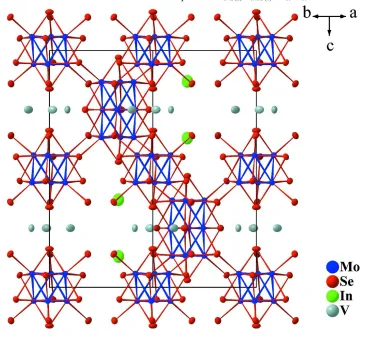
interconnected through additional Mo—Se bonds (Figs. 1 and 2). The first unit can be described as an Mo6 octahedron
surrounded by eight face-capping inner Sei and six apical Sea ligands. The Mo
9 cluster is surrounded by 11 Sei atoms
capping one or two faces of the bioctahedron and six Sea ligands above the apical Mo atoms. The Mo
6Sei8Sea6 and
Mo9Sei11Sea6 units are centered at Wyckoff positions 2b and 2c and have point-group symmetry 3 and 6, respectively. The
Mo—Mo distances within the Mo6 cluster are 2.6992 (7) Å for the distances of the Mo triangles formed by the Mo1
atoms related through the threefold axis, and 2.7223 (8) Å for the distances between these triangles. The Mo—Mo
distances within the Mo9 clusters are 2.6474 (7) and 2.7056 (10) Å in the triangles formed by the atoms Mo2 and Mo3,
respectively, and 2.7136 (5) and 2.7557 (5) Å for those between the Mo23 and Mo33 triangles. The Se atoms bridge either
one (Se1, Se2, Se4 and Se5) or two (Se3) triangular faces of the Mo clusters. Moreover, atoms Se1 and Se2 are linked to
an Mo atom of a neighboring cluster. The Mo—Se bond lengths range from 2.5467 (7) to 2.6378 (7) Å within the
Mo6Sei8Sea6 unit, and from 2.5259 (8) to 2.6966 (6) Å within the Mo9Sei11Sea6 unit. Each Mo9Sei11Sea6 cluster is
interconnected by six Mo6Sei8Sea6 units (and vice versa) via Mo2—Se1 bonds (and Mo1—Se2 bonds, respectively),
forming the three-dimensional Mo—Se framework, the connectivity formula of which is Mo9Sei5Sei-a6/2Se-ai6/2,
Mo6Sei2Sei-a6/2Sea-i6/2. It results from this arrangement that the shortest intercluster Mo1—Mo2 distance is 3.4216 (6) Å,
indicating only weak metal—metal interaction. The In+ cations are surrounded by seven Se atoms forming a distorted
tricapped tetrahedron, as is the case in In2.9Mo15Se19. The Se5 and Se2 atoms forming the tetrahedron are at 3.0759 (15)
and 3.1221 (5) Å from the In atom, and the capping Se1 atoms are at 3.4904 (7) Å. The V3+ cations, as the In3+ cations in
the In3Mo15Se19 compounds, occupy partially at 47.4 (6)% a triangular group of distorted octahedral cavities, which are
formed by two Mo6Sei8Sea6 and three Mo9Sei11Sea6 units, around the threefold rotation axis. The V—Se distances are in
Single crystals of V1.42In1.83Mo15Se19 were prepared from a mixture of V2Se3, MoSe2, InSe and Mo with a nominal
composition V1.5In2Mo15Se19. Before use, Mo powder was reduced under H2 flowing gas at 1273 K during ten hours in
order to eliminate any trace of oxygen. The binaries V2Se3, MoSe2, InSe were obtained by heating stoichioetric mixtures
of the elements in sealed evacuated silica tubes during about 2 days. All handlings of materials were done in an
argon-filled glove box. The initial mixture (ca. 5 g) was cold pressed and loaded into a molybdenum crucible, which was sealed
under a low argon pressure using an arc welding system. The charge was heated at the rate of 300 K/h up to 1773 K, the
temperature which was held for 48 hours, then cooled at 100 K/h down to 1373 K and finally furnace cooled.
S3. Refinement
The highest peak and the deepest hole are located 1.56 Å and 0.66 Å from Mo3, respectively. Refinement of the
[image:3.610.122.489.250.590.2]occupancy factors of the V and In atoms led to the final composition V1.42 (2)In1.832 (8)Mo15Se19.
Figure 1
Figure 2
Plot showing the atom-numbering scheme and the interunit linkage of the Mo9Se11Se6 and Mo6Se8Se6 cluster units.
Displacement ellipsoids are drawn at the 97% probability level.
vanadium indium pentadecamolybdenum nonadecaselenide
Crystal data
V1.42In1.83Mo15Se19
Mr = 3221.80
Hexagonal, P63/m
Hall symbol: -P 6c
a = 9.7361 (1) Å
c = 19.3090 (4) Å
V = 1585.11 (4) Å3
Z = 2
F(000) = 2797
Dx = 6.750 Mg m−3
Mo Kα radiation, λ = 0.71069 Å Cell parameters from 26495 reflections
θ = 2.6–35.0°
µ = 29.21 mm−1
T = 293 K
Nonius KappaCCD diffractometer
Radiation source: fine-focus sealed tube Graphite monochromator
φ scans (κ = 0) + additional ω scans Absorption correction: analytical
(de Meulenaar & Tompa, 1965)
Tmin = 0.161, Tmax = 0.329
27560 measured reflections 2390 independent reflections 1634 reflections with I > 2σ(I)
Rint = 0.093
θmax = 35.0°, θmin = 2.6°
h = −15→15
k = −15→12
l = −30→31
Refinement
Refinement on F2
Least-squares matrix: full
R[F2 > 2σ(F2)] = 0.037
wR(F2) = 0.087
S = 1.08 2390 reflections 67 parameters 0 restraints
Primary atom site location: structure-invariant direct methods
Secondary atom site location: difference Fourier map
w = 1/[σ2(F
o2) + (0.0413P)2 + 0.9587P]
where P = (Fo2 + 2Fc2)/3
(Δ/σ)max = 0.001
Δρmax = 3.22 e Å−3
Δρmin = −2.57 e Å−3
Extinction correction: SHELXL97 (Sheldrick, 2008), Fc*=kFc[1+0.001xFc2λ3/sin(2θ)]-1/4
Extinction coefficient: 0.00025 (5)
Special details
Geometry. All esds (except the esd in the dihedral angle between two l.s. planes) are estimated using the full covariance matrix. The cell esds are taken into account individually in the estimation of esds in distances, angles and torsion angles; correlations between esds in cell parameters are only used when they are defined by crystal symmetry. An approximate (isotropic) treatment of cell esds is used for estimating esds involving l.s. planes.
Refinement. Refinement of F2 against ALL reflections. The weighted R-factor wR and goodness of fit S are based on F2,
conventional R-factors R are based on F, with F set to zero for negative F2. The threshold expression of F2 > 2sigma(F2) is
used only for calculating R-factors(gt) etc. and is not relevant to the choice of reflections for refinement. R-factors based on F2 are statistically about twice as large as those based on F, and R- factors based on ALL data will be even larger.
Fractional atomic coordinates and isotropic or equivalent isotropic displacement parameters (Å2)
x y z Uiso*/Ueq Occ. (<1)
Mo1 0.16776 (5) 0.01669 (5) 0.55780 (2) 0.00914 (10) Mo2 0.68407 (5) 0.18577 (5) 0.63317 (2) 0.00965 (10) Mo3 0.51292 (7) 0.16694 (7) 0.7500 0.00868 (11) Se1 0.03647 (6) −0.28702 (6) 0.55134 (3) 0.01070 (11) Se2 0.37798 (6) 0.00665 (6) 0.64065 (3) 0.01233 (12) Se3 0.34594 (8) 0.30753 (9) 0.7500 0.01280 (15)
Se4 0.0000 0.0000 0.66221 (5) 0.01643 (19)
Se5 0.6667 0.3333 0.52902 (5) 0.01225 (17)
In1 0.6667 0.3333 0.36972 (6) 0.0374 (4) 0.916 (4)
V1 −0.2026 (4) −0.1744 (3) 0.7500 0.0177 (9) 0.474 (6)
Atomic displacement parameters (Å2)
U11 U22 U33 U12 U13 U23
Mo3 0.0096 (2) 0.0099 (3) 0.0071 (3) 0.0053 (2) 0.000 0.000 Se1 0.0110 (2) 0.0097 (2) 0.0116 (2) 0.00543 (19) 0.00107 (17) 0.00229 (17) Se2 0.0115 (2) 0.0119 (2) 0.0138 (3) 0.00598 (18) −0.00305 (18) −0.00208 (18) Se3 0.0121 (3) 0.0158 (3) 0.0117 (3) 0.0079 (3) 0.000 0.000
Se4 0.0203 (3) 0.0203 (3) 0.0086 (4) 0.01016 (14) 0.000 0.000 Se5 0.0142 (2) 0.0142 (2) 0.0083 (4) 0.00712 (12) 0.000 0.000 In1 0.0345 (4) 0.0345 (4) 0.0431 (7) 0.0172 (2) 0.000 0.000 V1 0.0216 (16) 0.0095 (13) 0.0165 (16) 0.0038 (11) 0.000 0.000
Geometric parameters (Å, º)
Mo2—Se5 2.5259 (8) Mo3—Mo3ii 2.7056 (10)
Mo2—Se2 2.5974 (6) Mo3—Mo3i 2.7056 (10)
Mo2—Se2i 2.6290 (6) Mo3—Mo2ix 2.7136 (5)
Mo2—Mo2i 2.6474 (7) Mo3—Mo2ii 2.7136 (5)
Mo2—Mo2ii 2.6474 (7) Mo3—Mo2viii 2.7557 (5)
Mo2—Se1iii 2.6504 (6) In1—Se5 3.0759 (15)
Mo2—Se3i 2.6966 (6) In1—Se2x 3.1221 (5)
Mo2—Mo3i 2.7136 (5) In1—Se2xi 3.1221 (5)
Mo2—Mo3 2.7557 (5) In1—Se2iv 3.1221 (5)
Mo1—Se1iv 2.5467 (7) In1—Se1x 3.4904 (7)
Mo1—Se4 2.5481 (8) In1—Se1xi 3.4904 (7)
Mo1—Se1 2.5717 (6) In1—Se1iv 3.4904 (7)
Mo1—Se1v 2.6111 (6) In1—Se3vii 4.2444 (9)
Mo1—Se2 2.6378 (7) In1—Se3xii 4.2444 (9)
Mo1—Mo1vi 2.6992 (7) In1—Se3xiii 4.2444 (9)
Mo1—Mo1v 2.6992 (7) V1—Se4 2.510 (2)
Mo1—Mo1vii 2.7223 (8) V1—Se4viii 2.510 (2)
Mo1—Mo1iv 2.7223 (8) V1—Se3v 2.730 (3)
Mo3—Se2 2.5631 (6) V1—Se2vi 2.7981 (18)
Mo3—Se2viii 2.5631 (6) V1—Se2xiv 2.7981 (18)
Mo3—Se3 2.5965 (9) V1—Se3vi 2.831 (3)
Mo3—Se3i 2.6095 (9) V1—Mo3vi 2.865 (3)
Se5—Mo2—Se2 92.603 (17) Se2viii—Mo3—Mo3i 117.84 (2)
Se5—Mo2—Se2i 91.858 (17) Se3—Mo3—Mo3i 118.92 (3)
Se2—Mo2—Se2i 173.59 (3) Se3i—Mo3—Mo3i 58.45 (3)
Se5—Mo2—Mo2i 58.396 (13) Mo3ii—Mo3—Mo3i 60.0
Se2—Mo2—Mo2i 120.06 (2) Se2—Mo3—Mo2ix 149.88 (3)
Se2i—Mo2—Mo2i 58.978 (19) Se2viii—Mo3—Mo2ix 59.685 (15)
Se5—Mo2—Mo2ii 58.396 (13) Se3—Mo3—Mo2ix 60.991 (14)
Se2—Mo2—Mo2ii 60.16 (2) Se3i—Mo3—Mo2ix 118.165 (16)
Se2i—Mo2—Mo2ii 118.878 (19) Mo3ii—Mo3—Mo2ix 61.129 (16)
Mo2i—Mo2—Mo2ii 60.0 Mo3i—Mo3—Mo2ix 89.824 (14)
Se5—Mo2—Se1iii 90.42 (2) Se2—Mo3—Mo2ii 59.685 (15)
Se2—Mo2—Se1iii 86.03 (2) Se2viii—Mo3—Mo2ii 149.88 (3)
Se2i—Mo2—Se1iii 98.54 (2) Se3—Mo3—Mo2ii 60.991 (14)
Se5—Mo2—Se3i 175.68 (2) Mo3i—Mo3—Mo2ii 89.824 (14)
Se2—Mo2—Se3i 85.76 (2) Mo2ix—Mo3—Mo2ii 112.47 (3)
Se2i—Mo2—Se3i 89.46 (2) Se2—Mo3—Mo2viii 145.46 (3)
Mo2i—Mo2—Se3i 119.150 (18) Se2viii—Mo3—Mo2viii 58.328 (15)
Mo2ii—Mo2—Se3i 117.432 (18) Se3—Mo3—Mo2viii 118.823 (15)
Se1iii—Mo2—Se3i 93.45 (2) Se3i—Mo3—Mo2viii 60.271 (14)
Se5—Mo2—Mo3i 120.23 (2) Mo3ii—Mo3—Mo2viii 88.941 (14)
Se2—Mo2—Mo3i 116.35 (2) Mo3i—Mo3—Mo2viii 59.578 (16)
Se2i—Mo2—Mo3i 57.311 (17) Mo2ix—Mo3—Mo2viii 57.893 (17)
Mo2i—Mo2—Mo3i 61.851 (15) Mo2ii—Mo3—Mo2viii 146.06 (3)
Mo2ii—Mo2—Mo3i 91.063 (14) Se2—Mo3—Mo2 58.328 (15)
Se1iii—Mo2—Mo3i 138.90 (2) Se2viii—Mo3—Mo2 145.46 (3)
Se3i—Mo2—Mo3i 57.36 (2) Se3—Mo3—Mo2 118.823 (15)
Se5—Mo2—Mo3 118.64 (2) Se3i—Mo3—Mo2 60.271 (14)
Se2—Mo2—Mo3 57.123 (17) Mo3ii—Mo3—Mo2 88.941 (14)
Se2i—Mo2—Mo3 116.58 (2) Mo3i—Mo3—Mo2 59.578 (16)
Mo2i—Mo2—Mo3 90.142 (14) Mo2ix—Mo3—Mo2 146.06 (3)
Mo2ii—Mo2—Mo3 60.255 (15) Mo2ii—Mo3—Mo2 57.893 (17)
Se1iii—Mo2—Mo3 131.66 (2) Mo2viii—Mo3—Mo2 109.90 (3)
Se3i—Mo2—Mo3 57.177 (19) Mo1vii—Se1—Mo1 64.26 (2)
Mo3i—Mo2—Mo3 59.29 (2) Mo1vii—Se1—Mo1vi 63.70 (2)
Se1iv—Mo1—Se4 176.34 (2) Mo1—Se1—Mo1vi 62.77 (2)
Se1iv—Mo1—Se1 88.948 (17) Mo1vii—Se1—Mo2xv 131.23 (2)
Se4—Mo1—Se1 91.765 (17) Mo1—Se1—Mo2xv 128.19 (2)
Se1iv—Mo1—Se1v 88.084 (17) Mo1vi—Se1—Mo2xv 81.114 (19)
Se4—Mo1—Se1v 90.859 (17) Mo3—Se2—Mo2 64.549 (18)
Se1—Mo1—Se1v 173.79 (3) Mo3—Se2—Mo2ii 63.004 (18)
Se1iv—Mo1—Se2 93.50 (2) Mo2—Se2—Mo2ii 60.86 (2)
Se4—Mo1—Se2 90.13 (2) Mo3—Se2—Mo1 130.39 (2)
Se1—Mo1—Se2 86.306 (19) Mo2—Se2—Mo1 126.33 (2)
Se1v—Mo1—Se2 99.32 (2) Mo2ii—Se2—Mo1 81.018 (19)
Se1iv—Mo1—Mo1vi 119.568 (17) Mo3—Se3—Mo3ii 62.62 (3)
Se4—Mo1—Mo1vi 58.018 (12) Mo3—Se3—Mo2ix 61.649 (16)
Se1—Mo1—Mo1vi 59.33 (2) Mo3ii—Se3—Mo2ix 62.551 (16)
Se1v—Mo1—Mo1vi 117.827 (19) Mo3—Se3—Mo2ii 61.649 (16)
Se2—Mo1—Mo1vi 129.11 (2) Mo3ii—Se3—Mo2ii 62.551 (16)
Se1iv—Mo1—Mo1v 118.595 (17) Mo2ix—Se3—Mo2ii 113.56 (3)
Se4—Mo1—Mo1v 58.018 (12) Mo1vi—Se4—Mo1 63.96 (2)
Se1—Mo1—Mo1v 119.25 (2) Mo1vi—Se4—Mo1v 63.96 (2)
Se1v—Mo1—Mo1v 57.903 (19) Mo1—Se4—Mo1v 63.96 (2)
Se2—Mo1—Mo1v 137.270 (18) Mo2i—Se5—Mo2 63.21 (3)
Mo1vi—Mo1—Mo1v 60.0 Mo2i—Se5—Mo2ii 63.21 (3)
Se1iv—Mo1—Mo1vii 59.30 (2) Mo2—Se5—Mo2ii 63.21 (3)
Se4—Mo1—Mo1vii 118.273 (15) Mo2i—Se5—In1 142.763 (16)
Se1—Mo1—Mo1vii 57.423 (15) Mo2—Se5—In1 142.763 (16)
Se1v—Mo1—Mo1vii 116.42 (2) Mo2ii—Se5—In1 142.763 (16)
Mo1vi—Mo1—Mo1vii 60.281 (10) Se4viii—V1—Se3v 87.27 (7)
Mo1v—Mo1—Mo1vii 90.0 Se4—V1—Se3v 87.27 (7)
Se1iv—Mo1—Mo1iv 58.31 (2) Se4viii—V1—Se2vi 166.76 (13)
Se4—Mo1—Mo1iv 118.273 (15) Se4—V1—Se2vi 87.36 (2)
Se1—Mo1—Mo1iv 116.86 (2) Se3v—V1—Se2vi 103.16 (8)
Se1v—Mo1—Mo1iv 56.998 (14) Se4viii—V1—Se2xiv 87.36 (2)
Se2—Mo1—Mo1iv 140.74 (2) Se4—V1—Se2xiv 166.76 (13)
Mo1vi—Mo1—Mo1iv 90.0 Se3v—V1—Se2xiv 103.16 (8)
Mo1v—Mo1—Mo1iv 60.281 (10) Se2vi—V1—Se2xiv 97.98 (8)
Mo1vii—Mo1—Mo1iv 59.44 (2) Se4viii—V1—Se3vi 85.09 (8)
Se2—Mo3—Se2viii 110.93 (3) Se4—V1—Se3vi 85.09 (8)
Se2—Mo3—Se3 93.18 (2) Se3v—V1—Se3vi 169.63 (12)
Se2viii—Mo3—Se3 93.18 (2) Se2vi—V1—Se3vi 83.50 (6)
Se2—Mo3—Se3i 88.30 (2) Se2xiv—V1—Se3vi 83.50 (6)
Se2viii—Mo3—Se3i 88.30 (2) Se4viii—V1—Mo3vi 122.97 (8)
Se3—Mo3—Se3i 177.38 (3) Se4—V1—Mo3vi 122.97 (8)
Se2—Mo3—Mo3ii 120.789 (19) Se3v—V1—Mo3vi 136.14 (12)
Se2viii—Mo3—Mo3ii 120.789 (19) Se2vi—V1—Mo3vi 53.80 (4)
Se3—Mo3—Mo3ii 58.92 (3) Se2xiv—V1—Mo3vi 53.80 (4)
Se3i—Mo3—Mo3ii 118.45 (3) Se3vi—V1—Mo3vi 54.23 (5)
Se2—Mo3—Mo3i 117.84 (2)