An International Double-Blind, Peer Reviewed, Refereed Open Access Journal -
Included in the International Indexing Directories
Page 11
TRANSFORMATIONAL LEADERSHIP RELATED WITH INTREPIDNESS IN NON-MONOTONIC RATIONALITY THAT RECOMMEND HIRING OLDER WORKERS IN YOUNG MANAGERS WITHPOSITIVEATTITUDES TOWARD SOCIAL RESPONSIBILITY
(Jauli Isaac, TS Campus Adyar, India) (Reig Enrique, IESDE México)
(Cervantes Cecilia, INSELF)
(Quintana-Kawage Bernardo, Instituto Bernardo Quintana) (Aiza-Engel Sharon, Instituto Bernardo Quintana)
(Llovera, José, Instituto Bernardo Quintana) (Rodríguez, M., Instituto Bernardo Quintana)
(Cárdenas Enrique, ESAN Peru)
ABSTRACT:
In the current exploratory research paper, transformational leadership with intrepidness (Self- determined, bold, impressive and brave) was correlated in a sample with positive attitudes toward social responsibility and positive attitudes to hire older workers; the sample was confirmed by executives form southeast part of Mexico. In the results, significant correlation between variables was obtained. In the discussion, further research is recommended and the situation of leaders with transformational approaches is not enough to command changes in the relevance of study variables such as intrepidness.
Key words: MLQ, Intrepidness, hire older workers, social responsibility attitudes
INTRODUCTION:
LEADERSHIP:
The creation of something different always implies energy transformation (Reig, Fernández&Jauli, 2003), and the person who leads the coordination of human energy for the creation of this transformation (superior or inferior), is the leader.
The leader can be described as a person who guides and advocates his or her followers to walk in a direction selected by the organizational vision and planning. This direction can change during the process due to unfavorable and unexpected circumstances. In cases such as this one, the leader has to react and manage the new situation with proficiency.
An International Double-Blind, Peer Reviewed, Refereed Open Access Journal -
Included in the International Indexing Directories
Page 12
The whole definition of leadership includes both, the ability to inspire followers to achieve harmonic goals, and the ability to produce results. Burns (1978 in Molero, 1995) defines the first idea mentioned as transformational leadership, and the second one as transactional leadership in his own leadership model.In the study of Kark, Shamir and Chen (2003), they found that transformational leadership was related in a positive way to the followers’ dependence and their empowerment. This idea demonstrates that transformational leadership can positively build the relationship between a leader and his or her subordinates.
Bass (1977) also endorses the possible idea of achieving harmonic goals through the following dimensions of the leadership: inspiration, individual consideration, intellectual stimulation and charisma. Bass also describes other dimensions to get results such as: contingent reinforcement and direction by exception. The Bass scale for leadership is the MLQ (Multifactor Leadership Questionnaire).
Cohen, Ettin and Fidler (1998) elaborated 2 models of leadership, immanent and transcendent. They mentioned that, not only the framework structure is important but also the relationship that the executive has with his followers.
Kozlowski and Doherty (1989) determined in their research that subordinates with high-quality supervisor relations had more positive climate perceptions, exhibited greater consensus on climate, and had perceptions more similar to those of their supervisors than subordinates with low-quality relations did.
McCall, M. (1994) developed a conceptual framework for assessing international executive potential by examining the ability to learn from experience; executives in this experiment had 3 components:
individual attributes and skills, context, and time. Sperry (1999), on the other hand mentioned that the candidates’ executive positions will need to have special personal qualities related with their character, rather than simply having technical abilities, superior knowledge and skills in order to be successful in their work performance.
Turner et Al. (2002) analyzed the human responses with elevated moral reasoning and concluded that they have greater transformational leadership. Bass (1997) in The Ethics of Transformational Leadership cites Kouzes and Posner and emphasizes that the leader’s credibility is dependent on his moral purpose.
According to Kirkpatrick, S & Locke, E (1996), there are various theories on charisma (Bass, 1977;
Conger &Kanungo, 1987; House, 1992) and they extracted three fundamental components common
An International Double-Blind, Peer Reviewed, Refereed Open Access Journal -
Included in the International Indexing Directories
Page 13
to all: 1- Communication of the vision, 2-Implementation of the vision and 3- Display of a charismatic communication style.Communication, implementation and display of a charismatic style (inspirational or a natural talent) arise from the leader and reach the follower without it being clear if this activation evolves from a source (charismatic leader) who influences or places inspiration in the follower, or if it is rather that the follower (as a collective entity) activates through this inspiration something that is his own (Reig, 2004).
Hersey, Blanchard and Johnson (1999), present another model in relation with leadership. The essence of this model is the importance of social demands (situations) on the effectiveness of the leader’s performance. In other words, every situation will demand different leaders’ skills in order to solve the diverse problems. The lesson is: there is not a singular leadership combination that can solve all possible problems.
If the situational model is real, it will be fitting for the leaders to have collaborators and followers with various skills, abilities, talents, attitudes, backgrounds, origins, values and so on. Therefore, it is necessary to take advantage of the diversity in followers in order to achieve positive results in the multiplicity of situations that can be presented.
At times, diversity has different faces, which may include: compensations, leadership styles, degree of specialization, work environments, etc. In all cases, it is necessary to know the possible relations between the variables of diversity involved. For example, Ostroff and Atwater (2003) examine in the organizational context of diversity, preferences in paying for male managers rather than female.
Also, in this case, the managers prefer to pay more to younger people rather than older people.
These examples show how the leaders can choose options in function of their prejudices or stereotypes.
SOCIAL RESPONSIBILITY:
As an ethical proposition, social responsibility could be defined as: an obligation of organizations and individuals to act in benefit of the environment and society at large. The moral obligation is to maintain a balance between economy and ecosystem. Maintaining equilibrium between economic development and welfare of the society and environment. In terms of power and leader’s free will responsibility, it consists in ethical foundations to avoid harmful acts or performing positive activities. It is also possible to add the moral disposition to have a positive impact on the territory (social and physical environment) where the company is located.
The main goal of corporate social responsibility consists in actions and encouraging a positive impact through its activities on the environment, consumers, employees, communities,
An International Double-Blind, Peer Reviewed, Refereed Open Access Journal -
Included in the International Indexing Directories
Page 14
stakeholders and all other members of the public sphere who may also be considered as stakeholders.Hiring older workers can be interpreted as philanthropy if the basic reasoning starts in the idea about elder workers being useless. However, if the basis is different, if it is possible to see the advantages of senior workers, then the situation could change. In both cases, there are previous inflexion points that obligate to perceive the situation always from the same point and inertia. If a leader accepts the challenge to change the starting point, then he will be able to perceive reality in a different way. To command the change, the leader will need a specific trait called intrepidness.
There are two possibilities if deciding to hire workers older than 50: one is breaking the inertia and the second one is a social responsibility attitude which means having feelings of solidarity with a specific population sector in disadvantage (old workers).
What is the rationality behind calling old workers “useless”? One would be the necessity to feel superior to others. There is an unconscious reaction learned in social contexts (Jauli, Reig and Soto, 2002) which recommend doing something to get better working positions than others. It is more intelligent, safer and increases the self-esteem (Reig and Jauli, 2001). People decide to perform this stereotypic play1 which is similar to predators looking for victims. Another possibility is the misunderstanding of studies which affirm that older workers are, form the younger workers’
stereotypical assumptions: less productive, less healthy, etc. (Hedge, Borman and Lammlein, 2006).
Sometimes, researchers refuse to validate studies which mention that there are no differences between younger and older workers’ performance (Westerman S. Davies, D. Glendon, A. Stammers, R and Matthews, G. 1998). Koller and Gruber (in Heywood, J and Jirjahn, U. 2010) also mentioned that while firm managers recognize that older workers have more technique and firm knowledge, they say these advantages come only with increased tenure within the firm, not from hiring new older workers.
Independently of evidences, there are reports which refer to complex relations of command between young managers and old followers. Yeatts, D. Folts, W and Knapp, J (2000) find that young managers are not comfortable managing or directing older workers. There is a challenge there, and it is necessary for leaders without prejudices or assumptions to have an effect directly in that relation. It is also necessary to work with older workers’ attitudes toward being commanded by younger leaders. But, which are the different perceptions about older workers?
An important perception could be the decision to retain older workers and offer them attractive new positions in the companies. Dychtwald, K. and Baxter, D. (2007) mentioned that retention of
1 Berne’s theories about games are well known.
An International Double-Blind, Peer Reviewed, Refereed Open Access Journal -
Included in the International Indexing Directories
Page 15
senior workers is a valuable key for employees who might prefer a change and are often used to retain top-performing employees who might prefer a change in responsibilities or reduced hours over full retirement; some additional benefits include access to industrial knowledge and expertise.Dychtwald, K. and Baxter, D. (2007) speaking about high range management, mentioned that it is possible to change management practices and build a culture to motivate older workforce; this culture should value the experience over other things.
It is necessary to know the existential part of old workers, evidently not all of the positions are good options for them. Heywood, J. Ho, L. and Wei, X. (1999) mentioned that some older workers are less likely to be hired when jobs require considerable skill investment.
CONCEPTS ABOUT OLD WORKERS:
Dionne and Reig (1994) mentioned how children have the anxiety and illusion to become adults, they draw their future in a piece of paper. However, those adults when they arrive to their fifties, expecting with no illusion the following decade knowing that the company will expect very few from them in terms of productivity. Kooij, D. De Lange, A. Jansen, J. and Dikkers, J. (2008) are some of the authors who studied the conceptualizations of the age factors (specifically age-related-factors) and how this affects the motivation to continue work in older workers.
Apparently, there is a cognitive circle related with concepts about old workers. Prejudgments (false or incomplete true information before generalizing: being senior is bad business) this perception affects concepts, and concepts determine heuristic reactions in different actors (young employees, chair persons and old workers) inside working place.
Schopenhauer defines concepts as mere abstractions from what is known through intuitive perception. The concepts are denoted and fixed merely by words. Kant, mentioned how empirical or a posteriori2concepts are created: comparison (likening of mental images of one another), reflection (going back over different mental images) and abstraction (Segregation of everything else by which the mental images differ). A mental example of a concept is a prototype.
Heuristics,in the other hand, are simple rules learned which have been proposed to explain how people make decisions3, come to judgements4, and solve problems.
2Empirical or a posteriori concept is a general representation of non-specific thought of which is common to several specific perceived objects.
3Tversky and Kahneman related heuristics with decision making.
4Gigerenzer, G. explains how heuristics can be used for make judgments.
An International Double-Blind, Peer Reviewed, Refereed Open Access Journal -
Included in the International Indexing Directories
Page 16
Coming from mechanism5 approaches, after the industrial revolution, many concepts derived from mechanics were developed: old things do not work; older workers do not work as well. If you believe in this affirmation, then you will focus your attention in obsolete signs in old workers in order to confirm your assumption. When you observe failures in old workers, you will interpret (using heuristic reasoning) that it is not convenient to hire them.The sense of being obsolete is permanently confirmed after making mistakes, the sense of uselessness and the discrimination from young workers and leaders produces a lack of motivation in old workers.
Analyzing the process of life (Stages of Life), Reig and Jauli, (2001) describe how in the second part of adulthood, people need to finish the previous cycle of productivity, growth and change as part of the process characterized to give and share experience and knowledge to young collaborators.
What are the possibilities in this part of the process? Share but with productivity; this means, in the first place, to receive good training to be able to teach, or knowledge to become advisors for audit situations inside organizations, but mainly they can be the guardians of ethical purposes of the company, some of them can become very special people that keep in practice the values of the firm.
Some other seniors can support the political part of the company in their relations with some of the stakeholders. All of those possibilities imply new labor conditions which are more flexible and useful for both: company and workers.
SOCIAL RESPONSIBILITY BENEFITS:
There is a common assumption in shareholders, employees, directives and even in clients related with benefits of uses a social responsibility image. The effect on the “prestige” of the firm is probably playing a role in the unconsciousness as a profitable preference. The good or bad perception of a multi-unit firm usually affects the rest of the products. On the other hand, Miller, K, Sturdivant, F (1977) suggests that socially questionable behavior by one component of a multi-unit firm may have a negative impact on sales of other components. Who wants to affect their products negatively? Normally, the social responsibility practices are associated with good behavior and add value to the firm’s prestige. That’s why firms try to add it to their image.
Pivato, S, Misani, N, Tencati, A. (2008) mentioned a critical and notoriously elusive issue in Corporate Social Responsibility research in the impact of Corporate Social Performance. These authors hypothesize that the first result of social responsibility activities is the creation of trust among the stakeholders. This is a linear rationality: If they are socially committed, they have to be
5 Mechanism is the belief that natural wholes (principally living things) are like machines or artifacts, composed of parts lacking any intrinsic relationship to each other
An International Double-Blind, Peer Reviewed, Refereed Open Access Journal -
Included in the International Indexing Directories
Page 17
good people, if they are good people, they surely produce good products and they must be good for society, etc. Nunez, E (2008) accepted that companies often consider corporate social responsibility as means of contributing to the public good, while simultaneously improving their image and reputation among its stakeholders. While literature is replete with examples of CSR leading to improved corporate reputation, there are some notable and striking exceptions.Positive attitudes toward social responsibility in managers:
Reig, Jauli, Cervantes and Tang (2011) created a questionnaire to measure social responsibility attitudes in a sample of 120 participants using the method of social representations of Moscovicci.
The method used was a social representation process which consisted in selecting the first 3 ideas related with social responsibility questions (When you listen to the phrase “social responsibility”, which are the first 3 ideas that come to mind?). The final questionnaire reliability was acceptable (Alpha of Cronbach of 0.8452, see appendix 1) and 10 items were selected using the principal components method (contribution with more than .69 to the expected variance, see appendix 2) the dimensions including the part of attitudes: necessity, responsibility, relevancy, moral obligation and financial viability, and the second part was presented in co-preterit: “If I were director of a company, then...” The final dimensions were: Implementing, rewarding social benevolence, promoting moral integrity, creating spaces to support and demand ethical behavior. As a validity, we proceeded to inter-correlate the independent variable of social responsibility measured through one operative definition (Social responsibility is a duty every individual or organization has to perform to maintain a balance between the economy and the ecosystem. A trade-off always exists between economic development, in the material sense, and the welfare of the society and environment. Social responsibility means sustaining the equilibrium between the two. It pertains not only to business organizations but also to everyone whose action impacts the environment6) with the dimensions of the questionnaire, (the results are presented in the table 1 in the appendix 3).
BRAKING RATIONALITY BASED ON BENEFITS:
Rationality is, in one sense, the conformity of one’s beliefs with one’s reasons to believe, or one’s actions with one’s reasons for action. Reasons and believes are the keys to understand rationality.
Epistemology is the philosophical study of process of knowledge and belief. Reasons are explanations of reality phenomenon.
Max Weber distinguished four different idealized types of rationality: the first (purposive) are the expectations in the behavior of another human being in the environment. The second (value-believe
6Source: Perceptions and Definitions of Social
Responsibilityhttp://inni.pacinst.org/inni/corporate_social_responsibility/standards_definitions.pdf.
An International Double-Blind, Peer Reviewed, Refereed Open Access Journal -
Included in the International Indexing Directories
Page 18
oriented) is an action motivated for intrinsic reasons (ethical). The third is affective, determined for specific affect or emotions, and the fourth was traditional (habituation). All of them are presented in combination forms. Emmanuel Kant distinguished theoretical from practical reason. Theoretical rationality has a formal component that reduces to logical and practical consistency which is related to empirical support. One of the examples of the relation between theoretical and practice is the conceptual schema 7 (appendix 4).Other approach to understand the logic reasoning is in the Porphyry three8. In this model, the monotonic logics are explained in which new information monotonically increases the number of theorems and none of the old information can ever be deleted or modified. It’s almost the same in the logical syllogisms; in the linear reasoning, a linear sequence from antecedents to consequences,
“if… then…” If the essence of a good manager is the profit (only utilitarian purpose), then… the good and profitable executive should observe behaviors which support this orientation such as: extending the possible utility of resources (technology and person). If I hire only young workers, then I will extend the time and the organization can have their work, then I am applying utilitarian management and then I will feel satisfied with myself. This reasoning is based on solid assumptions which have been planted in the students’ brains during their formation in business school. However, those solid arguments don’t have ethical foundations, they are simply formulas.
If you have built castles in the air, your work need not be lost; that is where they should be. Now put the foundations under them.
HENRY DAVID THOREAU:
If you have built castles in the air (vision, mission statement, planning) your work need not be lost;
that is where they should be. Now put the foundations under them (self-confidence, self- commitment, coherence, integrity, honesty, enthusiasm). Tenzin Gyatso, the 14th Dalai Lama pronounced: Do not confuse peace of mind with spaced-out insensitivity. A truly peaceful mind is very sensitive, very aware. Do not confuse peace of mind (observing without prejudices from the bottom of their self, with impartiality, sensible to everything) with spaced-out insensitivity (egotistic indifference, pretend to be peaceful but full of prejudices and personal interests). A truly peaceful
7 The conceptual schema was developed by American National standards institute, this schema binds three spaces together by providing the common definitions of the application entities and the relationships between them.
8The main source comes fromJohn F. Sowa in a revised and extended version of an article that was originally written for the Encyclopedia of Artificial Intelligence, edited by Stuart C. Shapiro, Wiley, 1987.
An International Double-Blind, Peer Reviewed, Refereed Open Access Journal -
Included in the International Indexing Directories
Page 19
mind is very sensitive, very aware (to discern correctly in the daily work dealing with each situation choosing preferably sensitivity and peace)Formulas are linear and produce probabilistically success, at least if you observe the success from certain angles. However, there are some versions of description logics that support a non-monotonic reasoning, which allows default rules to add optional information and canceling rules to block inherited information. Such systems can be useful to explain nonlinear situations and can also create problems of conflicting defaults.
One of the best examples of non-monotonic910 reasoning is the Nixon’s diamond: this is a diamond that shows a conflict caused by the inheritance (assumption planted, prejudice, preconception, etc.) from two different functions as a super-types11: by default, there are two names on one side of the geometric drawing: Quaker which people assume is Pacifist, and Republicans which people assume are not Pacifist. The relation of Nixon12 (on the other side of the diamond) with pacifism is blocked because Nixon is a Republican and Republicans are not Pacifists, but on the other side the relation between Quaker and Nixon is not blocked. Then, if Nixon has a relation with Quaker and Quaker is a Pacifist then Nixon will appear as a Pacifist at least through this path. The same could happen with a MBA student which is ready to lead a company, he has already planted assumptions about what a good leader is; he has the formula previously swallowed and digested. He knows that hiring senior workers is related with social commitment but is blocked with profit orientation which is related with good executive and personal successful image. Personal successful image is related with high self-esteem and high self-esteem is not in contact with social commitment and with the disposition to hire senior workers.
In northeast part of Spain, there is a famous example of this: in one prestigious factory, the next generation of a family firm decided to fire senior supervisors (supposedly because they were obsolete) and contract a specialist from Italy for their productive area. The productivity falls
9A non-monotonic logic is a formal logic whose consequence relation is not monotonic. Most studied formal logics have a monotonic consequence relation, meaning that adding a formula to a theory never produces a reduction of its set of consequences. Intuitively, monotonic indicates that learning a new piece of knowledge cannot reduce the set of what is known.
10 An excellent explanation of non-monotonic reasoning is in: Sowa, J. (1990) in Intelligent Systems: State of the Art and Future Directions, edited by Zbigniew W. Ras and Maria Zemankova, Ellis Horwood, New York, 456-487.
11 Porphyry used it to illustrate Aristotle's method of defining categories by specifying the genius or general type and the differentiae that distinguish different subtypes of the same super-type. Super-type abstraction is only valid as a reasoning formula if certain semantic conditions are placed on the behavior of the sub-type. The sub- type's function (with the same name and argument types) must satisfy the specification of the super-type's member function.
12 This defaultreasoning was started by Raymond Reiter in 1980 and follow in 1983 by the same Raymond Reiter and Giovanni Criscuolo. This reasoning explains and solves the problems related with conflicts for context knowledge.
An International Double-Blind, Peer Reviewed, Refereed Open Access Journal -
Included in the International Indexing Directories
Page 20
dramatically and after some time, the new executives step back and recover the senior supervisors in order to go back to previous productivity standards because the important goal is productivity and not theglamour of the specialist.Good or bad executives in reasoning process analysis based on Nixon’s diamond Modified and adapted to explain the circular reasoning based on prejudices.
Putting in balance social commitment with utilitarian purpose, removing blocked parts from utilitarian-oriented and social-orientation with disposition to hire competitive workers independently of their age (senior and junior workers) and removing the block from social orientation and good executive skills, the flow of the executive management will find it more comfortable to perform leadership.
INTREPIDNESS:
There are many tests of personality; one of the most important of them is the Myers-Briggs which consists on a test based on Jung’s typological theory (This theory was published in the book Psychological Types in 1921). Myers-Briggs originally used extraversion and introversion as Jung defines them (extraversion outward-turning, and introversion inward-turning) in the origins of the questionnaire13. There were differences developed into four opposite pairs or dichotomies, one of those dichotomies considered the dimensions of intrepid-inhibited. Jung identified two pairs of
13The preferences for extraversion and introversion are often called attitudes, Briggs and Myers recognized that each of the cognitive functions can operate in the external world of behavior, action, people, and things (extraverted attitude) or the internal world of ideas and reflection (introverted attitude).
Social orientation
Disposition to hire good executive senior workers
blocked
Social Utilitarian Personal successful Committed Oriented image
Young successful Executives High Self-esteem
An International Double-Blind, Peer Reviewed, Refereed Open Access Journal -
Included in the International Indexing Directories
Page 21
psychological functions: The perceiving functions, sensing and intuition; and the judging functions, thinking and feeling14.Jauli, Reig and Cervantes (2006) developed a personality questionnaire based on specific traits; one of the traits analyzed and developed was the intrepidness (originally, there were 12 questions selected which belonged to 4 dimensions in the extraction method. The final dimensions were: Self- determined, bold, impressive and brave (the reliability was superior to .85 Cronbach’s Alpha). The questionnaire is in the appendix).
Analyzing the inhibit/intrepid dichotomy, it is possible to find that the first part inhibition is complex and results in a lack of capacities to aspire the desire of action, the person fully capable to act is incompetent to want to take action. It is behind the desire of the desire that the inhibit person needs to repress their energy collapsing from their first desires and affecting the second desires. In the other hand, the intrepid is capable to desire, desire the action and then is highly probable than this person transforms his energy into actions.
The repression of the energy to desire and act is related with unconscious dynamisms, many of the behavioral theorists refuse to accept this way to explore this situation. However, they don’t offer alternative explanations, only the reinforcement or social learning alternative.
When the leader uses intrepidness, he is capable to desire the desire of action against the status quo and execute a process of change.
PURPOSE:
The purpose of this research is to detect if transformational leadership is related to intrepidness in young executives respecting and hiring older workers. The transformational approach gives the correct vision to leaders and intrepidness permits them operate the change of vision inside their companies.
MATERIAL AND METHOD:
PARTICIPANTS:
A sample of 97 Mexican executives with favorable attitudes to hire older workers, were selected;
both genders, ages below 44 years old, all in directive positions in private sector companies and all of them with MBA finished in prestigious business schools.
14Each person (according with Myers-Briggs) uses one of these four functions more dominantly; however, all four functions are used at different times depending on the situation.
An International Double-Blind, Peer Reviewed, Refereed Open Access Journal -
Included in the International Indexing Directories
Page 22
INSTRUMENTS:Simple attitude questionnaire: to hire older workers developed by authors (specify in the procedure).
Questionnaire of attitudes toward social responsibility (appendix) MLQ questionnaire: from Bass and Avolio
Intrepidness questionnaire: as a part of syncretistic scale of personality of Jauli, Reig and Cervantes (appendix).
PROCEDURE:
We proceeded to practice a non-random scouting (N=100 executives in banking [33], services [34]
and automotive sectors [33]) in order to know the main reasons (3) why an executive should not hire workers over 55; The main reasons were: It is wrong (64), it could affect your image (51), it is a bad investment (50), with this reactions we proceeded to design a simple questionnaire of attitudes.
The questionnaire was the following:
Attitudes to hire senior workers related with 3 possible options:
[1] There is nothing wrong with hiring people over 55 years old:
Absolutely agree, agree, don’t know, disagree and absolute disagree.
[2] I would lose prestige with the owners of the company if I decide to hire workers over 55 years old:
Absolutely agree, agree, don’t know, disagree and absolute disagree.
[3] It is a bad investment to hire workers over 55 years old.
Absolutely agree, agree, don’t know, disagree and absolute disagree.
The “executives with positive attitudes toward social responsibility” is another questionnaire and it is found in the appendixes.
We selected from a new sample of MBA alumni of private universities (2) in southeast Mexico a sample of 120 (age between 28 to 44, all of them working as a executives, directives, CEOs and/or people in charge with leadership functions and authority to decide the profiles to hire people). After the first scouting, we selected 70 people with the previous characteristics (eliminating 50 without leadership functions or without authority to hire). The second filter as it has been mentioned was a positive attitude toward social responsibility.
From the original selected sample (120), only 70 were selected because they showed positive attitudes to hire workers over 55 years old.
An International Double-Blind, Peer Reviewed, Refereed Open Access Journal -
Included in the International Indexing Directories
Page 23
With this reduced and selected sample, we applied the instruments for this exploratory research (intrepidness and MLQ). After we collect the data, we preceded to compute the answers and do the correlations between the variables.RESULTS:
The Alpha of Cronbach of the attitudes toward social responsibility was: .845 in the previous research reported in (Reig, Jauli, Cervantes and Tang, 2011).
According to the objective of this research, we proceed to get the reliability of the variables.
The reliability of the questionnaires is in the following table:
Table 1: reliability of the questionnaires
____________________________________________________
Questionnaire Alpha of Cronbach
____________________________________________________
1. Intrepidness .802
2. MLQ. .972
____________________________________________________
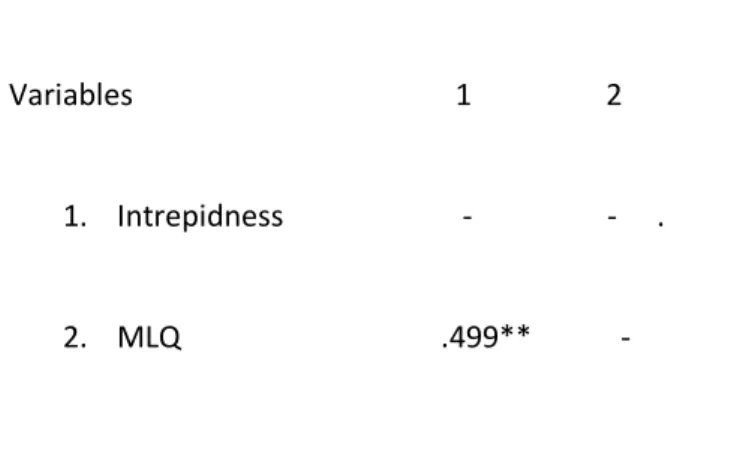
RESPECTING THE CORRELATION BETWEEN VARIABLES:
Table 1: correlation between MLQ and intrepidness _____________________________________________
Variables 1 2
1. Intrepidness - - .
2. MLQ .499** -
_____________________________________________
** Correlation is significant at the 0.01 level.
DISCUSSION:
The goal of this exploratory research was to measure the relation between intrepidness and leadership (MLQ) in a much selected sample: young executives, with power to decide an age profile
An International Double-Blind, Peer Reviewed, Refereed Open Access Journal -
Included in the International Indexing Directories
Page 24
to hire people, with positive attitudes to social responsibility and with positive attitudes to hire workers over 55 years old.If the leaders have transformational leadership, positive attitudes to social responsibility and don’t have prejudices about their image for hire old people, it is possible that being intrepid, with force to change situations, can influence their territories in order to practice reforms coherently, well meditated and brave.
Einstein mentioned a phrase which expresses a special relation between transformational perspective and courage to defend it, based in their deepest feelings, He said: My pacifism is an instinctive feeling, a feeling that possesses me because the murder of men is abhorrent. My attitude is not derived from intellectual theory but is based on my deepest antipathy to every kind of cruelty and hatred.
Einstein also mentioned the role of science: Science is a powerful instrument. How it is used, whether it is a blessing or a curse to mankind, depends on mankind and not on the instrument. Who uses the power of knowledge? The answer is simple: the leader. What is the base of the leader’s decisions? The answer is: in his values and models taken from their university formation.
To have a powerful vision of a healthy community, a transformational approach is necessary, but also a power to implement it (intrepidness). The previous background based on values is related to attitudes toward a more harmonic and equal organization (small territories).
To know how the power of decision works to hire people in a non-randomized sample of executives.
Finding a worthy place for senior workers (older than 55 years old) is a priority in societies. Finding the advantages and correct prejudices about disadvantages are a matter of directors and high commands of companies (Reig, Jauli, Cervantes and Tang, 2011).
An International Double-Blind, Peer Reviewed, Refereed Open Access Journal -
Included in the International Indexing Directories
Page 25
BIBLIOGRAPHY:Bass, Bernard M. (1977) Does the transactional-transformational leadership paradigm transcend organizational and national boundaries? American Psychologist. 52(2) 130-139
Bass, B.M. (1985). Leadership and Performance beyond Expectations.New York: Free Press.
Bass, B. (1997) Does the transactional-transformational leadership paradigm transcend organizational and national boundaries? American Psychologist. 52(2) 130-139
Burns (1977) in Molero F. (1995) El estudiodelcarisma y del liderazgocarismático en lascienciassociales: unaaproximacióndesde la psicología social. Revista de Psicología Social (10) 1, 43-60
Cohen, B.; Ettin, M.; Fidler, J. (1998) Conceptions of leadership: The "analytic stance" of the group psychotherapist. Group Dynamics. 2(2) 118-131
Conger J.A. &Kanungo R.N. (1988) Charismatic leadership: the elusive factor in organizational effectiveness. San Francisco: Jossey-Bass publishers
Conger, J.; Kanungo, R.; Menon, S. (2000) Charismatic leadership and follower effects.Journal of Organizational Behavior 21 (7) 747-767
Dionne, G and Reig, E. (1994) Reto al cambio (challenge to change) Mexico: McGraw Hill. Dychtwald, K. and Baxter, D. (2007) Capitalizing on the New Mature Workforce. Public Personnel Management.36 (4) 325 – 334Hersey, P, Blabchard, K & Johnson (1999) ComportamientoOrganizacional. México: Prentice Hall publishers.
Hedge, J. Borman, W and Lammlein, S. (2006) The ageing workforce, realities, myths and implications for organizations. American Psychological association, Washington D.C.
Heywood, J. Ho, L. and Wei, X. (1999) The determinants of hiring older workers evidence from Hong Kong. Industrial and Labor Relations Review 52(3) 444-459
Heywood, J and Jirjahn, U. (2010) Hiring older workers and employing older workers: German evidence. Journal of population economics. 23 (2) 595 - 615
House R.J. and Howell, J.M. (1992) Personality and charismatic leadership.Leadership quarterly. 81- 108
Jauli, I and Reig, E. (2001) Personas queaprenden en lasorganizaciones (people learning in organizations) Mexico: CECSA publishers.
Jauli, I. Reig, E. and Cervantes, C. (2006) Escalas de medicióndelcomportamientohumano en el trabajo (Measure scales to human behavior at work) Barcelona: Author-editor publishers RomanyaValls Press.
An International Double-Blind, Peer Reviewed, Refereed Open Access Journal -
Included in the International Indexing Directories
Page 26
Kark, R; Shamir, B; Chen, G (2003) The two faces of transformational leadership: Empowerment anddependency Journal of Applied Psychology. 88(2) 246-255
Kirkpatrick, S & Locke, E (1996) Direct and Indirect Effects of Three Core Charismatic Leadership Components on Performance and Attitudes Journal of Applied Psychology . 81, No. 1, 36-51 Kooij, D. De Lange, A. Jansen, J. and Dikkers, J. (2008) Older workers’ motivation to continue to
work: five meanings of age: a conceptual review. Journal of managerial psychology. 23 (4) 364- 394
Kozlowski, S.; Doherty, M. (1989) Integration of climate and leadership: Examination of a neglected issue.Journal of Applied Psychology. 74(4) 546-553
McCall, M (1994) Identifying leadership potential in future international executives: Developing a concept. Consulting Psychology Journal: Practice & Research. 46(1) 49-63
Miller, K, Sturdivant, F (1977) Consumer responses to socially questionable corporate behavior: An empirical test. Journal of Empirical Research. 4(1) 1-7
Nunez, E (2008) Unintended effects of corporate social responsibility on corporate reputation:
When is doing 'good' not good for business? Dissertation Abstracts International Section A:
Humanities and Social Sciences. 68(7A) 3029
Ostroff, C; Atwater, L. (2003) Does whom you work with matter? Effects of referent group gender and age composition on managers' compensation.Journal of Applied Psychology. 88(4) 725-740 Pivato, S, Misani, N., Tencati, A. (2008) The impact of corporate social responsibility on consumer
trust: The case of organic food. Business Ethics: A European Review. 3-12
Reig, E. Jauli, I. Cervantes, C and Tang, J. (2011) Attitudes and disposition to social responsibility with convincement to contract workers older than 55 years in young Mexican business executives.
Chapter 53 in the book/proceedings Vol. III: Integrating spirituality and organizational leadership. Editor: Singh-Sengupta, S. Delhi: ISOL foundation publishers. P 641 to 671
Reig, E, Fernandez, J and Jauli, I (2003) Los recursoshumanos (the human resources) Madrid:
Thomson Learning.
Reig, E. (2004) El líder y el desafíodelcambio (Leadership and the challenge to change). Mexico:
CECSA publishers.
Sperry, L. (1999) The 1999 Harry Levinson lecture: Leadership dynamics--Character assessment in the executive selection process. Consulting Psychology Journal: Practice & Research. 51(4) 211- 217
Raccanello, K., Reig, E. Anand, J. and Mantilla, A. (2011) Rational Vs. Heuristic motives. What matters when redeeming the pladge? inAdvances in behavioral finance and economics
An International Double-Blind, Peer Reviewed, Refereed Open Access Journal -
Included in the International Indexing Directories
Page 27
Reig, E., Raccanello, K., Jauli, I. and Cervantes, C. (2007) Integrating Perception of self and identityinto managerial context. Chapter in the book Integrating Spirituality and Organizational Leadership vol. I. edited by Sunita Singh-Sengupta, Macmillan Research Series. Pages 586 to 596 Reig, E., Jauli, I., Cervantes, C., Reig S. E., Soler, C. Gaete, H., and Montañes, P. (2009) Attributed
Role Models´ Degree of Development of Consciousness related with Transformational Leadership in young Mexican Private Sector Executives. In the book: Integratin Spirituality and Organziational Leadership. Vol II, editor: Singh-Sengupta. McMillan Research Series.Pages.428 to 442.
Reig, E., Jauli, I., and Cervantes, C. (2011) Leadership Coaching Profile based in Vivekananda´s values in Mexican successful executives. In the book: Integrating Spirituality and organizational leadership Vol. III. Edited by Singh-Sengupta. India: ISOL Publishers. Pages: 317 to 331.
Reig, E. Jauli, I. and Cervantes, C. (2011) Human and technical skills desirable profile of competencies to develop excellence in leadership performance. In the book: Enhancing Managerial Skills edited by: Santi, Jaya and Aryamala. Published by Asan Memorial College of Arts and Science. Pages 223 to 228.
Reig, E. Raccanello, K. Grebe, C., Anand, J., Cervantes, C., Jauli, I. and Soler, C. (2011) Victimization Remittances, and American Product Preferences in Mexican Families. International Journal of Research in Management, Sciences and Technology. 1 (1) 19-23
Westerman, S. Davies, D. Glendon, A. Stammers, R and Matthews, G. (1998) Ageing and word processing competence: compensation or compilation’ British journal of Psychology. 89, 579 to 597
Yeatts, D. Folts, W and Knapp, J. (2000) older workers’ adaptation to a changing workplace:
employment issues for the 21 century. Educational gerontology. (26) 565 to 582
An International Double-Blind, Peer Reviewed, Refereed Open Access Journal -
Included in the International Indexing Directories
Page 28
APPENDIXES:PRINCIPAL COMPONENTS TABLE OF THE QUESTIONNAIRE:
_____________________________________________
Variable: Social Responsibility attitudes
Dimensions (Initial 1.00) Extraction
Necessity RS 1 .931
Responsibility RS 2 .834
Relevance RS 3 .930
Moral obligation RS 4 .736 Financial viability RS 5 .695 Variable: Disposition to social responsibility If I were Director of a company
Dimensions (Initial 1.00) Extraction Implementing IF 1 .700
Reward social benevolence IF 2 .820
Promote moral integrity IF 3 .833 Create spaces for support IF 4 .832 Demand ethical behavior IF 5 .846
______________________________________________
Extraction Method: Principal Component Analysis
APPENDIX:
Inter-correlation between social responsibility construct with dimensions of social responsibility:
Necessity, responsibility, relevancy, moral obligation and financial viability.
________________________________________________________________________
Variables |1 2 3 4 5 6
1. Relevance - .497* .829** .102 -.098 .494*
2. Responsibility - - .474* .431 .086 .690**
3. Equity - - - .508* .275 .771**
An International Double-Blind, Peer Reviewed, Refereed Open Access Journal -
Included in the International Indexing Directories
Page 29
4. Moral obligation - - - - .538** .792**5. Financial viability - - - - .666**
6. S. R. construct - - - - -
________________________________________________________________________
** Correlation is significant at the 0.05 level * Correlation is significant at the 0.10 level.
APPENDIX:
Conceptual schema:
Intrepidness
Syncretistic personality questionnaire (2006) Section intrepidness
Dimensions: Self-determined, bold, impressive and brave
Questions
:
I consider myself perseverant
Always almost always often sometimes few times almost never I do not hesitate
Always almost always often sometimes few times almost never I feel certain about what I do
Always almost always often sometimes few times almost never
DATABASE
sharing APLICATIONS
Query conceptual Schema
Actions
USER INTERFASE
An International Double-Blind, Peer Reviewed, Refereed Open Access Journal -
Included in the International Indexing Directories
Page 30
I do not permit anyone to pass over meAlways almost always often sometimes few times almost never If it is necessary, I could be aggressive
Always almost always often sometimes few times almost never I am not afraid to deal with hard negotiations
Always almost always often sometimes few times almost never I inspire respect to others
Always almost always often sometimes few times almost never I have the ability to give consent to others
Always almost always often sometimes few times almost never My presence imposes
Always almost always often sometimes few times almost never I am determinant
Always almost always often sometimes few times almost never If it is necessary, I dare to take risks
Always almost always often sometimes few times almost never I throw myself to solve problems instead remaining cautious
Always almost always often sometimes few times almost never
APPENDIX:
Questionnaire of social responsibility attitudes:
Please answer the following questions marking the one that you believe it corresponds to your point of view.
Is age antiquity responsible for people? Does it aspire to be managing?
1. It is necessary that companies get involved in programs of social responsibility Totally agree agree neutral disagree totally disagree
2. It is a company’s responsibility to be in charge of social development Totally agree agree neutral disagree totally disagree
3. Each company should play a role to contribute their part of social responsibility Totally agree agree neutral disagree totally disagree
4. It is morally obligatory that the companies make social responsibility Totally agree agree neutral disagree totally disagree
An International Double-Blind, Peer Reviewed, Refereed Open Access Journal -
Included in the International Indexing Directories
Page 31
5. The companies should be involved in social responsibility in function of their utilities.Totally agree agree neutral disagree totally disagree
If I was the director of an organization right now
1. I would implement a program of social responsibility
Totally agree agree neutral disagree totally disagree 2. I would reward the benevolence like an organizational value Totally agree agree neutral disagree totally disagree 3. I would promote the moral integrity of the employees
Totally agree agree neutral disagree totally disagree 4. I would look for spaces to make a social and Solidary Company Totally agree agree neutral disagree totally disagree 5. I would demand an ethical behavior in the workers
Totally agree agree neutral disagree totally disagree