http://wrap.warwick.ac.uk/
Original citation:Chakkol, Mehmet and Johnson, Mark (2015) Benefits realisation from collaborative working. London, UK: Institute for Collaborative Working ; WBS.
Permanent WRAP url:
http://wrap.warwick.ac.uk/77424
Copyright and reuse:
The Warwick Research Archive Portal (WRAP) makes this work of researchers of the University of Warwick available open access under the following conditions. Copyright © and all moral rights to the version of the paper presented here belong to the individual author(s) and/or other copyright owners. To the extent reasonable and practicable the material made available in WRAP has been checked for eligibility before being made available.
Copies of full items can be used for personal research or study, educational, or not-for-profit purposes without prior permission or charge. Provided that the authors, title and full bibliographic details are credited, a hyperlink and/or URL is given for the original metadata page and the content is not changed in any way.
A note on versions:
The version presented in WRAP is the published version or, version of record, and may be cited as it appears here.
Dr. Mehmet
Chakkol
Dr. Mark
Johnson
Operations Management Group, Warwick Business School
November 2015
Commissioned by the
Institute for Collaborative Working
Benefits Realisation
from
Acknowledgements
This report details the outcomes from the Benefits Realisation from Collaborative Working
research project sponsored by ICW.
The researchers would like to thank the many individuals and organisations who gave of
their time and expertise to further the research.
This includes all those who took part through face to face interviews and the many who
responded to the major market survey. The contents of this report represent an important
contribution to Collaborative Working Thought Leadership.
Authors:
Dr Mehmet Chakkol
&
Dr Mark Johnson
Design and artwork:
Adrian Wright – Treefrog Multimedia
, UK
Printed in the UK by
Color.co
– London
The research will initially be jointly published by ICW and WBS. The data will be owned
jointly and severally by WBS and ICW.
Applications for reproduction in full or in part should be submitted to:
Institute for Collaborative Working
Sullivan House
4 Grosvenor Gardens
London
SW1W 0DH
For further information please contact:
[email protected]
Collaborative Working Executive Group
Index
Foreword...Page 5
Case Study: CAPITA...Page 6
Executive Summary...Page 7
Tomorrow’s World...Page 8
Case Study: EMCOR UK...Page 10
A Perspective on the Future...Page 11
Case Study: Lockheed Martin...Page 13
Detailed Analysis and Survey Feedback...Page 14
Focus of Collaboration...Page 17
Case Study: Costain/4Way Consulting...Page 18
Understanding the Benefits of Collaboration...Page 19
Case Study: Bluelightworks...Page 20
Distinction Between Benefits and Value...Page 21
Drivers for Collaboration...Page 23
Case Study: NATS/Business Continuity Institute...Page 24
Key Challenges for Collaboration...Page 25
Case Study: Bam Nuttall/Transport for London...Page 27
Case Study: General Dynamics...Page 28
In Which Areas of Business Does Collaboration Feature?...Page 29
Case Study: ABC Electrification...Page 30
Future Directions for Collaboration Research...Page 31
Case Study: Network Rail...Page 33
About the Authors...Page 34
Foreword
The Rt Hon Baroness Patricia Scotland of Asthal QC
Baroness Scotland was called to the bar at the Middle Temple in 1977, specialising in family and children’s law, and was called to the Bar of Antigua & the Commonwealth of Dominica - 1978. In 1991, she became the first black woman to be appointed a Queen’s Counsel and held a variety of government positions including Attorney General. Baroness Scotland is a Patron of the Global Foundation for the Elimination of Domestic Violence and President of Chatham House. She is currently a nominee for the role of Commonwealth Secretary General.
The Rt Hon Baroness Patricia Scotland of Asthal QC
As a firm believer in the value of collaboration. I was delighted to be asked to write a foreword for this research report, which I consider to be a most valuable contribution to current thinking. I commend the Institute for Collaborative Working (ICW) and Warwick Business School for their foresight and effort; I would also like to thank all the individuals, institutions and bodies who have contributed to this seminal piece of work.
Throughout my life and career, I have always recognised that the best solutions to challenges and problems come from focusing first on what we agree on and then developing ideas jointly to reach mutually agreeable conclusions. This for me is the underlying ethos of collaboration and the corner-stone of the work that ICW has been engaged with for the past 25 years.
In both my legal career and roles within government, not to mention my charity work, there has always been a challenge of bringing people and organisations together to focus on delivering solutions to difficult issues.
Collaboration may always be a goal between individuals, but it has been the work of the Institute and the BSI, that over the past decade codified collaboration through BS 11000 to provide a systemic sustainable approach, which I am glad to see, as a UK first, being taken onto the international stage. I commend the adoption of the principles embodied in BS 11000 as a “tool box” to deliver effective collaborative outcomes.
The nature of international business and intergovernmental relationships has never been more complex. Challenging where diversity of perspectives can easily engender conflict.
How collaborative working and adopting BS11000 principles helped Capita
Resourcing to secure an additional five years of revenue
BS11000 across the business
Capita Resourcing has worked with Sellafield Ltd and eight other participating site licensed companies, providing a master vendor managed service solution for all contingent labour across the nuclear estate since 2006.
Three years ago, as part of our ongoing commitment to continuous improvement, we established a joint relationship management framework based on the principles of BS11000 across the client group to build on the existing partnership, increase trust and identify opportunities for mutually beneficial outcomes.
In the wider business, Capita is committed to collaborative working within its own supply chain. During the complex implementation of another major client group, Capita established collaborative working principles with Fieldglass – providers of a Vendor Management System (VMS) used to facilitate large scale supplier management within our contingent workforce solutions – which allowed for the agreement of mutually beneficial commercials. Throughout the process, the relationship became accredited to the BS11000 Standard and Capita and Fieldglass began working together as trusted partners.
Joining collaborative partners
At the time of contract renewal, when the client went back out to market with a competitive process for the provision of contingent labour across the nuclear estate, Capita was able to directly reference the existing collaboration and effort already taking place within the relationship, providing ‘living and breathing’ examples and authenticity to the bid response.
Due to the trust established with the client and being able to evidence a previously successful collaborative relationship, Capita were also able to introduce the new technology partner as part of the proposed new contract. The client listened and responded positively to the advised suggestion, and recognised that Capita would manage the new partner appropriately and always with their best interests in mind.
Sharing mutual benefits
Due to the establishment of collaborative business relationships in a broader context across the business, Capita was able to bring two successful collaborations together under one new improved contract.
Capita’s collaborative relationships with a critical supplier strengthened the client proposition and we re-won the multimillion pound contract for an additional five years, positioning the NDA (we don’t mention the NDA before here?) as Capita Resourcing’s longest standing client with a 14-year relationship.
Not only has this delivered future revenue for Capita plc, it has also secured a platform to expand our footprint within a key target sector.
Executive Summary
Collaborative Working Builds Market Confidence
When we began this research programme on behalf of ICW into the Benefits of Collaborative Working our premise was that the principal driver behind collaboration would be cost reduction based on increased efficiency through better process integration. This was, to some extent, borne out by our investigations into past research of the subject which focused on either client or supplier-based engagement. It was equally apparent that the challenges came from mistrust of this single objective and limited consideration for the wider implications of the end-to-end or holistic perspective of multiple organisations - at various levels - being “joined up”.
This premise was quickly challenged when we engaged with Senior Executives in a series of one-to-one interviews. What emerged was a broader perspective where a more open and committed approach fostered greater confidence on both sides resulting in more productive engagements, allowing a flow-through supply chains to end users. Increased visibility leads to greater reliability and more constructive problem solving which in turn reduces perceived levels of risk. More inclusive relationships result in more business, enhanced scope, more innovation and greater certainty of outcomes on all sides of the relationship.
From the research, interviews, survey and case studies, some of which are contained within this report, we have clearly identified a range of tangible benefits achieved through collaborative working including: • Improved business and operational performance
• Increased business winning • Enhanced risk management • Innovation
• Multi-million pound efficiencies
• Increased client confidence and repeat business • New product development
Growing interdependency as a result of more complex, high risk, business together with increasing global trade is focusing industry and government on the need to invest in developing more integrated business relationships. The research detailed within the report indicates that drivers and trends are focused on building confidence in outcomes as opposed to the historical approach focused on cost reduction. As the survey discovered, cost reduction featured lowest in terms of collaborative working drivers. The challenge for organisations is in building commitment and sustainable relationships which ensure they do what they promise. Organisations managing complex and extended supply chains rate managing risk as a key factor; the research also highlights that business relationship risk is now an additional major consideration.
The most significant future challenge is to change traditional organisational cultures to accept more readily collaborative business models. This highlights the need to identify and further develop competencies and skills to harness collaborative working. There is a clear recognition that the adoption of a more systematic approach, such as BS 11000 and its future iteration as an International Standard (ISO 11000) scheduled for publication autumn of 2016, integrated with supportive collaborative processes and systems will underpin the business environment where collaborative working can be seen as a competitive advantage.
Dr. Mehmet Chakkol Dr. Mark Johnson
Tomorrow’s World
Given the pace of change of change over the past three decades it is easy to assume that the next two or three will takes us into even more complexity and change, which perhaps we would find hard to recognise in a similar context to those who can look back to the late twentieth century. When we consider the potential to harness the benefits of collaborative working we need to consider the future trends we can already see.
As part of this current research programme we wanted to reflect on the Institute’s two earlier programmes and how the findings from these have fared in our changing world. In 2000 ICW (then PSL) published ‘Vision 2010’ which focused on evolving ‘Supply chain’ dynamics. The clear picture then was the need for a greater focus on organisational relationships as opposed to the more traditional personal interfaces, increasing focus on integrated delivery processes, growing evidence of the creation of virtual organisations and the adoption of alternative business models (ABM) such as collaborations, consortiums and alliances.
The increasing interdependence of customers and suppliers was evident as was a greater premium placed on knowledge. There was a growing focus on branding and people rather than goods and capital where reputational risk was a concern. The balance between cost and value was getting greater recognition as strategic organisational relationships and alliances addressed the challenges of integration and de-integration in supply chains through increased globalisation, outsourcing and E-business offering more flexible choices.
The ‘Future Connections ‘study published five years later took a broader perspective looking beyond just supply chain interactions but aimed at business models reaching forward to 2020. The focus was on a wide spectrum of trends within which organisations would have to position their strategic development against a background of changing economic powers with the rise of BRIC (Brazil, Russia, India and China), increasing global trade and financial instability recognising now that the final crash of 2008 was only a prediction then.
The overall conclusion of this study was that we would see the progressive growth in changing business models to harness capabilities and develop solutions through networks demanding the need for greater Collaboration.
So what have seen over the past decade?
Much of what Future Connections envisaged for 2020 has already become reality. On the economic front we are still reflecting on the financial crash of 2008/9 and can expect the fallout will last well beyond 2020 in some regions. China is now close to par if not overtaken the USA. Technology continues at an even more rapid pace providing new business outlets and solutions with a focus on greater integration in the Internet of things. We are also seeing a focus on new energy resources such as shale and fracking overtaking the drive for green energy despite continued debate around global warming, erratic weather conditions and droughts with water remaining perhaps the governing factor for development.
The developing countries have been growing economically offering in some respects a challenge where they now have through increased education the ability to harness their youth premium whilst managing massive urbanisation with a 3rd of the world now in cities and a growing middle class. The increase in Cybercrime has been expediential both criminal and every indication of its use by governments creating instability compounded by terrorist activity prevalent across all five continents much of which is driven by offshoots or copies of Al Qaeda fanatical philosophies such as IS. At the same time as we see the growth of Islam as perhaps the most evident non- national grouping being hijacked by some militants.
In the business world the adoption of collaborations and consortia is increasing as a way of harnessing broader capabilities and addressing some of the challenges of more complex or competitive demands. It was the identification of the need for more systemic integration that prompted the development of BS 11000 the world’s first standard for collaborative working, which is now on track to become an International standard.
David Hawkins
Mega Trends
• Demographic change
• Growing global middle class
• Reducing Youth premium
• Reducing resources food/energy/
water
• Climate changes
• Skills shortages
Tangible Benefits from KAM/BS11000
The Collaborative ethos behind our KAM programme allows EMCOR to fully understand a client’s objectives and drivers through research, discussion and confirmation. This allows us to be fully aligned to their business, their customers and their goals. It means we can be proactive in identifying areas to add value and quick to respond to
changes in their market. It identifies all the stakeholders involved and by having our whole team fully understanding a client we can tackle issues from many different angles.
For example with AWE EMCOR implemented a customer satisfaction programme which had mutual benefits, for us being that we are able to understand our clients drivers and opinions on our service. In understanding BTs needs and objectives it gave them confidence that we can help them innovate and progress. For example, setting up a dedicated BT Support centre, and implementing a text service to track jobs and engineers easily, providing BT with real-time feedback and information.
KAM provides a dynamic strategy for the business ensuring that we are developing a clear customer focussed culture. It encourages ownership, generates trust of the Customer and gets the right people communicating in the right way. It reinforces the importance of relationships and relationship building and can identify any areas of vulnerability (where relationships need work). Used with our suppliers we can develop our supplier network so that they understand what they can do to support our customers in reaching their objectives.
KAM is flexible as it can be used with all account and customer types. By creating this consistent way of working and a standard unified process it enables us all to talk the same language. Benchmarking and knowledge sharing therefore become much easier in the business. An internal support network for senior operational management is created as people can identify and communicate better with each other.
KAM aids business growth as it helps us to retain accounts, therefore reducing the cost/risk of having to rely on finding new work. It helps us identify areas in which we can provide more services and develop capabilities such as Soft Services to support our current clients. It provides business continuity and therefore improves our position operationally and commercially. Also, by being able to analyse our contracts using the same framework it also enables the company to prioritise resource better.
By working collaboratively with our clients we have been able to deliver a range of benefits beyond the contract requirements for example:
• At no extra cost to AWE we also have a new works team working proactively on projects and responding to specific client requests. Although this was no extra cost to the contract when we receive projects they are chargeable and increase revenue to the account - We completed 1,700 projects between March 2011 and April 2012 alone
• When we took on AWE transportation of analytical samples in addition to the 15,000 deliveries we make every year • Working with BAE Systems since 1992, and in 2012 we were awarded a new five-year Total Facilities Management
(TFM) contract. We delivered savings of £122K by introducing our Asset Resource Management System (ARMS) to help carry out essential, critical and statutory maintenance at significantly reduced costs.
The KAM program is an investment in our teams, this ongoing training and development motivates those involved, improves their value and helps their prospects of promotion. It illustrates to the labour market that we are committed to our employees and identifies us as a more attractive employer. The AWE - RoSPA award-winning health and safety record as an award winning account this can attract employees. We set up a special recruitment day at British Sugar, allowing applicants to see the working conditions and undergo an induction process, so they could decide if the job was for them.
BS11000 provides an external means of proving that our KAM program does produce true collaboration. This gives us credibility in our own market and with our current and potential client base. It differentiates us from other FM providers.
A Perspective on the Future
So as a backdrop to this latest research programme we thought it would also be valuable to look to future trends reaching out to 2030 and where a collaborative approach could provide some answers and in some cases prove to be an imperative for future development. Looking across expert opinion we can see a number of common trends within which business and government leaders will have to create strategies to evolve.
Changes in the economic balance of power as the Asia economies will surpass those of Europe and North America. This will likely lead to a reduction in hegemonic power which will shift to networks, coalitions and trading groups. The increasing pressures from secular groups will influence markets together with an upsurge in people power through expediential growth in internet connectivity. As such the future looks to be heading towards a great diffusion of power. This will inevitably add complexity to existing trading models and greater reliance on sustainable inter-organisational relationships. Over the next decade or so the world’s population is anticipated to reach or exceed 8.3 billion with over 60% being located in urban communities. This will place increasing pressures on infrastructure development including housing and transport. The evolution of Smart City concepts will become a necessity both for existing conurbations as well as those still being developed. Creating these new urban centres will place pressures on governments and will certainly require both public and private sector investment whilst at the same time the spectrum of capabilities required will clearly demand a broad range of organisations working in collaboration.
The changing demographic patterns will also bring about a narrowing of the arc between developed and developing areas. As economic growth is declining in aging countries demand will increase for both skilled and unskilled workers which will put pressure on the economies of developed countries and the speed of change in developing countries. Managing population migration in both directions will challenge both governments and industry, and harnessing resources effectively will be a matter of collaboration for all.
As populations increase so the demand for food, water and energy will grow making resources critical. The focus on commodities will likely impact others where for example any major development of bio energy is already having a detriment impact on local food supplies. These key resource factors will remain a cause for tension and unrest and where a collaborative approach will be necessary to ensure a balanced approach.
So as we see a shift of economic power to east and south it will be coupled with increasing access to lethal and disruptive technologies. Unprecedented wide spread aging populations, growth of the global middle class whilst developing countries having advantages from youth premium. Urban centres 4.9 billion people generating 80% growth but with demand for food increased by 35%. Half the world will be under water stress as demand increases 40% and energy demand up 50%. However as far as energy is concerned new technologies (fracking/shale) could change power balance. It is predicted that the USA may be self-sufficient in energy by 2030 a situation which could change the balance of power in oil and gas producing regions.
So for both governments and industry these key developments provide a significant challenge where working together has to be a serious consideration. But when you also take into account the potential crisis’s the trading environment becomes even more complex against which to develop business strategies and consider the implications for inter organisational relationships.
It is estimated that the impacts of the financial crash may not get back to pre-2008 until 2025 or beyond which suggest crisis prone economies. The imbalance of differing economic interests where for example China could be delivering 1/3 of global growth could lead to intergovernmental tensions and conflict. The developing countries that hold significant resources and are becoming a growing global influence but have governance gaps which can be both internally and externally dangerous.
Governments and International institutions may be unable to adapt quickly enough to the new economic hierarchy leading to increased stresses and local regulatory changes. Together with shifts in power national and sectorial leading to increased interstate conflict over resources and wider regional instability particularly Middle East, creating global insecurity as Arab spring gives way to aging populations.
The impact of new technologies may address productivity, poverty and climate change but increase risk from Cyber terrorism alongside changing global power, economic growth in Asia versus USA and Europe changing the dynamics of political influence.
Looking further to the potential major disruptions and risks for global supply chains or extended enterprises we can see challenges around severe pandemic such as Ebola / Bird Flu breaking out globally, sharp increase in climate change, Chinese middle class forcing political change. A major cyber-attack or solar storms take out technology platforms. Perhaps less likely the collapse of the Euro or on the up side reform in Iran. The question arises as to how in these circumstances interdependent relationships react.
These trends may paint a potentially dark picture or just raise awareness to the risk and opportunities that exist. What is certain is that for many organisations their existing business models are already at risk and building stronger relationships and systemic collaboration can offer significant benefits to manage future growth. More integrated organisational relationships will both help to mitigate risk and contribute to building resilience into trading relationships whilst greater collaboration will aid more strategic optimisation of resources and provide a platform for innovation.
New Product Development
In a relationship spanning more than 20 years, NATS and Lockheed Martin (LM) have worked together to support and augment the Air Traffic Management (ATM) systems required to control the UK’s airspace. As part of the initial tranche of companies to gain BS 11000 accreditation in 2010, both
organisations have made a concentrated effort to optimise their collaboration and focus on creating mutual value for both parties and their customers. The Time Based Separation (TBS) project has delivered that value with outstanding results in delivering a world first, ATM tool at Heathrow Airport to optimise landing rate. It performs time critical functions that enable significant delay reduction benefits to the airport and airlines whilst enhancing service delivery within the ATM industry, driven by its customers.
TBS is concept which separates arriving aircraft at Heathrow by time instead of distance. Prior to the introduction of TBS, wind was the single highest cause of arrival aircraft delay (and the resultant cancellations) at Heathrow. Heathrow Airport experiences over 400,000 minutes of arrival delay each year, with 80% attributable to all adverse weather conditions.
The success of this project owes much to the willingness of both NATS and LM to collaborate fully to achieve the end result. NATS Supply Chain played a pivotal role in demonstrating the behaviours required to succeed and being the catalyst for bringing the vision to fruition. Underpinned by the BS 11000 Framework, the often commercially sensitive minefield of intellectual property (IP) within both organisations did not become a ‘sticking’ point and early in the process both parties agreed for IP to be shared jointly.
A key enabler in this process was an understanding that success should provide opportunities to create mutual value to sell a proven product to overseas markets. The successful development and delivery of TBS, would not have been possible without the efforts of LM and NATS teams in the UK and Minnesota, USA who worked collaboratively and seamlessly across continents and time zones.
Time Based Separation (TBS) has been used at Heathrow since 24th March 2015. Significant reduction of delay has been experienced by the airport and its airlines, in particular British Airways, which holds more than 50% of the slots at Heathrow halving weather related arrival delays. Overall this means TBS is on track to save 80,000 minutes of delay per-year at Heathrow. Work is in progress to quantify these benefits over a statistically significant period of time.
The system has been so successful in its short time in service that other airport operators and Air Navigation Service Providers around the world are now enquiring about the viability of the system elsewhere. Third Party
References:-Derek Provan, Heathrow Director of Airside Operations, said: “Time Based Separation on final approach, a world first at Heathrow, addresses the biggest single cause of arrival delay at the airport. Heathrow has been operating at 98% capacity for over a decade and so technology like this is essential to maintaining our efficient operations, and providing the best service possible to our passengers.”
Andy Lord, British Airways’ Director of Operations, added: “The introduction of Time Based Separation marks a significant milestone for Heathrow, NATS, Lockheed Martin and British Airways. “It has brought real benefits to our customers through reducing delays in high winds and has been a great example of the benefits of collaborative working. We look forward to building upon this great work to see what additional benefits can be reaped in the future.”
Mark Burgess, Head of Air Traffic Management & Flight Performance Airside Operations Heathrow Airport (HAL), continued: “Having the highest punctuality and developing weather resilience are two key objectives of Heathrow. TBS makes a step change towards meeting those objectives. The skill and efforts of the TBS project teams has brought the benefits of this system to Heathrow and its customers two years earlier than originally planned. This is a fantastic achievement.”
1. Detailed Analysis and Survey Feedback
Following a series of executive level interviews we sought to investigate what tangible benefits were being realised through collaborative behaviours and the drivers and inhibitors to successful collaboration using a detailed survey. The descriptive characteristics of these responses are documented below.
Industry sectors
Job Titles
Senior and strategic roles dominated the views captured in this survey. An advantage of this is that it captured the perspectives of the key decision makers in the organisations that took part. However, a limitation is the lack of middle management or operational staff responses which would have enriched the survey results with different perspectives. However the findings do indicate that collaborative working is being seen as a strategic consideration at the executive level of industry.
Buyer, Supplier or Both
Years of Experience
In terms of individuals’ personal experience with collaboration, the responses predominantly came from managers with 1-5 years of experience which accounted for 42% of the response. This was expected as collaboration as a formalised practice - such as in BS11000 – is relatively new.
Geographical Distribution of Responses
2. Focus of Collaboration
This was concerned with the extent to which the participant organisation engaged in collaborative relationships in terms of their customer, supplier, partner and internal relationships. Statistically, there was not a significant difference as all of the four types of relationships were rated between 4.8 and 5.2 out of 7. Partner relationships were considered the most collaboratively oriented, closely followed by customer, supplier and internal relationships. These results are consistent with the increasing demands from customers for more complex solutions requiring expanded capabilities.
BS11000 creating new ways of working to deliver best value for the
management of highways technology assets
Previously 4Way Consulting supplied services to Costain in a traditional manner using standard task briefs. There was little formal discussion at a strategic level and relationships tended to be built at a personal level. Both businesses recognised that there was a greater opportunity if they could collaborate better.
A Joint Management Team was established. Using Strategic Awareness tools that enabled the team to explore and identify the strategic objectives of the relationship. The Partner Development Plan (PDP) helped stimulate debate that surfaced consensus that having aligned cultures would be the foundation stone for success of the strategic relationship by identifying commonality of business objectives, enabling them to identify real addressable new business opportunities. Openness about what blocks progress, and what could make a difference enabled trust to flourish. The extent of knowledge sharing was a real benefit in sharing intelligence/knowledge about client needs, sharing ideas about possible solutions, and our skill/resources to deliver something unique. Levering the 4Way knowledge of the Highways Agency’s strategic asset management agenda for technology, blended with Costain’s asset management expertise and using decision support tools the joint team have been able to build a pipeline of opportunities that never existed before. The key elements of the collaborative approach were:
• To scope out the potential roles (end to end) and then to spearhead our approach using front end consultancy services which, if we did this well, would lead onto design, project management and delivery opportunities. This plays to both companies strengths.
• To further develop the innovative Costain ‘We Care’ system as a decision support tool and use it to provide data intelligence and GIS tools to enhance our approach to consultancy services and maintenance management. • To develop strong collaborative relationships with the HA through placing experienced and respected managers
to lead our service development, adopting the principles of BS11000.
• To develop an intelligence led (multiple data analysis) model for how we deliver technology into the ASC’s and to implement as these are secured in the current round of bidding.
• Through embracing Costain’s BS11000 toolset they have delivered breakthrough solutions that have enabled technology improvements that deliver benefits to road user safety, journey reliability and informed drivers and have received accolades from the Highways Agency.
What benefits have been delivered?
To date the relationship has delivered the following consultancy roles:
• Technology Study identifying the need for an Optimised Renewals Programme and Schemes Identification as well as gaps in the technology services provided previously.
• Initial Development of ‘We Care’ mapping to visualise the Technology Assets and identify ‘hot spots’. • Business Cases for 7 different studies were submitted and all of them approved.
• Business Cases for 4 different renewal schemes worth £1.2m all submitted and approved. • Business Cases for 6 scheme improvements submitted and 4 approved to a value of £1.5m.
• Business Cases for 2 scheme improvements submitted and further work is being undertaken to gain full approval. By embracing Costain’ s BS11000 toolset they have delivered breakthrough solutions that have enabled technology improvements that deliver benefits to road user safety, journey reliability and informed drivers and have received accolades from the Highways Agency. BS11000 processes and principle have been the catalyst for creating this new pipeline of work, without adopting these principles, this approach and resulting orders may never have materialised. The members of the Joint Management Team recognised the importance on building on the strong foundation they have created; central to this is maintaining and improving the relationship and trust between the parties.
3. Understanding the Benefits of Collaboration
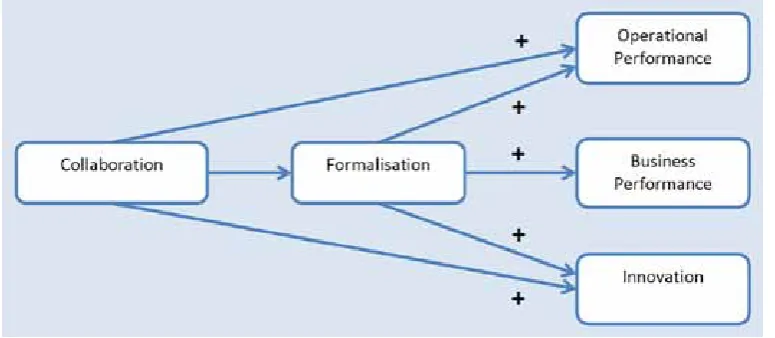
[image:20.595.104.492.178.347.2]In order to gain a richer picture of the benefits of collaboration, we conducted some advanced statistical analysis. The results showed that collaboration leads to increased business and operational performance, in addition to innovation in the form of products, services, processes and technology. Most strikingly, the results suggested that this positive relationship is statistically higher for organisations that are BS1100 certified compared to the firms that are not certified. We were also able to group the respondents according to their familiarity with the principles of BS1100 (shown as ‘Formalisation’). The firms that were familiar with the principles of BS11000 had a higher performance in terms of business and operational performance and were more innovative. The overall relationships between collaboration and outcomes can be seen in the figure below.
Figure 1. Relationships between collaboration, formalisation and performance outcomes
The second part of the analysis looked at the role of formalisation (i.e. standardisation through BS1100) in realising the benefits of collaboration. For the firms where collaborative behaviour were more formalised, the outcomes were perceived to be more significant or easier to demonstrate. This also suggests that managers are only able to understand, appreciate and demonstrate the business performance benefits of collaboration when an organisation provides an environment that systematically supports, captures and utilises collaborative behaviour. Contrary to some academic research, we observed that it is through formal and systematic processes and procedures that managers understand the benefits of collaboration in terms of cost and business growth. However this formalisation refers to systematic adoption of collaborative working and does not entail strict job descriptions or penalties that counter collaborative behaviour. Next we describe the measurements we used to achieve these results.
We used a combination of statistical analysis methods to analyse the relationship between collaboration and performance outcomes (or benefits), and also the role of formalisation (or standardisation) in terms of moderating the relationship between collaboration and outcomes. In other words, we also checked the effect of formalisation on the strength of the relationship between collaboration and outcomes. In order to measure collaboration, we assessed the collaborative working principles embedded within the survey respondent’s organisation. This included the level of mutual profitability, joint responsibilities, working together, shared culture, shared values, common language, willingness to collaborate and level of opportunistic behaviour. For performance outcomes, we focussed on three key outcome measures which are detailed below:
• Business Performance: This was a measure used to assess the performance of the firm. It specifically explored growth in sales, return on sales, growth in return on sales, growth in market share, return on investment, and growth in return on investment from the perspective of the survey respondent in relation to their firm. • Operational Performance: This measure assessed the responsiveness, time to market, order fulfilment and
level of customer service from the perspective of the survey respondent in relation to their firm.
• Innovation: The innovativeness of the firm was measured by number of product and service innovations, speed of introduction, number of new processes and the nature of technology.
Collaboration for Innovative
Solutions
The need for companies to work closely who may have previously been competitors (and sometimes for a significant period of their history) is becoming more and more prevalent these days. Business
requirements are more complex than ever and rarely can a single company have the entirety of knowledge and expertise to meet such complexity. However we also recognise that the risks pertaining to the formation, development and maintenance of a successful collaborative team can be significant and this poses yet another challenge in going down the collaborative route. Recognising and addressing such risks were key to understanding and then firmly establishing our collaborative approach in support of the Home Office Bluelightworks™ programme. Bluelightworks™ is a Home Office funded capability for which Selex ES is the lead supplier, managing a collaborative partnership of expertise from Industry, Academia and Trade Associations. Our role is to deliver efficiencies in technology, business processes and resources in support of our customers and we work with customers and end-users to optimise new and existing infrastructure, to de-risk critical decisions and outcomes, and improve outputs. The Bluelightworks™ team currently comprise a mix of approximately 100 companies who have come together to share best practice and expert knowledge delivering the best outcomes, whatever the question. A key success of the Bluelightworks™ programme has been the establishment of a trusted environment where all partners, individuals and Intellectual Property are respected, but where insightful knowledge and domain expertise can be shared.
The collaborative manner in which we operate delivers a firm foundation of trusted advice. In addition, the open working environment we have adopted with all partners spanning Industry, Academia and Trade Associations as well as with our client, has thus far demonstrated the following benefits: • Improved quality of decisions and negating the need for multiple rounds of clarifications to
obtain additional information
• Provided innovative and agile thinking engendering an environment that is comfortable with challenging the norm and thereby enabling more freedom of thought
• De-risk future outcomes from building a knowledge base for future re-use
Further, commenting on the recent announcement that Bluelightworks™ is through to the final of the Institute of Collaborative Working (ICW) Awards, Programme Director Clive Morgan said: “This is a credit to everybody who has been involved in Bluelightworks™, in setting up a unique organisation and collaborative way of working, with over a hundred partner companies. To date the Public Safety and Criminal Justice systems within England and Wales have seen savings of hundreds of millions of pounds due to Bluelightworks™”.
Bluelightworks™ operates closely with other organisations in the wider criminal justice system such as the College of Policing (CoP), the Home Office’s Centre for Applied Science and Technology (CAST), Home Office Crime & Policing Group (CPG), and Home Office Technology (HOT).
4. Distinction between Benefits and Value
“The value of collaboration is mutual benefit.”
“So the value has been in being able to have a different level, more
strategic conversations with our customers, but also the fact that it’s
created a framework for our teams and our more junior staff members to
work to. So there’s a common way of working across the business now.
So that’s a value that’s directly attributable to collaborative working”
“Value probably isn’t easy for us to quantify. I mean we don’t have
any particular measure that I’m aware of in our business that says,
you know, this is how… this is the measure that reflects the benefits of
collaboration. I don’t think it’s quite that straightforward. There are things
like the financial benefits that you could easily pick out, but there are other
things, such as the relationships, the communications, and the general
cultural improvement that comes from a collaborative arrangement that
aren’t easy to measure”
An overarching attribute of value is mainly around its future orientation. Whilst benefits are seen as the outputs of the present, value was considered as a strategic, longer-term outcome.
The notion of value was seen as a broader concept than only the financial outcomes. The quantification of value however is a major challenge. This was indicated at all levels of the research, including the interviews, workshop and the survey.
The Benefits and Value of Collaboration as Indicated by the Participants
of the Research
Benefits
Innovation
Better problem solving
Customer satisfaction
Operational efficiencies
Employee satisfaction
New competence & skill development
Continuous improvement
Customer repurchase intention
Better supply chain relationships
Increased trust
Reputation
Overall business performance
Cost reduction
Values
Value is more intentional, more
embedded, long-term and has a formal
structure
Brings out value for the right outcome
not output
As a means of working not the goal
Sharing knowledge, experience, input to
achieve better than what they produce
individually
Access to competences
Long term acceptable profit
More value than operating
independently
Working for future
Continuously evolving
Different for every project
More than project objectives
5. Drivers for Collaboration
Business Continuity
NATS is a global leader in innovative air traffic solutions, handling over 2 million flights annually over the UK and eastern North Atlantic, ensuring the safe passage of millions of passengers through some of the busiest and most complex airspace in the world. Operations run 24 hours a day, 365 days a year using highly sophisticated systems, designed and built to exacting standards, with high resilience and multiple fallback modes.
NATS seeks to develop successful relationships with the major suppliers that develop and support the critical systems and services that it uses, in order to work together to achieve common objectives, manage risk, reduce costs and generate mutual benefit. These relationships can be further enhanced, where the right collaborative behaviours are exhibited and appropriate protections agreed, to encourage NATS to maintain and actively increase its levels of business with these selected partners and look at joint business opportunities.
NATS and Lockheed Martin have established a strategic partnership through a long-standing, valued and mutually beneficial relationship in the Air Traffic Management Sector. NATS see Lockheed as a customer focused, high performing supplier of highly reliable technology solutions that supports its business continuity requirements. Lockheed view NATS as a valued customer and a strong reference for demonstrating commitment and proven performance for service provision in a safety critical environment. Lockheed Martin have been working with NATS for over 25 years, having been the prime contractor during the installation of the New En-route Centre at Swanwick, which opened in 2002. Since that time Lockheed Martin has provided a cost effective and stable long-term system development and support service at the centre. The system handles the London Flight Information Region, one of the busiest in the world.
On the afternoon of Friday 12th December 2014, following a technical fault with the Swanwick system, major disruption was caused over the south east of England, with a knock impact to the rest of Western Europe. Staff from both organisations worked to ensure the issue was dealt with rapidly and effectively, first to resolve the problem and then to identify the cause. The commitment shown by the Lockheed team on that day illustrates their
dedication to helping NATS provide a full, safe and efficient operational service on a continuous basis. Furthermore, the ethos of the Lockheed Martin senior team is to support NATS immediately in times of emergency, without obstruction, or ever seeking additional commercial advantage or benefit. It is the trust that these behaviours have engendered that has stood the relationship in such good stead for so many years. The UK Civil Aviation Authority (CAA) conducted an independent inquiry of the event and observed that the commercial and relationship model in place is both well practiced and highly appropriate to such a safety critical, operationally expedient environment.
6. Key Challenges for Collaboration
The greatest challenge identified in the survey was about creating a collaborative culture. Creating an organisational culture that fosters behaviours, incentives, systems and procedures around collaboration was mainly depicted as the biggest hurdle for further integration.
What actually constitutes a collaborative culture is still not readily defined. The flexible and dynamic nature of interactions and relationship makes this very difficult to systematise, measure or quantify. The next most commonly cited challenge was the lack of experience and skills that are necessary to embed collaborative working practices.
“Our biggest challenge was socialising collaboration amongst our staff, amongst our team. So doing more than ticking the boxes, and actually embedding the culture in the organisation, and keeping that momentum up so that teams have an awareness and understanding. It’s impossible to just have one or two people responsible for this and it has
to be embedded in our entire relationship management function.”
“The key thing for us is this whole culture around collaborative working. A lot of peo-ple just still don’t get it and they say, somebody will say we’ve got a major collaborative programme. We’ve got some really big programmes that are collaborative. If you asked them if they are exercising the principles of collaborative working within their collaborative programme, I think the answer would probably be no. So you can have a major programme which everybody talks about as being a collaborative programme but the collaboration is merely the partnership that exists for political expediency and it doesn’t necessarily involve
In our interviews, respondents clearly signalled a shortage of individuals who are capable and qualified to manage collaborative projects. Hence, it is important for business schools, academies and colleges to start addressing this educational need.
Our research has contributed to the domain of collaborative skills. In this respect, we have identified a list of professional skills as key identified by respondents of/to the interviews, workshop and survey. These are presented in Table below.
Linked to this, another major concern is the ad hoc approach for selection and allocation of resources for collaborative projects. This is evident across many industries and the selection of individuals and other important resources for a collaborative project is generally done based on experience or ‘gut feeling’. Hence we see this as a major issue and there is a need to better define the skills and resources necessary for effective collaboration both at the individual and organisational levels.
Identified Skills for Collaboration
Trust
Sharing Information
Giving early warning
Leadership Problem solving Cultural awareness Sharing objectives/goals Sharing leadership Joint decisions-making Autonomy Accountability Risk sharing Reward sharing Resource sharing Openness Honesty Responsiveness
Understanding peoples styles
Cross industry skills
Understand the importance and status of collaboration for each stakeholder
Continuous improvement
Taking responsibility
Collaborative working credentials and experience
Relationship honesty
Personal bonds
Trust
Accelerated Completion
The collaborative relationship between Transport for London (TfL) and BAM Nuttall is rooted in a common understanding of aspirations, a desire to improve risk management and an aim to create added value. This joint approach, which was developed through the Blackwall Tunnel Northbound Refurbishment project, allowed the team to take a fresh approach to programming and project management and ultimately deliver the project 12 months early.
Following the success of the Blackwall Tunnel Refurbishment, BAM Nuttall was awarded a place on the Structures and Tunnels Investment Portfolio (STIP) Framework, working directly with TfL on
three significant ECI projects: Chiswick Bridge, Fore Street Tunnel and Woodlands Retaining Wall.
Advanced Project Thinking (APT), used with great success on the Blackwall Tunnel Refurbishment, was introduced to the STIP Framework early on to facilitate collaborative planning.
BAM Nuttall, TfL and the designers were co-located in one office, which provided the perfect collaborative atmosphere for the creation of best benefit for each scheme. Joint KPIs were agreed and assessed every four weeks and together, the STIP Team developed a joint Vision, Mission and Values statement which set out the aims and objectives of all partners; where we wanted to be, what we would do and how we would do it.
On STIP, the ‘One Team’ delivery approach allowed the team to maximise benefit to the project and identify value engineering opportunities in the Early Contractor Involvement (ECI) phase. Open and honest communication enabled all ideas to be considered and allowed TfL to make informed decisions about the scheme. ECI developments were publicised to project members in a weekly newsletter that re-enforced the “One Team” approach.
Each week, representatives of BAM Nuttall, TfL, Site Agents and Designers hold a progress meeting. The meeting is led by an external facilitator to ensure that there is a collaborative environment and that the focus remains on the best way to achieve the right outcomes. The success of this approach has been considerable, for example the Fore Street Tunnel programme was reduced so much that it allowed the project to expand and include systems upgrades.
Crucially, the strength of the relationship between BAM Nuttall and TfL which produced genuine trust between the partners, gave the team confidence in developing solutions when dealing with risk. Risk workshops were carried out every two weeks to discuss and mitigate risk and allocate identified risks to the most appropriate owner, to achieve the most advantageous solution.
Collaboration between the BAM Nuttall and TfL extended far beyond the project controls. For example, to choosing supply chain partners and designers; BAM Nuttall included TfL and the designers in the vendor evaluation panel and TfL invited BAM Nuttall to help choose the designers for the Fore Street Tunnel project.
Stakeholder relationships were managed jointly and individual stakeholders were managed by the organisation best placed to do so. All parties were trusted to represent the team and this gave team members the ability to act in the best interests of the projects.
The close cooperation and coordination of many stakeholders helped to ensure that the works at Chiswick Bridge were complete in time for the 2015 Oxford and Cambridge University boat race. Through a flexible approach to construction at Woodlands Retaining Wall (eg. adjusting work areas and timings) the impact on the travelling public and local residents was kept to a minimum.
This fully integrated, collaborative team approach involving BAM Nuttall, TfL, Designers and the Supply Chain helped to ensure success of these projects and continues to ensure that a productive, mutually beneficial relationship exists between all partners.
Innovation Through Co-operation
Demographic change in combination with an overall positive economic development creates in a “rurally structured” region like the Western Palatinate in Southwest Germany issues concerning the “supply” with highly qualified people. GDELS-G identified this development not only as a risk but at the same time as an opportunity to keep its qualified personnel in the company in times of insufficient workload. It is critical for GDELS-G to keep/mange this capability as it is a pre-requisite for being able to accept future contracts within its area of business. GDELS-G developed a unique concept (“Turning labour leasing topsy-turvy”), to our knowledge as first company, leading to a win-win-win-win situation (GDELS as company entity – employees of GDELS – Third party companies – the region Western Palatinate) providing significant added value for all parties involved.
GDELS-G is sharing its most valuable resource, highly qualified production personnel e.g. aluminium welders ( more than 50 people, representing 1/7 of its staff) with other companies in the region that have a demand for these qualification and cannot satisfy it from the “depleted” job market. GDELS-G is doing this on a non-profit basis, keeping the critical capability within the company in times with insufficient workload, ensuring the employee’s job safety without negative impact on their income and at the same time creating value in the region by helping third parties to fulfill their delivery obligations.
The idea:
• Managing overcapacity through staff leasing.
• Qualified employees that are not working to full capacity are leased out through cooperation with other companies (cost effective or even generating gross margin)
The benefits:
• Keeping skills within the company
• Sustainable relationships with other companies within the region • Save severance and short time work costs
• Cover later staff requirements without having any recruiting and qualification costs
• High advertising effect, and significant impact on our reputation. (Big support by unions. politics and other business development organisations)
7. In which areas of business does collaboration feature?
The table shows the percentage of respondents who indicated the business functions where collaboration featured in their organisation. This question allowed for multiple answers therefore percentages represent the ratio of respondents that selected the respective business areas. Procurement and business development was by far the most collaborative business functions with circa 60% of respondents indicating collaborative working in these areas. These were then followed by New product development or service design , consulting, HR, manufacturing, and technology but these only accounted for 20-30% in the firms surveyed. The least collaborative area was distribution and packaging.
This result illustrates that collaboration in its broadest sense ‘has not travelled far into the organisation’. Collaboration is still at the external interfaces/peripheral interfaces of organisations. Even traditional organisational functions such as marketing and after-sales had very little collaborative activity. A surprising finding is the very low levels of collaboration in research and development. Current promising practice indicates an increasing trend towards collaboration in these more innovative parts of the organisation. However, our results indicate that the progress of collaboration across functions is slow. There are plenty of future opportunities for the adoption of collaboration within firms in various industries.
Network Rail have embarked on a programme of electrifying key UK rail routes that will mean faster, greener, quieter and more reliable journeys for thousands of passengers. More seats than diesel trains and superior performance will give journey-time savings.
Costain already had a strong presence in rail, having constructed many stations including the award winning terminus at St Pancras. Babcock had in-house engineering capability and knowledge of rail systems and Alstom had in-house design capability and experience of International best practice.
The three organisations came together and used the BS11000 approach as a framework for collaboration to understand their common strengths, weaknesses and goals. Partner Development Plans (PDPs) were developed and they started to work together to bid for work as part of Networks Rail’s electrification programme.
The new collaborative relationship focussed on the strengths of the partners in particular their complementary blend of skills and expertise and a focus on customer relationships to provide an alternative and flexible
offering for Network Rail.
This BSS 11000 collaborative relationship has been so successful that in 2014, Alstom, Babcock and Costain formed a new limited company, ABC Electrification Limited, to support customers in meeting their challenges - the only BS 11000 requirement was to formally enact the ‘Exit Strategy and close out the Partner Development Plan.
ABC is now a market leader in Electrification with major framework contracts on the West Coast Mainline, Great Western, South Wales and Scotland. ABC is now able to combine design, engineering and delivery expertise across all electrification activities, so it can be trusted with the most complex, demanding schemes and will now be seeking BS 11000 certification in its own name for collaboration with its own strategic partners.
8. Future Directions for Collaboration Research
The research clearly showed that engagement with collaboration is likely to increase in parallel with time, resources and investments spent on collaboration. Survey respondents overwhelmingly pointed out that they should spend more of their work time and resources on collaboration. As a result of this initial research, we identified further areas of interest that were considered as key priorities for managers across different industries.
1. Understanding the broader view of values and benefits of collaboration
We all know that collaboration provides more value than operating independently and this research provides further evidence. Collaborative work should establish goals and objectives which are actually driven by the expectation of added value. To achieve this, collaborative working needs to be taken seriously at strategic and operational levels within an organisation. As this research suggests, it is not only the collaboration itself but the approach also delivers value. In other words, collaboration should be seen as a means of organising, establishing or formalising the necessary procedures or systems to explore and capture added value. At a higher level, collaboration creates and sustains the environment necessary for open, honest and value-adding conversation with internal or external stakeholders. This research clearly suggests only through an effective, formalised or systematic means that collaboration actually results in business performance in terms of cost and revenue realisation. Whilst it is known that collaboration delivers value, we still lack a coherent and comprehensive framework that could help organisations to demonstrate and quantify value. How could value generated from collaboration be isolated to enable its quantification? How could managers go about demonstrating the value of collaboration to colleagues in their organisations? Are there any tools or measures which can help organisations from different industries to quantify value? What are the factual figures and measures which can allow us to articulate the value of collaboration?
2. Exploring the psychology of collaboration: What skills and traits are required for effective collaborative working?
Scientific research in evolutionary biology and psychology shows that, as humans, our moral ideas and actions are a product of our nature as social creatures. Thus we are ‘intuitively collaborative’ creatures: our automatic impulse or initial instinct is to act collaboratively as opposed to acting selfishly. Despite this natural impulse, collaborative working still has a long way to go to become a standard way of operating within and across different industries.
the way individuals enact collaborative behaviours. So at an organisational level, what kinds of mechanisms drive a collaborative culture? At an individual level, what specific skills or traits are more likely to be effective for collaboration? How could we create an organisational structure that fosters collaborative working? Embedded in these questions is the interplay between individuals and organisations and it is this dynamic that we would like to explore in future research on collaboration.
3. Involvement of Supply Chains: How can supply chains engage in collaboration?
It is argued that it is supply chains which compete, not companies. Hence it is important for an organisation that takes collaboration seriously to think about the role of its supply chain. Engaging supply chains in more collaborative relationships was generally seen as a UK business challenge. Respondents indicated that BS11000 does not cascade down to supply chains as rapidly or as easily as they envisaged. This is also linked to issues associated with creating a collaborative culture that encompasses suppliers, customers and partners. Poor communication and understanding are listed as other barriers for more collaborative relationships. From the other side however, buyers needs to trust and be brave enough to change traditional ways of working and adopt an open stance to engage with their suppliers.
In addition, supplier education is seen as an initial step to align collaborative behaviour across organisations. So it is important to further explore how can suppliers be proactively encouraged to engage in collaboration. What type of suppliers should be selected initially? How can a firm facilitate collaborative culture in its supply chain? How can learning occur within the supply chain? How can we transfer and capture knowledge generated from collaboration across the companies in the supply chain?
4. What does a good ‘exit strategy’ look like?
In general, exit strategies are associated with failed relationships or underperforming contracts; however an exit strategy is as much about managing the success of a project as it is about dealing with failure:
This excerpt from the interviews demonstrates the importance of an exit strategy for collaboration. This topic came out as an overarching important theme in this research. Across all industries, we observed a major lack of systematic exit strategy. As a practice, it was mainly carried out as an afterthought. Generally, it was only discussed when collaboration was likely to fail. A major risk associated with an ad-hoc exit approach was the movement of people. This could happen either internally through promotions or externally by individuals moving into a different role in a different organisation. A number of cases were documented where the movement of people negatively impacted collaborative relationships. It can be argued that maturity leads to better exit strategies and we observed that companies with more established exit strategies tended to have more mature supplier relationships or experienced an event in the past which triggered a more systematic approach. Closely associated with this is, of course, the nature of contracts and performance measurement. So it is important to proactively deal with issues such as; what triggers a bad exit? How do firms continue to support each other after the completion of the project? What happens if a customer decides not to sign an extension to the contract? As a firm, how and when do you stop providing support in terms of systems and infrastructure? What happens to the people and resources after collaborative project completion? How can contracts be shaped to include exit strategy?
As a whole, these four areas of research will underpin the follow up research projects that will be conducted by Warwick Business School in partnership with ICW. Hence please do not hesitate to contact us if your organisation would like to get involved in any of the areas mentioned in the report.
“We had a really successful programme where we designed the contracts and for many years it’s been extremely successful. But now, it’s got a few problems. And guess what? There’s only one person in the company and there’s only one person on the customer side that was involved at the start of the programme. So, you have to wonder if we’ve been able to maintain