warwick.ac.uk/lib-publications
A Thesis Submitted for the Degree of PhD at the University of Warwick
Permanent WRAP URL:
http://wrap.warwick.ac.uk/93215
Copyright and reuse:
This thesis is made available online and is protected by original copyright.
Please scroll down to view the document itself.
Please refer to the repository record for this item for information to help you to cite it.
Our policy information is available from the repository home page.
M
A
E
G NS
I
T A T
MOLEM
U N
IV ER
SITAS WARWIC EN
SIS
Nonlinear and multi-modal oscillatory
processes in active regions of the solar
atmosphere
by
Dmitrii Kolotkov
Thesis
Submitted to the University of Warwick
for the degree of
Doctor of Philosophy
Department of Physics
Contents
Acknowledgments iv
Declarations v
Abstract viii
Chapter 1 Introduction 1
1.1 The atmosphere of the Sun: photosphere, chromosphere, and corona 1
1.2 Solar flares . . . 6
1.2.1 Solar flares: observations and model . . . 6
1.2.2 Quasi-periodic pulsations (QPP) in solar flares . . . 11
1.3 Prominences . . . 37
1.3.1 Observations of oscillations in quiescent prominences . . . 38
1.3.2 Analytical modelling of oscillations in prominences . . . 40
Chapter 2 Spectral analysis of solar periodicities with the Hilbert– Huang transform (HHT) 45 2.1 HHT analysis in solar physics . . . 45
2.2 Empirical mode decomposition analysis of random processes in the solar atmosphere . . . 50
2.2.1 Introduction . . . 50
2.2.2 Methodology and properties of coloured noises in EMD . . . 52
2.2.3 Noise-testing of SDO/AIA data . . . 58
2.2.4 Discussion and conclusions . . . 63
2.3 Long-period quasi-periodic oscillations of a small-scale magnetic struc-ture on the Sun . . . 66
2.3.1 Introduction . . . 66
2.3.2 Observations . . . 67
2.3.4 Discussion and conclusions . . . 72
2.4 HHT analysis of periodicities in the solar activity cycles 22, 23, and 24 74 2.4.1 Introduction . . . 74
2.4.2 Data . . . 78
2.4.3 Analysis . . . 79
2.4.4 Discussion and conclusions . . . 87
2.5 Multi-mode quasi-periodic pulsations in a solar flare . . . 90
2.5.1 Observations . . . 91
2.5.2 HHT analysis . . . 93
2.5.3 Discussion of results and conclusions . . . 97
Chapter 3 Equilibria and oscillations of current sheets 102 3.1 Kinetic model of force-free current sheets with inhomogeneous trans-verse profiles . . . 102
3.1.1 Introduction . . . 102
3.1.2 Analysis . . . 104
3.1.3 Discussion and conclusions . . . 112
3.2 Nonlinear oscillations of coalescing magnetic flux ropes . . . 113
3.2.1 Introduction . . . 113
3.2.2 Analysis . . . 115
3.2.3 Nonlinear oscillations . . . 118
3.2.4 Discussion and conclusions . . . 122
Chapter 4 Transverse oscillations of quiescent prominences in a mag-netic field dip 124 4.1 Small amplitude oscillations and stability . . . 124
4.1.1 Introduction . . . 124
4.1.2 Model, forces, and equilibrium . . . 125
4.1.3 Small amplitude vertically polarised oscillations . . . 129
4.1.4 Small amplitude horizontally polarised oscillations . . . 131
4.1.5 Discussion and conclusions . . . 132
4.2 Finite amplitude regime of oscillations . . . 133
4.2.1 Nonlinear coupling and resonance of vertically and horizon-tally polarised oscillations . . . 134
4.2.2 Large amplitude oscillations . . . 143
4.2.3 Summary of results and conclusions . . . 150
Acknowledgments
I would like to thank my supervisor Prof. Valery Nakariakov for his support
through-out my PhD course. I am also grateful to my co-authors and colleagues: Sergey
Anfinogentov, Andrey Afanasyev, Anne-Marie Broomhal, Daniel O’Connell,
Bog-dan Hnat, Elena Kupriyanova, Giuseppe Nistic`o, David Pascoe, Ivan Vasko, George
Rowlands, Ivan Zimovets, for stimulating discussions and constructive comments.
Special thanks go to Warwick Postgraduate Coordinator, Susan Tatlock, for her
Declarations
I declare that this thesis is my own work except where indicated. It has not been
submitted for a degree at another university. The results presented in this thesis are
based on the following peer-reviewed journal articles (8 published and 1 submitted):
• D. Y. Kolotkov, V. V. Smirnova, P. V. Strekalova, A. Riehokainen, and V. M. Nakari-akov, Long-period quasi-periodic oscillations of a small-scale magnetic
struc-ture on the Sun,Astronomy and Astrophysics, 598:L2, 2017.
• D. Y. Kolotkov, S. A. Anfinogentov, and V. M. Nakariakov, Empirical mode decomposition analysis of random processes in the solar atmosphere,
Astron-omy and Astrophysics, 592:A153, 2016.
• D. Y. Kolotkov, V. M. Nakariakov, and G. Rowlands, Nonlinear oscillations of coalescing magnetic flux ropes,Physical Review E, 93(5):053205, 2016.
• D. Y. Kolotkov, G. Nistic`o, and V. M. Nakariakov, Transverse oscillations and stability of prominences in a magnetic field dip,Astronomy and Astrophysics,
590:A120, 2016.
• V. M. Nakariakov, V. Pilipenko, B. Heilig, P. Jel´ınek, M. Karlick´y, D. Y. Klimushkin, D. Y. Kolotkov, et al., Magnetohydrodynamic oscillations in the solar corona
and Earth’s magnetosphere: towards consolidated understanding, Space
Sci-ence Reviews, 200:75–203, 2016.
• D. Y. Kolotkov, I. Y. Vasko, and V. M. Nakariakov, Kinetic model of force-free current sheets with non-uniform temperature,Physics of Plasmas, 22(11):112902,
• D. Y. Kolotkov, A.-M. Broomhall, and V. M. Nakariakov, Hilbert–Huang transform analysis of periodicities in the last two solar activity cycles,Monthly
Notices of the Royal Astronomical Society, 451:4360–4367, 2015.
• D. Y. Kolotkov, V. M. Nakariakov, E. G. Kupriyanova, H. Ratcli↵e, and K. Shibasaki, Multi-mode quasi-periodic pulsations in a solar flare,
Astron-omy and Astrophysics, 574:A53, 2015.
• D. Y. Kolotkov, G. Rowlands, G. Nistic`o, and V. M. Nakariakov, Finite ampli-tude transverse oscillations of prominences in a magnetic field dip (submitted).
and have been partly reported at the following scientific conferences and workshops:
• 1st ISSI Workshop “Quasi-periodic Pulsations in Stellar Flares: a Tool for Studying the Solar-Stellar Connection ”, February–March 2017, Bern,
Switzer-land.
Oral talk: Nonlinear oscillations of coalescing magnetic ropes
Oral talk: Hilbert–Huang Transform analysis of solar quasi-periodicities
• 5th RadioSun Workshop, May 2016, Ceske Budejovice, Czech Republic. Oral talk: Nonlinear oscillations of coalescing magnetic islands
• Solar and Solar-Terrestrial Physics, October 2015, Pulkovo Observatory, Saint Petersburg, Russia.
Oral talk: Self-oscillations of a current sheet generated by the coalescence
instability
• 3rd SOLARNET Meeting “The Sun, the stars, and solar-stellar relations”, September 2015, Freiburg, Germany.
Poster session: Empirical mode decomposition studies of quasi-biennial
varia-tions in helioseismic frequencies
• 4th RadioSun Workshop, June 2015, Irkutsk, Russia.
Oral talk: Hilbert–Huang transform analysis of QPP in a solar flare in the
• Plasma Physics in Solar System, February 2015, Space Research Institute (IKI), Moscow, Russia.
Poster session: Hilbert–Huang analysis of periodicities in the last two solar
activity cycles
• 3rd ISSI Workshop “MHD Oscillations in the Solar Corona and Earth’s Mag-netosphere: Towards Consolidated Understanding”, December 2014, Bern,
Switzerland.
Invited talk: Analysis of nonlinear QPPs in solar flares
• Nobeyama Solar Radiophysics symposium, September 2014, Nobeyama, Japan. Invited talk: Nonlinear quasi-periodic pulsations in solar flares
• 3rd RadioSun Workshop “Solar Flares and Energetic Particles”, August 2014, Pulkovo Observatory, Saint Petersburg, Russia.
Abstract
For longer than a century, analysis of a quasi-periodic variability of the Sun
on various time scales has been attracting great interest among the research
commu-nity. These signals are continuously detected throughout the whole electromagnetic
spectrum, and often have non-stationary oscillation periods and irregular profile
shapes. The physical mechanisms responsible for such variations are usually
hid-den, and their revealing always require an advanced combination of powerful
spec-tral techniques and strong theoretical foundations. This thesis considers oscillatory
phenomena occurring in the solar atmosphere from these two perspectives.
For the spectral analysis of solar periodicities the self-adaptive Hilbert–
Huang transform (HHT) method is employed. With the statistics of coloured noises
incorporated, it allowed for the detection of a long-period oscillation of a small-scale
photospheric magnetic structure, whose period grows from 80 to 230 min and
posi-tively correlates with the amplitude. A multi-modal nature of the solar flare
quasi-periodic pulsations was also revealed with HHT. The detected intrinsic modes have
mean periods of 15, 45, and 100 s, and can be interpreted as the kink and sausage
magnetohydrodynamic oscillations of a flaring loop. Analysis of much longer solar
periodicities associated with the magnetic activity cycles 22, 23, and 24 was also
successfully performed with HHT, revealing a broad range of intrinsic modes with
periods from about a month to several years (including the 11 yr cycle).
From the theoretical point of view, the one-dimensional equilibrium and
dy-namical models of current sheets in the corona have been developed. The equilibrium
across the current sheet, as found for realistic physical conditions. The dynamical
model describes nonlinear oscillations of the current sheet formed by the
coales-cence of two magnetic flux ropes. The oscillation period is found to be about the
ion plasma period or longer, and is prescribed by the current sheet thickness, the
plasma parameter , and the oscillation amplitude.
Analytical modelling of finite amplitude transverse oscillations in quiescent
prominences situated in a magnetic field dip, is also performed in the thesis. The
model is based on the line-current concept and accounts for the interaction of
the prominence current with the electrically conductive photosphere. In the
lin-ear regime, the horizontal and vertical motions are considered independently, and
the mechanical stability of the system is analysed. The oscillation periods are
de-termined by the prominence current, its mass and height above the photosphere,
and the properties of the magnetic dip. In the case of finite amplitudes, the
hor-izontal and vertical modes were found to be nonlinearly coupled with each other,
and a metastable equilibrium state of the prominence was revealed. The periods of
Chapter 1
Introduction
Is our nearest star, the Sun, a rather quiet and boring astronomical object, or does it still provide us with research challenges full of rich interesting physics? Traditionally, the term “quiet” is indeed often applied to the Sun, characterising it as a steadily evolving massive plasma ball. However at the same time numerous observational results, continuously being obtained during the last several centuries and of continu-ously improved instrumental resolution and sensitivity, evidently show the presence of a variety of dynamical and transient phenomena of vast complexity, superimposed on a quiet solar atmosphere. These phenomena have very di↵erent manifestations, including rapid coronal mass ejections (CMEs), relatively cold sunspots and myste-riously levitating prominences, recently discovered solar “tsunamis”, coronal holes, and solar flares. This chapter partly based on the work by Nakariakov et al. [2016b], gives state-of-the-art insights into the physics of some of them.
1.1
The atmosphere of the Sun: photosphere,
chromo-sphere, and corona
The solar atmosphere is generally defined as the outer part of the Sun where the photons produced in the solar interior are able to escape into outer space. It is usually considered to consist of three quasi-spherical plasma shells, which can be distinguished by their unique physical properties (see Fig. 1.1). The inner, relatively thin (of a few hundred kilometres) and dense (⇠ 10 5 10 3 kg m 3) layer with
Figure 1.1: Schematic structure of the quiet solar atmosphere, i.e. the variation of the mean temperature (thick solid line) and density (dashed line) with height [adapted from Priest, 2014].
field lines with a typical strength of a few kilogauss, appearing during the magnetic flux emergence. Sunspots are usually about 4 to 60 Mm in diameter, while their life-time changes proportionally to their area, typically from a few days to a few months. Sunspots are also known to be efficient waveguides and resonators supporting vari-ous oscillatory phenomena. In particular, an example of a 3-min sunspot oscillation accompanied by small-scale quasi-periodic random processes in a sunspot umbra, is considered in Sec. 2.2. Large-scale conglomerates of sunspot groups of di↵erent polarities are known as active regions. On average, in the Northern and Southern hemispheres of the Sun there is always a domination of a certain magnetic polarity, i.e. for about 11 yr one of the hemispheres is more magnetically “positive” and the other is more “negative”. Then the polarity swaps, thus forming a continuous long-term chain of minimum and maximum solar activity, known as the 11 yr solar cycle [Hathaway, 2010]. Shorter-term periodicities of the global magnetic activity of the Sun, for example quasi-biennial (1–4 yr) and Reiger-type (shorter than 1 yr) oscillations, appearing over the cycles 22, 23, and 24 are addressed in Sec. 2.4.
The layer of the solar atmosphere, lying just above the photosphere, is the chromosphere. It is a partly-ionised, rarefied and more transparent plasma observed in the optical, ultraviolet (UV), and X-ray spectral bands. Its temperature in-creases gradually from about 4, 500 K (the temperature minimum, see Fig. 1.1) to 10, 000 K, then changes dramatically to coronal values of about 1 million K through a narrow transition region. Similarly to the photosphere, the chromosphere is a highly inhomogeneous and dynamic medium. It is full of various fine-scale objects and phenomena, including spicules (chromospheric plasma jets) typically observed at the limb, disk-situated fibrils, flare-induced particle beams and wave motions, and what is probably the most important – a network of the chromospheric magnetic field. It is anchored at the boundaries of photospheric supergranulation cells, and continuously spreads out with height as the background density rapidly decreases. The decrease in density leads to the decrease of the thermal pressure (according to the equation of state). Taking into account the equilibrium condition, which is the balance of the total pressure inside and outside the structure, and conservation of the magnetic flux, this process eventually forms wineglass-shaped magnetic funnels and magnetic arcs higher in the solar atmosphere. These magnetic non-uniformities play a key role in guiding of the magnetoacoustic and Alfv´en magnetohydrodynamic (MHD) modes, which are believed to significantly contribute to the heating of the chromosphere [Pascoe et al., 2013; Brady and Arber, 2016].
Figure 1.2: Typical examples of plasma loops in the solar corona, observed in the EUV band with the Atmospheric Imaging Assembly instrument of the Solar Dy-namics Observatory (SDO/AIA) in the 171 ˚A channel (left-hand panel), soft X-rays with the Hinode X-Ray Telescope (XRT) (middle panel), and in microwaves with the Nobeyama Radioheliograph (NoRH) at 17 GHz (right-hand panel).
soft X-ray, and microwave bands are shown in Fig. 1.2. Natural and externally-driven MHD oscillations of coronal loops are thought to produce various quasi-periodic pulsations (QPP) of the electromagnetic emission measured in solar flares. More details on this phenomenon, including other alternative physical mechanisms which can be responsible for solar flare quasi-periodicities, are given in Sec. 1.2.2. An example of such QPPs observed in a solar flare light curve in microwaves and interpreted in terms of two natural magnetoacoustic modes of a flaring loop, is shown in Sec. 2.5.
1.2
Solar flares
1.2.1 Solar flares: observations and model
Observationally, a flare phenomenon could be defined as “a brightening of any emis-sion across the electromagnetic spectrum occurring at a time scale of minutes” [Benz, 2008]. Sometimes this “scale of minutes” is extended for up to several hours, re-leasing up to 1026 J of energy in a form of electromagnetic radiation (from radio to gamma-rays), and producing an e↵ective plasma heating and induced bulk flows. The question of physical mechanisms for such impulsive energy releases still remains unanswered in detail, and is therefore very attractive for researchers. In particular, it is already confidently proved that solar flares occur due to the conversion of mag-netic energy into the kimag-netic energy of accelerated charged particles and induced plasma jets, and the internal energy of the plasma, with the temperature reaching several tens of million K. Reconnection of magnetic field lines is commonly accepted as the basic mechanism for this in a standard scenario of a solar flare.
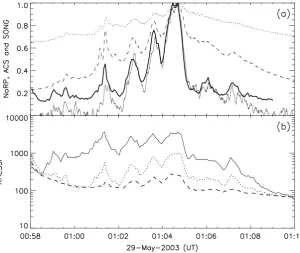
Solar flares are usually visible in all observational bands. A typical exam-ple of the light curves of the integrated (over the solar disk) solar emission during a solar flare is presented in Fig. 1.3. The observations were made simultaneously with the Nobeyama Radioheliograph [NoRH, Nakajima et al., 1994], the Ramaty High Energy Solar Spectroscopic Imager [RHESSI, Lin et al., 2002], and the Rus-sian SOlar Neutrons and Gamma-rays experiment (SONG) onboard CORONAS-F satellite [e.g. Myagkova et al., 2007]. Specific physical mechanisms responsible for the recorded emissions vary from bremsstrahlung radiation of colliding electrons accelerated by a flare trigger (for hard X-rays), to the gyrosynchrotron radiation of mildly relativistic electrons trapped inside a flaring magnetic structure (for mi-crowaves), and the thermal free-free emission of the plasma evaporated from the denser chromospheric material (for the white light, UV, EUV, microwaves and soft X-rays). The physical nature of the gamma-ray band emission is likely associated with nuclear processes, for example de-excitation, neutron capture, and positron annihilation, caused by the interaction of flare accelerated ions with dense plasma targets (e.g. the photosphere).
Figure 1.4: Top: Time derivative of the GOES soft X-ray (SXR) flux observed with a cadence of 3 s in a solar flare occurred on 27 March 1980. Vertical error bars represent 1- uncertainties generated by the digitization of the GOES data. Time interval corresponding to the GOES gain-change is replaced by the interpolated values and shown by ⇥-symbols. Bottom: Hard X-ray flux measured in the same flare with the Hard X-Ray Burst Spectrometer (HXRBS), with a time resolution of 128 ms. The vertical dotted lines in both panels indicate the position of the highest hard X-ray flux in the flare [adapted from Dennis and Zarro, 1993].
the “impulsive phase” which typically lasts up to several minutes only. In this phase hard X-ray and gamma-ray emissions rise rapidly, being often accompanied by numerous short but intense spikes, each lasting from a few seconds to tens of seconds (see e.g. Fig. 1.3). Some portion of the accelerated particles is trapped and gyrates around the magnetic field lines, producing the emission in the radio band. The following “flash phase” is characterised by the maximum of the soft X-ray and optical (in particular, H↵) emissions. After that the coronal plasma gradually returns to its initial state in the “decay phase”. However, the consequent development of the flare still can be recognised in the solar corona as the follow-up magnetic reconfiguration, plasma ejections, decaying oscillations of various coronal plasma structures and radio bursts, and at the solar surface as sunquakes.
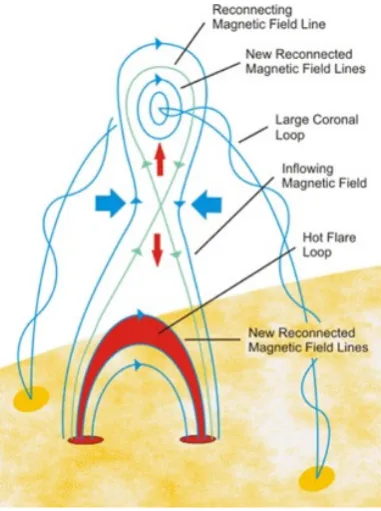
Figure 1.5: Schematic sketch of the standard model of a solar flare (courtesy Gordon Holman, NASA).
observed with the GOES satellite has a good correlation with the hard X-ray flux observed with the Hard X-Ray Burst Spectrometer (HXRBS), i.e. both light curves have nearly simultaneous peaks within the lowest time resolution provided (3 s for the SXR data). In fact, the importance of the Neupert e↵ect is that it shows a direct relationship between the accelerated electrons and the thermal plasma in a flare. In other words, a thermal soft X-ray emission is produced in a plasma heated by energetic non-thermal electrons.
lower chromosphere. In the chromosphere which behaves as a thick target for these nearly relativistic particles, they lose all their kinetic energy by Coulomb collisions and produce hard X-ray bremsstrahlung emission until they finally become thermal. The chromospheric material is thus heated up to tens of million K and evaporates upwards into the corona. This evaporated thermal plasma fills in coronal magnetic flux tubes (coronal loops), emitting soft X-rays (see Fig. 1.2, where typical examples of solar coronal loop-like plasma structures are shown).
am-plitude oscillations of current sheets created by coalescing magnetic flux ropes are investigated in Sec. 3.2.
Here the basic models of magnetic reconnection are briefly overviewed, which are characterised by the speed of reconnection (or the reconnection rate) defined as the magnetic flux reconnecting per unit time, and the reconnection time defined by the reconnection rate and the spatial scale of the current sheet [Shibata and Magara, 2011]. In the incompressible Sweet–Parker model of magnetic reconnection [Sweet, 1958; Parker, 1957], based on a steady di↵usion of the magnetic field in the current sheet, the estimated reconnection rate gives unrealistically long reconnection times, approximately of 108 109 s for typical coronal conditions. This result is unacceptably long in comparison with the typical time scale of a flare, 102 104 s. As this model cannot explain the rapid behaviour of a solar flare, the long-standing problem of fast reconnection is constituted. One of the possibilities to speed up the reconnection is o↵ered by the Petschek model [Petschek, 1964], which accounts for the plasma compressibility and the appearance of magnetoacoustic shocks leading to a much faster energy release than in the Sweet–Parker case. The reconnection rate in the Petschek model can theoretically give a value of the reconnection time comparable to the real durations of flares. Forbes and Priest [1987] extended the Petschek model for a two-dimensional case, and demonstrated that the speed of the magnetic reconnection is also controlled by the spatial structure of the inflow region of the plasma around the current sheet. However, despite significant progress, the study of fast regimes of magnetic reconnection remains one of the central problems of plasma astrophysics.
In addition, one can phenomenologically distinguish two types of magnetic reconnection: driven reconnection [e.g. Sato and Hayashi, 1979] and spontaneous reconnection [e.g. Ugai and Tsuda, 1977], which both are important in the coronal plasma context. In the latter type, various small-scale processes, for example such as microinstabilities and microturbulences, operating inside the current sheet, are the primary factor inducing the fast reconnection by a local enhancement of the resistivity up to anomalous values. On the other hand, there is an issue connected with the origin of the external source causing the driven reconnection. Its identifi-cation is important as it determines, in particular, the time variation of the energy release rate.
1.2.2 Quasi-periodic pulsations (QPP) in solar flares
emission intensity. These quasi-periodic variations of the electromagnetic emission are observed throughout the whole electromagnetic spectrum, in the radio, white light, soft and hard X-ray, and gamma-ray bands. Typical periods of solar flare QPPs range from a fraction of a second to several minutes [see e.g. Sych et al., 2009; Jakimiec and Tomczak, 2010; Nakariakov et al., 2010a; Kupriyanova et al., 2010; Van Doorsselaere et al., 2011; Ning, 2014; Van Doorsselaere et al., 2016, for recent findings]. An example of QPPs is shown in Fig. 1.3 where the oscillation period is about 40 s, and QPPs are almost synchronous in all observation bands. Moreover, it often appears that QPPs exhibit non-stationary [see e.g. Nakariakov et al., 2010b] or multiple [see e.g. Kupriyanova et al., 2013, and Sec. 2.5] periods during the same event. Likewise, QPPs can have a well-pronounced amplitude modulation. Usually, the most pronounced QPPs are seen in the emission associated with non-thermal electrons, for example the gyrosynchrotron emission in the microwave band and bremsstrahlung in hard X-rays. However, QPPs are also detected in the soft X-ray radiation produced by the thermal free-free emission [Sim˜oes et al., 2015]. QPPs can be found in all stages of the flare development, from pre-flare to decay phases.
It is commonly accepted that QPPs can be produced by several non-exclusive mechanisms, such as modulation of the plasma parameters by MHD waves [e.g. Nakariakov and Melnikov, 2006], modulation of a non-thermal electron kinematics by MHD waves [e.g. Zaitsev and Stepanov, 1982], periodic triggering of energy re-leases by external MHD waves [e.g. Nakariakov et al., 2006], MHD flow over-stability [e.g. Ofman and Sui, 2006], and self-oscillatory regimes of magnetic reconnection [e.g. Kliem et al., 2000; Murray et al., 2009]. Short period QPPs, in the sub-second pe-riod range, could be also associated with wave-particle interactions [Aschwanden, 1987].
and ground-based technological systems, for example causing distortions of the GPS navigation; disruptions of the long-distance radio communication; crucial electrical blackouts, such as the collapse of the Hydro-Quebec power network on 13 March 1989; a↵ect on humans at and near the ground level (e.g. crews and passengers of transpolar plane routes). However such e↵ects can hypothetically be caused even by relatively weak flares having QPPs in their light curves if the QPPs are in reso-nance with some geophysical oscillatory processes. Thus, understanding of QPP is certainly important for forecasting of geoe↵ectiveness of flares. In addition, QPPs have been recently detected in stellar flares, including superflares and megaflares too [see e.g. Anfinogentov et al., 2013; Pugh et al., 2016]. In the context of space weather it is important to understand whether similar devastating superflares and megaflares are possible on the Sun, and if they are, what their probability is. Stellar QPPs were found to be similar to those observed in solar flares [Cho et al., 2016], thus pointing out on the possible similarity of the physical processes operating in these phenomena.
MHD modes of a plasma cylinder
Wave and oscillatory phenomena in a plasma with spatial and temporal scales much longer than the ion gyroradii (typically < 1,000 m for almost all combinations of coronal parameters) and gyroperiods (< 10 3 s), respectively, can be adequately
described using magnetohydrodynamics. The set of ideal MHD equations considers a plasma as a single-fluid medium (assuming electrons to be inertialess and hence always providing the full electrical neutrality of the plasma), and links together the macroscopic parameters of the plasma: mass and electric current densities, temperature, gas pressure, bulk flow velocity, and the magnetic field. In the simplest case, the set of MHD equations includes the mass continuity equation, the Euler equation, the induction equation, and some form of the energy equation. On the other hand, collisionless plasma of the solar wind is observed to have anisotropic temperature distributions, i.e. the temperatures across and along the guiding field are di↵erent. This can be caused by numerous non-exclusive e↵ects, for example such as ion-cyclotron resonance, local Ohmic heating, heating by Alfv´en waves, and may lead to the development of various instabilities. In this case, the plasma pressure is a tensor with two independent components, each governed by a specific equation of state.
which are both essentially compressive, and the entropy mode. In the ideal MHD approximation the real part of the frequency of the entropy mode is zero. According to their dispersion relation all MHD waves propagate in a uniform medium without dispersion, i.e. their phase and group speeds are independent of the frequency. The typical speeds of MHD waves are characterised by the sound speedCs= ( p0/⇢0)1/2
with the adiabatic index , normally taken to be from 1 to 5/3 in the corona, and the Alfv´en speed,CA=B0/(µ0⇢0)1/2, where µ0 is the permeability of vacuum,B0, p0,
and⇢0 are the unperturbed values of the magnetic field, pressure, and mass density
of the plasma, respectively. It is also useful to introduce the cusp or tube speed, CT =CsCA/(CA2+Cs2)1/2 that corresponds to the group speed of an oblique slow
mode. Typical values of these speeds in coronal active regions vary from a hundred to a few thousand km s 1.
MHD waves are essentially anisotropic, their speeds strongly depend upon the angle↵between the wave vector and the magnetic field. These dependencies are usually visualised by the polar plots for phase and group speeds. For example, in the case of a highly magnetised plasma (with the plasma <1) the phase speed of the Alfv´en wave propagating strictly along the field (i.e. when↵= 0) is maximum and equals toCA, but it decreases in the case of oblique propagation, reaching zero
in the perpendicular (↵=⇡/2) case. The phase speed of the slow magnetoacoustic wave is always lower than that of the Alfv´en wave, but shows a similar behaviour: gradually decreases from the maximum valueCs to zero with↵ changing from 0 to
⇡/2, respectively. The fast magnetoacoustic wave can propagate perpendicularly to the field with the fast phase speed Cf = (CA2+Cs2)1/2, which is certainly
super-sonic and super-Alfv´enic. In the case of oblique propagation the phase speed of the fast mode decreases with↵and tends to the Alfv´en speedCAin the limit of parallel
propagation. In the strictly parallel direction the fast waves become incompressive. This classical picture of MHD wave propagation changes significantly in the presence of various plasma non-uniformities.
A standard theoretical model for linear MHD modes of coronal non-uniformities is based upon the interaction of MHD waves with a plasma cylinder stretched along the magnetic field. This simplified consideration addresses the main properties of various non-uniformities of the solar corona, for example such as coronal loops, jets, filaments, and other approximately axially-symmetric plasma structures that are characterised by the field-aligned filamentation.
Consider a straight cylindrical magnetic flux tube of a radiusa, filled in with a uniform plasma of density⇢0 and pressurep0. The magnetic fieldB0 is directed
Figure 1.6: Typical model of a solar coronal plasma non-uniformity: a straight field-aligned plasma cylinder of the radius a, filled in with a uniform plasma, and embedded in an external magnetised plasma [the sketch was taken from Nakariakov and Verwichte, 2005].
plasma of density⇢e and pressure pe with magnetic fieldBe that is also parallel to
the axis of the cylinder. The equilibrium state of such a plasma configuration is determined by the balance of the total pressure, which is the sum of the plasma and magnetic pressures, at the boundary (r = a) of the cylinder. In the internal and external media, the sound speeds areCs0 and Cse, the Alfv´en speeds are CA0 and CAe, and the tube speeds are CT0 and CTe, respectively. MHD modes supported
by this model were originally determined by Zaitsev and Stepanov [1975]. Later on, their dispersion relation was independently derived by Edwin and Roberts [1983]. Besides this, the potential role of MHD waves in coronal heating was realised by Wentzel [1981]. Detailed aspects and the subsequent progress in the theoretical study of MHD modes of plasma non-uniformities are summarised by, for example, Nakariakov and Verwichte [2005], Nakariakov [2007], and Nakariakov and Melnikov [2009].
Linearising MHD equations with respect to the cylindrical equilibrium, and substituting linear perturbations in the Fourier-transformed form P(r) exp[i(kzz+ m !t)], where the integermis the azimuthal wave number andkz is the parallel (or longitudinal) wave number, one obtains the following uncoupled equations
!2 CA2↵k2z = 0, (1.1)
d2 dr2 +
1 r
d dr
✓
2↵+m
2
r2
◆
P(r) = 0, (1.2)
cylin-der, respectively, and↵ is the transverse wave number defined as
2↵(!) = (k
2
zCs2↵ !2)(k2zCA2↵ !2) (C2
s↵+CA2↵)(kz2CT2↵ !2)
. (1.3)
It is impossible to make the Fourier transform with respect to the r coor-dinate, because the medium is not uniform in this direction. Equations (1.1)–(1.2) represent both types of basic MHD solutions: torsional Alfv´en waves whose dis-persion relation has the form ! = ±CA↵kz (see Eq. (1.1)); and magnetoacoustic waves determined by Eq. (1.2) that is the Bessel equation describing the transverse structure of the perturbation. To match external and internal solutions the jump conditions are used: the continuity of the total pressure and the normal displace-ment at the cylinder’s boundaryr=a[see e.g. Roberts, 1981a,b]. Solving the Bessel equations inside and outside the cylinder and matching the external and internal solutions with the use of the described boundary conditions, one can obtain the dispersion relation of the magnetoacoustic waves guided by the cylinder,
⇢e(!2 kz2CAe2 )0
Im0 (0a) Im(0a)
+⇢0(kz2CA02 !2)e
Km0 (ea) Km(ea)
= 0, (1.4)
where Im(x) and Km(x) are the modified Bessel functions of the order m, with Im0 (x) and Km0 (x) being their first derivatives with respect to the argument x. In Eq. (1.4), e plays the role of an e↵ective refractive index of the external medium,
and in dependence on its value two regimes of wave propagation are possible. More specifically, the case with2e>0 corresponds to trapped modes, which are confined to the cylinder, and exponentially evanescent outside. In the opposite case of2e<0 one obtains leaky modes, which have an oscillatory structure in the external medium and hence correspond to the radiation of oblique and perpendicular magnetoacoustic waves from the cylinder. In the following discussion, the condition e,0 > 0 is
assumed to be fulfilled, i.e. the attention is concentrated only on trapped modes. More detailed theoretical aspects of the leaky regime can be found, for example, in Zaitsev and Stepanov [1975]; Cally [1986]; Vasheghani Farahani et al. [2014], while the recent numerical studies of these modes in the cylindrical and plane geometries are developed, in particular, by Nakariakov et al. [2012]; Hornsey et al. [2014].
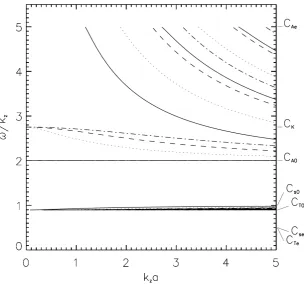
Figure 1.7: Dispersion diagram showing the real phase speed solutions of dispersion relation (1.4) for MHD waves in a magnetic cylinder as a function of the longitudinal wave numberkza, normalised to the radius of the cylinder. The typical speeds in the internal and external media are normalised to the internal sound speed: CA0= 2Cs0, CAe = 5Cs0, and Cse = 0.5Cs0, and are shown by the horizontal straight lines.
The solid, dotted, dashed and dash-dotted curves correspond to solutions with the azimuthal wave number m equal to 0, 1, 2 and 3, respectively. For fast modes (CA0 < !/kz < CAe), the lowest phase speed curves of each line style correspond
of ballooning solutions with|m|= 2 and 3, are shown in Fig. 1.7, while other modes appear for higher kz). Phase speeds of the trapped MHD modes guided by the cylinder occupy two distinct regions in the dispersion plot: they lie either between CA0 and CAe (in a typical coronal loop CA0 < CAe, so that B0 < Be), or between CT0 and Cs0. The wave modes in these two bands are the modified fast and slow
magnetoacoustic waves, respectively. Despite this apparent classification, MHD waves can have mixed properties due to the presence of plasma non-uniformity. For instance, the fundamental radial modes of a kink symmetry (non-axisymmetric) with phase speeds between CA0 and CAe possess very similar properties to surface
Alf´en waves, while higher radial overtones behave as fast magnetoacoustic modes in a uniform medium [Goossens et al., 2009, 2012]. The fast modes in a magnetic cylinder are seen to be highly dispersive, as their phase and group speeds depend strongly on the wave number. Also, in a low- plasma, the fast modes are almost transverse: the radial flows induced by these modes have much higher speeds than the longitudinal flows. In turn, the slow magnetoacoustic waves are almost dispersionless, and are mainly characterised by the longitudinal flows. In the research literature the slow modes are often referred to as longitudinal. In the limit of infinitely small plasma the phase speedCT0of the slow magnetoacoustic waves tends to the internal sound
speedCs0, and slow waves degenerate to acoustic waves.
For a fixed value of the azimuthal numbermand sufficiently large value of the parallel wavenumberkz, Eq. (1.4) has several solutions, which could be parametrised by the integer numberl. This additional quantisation is caused by the quasi-periodic behaviour of the radial component of the Bessel functions Im(x) and Km(x), and finite radius of the plasma cylinder. The integerlthus represents a number of nulls in the radial velocity perturbation, which appear inside the cylinder (i.e. forr < a), excluding the axis of the cylinder. For the considered combination of the physical parameters of the plasma inside and outside the cylinder, the phase speed of the fast modes increases with the increase inl. In Fig. 1.7 the lowest phase speed curves of each mode correspond to l= 0.
In the long wavelength limit kz ! 0, phase speeds of all but sausage fast modes of the first radial harmonic (l= 0) tend to the so-called kink speed
Ck=
✓
B02/µ0+Be2/µ0
⇢0+⇢e
◆1/2
⇡ ✓
2 1 +⇢e/⇢0
◆1/2
CA0. (1.5)
In a low- plasma, the kink speed is rather close to the internal Alfv´en speedCA0.
The sausage mode approaches a cut-o↵ at the external Alfv´en speed CAe and
For standing modes, the boundary conditions in the longitudinal direction lead to an additional quantisation of the parallel wave number kz, introducing a parallel wavenumbern that is an integer corresponding to the number of extrema (antinodes) of the transverse velocity perturbations along the loop. Thus, dispersion relation (1.4) allows one to determine the frequency of a trapped magnetoacoustic mode if the integer mode numbers, the longitudinal numbern, the radial numberl and the azimuthal numberm are given or observationally measured.
In closed magnetic configurations, for example in coronal loops, the longest period standing modes of each kind, with the wavelengths equal to the doubled loop length, are called global (or fundamental, principal). In particular, in the trapped regime the period Psaus of the global sausage mode of a coronal loop of the length L, determined bym= 0,n= 1,l= 0, is
Psaus = 2L/Cp, (1.6)
whereCpis the phase speed of the sausage mode corresponding to the wave number kz =⇡/L,CA0< Cp< CAe [see e.g. Vasheghani Farahani et al., 2014, for absolute
values]. Typically, the period of the global sausage mode of coronal loops varies from several seconds to several tens of seconds.
The period of the global kink mode withm= 1,n= 1,l= 0, is
Pkink= 2L/Ck, (1.7)
whereCk is the kink speed determined by Eq. (1.5). In typical coronal conditions,
the kink speed is slightly, by about a factor of 1.4, higher than the Alfv´en speed inside the loop. The periodPkink is typically about a few hundreds of seconds.
In the low- plasma of the corona, the period of the global longitudinal mode is defined mainly by the parallel wave number n = 1. The period is almost independent of the azimuthalmand radiall wave numbers, because the dispersion curves corresponding to the slow magnetoacoustic modes with di↵erentmandl, are located indistinguishably close to each other in the dispersion diagram (see Fig. 1.7). The period of the global longitudinal mode is given by
Plong = 2L/CT0. (1.8)
As in the low- coronal plasma, the internal tube speed CT0 is very close to the
internal sound speedCs0, the period Plong is practically determined by the
of the global longitudinal mode period range from a few minutes to several tens of minutes.
In addition, the cylindrical geometry implies the existence of a torsional Alfv´en wave in the model, which can be considered as a wave of plasma rotation and magnetic field twisting. In the discussed small amplitude linear regime, this wave is essentially incompressive and dispersionless, propagating at the local Alfv´en speed. It moves the plasma in the direction locally parallel to the boundary of the cylinder, and hence does not perturb the boundary. Strictly speaking, in the absence of viscous e↵ects torsional Alfv´en waves are not the oscillations of the cylinder as a whole, as they can have an arbitrary radial profile determined only by the initial excitation, and the variations of the neighbouring concentric magnetic surfaces do not “feel” each other. It is in contrast to the kink, sausage, longitudinal and bal-looning modes, which all are essentially collective oscillations of the cylinder. In a coronal loop, the resonant period of the global torsional mode is
Ptors= 2L/CA0, (1.9)
and is of the same order of magnitude as the periods of the kink modes.
Typical periods of MHD oscillations of solar coronal plasma structures, de-termined by Eqs. (1.6)–(1.9), range from several seconds to several tens of minutes. All these modes, except the Alfv´en wave, have been confidently identified in the solar corona with the use of high-precision imaging observational data obtained in the EUV, soft X-ray and microwave bands. In particular, multiple periods of about 15 s and 100 s detected in the same solar flare QPP in Sec. 2.5, are interpreted in terms of the sausage and kink oscillations of a flaring loop, respectively.
MHD-driven mechanisms of QPP: modulation by natural MHD modes and periodic triggering by external MHD oscillations
Quasi-periodic pulsations in the microwave band have been extensively investigated for more than fifty years. Recent achievements obtained with modern observational instruments provide the microwave data with excellent time and spatial resolutions. In some cases spectral resolution is also available. Based on these facts, QPPs in the microwave emission of solar flares are the most suitable natural tool for studying MHD oscillations in the corona and diagnostic of the macroscopic parameters of the plasma.
agreement with the global periods of the standing MHD modes in coronal plasma structures, described in the previous section in terms of the straight cylinder model. Such an apparent correspondence of QPP in flares and the observed and theoretically predicted parameters of MHD oscillations of coronal plasma structures leads to the idea of generating QPPs by intrinsic MHD modes of a plasma non-uniformity, for example a loop (see e.g. Fig. 1.2) in the flaring active region. There are several possible mechanisms for MHD oscillations to induce QPP in flares [Nakariakov and Melnikov, 2009]: either by direct periodic variations of the plasma conditions which define the intensity of the emitted electromagnetic radiation; or by a↵ecting the primary energy release process, for example periodically triggering a flare and thus modulating the density of accelerated non-thermal electrons; or by a↵ecting the kinematics of the non-thermal electrons and hence modulating their precipitation rate.
To demonstrate the first possibility, consider the mechanisms for modulation of the gyrosynchrotron emission produced by mildly relativistic electrons accelerated in solar flares, by MHD waves. These electrons have peaking energies at about 20 keV, and usually have the lower threshold value of 10 keV [Benz, 2008]. The radiation caused by these non-thermal electrons is emitted due to their interaction with the plasma of the flaring coronal loop, penetrated by the background magnetic field. A typical image of such a microwave emission is shown in the right-hand panel of Fig. 1.2. Generally the intensity If of the gyrosynchrotron emission at a certain frequency f has a peak value at some peak frequency fpeak (typically fpeak>10 GHz) and is determined by macroscopic parameters of the plasma, such as
the absolute value of the background magnetic fieldB0, the electron concentrationn0
in the loop, the angle✓ between the line-of-sight (LOS) and the magnetic field; and by the characteristics of the injected non-thermal particles: their total numberN in the emitting volume, the energy power law index and the pitch-angle anisotropy of the non-thermal electron distributions [see e.g. Ramaty, 1969; Fleishman and Melnikov, 2003].
The gyrosynchrotron radiation in flares can occur in both optically thin and optically thick regimes. Usually the optically thin regime is observed at frequencies higher than the peak frequency fpeak, while the optically thick emission radiates
at lower frequencies, f < fpeak. The intensity If depends upon the parameters described above di↵erently in di↵erent regimes [Dulk, 1985],
If / (
N B00.9 0.22 in optically thin regime,
For > 0.25 (plausible values of are usually greater than 3) the increase in the magnetic field leads to the increase in the emission intensity in the optically thin regime, and to the decrease in the intensity in the optically thick regime. In the optically thin case the gyrosynchrotron radiation is especially sensitive to variations of the magnetic field amplitudeB0, due to the strong power-law dependence. In
par-ticular, for = 4 this proportionality becomes If /B03.4. Hence even relatively low
perturbations of the magnetic field, typical for MHD waves observed in the corona, can cause a significant modulation of the observed gyrosynchrotron signal. In par-ticular, sausage oscillations generating variations of the magnetic field strength are able to produce significant modulation of the microwave gyrosynchrotron emission in the optically thin part of the spectrum [e.g. Reznikova et al., 2014].
Similarly, consider the dependence of the intensity of the gyrosynchrotron emission upon the angle ✓between the LOS and the magnetic field lines,
If / (
(sin ✓) 0.43+0.65 in optically thin regime,
(sin ✓) 0.36 0.06 in optically thick regime. (1.11)
In the optically thin regime small amplitude variations of the angle ✓, generated, for example, by the kink or torsional standing modes, are amplified in the emission intensity for > 0.67, according to Eq. (1.11). Hence, for the observed realistic values of >3 this e↵ect should be certainly pronounced. Similarly to Eq. (1.10), signals from the optically thick part of the gyrosynchrotron spectrum show an anti-phase behaviour [Mossessian and Fleishman, 2012].
Consequently, fast magnetoacoustic waves are readily able to produce a significant quasi-periodic modulation of the gyrosynchrotron emission intensity at high frequencies. Moreover, slow magnetoacoustic waves can also cause quasi-periodicities, which are manly pronounced at lower frequencies,f <10 GHz [lower than fpeak, Nakariakov and Melnikov, 2006]. Usually this part of the
gyrosyn-chrotron spectrum is optically thick for radiation, but it becomes optically thin in the case of a relatively high plasma density, according to the e↵ect of Razin suppression often observed in the flaring loops [see e.g. Melnikov et al., 2008]. A threshold characteristic frequency distinguishing between optically thick and opti-cally thin regimes, is referred to as the Razin frequency fR, and is determined as fR ⇡20 n0/B0, where n0 is measured in cm 3 and B0 is in G. For typical coronal
conditions, its value is in the vicinity of 10 GHz, reaching 20 GHz in some special cases [e.g. Melnikov et al., 2005]. In the case of periodic variations of the plasma concentration n0, for example, by a compressible longitudinal wave in which the
oscil-lations. It results in a continuous swapping of the emission regimes, pronounced as a quasi-periodic modulation of the observed microwave radiation. The modula-tion amplitude can become up to a factor of ten higher than the amplitude of the modulating signal.
All magnetoacoustic modes (sausage, kink, ballooning, and longitudinal) and torsional waves can produce quasi-periodic modulation of the microwave emission of solar flares by direct perturbation of the macroscopic parameters of the emitting plasma. Moreover, the observed amplitude of the emission intensity variation (the modulation depth) can be several times higher than the amplitude of the modulating oscillation. However, in some cases the observed modulation depth reaches 50% or even 100%, which is difficult to explain by this mechanism. In addition, this mechanism does not explain simultaneous and coherent QPP observed in di↵erent bands. For example, panel (a) of Fig. 1.3 shows that QPPs in the radio emission correlate well with the modulation of the hard X-ray and gamma-ray curves. In a standard model of a solar flare the hard X-ray and gamma-ray emissions are associated with the footpoints sources, generated by the bremsstrahlung radiation of highly energetic electrons in the dense chromospheric plasma. QPP of the hard X-ray and gamma-ray emissions can be explained by the modulation of non-thermal charged particle trajectories by an MHD oscillation.
A substantial portion of the accelerated particles, with pitch angles greater than the critical value ↵c determined as sin2↵c = Btop/Bfp, where Btop and Bfp
are the values of the magnetic field at the loop top and at the loop footpoints, re-spectively (withBtop Bfp), is confined inside the magnetic trap configured by the
magnetic flux tube of a non-uniform cross-section. The legs of the magnetic flux tube, where its cross-sectional area decreases, act as the magnetic mirrors for the population of non-thermal electrons. In case of periodic variations of the “mirror ratio” Btop/Bfp, the critical value of the pitch angle ↵c changes periodically too,
Figure 1.8: A typical coronal loop perturbed by the global, compressive sausage mode providing a non-uniform periodically varying cross-sectional area of the loop. Magnetic field and density perturbations are synchronous, and have maximum at the loop top, and nodes at the footpoints [adapted from Pascoe et al., 2007].
Another possibility for MHD-wave-driven QPPs in solar flares, which is an alternative to the described above processes of oscillatory variations of macroscopic flaring plasma parameters and kinematics of accelerated particles directly by the MHD modes of a coronal loop, is a periodic triggering of the primary energy re-lease, the reconnection of the magnetic field lines, by external MHD waves. These waves may be transverse MHD oscillations in nearby plasma structures, for exam-ple a neighbouring loop, or may be approaching propagating fast waves generated elsewhere. For example, the periodically varying inflow of the plasma with the frozen-in magnetic field should modulate the reconnection rate in a current sheet or an X-point. Moreover, such a mechanism does not require the driving external MHD oscillation to be of a large amplitude, due to a very small thickness of the reconnecting current sheet.
the oscillation period of the driving MHD mode, hence cannot address the question of the QPP’s appearance in the system. However, this mechanism would probably lead to QPP generation.
Long-period QPPs observed in the hard X-ray and microwave bands in two remotely situated solar flares, with periods of about 10 min, were also associated with external fast magnetoacoustic oscillations in Foullon et al. [2005]. The global periods of standing MHD modes of a magnetic cylinder are determined by the cylinder length and the wave phase speed (see Eqs. (1.6)–(1.9)). However, the observed geometry of the flaring sites in the event analysed in Foullon et al. [2005], was not suitable for generating such long-period modes: phase speeds of unrealistic values would be required. Hence, the mechanism of a direct modulation of the flaring plasma conditions by the intrinsic MHD modes cannot explain the observed long periods. In addition, the observed variability of these two flaring sites situated far from each other, in di↵erent hemispheres, showed a clear similarity. It was suggested that QPPs could have a common source, for example a transverse kink oscillation of an external, trans-equatorial loop, operating as a connector for these two flaring sites. Indeed, such a loop was found in the EUV observations, but it was impossible to resolve its oscillations because of the insufficient time resolution of the EUV imager. A theoretical foundation of this mechanism was developed by Nakariakov et al. [2006], where a detailed model of the interaction of transverse MHD waves, for example kink or sausage modes, in an external loop, with the flaring active region was designed (see the sketch in Fig. 1.9). The external oscillation can be either in the trapped or leaky regimes. Hence, the linkage of this oscillation with the flaring site is provided by the evanescent or leaky part of the oscillation. From the flaring site point of view, this external transverse oscillation looks like an incoming and outgoing periodic perpendicular plasma flow. Although these fast magnetoacoustic waves have relatively small initial amplitudes and periods, prescribed by the parameters of the external loop, approaching the magnetic null point of the flaring site, they rapidly grow as the fast speed decreases near the magnetic null point, and also by the e↵ect of focusing [see also numerical simulations in McLaughlin and Hood, 2004]. The fast wave evolution in the vicinity of the X-point is accompanied by a dramatic increase in the density of the periodically varying electric current induced by the wave. When the current density becomes greater than some threshold value jthres, various microinstabilities are excited in the plasma in the vicinity of the
piecewise relation,
⌘ =
(
⌘class, for|j|jthres,
⌘anom, for|j|> jthres,
(1.12)
where⌘classand⌘anom ⌘classare the classical and anomalous values of the
resistiv-ity, respectively. Oscillatory behaviour of the anomalous resistivity causes periodic triggering of the magnetic reconnection, which results, in turn, in the periodic accel-eration of charged particles. The periodic variation of the density, energy, and pitch angle distribution of non-thermal electrons produces QPPs of hard X-ray, gamma-ray, microwave, and sometimes white light emissions. The period of these QPPs is prescribed by the external magnetoacoustic oscillation and magnetic properties of the flaring region, and is not determined by its geometrical size.
A similar mechanism, but associated with slow magnetoacoustic waves, was independently developed by Chen and Priest [2006]. The periodic modulation pro-posed was based on the variation of the plasma density in the vicinity of the recon-nection site, generated by solar acoustic (p-mode) oscillations. Density variations can lead to the generation of the Buneman or ion-acoustic instabilities and, hence, cause anomalous resistivity.
The idea that flaring QPPs are triggered by external MHD waves is also consistent with the observed progression of a flaring QPP along the magnetic neutral line separating two ribbons in large solar flares [Nakariakov and Zimovets, 2011]. The impulsive energy releases are usually observed to propagate along the two-ribbon flaring structures at the speed of a few tens of km s 1. This value of the speed is significantly lower than the Alfv´en and sound speeds in the corona. However, it can be interpreted in terms of slow magnetoacoustic waves guided by a plasma arcade in the direction perpendicular to the magnetic field. In a uniform medium slow magnetoacoustic waves are able to propagate either strictly along the magnetic field lines or weakly obliquely, in a rather narrow cone along the field. However, in the presence of plasma non-uniformities these oblique slow waves can bounce between two reflecting or refracting boundaries situated across the field, for example the footpoints of the coronal magnetic flux tubes, and thus move gradually in the direction perpendicular to the field.
Figure 1.10: Simplified 2D model of the plasma arcade in a two-ribbon solar flare (top view). The thick horizontal lines show the magnetic field lines inside the loops, which form the arcade. The hatched regions show their footpoints, and correspond to the flare ribbons – the regions of the chromosphere where the hard X-ray, gamma-ray and white light emissions are observed during the flare. An oblique slow mag-netoacoustic wave excited somewhere at the top of the arcade propagates towards the footpoints, where it gets reflected on the sharp gradient of the sound speed and propagates back to the top of the arcade. There the wave triggers another energy release, and the scenario repeats. This results in a slow motion (with the speed of a few tens of km s 1) of the hard X-ray, gamma-ray and white-light sources along the
perpendicular propagation is about 25 –28 , while the perpendicular wave vector is determined by the width of the waveguide and the distance between the foot-points along the magnetic field lines in the arcade. Hence, the wave arrives back at the top of the arcade at a location slightly shifted along the arcade main axis. Approaching the X-point above the arcade, the slow wave triggers another energy release – another burst of QPP. Moreover, the induced energy release reinforces the slow perturbation, compensating its dissipative and scattering losses. The period of the generated QPP is then determined by the speed of the triggering slow magne-toacoustic wave and the travel path. Usually, it is about 10–300 s, which is similar to the second harmonic of the longitudinal mode of a coronal loop.
In addition, the discussed scenario can successfully address another interest-ing feature of flarinterest-ing QPP often seen in observations, the presence of double maxima in the elementary bursts [Tajima et al., 1987; Zimovets and Struminsky, 2009]. Ac-cording to the developed model, it may occur due to some natural asymmetry in the location of the wave source or in the arcade geometry. In this case, the slow pulses reflected from the opposite footpoints, arrive at the arcade top and trigger the next energy releases asynchronously, i.e. at slightly di↵erent times and locations. Similar asymmetric conditions in the propagation of longitudinal plasma flows evaporated from both footpoints may trigger the Kelvin–Helmholtz instability in the loop top, resulting into the development of magnetohydrodynamic turbulence and formation of hard X-ray sources at the loop apex [Fang et al., 2016].
Nonlinear mechanisms for QPP: current sheet oscillations and sponta-neous reconnection
Quasi-periodic pulsations in solar flares are often observed to exhibit typical signa-tures of nonlinear processes. These signasigna-tures are rather di↵erent and non-unique. For example, it can be a direct dependence of the oscillation period upon the os-cillation amplitude in a signal, anharmonicity of the osos-cillation profile, and nonsta-tionarity [for a more detailed consideration of highly nonlinear wave processes in multifluid plasmas see e.g. Dubinov et al., 2012a,b; Dubinov and Kolotkov, 2012, and references therein]. In the parlance of spectral analysis, these e↵ects can lead to the generation of higher harmonics and re-distribution of spectral energy across the components. Indeed, many solar flares, including the most powerful of them, are found to have non-stationary QPP with an anharmonic, in particular symmetric triangular profile shape (see e.g. Figs. 1.3 and 1.11, where examples of such QPPs are presented).
based upon the interaction of the flaring site with linear small amplitude MHD waves (internal or external), and hence cannot address these observational nonlinear properties. However, various nonlinear regimes of the magnetic reconnection driving the flare, may also efficiently contribute to producing of QPP of the electromagnetic radiation, if they occur in an oscillatory manner. Such oscillatory or rather repetitive regimes of non-stationary reconnection are known as “magnetic dripping”models [see e.g. Nakariakov et al., 2010b, where this term was introduced], which represent a gradual accumulating of free magnetic energy and consequent rapid release of it, when some threshold value is achieved.
The first illustration of such a process was seen in the numerical simulation of the dynamic phase of magnetic reconnection in a large-scale two dimensional current sheet, located above the flaring loop in the standard model of a flare [Kliem et al., 2000]. The simulated reconnection was caused by anomalous resistivity, which was a self-consistent parameter in the model and determined by the electron-ion drift velocity, proportional to the electric current density (cf. Eq. (1.12)). The repeti-tive regime was found to be provided by the coalescence of continuously generated magnetic islands (or plasmoids), which resulted in the formation of one or several hot and dense larger plasmoids. When finally such a plasmoid becomes sufficiently large, it is rapidly ejected upwards or downwards along the current sheet. Usually a plasmoid is ejected at about the Alfv´en speed [see e.g. Shibata and Magara, 2011], that consequently enables a new magnetic flux to refill in the current sheet, thus reinforcing the reconnection. However, if the plasma is unable to carry a sufficient amount of the magnetic flux into the di↵usion region to support the Alfv´enic out-flow in a steady Petchek state, the system continuously switches between the fast Petchek and slow Sweet–Parker regimes of reconnection. The repetitive ejections of each plasmoid were found to be accompanied by bursts of accelerated charged particles, which in turn created periodic enhancements of the observed emission in all bands associated with non-thermal electrons (namely, microwaves, hard X-rays, gamma-rays and white light, and indirectly, via the evaporation of the chromo-spheric plasma, in soft X-rays and EUV). The period of pulsations, predicted by the model, is determined by the plasma concentrationn0 and temperatureT0 inside the
current sheet, and the external magnetic fieldB0,
P /n01/2T02B01. (1.13)
partly irregular intervals between the peaks, as the plasmoid shedding is a rather irregular process.
Another possibility providing the oscillatory regime of magnetic reconnection is based on the coupling of the tearing and Kelvin–Helmholtz instabilities of the current sheet. It occurs in the presence of sufficiently fast shear flows and beams, propagating at Alfv´enic or super-Alfv´enic speeds aligned to the magnetic field in the vicinity of the current layers. This e↵ect is most pronounced if the plasma is greater than unity, i.e. when thermodynamical processes dominate in the plasma. In this case, overstable nonlinearly coupled tearing and Kelvin–Helmholtz modes (experiencing several quasi-periodic oscillations before the current sheet gets desta-bilised and eventually disappears) lead to the observed non-thermal X-ray emission oscillations, which are believed to be directly caused by variations of the electric current magnitude in the reconnection region. The current fluctuations can a↵ect the electric field magnitude and, consequently, modulate the electron acceleration rate [Heyvaerts et al., 1977]. Full-scale 2.5D compressive, visco-resistive MHD sim-ulations of this phenomenon were performed by Ofman and Sui [2006], who found the oscillation periods to be about 50 Alfv´en transit times across the current sheet half-width, giving about several tens of seconds for typical coronal plasma parame-ters.
Figure 1.12: Results of 2.5D MHD numerical simulations of a spontaneous recon-nection in the current sheet formed along the interface between an emerging loop and the oppositely directed vertical magnetic field lines (for example, of a neigh-bouring coronal hole). In the left-hand side of the loop system, the emerged field is directed positively (outwards from the solar surface), while the adjacent coronal hole field is of the opposite direction. Panel (a) shows the current sheet formation at the left-hand interface between these two flux systems at a certain instant of the computational time. The magnetic topology reconfigurated by the reconnection is shown in panel (b). The colour scheme shows the current density [adapted from Murray et al., 2009].
investigation, first of all addressing the e↵ect of the plasma parameters, especially the value of the resistivity, on the period.
A theoretical model describing small amplitude magnetoacoustic oscillations of a two-dimensional X-type magnetic neutral point was developed by Craig and McClymont [1991]. The equilibrium magnetic field lines were taken to be coplanar (withBz = 0), and frozen into a circular radial boundary. Neglecting gas pressure, viscosity, and assuming a constant value of resistivity in the background plasma of a uniform density, combination and subsequent linearisation of the induction equation for the magnetic field and the Euler equation resulted in a second-order governing evolutionary equation
¨
A ⌘r2A˙ =r2r2A, (1.14)
perturbation A = const at the boundary r = 1) were used, forcing the system to be closed, with no magnetic flux or plasma entering or leaving the volume. In the vicinity of the X-point, that isr⌧rc(whererc/⌘1/2 is the skin depth), Eq. (1.14)
reduces to the di↵usion equation, ˙A = ⌘r2A. Its radial solutions are determined by the Bessel function Jm(x) of order m. In the advection region (rc < r 1),
Eq. (1.14) is transformed into the wave equation, ¨A=r2r2A (r2Avanishes at the
boundary r = 1, where the perturbation A = const), revealing the characteristic time scale t⇡ |log ⌘|of the wave propagation from the outer boundary into the di↵usion region r < rc.
The radial solutions of the di↵usion equation derived from Eq. (1.14) in the case of r ⌧ rc, showed that the perturbations with m = 0 (here m is the
azimuthal wave number, hence the perturbations are of a sausage symmetry) are the only modes allowing for a topological reconnection. This is because only the Bessel functionJ0(x) has a non-zero value at the origin. The highermradial modes
rapidly decay in the outer non-resistive medium (rc < r 1), similarly to the
damping of a fluid motion by finite viscosity, and are therefore not able to a↵ect the global magnetic topology. In particular, the slowest decaying m = 0 mode for ⌘ ⇡ 10 14 (a plausible coronal value) was found to have an oscillation period of
about 60 Alfv´en times (r/CA, based on the Alfv´en speed at the external boundary
radius,r), and the perturbation decays in about three cycles of oscillations.
A substantial extension of the proposed model was performed by McLaughlin et al. [2012]. In this work, finite amplitude oscillations of a magnetic null point, excited by a fast magnetoacoustic wave, were studied numerically in a compressible, resistive 2D MHD simulation accounting for a non-zero thermal pressure e↵ect. Two phases of the null point dynamics were identified: an impulsive phase (during the first 90 s of the whole 480 s simulated time-domain) and a stationary phase. In the impulsive regime, oscillations of the magnetic field, density, electric current and induced plasma flows were found to be rather irregular, consisting of a number of sharp intense spikes, each lasting for about 10–20 s. In the stationary phase, the signal was much cleaner and closer to a decaying sinusoidal function, with a stable period comparable to that of them= 0 oscillating radial mode found in Craig and McClymont [1991].
electron density. However, these explanations still contain several unanswered ques-tions: in particular, it is not clear how the time-dependent reconnection can give a high monochromaticity and quality of some QPP, presence of several distinct significant periodicities; the properties of the non-thermal electron energy spectra produced by those mechanisms are also still to be revealed.
The nonlinear regime of the coalescence of two twisted current-carrying flux tubes can also provide repetitive energy bursts in solar flares [Tajima et al., 1987], and is widely considered to be responsible for producing QPPs. In this model the current sheet is formed in the region of coalescence of two colliding magnetic loops with identically directed magnetic twists (see the schematic sketch in Fig. 3.4), which are driven towards each other by the relative motion of their footpoints in the photosphere. The nonlinear evolution of this explosive coalescence was studied analytically and numerically with MHD and particle-in-cell simulations. The results obtained with these essentially di↵erent and independent approaches were found to be consistent with each other both qualitatively and in many detailed aspects. More specifically, in the analytical model the governing second-order nonlinear ordinary di↵erential equation, which describes the time evolution of the current sheet formed by the collision of two plasmoids, has the normalised form
¨
⇣ = ⇣ 2+ ⇣ 3, (1.15)
where ⇣ is a dimensionless function connected with the plasma parameters in the current sheet, for example with the magnetic field strength, as B /⇣ 2x/ , with x and being a spatial coordinate across the sheet and its thickness, respectively. The equilibrium state of such a current sheet is determined by the total pressure balance at the boundary, with the domination of the magnetic pressure in the inflow regions and the thermal plasma pressure inside the current sheet (see Fig. 1.13). In the normalisation, unperturbed values of the function⇣ and plasma parameter are unity. As the initial perturbation occurs, Eq. (1.15) describes sausage oscillations of the current sheet, with the minimum oscillation period measured in units of the Alfv´en transit time⌧A= /CAacross the sheet,
P = 2⇡ 3/2⌧A, (1.16)
ex-Figure 1.13: Interface between two coalescing plasmoids, with the domination of the magnetic pressure in the inflow regions and the thermal plasma pressure inside the current sheet formed by the coalescence. The equilibrium state of such a current sheet is determined by the total pressure balance at its boundaries.
ample, in Dubinov et al. [2012a,b] where highly nonlinear waves in multicomponent plasmas are considered. According to the definition of ⇣, the periodic solutions of Eq. (1.15) represent oscillatory variations of the magnetic field in the current sheet. The magnitude of the associated bursts of the electric field was found to grow up in the nonlinear phase even more rapidly than the magnetic field, which results in the efficient periodic acceleration of charged particles.
![Figure 1.1: Schematic structure of the quiet solar atmosphere, i.e. the variationof the mean temperature (thick solid line) and density (dashed line) with height[adapted from Priest, 2014].](https://thumb-us.123doks.com/thumbv2/123dok_us/9457509.452663/13.595.165.477.108.330/schematic-structure-atmosphere-variationof-temperature-density-adapted-priest.webp)


![Figure 1.8: A typical coronal loop perturbed by the global, compressive sausagemode providing a non-uniform periodically varying cross-sectional area of the loop.Magnetic field and density perturbations are synchronous, and have maximum atthe loop top, and nodes at the footpoints [adapted from Pascoe et al., 2007].](https://thumb-us.123doks.com/thumbv2/123dok_us/9457509.452663/35.595.194.452.101.325/perturbed-compressive-sausagemode-periodically-sectional-perturbations-synchronous-footpoints.webp)