warwick.ac.uk/lib-publications
Original citation:
Goodship, Vannessa, Middleton, Bethany J., Fiamegkou, Eleni and Cherrington,
Ruth (2017) Building in multifunctionality in plastic components : complexity, cost and
sustainability. In: 15th International Conference of Manufacturing Research, Greenwich,
London, UK, 4-7 Sep 2017. Published in: Advances in Manufacturing Technology XXXI, 6 pp.
377-382. ISBN 9781614997917. doi:10.3233/978-1-61499-792-4-377
Permanent WRAP URL:
http://wrap.warwick.ac.uk/93171
Copyright and reuse:
The Warwick Research Archive Portal (WRAP) makes this work by researchers of the
University of Warwick available open access under the following conditions. Copyright ©
and all moral rights to the version of the paper presented here belong to the individual
author(s) and/or other copyright owners. To the extent reasonable and practicable the
material made available in WRAP has been checked for eligibility before being made
available.
Copies of full items can be used for personal research or study, educational, or not-for-profit
purposes without prior permission or charge. Provided that the authors, title and full
bibliographic details are credited, a hyperlink and/or URL is given for the original metadata
page and the content is not changed in any way.
Publisher’s statement:
Copyright 2017, reproduced with permission from IOS Press
www.iospress.nl
“The final publication is available at IOS Press through
http://doi.org/10.3233/978-1-61499-792-4-377
A note on versions:
The version presented here may differ from the published version or, version of record, if
you wish to cite this item you are advised to consult the publisher’s version. Please see the
‘permanent WRAP URL’ above for details on accessing the published version and note that
access may require a subscription.
Building in Multifunctionality in Plastic
Components:
Complexity, Cost and Sustainability
Vannessa GOODSHIP a1, Bethany MIDDLETON a , Eleni FIAMEGKOUa, and Ruth
CHERRINGTONb
aWMG, University of Warwick, Coventry CV47AL
bUniversity of Exeter, Penryn, Cornwall TR109FE
Abstract.
Multifunctionality can be embedded into material systems by three distinct design processes. These are: firstly multifunction can be embedded at a material level such as the use of nanomaterials within a polymer. In the second instance, discrete material systems can be added together. Examples are laminate systems in food pouches consisting of thin layers of metal and polymer. In the third process this can be achieved by integrating these materials systems together to form one holistically behaving component with multifunctionality. An example is an embedded antenna in an automotive windscreen.Drivers for multifunctionality include the increased push towards intelligent objects, such as the creation of the internet of things. Here, the embedding of communication and electronic function into daily consumer objects, such as milk cartons and food packaging are demanded. This must be offset by consideration of the related rise of a new wave of short-lifetime waste electronic and electronic equipment, incapable with current plastic recycling infrastructure, for disposal systems to adapt too. Designing integrated and multifunctional plastic components however, is complicated by the sheer number of material choices, multiple processing platforms, cost implications and environmental legislation. Considering just the processes of injection moulding, compression moulding and additive manufacturing, a designer is confronted with considerable complexity and numerous engineering design and stakeholder issues to consider. This paper presents examples of current state of art in multifunctional systems and discusses the barriers and potential solutions to creating fully realized multifunctional systems within a polymeric manufacturing environment. Impacts on material lifecycles and disposal infrastructures must be considered, as is the necessity to retain diversity with new integrated and advanced manufacturing processes suitable for the demands of mass customization, automation and Industry 4.0.
Keywords. Multifunction, plastic, complexity, sustainability
1Corresponding Author, Vannessa Goodship, WMG, University of Warwick, Coventry, CV4 7AL, UK
1. Introduction
Next generation products are required to have ever increasing levels of functionality as we enter an age of multifunctional plastic design. Whether thinking about intelligent packaging, autonomous cars or smart houses the same underlying concept is one of multifunctionality. The difference being explored here lies in where that function is embedded within any complex system and how this can affect the design and manufacturing decision making in the plastic industry. The processing challenges to create multifunctional plastic products (MFPP) are considerable and initial attempts at describing and reviewing all materials and process challenges can be found in the work of Salonitis et al [1]. Here, the concept is broken into processes: primary forming, deforming, removing, joining and modifying material property processes.
Whilst these processes are valid for many materials for fully integrated MFPP this is fundamentally directed by two just choices; the material and the polymer processing route, therefore before any further discussion of this issue takes place it is important to consider the impact and relationship of the material and process.
Matic [2], defined three levels of introducing multifunction, he termed these processes as Embedding, Addition and Integration. For the purposes here, these are defined as Level 1: EMBED, Level 2: COMBINE and Level 3: INTEGRATE. A complex system or product may be made up of many instances of Levels 1 and 2 operating, however a Level 3 system is by default a value of just 1 in any ‘ideal’ multifunctional fully integrated product system. Similarly, just because other lower levels are in place it does not necessarily mean you have created a single holistic multifunctional system.
Creating Level 1 embedding functions are of course very common and routine in the plastic industry where manufacturing processes allow the use of both inbuilt polymeric function such as a shape memory material or an intrinsically conductive polymer, as well as the addition of numerous different additives. Embedding multifunctional particles into plastic components is not problematic as polymers can be readily mixed with a wide range of other polymeric, ceramic or metallic particulates right through from nano to micron and continuous fibre strands such as glass fibres and carbon fibre mats in various configurations and sizes.When combined with base polymeric materials these can be tailored to induce functional properties such as conductivity, magnetic function, or antimicrobial properties for instance. This also includes reinforced materials with glass, carbon, boron fibres and so forth. A commercial example is plastic bottles that contain carbon nanotubes. The result is beer bottles that stay colder for longer [3].
For the purposes of this paper, the materials chosen themselves are less important than the concept of EMBED. For a review of materials the reader is directed to Duarte et al [4].
together into a common component. This process adds an element of complexity in production as to when this combination process takes place. It can be a) during the production process, such as in-mould labelling, or b) after the production process such as off-line painting.
In both of these cases a further process is introduced – joining. For end of life purposes, it is also a point that may require a separation or disassembly process be it for digestion or composting, recycling, remanufacture and/or ultimately disposal. The circular economy and the need to consider the next use of materials and products needs consideration of cradle to grave or perhaps more accurately from a circular ecomony perspective ‘cradle to next cradle.’ Legislation on product design and disposal issues in the European Union, require consideration, given the need to deal with and safely dispose of growing electronic waste streams to which integrated multifunctional designs will contribute to. There are many unknowns in newer materials entering the waste streams and their long term impacts on recycling infrastructures.
Achieving a Level 3 functionality, requires the creation of a fully integrated holistically acting structure – a biological example being the human body. Here we can find a structural component, fully integrated with five senses, movement through an actuation process and self-healing. It is therefore not surprising than biomimetics inspires much multifunctional research with a bottom-up (molecular level approach) to multifunctional system design. For these kind of systems there is also a dependency on the integration of (electronic) control functions as sytem communication is needed. Whilst this approach has bought major scientific breakthroughs, it is currently, not an approach relevant to a mass production environment in the plastic industry; for example a blow moulder wishing to make an internet ready milk bottle. These are routinely mass produced using HDPE material and a blow moulding process. It is therefore necessary to introduce the new function that can monitor, then actively switch on at a preset condition to communicate via the internet to monitor and re-order the customer a new bottle. This requires either some kind of link with sensors in the fridge to read that the bottle is nearly empty or a functionality embedded entirely within the bottle.
Which approach should be taken ?
What are the implications of varying the concepts of level 1-3 design in this case? To do this, there is a need for an entirely different but structured approach to the problem.
2. Drivers for Multifunctionality
The creation of new products is generally driven by a well-defined market opportunity and success will depend on making a profit (whether the customer knows they need products at this point at not). The demands for MFPP therefore comes from the market stakeholders. Several overarching technological drivers are driving the push towards MFPP, these are:
Manufacturing cost reduction by combining function
Weight reduction by combining function
Energy efficiency
Increased product communication – 'internet of things'
Mass customization
Industry 4.0 and associated automation
Environmental legislation demands
–
plastics recycling and recovery for example.Furthermore in some cases it may be necessary to consider any societal impacts such as on infrastructure, our health, energy concerns and security: whether this is materials security or product security.
Each of these drivers may positively or negatively impact upon others. For example, returning to the example of the intelligent HDPE milk bottle, by introducing a new stream of short life electronic food packaging waste there are serious impacts on the current disposal infrastructure in place for plastic milk bottles. With all these issues to consider, the designing of MFPP can now be considered.
3. Designing for Multifunction
The first assumption here is that all the pre-market new product issues are complete (which are beyond the scope of this paper). Therefore the first question should already be clear
–
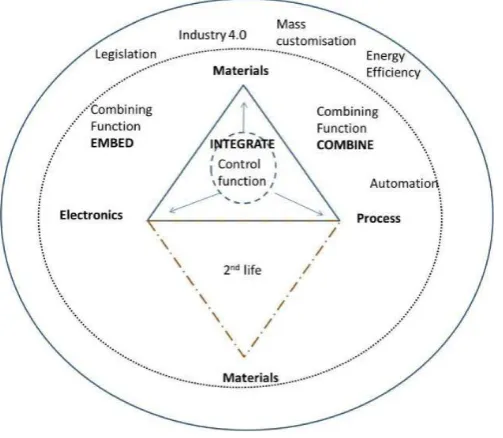
namely the product that will be made and how much it can viably cost to manufacture.With this in mind the complexity, engineering design and stakeholder issues can at least be attempted. Looking back at the list of eight challenges, assignments can be made as to whether these are Material, Process, COMBINE, or Environmental issues, or in many cases combinations of a number of areas. It should also be noted that not one of these challenges can, in isolation, necessarily produce INTEGRATE.
Only point, automation, sits in 'Process', all other points are combinations of materials, processes and COMBINE or environmental factors. This is because the use of any underlying processing platforms are often restricted by the choices made in material selection which can cause problems if making significant changes in the product or volumes of production. To return to the example of a high commodity milk bottle at this point, blow moulding remains the key underlying process for cost effective manufacture, but by default places restrictions on the structure of the bottle materials that can be processed, in that they must be processable by a blow moulding route. It is therefore highly unlikely that an internet ready milk bottle will be produced by a single shot process through the blowing head and further function must be introduced in the tool (such as addition of an insert) or as an after production process (such as a sticky label), it is however possible to EMBED a functional material into the main bottle material, such as nanotubes, as discussed earlier in the example of the bottle that stayed cooler for longer.
For an internet ready, stand alone bottle it would be necessary to add both a sensor device (in this case a simple weight sensitive indicator could be suitable), and a wireless device to transmit that the bottle has reached the pre determined low level to trigger automatic re-order or perhaps just addition to the home cloud shopping list. These two devices could be produced by the roll to roll technology used in polymer electronics and added to a bottle by suitable adhesives or suitable melt processes to give the desired function. Job done.
systems. The carbon footprint has increased through the additional use of a further technology platform (roll-to-roll).
On the plus side, the desired objective of saving the consumer time and the addition reduction in food wastage has been achieved, but will consumers actually be willing to pay such an increased price for their milk?
However, if we now consider a similar scenario but for an essential and expensive prescription drug used regularly, and we have a far more likely adoption scenario where mass customization of labels and devices becomes a benefit, also allowing the use of drugs to be monitored regularly through the cloud perhaps linking directly back form patient to doctor to ensure drug regimes are being followed, and allowing a potential for reclamation of unopened and unused drugs.
These examples consider functionality as an ‘add-on’ function after a more basic production route has taken place, however for other methods to develop Level 3 systems with integrated structure and functions, production routes that enable fully formed integrated products are required.
Updated roadmaps on developmental routes for printed electronic devices are regularly being produced [6]. Continuing developments have enabled electronics and components to be printed directly onto plastic substrates, offering the potential for structural components such as printed memory devices, batteries and solar cells to be added on to product lines. These can be used as both active and passive components and allows integration of electronic function and plastic product. Therefore these integrated multifunctional systems (smart systems) can include sensors, RFID tags and smart textiles.
Figure 1. Multifunctional product design
4. Conclusion
Producing viable MFPP remains a key challenge for plastic manufacturing, where breakthroughs in materials, processes and electronics must be aligned to realise the potential of fully integrated and functional products (see Figure 1). The challenges for disposal of a new generation of plastic electronic products should not be overlooked, especially in short life products such as food packaging. Whilst MFPP offer great potential to enhance the quality of human life, it could also create a serious environmental challenge if all lifecycle impacts are not fully considered.
References
[1] K. Salonitis, J. Pandremenos, J. Paralikas, G. Chryssolouris, Multifunctional materials: engineering applications and processing challenges, Int J Adv Manuf Technol 49 (2010), 803–826.
[2] P. Matic, Overview of Multifunctional Materials, Smart Struct. Mater. Active Materials: behaviour and mechanics, Proceedings of the SPIE, 5053 (2003), 61-69
[3] K. Arivalagan, S. Ravichandran, K. Rangasamy, E. Karthikeyan, Nanomaterials and its potential applications, Int. J. ChemTech Res., 3 (2011) 534-538
[4] A. Duarte, B.L. Ferreira, R.O. Novoa, A. Torres Marques, Multifunctional Material Systems: A state-of-the-art review, Composite Structures 151 (2016), 3–35.
[5] V.Goodship, Injection Moulding of Thermoplastics, in V. Goodship, B. Middleton, R. Cherrington [Eds],
Design and Manufacture of Plastic Components for Multifunctionality, Elsevier, UK, 2016
[6] S. Kirchmeyer, The OE-A roadmap for organic and printed electronics: creating a guidepost to complex interlinked technologies, applications and markets, Translational Materials Research, 3 (2016)
[7] R.Cherrington, D. J. Hughes, S. Senthilarasu,V.Goodship, Inkjet-Printed TiO2 Nanoparticles from Aqueous Solutions for Dye-Sensitized Solar Cells (DSSCs), Energy Technol , 3 (2015), 866 – 870 [8] B. Middleton, V. Goodship, Injection moulding electroluminescent components, Polym, Eng. Sci., 53