http://go.warwick.ac.uk/lib-publications
Original citation:Allen, M. P. and Swetnam, A. D. (2012). Studying the adsorption of polymers and biomolecules on surfaces using enhanced sampling methods. MRS Proceedings, 1470. Permanent WRAP url:
http://wrap.warwick.ac.uk/48910
Copyright and reuse:
The Warwick Research Archive Portal (WRAP) makes the work of researchers of the University of Warwick available open access under the following conditions. Copyright © and all moral rights to the version of the paper presented here belong to the individual author(s) and/or other copyright owners. To the extent reasonable and practicable the material made available in WRAP has been checked for eligibility before being made available.
Copies of full items can be used for personal research or study, educational, or not-for-profit purposes without prior permission or charge. Provided that the authors, title and full bibliographic details are credited, a hyperlink and/or URL is given for the original metadata page and the content is not changed in any way.
Publisher’s statement:
http://dx.doi.org/10.1557/opl.2012.1203
This article has been accepted for publication and will appear in a revised form,
subsequent to peer review and/or editorial input by Cambridge University Press, in MRS Proceedings published by Cambridge University Press.
A note on versions:
The version presented here may differ from the published version or, version of record, if you wish to cite this item you are advised to consult the publisher’s version. Please see the ‘permanent WRAP url’ above for details on accessing the published version and note that access may require a subscription.
Studying the Adsorption of Polymers and Biomolecules on Surfaces Using Enhanced Sampling Methods
Michael P. Allen and Adam D Swetnam
Department of Physics, University of Warwick, Coventry CV4 7AL, United Kingdom
ABSTRACT
We discuss how to use Wang-Landau simulations in an efficient manner to investigate the statistical mechanics of individual lattice polymers and peptides adsorbed at a planar surface. For nearest neighbor interactions, we show that a single Wang-Landau simulation, recording the density of states as a function of numbers of internal contacts and of surface beads, is sufficient to give a full description of the phase behavior of both adsorbed and desorbed states of single molecules. It is not necessary to introduce a second confining wall. Moreover, moves are never rejected due to overlap with the surface.
The proposed “wall-free” method has already been applied to homo-polymers and hetero-polymers (lattice peptides using the HP model) on a uniform surface, and on regularly patterned surfaces. We give here a specific example to indicate how the relative adsorption strengths of a given peptide on different surfaces may be calculated.
INTRODUCTION
There is considerable current interest in carrying out Monte Carlo (MC) simulations of simple models of polymers and peptides, with the aim of understanding their affinity for specific solid surfaces, and the intention of assisting in the design of new materials, which exploit this affinity. Although the model of a polymer whose monomers (beads) are confined to a regular lattice, with interactions only between nearest-neighbor beads, is a very simple one, it contains much of the essential physics and chemistry of the problem, especially the issue of locating minimum-energy folded structures, and balancing energetic and entropic effects in the
thermodynamics of collapse and adsorption. The HP model of lattice peptides [1], for instance, has been described as the “Ising model of protein folding” [2]. We shall be concentrating on this model in what follows.
The simulation of lattice polymers and peptides has been a fruitful area for the development of accelerated simulation methods in recent years [3–20]. The essential ideas behind the current work have been presented already in the context of the HP model and the simulation of confined ring polymers [21–24], so only a brief summary will be given here.
THEORY
For illustrative purposes we adopt the model of a single unbranched heteropolymer of L beads on a simple cubic lattice defined by integer values of the coordinates
(
x,y,z)
. Each latticesites that are left vacant by the peptide, and the interactions are assumed to reduce to a set of nearest-neighbor effective attractions of equal strength -
e
between the hydrophobic beads. The number of these H-H nearest-neighbor contacts, nG, depends on the microscopic state G º{ }
rmof the peptide: this denotes the set of all relative bead positions rm=
(
xm,ym,zm)
=Rm-R whereRm is the absolute position of monomer mand R=
(
X,Y,Z)
is the position of a reference point in the molecule. The state G therefore has an internal energy -nGe
.In addition, we consider a planar surface defined by all the lattice sites for which z=0. The peptide is restricted to Zm>0 for all m; in addition any peptide beads, which lie in the plane Zm=1, may interact with the surface with a nearest-neighbor attraction of strength -
s
. We allow the surface sites to be of two kinds: attractive and non-interacting. In this paper, we assume that there is a regular pattern of the two types of surface site (for example, checkerboard or striped). Moreover, the attractive sites may interact with H beads, P beads, or both kinds. IfsGXYZ denotes the number of such interactions (which clearly depends on both the internal
configuration and the absolute position of the peptide) then the total energy is
E= -nG
e
-sGXYZs
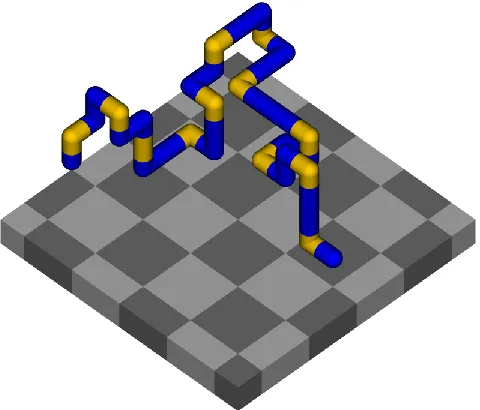
(1) [image:3.612.187.427.391.596.2]A snapshot of a typical configuration is shown in Figure 1.
Figure 1. Snapshot of lattice peptide (PHP)12 on 2 2 checkerboard surface, in the
desorbed-expanded (DE) phase. The beads, and the bonds between them, are given the same radius for clarity. P-beads are colored blue, H-beads yellow. Dark squares attract P-beads only; light squares are non-attractive.
proportional to the density of states W
( )
n,s , resolved according to the number of internalcontacts n and surface contacts s. This involves implementing a set of Monte Carlo moves, which change the internal configuration G and position of the peptide, and then accepting or rejecting the moves according to a Metropolis-like criterion [27–30]
Pacc=min 1,Wold
Wnew æ è
ç ö
ø
÷ (2)
Additional terms may be added to correct for any bias in choice of moves (see below). The density of states is unknown at the start of the simulation, and the Wang-Landau approach determines it in an iterative fashion. At the start of the simulation the density of states is initialized, W
( )
n,s =1 for each pair of values( )
n,s , and a “visit histogram’’ is also initialized,H n
( )
,s =0. After each move is accepted or rejected according to equation (2), both the entries for the current values( )
n,s are updated as follows: H n( )
,s ®H n( )
,s +1, W( )
n,s ®f ´W( )
n,swhere f is a scaling factor initially set to e=2.71828. This has the effect of reducing the acceptance probability of future attempted moves to the same values of
( )
n,s and, eventually,generating an approximately flat visit histogram. After H n
( )
,s passes a “flatness test”, thescaling factor f is reduced, the visit histogram re-initialized to zero, and the process repeated. Eventually, f ®1 and, when sufficiently close to this limit, the simulation is taken to have converged. The original prescription [25,26] for reducing f at each stage was f ® f but there are arguments for using a more conservative scheme, and this is what we employ here [22–24]. Finally, we note that we employ a Monte Carlo move set known as “pull moves” [3,17,21–24] which allows the peptide to explore configuration space efficiently.
The essential output from a single Wang-Landau simulation is the density of states itself, which may be used to compute thermodynamic properties, and other quantities, in the canonical ensemble at any desired temperature. The partition function may be written
Q(T)= W
( )
n,sn,s
å
exp[
nbe+sbs]
(3)where
b
=1 /kT, k being Boltzmann’s constant, and the Helmholtz free energy may beexpressed as F= -kTlnQ in the usual way. In equation (3), the sum over internal states G and positions
(
X,Y,Z)
has been partially performed in the calculation of W( )
n,s which is, to withina constant of proportionality, the number of such states that have the prescribed combination of internal and surface contacts. The remainder of the sum is performed explicitly. Canonical ensemble average values of (powers of) the energy, and fluctuations in the energy which give the heat capacity C, are straightforwardly obtained
Ek =Q-1 W n
,s
( )
n,s
å
[
-ne-ss]
kexp(
nbe+sbs)
and C= E2 - E 2
and indeed it is possible to measure the separate contributions to C of fluctuations in internal contacts, surface contacts, and cross correlations between them.
Now we come to the key part of this paper, regarding the way that simulations of this kind are used to investigate adsorption at a single surface. The restriction of the polymer beads to the region z>0 leaves the desorbed molecule free to explore the infinitely large upper half-space; in other words, the system is unbounded. To counter this, and ensure that the system has “regularized” thermodynamic behavior, two approaches are in common use. The first is to study a system in which one end of the polymer is permanently “tethered” or “grafted” to the surface [12–16]. This has the disadvantage of being different from the physical system of interest, in many cases, namely adsorption of free molecules from the bulk. The more common alternative is to add a second, confining, wall, parallel to the surface of interest, far enough away to interfere only minimally with the adsorption [2,6–8,17,20]. This is usually called “slit” or “slab”
geometry. The two approaches have been compared recently [19].
Simulations in slab geometry suffer from at least two unnecessary sources of inefficiency. Firstly, moves of the peptide may be rejected due to violation of the condition
Zm >0 for any monomer, in other words “overlap with the walls”. Secondly, any transition between the adsorbed (more specifically s>0) and desorbed (s=0) states requires proximity of the chain and the wall. Typically, a molecule making a desorbed, diffusive, excursion in the slit will experience long intervals between opportunities to make such transitions, during which values of W
(
n,s=0)
will accumulate relative to the un-sampled states with s>0. These excursions will be interrupted by long periods in the adsorbed state in which the overwhelming fraction of attempts to desorb will be rejected, due to the accumulated imbalance in values ofW
( )
n,s between s=0 and s>0 states. A conventional Wang-Landau simulation would become very inefficient because of this, for large separation between the walls.We have proposed a third approach to the simulation of adsorption in systems of the kind discussed here, which avoids both these problems [21,24]. In essence, the peptide is always kept in contact with the surface, for the purposes of counting the surface interactions. To understand this, it is convenient to define the reference position of the peptide to be
X,Y,Z
(
)
=(
min( )
Xm , min( )
Ym , min( )
Zm)
(5)i.e. the minimum in each Cartesian direction, over all beads m=1, 2, ,L. Then, if Z>1, the peptide is desorbed from the surface, and s=0, while if Z=1 then the peptide is adsorbed, and
s=sGXY is the number of interactions involving beads on the lowest surface of the peptide. It is
only necessary to sample the Z=1 case, and for this case we can regard s as depending only on the internal state G and the coordinates X and Y which are sampled by the pull moves in the usual way. (For the patterned surfaces of interest here, these coordinates need only range over the periodicity of the pattern in each direction). Each pull move can be regarded as being combined with the unique vertical translation that brings the surface into contact with the peptide: overlaps of monomer beads with the surface, and desorbed configurations of the
having the same value of n. The same observation applies to the partition function for desorbed states at any chosen temperature:
Wdes
( )
n = W( )
n,s så
and Qdes( )
T = Wdes( )
nn
å
exp( )
nbe = W( )
n,sns
å
exp( )
nbe (6)We term these “wall-free” simulations, because there is no need to consider wall overlaps at any stage: the simulations simply serve to count the relevant states, resolved by internal and surface contacts. Elsewhere [24] we describe how this approach can be extended to describe the statistical mechanics of polymers, which are confined between two walls, again without the need to consider wall overlaps. Here we focus on the single-wall adsorption thermodynamics. For an ideal gas of non-interacting peptides, at activity
l
=expbm
wherem
is the chemical potential, the grand partition function and average number of molecules at any position on the surface are given byX
( )
l,T = lNQN
N!
N³0
å
=explQ and N =l¶lnX¶l =lQ (7)
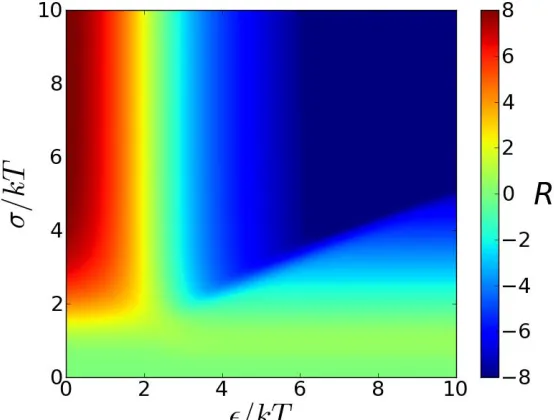
with a similar formula for the desorbed molecules. Accordingly, the ratio of adsorbed to desorbed molecules is simply the ratio of the corresponding partition functions, a result which also follows directly from the definition of the partition function. (We note in passing that the adsorption isotherms derived from single-molecule simulations are trivial compared with the well-known Langmuir and BET forms, unless significant assumptions regarding intermolecular interactions are made). In the following, we compare the adsorption of a given molecule from bulk onto two different surfaces, A and B, under identical thermodynamic conditions, on a logarithmic scale, using the following quantity:
R=ln NB
NA æ è
çç öø÷÷=ln QB
QA æ è
ç ö
ø
÷ = -b
(
FB-FA)
(8)RESULTS
We present here some specimen results, for a single peptide of length L=36 consisting of the sequence PHP repeated twelve times. This peptide has a well-defined ground state in the bulk, in which a cuboidal 2 2 3 hydrophobic core is formed, shielded almost completely by polar beads [31]. We have computed the phase behavior for a wide range of patterned surfaces. Here, we just compare two surfaces against each other: surface A consists of 2 2 squares of each type (attractive and non-attractive) in a checkerboard arrangement, while surface B has
alternating stripes of width 3 lattice units. In both cases the attractive sites interact with polar beads only. The surface phase diagrams of both systems, in the form of heat capacity plotted as a function of the internal interaction strength and surface interaction strength, both normalized by temperature, are shown in Figure 2. Both systems show a similar set of (pseudo-)phase
which sacrifices orientational freedom in favor of maximizing the surface energy. The general nomenclature of the five main phases is well established [15,16].
Figure 2. Phase diagrams (heat capacity maps) of surface A (2 2 checkerboard, left) and B (3+3 stripes, right) for the PHP 12-mer. Phases are labelled as follows. DE: desorbed expanded; DC: desorbed compact; SAG: surface-adsorbed globule; AC: surface-adsorbed compact; AE: surface-adsorbed expanded. For surface B, the surface-adsorbed phases are strongly influenced by the surface pattern, indicated by the additional symbol P.
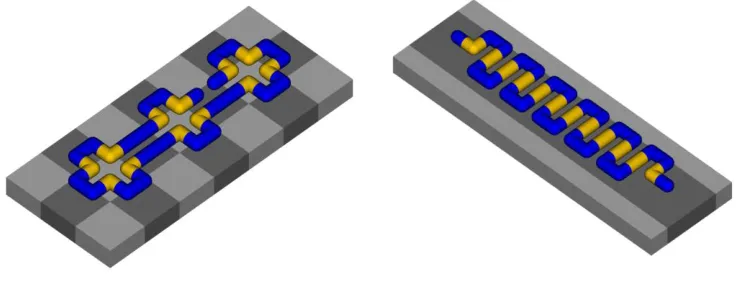
A snapshot of the DE (desorbed expanded) phase for surface A appears in Figure 1. The AC (adsorbed collapsed) phases are shown in Figure 3. The geometry of the striped pattern restricts the internal interactions in surface B, and this effect is even more noticeable for the AE (adsorbed expanded) phase illustrated in Figure 4, where the two-dimensional configurational entropy appears to be severely reduced by confinement due to the pattern. For this reason we denote these phases as ACP and AEP on surface B.
Figure 3. Snapshots of AC (adsorbed collapsed) phase for surfaces A (left) and B (right). Notation as for Figure 1.
[image:7.612.120.498.454.595.2]Figure 4. Snapshots of AE (adsorbed expanded) phase for surfaces A (left) and B (right). Notation as for Figure 1.
Figure 5. Affinity of peptide for surface B relative to surface A, on a logarithmic scale, as a function of internal and surface attraction strengths.
[image:8.612.164.441.326.536.2]alone, for a suitable ratio of
s
/e
, since this corresponds to taking a path along a straight line through the origin in Figure 5.CONCLUSIONS
This paper has shown explicitly how the adsorption of a simple lattice model of a peptide, at a planar surface, with a regular pattern of adsorption sites, may be obtained by a single Wang-Landau Monte Carlo simulation which does not require a second, confining, wall. The simulation determines the density of states of the peptide resolved by the numbers of internal contacts and surface contacts in the adsorbed state, while simultaneously calculating the same quantity for the desorbed state. An example has shown how the preference of a simple, regular, peptide for a checkerboard or striped surface, may be influenced by varying the temperature, and driving the system through the expanded-compact phase transition.
The principal advantage of the approach proposed here is that it avoids slit geometry, or tethering to the surface, which introduce some differences from the system of interest.
Simulations in a wide slit most likely introduce some inefficiencies, including move rejection due to overlap with the walls, and long periods spent in either adsorbed or desorbed states, again with some attendant move rejection. The present approach does not suffer from these problems.
We have investigated some ways of improving the efficiency of the basic method used here: for instance, there is nothing intrinsically unique about the z-direction, so any peptide move could be accompanied by a choice between different orientations relative to the surface, with the possibility of optimization. However, to date we have found no substantial speedup using this approach.
ACKNOWLEDGMENTS
Funding for this research was provided by EPSRC. Computing facilities were provided by the Centre for Scientific Computing. Discussions with Michael Bachmann, Ying-Wai Li, Wolfhard Janke, Thomas Wüst, Wolfgang Paul and Kurt Binder are gratefully acknowledged.
REFERENCES
1. K. F. Lau and K. A. Dill, Macromolecules22, 3986 (1989).
2. Y. W. Li, T. Wüst and D. P. Landau, Comput. Phys. Commun.182, 1896 (2011).
3. N. Lesh, M. Mitzenmacher and S. Whitesides, in Proceedings of the 7th Annual International Conference on Research in Computational Molecular Biology, RECOMB, edited by
M. Vingron, S. Istrail, P. Pevzner and M. Waterman (ACM, New York, 2003) pp. 188–195. 4. M. Bachmann and W. Janke, J. Chem. Phys.120, 6779 (2004).
5. R. Schiemann, M. Bachmann and W. Janke, Comput. Phys. Commun.166, 8 (2005). 6. M. Bachmann and W. Janke, Phys. Rev. Lett.95, 058102 (2005).
12.J. Luettmer-Strathmann, F. Rampf, W. Paul and K. Binder, J. Chem. Phys.128, 064903 (2008).
13.A L Owczarek, A Rechnitzer, J Krawczyk and T Prellberg, J. Phys. A40, 13257 (2007). 14.J. Krawczyk, A. L. Owczarek, T. Prellberg and A. Rechnitzer, Europhys. Lett.70, 726
(2005).
15.T. Vrbová and S. G. Whittington, J. Phys. A 31, 3989 (1998). 16.Y. Singh, D. Giri and S. Kumar, J. Phys. A34, L67 (2001).
17.T. Wüst and D. P. Landau, Comput. Phys. Commun.179, 124 (2008). 18.T. Wüst, Y. W. Li and D. P. Landau, J. Stat. Phys. 144, 638 (2011).
19.M. Möddel, W. Janke and M. Bachmann, Macromolecules44, 9013 (2011). 20.M. Radhakrishna, S. Sharma and S. K. Kumar, J Chem. Phys.136, 114114 (2012). 21.A. D. Swetnam and M. P. Allen, Phys. Chem. Chem. Phys.11, 2046 (2009). 22.A. D. Swetnam and M. P. Allen, J. Comput. Chem.32, 816 (2011).
23.A. D. Swetnam, C. Brett and M. P. Allen, Phys. Rev. E85, 031804 (2012). 24.A. D. Swetnam and M. P. Allen, Physics Procedia. (to appear).
25.F. G. Wang and D. P. Landau, Phys. Rev. Lett.86, 2050 (2001). 26.F. G. Wang and D. P. Landau, Phys. Rev. E64, 056101 (2001).
27.N. Metropolis, A. W. Rosenbluth, M. N. Rosenbluth, A. H. Teller and E. Teller, J. Chem. Phys. 21, 1087 (1953).
28.D. Frenkel and B. Smit, Understanding Molecular Simulation (2nd edition, Academic Press, 2002).
29.D. P. Landau and K. Binder, A Guide to Monte Carlo Simulations in Statistical Physics (3rd edition, Cambridge University Press, 2009).