University of Warwick institutional repository: http://go.warwick.ac.uk/wrap
A Thesis Submitted for the Degree of PhD at the University of Warwick
http://go.warwick.ac.uk/wrap/66898
This thesis is made available online and is protected by original copyright. Please scroll down to view the document itself.
Self Organising Map Machine Learning Approach
to Pattern Recognition for Protein Secondary
Structures and Robotic Limb Control
Vincent Austin Hall
Submitted to
University of Warwick
for partial fulfilment of the degree of
Doctor of Philosophy
MOAC Doctoral Training Centre
Contents
1 Acknowledgments 4
2 Declarations 5
3 Abstract 6
4 Abbreviations 8
5 List of equations 13
6 Introduction 14
6.1 Self-organising map machine learning technique . . . 14
6.1.1 Origins of SOM . . . 20
6.1.2 Training a SOM . . . 21
6.1.3 Validating a SOM . . . 21
6.1.4 Applications . . . 22
6.1.5 Good practice with SOMs . . . 23
6.1.6 SOM applied to circular dichroism spectra . . . 25
6.1.7 Developments to SOM . . . 29
6.1.8 General good practice in machine learning . . . 32
6.2 Circular Dichroism for protein secondary structure estimation . . 38
6.2.1 Where CD signals come from . . . 41
6.2.2 Buffers . . . 43
6.2.3 Algorithms for circular dichroism pattern recognition . . . 46
6.2.4 Synchrotron radiation CD . . . 62
6.2.5 Crystal structures . . . 64
6.3.1 Time windows for MES . . . 72
6.3.2 Other ML and MES advice . . . 73
6.4 Contribution to knowledge of the research reported in this thesis . 74 6.4.1 CD spectra fitting for protein structures . . . 74
6.4.2 Concentration correction . . . 74
6.4.3 HASSANN for BioPatRec . . . 75
6.5 Further work . . . 77
6.5.1 Diabetes patient insoles and clustering academics for col-laborations . . . 77
7 Introductions to publications 78 7.1 Paper 1: “Elucidating Protein Secondary Structure with Circular Dichroism and a Neural Network” by V. Hall, A. Nash, E. Hines, A. Rodger . . . 79
7.2 Paper 2: “Protein Secondary Structure Prediction from Circular Dichroism Spectra Using a self-organising Map with Concentration Correction” by V. Hall, M. Sklepari, A. Rodger . . . 80
7.3 Paper 3: “SSNN, a method for neural network protein secondary structure fitting using circular dichroism data” by V. Hall, A. Nash, A. Rodger . . . 82
7.4 Paper 4: “Self organising map pattern recognition for real-time prosthetic control: HASSANN” by V. Hall, M. Ortiz-Catalan . . . 83
8 Discussion and Conclusions 85 8.1 SSNN: CD spectra to structure prediction . . . 86
8.1.1 SSNN further work . . . 89
8.2 HASSANN: myoelectric data for limb movement . . . 94
8.3 Final summary . . . 97
1
Acknowledgments
I would like to thank: my supervisor Prof. Alison Rodger of the Department
of Chemistry; Anthony Nash, also from MOAC and Chemistry, who gave lots
of advice on the coding side; my collaborator Max J. Ortiz-Catalan of Chalmers
University of Technology; my colleagues and friends in MOAC, Chemistry, and
Systems Biology. All of these people were great help to me. Thanks to Bonnie
Wallace and Lee Whitmore et al. from Birkbeck College, University of London;
Robert Janes et al. from Queen Mary, University of London as I made use of
excellent tools they developed, especially Dichroweb; and Narasimha Sreerama
and Robert Woody for their CDPro database and publications in the circular
dichroism software field. Thanks to my fianc´ee Anna Cunningham, who was
al-ways present to provide lots of support and advice. Thanks to my parents Austin
and Heather Hall for making and raising me, and giving me my determination to
succeed. Thanks to my son Peter Hall for teaching me to make the most of time
2
Declarations
The work contained in this thesis is entirely my own, except where
acknowl-edged in the text, for example the papers that form the results chapters were
co-authored with supervisors, colleagues and collaborators. I confirm that this
3
Abstract
With every corner of science, engineering and business generating vast amounts
of data, it is becoming increasingly important to be able to understand what
these data mean, and make sensible decisions based on the findings.
One tool that can assist with this aim is the type of program called a
self-organising map (SOM). SOMs are unsupervised Artificial Neural Networks (ANNs)
that are used for pattern recognition, dimensionality-reduction of datasets, and
can give a visual representation of the data using topology. For this project,
SOMs were used to do pattern recognition on circular dichroism (CD) and
myo-electric signal (MES) data, among other applications.
To the first of these SOMs, we gave the name SSNN for Secondary Structure
Neural Network, as it analyses CD spectra to find structures of proteins. CD is
a polarised UV light spectroscopy, it is a useful for estimating structures
(confor-mations) of chiral molecules in solution. In this work we report on its use with
proteins and lipoproteins. The problem with using CD spectra is that they can
be difficult to interpret, especially if quantitative results are required. We have
improved the structure estimations compared with similar methodologies. The
overall error across all structures for SELCON3 was 0.2, for CDSSTR: 0.3, for
K2d: 0.2, but for our methodology, SSNN, it was 0.1.
Another difficult problem the world faces is that thousands more people every
year have limb amputations or are born with non-fully-functioning limbs. Robotic
limbs can help people with these afflictions, and while many are available, none
give much dexterity or natural movements, or are easy to use. To help rectify the
situation we adapted the SOM tool we developed, SSNN, to work as part of a
Hand Activation Signals, SOM Artificial Neural Network. The system works by
performing pattern recognition on myoelectric signals, which are electrical signals
from muscles. The software platform is called BioPatRec, and was developed by
Max Ortiz-Catalan and his other collaborators. The SOM HASSANN was written
by the author, who also tested how well the software works at predicting which
4
Abbreviations
ANN – Artificial Neural Network
BMU – Best Matching Unit
CD – Circular Dichroism
CCA – Convex Constraint Analysis
CDNN – CD Neural Network, by B¨ohm et al.
CDSSTR – Variable selection method, an SVD algorithm by Compton and
John-son
CONTIN(LL) – Ridge regression algorithm of Provencher and Glockner,
DSSP – Define Secondary Structure of Proteins algorithm by Kabsch and Sander1
EM – Electromagnetic
GA – Genetic Algorithm
GP – Genetic Programming
GUI – Graphical User Interface
HASSANN – Hand Activation Signals SOM Artificial Neural Network, Hall and
Ortiz-Catalan
HMM – Hidden Markov Model(s)
HT – High Tension
ICA – Independent Component Analysis, similar to PCA
IT – Information Technology
K2d – or “K2D”, a SOM for CD structure determination by Andrade et al.
K2D2 – SOM by Andrade and Perez-Iratxeta, inspired by K2d
K2D3 – Later version of K2D2 by same team plus Louis-Jeune
Kohonen Map – Self-Organising Map unsupervised ML algorithm architecture
LCP – Left Circularly Polarised as in LCP light
LOOCV – Leave-One-Out Cross-Validation
MATLAB – Software language and platform developed by Mathworks
MES – MyoElectric Signal
ML – Machine Learning (software that learns from data)
MLP – MultiLayer Perceptron
MLR – Multiple Linear Regression
NN – or ANN for (Artificial) Neural Network NRMSD – Normalised Root Mean
Squared Deviation
NRMSE – Normalised Root Mean Squared Error
OS – Operating System
P – Pearson correlation coefficient
PDB – Protein Data Bank
PEM – PhotoElastic Modulator
PMT – PhotoMultiplier Tube
PVA – Population Vector Algorithm
RCP – Right Circularly Polarised as in RCP light
RMSD – Root Mean Squared Deviation
RMSE – Root Mean Squared Error
SELCON(3) – Self-Consistent method (3) by Sreerama and Woody
SOFM – Self-Organising Feature Map, or SOM by Kohonen
SOM – Self-Organising Map by Kohonen
SOMCD – SOM inspired by K2d, by Unneberg et al.(similar team to K2d)
SRCD – Synchrotron Radiation Circular Dichroism
SSNN – Secondary Structure Neural Network by Hall et al.
SVD – Singular Value Decomposition
TM – TransMembrane
List of Figures
1 Schematic illustration of a SOM. Each input vector is presented to the map,
and each node comes to represent an input vector, or the interpolation between
inputs. This assignment is completed by the time training has finished.2 . . 18
2 Schematic of the SOM training process. The BMU (cream circle), and its
neighbourhood are selected for training to become more like the input data,
with those closest to the BMU learning more in the current iteration than
those further from it. The rest (blue circles) are not updated this iteration.3 19
3 The trained SOM. The example here is a view of one level of a SOM that has
clustered CD spectra; this represents the light intensities at one wavelength.
Note how the terrain undulates smoothly, forming clusters: hills and valleys. 20
4 Voronoi regions, a) a well adapted network arrangement with good modelling
of a probability distribution the connections are mostly short. This is good,
but there are still some extraneous connections. In b) these extraneous
connec-tions have been removed, and there are only short connecconnec-tions. The network
now models the probability distribution nearly perfectly . . . 30
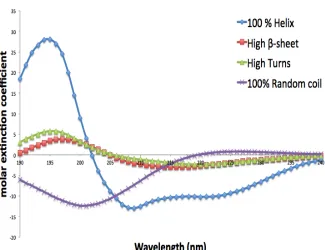
5 The different CD spectra that are produced by the various structures of chiral
molecules.4 . . . 40
6 The magnetic dipole transition moment, mexhibits circular motion, and the
electric dipole transition moment, µ, exhibits linear translation. These
7 A diagram of the optics that go into making a CD spectropolarimeter. It
contains a xenon arc lamp, mirrors, prisms, slits, polarisers, a lens, a PEM
and a PMT . The xenon lamp emits white light with a maximum flux in the
300 nm to 400 nm region. Mirrors direct the light to the slits and prisms.
Prisms select the relevant wavelength of light, polarisers perfect the linear
polarisation before the PEM makes it circularly polarised.5 . . . . 44
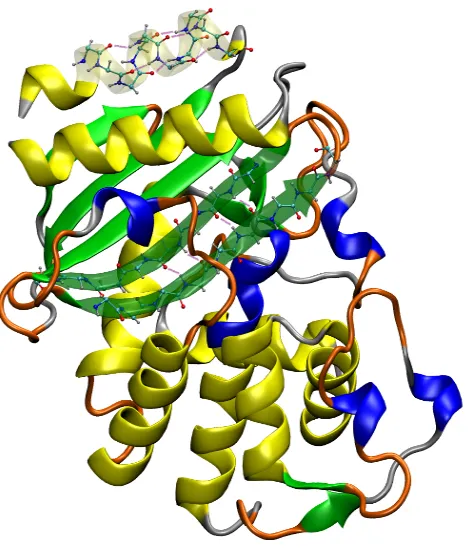
8 A picture of a protein with the different structures present: β−lactamase:
α−helix in yellow (long helices), 3-10 helix in blue (short helices), β−sheet
in green, turns in orange, random coil in grey. The atomic-scale detail, along
with hydrogen bonds, is also shown for two small sections: α-helix andβ-sheet
sections. The hydrogen bonds are the purple/pink lines between the red and
white atoms. Atoms are carbon in turquoise, hydrogen in white, oxygen in
red, and nitrogen in dark blue. . . 47
9 Figure from SOMCD paper showing that like proteins are clustered close
to-gether. The grey scales represent the Euclidean distances between nodes:
darker grey means the nodes are further apart. . . 56
10 A simple 2 dimensional representation of a transmembrane protein, E is
ex-tracellular space (outside the cell, which is an aqueous environment), P is the
plasma membrane (inside the membrane, which is a non-polar, phospholipid
environment, so it’s oily), I is the intracellular space (inside aqueous
environ-ment of the cell).7 . . . . 58
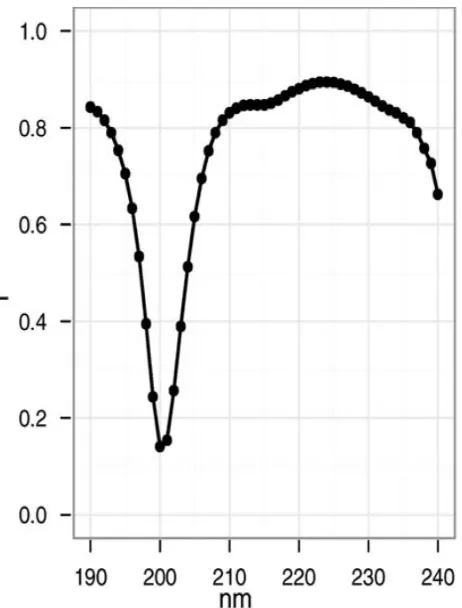
11 Plot from the K2D3 paper by Louis-Jeune et al. 2012 showing the Pearson
correlation coefficient against wavelength predicted by DichroCalc. . . 61
12 An annotated diagram of the intact human hand, by the American Society for
Surgery of the Hand.8 . . . . 66
5
List of equations
1. Euclidean distance ... Equation 1
2. RMSD ... Equation 2
3. NRMSD ... Equation 3
4. Learning rule ... Equation 4
5. Neighbourhood radius ... Equation 5
6. CD definition ... Equation 6
7. Absorbance ... Equation 7
8. Molar extinction ... Equation 8
9. Beer Lambert Law for ∆... Equation 9
10. Beer Lambert Law ... Equation 10
11. MRE Beer Lambert ... Equation 11
12. Mean residue ellipticity Beer Lambert ... Equation 12
6
Introduction
6.1
Self-organising map machine learning technique
As the rate of technological development increases more fields of research,
busi-ness, education, politics etc. have started and continued to produce prodigious
volumes of data. IBM estimated in 2012 that there were 2.5 exabytes (one
ex-abyte is 1018 bytes) of data created every day10, and this will only keep
accelerat-ing. Actually research shows that technology and scientific knowledge have been
growing exponentially for some time, and it is increasing this acceleration.11 This
leads to the conclusion that what is needed is constant development of better
tools to manage the ever-growing data.
To that end we need to be sure that the software and hardware we use can
constantly grow its abilities for producing meaningful results, and that we have
enough data scientists, data analysts, software engineers and I.T. people applied
to the task. IBM estimates the world will need 4.4 million data scientists by
2015, and this will only be 1/
3 filled.10
One of the fields that could greatly benefit from more automation of the
understanding of the information coming in from machines is the Biophysical
Chemistry work of circular dichroism (CD) spectroscopy. CD uses polarised UV
light to determine the conformation of certain molecules (proteins, DNA etc.)
be-fore, during and after chemical reactions, or other changes in the environment of
these molecules. This work aids in understanding the function of these molecules,
which helps with understanding biology, designing new medicines, and making
The research done in this project had the initial aim of developing something
that would help Chemistry researchers understand proteins, and make their work
easier, faster, and more accurate by becoming a sort of circular dichroism expert
software agent. This software, called SSNN for Secondary Structure Neural
Net-work, was designed to do pattern recognition on the CD spectra. The desired
outcome was for SSNN to learn what spectral features in the CD spectra lead to
which amounts of which secondary structures in the molecules. Though this is
not shown to users, it is just understood by the software.
The initial aim was to help CD practitioners by developing a software
ap-plication to learn about CD, however, the software developed with this aim has
grown far beyond that to include: finding the healthiest, comfortable insoles
for diabetes sufferers; controlling robotic prosthetic arms and hands, and even
matching Chemistry academics for research projects. CD, myoelectric signals
for robotic limb-control and diabetes was done by the author, the matching of
Chemistry academic primary investogators was done by Alison Rodger. This
software is now packaged in a graphical user interface (GUI), along with a guide,
so that anyone may download it from the Rodger Group website and use it on
their dataset.
As a machine learning method (see section 6.1.8), SSNN, the key software
package developed in this work, can be applied to any data set. It is the type of
software that will work on unlabelled data, where very little or no prior
knowl-edge is present (data mining). SSNN is a self-organising map artificial neural
network, or simply SOM, the SOM technique was invented by Teuvo Kohonen
Ko-honen Map. The acronym SOM is used to refer to an algorithm that constructs
an organised map, and the map itself. Hence the term self-organising map; it is
auto-organised. The self-organising map algorithm is a data-analysis technique
that works automatically, in an unsupervised manner.
This approach was employed to estimate structures (or conformations) of
proteins using circular dichroism (CD) spectroscopy, and later to control robotic
prosthetic limbs by performing the pattern recognition stage of interpreting
my-oelectric signals (MES) from patients.
This work focuses on unsupervised learning, and the SOM/SOFM or Kohonen
Map. The SOM places features of the dataset on its map in a way that enables
the user to gain knowledge about the features present, and their relationships
with other features, from the location on the map.13 The way the SOM is
organ-ised to cluster data and display it in a 2 dimensional form helps one to easily get
an impression of what the topographical relationships between elements of the
data are, especially high-dimensional data that is very hard to picture or make
clear, quick conclusions about.
In summary, a SOM takes input vectors and generates a clustered map
rep-resentation of them, with interpolations. The interpolations are calculated as
a weighted sum of the few nearest nodes that best represent the experimental
vectors; these nearest nodes are called the best matching units, or BMUs. These
BMUs are closest in Euclidean distance. The Euclidean distance depends on
d=
v u u t
n X
i=1
(xi−x0i)2 (1)
where x is the observed datum in the input vector at position i, and x’ is the
calculated or theoretical value of it from the model generated by the SOM. Lower
case n is the number of elements in the input vector.
For the complete training of a SOM, the following is repeated for thousands
of iterations:
1. A CD spectrum (another input) is selected at random from the database
or reference set, and compared with the map to find a BMU (Figure 1).
2. The BMU on the map is made more similar to the input vector.
3. The neighbours of the BMU are updated too (Figure 2).
Through this process the SOM makes an organised map, or a clustered map of
input vectors. Similar vectors should be close to each other, and dissimilar ones
further apart. See Figure 1 for a view of how inputs correspond to the nodes of
a SOM.
Figure 2 shows the neighbourhood of a BMU is selected for learning as well,
while the rest of the map remains static for this iteration. This is how the
clus-tering works, if it does not make the BMU neighbourhood similar to the BMU,
then there will never be regions where certain classes of vectors are clustered,
Figure 1: Schematic illustration of a SOM. Each input vector is presented to the map, and each node comes to represent an input vector, or the interpolation between inputs. This assignment is completed by the time training has finished.2
See Figure 3, for an example of what one level of a SOM looks like once the
data it holds have been clustered. There is one level for each dimension of the
data space. The red, higher areas represent the regions of the data space that
have more positive values at this, the nth element of each input vector. Note how
each value has been located amongst its equals or near equals. However, there
are still two areas with larger negative values: the low region in the front–left,
and the very low region in the front right. This shows that they belong to input
vectors that are of two different types. The other elements of the input vectors
(those not in this layer) place them in different classes, even if the elements on this
layer are similar. This is because there are far more relationships between data
points in the vectors present than just this layer, so they have a much stronger
influence on the organisation of the SOM than the elements of vectors that are
Figure 3: The trained SOM. The example here is a view of one level of a SOM that has clustered CD spectra; this represents the light intensities at one wavelength. Note how the terrain undulates smoothly, forming clusters: hills and valleys.
6.1.1 Origins of SOM
SOM is similar to the simpler, older methodology called VQ, vector quantisation.
The operation VQ performs is to compress and map continuous or discrete data
for transmission or storage in a digital channel. Vector-valued input data space
is segmented into a number of adjacent regions. A single model represents each
region optimally (a single point on the map). This is called the codebook vector.
In a SOM the equivalents of codebook vectors become globally ordered in space
6.1.2 Training a SOM
There are two ways to train a SOM 1) stochastically selecting individual examples
from the dataset, or 2) batch training, by considering all reference set examples in
one batch, and all models are updated simultaneously in a single step.
Stochas-tic training needs at least a few thousand training iterations to make sure all
examples from the reference set have had a good chance to have their impact
on the map. Batch training only requires a few dozen iterations before training
is complete, this is because a batch will typically contain many individual
vec-tors, so one iteration represents many from a stochastic training point of view.
Batch training is usually quicker and more likely to converge. Batch training does
not require any learning-rate parameter either (see sub subsection 6.1.6). The
stochastic training requires two learning-rate parameters, L0, the initial learning
rate, and k1, the rate at which learning decelerates. L0should be a small number,
in this work 0.06 or occasionally 0.1 were used. This ensures the algorithm learns
a bit each iteration, if the L0 were 1.0, then a node would become exactly the
training set spectrum in one iteration. This is not idea for clustering, it doesn’t
come to as good a convergence as slower learning. The k1 parameter should be
very small, as it multiplies the exponential in the learning rule equation, and
learning is needed throughout training.
6.1.3 Validating a SOM
One reasonably reliable way to validate the training parameters is to use
leave-one-out cross-validation (LOOCV). Here the SOM is trained with all but one of
the training set vectors, and tested on the vector that was left out of training.
of the map, the learning rate, the number of BMUs that go into making the
model, the learning equation parameters t1 and k1, and others. This is detailed
in “Paper 1”.17
6.1.4 Applications
Applications of SOM for clustering data are wide and include exploratory data
analysis, control systems, telecommunications, finance, natural science, statistical
analysis, biomedical analyses, profiling of criminal behaviour, characterisation of
galaxies, categorisation of real estate, and linguistics/organisation of texts.18–23
Some of the largest applications are bioinformatics, and huge textual databases.
In 2012, Kohonen et al. found over 10,000 applications of SOM14. Besides
SOM, there are other artificial neural networks, and there are many other
ar-chitectures, including evolutionary programs, artificial immune systems, random
6.1.5 Good practice with SOMs
The distance metric to measure the distances between data vectors on the map
needs to be decided upon. This could be Euclidean or more generally Minkowski,
Euclidean distance being Minkowski in 2 dimensions.14
The SOM is usually a square or hexagonal array of nodes containing the data
vectors. The square array is easier to build, and the hexagonal is better for
vi-sualisation purposes. It has been suggested that one should use a cyclic array,
such as a toroidal or spherical shape so that the edges of the map loop around
and become contiguous with each other. This is because there can be irregular
spacing between adjacent models at the extreme edges of the map. This format
is only suitable if the data itself is cyclic in some way.14–16,24
The size of a SOM should be large enough to include models for all spectra
or data vectors in the reference set, and to extract fine features of the data. So
if the data are expected to contain many fine features, a large map should be
used, otherwise the size should not be very large to optimise computational time.
The best way to establish the optimum size is trial-and-error. Typical sizes are
in the order of a few dozen to a few hundred nodes, and the dimensions of an
array should approximate the two principal components of the input data. Some
suggest using 4 to 10 nodes per expected class in the dataset.25 However, this
should be validated by training a map of a particular size, and comparing its
results with results of maps of different sizes.
To initialise a large map, it may be advisable to train a small map, initialised
with the principal components, then once trained to a partially complete state, to
from the existing nodes. After that the larger map is trained until it reaches
acceptable clustering.14
When searching for the BMU for any reference or test vector in general, one
may save a great deal of computational time by taking note of the locations of the
previous BMUs, and the corresponding training data. In subsequent iterations
the search for the BMUs can be restricted to the vicinity of the previous winners.
This may also be done by pre-training a smaller map first: the approximate
regions of likely BMUs can be given to the large map. So if a cluster of one class
of data (Class 1) is found in the top, right corner, and another cluster of different
class of data (Class 2) is found in the opposite corner, then it can be assumed
that these two clusters will be in opposite corners of any map with the same
data. Training a larger map with these data should then proceed by only looking
for BMUs in opposite corners for these inputs when they are selected. One can
search only in the top, right corner for BMUs for class 1 input, then that corner
will be trained on that class 1. Later, when Class 2 data requires a BMU corner,
the bottom, left corner could be assigned to that. This is manually biasing the
larger map, so injecting knowledge, but that knowledge comes from the earlier
clustering with the smaller map.
Another method to speed up computation, and reduce memory requirements
is to truncate the data vectors:14 for example, selecting every fifth element in
the vector can reduce computation by a factor of 5, without losing many of the
features.
On may also select features one thinks are important in each input vector,
and then make a new dataset, where the first column is Feature 1, column 2 is
while hopefully keeping most of the important information. Features used should
be theoretically sound, and should be tested to determine if they lead to good
predictions, if there is a desired outcome.
6.1.6 SOM applied to circular dichroism spectra
In our methodology, SSNN, the spectra are clustered in an unsupervised manner,
but the protein secondary structures corresponding to these spectra are known,
so the algorithm can be improved until a certain level of accuracy is attained.
This is done by running the software many times (validation, usually LOOCV)
while varying the iteration count. An error metric that is useful in this effort is
the normalised root mean squared deviation, or NRMSD. The formula for it is
the same as the root mean squared deviation divided by the range of the observed
data:
RM SD=
r P
(xi−x0i)2
n (2)
and
N RM SD= RM SD
xmax−xmin
(3)
where for the CD data, xi is an element of the experimental circular dichroism,
CD, spectrum; xi’ is the estimation of xi from the predicted spectrum; n is the
number of elements in the spectrum (for example, for us this was 51 due to the
range of CD data wavelengths: 240 nm-190 nm); xmax and xmin are the
maxi-mum and minimaxi-mum of the observed values. The NRMSD is used in Dichroweb to
compare the CD analysis methodologies or algorithms available for use on that
website. On Dichroweb, each methodology used produces an NRMSD for the
test CD spectrum.
When testing many different SOMs with various numbers of iterations, using
a LOOCV test, the SOM arrangement with the smallest NRMSD for the test
spectrum in question is considered to have the best number of iterations.
A summary of how a SOM works is that one starts with a map, a collection
of random vectors arranged in an NxN square or hexagonal lattice. This map
comes to represent the data. This will be expanded with much greater detail later.
In our case we made a 40x40 square map of CD spectra. So the map in 3
dimensions is 40x40x51. Various sizes of map were tested, this was the best,
as is detailed in Paper 1.17 The value of 40x40 nodes in the SOM trained with
our then 48 CD spectra was arrived at by running LOOCV for various map
sizes. It was found that a larger map size generally produced smaller error, but
larger than 40x40 nodes did not improve the accuracy much, and took a lot more
computational and real time to train. We found that this very large map, with 5
or 6 BMUs to make the model spectra from produced models with elements from
each of the BMUs: different regions of the spectrum were ’inherited’ from the
BMUs. If this were a simple classification question, then having a small map with
very few models might have been successful, but we were looking for 6 numbers
adding to 1.00 for the 6 different structure types, and the sets are not boolean,
but fuzzy. So for the most part each protein contained non-zero values for all 6
structures in varying amounts. The reference or training dataset also contained
these, and the test set did not contain any of the same spectra, so the structure
results should not be the exact structures of one model spectrum. Also, when a
small map is being used, making a model out of several BMUs tends to result in
in the map. For example, having a map with 9 nodes, and using 6 of those
to make the model of the test spectrum (6 BMUs) would be illogical, because
the model would be very average every time, there would not be much room for
individuality, and making a different decision (structure vector) each time.
The 48 spectra were later expanded to 53. We added 2 theoretically 100 %
α-helix proteins, by taking two helix spectra and stretching the peaks until they were where a protein of 100 % helix would be. We added 3 truly 100 % random
coil protein spectra. We present the map with the reference set of 53 CD spectra
in the sequential, stochastic manner detailed above. SSNN selects a spectrum,
and tries to find a match for it on the map. Each vector on the map is compared
with the selected CD spectrum, and the most similar one is said to be the BMU.
A learning rule (equation 4) makes the random vector more similar to the CD
spectrum. The region around the vector or BMU on the map, the
neighbour-hood, is made more similar to the CD spectrum by a smaller amount: decreasing
toward the edge of the neighbourhood (Figure 2).
The SOM architecture is used by some other methodologies for determining
protein secondary structure from circular dichroism, e.g. the K2d family26–28, and
SOMCD13. The SOM is a good artificial neural network, ANN, for CD spectra,
as it allows one to see the clustering of the spectra without too much difficulty,
as each node of a SOM trained with CD spectra contains a spectrum; the SOM
is topological. The SOM is not the only ANN that might be used for pattern
recognition of CD spectra, but the visualisation capabilities do make it appealing
for such work.
After the SOM has clustered the CD spectra so similar spectra are close, it
These structures come from X-ray crystallography data. SSNN makes a map of
structures that correspond to the spectra by finding the CD spectra in the map
that are most similar to the reference set spectra. There are also many spectra
that are intermediate between the training set BMUs, and these are referred to
here as virtual spectra. These virtual spectra number (40x40 - 53 = 1547), more
of this is covered in Paper 1.17
Briefly, the 53 training or reference set spectra take up 53 nodes on the map,
the other 1547 nodes hold spectra intermediate between those. These are virtual
spectra, and are hybrids made from the elements from their training set
neigh-bours.
During the training process, learning proceeds so as to cause the SOM to learn
fast at the beginning, and exponentially slower towards the end of training. The
size of the neighbourhood is also reduced in size with iterations. The equation
for the learning is:
L(t) = L0·exp(−k1·t) (4)
where L is learning rate, L0 is the initial learning rate, t is the current iteration,
and k1 is a parameter of size<<1. According to Kohonen,14the learning rate of
the nodes should decrease monotonically (e.g. hyperbolically, exponentially, or
piecewise linearly) with iterations.
The equation for the neighbourhood radius is as follows:
radius(t) =
(RADIU S0−1)·(1− tt1) + 1 if t≤t1
1 if t>t1
(5)
where RADIU S0 is the initial radius of the neighbourhood, t1 is a parameter
According to Kohonen, the first 1000 or so steps of training the SOM should be
for ordering the map topologically, the rest of the time should be spent carefully
ordering the models to reach their best states. This may take 10 times longer
than the initial topological ordering stage.14
6.1.7 Developments to SOM
Fritzke 199429 made a self-organising network inspired by Kohonen’s SOM that
adds more cells or nodes with iterations, i.e. “Growing Cell Structures”. There
are a few main differences between this and the SOM approach:
1. The learning or adaptation parameter remains fixed, while in a SOM it
reduces monotonically.
2. Only the BMU and its direct topological neighbours are updated to become
more similar to the relevant input vector, not a whole region.
3. Cells can also be removed
Removal of a cell can happen when the cell is considered superfluous, i.e. if it
has a position in a region of the data space with very low probability density; lower
than a threshold. The removal causes there to be fewer connections between cells,
and there can even be separate clusters with no links to each other, see Figure 4.
This method works using Voronoi regions, or regions created using Voronoi
tessellation.30,31Voronoi regions result from clustering data, such that every point
in a Voronoi region of a Voronoi diagram is closer to the centre of each region than
any other centre. The centre of a region is called the seed, or centroid, and the
and an alternate name is Dirichlet tessellation, after Peter G. L. Dirichlet.30,31
The map is made of k-dimensional hypertetrahedrons, which look like
tri-angles when plotted in 2-dimensions. So the deletion of cells or nodes must
always leave behind connections forming hypertetrahedrons (in high dimensions,
or tetrahedrons in 3-dimensions, or triangles in 2-dimensions), rather than just
lines connecting free-floating nodes. The connection lines, or edges represent
neighbourhood relationships.29,30One advantage of using this ‘growing cell
struc-ture’ methodology is that it makes obvious separation between different classes,
as there are no connections between nodes of different classes, due to deletion of
cells (nodes).
Fritzke et al. gave an example of classifying animals using the frequency cell
approach, with data taken from a SOM paper by Ritter and Kohonen.29,32 The
SOM classified the animals correctly, but borders between the different classes
(bird, herbivorous quadruped, carnivorous quadruped) had to be drawn in by a
human, while the self-organising growing cell structure of Fritze classified
cor-rectly, and showed the boundaries automatically (projected in 2-dimensions).
In 1997 Kohonen et al. developed a SOM algorithm for signal processing
called ASSOM, or adaptive subspace SOM.33 In ASSOM, each node of the map
adapts to become an expert for one class of transformations. ASSOM makes
statistical representations that refer to various temporal events. As a member of
the SOM family of algorithms, it works by competitive learning, where there is
only 1 winner. This is in contrast to PCA, for example, which finds average data
features that come from global properties that are not temporal.
recog-nising patterns that are simple transformations such as rotation, scaling, and
translation. Examples they looked at were speech waveforms, and coloured noise
patterns from photographic images. ASSOM was successful in finding relevant
filters.33
6.1.8 General good practice in machine learning
SOM is a neural network type of machine learning; this section describes what
machine learning is, and how best to use it.
Machine learning is the branch of computing that deals with software that
can adapt its models to datasets; it learns from the data to produce more
accu-rate predictions. There are two main types of machine learning: supervised (for
labelled data) and unsupervised (for unlabelled data). An additional method is
reinforcement learning, described just below.34
In supervised learning, the algorithm is given the input vectors, and their
target vectors, so that, during training, it may perfect its patterns to replicate
those targets/predictions. Examples of supervised learning include multilayer
perceptrons (MLPs), and genetic algorithms (GAs) with definite goals.29
In unsupervised learning, the algorithm will study the data, and find
pat-terns that are previously unknown. This process includes clustering, for example
SOM, hidden Markov models (HMM), and GAs with open-ended goals. SOM
is an unsupervised, competitive learning method.14,29,35 The ability to use
unla-belled data makes unsupervised learning useful for data mining, where the truth
because no human can understand the data, as they are far too high dimensional,
so there can be no correction of the predictions.
There is also reinforcement learning, which is a method of programming
soft-ware agents using rewards and punishments, while not requiring an explanation of
how to perform a given task. The agent must learn using trial-and-error methods
in a dynamic environment. The two main ways to solve reinforcement problems
are 1) to search for a behaviour that performs well in the environment, and use it
(GAs and GP), and 2) to estimate the usefulness of taking actions in the
environ-ment by using statistical techniques and dynamic programming techniques.36,37
The basic goal of all machine learning, ML, techniques is to gain the ability
to generalise to much more than just the training set. This is because the ML
system will never be able to have all information about every possible situation,
however, just having vast amounts of data does not suffice to be able to generalise
well. Like a brain needs to be able to learn new knowledge, because instinct will
never give it the ability to cope with every possible situation in a changing world.
If we give a ML system a Boolean function (two possible correct answers for
each variable: true or false) with a moderate 100 dimensions, and one million
examples in the sample data, this would mean that there would be 2100 - 106
ex-amples with unknown classes, i.e. approximately 1030 unknown classes. The way
to solve this problem, or set of problems, is to include some knowledge or at least
assumptions along with the raw data. 100-dimensional data is easily reached,
the circular dichroism spectroscopy data we work with is 57 dimensional, and the
Wolpert gave a name to the problem of having to include knowledge, rather
than just data, to make better learners. He called this ‘no free lunch’ theorem,
meaning that, when trying to understand all functions that are needed in the
universe, on average no learner may do better than guessing randomly. In this
sense there is no difference between algorithms without knowledge.39–41 No
al-gorithm can predict everything in the universe. It will need some knowledge to
be better than another prediction algorithm that has no knowledge, just data.
This may lead to the problem of having to supply vast amounts of data to train
the algorithm, assuming the functions that describe the patterns in a given data
space are uniformly distributed.
Fortunately, the functions that describe the samples are not taken uniformly
from all possible mathematical functions. Assuming the following: that similar
examples will have similar class membership, that the functions will be smooth,
and that complexity is finite, are all in the set of few assumptions that are
suffi-cient to understand rather well.
When learners use induction, a little input knowledge can be transformed into
a lot of output knowledge. It is superior to deduction in that it requires a much
smaller supply of knowledge to show good results.41 However, it was always
be-lieved that with inductive reasoning the correct decisions and causations cannot
be guaranteed, unlike with deductive reasoning, where they can be. More recently
this has been found to be untrue; there can be guarantees on results gained from
inductive reasoning, especially when accepting probabilistic guarantees.41
In any machine learning methodology, before beginning the training, the data
classifier may a) learn the data well, b) have its parameters and architecture
val-idated, and c) be tested on a new dataset. The testing phase is needed so it may
show that it can make general conclusions about data, and is not over-trained
on specific data. This cannot really be done when the answers are not known, as
can be the case with data mining.
Having the test dataset enables one to answer the question of how accurately
the classifier needs to predict the target vectors; too little training, and the
algo-rithm does not know the data, and has not recognised any patterns (underfitting),
too much training on the specific training set, and the algorithm cannot
gener-alise (overfitting).41
Underfitting is where a learning or heuristic algorithm has not been trained
enough to recognise patterns in the dataset, and so cannot make good
predic-tions or classificapredic-tions for this or any dataset. Overfitting is where a heuristic
algorithm has trained too much on one particular dataset, and believes that is
all there is to know, so it cannot predict or classify any new data well. It keeps
assuming the new data is exactly the same as, or very similar to the training data
set.41
One can understand the problem of overfitting by dividing the error of
gen-eralisation into two parts: bias and variance.42 Bias is learning the wrong thing
consistently, and variance is caused by a tendency to learn random things, and
not the true information.
There are various ways to work against overfitting. Cross-validation can help,
terms added to the evaluation function are also a good idea, like penalizing the
size of classifiers so that they do not get too large and have space to overfit.
The next biggest problem for machine learning is “the curse of
dimension-ality”. As dimensions (or number of features) of the data grow, generalising
becomes exponentially more difficult. If the number of features in the database
is again just 100 with a Boolean solution space (two options: true or false), and
even as many as 1012 samples are given to the classifier algorithm, the samples
still only cover 10−18 of the input space (2100 ≈1030).
A more deep-rooted and important issue is that the way ML algorithms
clas-sify based on similarity fails in high dimensions. When there are 100 dimensions,
and only 2 are being compared, the noise from the other 98 dimensions can act
as noise, and can drown-out the signals from the first 2.14
So is gathering more features always a good thing? No, it can be that they
offer nothing new that is not already known, and their pros can be outweighed
by their cons, when they contribute to there being too many dimensions to the
features. Assuming the examples are uniformly distributed, then the detriments
to having more data become much worse quickly. Actually, the situation is not
as bad as it may seem, as examples are not usually spread uniformly, but cluster
about the lower-dimensions.14
In success or failure of ML techniques the most vital element is that the
features used are good. When dealing with raw data, learning is not
straight-forward. However, if one forms good features from the raw data, learning can
the ML algorithm takes raw data, it will find pattern recognition far more
dif-ficult than if it works with data that has had some important features highlighted.
Machine learning is an iterative process of 1) applying the data or features
to the learning algorithm, 2) analysing the results, 3) altering the algorithm and
maybe the data. Here learning is usually the easy stage (ML algorithms have
general application, so easily learn data), while feature engineering is the most
difficult stage, as it is domain-specific. Automating feature engineering to an
increasing degree is therefore a very worthy pursuit. This could be done by
cre-ating a large collection of features that might be useful and picking those that
help best to improve classification information.
Despite all of the above, an algorithm with vast amounts of data still wins
over a better classifier with much less, which of course might lead to computation
time issues.41
There were no computation time issues for the CD project, as the dataset
that trained the selected ML technique, the SOM, was 57 by 53 data (points),
from 57 dimensions and 53 examples. As mentioned above, the aim was to take
the CD spectra and structure knowledge, and do some pattern recognition on
them to find spectral features that link the spectra to the secondary structures.
The question was: what features lead to what structures of proteins, and in
what proportions? Aspects of the history of this field of work, along with some
6.2
Circular Dichroism for protein secondary structure
estimation
Circular dichroism, CD, is a spectroscopy that has been used since the 1960s
in structural biology to study the structures of peptides, polypeptides and
pro-teins.43
CD was discovered in the 19th century by Jean-Baptiste Biot, Augustin
Fres-nel, and Aim´e Cotton.44 CD is the difference in absorption of left- and
right-circularly-polarised light (LCP light minus RCP light), see the equation below5
∆A=AL−AR (6)
where ∆A is the difference in light absorbed by the chiral molecule, and AL
and AR are the absorptions for the LCP, and the RCP light respectively.
Absorbance is the logarithm of the incident divided by the transmitted
radi-ation, as in the equation below:
A=log10(
I0
I ) (7)
where A is absorbance, I0 is the incident radiation, and I is the transmitted
ra-diation.45–47
In order for a CD spectrum to produce a useful, non-zero signal, the molecules
have to be in a suitable solution (known as a buffer), and the molecule must have
some chirality (explained just below). A buffer is a solution that resists changes in
acidity, so if a small amount of acid or a base is added to the buffer solution that
approxi-that is being used. A chiral molecule cannot be superposed onto its mirror image,
the arrangement in space is very similar, but not exactly the same, just in the
same way that a left and a right hand are not arranged in exactly the same way,
and are not simply reflections of each other. CD is based on the Cotton Effect
or Optical Rotatory Dispersion, which is where the biased absorption between
LCP and RCP light by stereoisomers of a chiral molecule causes redistribution of
electrons in a helical way, for certain transitions, at particular wavelengths. By
studying the CD spectrum of a chiral molecule, the handedness of the changes in
electron positions can be found. Some aspects of the structure of the molecule in
three dimensions can be derived from this.43,48 Stereoisomers are molecules that
have the same atoms and sequence, but different spatial arrangements.49,50
The basis of the CD spectrum is electronic transitions, this gives rise to
spec-tral features: peaks and negative bands. In Figure 5, we can see the CD specspec-tral
features that arise from the structures present in a chiral molecule. α-helices have a characteristic large peak at about 190 nm, and two negative bands at 208
nm (called the π →π∗ transition) and 222 nm (n →π∗ transition). β-sheets are characterised by a peak between 195 nm and 202 nm (π→π∗ transition), and a negative band between 215 nm and 220 nm. Turns are negative at 180 nm to 190
nm, and positive at 200 nm to 205 nm. A disordered structure has a negative
band at 200 nm. These are for the same set of electronic transitions, they just
shift in wavelength a little for different structure types.
Electronic transitions involve electrons jumping energy levels near the ground
Figure 5: The different CD spectra that are produced by the various structures of chiral
molecules.4
CD can be measured in terms of molar extinction coefficients, or ∆, also called molar absorptivity, which has the units L mol−1 cm−1:
∆=L−R (8)
and
∆ = ∆A
cl (9)
whereL andR are the molar extinction coefficients for the LCP and RCP light,
c is the concentration of the chiral molecule in solution measured in mol·l−1, and
I is the cell pathlength, measured in centimetres. The pathlength is the width
passes through.
We worked with ∆ values, which are per mol, so our data are independent of the number of residues. Equation 9 is derived from Beer Lambert’s Law:5
A=cl (10)
∆ values can be converted to mean residue ellipticity (MRE or θ) using the simple equation:
θ = ∆∗3298.2 (11)
MRE is measured in degrees cm2 dmol−1 residue−1. CD spectrophotometers
output the CD signal in units called millidegrees. This is because, historically,
the change in polarisation of linearly polarised light into elliptically polarised
light passing through the sample was measured as the CD signal. Millidegrees
can be converted into ∆ units using the equation below:
θ/millidegrees = 32,982·cl (12)
which is the Beer Lambert Law (equation 10) restated for different units.5
LCP light is defined as: when viewed from the source, the electromagnetic
field of LCP light rotates in an anti-clockwise direction, and the EM field of a
beam of RCP light rotates in a clockwise direction.51
6.2.1 Where CD signals come from
Circularly polarised light has a magnetic dipole moment that rotates (a magnetic
motion of the electromagnetic field. The helical motion of the EM field causes
an electron to move in a helical path, as can be seen in Figure 6.5,6
Figure 6: The magnetic dipole transition moment,mexhibits circular motion, and the electric dipole transition moment,µ, exhibits linear translation. These combine to make helical motion of the EM field.5,6
So the EM field moves in a helical motion, but how do CD practitioners find
the signals these helical motions of light produce? The CD machine, which is
called a spectrophotometer or spectropolarimeter records the CD spectra. An
extremely important part of a circular dichroism spectropolarimeter is the
com-ponent that makes sure the machine produces exactly equal intensities of both
LCP and RCP light. This component is the PEM, or photoelastic modulator.
The UV light source is a xenon arc lamp, which also emits visible light. Various
mirrors, prisms and slits are needed to collimate the light from the lamp.
Subse-quently, the light is linearly polarised (as would be useful for linear dichroism),
and the PEM circularly polarises the light.
The PEM is made of crystalline quartz stuck to a piece of isotropic quartz
(sil-ica). Light travels through the silica section. The light is split into two orthogonal
dif-section of the PEM, this makes it oscillate at 50 kHz. Varying the amplitude
of the voltage causes the PEM to select alternately for light polarised in one
direction, followed by the orthogonally polarised light.
So the PEM effectively forms a wavelength-dependent quarter-wave plate that
is needed to make circularly polarised light. In Figure 7, see a diagram of the
optics of a CD spectrophotometer (another name for a CD machine). The PMT
(photomultiplier tube) detects the light that was not absorbed by the sample,
and converts it to an electrical signal; it vastly multiplies the current received,
and is a very sensitive detector.
The CD signal is then determined by the ratio of the AC to DC elements
detected by the PMT, see equation 13. The sign of the CD derives from the
phase of the AC element using a lock-in amplifier that uses the AC voltage of the
PEM as a time reference.5,36
CD = < AC >
DC (13)
Instruments can now hold the DC current constant, with the use of a servo that
adjusts the PEM voltage. With a constant DC voltage, the CD is proportional
to the <AC> voltage.
6.2.2 Buffers
To perform CD analysis of chiral molecules, an appropriate buffer should be used.
A buffer is a solution containing a weak base and its conjugate acid, or a weak
acid and its conjugate base. The purpose of a buffer is to resist changes in pH
when small amounts of acid or base is put in it52. A buffer should be at a
concen-tration in the solution such that it may withstand variations in the pH due to the
addition of a highly charged ligand, for example ATP4−. The buffer must be used
constant. The pH should be checked at the temperature the buffer will be used
at; some buffers have high temperature coefficients.53,54
Buffers can affect the CD spectra when they are used for solutions of proteins
or other chiral molecules. Every time a CD spectrum is taken of a chiral molecule,
the base line should also be scanned. This is the CD spectrum without the chiral
molecule present, i.e. just the buffer solution. This should then be subtracted
from the CD spectrum for the molecule of interest to obtain the true spectrum.
This should also be done to check the quality of the buffer, as some can cause
the high tension, HT, voltage to rise to a level where the CD spectrum becomes
too noisy to be useful. This is due to the buffer having a high absorbance in this
wavelength range. The high tension voltage is the voltage applied to the PMT.
Absorbance in a CD spectrum due to the buffer solution can cause degradation
of the signal, to the point that the signal to noise ratio becomes too low. Kellyet
al.53 found that absorbance is wavelength dependent, and more noise is caused
at short wavelengths, particularly the 190 - 200 nm region. The absorbance is
measured by the HT voltage. This is the voltage applied to the photomultiplier
tube (PMT). This means the PMT has to work hard in the short wavelength
region. For good CD spectra the HT should be at most 600 V, but this depends
on the CD machine.53
For this reason synchrotron light sources with much greater light fluxes than
xenon arc lamps are used to gather what is termed SRCD, or synchrotron
ra-diation CD. With a synchrotron, useable CD spectra can currently be obtained
down to approximately 160 nm. However, due to noise from most desktop CD
nm.
Unwarranted interactions, like chelation (the formation or presence of bonds
between separate binding sites on the same ligand and one central atom) of
essential metal ions can also cause trouble with phosphate buffers among others.53
6.2.3 Algorithms for circular dichroism pattern recognition
With knowledge of where the CD signals come from, and how to prepare the
buffer, the data analysis stage needs to be considered, as the CD spectra are
not easily read by non-expert CD practitioners. Despite being able to tell which
structures are present, even the experts cannot say exactly what proportions of
structures are present. For this statistical or learning algorithms should be used.
There are various methodologies for CD pattern recognition to find secondary
structures of proteins: CDSSTR, SELCON3, VARSLC, CONTIN, LINCOMB,
MLR, CDNN, SOMCD, K2d, K2D2, K2D3, as well as our own: SSNN.13,26–28,55–57
Here is a brief review of the methods used. SELCON3, CDSSTR and K2d were
tested and reviewed in attached papers. The methodologies are based on
multi-ple linear regression (MLR), singular value decomposition (VARSLC, SELCON,
CDSSTR), ridge regression(CONTIN), convex constraint analysis (CCA),
self-consistent method (SELCON), constrained least squares analysis (LINCOMB),
and neural network (CDNN, SOMCD, K2d, K2D2, K2D3, SSNN).58 The
struc-tures for these databases generally come from X-ray crystallography. See Figure
Greenfield’s review
In reference58 Greenfield compared the structure prediction qualities of MLR,
LINCOMB, SVD, CCA, CONTIN, SELCON, B¨ohm et al.’s NN, and K2d.
Most of the algorithms are good at predicting the α-helix structures from CD, but have more difficulty with all other structures. The helix structures were
predicted by all algorithms with Pearson correlation coefficients (P) of 0.88 or
higher, and standard deviations (σ) of usually about 0.1. Theβ-sheet andβ-turn structures were not as well done, and were far more variable. β-sheets were pre-dicted with P of 0.00 to 0.91, and σ of 0.07 to 0.28. Theβ-turns were predicted with P values of -0.56 to 0.84, and standard deviations of 0.05 to 0.27.
K2d does not predict the structure type β-turns, it uses the structure types 1) α-helix, 2) β-sheet and 3) other.26,58
MLR (non-constrained least squares analysis) predicts α-helix, β-sheet parallel and anti-parallel, β-turns, and random conformations.
LINCOMB predictsα-helix, β-sheets, β-turns, and “random coils”. B¨ohm et al.’s neural network predicted helix, parallel and anti-parallel sheet, turns, and
remainder.
A likely reason these algorithms predict β-turns so poorly is because there are at least 4 different types of turns, which do not have very similar spectral
features associated with them.
MLR predicts helix well, sheet with some correlation with experimental, and
turns very poorly. Similar to MLR, LINCOMB predicts helix well, sheet with
some correlation (very variable), and turns rather badly.
SVD predicts helical structures very well, but sheets and turns extremely
0.12 ≤ σ ≤ 0.27, and turns -0.56 ≤ P ≤ 0.22, and 0.1 ≤ σ ≤ 0.27. Here P is Pearson’s correlation coefficient, and σ is the standard deviation. So a large P, closer to 1.00, is better (higher correlation), and a small σ is good (small error). CCA makes good predictions of helical structure, but its estimates of sheets
and turns are worse than that of other methods.58
CONTIN gives good helix predictions, and its turns predictions are better
than MLR, SVD and CCA. VARSLC produces excellent helical structure
pre-dictions, while sheet and turn predictions are much improved over the above,
especially the sheet predictions. Data needs to be collected to 184 nm to make
useful predictions/estimations, which is a handicap.58–60
SELCON’s predictions for globular protein helix, sheet and turns are all very
good. There does not seem to be much detriment to using a reduced data range of
240 nm - 200 nm. The 1996 version of SELCON worked well for globular proteins,
but did not predict well the structures of polypeptide with large percentages of
sheet; it over-estimated helix content, while under-estimating sheet content quite
badly. For a comparison between SELCON3, a more recent version of SELCON,
and SSNN see Paper 117 and Paper 34.
The Neural Network for protein secondary structure estimation that was
writ-ten by B¨ohm et al. was extremely good at predicting helical, and antiparallel
sheet structures. The correlation coefficients were 1.0 and 0.91. The only
prob-lem appears to be when the wavelength is restricted to 250 nm - 200 nm, the
sheet estimation is negatively correlated.61
K2d gives good sheet estimates when the wavelength range is restricted. It does
not estimate turns.
nm - 200 nm, VARSLC uses the range 260 nm - 184 nm, and SELCON uses
260 nm - 200 nm. B¨ohm’s NN (neural network) used 83 element input vectors,
representing the intensities at 260 nm - 178 nm.58 MLR does not require an exact
value of the protein concentration. According to Greenfield, CCA does not find
the secondary structures of unknown proteins easily, given no extra information,
but it is very good for analysis of spectra of proteins and peptides with regard to
temperature, pH and ligand binding.
MLR, SVD and CCA do not have selection procedures for known spectra
to make model spectra of unknown proteins. The known spectra do not
neces-sarily have similar features to the test spectra. This leads to the models being
very dependent on the spectra which were chosen to make the models. So, the
suggestion was to introduce these similarity selection measures. That is what
has been done with (1) ridge regression, (2) variable selection, and (3) neural
networks; examples of these are (1) CONTIN, (2) VARSLC (which is SVD with
variable selection) and SELCON (VARLSC modified), and (3) K2d. Algorithms
with selection perform better than those without. SELCON, or self-consistent
method by Sreerama and Woody gains a speed advantage by routinely removing
the spectra least like the test spectrum.58,62–64
It should be noted that the algorithms that produce the best spectral
predic-tions do not necessarily produce the best structure estimates. Greenfield points
to CONTIN as “almost always [giving] excellent agreement between the
experi-mental and calculated CD curves, even when the fits are relatively poor compared
to other methods.” Greenfield says that K2D often produces very poor spectral
models, while making very good structure predictions.58 Another example of this
CD-to-protein-structure algorithms, but its structure predictions/estimations are not as
good as some competitors (e.g. SELCON3 and SSNN). SELCON3 has possibly
the best structure predictions besides SSNN.58
The most sensible way to analyse CD spectra to get structure predictions is
to use at least a few different methods, and see where they agree. If the
predic-tions vary greatly, then one cannot have great confidence about the structures
present.4,58
Greenfield says that if one needs structure predictions, but does not know the
concentration accurately, then non-constrained least-squares analysis programs
like MLR are the only options, but these do not give the best predictions. This
issue is dealt with in reference38 also known as Paper 2 in this thesis.
K2d
In their 1993 paper, Andrade et al. introduce K2d, their SOM methodology
for estimating protein secondary structures from CD spectra.26 This paper lends
more detail about K2d and its proteinotopic map, than given by Greenfield,
mentioned above. A proteinotopic map is a topological map of some information
about proteins.
The training set for the K2d SOM is 24 CD spectra. One of these proteins is
poly-L-lysine, which has different CD spectra depending on pH and temperature;
for this reason it is used as a model protein for the various spectral features.
Eighteen of the proteins have known (static) structures, and 3 are constructed
from 15 proteins of known structure originating from Chang et al. 1978.65 More
The K2d map is a 13x13 square lattice of nodes and, like other SOMs, it
in-terpolates between experimental CD spectra, but does not extrapolate. For this
reason, unlike some methodologies, K2d does not give structure estimates with
negative values, which would be physically impossible.
As Unneberget al.13point out, the database size determines the possible sizes
of the map: a map needs to have enough data space to store all the examples,
but must not be so large as to make all BMUs in a region essentially the same,
and negate the use of multiple BMUs. That would cause the SOM to produce
poor spectra models. So with 24 spectra in its training set, K2d needs a smaller
map than a SOM with more spectra would.
Due to the CD data used by K2d being of the wavelength range 240 - 200 nm,
there are 41 data points. The SOM does not use CD spectral data beyond 240
nm, as there is not much information from the peptide backbone in that region.
For reasons of wavelength range and how much information can be extracted
from such a range, there are 3 structures types estimated by K2d, α-helix, β -sheet and “random coil”, or other. There are not enough electronics transitions
that emit light in this region to provide information to resolve more thanα-helix
and β-sheet. The n → π∗ transitions are between 190 nm and 200 nm. This
means that there are only 2 independent variables, for the helix and sheet; the
random coil value is calculated by subtracting the helix and sheet values from
1.00.26 It should be pointed out that random coil is a particular structure type,
though rather difficult to generate, but is often used as a category for everything
that does not fit into any other categories, like the group “other” structures.
to the structure of the protein, or other chiral molecule, in the short-wavelength
range below 200 nm. However, this data is much harder to access due to the
high energies required, and most desktop CD spectrophotometers cannot get CD
spectra in this range without increasing the absorbance to such levels that there
is a great deal of noise (at the time of writing, May 2014).
As mentioned above, this is a reason to use SRCD, the synchrotron overcomes
this absorbance issue, see the section on SRCD, section 6.2.4.
Some later algorithms inspired by K2d do use data in the 200 - 190 nm range.
The Andrade team point out that while collecting spectra without the shorter
wavelength region, the methodology cannot hope to reliably estimate multiple β
structures, hence why they decided to estimate just one helix structure and one
sheet structure.
K2d uses a parameter to track the training progression of the SOM, it is
called the distortion parameter, D. D is the sum of all the distances between
each training set spectrum and the model spectrum most similar to it. If this
value is generally decreasing, then training is headed in the right direction. If
it stalls, and does not continue decreasing, then training has stopped being useful.
With regard to the success of clustering CD spectra, the K2d SOM team
found that each of the three structure labels claimed a corner of the map; in the
random coil corner, those spectra of proteins with high random coil clustered,
with the same result for sheet- and helix-rich proteins.
K2d uses a BMU count of 2. This is the number of BMUs, or model spectra
from the map that go into making the final output model of the test spectrum,