http://wrap.warwick.ac.uk
Original citation:Vereenooghe, Leen, Reynolds, Shirley, Gega, Lina and Langdon, Peter E.. (2015) Can a computerised training paradigm assist people with intellectual disabilities to learn
cognitive mediation skills? A randomised experiment. Behaviour Research and Therapy, 71 . pp. 10-19.
Permanent WRAP url:
http://wrap.warwick.ac.uk/73723
Copyright and reuse:
The Warwick Research Archive Portal (WRAP) makes this work by researchers of the University of Warwick available open access under the following conditions. Copyright © and all moral rights to the version of the paper presented here belong to the individual author(s) and/or other copyright owners. To the extent reasonable and practicable the material made available in WRAP has been checked for eligibility before being made available.
Copies of full items can be used for personal research or study, educational, or not-for-profit purposes without prior permission or charge. Provided that the authors, title and full bibliographic details are credited, a hyperlink and/or URL is given for the original metadata page and the content is not changed in any way.
Publisher’s statement:
© 2015, Elsevier. Licensed under the Creative Commons Attribution-NonCommercial-NoDerivatives 4.0 International http://creativecommons.org/licenses/by-nc-nd/4.0/
A note on versions:
The version presented here may differ from the published version or, version of record, if you wish to cite this item you are advised to consult the publisher’s version. Please see the ‘permanent WRAP url’ above for details on accessing the published version and note that access may require a subscription.
Can a computerised training paradigm assist people with intellectual disabilities to learn cognitive mediation skills? A randomised experiment
Leen Vereenooghe University of East Anglia
Shirley Reynolds University of Reading
Lina Gega
University of East Anglia
Peter E Langdon University of Kent and
Hertfordshire Partnership University NHS Foundation Trust - Norfolk
Author Note
Leen Vereenooghe, Department of Psychological Sciences, Norwich Medical School, University of East Anglia, UK; Shirley Reynolds, Charlie Waller Institute, University of Reading, UK; Lina Gega, Department of Psychological Sciences, Norwich Medical School, University of East Anglia, UK; Peter E. Langdon, Tizard Centre, University of Kent, UK and Broadland Clinic, Hertfordshire Partnership University NHS Foundation Trust - Norfolk, UK
ABSTRACT
Aims: The aim was to examine whether specific skills required for cognitive behavioural
therapy (CBT) could be taught using a computerised training paradigm with people who have
intellectual disabilities (IDs). Training aimed to improve: a) ability to link pairs of situations
and mediating beliefs to emotions, and b) ability to link pairs of situations and emotions to
mediating beliefs.
Method: Using a single-blind mixed experimental design, sixty-five participants with IDs
were randomised to receive either computerised training or an attention-control condition.
Cognitive mediation skills were assessed before and after training.
Results: Participants who received training were significantly better at selecting appropriate
emotions within situation-beliefs pairs, controlling for baseline scores and IQ. Despite
significant improvements in the ability of those who received training to correctly select
intermediating beliefs for situation-feelings pairings, no between-group differences were
observed at post-test.
Conclusions: The findings indicated that computerised training led to a significant
improvement in some aspects of cognitive mediation for people with IDs, but whether this
has a positive effect upon outcome from therapy is yet to be established.
KEYWORDS: Cognitive Behavioural Therapy, Training, Learning Disabilities, Cognitive
Can a computerised training paradigm assist people with intellectual disabilities to
learn cognitive mediation skills? A randomised experiment
Prevalence rates of mental health problems among people with intellectual disabilities
(IDs) vary widely depending on the diagnostic criteria and assessments used, with recent
estimates suggesting that between thirteen and forty percent of people with IDs are affected
(Cooper, Smiley, Morrison, Williamson, & Allan, 2007; Deb, Thomas, & Bright, 2001;
Emerson & Hatton, 2007). The high prevalence rates, when compared to the general
population, can be partly explained by the genetic vulnerability of people with IDs, and
disadvantageous life events such as stigmatisation and isolation (Clarke, 2003; Cooper et al.,
2007; Emerson & Hatton, 2007; Hulbert-Williams & Hastings, 2008; Reiss & Benson, 1984).
Even though people with IDs have an elevated risk of developing mental health
problems, the evidence regarding the efficacy of psychological therapies for this population
has only been emerging slowly. A recent meta-analysis concluded that cognitive behavioural
therapy was at least moderately effective for the treatment of anger regulation problems and
depression (Vereenooghe and Langdon, 2013), and previous reviews have also supported the
potential benefits of cognitive-behavioural therapy (CBT) for anger management (Hamelin,
Travis and Sturmey, 2013; Nicoll, Beail and Saxon, 2013). However, there is insufficient
evidence to conclude that psychological treatments for mental health problems amongst
people with IDs are empirically validated (Vereenooghe & Langdon, 2013). One of the
reasons for this is that people with IDs are thought to have difficulty grasping some of the
concepts presented within CBT (Biza Stenfert-Kroese, Dagnan, & Loumidis, 1997), and
while suitability criteria for CBT have been described in terms of the potential to form a
therapeutic alliance, motivation for change, ability to remain problem-focused, accessibility
affinity with the cognitive rationale (Safran, Segal, Vallis, Shaw, & Samstag, 1993; Safran,
Vallis, Segal, & Shaw, 1986), there has been little work looking at these variables within
therapy for people with IDs.
The antecedent-belief-consequent (A-B-C) model (Ellis, 1977; Trower, Jones,
Dryden, & Casey, 2011) has helped inform clinicians about the necessary skills that are
needed in order to successfully take part in cognitive-behavioural therapy. The model asserts
that emotional and behavioural responses or consequences (C) to an activating event or
antecedent (A) are shaped by the person’s interpretation or beliefs (B). These three
components reflect three component skills needed in order to take part in CBT: (a)
accessibility of automatic thoughts, (b) ability to differentiate emotions, and (c)
understanding of the cognitive rationale (Safran et al., 1993, 1986). Accessibility of
automatic thoughts corresponds with the belief component, while differentiation of emotions
corresponds to the consequences component, and the cognitive rationale is reflected within
the cognitive mediation process, which hypotheses that the relationship between situations
and emotions are mediated by cognition.
Several authors have examined whether people with IDs have difficulties with some
of the component skills needed to take part in CBT. Reed and Clements (1989) examined
whether people with IDs could link situations and feelings using six simple pictured scenarios
and pictures of a happy face and a sad face. Approximately two thirds of participants made
correct links for each scenario; incorrect responses were associated with lower levels of
verbal comprehension. This task has since been used by Dagnan, Chadwick and Proudlove
(2000), Joyce, Globe and Moody (2006) and Oathamshaw and Haddock (2006) with people
Oathamshaw and Haddock (2006), rather than just focus on emotions, assessed the
ability of people with IDs and psychosis to differentiate between emotions, thoughts, and
behaviours, reporting that behaviours and feelings were more easily identified than thoughts.
A similar finding was reported by Quakley, Reynolds & Coker (2004) in relation to the
abilities of young children to learn the skills required for CBT.
Dagnan and Chadwick (1997) assessed the ability of people with IDs to supply
mediating beliefs that would link each of six simple scenarios to an emotion, which was a
picture of a sad or angry face. They prompted participants to formulate a mediating belief
which linked the given situation and emotion. Twenty percent of participants were able to
produce mediating beliefs.
In a subsequent study, Dagnan, Chadwick and Proudlove (2000) introduced a revised
assessment of cognitive mediation skills. Five scenarios were presented twice, once with a
belief or emotion that matched or was congruent with the situation, while at other times the
belief or emotion did not match the situation, i.e., was incongruent. For example, the
antecedent ‘You walk past a group of friends and they don’t say hello’ is negatively valenced
and was followed with the negatively valenced belief, ‘I’m not likeable’, to form a negatively
valenced congruent pair. When the same antecedent was followed by the positvely valenced
belief, ‘I am likeable’, it formed an incongruent pair. For congruent pairs the consequential
emotion, happy or sad, should have the same valence as both the antecedent and the belief,
whereas for incongruent pairs the consequential emotion should have the same valence as the
mediating belief. The findings indicated that people with IDs found incongruent pairings to
be particularly difficult. Other studies have reported similar results (Oathamshaw and
To examine if training improved the cognitive mediation skills of people with IDs,
Bruce, Collins, Langdon, Powlitch and Reynolds (2010) randomised people with IDs to a
graded training programme in CBT skills or a relaxation intervention. Training led to
improvements in the ability to link thoughts and feelings, as measured by the Thought to
Feeling task (Doherr, Reynolds, Wetherly, & Evans, 2005) but participants’ ability to
distinguish amongst thoughts, feelings and behaviours did not improve, as measured using
the Thought-Feeling-Behaviour discrimination task (Quakley, Reynolds, & Coker, 2004).
Together, these studies suggest that people with IDs have some understanding that
emotions are linked to situations, but find it harder to understand how cognitions mediate this
connection. However, while there is evidence that an understanding of the A-B-C model is
associated with outcome from CBT (Safran et al., 1993), we still do not know whether this is
also the case for people with IDs. Furthermore, various studies have shown strong links
between verbal ability, and both readiness for CBT (Dagnan et al., 2000; Dagnan &
Chadwick, 1997; Joyce et al., 2006; Reed & Clements, 1989; Sams, Collins, & Reynolds,
2006), as well as therapeutic gains (Willner, Jones, Tams, & Green, 2002). The currently
available assessments and training methods (Dagnan et al., 2000; Joyce et al., 2006; Reed &
Clements, 1989) rely heavily on verbal comprehension and may be too difficult for some
people with moderate IDs. They also use abstract symbols of emotions that do not conform to
the recommendations of McKenzie et al. (2000). Hence, there is scope to make further
adaptations to existing assessment and training methods which aim to improve CBT skills.
This may improve the accessibility of therapy (Vereenooghe & Langdon, 2013) for a
population with a high prevalence of mental health problems (Clarke, 2003; Emerson &
The present study evaluated cognitive mediation training for people with IDs skills
using a computer-based paradigm. The specific objective was to compare the effects of
training in cognitive mediation skills compared to an attention-control intervention. It was
hypothesised that:
1. Training in linking situation to feelings, and vice versa, would significantly improve
ability to (a) link pairs of situations and mediating beliefs to appropriate emotional
responses, whereby (b) congruent items, but not incongruent items, will be
significantly associated with this ability to link pairs of situations and mediating
beliefs to appropriate emotional responses.
2. Training in linking situation to feelings, and vice versa, would significantly improve
ability to (a) link pairs of situations and emotions to appropriate mediating beliefs,
whereby (b) congruent items, but not incongruent items, will be significantly
associated with this ability to link pairs of situations and emotions to appropriate
mediating beliefs.
METHODS
Participants
Twenty-three men and 42 women were recruited and randomly assigned to the
training or attention-control condition, stratified by general intellectual functioning. The
specific inclusion criteria were (a) minimum age of 18 years old, (b) IQ below 70. The
exclusion criteria were (a) additional sensory impairments, (b) pervasive developmental
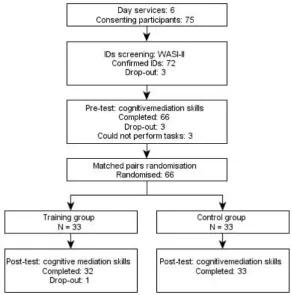
disorder, (c) acute psychosis, or (d) currently receiving CBT. A flowchart depicting
participant flow through the study is shown in Figure 1. Seven people were not retained at
participant left on holiday before pre-test assessments were administered, three participants
did not want to continue the pre-test assessments, and one participants had become frustrated
during the intervention and eventually dropped out during post-test assessments. Three were
unable to take part in the computer task without significant assistance. Mann-Whitney tests
yielded no significant difference between the training and attention-control groups on age, U
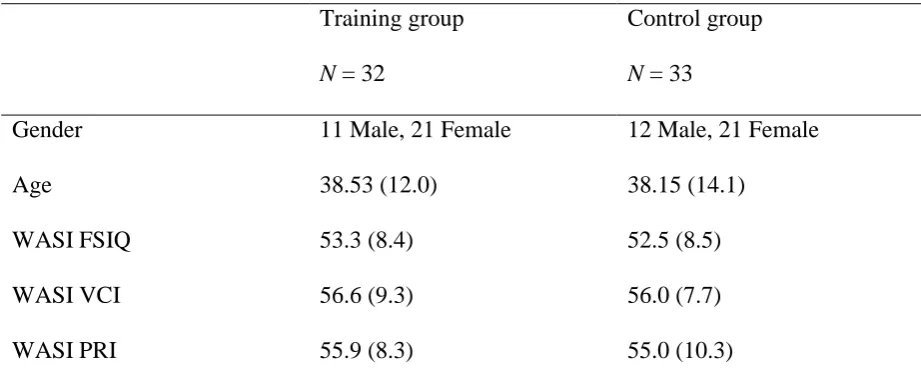
= 506.000, p = .773; sex, 2 (1) = .028, p = .867. Similarly, a one-way ANOVA showed no
group differences in Full Scale IQ, F(1, 63) = < 1, p = .717, indicating that the groups were
well matched (Table 1).
Design
A 2 (Group: training or attention-control) x (2 (Time: 1 or 2) x S) mixed experimental
design was used to evaluate whether training improved ability to link situations to feelings on
two tasks of cognitive mediation skills. Randomisation was masked and allocation was
concealed from the researcher. This was achieved by using a randomisation script, written in
PsychoPy (Peirce, 2007), and run at the start of the intervention. The researcher entered the
participants’ Full Scale IQ into the computer, and the participant was assigned to one of the
two group using matched-pairs randomisation. Randomisation was stratified based on IQ.
There was no information regarding allocation presented to the researcher or the participant,
and the researcher did not have sight of the computer once the IQ had been entered.
Participants completed computerised pre- and post-training assessments of cognitive
mediation skills.
Measures
Intellectual and Verbal Functioning. The Wechsler Abbreviated Scale of Intelligence
IQ based on verbal comprehension and perceptual reasoning subscales. It can be used with
people aged from 6 – 89 and takes approximately 30 minutes to complete. The WASI-II has
good reliability and validity (Wechsler, 2011).
Cognitive Mediation Skills. Two computer based tasks were used to assess different
types of cognitive mediation skills: the ‘AB, choose C’ task and the ‘AC, choose B’ task.
This was based on materials developed by Dagnan and Chadwick (1997) and Dagnan et al.
(2000). These tasks were counterbalanced between participants and were used as measures
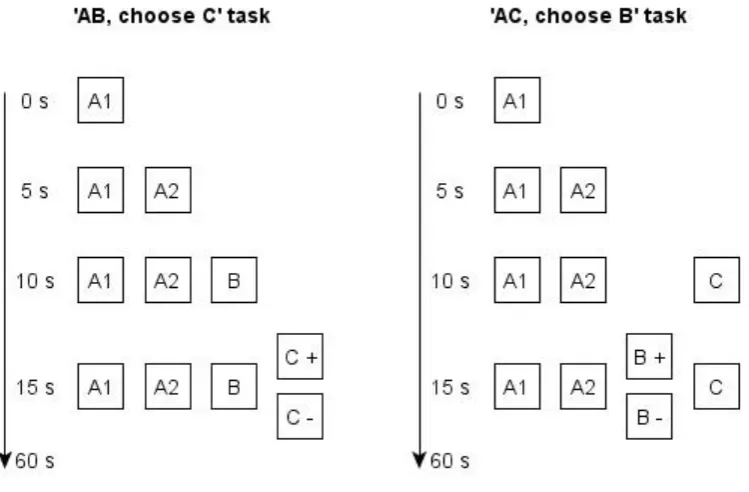
of performance at pre- and post-training. Figure 2 illustrates how task items were presented.
Pictures were created using an online computer package called Pixton Comics (2013). Task
items of the ‘AB, choose C’ task started with the presentation of picture A1, and after 5
seconds, picture A2. Pictures A1 and A2 depicted the situation, or antecedent (A). Next, a
picture of a belief (B in Figure 2) was presented, followed five seconds later, by a picture of a
positive emotion, or consequence (C +), and then a negative emotion, or consequence (C -).
The presentation of each picture was accompanied by audio telling the participant what was
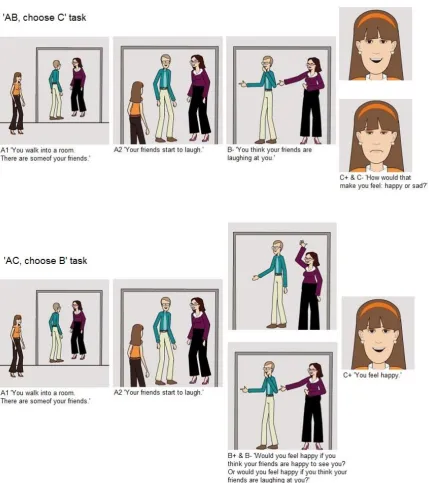
happening in each picture. Figure 3 presents a sample task item.
For example, one scenario involved pictures of a person walking into a room where
some friends were located. The presentation of pictures A1, accompanied by the audio, ‘You
walk into a room’ was initially presented; picture A2 is then presented, where a group of
people are laughing, accompanied by the speech, ‘Your friends start to laugh’; picture B is
then presented accompanied by, ‘You think your friends are laughing at you’; and finally,
picture C +, a happy face, and C -, a sad face is presented. Participants were asked how the
situation and thought would led them to feel and used the external response box to select
For the ‘AC, choose B’ task a situation was presented using both the A1 and A2
pictures, followed by the presentation of a feeling, C+ or C-, where a person’s positive or
negative facial expression was depicted, and the audio description told the person how the
character was feeling. Participants were then asked to select one of two mediating beliefs,
B+ or B-. For example, in the above described item ‘Your friends start to laugh’, B+ was
‘You think your friends are happy to see you’, and B- ‘You think your friends are laughing at
you’. Items were presented for a maximum duration of sixty seconds. Participants could
respond after the two response options (C+ and C- , or B+ and B-, depending on the task)
were presented. Hence, participants were given 45 seconds to respond.
Each task comprised twelve items. Items were created using six situations paired once
with a positive belief, or feeling, and once with a negative belief, or feeling. Hence,
congruent and incongruent situation-belief (AB) and situation-feeling (AC) pairs were
created. The maximum score on each task was 12; scores were converted to percentages for
data analyses. In addition, scores of 10 or more were designated as ‘pass’; this score is
associated with a probability of being obtained by chance of .016.
Two scenarios were replaced because they were difficult to unambiguously present in
pictures (‘being asked to meet the day centre manager’, and ‘the first day of a new job’).
These were replaced with the new situations of ‘You are sitting in the waiting room. You
have to see the dentist’, and ‘You are sitting at the table, painting a picture for a friend’. From
the Dagnan et al. (2000) tasks, the forced choice responding and formation of congruent and
potentially reduce the impact of verbal ability associated with the original open ended
questions (Dagnan & Chadwick, 1997).
Training and Control Interventions
Training Condition. Training comprised two tasks derived from the Reed and
Clements (1989) assessment of linking situations to feelings which were different, in terms of
content, from the assessment tasks. The ‘A, choose C’ and ‘C, choose A’ training tasks both
consisted of six randomised items and presentation of the tasks was counterbalanced between
participants.
The ‘A, choose C’ training task presented participants with six scenarios of which the
antecedent was depicted by two pictures, A1 and A2. For example, ‘You are walking home’,
A1, ‘when you get caught in the rain’, A2. Next, pictures of a happy face, positive
consequence C+, and sad face, negative consequence C-, appeared and participants were
prompted to indicate how they would feel in the given situation by pressing the
corresponding button on the external response box. The ‘C, choose A’ training task saw
participants presented with a pictured happy face or sad face, followed by the presentation of
two possible antecedents, A1 A2 + and A1 A2 -, pictured left of the emotional consequence,
as presented schematically in Figure 4.
Task items for the training intervention were adapted from the original items used by
Reed and Clements (1989). However, one original item (‘You entered a competition and won
the first prize.’) had been replaced with an item more suitable for presentation in two simple
line drawings (‘Some time ago you planted seeds. They grew into beautiful flowers.’).
Each training task was conducted over a maximum of three rounds. In round 1, all six
presented again in round 2, after which any remaining incorrect items were randomised and
presented a final time in round 3. Rounds 2 and 3 were introduced as follows: ‘Well done.
Now, let’s look at some of the stories again.’ Participants received automated feedback in
rounds two and three as follows: for the ‘A, choose C’ task correct responses were followed
by the feedback, ‘That’s right, I would feel happy too if [insert antecedent, e.g. my flowers
had grown]’, whereas incorrect responses were followed by the feedback ‘Really? I would
feel happy if [insert antecedent, e.g. my flowers had grown]’. Correct items were not
re-presented in rounds 2 and 3 to keep the time of the tasks limited as well as to ensure that
participant motivation and concentration would not decrease due to repeated presentation.
It was anticipated that improved understanding of the connection between situations
and feelings would enhance participants’ ability to understand cognitive mediation when the
belief component was re-introduced during post-test assessments.
Attention Control Task. The control task comprised an attention-control task requiring
interaction with the computer programme. Participants were presented with twelve scenarios
consisting of two images picturing a situation, A1 and A2, and one image of an emotion, C.
The six scenarios were identical to the task items of the ‘A, choose C’ training items, whereas
six new scenarios were added for the control task. Each scenario was presented in three steps:
picture A1, followed after five seconds by picture A2, followed after an additional five
seconds by picture C (see Figure 4). The scenarios included audio descriptions, but did not
include any questions and at no point were participants required to make a decision regarding
which situation would elicit a given emotional response or how a given situation would make
intervention participants were given the option to press a button to have a scenario repeated.
Scenarios could be repeated up to five times.
Ethical Considerations
A favourable ethical opinion for the study was given by a National Health Service
(NHS) Research Ethics Committee and the study protocol was registered with
ClinicalTrials.gov, registration number NCT01652963. Study information sheets and consent
forms were presented in an easy to read format and explained to potential participants.
Participants were encouraged to discuss their participation with staff and carers. Particular
attention was given to the right to withdraw, confidentiality and consent. Ability to give
informed consent was assessed through consultation with service staff and by asking yes or
no questions about the study information sheets. All participants were judged to have
capacity to make a decision as to whether they would like to take part or not.
Procedure
Six local authority and charity organisations that provided activities for people with
IDs in Norfolk and Suffolk supported the recruitment process. Staff were informed about the
study and were asked to suggest potential participants. At pre-test, participants completed the
WASI-II and both cognitive mediation tasks. Randomisation was computerised using
matched pairs and stratified based on IQ-score. After the intervention, the cognitive
mediation tasks were presented again. Breaks of maximum half an hour were given between
the tasks. All assessments and intervention tasks were programmed and presented using
PsychoPy2, v1.74.00, software (Peirce, 2007) and responses were recorded with an external
response box, DirectIN Button Box (Empirisoft). The programme and its content is freely
– were presented visually in coloured line drawings created with Pixton® Comics (2013). A
Toshiba TECRA R850-119 laptop with Windows 7 operating system was used for this study.
A registered speech and language therapist recorded voice commands to provide task
instructions and support. The researcher provided assistance for the first six items during
pre-test to ensure participants understood the task requirements and were able to perform the
response procedures independently.
Data-collection and Analysis
Pre-test scores were inspected for normality and found to be negatively skewed for
both cognitive mediation tasks. Descriptive data will be presented alongside non-parametric
analyses of potential between-group differences. Participants whose scores had reached
ceiling level at pre-test (100 % accuracy) were subsequently excluded from the data-analysis
as they could no longer benefit from a potential training effect. Removal of these data points
did not improve the skewed distributions. Linear regression analyses could be performed,
however, because assumptions regarding multicollinearity between predictors, homogeneity
of regression slopes and the normal distribution of residuals were not violated. Hence, the
main effect of training was investigated using regression analyses, whilst controlling for
variability in pre-test scores and IQ. Additional regression analyses were performed for
congruent and incongruent items of each task separately. The association between verbal
ability and cognitive mediation skills was assessed at pre-test using spearman correlations. In
addition, a linear regression model was fitted to examine the impact of verbal skills on
RESULTS
Hypothesis 1a: Training in linking situation to feelings, and vice versa, will significantly
improve ability to link pairs of situations and mediating beliefs to appropriate
emotional responses
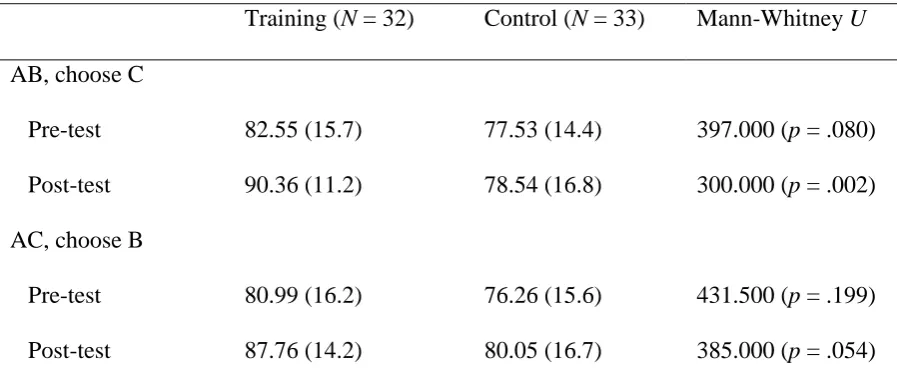
The average percentage of correct responses in the training group and the control
group at pre-test was 82.55 percent, SD = 15.7, and 77.53 percent, SD = 14.4, respectively
(Table 2) for the ‘AB, choose C’ task; this was not significant, Mann-Whitney U = 397.000,
p = .080.
Table 3 shows the results of the regression analysis of post-test scores. Eight
participants were excluded from this analysis: three participants in the control group and five
in the training group reached 100 percent accuracy level at pre-test and hence could not
benefit from training. Pre-test performance: β = .330, p = .005; IQ: β = .347, p = .003, and
training: β = .299, p = .005, made significant contributions in predicting post-test
performance and together, explained 42 percent (i.e. adjusted R square) of the variability in
performance after the intervention. These results indicate that training significantly improved
participants’ ability to correctly identify emotions associated with situation-belief pairs.
Hypothesis 1b: Congruent items, as opposed to incongruent items, will be significantly
associated with ability to link pairs of situations and mediating beliefs to appropriate
emotional responses following training.
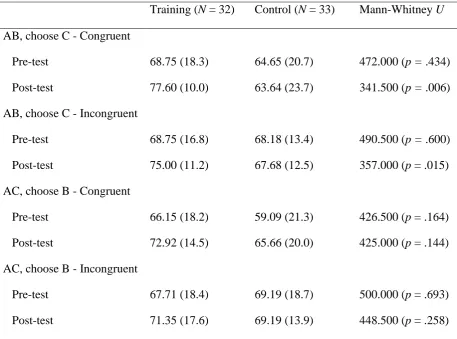
Participants’ performance on congruent and incongruent items is presented in Table 4.
Regardless of intervention group, overall post-test performance was correlated with pre-test
performance on the congruent items, r(32)Training = .538, p = .001; r(33)Control = .618, p <
Separate regression analyses of congruent items indicated that their respective pre-test scores:
β = .384, p =.001; IQ: β = .314, p = .006, and training: β = .312, p = .003, predicted post-test
performance. Performance on incongruent items, however, was only predicted by IQ: β =
.268, p = .040, and not by pre-test performance: β = .146, p = .254; or training: β = .227, p =
.077. These results indicate that training significantly improved participants’ ability to
correctly identify emotions associated with situation-belief pairs, but only for congruent
items.
Hypothesis 2a: Training in linking situation to feelings, and vice versa, will significantly
improve ability to link pairs of situations and emotions to appropriate mediating beliefs.
Pre-test performance of the training group M% = 80.99, SD = 16.2, and control group
M% = 76.26, SD = 15.6, did not differ significantly for the ‘AC, choose B’ task:
Mann-Whitney U = -431.500, p = .199.
A linear regression analysis of post-test performance excluding participants with
perfect pre-tests scores (Control group, n = 3; Training group, n = 7) was conducted. Pre-test
scores: β = .296, p = .027; IQ: β = .226, p = .088; and training: β = .147, p = .246, were
entered as predictors, adjusted R2 = .157. However, within-group changes were tested using
Wilcoxon signed rank tests and a significant change in cognitive mediation skills was found
for the training group z = -2.600, p = .009, but not for the attention control group, z = -1.207,
p = .227.
Hypothesis 2b: Congruent items, as opposed to incongruent items, will be significantly
associated with ability to link pairs of situations and emotions to appropriate mediating
Congruency of task items had little impact on task performance of the control group
with no association found between pre-test congruent, r(33)Control = .119, p = .511, and
incongruent items r(33)Control = .332, p = .059, and overall post-test performance. For the
training group, however, pre-test performance on both congruent, r(32)Training = .527, p =
.002, and incongruent items r(32)Training = .454, p = .002, was associated with overall post-test
performance. Separate regression analyses for congruent items showed only pre-test
performance on congruent items to be a significant predictor of their respective post-test
performance, β = .368, p = .006. No significant predictors could be identified for post-test
performance on incongruent items.
Additional Analyses
The computer based assessment tasks, though adapted from earlier tasks developed by
Dagnan and Chadwick (1997) and Dagnan et al. (2000), are nevertheless novel. Additional
analyses were performed to examine whether performance on each task was close to
floor-level or ceiling-floor-level, and to what extent intellectual or verbal functioning was associated
with performance.
Baseline ability to link situations, thoughts and feelings. A Wilcoxon Signed Rank
test revealed no differences in pre-test performance between the two cognitive mediation
tasks, indicating they had similar difficulty levels, z = -.795, p = .427. Fifty nine percent of
participants passed the ‘AB, choose C’ task and 45 % passed the ‘AC, choose B’ task.
Ability to link situations to feelings. Data were available for 33 participants allocated
to the training group. Average accuracy rates at the first presentation of the training tasks (or
Wilcoxon signed rank test indicated this was a significant betweentask difference: z =
-2.523, p < .012. For the ‘A, choose C’ task, errorless performances were recorded for 65.6 %
of participants in round 1. Seventy-two percent of participants who proceeded to round 2 had
errorless performance at this stage, and all 3 participants who continued to round 3 succeeded
in answering all remaining items correctly. Likewise, 46.9 % of participants performed
errorlessly at round 1 of the ‘C, choose A’ task; with 64.7 % of remaining participants
performing errorlessly at round 2, and three out of six participants in round 3 answering the
remaining items correctly.
Association of intellectual and verbal functioning with CBT skills. Spearman
correlations were slightly higher between IQ and cognitive mediation tasks involving the
selection of emotions, r(65) = .392, p = .001, than between IQ and cognitive mediation tasks
involving the selection of beliefs, r(65) = .320, p = .009. The verbal comprehension index of
the WASI –II correlated significantly with performance on the congruent items, r(65) = .578,
p < .001, but not the incongruent items, r(65) = .172, p = .170, on the ‘AB, choose C’ task.
However, the verbal comprehension index correlated significantly with the incongruent
items, r(65) = .350, p = .004, but not the congruent items, r(65) = .147, p = .242, of the ‘AC,
choose B’ task.
DISCUSSION
The results of this study suggest that training in linking situations to feelings may
improve some aspects of cognitive mediation skills for people with mild to moderate IDs.
Training effects were found for the ability to select appropriate emotional responses for
situation-belief pairs, when compared to an attention-control intervention (Hypothesis 1a).
congruency of situations and beliefs is a determining factor, with congruent, but not
incongruent, items improving significantly following the training intervention (Hypothesis
1a). The findings also suggest that training improved the ability to select appropriate
mediating beliefs when presented with a situation and feeling (Hypothesis 2a), although this
effect was not maintained when controlling for variability in pre-test scores and IQ, nor when
considering the congruency and incongruency of task items levels (Hypothesis 2b).
The findings of the study are consistent with Dagnan et al. (2000) and confirms the
association between verbal ability and task performance for both the cognitive mediation
assessments and the adapted Reed and Clements (1989) task (Dagnan et al., 2000; Joyce et
al., 2006; Oathamshaw & Haddock, 2006). However, with 59 and 45 percent of participants
passing the computerised ‘AB, choose C’ and the ‘AC, choose B’ task in this study baseline
performance far exceeded previously reported pass-rates of respectively 10 and 25 percent
(Dagnan et al., 2000), 12 and 13 percent (Joyce et al., 2006), and 12 and 10 percent
(Oathamshaw & Haddock, 2006). It is unlikely that the higher pass-rates reported in this
study are a result of sampling, because no cut-off scores for verbal comprehension skills were
applied to exclude participants, as has been used in some previous studies (Joyce et al., 2006;
Oathamshaw & Haddock, 2006). Furthermore, scores on the ‘A, choose C’ training task saw
65.6 percent of participants performing errorlessly compared to 75% (Dagnan et al., 2000),
72% (Oathamshaw & Haddock, 2006) and 50% (Joyce et al., 2006) on the associated Reed
and Clements (1989) task in previous studies.
A possible explanation for the higher pass-rates found for the cognitive mediation
tasks in this study is the use of inferential rather than evaluative beliefs in the cognitive
mediation tasks. Indeed, Dagnan and Chadwick (1997) found that people with IDs are more
likely to respond with inferential beliefs when asked what they could be thinking in a given
clinical utility that evaluative beliefs (Dagnan et al., 2009). Alternatively, the use of pictures
accompanied by audio presented to participants using a computer is likely to have facilitated
understanding. Observations and feedback from participants suggest that they experienced
the study as engaging and fun, which may have increased their motivation, and thus resulted
in better attendance and performance.
Participants’ engagement with the computerised tasks may reflect an increase in
accessibility. The accessibility of the task was demonstrated by relatively good performance
of participants at baseline, considering that the sample included had an average Full Scale IQ
that fell towards the bottom of the “mild” range of IDs. In addition, all participants
successfully passed the control questions prior to the baseline tasks, and very few (4 %) could
not complete the tasks independently. Furthermore, across all participants and task items,
only four missing data points, due to responding out of time, were identified. Three of these
occurred during the ‘AC, choose B’ task. However, a potential drawback of computerised
training is the use of automated feedback that lacks individualisation. Further research is
needed to explore the role of therapist feedback alongside computerised assessment and
training programmes in therapy.
Turning to the training of CBT skills, both Bruce et al.’s (2010) and the present
findings indicated that some CBT skills can be trained and further diversification and
development of training interventions is desirable. In the current study participants
completed the study in one day rather than over two weeks as in Bruce et al., (2010). This
quick succession of tasks, and familiarisation with the computer, may explain the improved
performance noted within the attention-control group.
Other factors may have contributed to the observed improvements in the
attention-control group. Unlike the relaxation attention-control group in the Bruce et al. (2010) study, the present
task items. The opportunity to attend to these stories without additional task demands may
have freed more cognitive resources for participants to implicitly reflect on the cognitive
mediation task, thereby improving their post-test performance. Furthermore, the absence of
specific questions in the control task may have indirectly may have impacted on participants’
attention and motivation throughout the rest of the study. However, we did not examine if
any gains were maintained over time or if generalisation of learning occurred.
The current experimental design does not allow us to demonstrate generalisation,
which has both clinical and methodological implications. From a clinical perspective, it
would be important to assess whether gains made in training are translated into an improved
understanding of the cognitive rationale when applied to experiences relevant to the
individual. Ideally, people would demonstrate generalisation to relevant experiences
discussed in therapy, as well as to situations they encounter outside of therapy (Beck, 1976).
From a research perspective, generalisation was facilitated by using different items for the
assessment and training tasks, thereby requiring participants to apply the skills learned in
training to the items of the cognitive mediation task. However, generalisation to other
situations, which can be achieved by adding new items at post-test, was not assessed. Hence,
future studies should evaluate whether training gains generalise to new items at post-test, to
personal experiences, and to situations experienced outside of therapy (Green & Glasgow,
2006). Linked to this, we also do not know whether training leads to improvements in therapy
outcomes for people with IDs.
A more considerable limitation of the present study was the absence of cognitive
components in the training intervention, and this may be why the ability to correctly choose
mediating beliefs did not improve. Indeed, the use of Reed and Clements (1989) task taught
participants to link situations to feelings, and vice versa, but did not actively target the
perspective taking, it is likely that this was insufficient to have led to substantial
improvements on the ‘AC, choose B’ task, and this should be addressed further in a future
study.
Furthermore, it could be argued that the presented beliefs were not recognised as
cognitions, but interpreted as a fact, similar to the antecedent. Further inspection of the data
from the training group, however, shows that performance is generally lower for tasks that
include a belief component (i.e. the baseline cognitive mediation tasks) than for tasks without
a belief component (i.e. the training tasks). This would suggest that the added belief
component increased task demands and was not interpreted by participants as part of the
original antecedent. The present study design does not allow for strong conclusions to be
drawn regarding participants’ ability to identify cognitions.
Taken together, these limitations question the appropriateness of the current tasks for
assessing and training cognitive mediation skills. However, the Reed & Clements (1989) did
target a necessary component of this process, namely linking antecedent to consequent.
Similarly, the ‘AB, choose C’ and ‘AC, choose B’ tasks assess separate components of the
cognitive mediation process, albeit not the entire process. These assessments were chosen for
the current study because they have been used by other studies that have attempted to assess
cognitive mediation skills. Nevertheless, some further work is needed to develop tasks that
assess all domains of cognitive mediation, bearing in mind that Dagnan, Mellor, and
Jefferson (2009) evaluated whether beliefs offered by people with IDs to link a situation and
emotion were actual mediating beliefs or were responses to the activating event, restatements
of the event or emotion, or other non-mediating beliefs.
Future studies could address these concerns by having participants identify each task
component as a situation, belief or emotion, as well as explore whether cognitions would be
advised, however, that in the development of new assessments of cognitive mediations skills
attention is given to their clinical usability, as well as their applicability for research studies.
This study has a number of strengths. The use of an experimental design, including
concealed allocation and masked assessment, allows for an examination of causation. The
participants were representative of the population and the stratification ensured that they were
well matched in terms of IQ. Furthermore, the use of pictures throughout the study, to
present task instructions, task items and feedback, may have improved the accessibility of the
tasks and their ability to engage participants; which may consequently had a positive impact
upon task performance.
Similar and further research will hopefully lead to the development of effective
training programmes that can be used with people with IDs before they begin therapy, or
during therapy. Furthermore, some recent findings suggest that patients’ understanding of
cognitive mediation and ability to identify thoughts, feelings and behaviours improves during
therapy (Barrowcliff, Jones, Oathamshaw & McConachie, 2013). However, more research is
needed to understand how CBT skills link to therapeutic success in people with IDs. This is
clearly important because of the extremely high rates of mental health problems amongst this
ACKNOWLEDGEMENTS
We would like to thank clinical psychologist Dr Anne-Marie Mensink for her feedback and support, and Miss Katrina Baker, language and speech therapist, for lending her voice to the computer programme.
Peter E Langdon is funded by a National Institute for Health Research Postdoctoral Fellowship
This article presents independent research funded by the National Institute for Health
REFERENCES
Barrowcliff, A., Jones, S., Oathamshaw, S., & McConachie, D. (2013, December). Cognitive
mediation and control, recognising emotions, and changing behaviours: Core CBT
skills development following engagement in a CBT informed group intervention for
anger management. Poster session presented at the annual meeting of the Seattle Club,
Cardiff, United Kingdom.
Beck, A. T. (1976). Cognitive Therapy and the Emotional Disorders. London: Penguin.
Bruce, M., Collins, S., Langdon, P., Powlitch, S., & Reynolds, S. (2010). Does training improve understanding of core concepts in cognitive behaviour therapy by people with intellectual disabilities? A randomized experiment. British Journal of Clinical
Psychology, 49(Part 1), 1–13. doi:10.1348/014466509x416149
Clarke, D. (2003). Diagnostic criteria for psychiatric disorders for use with adults with learning disabilities/mental retardation (DC-LD) and psychiatric phenotypes. Journal of Intellectual Disability Research, 47(1), 43–49.
Cooper, S., Smiley, E., Morrison, J., Williamson, A. W., & Allan, L. (2007). Mental ill-health in adults with intellectual disabilities : prevalence and associated factors. British Journal of Psychiatry, 190, 27–36.
Dagnan, D., & Chadwick, P. (1997). Cognitive-behaviour therapy for people with learning disabilities: Assessment and intervention. In B. Stenfert-Kroese, D. Dagnan, & K. Loumidis (Eds.), Cognitive-Behaviour Therapy for People with Learning Disabilities (pp. 110–123). London: Routledge.
Dagnan, D., Chadwick, P., & Proudlove, J. (2000). Toward an assessment of suitability of people with mental retardation for cognitive therapy. Cognitive Therapy and Research, 24(6), 627–636.
Dagnan, D., Mellor, K., & Jefferson, C. (2009). Assessment of cognitive therapy skills for people with learning disabilities. Advances in Mental Health & Learning Disabilities, 3(4), 25–30.
Deb, S., Thomas, M., & Bright, C. (2001). Mental disorder in adults with intellectual disability. 1: Prevalence of functional psychiatric illness among a community-based population aged between 16 and 64 years. Journal of Intellectual Disability Research, 45(6), 495–505.
Experience. Behavioural and Cognitive Psychotherapy, 33(2), 201–215. doi:10.1017/S1352465804001894
Ellis, A. (1977). The basic clinical theory of rational emotive therapy. In A. Ellis & R. Grieger (Eds.), Handbook of rational-emotive therapy. New York: Springer.
Emerson, E., & Hatton, C. (2007). Mental health of children and adolescents with intellectual disabilities in Britain. The British Journal of Psychiatry, 191, 493–499.
doi:10.1192/bjp.bp.107.038729
Green, L. W., & Glasgow, R. E. (2006). Evaluating the relevance, generalization, and applicability of research: issues in external validation and translation methodology. Evaluation & the Health Professions, 29(1), 126–153. doi:10.1177/0163278705284445
Hamelin, J., Travis, R., & Sturmey, P. (2013). Anger management and intellectual disabilities: A systematic review. Journal of Mental Health Research in Intellectual Disabilities, 6(1), 60–70. doi:10.1080/19315864.2011.637661
Hulbert-Williams, L., & Hastings, R. P. (2008). Life events as a risk factor for psychological problems in individuals with intellectual disabilities: A critical review. Journal of Intellectual Disability Research, 52(11), 883–895.
doi:10.1111/j.1365-2788.2008.01110.x
Joyce, T., Globe, A., & Moody, C. (2006). Assessment of the component skills for cognitive therapy in adults with intellectual disability. Journal of Applied Research in Intellectual Disabilities, 19(1), 17–23. doi:10.1111/j.1468-3148.2005.00287.x
Nicoll, M., Beail, N., & Saxon, D. (2013). Cognitive behavioural treatment for anger in adults with intellectual disabilities: A systematic review and meta-analysis. Journal of Applied Research in Intellectual Disabilities, 26(1), 47–62. doi:10.1111/jar.12013
Oathamshaw, S. C., & Haddock, G. (2006). Do People with Intellectual Disabilities and Psychosis have the Cognitive Skills Required to Undertake Cognitive Behavioural Therapy? Journal of Applied Research in Intellectual Disabilities, 19(1), 35–46.
Peirce, J. W. (2007). PsychoPy--Psychophysics software in Python. Journal of Neuroscience Methods, 162(1-2), 8–13. doi:10.1016/j.jneumeth.2006.11.017
Quakley, S., Reynolds, S., & Coker, S. (2004). The effect of cues on young children’s abilities to discriminate among thoughts, feelings and behaviours. Behaviour Research and Therapy, 42(3), 343–56. doi:10.1016/S0005-7967(03)00145-1
Reed, J., & Clements, J. (1989). Assessing the understanding of emotional states in a population of adolescents and young adults with mental handicaps. Journal of Mental Deficiency Research, 33(3), 229–233. Retrieved from
http://www.ncbi.nlm.nih.gov/pubmed/2754722
Safran, J. D., Segal, Z. V., Vallis, T. M., Shaw, B. F., & Samstag, L. W. (1993). Assessing patient suitability for short-term cognitive therapy with an interpersonal focus. Cognitive Therapy and Research, 17(1), 23–38. doi:10.1007/BF01172738
Safran, J. D., Vallis, T. M., Segal, Z. V., & Shaw, B. F. (1986). Assessment of core cognitive processes in cognitive therapy. Cognitive Therapy and Research, 10(5), 509–526. doi:10.1007/BF01177815
Sams, K., Collins, S., & Reynolds, S. (2006). Cognitive therapy abilities in people with learning disabilities. Journal of Applied Research in Intellectual Disabilities, 19(1), 25– 33.
Stenfert-Kroese, B., Dagnan, D., & Loumidis, K. (1997). Cognitive-behaviour therapy for people with intellectual disabilities. London: Routledge.
Trower, P., Jones, J., Dryden, W., & Casey, A. (2011). Cognitive-Behavioural Counselling in Action (2nd ed.). London: Sage.
Vereenooghe, L., & Langdon, P. E. (2013). Psychological therapies for people with intellectual disabilities: A systematic review and meta-analysis. Research in Developmental Disabilities, 34(11), 4085–4102. doi:10.1016/j.ridd.2013.08.030
Wechsler, D. (2011). Wechsler Abbreviated Scale of Intelligence (2nd ed.). San Antonio, TX: The Psychological Corporation.
Table 1. Participant characteristics per group.
Training group
N = 32
Control group
N = 33
Gender 11 Male, 21 Female 12 Male, 21 Female
Age 38.53 (12.0) 38.15 (14.1)
WASI FSIQ 53.3 (8.4) 52.5 (8.5)
WASI VCI 56.6 (9.3) 56.0 (7.7)
WASI PRI 55.9 (8.3) 55.0 (10.3)
Note. Mean (SD) scores for Wechsler Abbreviated Scale of Intelligence – II Full Scale IQ
(WASI FSIQ), Verbal Comprehension Index (WASI VCI) and Perceptual reasoning Index
Figure 2. Schematic presentation of a single item of the cognitive mediation tasks
Figure 3. Sample items from the cognitive mediation tasks.
Figure 4. Schematic presentation of a single item of the training tasks and control task.
Table 2. Pre-test and post-test cognitive mediation skills
Training (N = 32) Control (N = 33) Mann-Whitney U
AB, choose C
Pre-test 82.55 (15.7) 77.53 (14.4) 397.000 (p = .080)
Post-test 90.36 (11.2) 78.54 (16.8) 300.000 (p = .002)
AC, choose B
Pre-test 80.99 (16.2) 76.26 (15.6) 431.500 (p = .199)
Post-test 87.76 (14.2) 80.05 (16.7) 385.000 (p = .054)
Note. Mean percentage correct responses (SD) and Mann-Whitney U test for between group
Table 3. Regression of pre-test performance, IQ and intervention on ‘AB, choose C’ task
scores (N = 57).
B
(St. Error) a
beta a t a Adjusted
R square b
Change R
square b
‘AB, choose C’ task: total a
Intercept 17.326
(11.038)
- 1.570 - -
Pre-test .365 (.125) .330 2.920** .256 .269**
IQ .625 (.202) .347 3.096** .340 .095**
Intervention 9.208 (3.165) .299 2.909** .420 .088**
‘AB, choose C’ task: congruent items a
Intercept -.075 (.770) - -.097 - -
Pre-test: congruent .394 (.112) .384 3.508** .271 .284***
IQ .044 (.015) .314 2.875** .345 .084*
Intervention .754 (.243) .312 3.097** .435 .097**
‘AB, choose C’ task: incongruent items a
Intercept 2.394 (.678) - 3.533**
Pre-test:
incongruent
.120 (.104) .146 1.154 .011 .029
IQ .023 (.011) .268 2.109* .071 .076*
Intervention .331 (.184) .227 1.801 .108 .052
Note. *, p < .05; **, p < .01; ***,p < .001; a, regression model includes all predictors; b,
Table 4. Pre-test and post-test performance on congruent and incongruent items of the cognitive mediation tasks for the training group and the control group.
Training (N = 32) Control (N = 33) Mann-Whitney U
AB, choose C - Congruent
Pre-test 68.75 (18.3) 64.65 (20.7) 472.000 (p = .434)
Post-test 77.60 (10.0) 63.64 (23.7) 341.500 (p = .006)
AB, choose C - Incongruent
Pre-test 68.75 (16.8) 68.18 (13.4) 490.500 (p = .600)
Post-test 75.00 (11.2) 67.68 (12.5) 357.000 (p = .015)
AC, choose B - Congruent
Pre-test 66.15 (18.2) 59.09 (21.3) 426.500 (p = .164)
Post-test 72.92 (14.5) 65.66 (20.0) 425.000 (p = .144)
AC, choose B - Incongruent
Pre-test 67.71 (18.4) 69.19 (18.7) 500.000 (p = .693)
Post-test 71.35 (17.6) 69.19 (13.9) 448.500 (p = .258)
Note. Mean percentage correct responses (SD) and associated Mann-Whitney U test for