BINP electron-positron facilities
D. Shwartz1,2,*, K. Astrelina1, V. Balakin1, A. Batrakov1, O. Belikov1, D. Berkaev1, D. Bolkhovitianov1, F. Emanov1, A. Frolov1, K. Gorchakov1, A. Kasaev1, A. Kirpotin1, I. Koop1,2, A. Krasnov1, N. Lebedev1, E. Levichev1, A. Lysenko1, Yu. Maltseva1, P. Martishkin1, O. Meshkov1,2, S. Motygin1, A. Murasev1, V. Muslivets1, A. Otboyev1, E. Perevedentsev1,2, P. Piminov1, V. Prosvetov1, Yu. Rogovsky1,2, A. Semenov1, A. Senchenko1,2, P. Shatunov1, Yu. Shatunov1,2, M. Timoshenko1, S. Vasiliev1, I. Zemlyansky1, Yu. Zharinov1, A. Zhuravlev1
1Budker Institute of Nuclear Physics, Novosibirsk, Russia 2Novosibirsk State University, Novosibirsk, Russia
Abstract. The present status of two operating BINP electron-positron colliders VEPP-2000 and VEPP-4M is given.
1 Introduction
Budker Institute of Nuclear Physics (BINP) has a long history of experiments at lepton colliders. Starting from pioneer electron-electron machine VEP-1 in early 1960s a number of electron-positron colliders served for several generations of particle detectors. Presently two operating colliders VEPP-4M and VEPP-2000 are joint via single new BINP Injection Complex (IC) and cover in common energy range from 0.16 to 5.5 GeV per beam.
2 Injection Complex
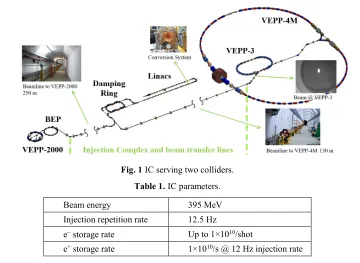
IC is designed to supply BINP colliders with electron and positron beams. IC is a linac-based e+/e− beam source with Damping Ring (DR) and beam transfer lines to colliders. Linacs are based on 14 S-band round disc-loaded waveguide accelerating structures which are fed with 4 SLAC 5045 klystrons. They are capable to reliably provide beams with energy about 400 MeV. Initially IC was designed to serve Charm-Tau factory, thus 700 MHz (q = 64) DR RF cavity was used in order to provide damped bunch length about 1 cm, suitable for further acceleration in S-band linac to experiment energy [1–3].
Since 2016 existing BINP colliders VEPP-2000 and VEPP-4M are using IC e+/e− beams in routine operation (see Fig. 1). Currently beams are accelerated to experiment energy by boosters, which can accept much longer bunch (up to 1 m full-length). In 2017 DR RF cavity was replaced with 10.94 MHz (q = 1) one with maximum accelerating voltage of 10 kV [3]. It allowed us to capture multi-bunch beam from pre-injector to damping ring with 40% increased efficiency. Currently achieved typical beam production parameters are shown in Table 1.
Fig. 1 IC serving two colliders. Table 1. IC parameters.
Beam energy 395 MeV
Injection repetition rate 12.5 Hz
e− storage rate Up to 1×10¹⁰/shot
e+ storage rate 1×10¹⁰/s @ 12 Hz injection rate
3 VEPP-4M
VEPP-4 is an electron-positron facility consisting of two storage rings VEPP-3 (up to 2 GeV beam energy) and VEPP-4M (up to ≈5 GeV) [4]. The facility runs several research programs including high-energy physics in colliding mode [5], nuclear physics study with internal gas target [6], experiments with synchrotron radiation [7], external beam (electron, photon) test facility [8] and accelerator physics studies. Fig. 2 shows the facility schematically; Table 2 lists the main parameters.
Table 2. Parameters of VEPP-3 and VEPP 4M storage rings.
Ring VEPP-3 VEPP-4M
Energy (GeV) 0.4–2.0 0.925–4.75 (5.2)
Circumference (m) 74.4 366
No of bunches 2e– / 2e+ 2e+ × 2e– (16e–)
Harmonic number 2/18 222
Betatron tunes, h/v 5.1/5.2 8.54/7.57
Compaction factor 0.076 0.0168
Coupling 0.05 0.05
Beam Energy (GeV) 2.0 1.5 1.9 4.7 5.2
Bunch length (cm) 9 5
Emittance (nm) 290 16 25 167 200
Energy Spread 7.2 2.5 3.0 7.8 8.5
Bunch Current (mA) 200 1.6 3.5 25 25
Fig. 2 VEPP-4 layout. Legend: KEDR is the universal superconducting magnet detector for HEP, deuteron is the nuclear physics facility at VEPP-3, SR are the synchrotron radiation halls, ROKK-1M is the external beam test hall.
We take e+e– beams from the BINP IC, transport them through ~120 m long pulsed magnet transfer line and inject into VEPP-3 at energy of 390 MeV. The injection repetition rate is 1 Hz. VEPP-3 (a) accelerates e+e– beams (alternatively) up to the maximum energy of 1.8 GeV and delivers them into VEPP-4M, (b) polarizes e+e– beams for HEP in VEPP-4M, (c) performs separate experiments with SR and internal gas target.
The main research program of VEPP-4M is the colliding beams. In spite of low luminosity, the benefits of our collider are wide energy range (from 1 to 5 GeV per beam), precise electron-positron tagging system for two-photon experiments and energy calibration by resonant depolarization with record accuracy of 10-6. Thanks to these advantages, we still stay afloat and make world level experiments. For instance, our mass measurements for J/ψ- and ψ′-mesons are among seven most accurate particle mass measurements ever made. In 2018, at VEPP-4M collider experimental program in low energy range (1–1.9 GeV per beam) was finished. The next run concentrates on:
•Hadronic cross-section measurement in the range of 2.3–3.5 GeV (~ 10 pb-1);
•Upsilon mesons study (~ 50 pb-1);
•Gamma-gamma physics (~ 200 pb-1).
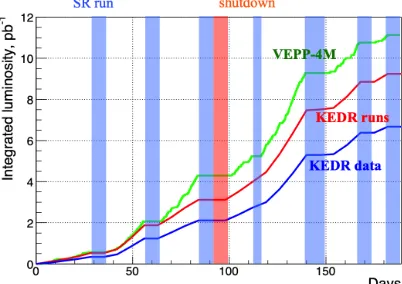
The first stage of this program is the hadronic cross-section measurement in the beam energy range of 2.3–3.5 GeV. The first scan is finished and the results are shown in Fig. 3.
4 VEPP-2000
The VEPP-2000 collider [9–11] exploits the round beam concept (RBC) [12]. This approach, in addition to the straightforward geometrical gain factor in luminosity should yield the beam-beam limit enhancement. An axial symmetry of the disruptive nonlinear counter-beam force together with the X–Y symmetry of the transfer matrix between the two IPs provide an additional integral of motion, namely, the longitudinal component of angular momentum Mz = x′y − xy′. Although the particles’ dynamics remain strongly nonlinear due
to beam-beam interaction, it becomes effectively one-dimensional. The reduction of degrees of freedom thins out the resonance grid and suppresses the diffusion rate resulting finally in a beam-beam limit enhancement [13].
Several demands upon the storage ring lattice suitable for the RBC appears: 1.Head-on collisions (zero crossing angle).
2.Small and equal β functions at IP (β*x = β*y). 3.Equal beam emittances (εx = εy).
4.Equal fractional parts of betatron tunes (νx = νx).
The first three requirements provide the axial symmetry of collisions while requirements (2) and (4) are needed for X–Y symmetry preservation between the IPs.
4.1 VEPP-2000 overview
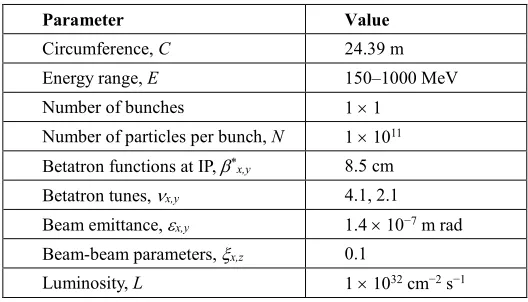
VEPP-2000 is a small 24 m in perimeter single-ring collider operating in one-by-one bunch regime in the energy range below 1 GeV per beam. Its layout is presented in Fig. 4. Collider itself hosts two particle detectors [14, 15], Spherical Neutral Detector (SND) and Cryogenic Magnetic Detector (CMD-3), placed into dispersion-free low-beta straights. The final focusing (FF) is realized using superconducting 13 T solenoids. The main design collider parameters are listed in Table 3.
Table 3.VEPP-2000 design parameters (at E = 1 GeV).
Parameter Value
Circumference, C 24.39 m
Energy range, E 150–1000 MeV
Number of bunches 1 × 1
Number of particles per bunch, N 1 × 10¹¹ Betatron functions at IP, β*x,y 8.5 cm
Betatron tunes, νx,y 4.1, 2.1
Beam emittance, εx,y 1.4 × 10⁻⁷ m rad
Beam-beam parameters, ξx,z 0.1
Fig. 4 VEPP-2000 layout and photo.
4.2 Flip-flop effect and beam shaking
The final beam-beam limit at VEPP-2000 corresponds to the onset of a flip-flop effect 16: the self-consistent situation when one of the beam sizes is blown-up while another beam size remains almost unperturbed. Observed in VEPP-2000 behavior is most likely caused by an interplay of beam-beam interaction and nonlinear lattice resonances.
The flip-flop threshold is sensitive to several tuning knobs, in particularly to X–Y coupling and beta-functions misbalance at IP. In addition, the influence of bunch length on the threshold was observed.
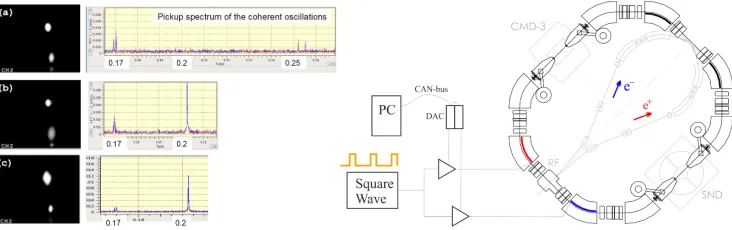
In Fig. 5 (left) images from the online TV camera are presented for the cases of regular beams (a), blown-up electron beam (b) or positron beam (c). The corresponding coherent oscillations spectra are shown on the right. One can see in the spectra of a slightly kicked bunch that the shifted tune (π-mode) sticks to the 1/5 resonance in the case of a flip-flop.
Fig. 5 Left: three flip-flop meta-stable states as visible in transverse profile and coherent beam-beam oscillations spectra. Right: the scheme of beam shaking.
While taking data at low energy range where the radiative emittance is small but significant beta-squeeze is not allowed due to the DA shrinking thus leaving mechanical aperture not fully used the natural desire appeared to increase the emittance. It allows to increase the beam current with fixed particles density, i.e. with fixed at the threshold beam-beam parameter, and to increase luminosity linearly to beam-beam intensity.
The idea was proposed to kick the beam weakly (in comparison to beam size) and frequently (in comparison to damping time). In the presence of strong nonlinear forces of colliding beam after the single kick the excited coherent oscillation decoheres very quickly thus increasing effective beam emittance.
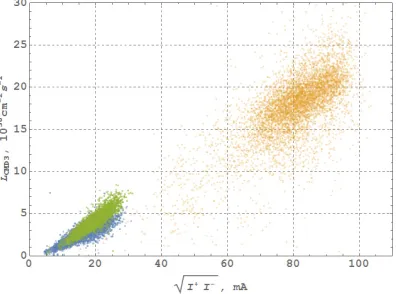
Fig. 6 The CMD-3 recorded luminosity as a function of beam currents. Blue and green dots correspond to machine performance in 2013 with short and long bunch correspondingly. Yellow dots correspond to 2018.
The typical pulses parameters are the following: pulse duration ~300 ns (3–4 turns), repetition rate (50 µs)−1, pulse amplitude 50–100 V (depends on beam energy).
The beam shaking experimentally results in beams emittance growth. This growth depends on the controllable shaker parameters (pulse amplitude, pulse duration, repetition rate). The properly increased emittance prevents the flip-flop development during injection cycle: the “strong” beam can't shrink to unperturbed size when “weak” beam oscillates with large amplitudes. In addition, the beam lifetime is improved due to suppression of Touschek scattering with increasing emittance.
As a result of beam shaking technique implementation the beams intensities and luminosity at low energy range increased significantly. In Fig. 6 the luminosity is presented achieved in 2013 and in 2018 at the same given energy of 391 MeV.
4.3 Data collection
The 2016/17 run was the first data taking VEPP-2000 run with new injector [17–19]. It was dedicated to energy range from 640 to 1003.5 MeV per beam. The design top energy was exceeded in order to achieve the mass of D*0(2007). The run 2017/18 was dedicated to the data collection at low beam energies: 274–600 MeV.
Fig. 7 CMD-3 recorded in 2010–2013 (crimson) and in 2017–2018 (orange) luminosity averaged over 10% of best runs. Pink lines show scaling laws with fixed and variable β*.
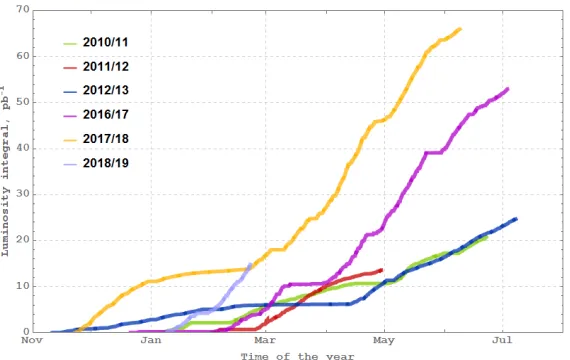
Fig. 8 CMD-3 recorded luminosity integral.
The Fig. 8 presents the integrated luminosity as compared for several operating years. One should beware of direct comparison of integrals due to luminosity dependence on energy. 2012/13 and 2017/18 runs were spent for data taking below 500 MeV while the others were dedicated to higher energies.
5 Future Facilities
The main BINP future project for HEP is the Super Charm Tau factory [20]. It is an e+e− collider with the beam energy range from 1 to 2.5 GeV with extremely high luminosity (~ 1035 cm−2·s−1) and longitudinal polarization of electron beam at the IP. The facility can study the tau leptons, charmed particles and light quark spectroscopy in the unique manner.
3. Yu. Maltseva et al., “VEPP-5 Injection Complex: New Possibilities for BINP Electron-Positron Colliders”, in Proc. IPAC'18, Vancouver, Canada, p.371 (2018).
4. E.B. Levichev, “Status and upgrade of the VEPP-4 storage-ring facility”, Phys. Part. Nucl. Lett. 13 no.7, p.876 (2016).
5. P. Piminov, “Status of the electron-positron collider VEPP-4”, in Proc. IPAC'17, Copenhagen, Denmark, p.2985 (2017).
6. D.M. Nikolenko, “Experiments with internal targets at the VEPP-3 electron storage ring”, Phys.
Atom. Nucl.,73, 8, p.1322 (2010).
7. P. Piminov et al., “Synchrotron radiation research and application at VEPP-4”, Physics Procedia 84, 19, p.26 (2016).
8. V.S. Bobrovnikov et al, “Extracted electron and gamma beams in BINP”, JINST9 C08022 (2014).
9. Yu.M. Shatunov et al., “Project of a New Electron-Positron Collider VEPP-2000”, in Proc.
EPAC’00, Vienna, Austria, p. 439 (2000).
10. D. E. Berkaev et al., “The VEPP-2000 electron-positron collider: First experiments”, J. Exp.
Theor. Phys., Vol.113, no.2, p.213 (2011).
11. Yu.M. Shatunov et al., “Recommissioning the Modernized VEPP-2000 Electron–Positron Collider”, Phys. Part. Nucl. Lett.15, no.7, p.749 (2018).
12. V.V. Danilov et al., “The Concept of Round Colliding Beams”, in Proc. EPAC’96, Sitges, Spain, p. 1149 (1996).
13. K. Ohmi, K. Oide and E.A. Perevedentsev, “The beam-beam limit and the degree of freedom”,
in Proc. EPAC'06, Edinburgh, Scotland, p.616 (2006).
14. M. Achasov et al., “Recent results from SND detector at VEPP-2000 collider”, these
proceedings.
15. F. Ignatov et al., “Recent results from CMD-3”, these proceedings.
16. D. Shwartz et al., “Recent Beam-Beam Effects at VEPP-2000 and VEPP-4M”, in Proc. ICFA
Mini-Workshop on Beam-Beam Effects in Hadron Colliders (BB2013), Geneva, Switzerland,
CERN-2014-004, p. 43 (2013).
17. P.Yu. Shatunov et al., “Status and perspectives of the VEPP-2000”, Phys. Part. Nucl. Lett.13, p. 995 (2016).
18. D. Berkaev et al., “Commissioning of Upgraded VEPP-2000 Injection Chain”, in Proc. IPAC'16, Busan, Korea, p. 3811 (2016).
19. D. Shwartz et al., “Recomissioning and Perspectives of VEPP-2000 e+e− Collider”, PoS
ICHEP2016, p.054 (2016).
20. I. Logashenko et al., “Super Charm-Tau project at Novosibirsk”, these proceedings.