Effect of Alloying Elements and Generation of Hydrogen Gas on Zincate
Treatment and Electroless Nickel-Phosphorus Plating of Aluminum Alloys
+Koji Murakami
1, Makoto Hino
2, Norihito Nagata
3and Teruto Kanadani
41Industrial Technology Center of Okayama Prefecture, Okayama 701-1296, Japan 2Faculty of Engineering, Hiroshima Institute of Technology, Hiroshima 731-5193, Japan 3Surtech Nagata Co., Ltd., Akashi 673-0028, Japan
4Faculty of Engineering, Okayama University of Science, Okayama 700-0005, Japan
The effect of alloying elements and the generation of hydrogen gas during zincate treatment and electroless nickel-phosphorus plating were studied by electron microscopy. Hydrogen gas was vigorously evolved during the zincate treatment for binary Al-2 at%Mg and Al-2 at%Si alloys, and the zincated surfaces were nonuniformly covered with excess coarse zinc particles due to the continuing oxidation of the substrate and reduction of proton and zincate ions. On the other hand, the surfaces of the ternary Al-2 at%Zn-0.2 at%Mg and Al-2 at%Zn-4.5 at%Mg alloys were immediately covered with a thin and uniformfilm of zinc.
Magnesium in aluminum alloys and the excess precipitation of zinc were found to lower the adhesion of the electroless nickel-phosphorus platedfilms. When the zincated Al-2Mg and Al-2Si alloys were immersed in the plating solution, dissolution of the excess zinc generated hydrogen gas, and the platedfilms were poorly adhered to the substrates. Despite the thin and uniform zincatefilm, the platedfilm on the Al-2Zn-4.5Mg alloy was easily peeled off due to the voids formed between the platedfilm and the substrate. Magnesium in the alloy may suppress precipitation of the nickel and accelerate generation of hydrogen gas at the beginning of the plating. [doi:10.2320/matertrans.M2014385]
(Received November 4, 2014; Accepted February 9, 2015; Published March 27, 2015)
Keywords: aluminum, zincate treatment, electroless nickel-phosphorus plating, hydrogen gas, adhesion
1. Introduction
Aluminum alloys are indispensable in reducing the weight of automobiles and electronic equipment, and improvement of their properties and addition of functions by surface modification are required as well as improvement of their strength and workability by controlling the micro-structure. Wet surface modification, such as electroplating and electroless plating, is applied especially when the surfaces need to be corrosion resistive, wear resistive and show improved appearance or electromagnetic properties. However, since the surfaces of aluminum alloys are protected by a stable passivation film, activation by acid or alkaline solutions and inhibiting passivation to keep the surfaces active are indispensable prior to plating. For this purpose, zincate treatment, in which the surface of the aluminum alloys are covered by a zinc film formed by a conversion reaction between the metallic aluminum and zincate ion in an alkaline solution, is commonly used prior to plating.
In previous reports,1,2) it was shown that the formation mode of zincate films during zincate treatment was significantly affected by aluminum alloying elements such as manganese, iron, copper and zinc. The effect of the typical alloying elements (zinc, magnesium and silicon) on the zincate treatment and electroless nickel-phosphorus plating, and the generation of hydrogen gas during the sequence were investigated in this study. The electroless nickel-phosphorus plating will be described simply as‘plating’in the following sections.
2. Experimental
Binary aluminum alloys, which contain 2.0 at% magne-sium or silicon, and ternary alloys, which contain zinc and magnesium, were used as substrates for the zincate treatment and plating. The concentration of zinc in the ternary alloy is 2.0 at%, and that of magnesium is either 0.2 or 4.5 at%. The content of magnesium (4.5 at%) in the ternary alloy is the same as that in the cast alloy for automobile wheels which was discussed in a previous report.3)The alloys are described as ‘Al-2Mg’,‘Al-2Si’, ‘Al-2Zn-0.2Mg’, ‘Al-2Zn-4.5Mg’in the following sections. Ingots of these alloys were obtained by casting the molten alloys into a steel mold as previously reported,2)then the ingots were homogenized in still air. The homogenizing temperatures for the Al-2Mg, Al-2Si, Al-2Zn-0.2Mg and Al-2Zn-4.5Mg were 573, 823, 703 and 703 K, respectively. The ingots were cooled in water immediately after the homogenizations for 173 ks, then sliced and polished to a mirror-like surface with waterproof silicon carbide abrasive papers and loose abrasive of 1 µm diamond. The polished surfaces were used for evaluation of the zincate treatment and plating.
The zincate treatment and plating were conducted follow-ing the procedure in a previous report.2)After pretreatment by alkaline degreasing and activation by nitric-hydrofluoric acid, the substrate was immersed in a zincate solution as the first zincate treatment. The zinc film was then removed by nitric acid, and the second zincate treatment was conducted. A solution of sodium hydroxide and zinc oxide was used for the zincate treatment in order to increase the amount of precipitated zinc and make the observation easier. On the other hand, a zincate solution, which contains ferric ion, was used prior to plating since the amount of precipitated zinc is reduced and the adhesion between the substrate and plated +This Paper was Originally Published in Japanese in J. Japanese Inst. Met.
Mater.77(2013) 599603. Ref. 4) and Acknowledgement are added to this paper.
film is improved.4) Generation of gas during the zincate treatment was visually observed. The zincated substrates were immersed in the 363 K plating solution, and plating for a substrate of 99.5 mass% zinc was also performed to investigate the behavior of excessively precipitated zinc during the zincate treatment. The substrate of zinc is described as ‘2N-Zn’ in the following sections. Activation of the 2N-Zn was conducted with the nitric acid used for dissolving the zincate film, and the zincate treatment before plating for the 2N-Zn was omitted.
Surface and cross-sectional observations and elemental analysis of the zincated and plated specimens were performed. Field emission scanning electron microscopy was used for observation, and the cross sections were obtained by argon ion beam sputtering. A cross-sectional elemental analysis was performed by an electron probe microanalyzer.
3. Experimental Results
3.1 Zincate treatment
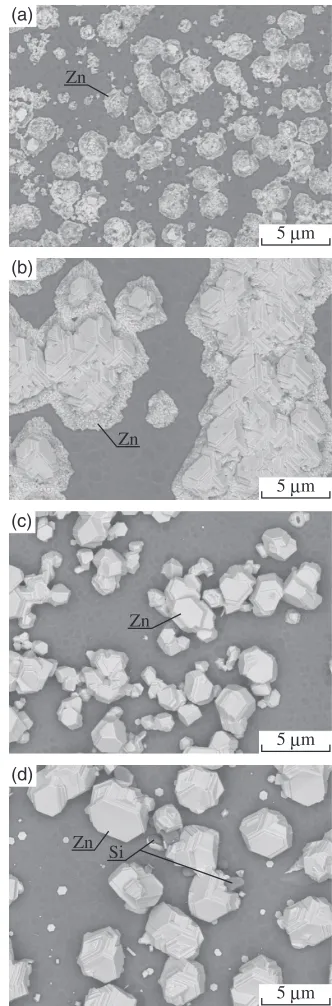
Figure 1 is the backscattered electron images (composi-tional mode) of the surfaces of Al-2Mg and Al-2Si after the zincate treatments. The images are described as‘BEIs’in the following sections. Generation of the gas continued during thefirst and second zincate treatments of the 2Mg and Al-2Si, and the excessively precipitated zinc repeatedly fell off the substrates. Therefore, the precipitated zinc, which barely adhered to the substrates, was removed by ultrasonic cleaning in acetone, then the surface was observed as shown in Fig. 1. In Fig. 1(a), the brighter areas, which consist of particles of
[image:2.595.342.508.69.572.2]³102nm, partly covered the surface of the Al-2Mg after the first zincate treatment. While zinc was detected by elemental analysis of the brighter areas, aluminum and magnesium were detected on theflat darker areas. Some areas were not covered with zinc when the Al-2Mg underwent the second zincate treatment (Fig. 1(b)), and the covered areas consisted of coarse zinc particles compared to the case of the first zincate treatment. For the Al-Si, coarse zinc particles and exposure of the substrate were observed after thefirst and the second zincate treatment (Fig. 1(c), (d)). In Fig. 1(d), silicon was detected on the darker particles.
Figure 2 shows the surface BEIs of 2Zn-0.2Mg and Al-2Zn-4.5Mg after the zincate treatments. From Fig. 2(a), precipitation of zinc on the Al-2Zn-0.2Mg differs depending on the crystal orientation of the aluminum matrix. Coarse grains of zinc, as shown in Fig. 1, were not observed in Fig. 2(a), (b), but the surfaces were uniformly covered with thin layers of zinc. The surfaces after the first and second zincate treatments showed almost the same morphology, and no generation of gas was observed. For the Al-2Zn-4.5Mg (Fig. 2(c), (d)), morphology of the zincated surfaces was almost the same as that of Al-2Zn-0.2Mg (Fig. 2(a), (b)), and generation of gas was not confirmed, either. Coarse grains of zinc, observed in Fig. 1, did not precipitate even near the cavities formed during the solidification when cast.
3.2 Electroless nickel-phosphorus plating
Figure 3 shows the cross-sectional BEIs of the 2N-Zn after plating for 600 s. During the 2N-Zn plating, gas was more
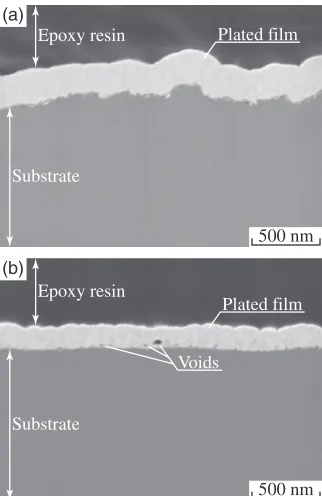
vigorously generated than for the zincated aluminum alloys, and the gas generation did not change from the beginning to the end of the plating. Although a plated film of ³t5 µm is formed, the film did not adhere to the substrate. A porous region, which consists of zinc, nickel and phosphorus, exists between the platedfilm and the substrate. The porous region wasfilled with epoxy resin used for the pretreatment, and the sensitivity of the characteristic X-rays of the nickel and phosphorus in this region is lower than that in the platedfilm. Figure 4 shows the cross-sectional BEIs of the 2Zn-0.2Mg, 2Zn-4.5Mg after the plating for 60 s. For the
Al-5 µm
(a)
Zn
5 µm
(d)
Si Zn
5 µm
(c)
Zn
5 µm
(b)
Zn
2Zn-0.2Mg (Fig. 4(a)), gaps do not exist between the plated film and the substrate, but many voids were observed in the platedfilm near the interface between the platedfilm and the Al-2Zn-4.5Mg substrate (Fig. 4(b)). Although the data are not shown here, peeling of the platedfilm on Al-2Zn-0.2Mg, obtained by plating for 5.4 ks, was very difficult such that the peeled surface of the substrate showed dimple patterns formed by ductile fracture of the substrate. On the other hand, the plated film on Al-2Zn-4.5Mg was easily peeled, and the peeling of the plated films was still easy even when the amount of magnesium in the ternary alloys was reduced to 0.5 at%.
4. Discussion
4.1 Zincate treatment
As previously reported,2)while dissolution of the alumi-num (Alþ2H2O!AlO2 þ4Hþþ3e) occurs as an oxidation reaction at the electrode potential of the zincate treatment of aluminum alloys, precipitation of zinc (ZnO22þ4Hþþ2e!Znþ2H2O) and generation of gas (2H++2e¹¼H2)5,6)take place as reduction reactions. Since the electrode potential during the zincate treatment 5 µm
(c)
Zn
Grain boundary
Cavity
5 µm
(b)
5 µm
(a)
Grain boundary
5 µm
(d)
Grain boundary
Cavity
Fig. 2 Surface BEIs of Al-Mg-Zn alloys after the zincate treatments for 30 s, (a) Al-2Zn-0.2Mg after thefirst zincate treatment, (b) Al-2Zn-0.2Mg after the second zincate treatment, (c) Al-2Zn-4.5Mg after thefirst zincate
treatment, (d) Al-2Zn-4.5Mg after the second zincate treatment. 10 µm
(d)
10 µm (c)
10 µm (b)
20 µm (a)
Plated film Epoxy resin
Zn substrate Porous area
[image:3.595.337.519.68.631.2] [image:3.595.89.251.72.573.2]measured in a previous report2) corresponds to the range where proton is reduced, the visually observed gas is thought to be hydrogen gas. When electrons are released due to the dissolution of aluminum, the dissolved area is covered with the zinc film if zincate ions are adequately supplied to the area. If the supply rate of zincate ions is low, proton reduction precedes that of the zincate ions, and hydrogen gas is generated on the surface of the substrate due to the higher diffusion rate of protons. In this case, the reduction of zincate ions mainly takes place off the substrate, since zincate ions are supplied by diffusion from the zincate solution distant from the substrate. Electrons required for the reduction of zincate ions off the substrate are considered to move from some areas on the substrate, not covered with zinc film as shown in Fig. 1, to the reduction sites of zincate ions through the precipitated zinc particles. Excessively precipitated zinc is not afilm, but a porous mass of coarse particles, which does not adhere to the substrate and easily falls off.
This phenomenon is thought to become significant when the passivation film on the aluminum alloys does not immediately dissolve, and the distribution of anode sites and cathode sites becomes nonuniform. As previously reported,2) copper and zinc in aluminum alloys promote immediate dissolution of the passivationfilm, but magnesium and silicon do not have such an effect, that is, once the generation of hydrogen gas begins at an area, the area continues to function as an anode site throughout the zincate treatment. For the Al-2Zn-0.2Mg and Al-2Zn-4.5Mg (Fig. 2), it is considered that thin and uniform films of zinc were immediately formed and the zincate reaction stopped due to the zinc in the alloys.
4.2 Electroless nickel-phosphorus plating
When the aluminum alloys, which undergo the above
[image:4.595.89.250.69.317.2]zincate treatments, are immersed in the plating solution, part of zinc dissolves, and the resulting electrons are used for the reduction of nickel ions in the solution. Since the precipitated nickel acts as a catalysis for the oxidation of hypophosphorous acid and electrons are released, nickel continuously precip-itates and forms a platedfilm. As previously reported,1)when zinc excessively precipitates during the zincate treatment, the reduction of protons precedes that of the nickel ions, and hydrogen gas is vigorously generated. Based on the plating for 2N-Zn (Fig. 3), it is obvious that excessively precipitated zinc during the zincate treatment causes poor adhesion of the platedfilms due to a high number of voids formed between the platedfilms and substrates. Zinc vigorously dissolves on the surface of the 2N-Zn which is not covered with the plated film, then the dissolving area propagates through the interface between the plated film and the substrate. Thus, fragments of the precipitated nickel kept falling off since zinc could dissolve beneath the plated areas near the uncovered ones. In Fig. 3, the porous areas between the plated film and the substrate are thought to be formed by the generation of hydrogen gas due to the dissolution of zinc and simultaneous precipitation of nickel-phosphorus which contains zinc.
This mechanism explains how adhesion of the platedfilms becomes poor when zinc excessively precipitates. However, adhesion of the plated films on Al-2Zn-4.5Mg is extremely poor despite the thin and uniform zincatefilms (Fig. 2(c), (d), Fig. 4(b)), similar to the zincatefilms formed on Al-2Cu and Al-2Zn in a previous report.2) The gaps in Fig. 4(b) are not due to the continued dissolution of the excessively precipitated zinc as the cases of Al-2Mg and Al-2Si, but they are supposed to be formed because hydrogen gas is vigorously generated immediately after initiation of the plating. Although its detailed mechanism is unknown, the reduction of nickel ions might be inhibited or that of the protons might be promoted on the surfaces which contain a certain amount of magnesium. In addition, even when the amount of magnesium in the aluminum alloys is rather low, the diffusion of magnesium toward the surface can cause enrichment of the magnesium, and change the surface properties to produce the above state at the beginning of the plating. In order to improve the adhesion of the plated films on the aluminum alloys, which contain magnesium and zinc, it is important to suppress the generation of hydrogen gas and to promote the immediate precipitation of nickel. These initial plating reactions require the appropriate control of the thickness and chemical state of the zincate films, and such detailed research will be a future subject.
5. Summary
In this study, the zincate treatment and electroless nickel-phosphorus plating of aluminum alloys, which contain zinc, magnesium and silicon, were studied from the viewpoints of alloying elements and generation of hydrogen gas. The results are summarized as follows.
(1) Magnesium and silicon do not have effects on the immediate initiation and termination of the zincate reaction, therefore, zinc excessively precipitates due to the continuous dissolution of aluminum and generation of hydrogen gas.
500 nm
(b)
Plated film Epoxy resin
Substrate
Voids
500 nm
(a)
Plated film Epoxy resin
Substrate
(2) Since the generation of hydrogen gas precedes precipitation of nickel on the surfaces which bear excess zinc, many voids are formed between the plated films and the substrates causing poor adhesion of the platedfilms.
(3) Although thin and uniform zincate films are formed and the vigorous generation of hydrogen gas does not continue for the aluminum-zinc-magnesium alloys, the adhesion strength of the plated films significantly decreases when the amount of magnesium exceeds a certain value. This is due to the voids between the plated films and the substrates supposedly formed by the generation of hydrogen gas at the beginning of the plating.
Acknowledgement
Part of this study was supported by the promotional project for private universities by the Education and Science
Ministry; “Creation of Innovation and Research Sites for the Supporting Technology for QOL Improvements”, and we would like to show our sincerest appreciation.
REFERENCES
1) K. Murakami, M. Hino, R. Furukawa and T. Kanadani: J. JILM 60
(2010) 8187(in Japanese).
2) K. Murakami, M. Hino, M. Ushio, D. Yokomizo and T. Kanadani:
J. JILM62(2012) 199205(in Japanese).
3) K. Murakami, M. Hino, N. Nagata, H. Kanetsuki, S. Kawai and T. Kanadani:J. JILM62(2012) 219222(in Japanese).
4) K. Murakami, M. Hino, R. Furukawa and T. Kanadani:Mater. Trans.51
(2010) 7884.
5) M. Pourbaix:Atlas of Electrochemical Equilibria in Aqueous Solutions, National Association of Corrosion Engineers, Houston, TX, (1974) pp. 168176.