Reducing delay time by using RTS/CTS along with
RTR
Deepak Sharma Sangeeta Sharma (Astt. Prof)
Dept. of Computer Science and engineering Dept. of Computer Science and engineering Lovely Professional University Lovely Professional university,
Jalandhar,Punjab. Jalandhar,Punjab.
[email protected] [email protected] Abstract-Ad hoc network or without
infrastructure- Ad hoc network is temporary based network which does not rely on the infrastructure that is it is a decentralized kind of network. There are two problems associated with the Ad hoc network- one is Hidden node problem and other one Exposed node problem. And there are number of techniques to remove hidden node problem like RTS/CTS handshake, MACA,MACAW, MACA-BI etc. But in this paper I am going to elaborate on how to avoid delay time occur when during (RTS/CTS handshake) i.e. when CTS receiving node goes to waiting state. To reduce delay time I am integrating both the mechanism- RTS/CTS and RTR and to improve performance of the network.
Keywords- RTS/CTS, RTR, MACA, MACAW. I INTRODUCTION
Today the technologies used in various fields are at peak. And wireless network is playing important role in our day today life. Wireless network is generally of two types. Infrastructure based wireless network in which network rely on the pre-existing infrastructure like access points. It is mainly of three types LAN,MAN,WAN etc. Ad-hoc network or without fixed infrastructure is temporary based network which does not rely on the infrastructure that is it is decentralized kind of network. There are two problem associated
with ad hoc network Hidden node and Exposed Node Problem .Hidden node problem is as follow let us suppose A sends data to B; C sends data to B at the same time.As a result collision takes place at B. Because C node is Hidden from Node A or vice versa.
Fig 1 Hidden node problem
Techniques To Remove Hidden Node Problem- There are number of techniques to remove Hidden Node Problem like RTS/CTS,
MACA,MACA-BI,MACA-W,CSMA,PAMAS,DBTMA. II Problem Formulisation
To remove hidden node problem, RTS/CTS mechanism is used in which node that wants to communicate with other node send RTS (Request to send) to that node and RTS receiving send CTS (clear to send) to RTS sending node and all the nodes which are in its range .These CTS receiving nodes goes to waiting state for a time that is provided in CTS control packet i.e. CTS timer. And I have taken assumption that if the communication between the sender and
receiver node occurs before CTS timer expires, then the nodes which receive CTS timer i.e. which were in the range of receiver node still has to wait till CTS timer expires even if the communication between the sender and receiver has completed .so these CTS receiving node has to wait. So a kind of delay is developed in the network. To remove this I am integrating RTR with RTS/CTS.
III Methodology
In this paper I am introducing concept of RTR with RTS/CTS .As we know nodes communicate to each other by sending RTS/CTS control packet. Let us consider Node A wants to communicate with Node B. Node A sends RTS to Node B and Node B reply with CTS which is broadcasted to all the nodes within its range i.e. Node C. Node C after receiving CTS donot interfere in the communication between A and B Nodes. As I have taken assumption that if communication ends before the expected time sent by CTS then the node (Node B) which was previously communicating will send RTR signal to all other nodes which are in its range and other nodes will start sending data to RTR sending node.
Fig 2 Showing integration of RTS/CTS and RTR
When RTR is broadcasted to other nodes, these nodes will communicate or send data according to two techniques-
According to distance preference - when CTS is broadcasted to other nodes, these nodes goes to the waiting state , so if communication done before the approximate timer of the CTS . Then the receiving node send RTR to other nodes to reduce delay time . This RTR is broadcasted to all the nodes and nodes will communicate or send according to distance preference .This means that node which is at shorter distance will send data to that Node so a kind of Queue is developed and all nodes will communicate according to this queue. That having smallest distance will be at the top of queue will be added at top position. And that topmost node will communicate first or send data first.
According to data size preference- when CTS is broadcasted to other nodes, these nodes goes to the waiting state , so if communication done before the approximate timer of the CTS . Then the receiving node send RTR to other nodes to reduce delay time . This RTR is broadcasted to all the nodes and nodes will communicate or send according to data size preference .This means that node which has smaller data size will send data to that Node so a kind of Queue is developed and all nodes will communicate according to this queue. That having smallest data size will be at the top of queue will be added at top position. And that topmost node will communicate first or send data first. So we can this queue is according to our operating system concept i.e. SJF( shortest job first). Node which smallest in data size will execute first.
Algorithm as follow- Algorithm:
Step 1: START Step 2: Sender -> RTS
Step 3: Receiver -> CTS + Time by receiver Step 4: If (Communication ends before time) then:
Step 5: Receiver -> RTR ( Broadcast to all the nodes which are in its range)
Step 6: Waiting Queue <- nodes with CTS(distance preference and data size preference)
Step 7: Send data Step 8: Else: Timer++ Step 9: END
IV RESULT Simulation Scenario-
Work on Matlab- Matlab is a numerical computing environment and programming language. Matlab allows easy matrix manipulation, plotting of function and data, implementation of algorithm, creation of user interfaces and interfacing with programs.
There are two scenarios in my simulation- • Distance preference scenario • Data size preference scenario
Distance preference Node Deployment
Total number nodes taken -50
Fig 3 Deployment of nodes
Fig 4 Selecting sender and receiver In this node 31 is taken as sending node nad 37 node as receiving node. Node 31 will send RTS control packet node to node 37.And node 37 will send CTS to all nodes which are in its range.
Fig 5 RTS Control Packet
Fig 6 Receiver node sending CTS and
sender node starts sending data
Fig7 Communication occurs before CTS
timer
Fig 8 RTR (Ready to Receive) Data Sending- Data receiving node after
receiving data send RTR to all the nodes within its range if the communication occurs before its CTS timer expires. As a result after getting RTR, nodes start sending data to the RTR sending node on the basis Distance preference.
Fig 9 Distance preference is chosen
Fig 10 Nodes sending data to node 37
According to Distance Preference Scenario 2- Data size preference
Nodes deployment
Total number of nodes taken-50
Fig 11 Deployment of nodes
Fig 12 Selecting sender and receiver
Fig 13 RTS Control Packet
Fig 14 Sender sends data
And communication before CTS timer
Fig 15 RTR Control Packet
Fig 16 Selecting Data size preference
Fig 17 Sending data to node 11 according to Data size Preference
Results
With distance preference choice– By integrating RTR with RTS/CTS delay time is reduced now nodes do not have to wait till timer expires if the communication occurs before CTS timer.
From the above scenario of communication between Node 31 and node 37, we can see that as the communication between node 31 and node 37 occurs before CTS timer so as result Node 37 send RTR to all the nodes within its range i.e. 19,14,38,29,43, 36,48,8 . As a result these nodes now can communicate with node 37 without any wait of CTS timer and unwanted delay can be removed. we can see from delay graph that with simple RTS/CTS mechanism delay is more as nodes have to wait till timer expires and in case of integration of RTS/CTS and RTR delay time get reduced as nodes 19,14,38,29,43,36,48,8 starts communicating with node 37 as soon as communication ends or we can say before CTS timer expires.
Fig 18 Time and throughput comparison of RTS/CTS and RTS/CTS/RTR
As now delay time is reduced in the network due to integration of RTS/CTS and RTR so throughput of the network is also improved. We can see from throughput graph that performance or throughput has been improved.
Fig 19 Time comparison of all the nodes From this graph we can see time taken by nodes ( 36,31,8,43,19,38,14,48) to send data to node 37 after getting RTR . In this nodes (36, 31, 8, 43, 19, 38, 14, 48) send data to node 37 according to Distance preference i.e. node which is at shortest distance send first.
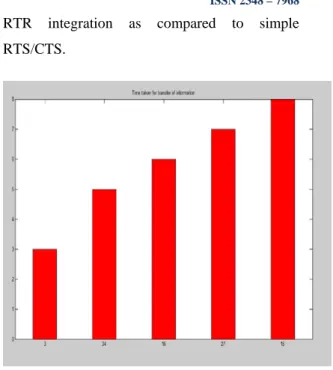
With Data Size preference- By integrating RTR with RTS/CTS delay time is reduced now nodes do not have to wait till timer expires if the communication occurs before CTS timer. According to data size , node which have shortest data will send data first to the RTR sending node.
Fig 20 Time and Throughput between RTS/CTS and RTS/CTS/RTR
As Delay in the network has been removed by integrating RTS/CTS and RTR so network performance will increase and throughput will be increased. This can be seen from Throughput graph generated during simulation that shows throughput increased in case of RTS/CTS and
RTR integration as compared to simple RTS/CTS.
Fig 21 Time comparison of all the nodes From this graph we can see time taken by nodes (3, 34, 16, 27, 15) to send data to node 11 after getting RTR . In this nodes (3,34,16,27,15) send data to node 11 according to Data size preference i.e. node which has data in smallest size will send data first (SJF) .From both the scenarios ( Distance and Data size) we can see that with the integration of RTS/CTS with RTR , delay time of the network has been reduced and also throughput also improved.
V Conclusion
Various evaluation and Simulation results lead to following Conclusion-
Integration of RTS/CTS and RTR- It leads to reduction of delay time occurs during RTS/CTS if the communication occurs before the expiration of CTS timer.
Increase in Throughput- And also due to reduction in delay time and Throughput of the network also increased .Hence integration of RTS/CTS and RTR is more beneficial and improved technique as compared to RTS/CTS technique. VI References
[1] AO HAN and Weije Lu Department of Electronics and Information Engineering Huazhong University of Science and Technology (HUST)” An Improvement of MACA in Alleviating Hidden Terminal Problem in Ad-hoc Networks” in 2009.
[2] Aruna jayasurya ,Sylvie perreau,Arek dadej, Steven Gordan institute of telecommunication and research .university of south Australia “Hidden vs. Exposed Terminal Problem in Ad hoc Networks “ in 2004
[3] Ashikar rehman and Pawel Gburzynski Department of Computing Science University of Alberta Edmonton, Alberta, Canada, T6G 2E8 “Hidden problems in hidden node problem” in 2006.
[4] A.A. Abdullah, Lin Cai, F. Gebali, “Enhanced busy-tone-assisted MAC protocol for wireless ad hoc networks,” in Proc. of 72nd IEEE Vehicular Technology Conference, pp. 1-5, Sep. 2010
[5] C.-K. Toh, V. Vassiliou, G. Guichal, C.-H. Shih, “March: a medium access control protocol for multihop wireless ad hoc networks,” in Proc. of 21st Century Military Communications Conference, pp. 512-516, 2000.
[6] C. Wu, V. Li, “Receiver-initiated busy-tone multiple access in packet radio networks,” in Proc. of the ACM Workshop on Frontiers in Computer Communications Technology, vol. 17, no. 5, 1988.
[7] Mostefa Fatima Zohra, Mekkakia maaza Zoulikha.Khelifa “Techniques of detection of the hidden node in wireless ad-hoc network ” in 2011.