T w o A c c o u n t s of S c o p e Availability and S e m a n t i c
U n d e r s p e c i f i c a t i o n
A l i s t a i r W i l l i s a n d S u r e s h M a n a n d h a r , D e p a r t m e n t of C o m p u t e r Science,
University of York, York Y010 5DD, UK. {agw, s u r e s h } @ c s , y o r k . a c . uk
A b s t r a c t
We propose a formal system for representing the available readings of sentences displaying quan- tifier scope ambiguity, in which partial scopes may be expressed. We show that using a theory of scope availability based upon the function- argument structure of a sentence allows a deter- ministic, polynomial time test for the availabil- ity of a reading, while solving the same problem within theories based on the well-formedness of sentences in the meaning language has been shown to be NP-hard.
1 I n t r o d u c t i o n
The phenomenon of quantifier scope ambigu- ity has been discussed extensively within com- putational and theoretical linguistics. Given a sentence displaying quantifier scope ambiguity, such as Every man loves a woman, part of the problem of representing the sentence's meaning is to distinguish between the two possible mean- ings:
Vx(ma (x) -+
3y(woma (y)
Alo e(x, y)))
where every man loves a (possibly) different woman, orwhere a single woman is loved by every man. One aspect of the problem is the generation of all available readings in a suitable representa- tion language. Cooper (1983) described a sys- tem of "storing" the quantifiers as A-expressions during the parsing process and retrieving them at the sentence level; different orders of quan- tifier retrieval generate different readings of the sentence. However, Cooper's method generates logical forms in which variables are not correctly
bound by their quantifiers, and so do not cor- respond to a correct sentence meaning. This problem is rectified by nested storage (Keller, 1986) and the Hobbs and Shieber (1987) al- gorithm. However, the linguistic assumptions underlying these approaches have recently been questioned. Park (1995) has argued that the availability of readings is determined not by the well-formedness of sentences in the meaning lan- guage, but by the function-argument relation- ships within the sentence. His theory proposes that only a subset of the well-formed sentences generated by nested storage are available to a speaker of English. Although the theories have different generative power, it is difficult to find linguistic data that convincingly proves either theory correct.
In the absence of persuasive linguistic data, it is reasonable to ask whether other grounds exist for choosing to work with either of the two theories. This paper considers the appli- cation of both theories to the problem of un- derspecified meaning representation, and the question of determining whether a set of con- straints represents an available reading of an ambiguous sentence or not. We show that a constraint language based upon Park's linguis- tic theory (Willis and Manandhar, 1999) solves this problem in polynomial time, and contrast this with recent work based on dominance con- straints which shows that using the more per- missive theory of availability to solve the same problems leads to NP-hardness.
2 U n d e r s p e c i f i c a t i o n
ory (UDRT) (Reyle, 1995). We shall charac- terise the desirable properties of an underspec- ified meaning representation as:
1. the meaning of a sentence should be rep- resented in a way that is not c o m m i t t e d to any one of the possible (intended) meanings of t h e sentence, and
2. it should be possible to incrementally intro- duce partial information about t h e mean- ing, if such information is available, a n d w i t h o u t the need to undo work t h a t has already been done.
A principal aim of systems providing an un- derspecified representation of quantifier scope is the ability to represent partial scopings. T h a t is, it should be possible to state that some of the quantifiers have some scope relative to each other, while remaining u n c o m m i t t e d to the rel- ative scope of the remaining quantifiers. How- ever, representations which simply allow partial scopes to be stated without further analysis do not adequately capture the behaviour of quanti- tiers in a sentence. Consider the sentence Every representative of a company saw most samples,
represented in the style of QLF:
_:see(<+i every x _:rep.of(x, <+j exists y co(y)>)>, <+k most z sample(z)>)
[image:2.612.372.490.367.429.2]A fully scoped logical form of this QLF is: [+i,+k,+j] :see(<+i every x r e p . o f ( x ,
<+j exists y co(y)>)>, <+k most z sample(z)>)
where the list of quantifier labels indicates the rela- tive scope of qnantifiers at that point in the sentence. Although this formula is well formed in the QLF language, it does not correspond to a well formed sentence of logic, seeming closer to the formula:
every (x, rep. of (x, y), most (z, sample (z),
exists(y, co(y), see(x, z))))
where the variable y does not appear in the scope of its quantifier. A language such as
QLF will generally allow this scoping to be ex- pressed, even t h o u g h it does not correspond to a reading available to a speaker. In QLF se- mantics, a scoping which does not give rise to any well formed readings is considered "uninter- pretable"; ie. there is no interpretation in which an evaluation function maps the QLF onto a t r u t h value.
Our aim is to present a system in which there is a straightforward computational test of whether a well-formed reading of a sentence ex- ists in which a partial scoping is satisfied, with- out requiring recourse to the final logical form. T h e language CLLS (Egg et al., 1998) has re- cently been developed which correctly generates the well-formed readings by using dominance constraints over trees. Readings of a sentence can be represented using a tree, where domi- nance represents outscoping, a n d quantifiers are represented using binary trees whose daughters correspond to the quantifiers' restriction and scope. So for the current example, Every repre- sentative of a company saw most samples, the reading:
every(x, a(y, co(y), rep.o f ( x, y ) ),
m o s t ( z , sample(z), see(x, z) ) )
can be represented by the tree in figure 1, w h e r e the restrictions of a a n d most have been o m i t t e d for clarity. Domination in t h e tree represents outscoping in the logical form.
e v e r y / / ~
a • • m o s t
I
I
rep.o f • • see
Figure 1: Representing relative scope as a tree
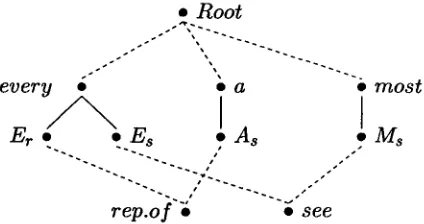
Underspecification can be captured by defin- ing dominance constraints between nodes rep- resenting the quantifiers and relations in a sen- tence. Readings of the sentence with a free variable are avoided by asserting that each re- lation containing a variable must be dominated by that variable's quantifier, and an available reading of the sentence is represented by a tree in which all the dominance constraints are sat- isfied. So the ill-formed readings of the sen- tence can be avoided by stating that the relation
rep.of is d o m i n a t e d by the restriction of every
and the scope of a, while see is d o m i n a t e d by the scopes of b o t h a and most. This is represented in figure 2, where the dominance constraints are illustrated by d o t t e d lines.
Further partial scope information can be introduced with additional dominance con- straints. So the partial scope requirement that
• R o o t
jy: :
...
e v e r y • ~ a • m o s t
i/%.
, -
r e p . o f " . "-~ see
Figure 2: Representing available scopes with dominance constraints
most should outscope every would be captured by a constraint stating t h a t t h e node represent- ing most should d o m i n a t e the node representing every in the constraints' solution.
It is has been shown (Koller et al., 1998) that determining the consistency of these constraints is NP-hard. In the rest of this paper, we show that an alternative theory of scope availability yields a constraint system that can be solved in polynomial time.
3 A l t e r n a t i v e A c c o u n t o f A v a i l a b i l i t y
The NP-hardness result of the previous section arises from the a s s u m p t i o n t h a t the availability of scopings is determined by the well formedness of the associated logical forms. Park (1995) has proposed an alternative theory of scope avail- ability which states t h a t available scopes are accounted for by relative scopes of arguments around relations, whereby quantifiers may not move across NP boundaries. For example, con- sider the sentence Every representative of a company saw most samples, containing two rela- tions, saw and of. A r o u n d saw, every (represen- tative of a company) can outscope most (sam- ples), or vice versa, and around of, every (rep- resentative) can outscope a (company), or vice versa. Park generalises this observation to the claim that for any n-ary relation in a sentence, there are n! possible orderings of quantified ar- guments around that relation. Other quanti- tiers in the sentence should not "intercalate" be- tween those which are single arguments to a re- lation. So in the example sentence there are four possible scopes, because there are 2! = 2 scop- ings around saw and 2! = 2 scopings around of. What is not possible is a reading where a
outscopes most which outscopes every; although this can be represented by a well formed sen- tence of logic (with no u n b o u n d variables), it is not available to a speaker of English.
By using this theory as t h e basis of under- specification, we can say:
• underspecification is to be captured by al- lowing different possible relative scope as- signments around the predicates, and • partial scopes between arbitrary quanti-
tiers in the sentence will be translated into the equivalent scoping of quantifiers a r o u n d their predicates.
T h e chosen representation will be based u p o n a sentence's quantifiers and relations (for exam- ple, verbs a n d prepositions).
Quantifiers and the relations which determine their relative scope are represented by a set of elements under a strict partial order, where the ordering represents the relative scopes. A strict order will be taken to be transitive, antisym- metric and irreflexive. However, because the interaction between the predicates in the sen- tence has implications for possible scopings, it is also necessary to consider the relationships between the ordered sets.
Consider again the sentence Every m a n loves a woman. T h e quantifiers a n d relation in this sentence can be represented by a set of elements {every, a, love}. A strict partial order, ~-, is de- fined over the set which states t h a t the relation love must be outscoped by b o t h quantifiers:
({every, a, love}, (every ~- love, a ~- love)) T h e partial order states that b o t h quantifiers outscope the verb, b u t says nothing about their scopes relative to each other. This represents a completely underspecified meaning. An unam- biguous reading of the sentence is represented when ~- defines a total order on the set. So if the relation e v e r y ~- a were added, t h e reading:
V x . m a n ( x ) --~ 3 y . w o m a n ( y ) A love(x, y) e v e r y ~- a ~- love would be represented. Alternatively, adding a ~- e v e r y to the underspecified form would rep- resent t h e reading:
[image:3.612.70.282.63.175.2]T h e introduction of a further relation which does not lead to a well formed sentence (such
as love ~- every) is shown by the irreflexivity of ~- being violated.
While using a single set of elements correctly accounts for the possible scopes of quantifiers in the sentences discussed so far, relative clauses and prepositional a t t a c h m e n t to NPs are more complex. Consider the sentence Every repre- sentative of a company saw most samples. T h e presence of two binary relations, of a n d saw,
implies that there should be 2!.2! -- 4 readings. Continuing with the system developed so far, these possibilities could be represented by a pair of strictly partially ordered sets:
({every, most, s e e } , ( e v e r y N s e e , m o s t N s e e ) )
({every, a, o f } , (every ~ ' of, a ~ ' o f ) )
where the four possible ways of completing the strict orders on the sets correspond to t h e four available readings. To represent relative scope between arbitrary quantifiers in the sentence, a further transitive relation, .>, is defined. Say t h a t if (S, ~-) is a strictly partially ordered set in the structure where x, y E S and x ~- y t h e n x .> y. So for example, consider the pair of strictly partially ordered sets:
({every, most, s e e } , ( e v e r y ~ m o s t ~ s e e ) )
({every, a, o f } , (a ~ ' every ~-' of))
which would represent the reading (in a format similar to generalised quantifiers):
a(y,
every(x, rep.of(x, y),
most(z, sample(z), see(x,
z))))
T h e orders on the sets state t h a t every .:> m o s t see and a .> every .:> o f , a n d from the transi- tivity of .> it can be inferred (correctly) t h a t
a .:> most. Similarly, given the ambiguous sen- tence and the partial scope requirement t h a t a should outscope most, the required partial scope can be obtained by adding the relations
a ~-~ every and every ~- most.
T h e transitivity of .> is not enough to cap- ture all the available scope information. Sup- pose it were required t h a t m o s t should outscope a. There are two readings of t h e sentence which satisfy this partial scope, those being:
m o s t ( z , sample(z),
every(x, a(y, co(y), rep.of (x, y)), see(x, z)))
and
m o s t ( z , sample(z), a(y, co(y),
every(x, rep.oI (x, y), see(x,
z)))).
These readings are precisely those for which the object of see outscopes its subject; the partial scope is captured by the pair:
({every, most, see}, (most ~- every ~- see))
({every, a, o f } , (every ~-' of, a ~-' of))
where there is no additional information a b o u t the relative scope of every and a. However, t h e transitivity of -> alone does not capture t h e fact that m o s t .:> a follows from m o s t .:> every.
We remedy this by defining a domination re- lation. In the current case, say that every dom- inates a, which means t h a t a is nested within the Q N P whose head quantifier is every. T h e n because quantifiers may not "intercalate" across NP boundaries, anything t h a t outscopes every
also outscopes anything t h a t every dominates (here, a); if most outscopes one it must outscope both. We capture this behaviour by p u t t i n g the sets into a tree structure, where each of the nodes is one of t h e strictly ordered sets repre- senting the scopes a r o u n d a relation. For any node, N, each of the daughter nodes has (ex- actly) one element in c o m m o n with N , oth- erwise, any element appears only once in the structure. So, consider again the sentence Ev- ery representative of a company saw most sam- ples. T h e scope information of the underspeci- fled form is represented by the tree:
({every, most, see}, (every
see, most
see))
/
({every, a, o f } , ( e v e r y ~-' of, a ~ ' of))
Now, say that an element X dominates another element Y (denoted as X ~-~ Y) if X and Y are (distinct) elements in a set at some node, and X is also in t h e parent node. Also, ~-+ is transitive and irreflexive. So in the example given:
every ~-+ a and every ~ o f ,
b u t every ~-+ every.
We can now extend the definition of -> by saying that:
if (P,~-) is a node in the tree, a n d x, y E P a n d x ~- y, t h e n x.>y a n d x.>z where z is any t e r m t h a t y dominates. Also, .> is transitive a n d irreflexive.
This captures t h e scoping behaviour for nested quantifiers. So from the ambiguous representa- tion of scopes:
({every,
most, see}, (most
every
see))
I
({every, a, of}, (every
of, a
of))
where m o s t ~-- every a n d every ~ a, it is pos- sible to infer correctly t h a t m o s t .> a, whatever t h e relation is between every a n d a.
4 F o r m a l D e f i n i t i o n o f S c o p e R e p r e s e n t a t i o n s
We now provide a formal description of t h e structures described in section 3. T h e defini- tion is divided into two parts. First a scope structure is defined, which is a tree s t r u c t u r e whose nodes are sets under a strict order a n d describes t h e correct possible scopings of quan- tiffed a r g u m e n t s a r o u n d their relations. Next, a scope representation is defined, which is t h e pair of a scope s t r u c t u r e and an outscoping relation,
•
>, which is defined over all t h e elements in t h e structure.
T h e analysis presented here differs from t h a t of t h e previous section in t h a t t h e nodes in the scope ~ structures are sets u n d e r a strict to- tal order, r a t h e r t h a n u n d e r a p a r t i a l order. T h e s t r u c t u r e s therefore represent u n a m b i g u - ous readings of t h e sentence. Underspecifica- tion will t h e n be c a p t u r e d in the constraint lan- guage, r a t h e r t h a n in the u n d e r l y i n g structures, as discussed in section 5.
A scope s t r u c t u r e is a finite tree, where each node of the tree is a finite, n o n - e m p t y set of el- ements, P , taken from a set (9 = {a,/~,-),,...} u n d e r a strict total order. For a n y node, each d a u g h t e r node is also a strictly ordered set, such t h a t each d a u g h t e r set di has exactly one el- ement in c o m m o n with P , a different element for each of the di. An element can only a p p e a r once in the tree, unless it is the c o m m o n node between a m o t h e r a n d a daughter. So:
is a correct scope s t r u c t u r e , because no element appears twice except c~ a n d 8, which a p p e a r in m o t h e r / d a u g h t e r pairs (the ordering relations have been o m i t t e d for clarity).
A scope s t r u c t u r e is defined as a triple (P, ~- , :D), where P is a set of elements, ~- is a strict t o t a l order over P a n d 7:) is t h e set of daughters. We say t h a t an element occurs in a scope struc- t u r e if it is a m e m b e r of t h e set at a n y node in t h e scope structure. If (9 is a (countable) set of elements, t h e n scope s t r u c t u r e s can be recur- sively defined as:
• If S = (Ps, >-s, {}), where P s is a finite, n o n - e m p t y subset of (9 a n d >-s is a strict t o t a l order on Ps, t h e n S is a scope struc- ture, where:
1. if x E Ps, t h e n x occurs in S,
• If R a n d S are scope structures such t h a t R = (PR, ~ R , DR) a n d S = (Ps, ~-s, :DS), where no element occurs in b o t h R a n d S, a n d there is some element a such t h a t a E Pn, t h e n if T = (PT,
N'T,~T),
where PT = {a} t2 Ps, T~T = {R} U :Ds a n d ~-T is a strict t o t a l order on PT t h e n T is a scope structure, where:1. If some element x occurs in either R or S t h e n x occurs in T
2. If some element x occurs in R a n d x a, t h e n a dominates x in T
3. If x a n d y occur in R a n d x d o m i n a t e s y in R t h e n x d o m i n a t e s y in T
4. If x a n d y occur in S a n d x d o m i n a t e s y in S t h e n x d o m i n a t e s y in T
If S is a scope structure, t h e n a node in S is defined as:
• If S is a scope s t r u c t u r e such t h a t S -- (Ps, >-s, T~S), then:
- (Ps, >'-s) is a node in S
- if di E :Ds, t h e n a n y node in di is a node in S.
pair of elements in the structure, rather t h a n j u s t between elements at a c o m m o n node.
If S is a scope s t r u c t u r e such t h a t S = ( P s , ~ - s , 7 ) s ) , t h e n (S, > s ) is a scope represen- tation, where ">s is the m i n i m u m relation such that:
* If (P, ~-p) is a node in S and x, y E P and x N-p y, t h e n x ">s Y.
• If (P, ~-p) is a node in S and x, y E P and x ~-p y, t h e n i f z is an element which occurs in S a n d y d o m i n a t e s z in S then x ">s z. • ">s is transitive.
If (S, ">s) is a well formed scope representation, then ">s is a strict partial order over the set of elements which occur in S.
5 C o n s t r a i n t s f o r S c o p e U n d e r s p e c i f i c a t i o n
We now consider a constraint language for rep- resenting the available scopes in a sentence. T h e s t r u c t u r e of t h e sentence can b e defined in terms of c o m m o n a r g u m e n t s to a relation (which is represented b y m e m b e r s h i p of a c o m m o n set in the scope s t r u c t u r e ) and the d o m i n a t i o n rela- tion. T h e constraint language is:
¢, ¢ ::= x o y C o m m o n set m e m b e r s h i p x ¢--+ y D o m i n a t i o n
x D y O u t s c o p i n g ~b A ¢ C o n j u n c t i o n
where x, y are m e m b e r s of a (countable) set of constants, C O A l = { x , y, z, . . . }.
It is intended t h a t these constraints b e de- fined over terms in an underspecified semantic representation, such as Q L F or U D R T , with a function m a p p i n g g r a m m a t i c a l o b j e c t s in the representation onto m e m b e r s of C O N . Repre- senting the quantifiers and relations in the sen- tence is sufficient for our current needs. Con- straints of the form x o y (where o is symmetric) state either t h a t x a n d y represent c o m m o n ar- guments to a relation, or t h a t x and y represent a relation and a quantifier which quantifies over it. Constraints of the form x ~-4 y indicate t h a t x is the head quantifier of a complex NP, in which y, a n o t h e r g r a m m a t i c a l object (either a quantifier or a relation), is nested.
So for example, consider again the sentence E v e r y representative of a c o m p a n y saw m o s t
samples, and assume t h a t t e r m s in the un- derspecified representation representing the the g r a m m a t i c a l o b j e c t s every, exists, most, rep.of and see m a p onto the elements e, a, m, o and s respectively, where {e, a, m , o, s } C C O N . T h e n the constraint representing the fully underspec- ified meaning is:
e o s A m o s A e o m A s o e A s o m A m o e A
e o o A a o o A e o a A o o e A o o a A a o e A
e c-~ a A e ~-+ o A
ei> s A e ~ o A m i > s A a D o
N o t e t h a t the s y m m e t r y of o is s t a t e d explic- itly in the constraint. T h e (underspecified) con- straint is generated either from the g r a m m a r or directly from t h e underspecified structure, so the inference rules for d e t e r m i n i n g the availabil- ity of a partial scope only generate constraints of t h e form X t> Y. These rules are discussed further in section 6. Underspecification is now c a p t u r e d within the constraint language; note the parallels b e t w e e n the constraints of the form X t> Y in this example and t h e partial orders used in section 3.
T h e satisfiability of the constraints is given in terms of the scope representations defined in section 4. A scope representation, (S, ">s), sat- isfies a constraint of the form X o Y if (P, >-p) is a node in S such t h a t X ' , Y' E P s , X ' # Y ' , where some assignment function m a p s X and Y onto X ' and Y'. Similarly, constraints of the form X ~-+ Y are satisfied if X ' d o m i n a t e s Y' in S, and constraints of the form X D Y are satisfied if X ' ">s Y'. So the above constraint is satisfied by a set of scope s t r u c t u r e s of the form:
( { e v e r y , m o s t , see}, >-) /
( { e v e r y , a, o f } , ~-')
where the assignment function m a p s the con- stants e , a , m , o and s onto t h e elements e v e r y , a, m o s t , o f and see respectively, and where e v e r y ~- see, m o s t ~- see, e v e r y ~-' o f a n d a ~-' o f .
We can now define the semantics for the con- straint language. An assignment function, I[-~/, m a p s constants of the constraint language onto
elements which occur in S a n d wffs of the con- straint language onto one of t h e pair of values { t , f } . I is a pair ((I),~4}, where (I) is a scope representation, such t h a t (I) = (S, ">s}, and .4 is a function m a p p i n g constants of t h e constraint language onto t h e set of elements which occur in S. T h e denotation of t h e constraints is t h e n given by:
• IX~ I -= , A ( X ) if X is a constant in the
constraint language.
• I X o Y ] I = t if there is a n o d e in S, (P,
N-p),
such t h a t IX~ I E P a n d [[y]]/ E P and [[X]]I ~ [[y]]1, otherwise I X o y ] I = f . • I X ~ y ] I = t if IX~ I d o m i n a t e s ~y~I in
S, otherwise I X ~-+ y ~ I = f .
• I X ~> Y ~ I = t
if
I Z ] I > s lynX, otherwiseotherwise [[¢ A ¢]]" ---- f .
Satisfiability
A constraint set, A, is satisfiable iff there is at least one I such t h a t I¢~ / = t for all constraints ¢ where ¢ E A.T h e satisfiability of a constraint set represents t h e existence of a reading of t h e sentence which respects the partial scoping.
6 A v a i l a b i l i t y o f
Partial Scopes
We now t u r n to t h e question of d e t e r m i n i n g w h e t h e r a partial scoping is available. In sec- tion 3 it was s t a t e d t h a t scope availability is accounted for by the relative scope of quanti- tiers a r o u n d their predicates. It t u r n s out (al- t h o u g h we do not prove it here) t h a t for any partial scoping, there is a necessary and suffi- cient set of scopings of quantifiers a r o u n d their relations t h a t gives the partial scoping. For ex- ample, we showed t h a t for t h e sentence Every representative of a company saw most samples, t h e readings where most outscopes a are exactly those where the subject of see outscopes its ob- ject. Therefore, from the constraint m o s t C> a, it should be possible to infer m o s t E> every. T h e aim of t h e constraint solver is to d e t e r m i n e what scopings of quantifiers a b o u t their relations are required to obtain t h e required partial scoping, a n d therefore to state w h e t h e r t h e partial scope is available.
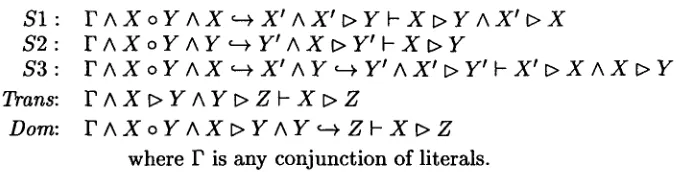
A set of rules is defined on t h e constraints, so t h a t additional scope information m a y be in- ferred. T h e i n t r o d u c t i o n of f u r t h e r scope con- straints does not affect scope information al- ready present (monotonicity). T h e rules are given in figure 3, where F represents any con- j u n c t i o n of literals a n d the associativity a n d c o m m u t a t i v i t y of A are assumed. T h e infer- ence rules S1, $2 and $3 o p e r a t e by recursively reducing t h e (arbitrary) outscoping constraint X ~ > Z to X I > Y A Y E > Y ~ , where Y a n d Y~ represent a r g u m e n t s to a c o m m o n relation, a n d Y' either d o m i n a t e s or is equal to Z. R e p e a t e d application of these constraints gives t h e set of scopes of quantifiers a r o u n d their relations for t h e initial partial scoping. T h e rules T r a n s and D o r a t h e n generate t h e remaining possible scope constraints. If a scope is unavailable, t h e n completing t h e transitive closure of D across t h e s t r u c t u r e yields a constraint of the form X ~> X .
We t h e n say that:
• A constraint set is in normal ]orm iff ap- plying t h e rules S1, $2, $3, Trans a n d D o m does not yield any new constraints.
If F is a constraint set in n o r m a l form then: • F represents an available scoping iff it does
not contain a constraint of the form X ~> X . • F represents a complete scoping iff it rep- resents an available scoping, and for every constraint of t h e form X o Y there is either a constraint X D Y or a constraint Y D X . T h e condition for a scoping to be available fol- lows from t h e irreflexivity of ->. T h e condition for a scoping to be complete states t h a t if two elements are a r g u m e n t s to a relation, or are a re- lation a n d one of its arguments, t h e n t h e y must have scope relative to each other. This corre- sponds to considering sets u n d e r a total order, r a t h e r t h a n u n d e r a partial order.
S1 : $ 2 : $3 :
Trans: Dora:
F A X o Y A X ~ X t AXtC> Y F X ~> Y AXtC> X F A X o Y A Y ¢-4 Y ' A X t> Y t I- X i:> Y
F A X o Y A X ,--~ X~ A Y , - + YI AXIC> y ' ~ - X ' D X AXC> Y F A X t> Y A Y t > Z~- X c> Z
F A X o Y A X ~> Y A Y c-.+ Z t - X t> Z
where F is any conjunction of literals.
Figure 3: Rules of inference
Application of rules $1, $2 and $3 to comple- tion can be completed in linear time; if X i> Y is a constraint between two arbitrary quanti- tiers X and Y where X fi Y, t h e n exactly one of the rules S1, $2 or $3 applies (lack of space prevents us proving this here). If X o Y, t h e n none of these three rules applies. Application of S1, $2 or $3 adds at most two new constraints, of which at most one is a scope constraint XC>Y ~
where X fi Y~. At most n - 1 such constraints are generated.
Application of the rules S1, $2 a n d $3 re- duces an arbitrary partial scope into relative scopes of a r g u m e n t s around their relations. If a scoping is unavailable, this is represented by the irreflexivity of C> being violated. Testing for this requires that the transitive closure of C> be completed; this is known to be soluble in b e t t e r t h a n cubic time. We conclude t h a t testing for the availability of a partial scope in this frame- work can be achieved in better t h a n cubic time in the worst case.
7 C o n c l u s i o n a n d C o m m e n t s
A desirable property for an underspecified rep- resentation of quantifier scope ambiguity is t h a t there should be a computationally efficient test for whether a partial scope is available or not. We have shown that accepting a theory of avail- ability which states that scope availability is de- termined by the function-argument structure of a sentence allows the development of a test for availability which is polynomial in t h e n u m b e r of quantifiers and relations in a sentence, while theories of availability based u p o n the logical well-formedness of meaning representations has been shown to be NP-hard.
A c k n o w l e d g e m e n t s T h e authors would like to t h a n k Alan Frisch, Mark Steedman and three anonymous reviewers for useful comments. T h e first a u t h o r is funded by an E P S R C grant.
R e f e r e n c e s
H. Alshawi and R. Crouch. 1992. Monotonic Semantic Interpretation. In Proceedings of the 30th Annual Meeting of the ACL, pages 32-39, Newark, Delaware.
R. Cooper. 1983. Quantification and Syntactic Theory. Reidel.
T. Cormen, C. Leiserson, and R. Rivest. 1990.
Introduction to Algorithms. T h e M I T Press, Cambridge, Massachusetts.
M. Egg, J. Niehren, P. Ruhrberg, and F. Xu. 1998. Constraints over lambda-structures in semantic underspecification. In Proceedings of the 17th International Conference on Com- putational Linguistics and 36th Annual Meet-
ing of the A CL, Montreal, Canada.
J. Hobbs and S. Shieber. 1987. An algorithm for generating quantifier scopings. Computa-
tional Linguistics, 13.
W. Keller. 1986. Nested Cooper storage: T h e proper t r e a t m e n t of quantification in ordinary n o u n phrases. In U. Reyle and C. Rohrer, editors, Natural Language Parsing and Linguistic Theory, Studies in Linguistics and Philosophy, pages 432-437. Reidel. A. Koller, J. Niehren, and R. Treinen. 1998.
Dominance constraints: Algorithms and com- plexity. In Third International Conference on Logical Aspects of Computational Linguistics (LA CL '98), Grenoble, France.
J.C. Park. 1995. Quantifier scope and con- stituency. In Proceedings of the 33rd Annual Meeting of the Association for Computational Linguistics, pages 205-212. Cambridge, MA. U. Reyle. 1995. On reasoning with ambiguities.
In Proceedings of the E A CL, Dublin.
A. Willis and S. Manandhar. 1999. T h e avail- ability of partial scopings in an underspeci- fled semantic representation. In 3rd Interna- tional Workshop on Computational Seman- tics, Tilburg, the Netherlands, January.
[image:8.612.85.429.62.148.2]