Munich Personal RePEc Archive
Evaluating the Impact of Outsourcing
Strategy on Procurement Performance of
Selected Technical Universities in Ghana
Prempeh, Kwadwo Boateng and Nsiah-Asare, Evelyn
Sunyani Technical University, Sunyani Technical University
14 July 2017
EVALUATING THE IMPACT OF OUTSOURCING STRATEGY ON PROCUREMENT PERFORMANCE OF SELECTED TECHNICAL UNIVERSITIES IN GHANA
Evelyn Nsiah Asare1, Kwadwo BoatengPrempeh2
1
(Department of Procurement and Supply Chain Management, Sunyani Technical University)
2
(Department of Accountancy, Sunyani Technical University)
Abstract:
Due to globalization, outsourcing has become one of the widely embraced strategies for delivering outstanding services in the educational sector. However, in spite of the increasing trend in outsourcing arrangements, there are inadequate literature underpinnings on how outsourcing activities affect the performance of educational institutions in Ghana. In order to bridge that gap, this research seeks to evaluate the effects of outsourcing strategy on procurement performance of some selected Technical Universities in Ghana. The main data collection instrument employed in this study is the structured questionnaire. The study employed the purposive and stratified sampling technique. The findings revealed that contracting, comprehensive outsourcing, licensing agreement and selective outsourcing strategies were main determinants of procurement performance of Technical Universities in Ghana. The study recommends that technical universities in Ghana should put more emphasis on training and information sharing in order to improve procurement performance. All procurement processes should be automated so as to reduce the error rates and discrepancies in the process and align the procurement procedures to the Public Procurement Act. This is because efficient procurement process could be used as a competitive advantage.
Keywords: Outsourcing Strategy, Procurement Performance, Public Procurement Act, Technical Universities
1. INTRODUCTION
Due to the rapid increase in globalization, outsourcing has become one of the vital business approaches, and one can gain a competitive advantage if products or services are produced more effectively and effectively by outside suppliers (Yang, Seongcheol, Changi, & Ja-Won, 2007). For an organization to be able to respond to daily changes in the market and the difficulty of predicting the direction of such changes means that they should focus on their core competencies and capabilities (McIvor, 2008). Traditionally, outsourcing is an abbreviation for “ outside resource using”. Outside means to create value from without, not within the company (Yang et. al., 2007). Outsourcing is the allocation of services and functions or functions previously done within the organization to a provider outside of the organization and has become one of the key components in many business strategies (Hern & Burke, 2006). Outsourcing enables organizations to focus on their (Lee & Kim, 2010) and to strategically use outside suppliers to perform services that traditionally have been an internal function. (Raiborn, Butler, & Massoud, 2009). Outsourcing can also involve the transfer of both people and physical assets to the supplier (McIvor, 2005). In the past, outsourcing emphasized on strategic benefits like cost reduction, but currently, the emphasis is much on productivity, flexibility, speed and innovation in developing a business application, and access to new technologies (Elmuti, 2004).
constitutes a growing dimension of corporate procurement strategy. To date, procurement outsourcing has mostly been limited to the transactional purchase-to-pay process rather than the more strategic aspects of procurement. However, research by The Hackett Group, a leading global strategy and operations consulting firm, indicates that major companies will likely expand the scope of procurement outsourcing in the coming years (Lankford and Parsa, 2009).
For procurement outsourcing to yield the expected results, its implementers would need to do a comparative cost benefit analysis and the risk of insourcing and outsourcing across specific procurement activities, manage potential risk and ensure that adequate effort goes into process design and optimization (Yang et.al., 2007). Two influential theories in the study of outsourcing have been transaction cost economics (TCE) and the resource based view (RBV) of the firm. According to transaction cost economics, a company will make the outsourcing decision on the basis of reducing production and transaction costs. The resource-based view which views the firm as a bundle of assets and resources that if employed in distinctive ways can create competitive advantage (McIvor, 2008).
In Ghana, research works on outsourcing is mainly geared towards the Health, Manufacturing and Financial sectors overlooking other equally-important sectors. This may be as a result of their dominance in the Ghanaian economy relative to the others and the ease with which data can be obtained from those sectors. This study seeks to contribute existing literature by evaluating the impact of outsourcing strategy on procurement performance of Technical Universities in Ghana and also to identify factors that influence the outsourcing decisions of Technical Universities in Ghana.
2. LITERATURE REVIEW
2.1 Theoretical Framework
Theoretical framework provides a general representation of relationships between things in a given phenomenon. In an attempt to explain the relationship between outsourcing and procurement performance, the theoretical framework for this study deals with relevant theories relevant to outsourcing namely Resource Based View (RBV), Transaction Cost Economies (TCE) theory, Core Competency and contractual Theory.
2.1.1 Resource Based View (RVB) Theory
RBV theory puts more emphasis on the firm's internal resource rather than external opportunities and threats created by industry conditions. The theory maintains that in order to generate a sustainable competitive advantage, a resource must provide economic value and must be presently scarce, difficult to imitate, non-substitutable and not readily obtainable from markets. The theory also relies on two key points; first, that resources are determinants of firm performance and second, that resources must be rare, valuable, difficult to imitate and non-substitutable by other rare resources. When the latter occurs, a competitive advantage has been created (Priem & Butler, 2001).
2.1.2 Transaction Cost Economics (TCE) Theory
Transaction costs arise from the fact that it is not possible for a firm to completely contract while incomplete contracts create renegotiations when the balance of power between the transacting parties shifts (Williamson, 1979). The attributes of a firm’s transactions positively associated with transaction costs include the necessity of investment in durable, specific asset, the inefficiency of transacting, task complexity and uncertainty, difficulty in measuring task performance and interdependence with other transactions. Transaction cost economics (TCE) theory is based on a rational decision made by firms after considering transaction-related factors such as asset specificity, environmental uncertainty and other types of transaction costs. Activities conducted under conditions of high uncertainty require specific assets e.g. human and physical capital. Asset specifically refers to the non-trivial investments in transaction i.e. specific assets.
On the other hand, transaction cost economics (TCE) or theory view the relationship between service receiver and service provider as a model that allows economic transactions to take place (Reuben et al., 2007). Transaction costs include time, money, human resources, contract issues negotiation matters, risks e.tc. Hence, the relationship between service receiver and service providers is closely integrated due to cost considerations (Shaharudin et al, 2014). However, according to Mclvor et al., (2008), the two theories RBV &TCE can be combined to form a combined view through which outsourcing decisions can be based upon as RBV & TCE complement each other.
2.1.3 Core competency theory
Simchi-Levi, Keminisky & Simchi-Levi, (2004), defined core competency as the collective learning in the organization on how to coordinate diverse production skills and integrate multiple streams of technologies. This theory suggests that firm activities should either be performed in house or by external service providers. It is based on a make or buy decision. Non-core activities should be considered for outsourcing to the best-suited service providers who are experts in that field. However, some few non-core activities which have an impact on competitive advantage should be retained in house. Core competencies refer to the collective knowledge of the production system concerned in particular knowledge of procedures and how to best integrate and optimize them. The process of outsourcing non-core competencies continues to gain importance as it transfers responsibilities such as maintenance and transport functions, in the hands of suppliers most capable of performing them most successfully (Chandra & Kumar, 2000). Vendors’ competence is an important factor that influences the success of an outsourcing arrangement (Lavina & Ross, 2003).
For an outsourcing strategy to be implemented, it requires a legally-bound contract which sets the institutional framework in which each party’s rights, duties, and responsibilities are clearly defined. The goals, policies, practices, and strategies on which the arrangement is based are also specified in the contract. The purpose of the outsourcing contract is to facilitate proper exchange of services between the two parties, prevent misunderstanding, prohibit moral hazards in a cooperative relationship, and protect each party’s proprietary knowledge. Properly written contracts prevent risks arising from non-performance and misunderstanding and also reduces uncertainty likely to be faced by firm decision-making process. The contract sets a procedure for conflict resolution (Luo, 2002). Legal experts emphasize the need for a comprehensive contract which can serve as a reference point specifying how the client and the vendor relate (Willcocks, 2003).
2.2 Empirical Review
Nyangau, Mburu, and Ogolla (2014) in their study on the effects of outsourcing strategy on procurement performance among Universities in Kenya showed that contracting, comprehensive outsourcing, licensing agreement and selective outsourcing strategies were the main determinants of procurement performance of universities in Kenya. According to Adu- Gyamfi (2015) in his study on the impact of outsourcing on organisational profitability, there is a significant positive relationship between outsourcing and profitability. Khalili and Adhami (2014) in their research investigated the relationship between outsourcing and the performance based on Balanced Score Card and the results showed that there was a strong and positive relationship between outsourcing post office activities and performance management in three aspects of financial, customers and internal processes. However, there is a weak positive relationship between the aspect of learning and outsourcing.
The study of Elmuti, Julian and Dereje (2010) investigated the perceived impact of outsourcing on organizational procurement performance in the USA Universities. This study examined the relationships between outsourcing strategies and organizational performance in 150 schools of higher learning widely spread in the USA. It further assessed the procurement performance of outsourcing strategies in use by these organizations as well as their organizational performance. Productivity, quality, satisfaction and market performance (market share, return on investment, and return on sales) are the procurement performance variables investigated in this study.
A study conducted by Mwichigi and Waiganjo (2015), investigated the relationship between outsourcing and operational performance of Kenya's energy sector. Specifically, the study sought to determine the relationship between the key outsourced services, that is, administrative support outsourcing, finance outsourcing, human resource outsourcing and technical outsourcing and operational performance. The study findings revealed that outsourcing of services at Kenya Power had led to a reduced operational costs and had also resulted in operational efficiency. The study concludes that there is a positive significant relationship between administration, financial, resourcing and technical outsourcing services with operational performance.
concentrating on their core functions on the areas of accommodation, food and bar services and housekeeping and have outsourced most of their non-core functions.
3. METHODOLOGY 3.1 Research Design
The study employed a descriptive survey adopting a cross sectional survey designed at evaluating the impact of outsourcing strategy on the procurement performance of Technical Universities in Ghana. Descriptive research design is preferred where the research aims at describing the features of a particular individual or group (Kothari, 2004). This method lays focus on eliciting subjective opinions from respondents. The method was adopted because it gives information regarding the status of a phenomenon with respect to variables on conditions in the situation being studied. The data was collected on a sample of five (5) Technical Universities in Ghana. The design seeks to capture both qualitative and quantitative aspects.
3.2 Population of the Study
Population refers to the entire group of individuals or objects to which researchers are interested in generalizing the conclusions. The target population of this study was all the procurement practitioners in all the Technical Universities in Ghana. Currently, there are 8 Technical Universities in Ghana and they are all public institutions. These Technical Universities are established through institutional Act of Parliament under the Technical Universities Act, 2016 (Act 922), which provides for the development of Technical University education, accreditation and governance of Technical Universities.
3.3 Sample and Sampling Techniques
Sampling is the selection of a given number of respondents from a defined population as representative of that population (Orodho, 2002). Any conclusion that is drawn from the sample should also hold for the entire population. Judgemental sampling technique was used to select procurement practitioners and stakeholders in the various Procurement Departments in the selected Technical Universities in Ghana since they can give reliable and accurate information on the impact of outsourcing on procurement performance of Technical Universities in Ghana. Quota sampling which is a non-probability sampling technique was employed in this study. A sample size of 100 respondents was picked using quota sampling technique. This was necessary due to the absence of the sample frame for the selected population. Quota sampling in this study was convenient due to the difference in the experience and level of motivational expectations across departments.
3.4 Data Collection Instruments
Primary and secondary data sources were used in order to achieve the objectives of this study. Primary data was collected from the selected respondents using postal questionnaires. The survey was created using suitable questions modified from related research and individual questions formed by the researchers. Likert scale was used to determine if the respondent agreed or disagreed with a statement. The analysis of the study was substantially based on this data.
3.5 Data Collection Procedure
Primary and secondary data were used for the study. Primary data is the information the researcher obtained from the field using the questionnaires. The researchers administered the questionnaires. The questionnaires were used because they allow the respondents to give their responses in a free environment and help the researchers obtain information that would not have been given.
3.6 Pilot Testing
The research instrument was pre-tested before final administration to the respondents. Pre-testing allows errors to be discovered before the actual collection of data begins and 1% of the population is considered adequate for the pilot study that is 10 out of the 100 selected respondents seen to be knowledgeable in procurement matters. Researchers conducted a pilot test to ensure that there is validity and reliability of instrument using Cronbach’s alpha while conducting the research in order to obtain data that is consistent with the main objective. An alpha score of 0.70 or more indicates that the instrument is reliable. Besides this, pre-testing aided the researchers in clearing any ambiguities and ensuring that the questions posed measured what was intended.
3.7 Data Processing and Analysis
The responses that were received from the questionnaires were edited for completeness and consistency, checked for errors and omissions then coded to SPSS and analysed both quantitatively and qualitatively. Descriptive statistics such as mean, standard deviation was then generated, each for the outsourcing strategies. Standard deviation represented the degree of variability in the responses. Respondents are required to provide answers by marking a number on a 5-point Likert Scale in order to make it easier for them. The five-point Likert scale scoring system formed the basis of calculating the mean score for each of the factors. The relative ranking of the factors by all respondents was then determined by comparing the individual mean score and the standard deviation for each criterion. After the ranking of the factors, linear regression analysis was used to investigate the relationship between outsourcing strategies and procurement performance of Technical Universities in Ghana. The coefficient of determination (R2) resulting from the linear regression was used to determine the goodness of the fit. R2 greater than 0.7 indicates a very good fit. P- value for the t-test statistics was to determine the significance of the independent variables in the regression model. Those with a p-value less than 0.05 are significant in the equation. A Simple regression model was used to determine the level of influence the independent variables have on the dependent variable as shown below.
PPerf = 𝛽! +𝛽!CONT +𝛽!COMP + 𝛽!𝐿𝐴 + 𝛽!S0 +𝛽!𝐺𝑂𝑉𝑃+𝜀!
Where;
PPERf = Procurement performance of Technical Universities in Ghana
𝛽! = Constant Term
𝛽!,𝛽!,𝛽!, 𝛽! = Coefficients CONT = contracting
SO = Selective Outsourcing GOVP = Government Policy
𝜀! = Error term
4. RESULTS AND DISCUSSIONS
4.1 Reliability and Validity Test
Piloting of the questionnaire was conducted to find out if the respondents could answer the questionnaires without difficulty. The pre-test was done using respondents from Sunyani Technical University (equating to 10 purposively selected respondents) seen to be knowledgeable in the procurement activities of the school. They were asked to evaluate the questions for relevance, comprehension, meaning and clarity. The instrument was modified on the basis of the pilot test before administering it to the study respondents. Cronbach’s Alpha was used to test the reliability of the instrument. A coefficient of 0.7 and above shows high reliability of data. The Cronbach's Alpha test of the instrument resulted in a value of 0.73 which is greater than 0.7, thus the questionnaires were reliable.
4.2 Background of Respondents
This section presents the background information of the respondents such as the level of education and years of work experience. Such analyses are important because the background of the respondents helps generate confidence in the reliability of the data collected and eventually the findings of the study.
4.2.1 Distribution of Respondents by Level of Education
Source: Authors Fieldwork (2017)
Table 4.1 shows the frequency and percentage of the level of education of respondents. A majority of the respondents constituting 51% of the total respondents had a first degree (University graduate). Respondents who had attained postgraduate degrees constituted 34% and those with a Diploma or its equivalent constituted 15% of the respondents. This shows that all the people involved in the procurement activities in the selected Technical University have obtained tertiary education and hence capable of reading and understanding the items on the questionnaire. This can be a contributing factor to the high-reliability results obtained in the previous section.
4.2.3 Distribution of Respondents by Years of Work Experience
Table 4.1 Distribution of Respondents by Level of Education
Level of Education Frequency Percentage (%) Diploma 15 15.0 University graduate 51 51.0 University postgraduate 34 34.0
Total
Table 4.2 Distribution of Respondents by Years of Work Experience
Years of Experience Frequency Percentage (%) 1-3 years 13 13.0 3-5 years 44 44.0 Over 5 years 43 43.0
Total 100 100.0
Source: Authors Fieldwork (2017)
4.3 Mode of Outsourcing Procurement System
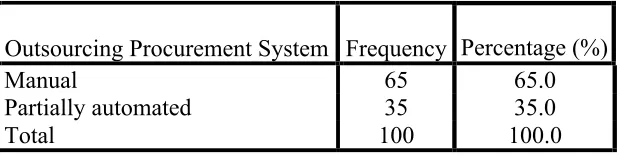
From the results displayed in Table 4.3 below, it was found out that outsourcing procurement systems in Technical universities in Ghana were not fully automated. 65% of the respondents were of the view that their outsourcing procurement systems were manually done while the rest constituting 35% of the responses were of the view that their outsourcing procurement systems were partially automated.
Table 4.3 Mode of Outsourcing Procurement System
Outsourcing Procurement System Frequency Percentage (%) Manual 65 65.0 Partially automated 35 35.0 Total 100 100.0 Source: Authors Fieldwork (2017)
4.4 Analysis of Independent Variables
The respondents were asked to rate the factors (variables) which have an impact on the overall procurement performance of the institution. Using the five-point Likert scale rating, a criterion is deemed significant if it has a mean score of 3.5 or more. Where two or more criteria have the same mean score, the one with the lowest standard deviation is assigned the highest significance ranking. Standard deviation values of less than 1.0 indicate consistency in the agreement among the respondents of the reported level of results (Ahadzie, 2007). They were altogether used to assess the various factors under different sub-sections. The procedure, findings and relevant discussions are as follows.
4.4.1 Impact of Outsourcing Strategy on the Procurement Performance of the Institution
[image:9.612.92.402.342.420.2]The 2nd was ‘Outsourcing strategy and Training helps in reducing transactional costs in the procurement process’ with a mean score of 3.98 and a standard deviation of 0.887. ‘Regular health and safety monitoring activities during outsourcing promotes overall procurement performance', ‘Outsourcing strategy, Recruitment, testing and selection promote the best practices in procurement performance', ‘Outsourcing non-core capabilities facilitate collaboration within the supply chain' and ‘Outsourcing strategy and operating environment helps to create visibility in procurement process ‘ were the other variables of importance in their order of rankings with mean scores above 3.5.
Table 4.4 Impact of outsourcing strategy on the overall procurement performance of Technical Universities
Variables Mean
Score
Std. Deviation
Ranking
Outsourcing strategy and procurement Performance management creates efficiency and effectiveness in the procurement process for competitive advantage
4.08 0.774 1ST
Outsourcing strategy and Training helps in reducing transactional costs in the
procurement process 3.98 0.887 2ND
Regular health and safety monitoring activities during outsourcing promotes
overall procurement performance 3.89 0.928 3RD
Outsourcing strategy, Recruitment, testing and selection promote the best
practices in procurement performance 3.85 0.925 4TH
Outsourcing non-core capabilities facilitate collaboration within the supply chain
3.85 0.968 5TH
Outsourcing strategy and operating environment helps to create visibility in
procurement process 3.62 1.062 6TH
Source: Authors Fieldwork (2017)
4.4.2 Contract Outsourcing Strategy
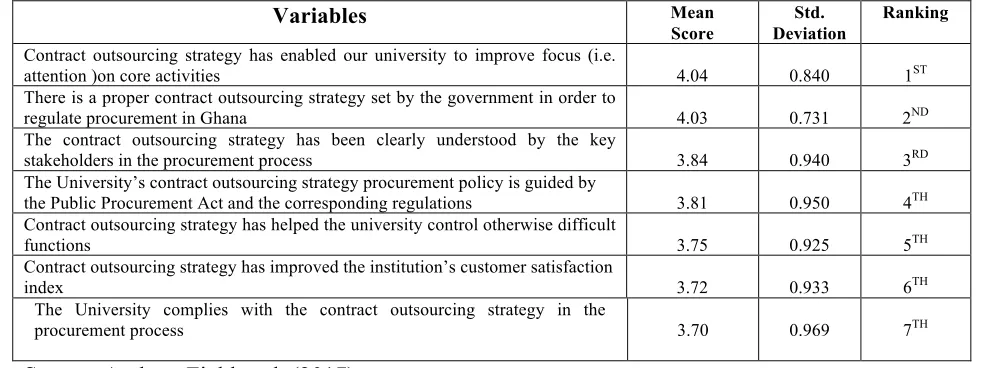
Table 4.5 Impact of contracts outsourcing strategy on procurement performance of Technical Universities in Ghana
Variables Mean
Score
Std. Deviation
Ranking
Contract outsourcing strategy has enabled our university to improve focus (i.e.
attention )on core activities 4.04 0.840 1ST
There is a proper contract outsourcing strategy set by the government in order to
regulate procurement in Ghana 4.03 0.731 2ND
The contract outsourcing strategy has been clearly understood by the key
stakeholders in the procurement process 3.84 0.940 3RD
The University’s contract outsourcing strategy procurement policy is guided by
the Public Procurement Act and the corresponding regulations 3.81 0.950 4TH
Contract outsourcing strategy has helped the university control otherwise difficult
functions 3.75 0.925 5TH
Contract outsourcing strategy has improved the institution’s customer satisfaction
index 3.72 0.933 6TH
The University complies with the contract outsourcing strategy in the
procurement process 3.70 0.969 7TH
Source: Authors Fieldwork (2017)
[image:10.612.82.568.215.387.2] [image:10.612.78.569.470.654.2]university to improve focus (i.e. attention) on core activities’ was ranked 1st with a mean of 4.04 and a standard deviation of 0.840. The second factor was ‘There is a proper contract outsourcing strategy set by the government in order to regulate procurement in Ghana’ with a mean of 4.03 and a standard deviation of 0.731. ‘The contract outsourcing strategy has been clearly understood by the key stakeholders in the procurement process’, ‘The University’s contract outsourcing strategy procurement policy is guided by the Public Procurement Act and the corresponding regulations’, ‘Contract outsourcing strategy has helped the university control otherwise difficult functions', ‘Contract outsourcing strategy has improved the institution's customer satisfaction index' and ‘The University complies with the contract outsourcing strategy in the procurement process' were the other major factors in their order of ranking with mean value above 3.5. The findings of this study are inconsistent with the findings of Nyangau, et al., (2014) in their order of the ranking of variables.
4.4.3 Selective Outsourcing Strategy
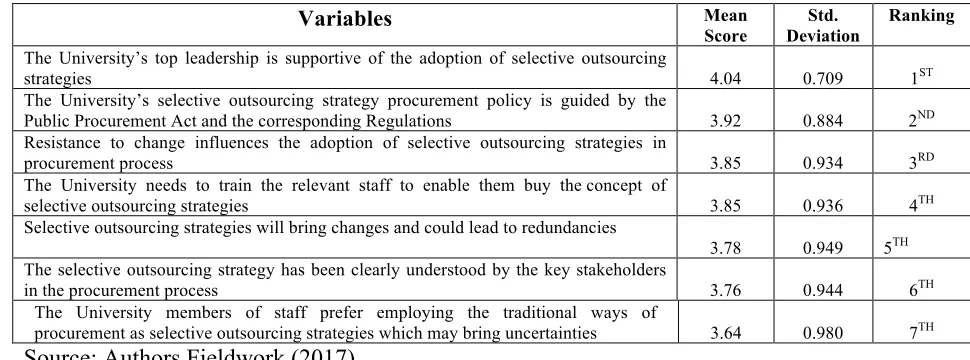
Table 4.6: Impact of selective outsourcing strategy on procurement performance of Technical Universities in Ghana
Variables Mean
Score
Std. Deviation
Ranking
The University’s top leadership is supportive of the adoption of selective outsourcing
strategies 4.04 0.709 1ST
The University’s selective outsourcing strategy procurement policy is guided by the
Public Procurement Act and the corresponding Regulations 3.92 0.884 2ND
Resistance to change influences the adoption of selective outsourcing strategies in
procurement process 3.85 0.934 3RD
The University needs to train the relevant staff to enable them buy the concept of
selective outsourcing strategies 3.85 0.936 4TH
Selective outsourcing strategies will bring changes and could lead to redundancies
3.78 0.949 5TH
The selective outsourcing strategy has been clearly understood by the key stakeholders
in the procurement process 3.76 0.944 6TH
The University members of staff prefer employing the traditional ways of
procurement as selective outsourcing strategies which may bring uncertainties 3.64 0.980 7TH
Source: Authors Fieldwork (2017)
From table 4.6 the highest ranked variable was ‘The University’s top leadership is supportive of the adoption of selective outsourcing strategies’ with a mean value of 4.04 and a standard deviation of 0.709. ‘The second ranked variable was ‘The university’s selective outsourcing strategy procurement policy is guided by the Public Procurement Act and the corresponding Regulations’ with a mean of 3.92 and a standard deviation of 0.884. Other important variables include ‘Resistance to change influences the adoption of selective outsourcing strategies in procurement process‘, ‘The University needs to train the relevant staff to enable them to buy the concept of selective outsourcing strategies’, ‘Selective outsourcing strategies will bring changes and could lead to redundancies’, ‘The selective outsourcing strategy has been clearly understood by the key stakeholders in the procurement process’ and ‘The University members of staff prefer employing the traditional ways of procurement as selective outsourcing strategies may bring uncertainties’ were the other significant factors in their order of ranking with mean value above 3.5.
4.4.4 Licensing Agreements Strategy
[image:11.612.78.563.315.495.2]an impact on procurement performance of Technical Universities in Ghana. ‘The University’s level of licensing agreements as an outsourcing strategy in place to facilitate the overall procurement performance of the institution’ was ranked 1st with a mean of 3.98 and a standard deviation of 0.738. ‘The University’s licensing outsourcing strategy procurement policy is guided by the PPA and regulations’, ‘The University’s systems are compatible with the level of licensing agreements outsourcing’, ‘The licensing outsourcing strategy has been clearly understood by the key stakeholders in the procurement process’, ‘The University has the right level of licensing agreements in place to facilitate the procurement performance of Universities in Ghana’ and ‘The level of licensing agreements is simple and easy to be in procurement’ were the other major factors in their order of ranking with a mean value above 3.5. Table 4.7 below displays the result.
Table 4.7 Impact of licensing agreements strategy on procurement performance of Technical Universities in Ghana
Variables Mean
Score
Std. Deviation
Ranking
The University’s level of licensing agreements as an outsourcing strategy in place
to facilitate the overall procurement performance of the institution 3.98 0.738 1ST
The University’s licensing outsourcing strategy procurement policy is guided by
the PPA and regulations 3.92 0.992 2ND
The University’s systems are compatible with the level of licensing agreements
outsourcing 3.91 0.889 3RD
The licensing outsourcing strategy has been clearly understood by the key
stakeholders in the procurement process 3.84 0.825 4TH
The University has the right level of licensing agreements in place to facilitate the
procurement performance of universities in Ghana 3.81 0.907 5TH
The levels of licensing agreements outsourcing are necessary for implementation
of outsourcing strategy in the procurement performance of Universities in Ghana 3.78 1.001 6TH
The level of licensing agreements is simple and easy to be in procurement
3.77 0.897 7TH
Source: Authors Fieldwork (2017)
4.4.5 Comprehensive Strategy/ Selective Business Outsourcing Strategy
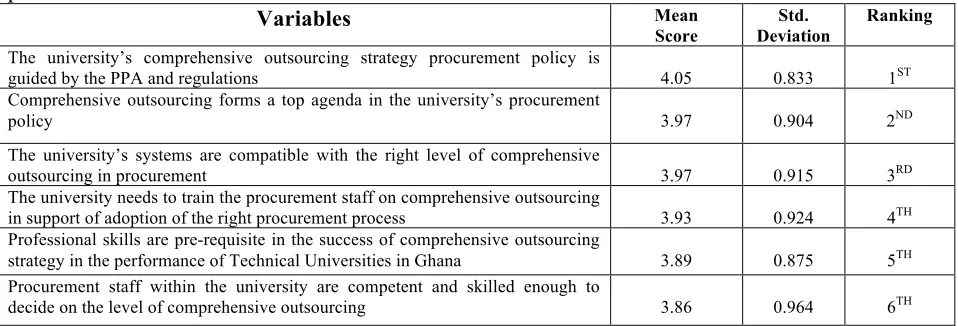
Table 4.8 Impact of comprehensive/ selective BPO outsourcing strategy on procurement performance of Technical Universities in Ghana
Variables Mean
Score
Std. Deviation
Ranking
The university’s comprehensive outsourcing strategy procurement policy is
guided by the PPA and regulations 4.05 0.833 1ST
Comprehensive outsourcing forms a top agenda in the university’s procurement
policy 3.97 0.904 2ND
The university’s systems are compatible with the right level of comprehensive
outsourcing in procurement 3.97 0.915 3RD
The university needs to train the procurement staff on comprehensive outsourcing
in support of adoption of the right procurement process 3.93 0.924 4TH
Professional skills are pre-requisite in the success of comprehensive outsourcing
strategy in the performance of Technical Universities in Ghana 3.89 0.875 5TH
Procurement staff within the university are competent and skilled enough to
[image:12.612.95.564.264.453.2] [image:12.612.86.565.542.705.2]The comprehensive outsourcing strategy has been clearly understood by the key
stakeholders in the procurement process 3.66 0.997 7TH
Source: Authors Fieldwork (2017)
The results as indicated in Table 4.8 show that comprehensive strategy significantly affects procurement performance of Technical Universities in Ghana since all the means were more than 3.5. ‘The University's comprehensive outsourcing strategy procurement policy is guided by the PPA and regulations' was ranked the highest with a mean of 4.05 and a standard deviation of 0.833, Comprehensive outsourcing forms a top agenda in the University’s procurement policy was ranked 2nd with a mean score of 3.97 and a standard deviation of 0.904. ‘The University’s systems are compatible with the right level of comprehensive outsourcing in procurement’, ‘The University needs to train the procurement staff on comprehensive outsourcing in support of adoption of the right procurement process’, ‘Professional skills are pre-requisite in the success of comprehensive outsourcing strategy in the performance of Technical Universities in Ghana’, Procurement staff within the University are competent and skilled enough to decide on the level of comprehensive outsourcing' and ‘The comprehensive outsourcing strategy has been clearly understood by the key stakeholders in the procurement process' were the order factors in order of ranking. The findings of this study conform to the findings of (Worley, 2011: Nyangau, et al., 2014) which state that comprehensive business process outsourcing (BPO) entails using third parties to deliver back office services such as finance and payroll.
[image:13.612.78.563.382.576.2]4.4.6 Government Policy
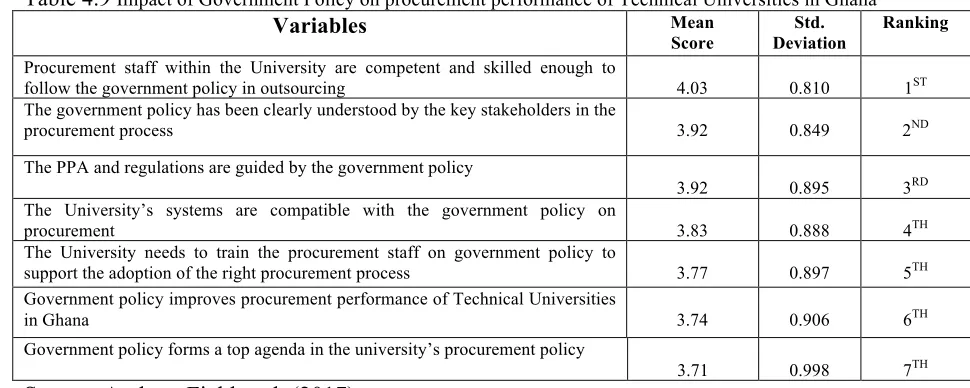
Table 4.9 Impact of Government Policy on procurement performance of Technical Universities in Ghana
Variables Mean
Score
Std. Deviation
Ranking
Procurement staff within the University are competent and skilled enough to
follow the government policy in outsourcing 4.03 0.810
1ST The government policy has been clearly understood by the key stakeholders in the
procurement process 3.92 0.849 2ND
The PPA and regulations are guided by the government policy
3.92 0.895 3RD
The University’s systems are compatible with the government policy on
procurement 3.83 0.888 4TH
The University needs to train the procurement staff on government policy to support the adoption of the right procurement process
3.77 0.897 5TH
Government policy improves procurement performance of Technical Universities
in Ghana 3.74 0.906 6TH
Government policy forms a top agenda in the university’s procurement policy
3.71 0.998 7TH
Source: Authors Fieldwork (2017)
train the procurement staff on government policy to support the adoption of the right procurement process’, ‘Government policy improves procurement performance of Technical Universities in Ghana’, and ‘Government policy forms a top agenda in the University’s procurement policy’ were the major government policy variables affecting procurement performance in Technical Universities.
[image:14.612.90.485.191.308.2]4.5 Regression Analysis
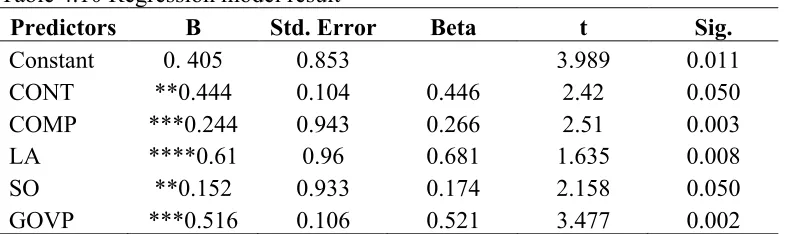
Table 4.10 Regression model result
Predictors B Std. Error Beta t Sig.
Constant 0. 405 0.853 3.989 0.011 CONT **0.444 0.104 0.446 2.42 0.050 COMP ***0.244 0.943 0.266 2.51 0.003 LA ****0.61 0.96 0.681 1.635 0.008 SO **0.152 0.933 0.174 2.158 0.050 GOVP ***0.516 0.106 0.521 3.477 0.002
Source: Authors Fieldwork (2017) NB: *significant at 10% **significant at 5% *** significant at 1%
The established regression equation becomes:
PPerf = 0.405 + 0.444CONT +0.244COMP + 0.61𝐿𝐴 + 0.152S0 +0.516𝐺𝑂𝑉𝑃
Constant = 0.405, shows that if contracting, comprehensive outsourcing, licensing agreement, selective outsourcing strategies were all rated as zero, procurement performance of Technical Universities in Ghana rating would be 0.295
β1= 0.444, shows that a unit increase in contracting strategy results in 0.444 units increase in procurement performance of Technical Universities in Ghana if other factors are held constant.
β2= 0.244, shows that one unit increase in comprehensive outsourcing strategy results in 0.244 units increase in procurement performance of Technical Universities in Ghana if other factors are held constant.
β3= 0.61, shows that one unit increase in licensing agreement results in 0.61 units increase in procurement performance of Technical Universities in Ghana if other factors are held constant.
β4= 0.152, shows that one unit increase in selective outsourcing strategy results in 0.152 units increase in procurement performance of Technical Universities in Ghana if other factors are held constant.
Β5 = 0.516, shows that a unit increase in government policy results in 0.516 units increase in procurement performance of Technical Universities in Ghana if other factors are held constant
is, contracting, comprehensive outsourcing, licensing agreement, selective outsourcing strategies and government policy explain 66% of the variation in procurement performance of Technical Universities in Ghana leaving 34% unexplained. The P- value of 0.013<0.05) implies that the model of procurement performance of Technical Universities in Ghana is significant at the 5% significance level.
5.0 CONCLUSIONS AND RECOMMENDATIONS
5.1 Conclusion
The findings revealed that there is a proper outsourcing strategy set by the Government in order to regulate procurement activities in Technical universities in Ghana. Also, Licensing agreements strategy had great influence on procurement performance of Technical Universities in Ghana. The respondents were of the opinion that; the University’s level of licensing agreements as an outsourcing strategy in place to facilitate the overall procurement performance of the institution, the university’s licensing outsourcing strategy procurement policy is guided by the Public Procurement Act and, the University’s systems are compatible with the level of licensing agreements outsourcing and the University has the right level of licensing agreements in place to facilitate the procurement performance of the Universities. To a great extent; the University’s top leadership is supportive of the adoption of selective outsourcing strategies, the University needs to train the relevant staff to enable them buy the concept of selective outsourcing strategies and the university’s selective outsourcing strategy procurement policy is guided by the Public Procurement Act and the corresponding Regulations on the same. On the other hand, Selective outsourcing strategies would bring changes and could lead to redundancies, resistance to change influences the adoption of selective outsourcing strategies in procurement process, the selective outsourcing strategy has been clearly understood by the key stakeholders in the procurement process were rated as having moderate influence on procurement performance of Technical Universities in Ghana. The study further revealed that procurement staff within the University are competent and skilled enough to follow the government policy on outsourcing.
The regression and correlation results showed that there is a significantly positive relationship between the independent variable (procurement performance) and the predictors (contracting, comprehensive outsourcing, licensing agreement and selective outsourcing strategies) in Technical Universities in Ghana (that is, 66% of the variation in procurement performance of Technical Universities in Ghana can be explained by the predictors). Each predictor variable was individually linearly related to procurement performance of Technical Universities in Ghana (P-value<0.05) and, therefore, a four predictor variable model could be used in forecasting procurement performance of Technical Universities in Ghana.
The main aim of the study was to evaluate the impact of outsourcing strategy on procurement performance of Technical Universities in Ghana. The study concludes that contracting, comprehensive outsourcing, licensing agreement and selective outsourcing strategies were the main determinants of procurement performance of Technical Universities in Ghana. The regression model established was a good fit for forecasting and predicting the procurement performance of Technical Universities in Ghana.
5.2 Recommendations
information-sharing in order to improve procurement performance. All procurement and outsourcing processes should be fully automated so as to reduce the error rates and discrepancies in the process and align their procurement procedures to the Public Procurement Act (Act 663 and Act 914 (amended)) since efficient procurement process could be used as a competitive advantage.
Organizations should outsource with a clear picture in mind as to why they want to outsource. When organizations outsource, they should have measurable indicators in the form of Key Performance Indicators (KPI) for the service provider(s).
5.2.1 Suggestion for further research
Based on the findings of this study, the researchers recommend that:
1. Research should be carried out on procedures which can be used to measure outsourcing performance with more emphasis on Key Performance Indicators (KPI’s).
2. More research is needed to evaluate and analyze the risks associated with outsourcing arrangements as most outsourcing contracts are full of conflicts and some of them end prematurely.
3. since the current research was carried out in Technical Universities, more research needs to be done in other areas in order to compare the results.
REFERENCES
Adu- Gyamfi, L. (2015). Evaluating the impact of outsourcing on organisational profitability. World wide journal of multidisciplinary research and development, 1 (3), 23-39.
Agyemang- Duah, P., Aikins, I., Asibey, O., & Broni, A. O. (2014). Evaluating the impact of outsourcing of non-core functions in the hotel industry: A case study of Anita, NODA and Golden Gate Hotel. European Journal of Business and Innovation Research, 2 (3), 25-45.
Chandra, C. and Kumar, S. (2000), “Supply chain management in theory and practice: a passing fad or a fundamental change?” Industrial Management & Data Systems, Vol. 100 No. 3, pp.100-13.
Elmuti, D. (2004). The Perceived Impact of Outsourcing on Organizational Performance. Mid-American Journal of Business, 18 (2), 33-42.
Elmuti, D., Julian, G., & Dereje, A. (2010). Consequences of outsourcing strategies on employee quality of work life, attitudes, and performance. Journal of Business Strategies, 27 (2).
Grover, V. T., & Cheon, J. M. (1998). Towards a theoretically-based contingency model of information systems outsourcing. Journal of Management Systems, 12 (4), 89-116.
Hern, J. T., & Burke, M. M. (2006). Elements of Administration for Building students (2nd ed.). London: Hutchinson Press Ltd.
Journal of Business and Economic Research, 10 (2&3), 47-86.
Khalili, K., & Adhami, A. (2014). Investigating the relationship between outsourcing and performance based on Balanced Score Card (Case study: Ilam Post Office). Journal of Data Envelopment Analysis and Decision Science, 2014 (1), 1-11.
Kothari, C. R. (2004), Research methodology: Methods and techniques (2nd Ed.), New Delhi: New Age International Publishers.
Lee, P. R., & Kim, D. (2010). Implications of service processes outsourcing on firm value. Industrial Marketing Management, 39, 853-861.
Levina, N. & Ross, J.W. (2003), “From the vendor’s perspective: exploring the value proposition in information technology outsourcing”, MIS Quarterly, Vol. 27 No. 3, pp. 331-64.
Luo, Y. (2002), “contract, cooperation, and performance in international joint ventures”,
Strategic Management Journal, Vol. 23 No. 10, pp. 903-19.
McIvor, R. (2005). The outsourcing process strategies for evaluation and management. New York: Cambridge University Press.
McIvor, R. (2008). What is the right outsourcing strategy for your process? European Management Journal, 26, 24-34.
Mwichigi, S. N., & Waiganjo, E. W. (2015). Relationship between Outsourcing and Operational Performance of Kenya’s Energy Sector: A Case Study of Kenya Power. International Journal of Academic Research in Business and Social Sciences, 5 (3), 497-513
Nyangau, I. K., Mburu, D. K., & Ogolla, K. (2014). Effects of Outsourcing Strategy on Procurement Performance among Universities in Kenya. International Journal of Economics, Commerce and Management, 2 (11), 1-40.
Petus, L. M. (2001). The resource-based view as a development growth process: evidence from the deregulated trucking industry. Academy of Management Journal, 441 (4), 879-896.
Priem, L. R., & Butler, E. j. (2001). Is the resource-based view a useful perspective for strategic management research? Academy of Management Review, 26 (1), 22-40.
Raiborn, A. C., Butler, B. B., & Massoud, F. M. (2009). Outsourcing support functions: Identifying and managing the good, the bad, and the ugly. Business Horizons, 52, 347-356.
Reuben, R., Boselie, D.M., & Lu, H. (2007). Vegetables procurement by Asian supermarkets: a transaction cost approach. Supply Chain Management International Journal, 12(1), 60-68
Shaharudin, M.R., Zailani, S., & Ismail, M. (2014).Third party logistics role in reverse logistics and closed-loop supply chains., International Journal Logistics Systems Management, 18(2), 200-215.
Willcocks, L. (2003), “Business process outsourcing: The promise of the “enterprise partnership”, model. http://www.templeton.ox.ac.uk/oxiim/bpo.htm. Accessed 15 June 2007.
Williamson, O.E. (1979). Transaction-cost economics: the governance of contractual relations.
The Journal of Law and Economics, 22 (3), 233-261.
Worley, L. (2011). Outsourcing, offshoring, nearshoring, onshoring–What's going on? Legal Information Management, 12(01), 9-11.