Convolution Kernel over Packed Parse Forest
Min Zhang Hui Zhang Haizhou Li
Institute for Infocomm Research
A-STAR, Singapore
{mzhang,vishz,hli}@i2r.a-star.edu.sg
Abstract
This paper proposes a convolution forest ker-nel to effectively explore rich structured fea-tures embedded in a packed parse forest. As opposed to the convolution tree kernel, the proposed forest kernel does not have to com-mit to a single best parse tree, is thus able to explore very large object spaces and much more structured features embedded in a forest. This makes the proposed kernel more robust against parsing errors and data sparseness is-sues than the convolution tree kernel. The pa-per presents the formal definition of convolu-tion forest kernel and also illustrates the com-puting algorithm to fast compute the proposed convolution forest kernel. Experimental results on two NLP applications, relation extraction and semantic role labeling, show that the pro-posed forest kernel significantly outperforms the baseline of the convolution tree kernel.
1
Introduction
Parse tree and packed forest of parse trees are two widely used data structures to represent the syntactic structure information of sentences in natural language processing (NLP). The struc-tured features embedded in a parse tree have been well explored together with different ma-chine learning algorithms and proven very useful in many NLP applications (Collins and Duffy, 2002; Moschitti, 2004; Zhang et al., 2007). A forest (Tomita, 1987) compactly encodes an ex-ponential number of parse trees. In this paper, we study how to effectively explore structured fea-tures embedded in a forest using convolution kernel (Haussler, 1999).
As we know, feature-based machine learning methods are less effective in modeling highly structured objects (Vapnik, 1998), such as parse tree or semantic graph in NLP. This is due to the fact that it is usually very hard to represent
struc-tured objects using vectors of reasonable dimen-sions without losing too much information. For example, it is computationally infeasible to enu-merate all subtree features (using subtree a fea-ture) for a parse tree into a linear feature vector. Kernel-based machine learning method is a good way to overcome this problem. Kernel methods employ a kernel function, that must satisfy the properties of being symmetric and positive, to measure the similarity between two objects by computing implicitly the dot product of certain features of the input objects in high (or even in-finite) dimensional feature spaces without enu-merating all the features (Vapnik, 1998).
Many learning algorithms, such as SVM (Vapnik, 1998), the Perceptron learning algo-rithm (Rosenblatt, 1962) and Voted Perceptron (Freund and Schapire, 1999), can work directly with kernels by replacing the dot product with a particular kernel function. This nice property of kernel methods, that implicitly calculates the dot product in a high-dimensional space over the original representations of objects, has made kernel methods an effective solution to modeling structured objects in NLP.
In the context of parse tree, convolution tree kernel (Collins and Duffy, 2002) defines a fea-ture space consisting of all subtree types of parse trees and counts the number of common subtrees as the syntactic similarity between two parse trees. The tree kernel has shown much success in many NLP applications like parsing (Collins and Duffy, 2002), semantic role labeling (Moschitti, 2004; Zhang et al., 2007), relation extraction (Zhang et al., 2006), pronoun resolution (Yang et al., 2006), question classification (Zhang and Lee, 2003) and machine translation (Zhang and Li, 2009), where the tree kernel is used to com-pute the similarity between two NLP application instances that are usually represented by parse trees. However, in those studies, the tree kernel only covers the features derived from single
best parse tree. This may largely compromise the performance of tree kernel due to parsing errors and data sparseness.
To address the above issues, this paper con-structs a forest-based convolution kernel to mine structured features directly from packed forest. A packet forest compactly encodes exponential number of n-best parse trees, and thus containing much more rich structured features than a single parse tree. This advantage enables the forest ker-nel not only to be more robust against parsing errors, but also to be able to learn more reliable feature values and help to solve the data sparse-ness issue that exists in the traditional tree kernel. We evaluate the proposed kernel in two real NLP applications, relation extraction and semantic role labeling. Experimental results on the benchmark data show that the forest kernel sig-nificantly outperforms the tree kernel.
The rest of the paper is organized as follows. Section 2 reviews the convolution tree kernel while section 3 discusses the proposed forest kernel in details. Experimental results are re-ported in section 4. Finally, we conclude the pa-per in section 5.
2
Convolution Kernel over Parse Tree
Convolution kernel was proposed as a concept of kernels for discrete structures by Haussler (1999) and related but independently conceived ideas on string kernels first presented in (Watkins, 1999). The framework defines the kernel function be-tween input objects as the convolution of “sub-kernels”, i.e. the kernels for the decompositions (parts) of the input objects.
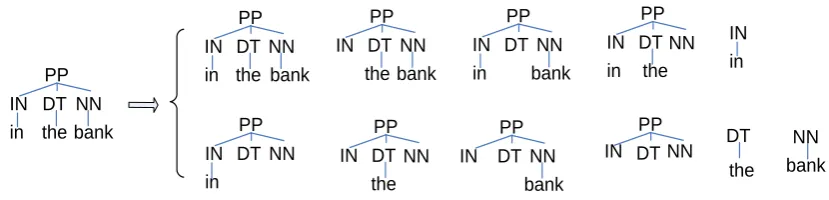
The parse tree kernel (Collins and Duffy, 2002) is an instantiation of convolution kernel over syntactic parse trees. Given a parse tree, its fea-tures defined by a tree kernel are all of its subtree types and the value of a given feature is the number of the occurrences of the subtree in the parse tree. Fig. 1 illustrates a parse tree with all
of its 11 subtree features covered by the convolu-tion tree kernel. In the tree kernel, a parse tree
T
is represented by a vector of integer counts of each subtree type (i.e., subtree regardless of its ancestors, descendants and span covered):( )
T
(# subtreetype1(T), …, # subtreetypen(T))where # subtreetypei(T) is the occurrence number of the ith subtree type in T. The tree kernel counts the number of common subtrees as the syntactic similarity between two parse trees. Since the number of subtrees is exponential with the tree size, it is computationally infeasible to directly use the feature vector
( )
T
. To solve this com-putational issue, Collins and Duffy (2002) pro-posed the following tree kernel to calculate the dot product between the above high dimensional vectors implicitly.1 1 2 2
1 1 2 2
1 2 1 2
1 2 1 2 1 2 ( , ) ( ), ( ) # ( ) # ( ) ( ) ( ) ( , ) i i i i i subtree subtree
i n N n N
n N n N
K T T T T
subtreetype T subtreetype T
I n I n
n n
where N1 and N2 are the sets of nodes in trees T1 and T2, respectively, and
( )
i
subtree
I
n
is a function that is 1 iff the subtreetypei occurs with root at node n and zero otherwise, and ( ,n n1 2) is the number of the common subtrees rooted at n1 andn2, i.e.,
1 2 1 2
( , ) ( ) ( )
i i
subtree subtree i
n n I n I n
1 2
( ,n n )
can be computed by the following recur-sive rules:
IN
in the bank DT NN PP IN the bank DT NN PP IN in bank DT NN PP IN in the DT NN PP IN in DT NN PP IN the DT PP NN IN bank DT NN PP
IN DT NN PP IN in the bank DT NN IN
in the bank DT NN
[image:2.595.87.502.79.179.2]PP
Rule 1: if the productions (CFG rules) at n1 and
2
n are different, ( ,n n1 2)0;
Rule 2: else if bothn1 and n2 are pre-terminals
(POS tags), ( ,n n1 2) 1 ;
Rule 3: else,
1
( )
1 2 1 2
1
( , ) (1 ( ( , ), ( , )))
nc n
j
n n
ch n j ch n j
,where nc n( )1 is the child number of n1, ch(n,j) is the jth child of node n and
(0<
≤1) is the de-cay factor in order to make the kernel value less variable with respect to the subtree sizes (Collins and Duffy, 2002). The recursive Rule 3 holds because given two nodes with the same children, one can construct common subtrees using these children and common subtrees of further offspring. The time complexity for computing this kernel isO N(| 1| |
N2|).As discussed in previous section, when convo-lution tree kernel is applied to NLP applications, its performance is vulnerable to the errors from the single parse tree and data sparseness. In this paper, we present a convolution kernel over
packed forest to address the above issues by ex-ploring structured features embedded in a forest.
3
Convolution Kernel over Forest
In this section, we first illustrate the concept of packed forest and then give a detailed discussion on the covered feature space, fractional count, feature value and the forest kernel function itself.
3.1 Packed forest of parse trees
Informally, a packed parse forest, or (packed) forest in short, is a compact representation of all the derivations (i.e. parse trees) for a given sen-tence under context-free grammar (Tomita, 1987; Billot and Lang, 1989; Klein and Manning, 2001). It is the core data structure used in natural language parsing and other downstream NLP applications, such as syntax-based machine translation (Zhang et al., 2008; Zhang et al., 2009a). In parsing, a sentence corresponds to exponential number of parse trees with different tree probabilities, where a forest can compact all the parse trees by sharing their common subtrees in a bottom-up manner. Formally, a packed for-est 𝐹 can be described as a triple:
𝐹 = < 𝑉, 𝐸, 𝑆 >
where 𝑉is the set of non-terminal nodes, 𝐸 is the set of hyper-edges and 𝑆 is a sentence
NNP[1,1] VV[2,2] NN[4,4] IN[5,5]
John saw a man
NP[3,4]
in the bank
DT[3,3] DT[6,6] NN[7,7]
PP[5,7]
VP[2,4] NP[3,7]
VP[2,7] IP[1,7]
NNP VV NN IN DT NN
John saw a man in the bank
DT VP
NP VP IP
PP
NNP VV NN IN DT NN
John saw a man in the bank
DT
NP
NP VP IP
PP IP[1,7]
VP[2,7]
NNP[1,1]
a) A Forest f
b) A Hyper-edge e
c) A Parse Tree T1
d) A Parse Tree T2
represented as an ordered word sequence. A hy-per-edge 𝑒 is a group of edges in a parse tree which connects a father node and its all child nodes, representing a CFG rule. A non-terminal node in a forest is represented as a “label [start, end]”, where the “label” is its syntax category and “[start, end]” is the span of words it covers. As shown in Fig. 2, these two parse trees (𝑇1 and 𝑇2) can be represented as a single forest by sharing their common subtrees (such as NP[3,4] and PP[5,7]) and merging common non-terminal nodes covering the same span (such as VP[2,7], where there are two hyper-edges attach to it).
Given the definition of forest, we introduce the concepts of inside probability β . and out-side probability α(. ) that are widely-used in parsing (Baker, 1979; Lari and Young, 1990) and are also to be used in our kernel calculation.
β 𝑣 𝑝, 𝑝 = 𝑃(𝑣 → 𝑆[𝑝])
β 𝑣 𝑝, 𝑞 = 𝑃 𝑒
𝑒 𝑖𝑠 𝑎 𝑦𝑝𝑒𝑟 −𝑒𝑑𝑔𝑒 𝑎𝑡𝑡𝑎𝑐 𝑒𝑑 𝑡𝑜 𝑣
∙ 𝛽(𝑐𝑖[𝑝𝑖, 𝑞𝑖])
𝑐𝑖 𝑝𝑖,𝑞𝑖 𝑖𝑠 𝑎 𝑙𝑒𝑎𝑓
𝑛𝑜𝑑𝑒 𝑜𝑓 𝑒
α 𝑟𝑜𝑜𝑡(𝑓) = 1
α 𝑣 𝑝, 𝑞 = α 𝑟𝑜𝑜𝑡 𝑒 ∙ 𝑃 𝑒
𝑒 𝑖𝑠 𝑎 𝑦𝑝𝑒𝑟 − 𝑒𝑑𝑔𝑒 𝑎𝑛𝑑 𝑣
𝑖𝑠 𝑖𝑡𝑠 𝑜𝑛𝑒 𝑙𝑒𝑎𝑓 𝑛𝑜𝑑𝑒
∙ 𝛽(𝑐𝑖[𝑝𝑖, 𝑞𝑖])) 𝑐𝑖 𝑝𝑖,𝑞𝑖 𝑖𝑠 𝑎
𝑐𝑖𝑙𝑑𝑟𝑒𝑛 𝑛𝑜𝑑𝑒 𝑜𝑓 𝑒 𝑒𝑥𝑐𝑒𝑝𝑡 𝑣
where 𝑣 is a forest node, 𝑆[𝑝] is the 𝑝𝑡 word of input sentence 𝑆, 𝑃(𝑣 → 𝑆[𝑝]) is the probability of the CFG rule 𝑣 → 𝑆[𝑝], 𝑟𝑜𝑜𝑡(. ) returns the root node of input structure, [𝑝𝑖, 𝑞𝑖] is a sub-span of 𝑝, 𝑞 , being covered by 𝑐𝑖, and 𝑃 𝑒 is the
PCFG probability of 𝑒. From these definitions, we can see that the inside probability is total probability of generating words 𝑆 𝑝, 𝑞 from non-terminal node 𝑣 𝑝, 𝑞 while the outside
probability is the total probability of generating node 𝑣 𝑝, 𝑞 and words outside 𝑆[𝑝, 𝑞] from the root of forest. The inside probability can be cal-culated using dynamic programming in a bottom-up fashion while the outside probability can be calculated using dynamic programming in a top-to-down way.
3.2 Convolution forest kernel
In this subsection, we first define the feature space covered by forest kernel, and then define the forest kernel function.
3.2.1 Feature space, object space and
fea-ture value
The forest kernel counts the number of common subtrees as the syntactic similarity between two forests. Therefore, in the same way as tree kernel, its feature space is also defined as all the possible subtree types that a CFG grammar allows. In a forest kernel, forest 𝐹 is represented by a vector of fractional counts of each subtree type (subtree regardless of its ancestors, descendants and span covered):
( )
F
(# subtreetype1(F), …, # subtreetypen(F))= (#subtreetype1(n-best parse trees), …, (1) # subtreetypen(n-best parse trees))
where # subtreetypei(F) is the occurrence number of the ith subtree type (subtreetypei) in forest F, i.e., a n-best parse tree lists with a huge n.
Although the feature spaces of the two kernels are the same, their object spaces (tree vs. forest) and feature values (integer counts vs. fractional counts) differ very much. A forest encodes expo-nential number of parse trees, and thus contain-ing exponential times more subtrees than a scontain-ingle parse tree. This ensures forest kernel to learn more reliable feature values and is also able to help to address the data sparseness issues in a better way than tree kernel does. Forest kernel is also expected to yield more non-zero feature val-ues than tree kernel. Furthermore, different parse tree in a forest represents different derivation and interpretation for a given sentence. Therefore, forest kernel should be more robust to parsing errors than tree kernel.
probability. So one subtree extracted from differ-ent parse trees should have differdiffer-ent fractional count with regard to the probabilities of different parse trees. Following the previous work (Char-niak and Johnson, 2005; Huang, 2008), we de-fine the fractional count of the occurrence of a
subtree in a parse tree 𝑡𝑖 as
𝑐 𝑠𝑢𝑏𝑡𝑟𝑒𝑒, 𝑡𝑖 = 𝑃 𝑠𝑢𝑏𝑡𝑟𝑒𝑒, 𝑡0 𝑖𝑓 𝑠𝑢𝑏𝑡𝑟𝑒𝑒 ∉ 𝑡𝑖
𝑖|𝑓, 𝑠 𝑜𝑡𝑒𝑟𝑤𝑖𝑠𝑒
= 0 𝑖𝑓 𝑠𝑢𝑏𝑡𝑟𝑒𝑒 ∉ 𝑡𝑃 𝑡 𝑖
𝑖|𝑓, 𝑠 𝑜𝑡𝑒𝑟𝑤𝑖𝑠𝑒
where we have 𝑃 𝑠𝑢𝑏𝑡𝑟𝑒𝑒, 𝑡𝑖|𝑓, 𝑠 = 𝑃 𝑡𝑖|𝑓, 𝑠 if
𝑠𝑢𝑏𝑡𝑟𝑒𝑒 ∈ 𝑡𝑖. Then we define the fractional count
of the occurrence of a subtree in a forest f as
𝑐 𝑠𝑢𝑏𝑡𝑟𝑒𝑒, 𝑓 = 𝑃 𝑠𝑢𝑏𝑡𝑟𝑒𝑒|𝑓, 𝑠
= 𝑃 𝑠𝑢𝑏𝑡𝑟𝑒𝑒, 𝑡𝑡𝑖 𝑖|𝑓, 𝑠 (2)
= 𝐼𝑡𝑖 𝑠𝑢𝑏𝑡𝑟𝑒𝑒 𝑡𝑖 ∙ 𝑃 𝑡𝑖|𝑓, 𝑠
where 𝐼𝑠𝑢𝑏𝑡𝑟𝑒𝑒 𝑡𝑖 is a binary function that is 1
iif the 𝑠𝑢𝑏𝑡𝑟𝑒𝑒 ∈ 𝑡𝑖 and zero otherwise.
Ob-viously, it needs exponential time to compute the above fractional counts. However, due to the property of forest that compactly represents all the parse trees, the posterior probability of a subtree in a forest, 𝑃 𝑠𝑢𝑏𝑡𝑟𝑒𝑒|𝑓, 𝑠 , can be easi-ly computed in an Inside-Outside fashion as the product of three parts: the outside probability of its root node, the probabilities of parse hyper-edges involved in the subtree, and the inside probabilities of its leaf nodes (Lari and Young, 1990; Mi and Huang, 2008).
𝑐 𝑠𝑢𝑏𝑡𝑟𝑒𝑒, 𝑓 = 𝑃 𝑠𝑢𝑏𝑡𝑟𝑒𝑒|𝑓, 𝑠 (3)
=𝛼𝛽(𝑠𝑢𝑏𝑡𝑟𝑒𝑒) 𝛼𝛽(𝑟𝑜𝑜𝑡 𝑓 )
where
𝛼𝛽 𝑠𝑢𝑏𝑡𝑟𝑒𝑒 = 𝛼 𝑟𝑜𝑜𝑡 𝑠𝑢𝑏𝑡𝑟𝑒𝑒 (4)
∙ 𝑃 𝑒
𝑒∈𝑠𝑢𝑏𝑡𝑟𝑒𝑒
∙ 𝛽 𝑣
𝑣∈𝑙𝑒𝑎𝑓 𝑠𝑢𝑏𝑡𝑟𝑒𝑒
and
𝛼𝛽 𝑟𝑜𝑜𝑡 𝑓 = 𝛼 𝑟𝑜𝑜𝑡 𝑓 ∙ 𝛽 𝑟𝑜𝑜𝑡 𝑓 = 𝛽 𝑟𝑜𝑜𝑡 𝑓
where 𝛼 . and 𝛽(. ) denote the outside and in-side probabilities. They can be easily obtained using the equations introduced at section 3.1.
Given a subtree, we can easily compute its fractional count (i.e. its feature value) directly using eq. (3) and (4) without the need of enume-rating each parse trees as shown at eq. (2)1. Nonetheless, it is still computationally infeasible to directly use the feature vector 𝜙(𝐹) (see eq. (1)) by explicitly enumerating all subtrees al-though its fractional count is easily calculated. In the next subsection, we present the forest kernel that implicitly calculates the dot-product between two 𝜙(𝐹)s in a polynomial time.
3.2.2 Convolution forest kernel
The forest kernel counts the fractional numbers
of common subtrees as the syntactic similarity between two forests. We define the forest kernel function 𝐾𝑓 𝑓1, 𝑓2 in the following way.
𝐾𝑓 𝑓1, 𝑓2 =< 𝜙 𝑓1 , 𝜙 𝑓2 > (5)
= #𝑠𝑢𝑏𝑡𝑟𝑒𝑒𝑡𝑦𝑝𝑒𝑖(𝑓1). #𝑠𝑢𝑏𝑡𝑟𝑒𝑒𝑡𝑦𝑝𝑒𝑖(𝑓2)
𝑖
= 𝐼𝑒𝑞 𝑠𝑢𝑏𝑡𝑟𝑒𝑒1, 𝑠𝑢𝑏𝑡𝑟𝑒𝑒2
𝑠𝑢𝑏𝑡𝑟𝑒𝑒 1∈𝑓1
𝑠𝑢𝑏𝑡𝑟𝑒𝑒 2∈𝑓2
∙ 𝑐 𝑠𝑢𝑏𝑡𝑟𝑒𝑒1, 𝑓1
∙ 𝑐 𝑠𝑢𝑏𝑡𝑟𝑒𝑒2, 𝑓2
= Δ′ 𝑣 1, 𝑣2 𝑣2∈𝑁2
𝑣1∈𝑁1
where
𝐼𝑒𝑞 ∙,∙ is a binary function that is 1 iif the input two subtrees are identical (i.e. they have the same typology and node labels) and zero otherwise;
𝑐 ∙,∙ is the fractional count defined at eq. (3);
𝑁1 and 𝑁2 are the sets of nodes in
fo-rests 𝑓1 and 𝑓2;
Δ′ 𝑣
1, 𝑣2 returns the accumulated value
of products between each two fractional counts of the common subtrees rooted at
𝑣1 and 𝑣2, i.e.,
Δ′ 𝑣 1, 𝑣2
= 𝐼𝑒𝑞 𝑠𝑢𝑏𝑡𝑟𝑒𝑒1, 𝑠𝑢𝑏𝑡𝑟𝑒𝑒2 𝑟𝑜𝑜𝑡 𝑠𝑢𝑏𝑡𝑟𝑒𝑒 1 =𝑣1
𝑟𝑜𝑜𝑡 𝑠𝑢𝑏𝑡𝑟𝑒𝑒 2 =𝑣2
∙ 𝑐 𝑠𝑢𝑏𝑡𝑟𝑒𝑒1, 𝑓1 ∙ 𝑐 𝑠𝑢𝑏𝑡𝑟𝑒𝑒2, 𝑓2
1 It has been proven in parsing literatures (Baker,
We next show that Δ′ 𝑣1, 𝑣2 can be computed recursively in a polynomial time as illustrated at Algorithm 1. To facilitate discussion, we tempo-rarily ignore all fractional counts in Algorithm 1. Indeed, Algorithm 1 can be viewed as a natural extension of convolution kernel from over tree to over forest. In forest2, a node can root multiple hyper-edges and each hyper-edge is independent to each other. Therefore, Algorithm 1 iterates each hyper-edge pairs with roots at 𝑣1 and 𝑣2 (line 3-4), and sums over (eq. (7) at line 9) each recursively-accumulated sub-kernel scores of subtree pairs extended from the hyper-edge pair
𝑒1, 𝑒2 (eq. (6) at line 8). Eq. (7) holds because
the hyper-edges attached to the same node are independent to each other. Eq. (6) is very similar to the Rule 3 of tree kernel (see section 2) except its inputs are hyper-edges and its further expan-sion is based on forest nodes. Similar to tree ker-nel (Collins and Duffy, 2002), eq. (6) holds be-cause a common subtree by extending from
(𝑒1, 𝑒2) can be formed by taking the hyper-edge
(𝑒1, 𝑒2), together with a choice at each of their
leaf nodes of simply taking the non-terminal at the leaf node, or any one of the common subtrees with root at the leaf node. Thus there are
1 + Δ′ 𝑙𝑒𝑎𝑓 𝑒
1, 𝑗 , 𝑙𝑒𝑎𝑓 𝑒2, 𝑗 possible
choices at the jth leaf node. In total, there are
Δ′′ 𝑒
1, 𝑒2 (eq. (6)) common subtrees by
extend-ing from (𝑒1, 𝑒2) and Δ′ 𝑣1, 𝑣2 (eq. (7)) com-mon subtrees with root at 𝑣1, 𝑣2 .
Obviously Δ′ 𝑣1, 𝑣2 calculated by Algorithm
1 is a proper convolution kernel since it simply counts the number of common subtrees under the root 𝑣1, 𝑣2 . Therefore, 𝐾𝑓 𝑓1, 𝑓2 defined at eq.
(5) and calculated through Δ′ 𝑣1, 𝑣2 is also a
proper convolution kernel. From eq. (5) and Al-gorithm 1, we can see that each hyper-edge pair
(𝑒1, 𝑒2) is only visited at most one time in
com-puting the forest kernel. Thus the time complexi-ty for computing 𝐾𝑓 𝑓1, 𝑓2 is 𝑂(|𝐸1| ∙ |𝐸2|),
where 𝐸1 and 𝐸2 are the set of hyper-edges in
forests 𝑓1 and 𝑓2, respectively. Given a forest and the best parse trees, the number of hyper-edges is only several times (normally <=3 after pruning) than that of tree nodes in the parse tree3.
2 Tree can be viewed as a special case of forest with
only one hyper-edge attached to each tree node.
3 Suppose there are K forest nodes in a forest, each
node has M associated hyper-edges fan out and each hyper-edge has N children. Then the forest is capable of encoding 𝑀
𝐾−1
𝑁−1 parse trees at most (Zhang et al., 2009b).
Same as tree kernel, forest kernel is running more efficiently in practice since only two nodes with the same label needs to be further processed (line 2 of Algorithm 1).
Now let us see how to integrate fractional counts into forest kernel. According to Algo-rithm 1 (eq. (7)), we have (𝑒1/𝑒2 are attached to
𝑣1/𝑣2, respectively)
Δ′ 𝑣
1, 𝑣2 = 𝑒1=𝑒2Δ′′ 𝑒1, 𝑒2
Recall eq. (4), a fractional count consists of outside, inside and subtree probabilities. It is more straightforward to incorporate the outside and subtree probabilities since all the subtrees with roots at 𝑣1, 𝑣2 share the same outside
probability and each hyper-edge pair is only vi-sited one time. Thus we can integrate the two probabilities into Δ′ 𝑣1, 𝑣2 as follows.
Δ′ 𝑣
1, 𝑣2 = 𝜆 ∙ 𝛼 𝑣1 ∙ 𝛼 𝑣2
∙ 𝑒1=𝑒2 𝑃 𝑒1 ∙ 𝑃 𝑒2 ∙ Δ′′ 𝑒1, 𝑒2 (8)
where, following tree kernel, a decay factor
𝜆(0 < 𝜆 ≤ 1) is also introduced in order to make the kernel value less variable with respect to the subtree sizes (Collins and Duffy, 2002). It func-tions like multiplying each feature value by
𝜆𝑠𝑖𝑧𝑒𝑖, where 𝑠𝑖𝑧𝑒
𝑖 is the number of hyper-edges
in 𝑠𝑢𝑏𝑡𝑟𝑒𝑒𝑖.
Algorithm 1.
Input:
𝑓1, 𝑓2: twopacked forests
𝑣1, 𝑣2: any two nodes of 𝑓1 and 𝑓2 Notation:
𝐼𝑒𝑞 ∙,∙ : defined at eq. (5)
𝑛𝑙 𝑒1 : number of leaf nodeof𝑒1
𝑙𝑒𝑎𝑓 𝑒1, 𝑗 : the jth leaf node of𝑒1 Output: Δ′ 𝑣1, 𝑣2
1. Δ′ 𝑣1, 𝑣2 = 0
2. if 𝑣1. 𝑙𝑎𝑏𝑒𝑙 ≠ 𝑣2. 𝑙𝑎𝑏𝑒𝑙 exit
3. for each hyper-edge 𝑒1 attached to 𝑣1do
4. for each hyper-edge 𝑒2 attached to 𝑣2do
5. if 𝐼𝑒𝑞 𝑒1, 𝑒2 == 0do
6. goto line 3 7. elsedo
8. Δ′′ 𝑒1, 𝑒2 = 𝑛𝑙 𝑒𝑗 =11 1 +
Δ′ 𝑙𝑒𝑎𝑓 𝑒
1, 𝑗 , 𝑙𝑒𝑎𝑓 𝑒2, 𝑗 (6)
9. Δ′ 𝑣1, 𝑣2 += Δ′′ 𝑒1, 𝑒2 (7) 10. end if
11. end for
The inside probability is only involved when a node does not need to be further expanded. The integer 1 at eq. (6) represents such case. So the inside probability is integrated into eq. (6) by replacing the integer 1 as follows.
Δ′′ 𝑒
1, 𝑒2 = 𝛽 𝑙𝑒𝑎𝑓 𝑒1, 𝑗 ∙ 𝛽 𝑙𝑒𝑎𝑓 𝑒2, 𝑗
𝑛𝑙 𝑒1
𝑗 =1
+ Δ
′ 𝑙𝑒𝑎𝑓 𝑒
1, 𝑗 , 𝑙𝑒𝑎𝑓 𝑒2, 𝑗
𝛼 𝑙𝑒𝑎𝑓 𝑒1, 𝑗 ∙ 𝛼 𝑙𝑒𝑎𝑓 𝑒2, 𝑗
(9)
where in the last expression the two outside probabilities 𝛼 𝑙𝑒𝑎𝑓 𝑒1, 𝑗 and 𝛼 𝑙𝑒𝑎𝑓 𝑒2, 𝑗
are removed. This is because 𝑙𝑒𝑎𝑓 𝑒1, 𝑗 and
𝑙𝑒𝑎𝑓 𝑒2, 𝑗 are not roots of the subtrees of being
explored (only outside probabilities of the root of a subtree should be counted in its fractional count), and Δ′ 𝑙𝑒𝑎𝑓 𝑒1, 𝑗 , 𝑙𝑒𝑎𝑓 𝑒2, 𝑗 already contains the two outside probabilities of
𝑙𝑒𝑎𝑓 𝑒1, 𝑗 and 𝑙𝑒𝑎𝑓 𝑒2, 𝑗 .
Referring to eq. (3), each fractional count needs to be normalized by 𝛼𝛽(𝑟𝑜𝑜𝑡 𝑓 ). Since
𝛼𝛽(𝑟𝑜𝑜𝑡 𝑓 ) is independent to each individual fractional count, we do the normalization outside the recursive function Δ′′ 𝑒1, 𝑒2 . Then we can
re-formulize eq. (5) as
𝐾𝑓 𝑓1, 𝑓2 =< 𝜙 𝑓1 , 𝜙 𝑓2 >
= Δ
′ 𝑣 1, 𝑣2 𝑣2∈𝑁2
𝑣1∈𝑁1
𝛼𝛽 𝑟𝑜𝑜𝑡 𝑓1 ∙ 𝛼𝛽 𝑟𝑜𝑜𝑡 𝑓2
(10)
Finally, since the size of input forests is not constant, the forest kernel value is normalized using the following equation.
𝐾 𝑓 𝑓1, 𝑓2 = 𝐾𝑓 𝑓1, 𝑓2 𝐾𝑓 𝑓1, 𝑓1 ∙ 𝐾𝑓 𝑓2, 𝑓2
(11)
From the above discussion, we can see that the proposed forest kernel is defined together by eqs. (11), (10), (9) and (8). Thanks to the compact representation of trees in forest and the recursive nature of the kernel function, the introduction of fractional counts and normalization do not change the convolution property and the time complexity of the forest kernel. Therefore, the forest kernel 𝐾 𝑓 𝑓1, 𝑓2 is still a proper
convolu-tion kernel with quadratic time complexity.
3.3 Comparison with previous work
To the best of our knowledge, this is the first work to address convolution kernel over packed parse forest.
Convolution tree kernel is a special case of the proposed forest kernel. From feature exploration viewpoint, although theoretically they explore the same subtree feature spaces (defined recur-sively by CFG parsing rules), their feature values are different. Forest encodes exponential number of trees. So the number of subtree instances ex-tracted from a forest is exponential number of times greater than that from its corresponding parse tree. The significant difference of the amount of subtree instances makes the parame-ters learned from forests more reliable and also can help to address the data sparseness issue. To some degree, forest kernel can be viewed as a tree kernel with very powerful back-off mechan-ism. In addition, forest kernel is much more ro-bust against parsing errors than tree kernel.
Aiolli et al. (2006; 2007) propose using Direct Acyclic Graphs (DAG) as a compact representa-tion of tree kernel-based models. This can largely reduce the computational burden and storage re-quirements by sharing the common structures and feature vectors in the kernel-based model. There are a few other previous works done by generalizing convolution tree kernels (Kashima and Koyanagi, 2003; Moschitti, 2006; Zhang et al., 2007). However, all of these works limit themselves to single tree structure from modeling viewpoint in nature.
From a broad viewpoint, as suggested by one reviewer of the paper, we can consider the forest kernel as an alternative solution proposed for the general problem of noisy inference pipelines (eg. speech translation by composition of FSTs, ma-chine translation by translating over 'lattices' of segmentations (Dyer et al., 2008) or using parse tree info for downstream applications in our cas-es) . Following this line, Bunescu (2008) and Finkel et al. (2006) are two typical related works done in reducing cascading noisy. However, our works are not overlapped with each other as there are two totally different solutions for the same general problem. In addition, the main mo-tivation of this paper is also different from theirs.
4
Experiments
Forest kernel has a broad application potential in NLP. In this section, we verify the effectiveness of the forest kernel on two NLP applications, semantic role labeling (SRL) (Gildea, 2002) and relation extraction (RE) (ACE, 2002-2006).
In our experiments, SVM (Vapnik, 1998) is selected as our classifier and the one vs. others
largest margin as the final answer. In our imple-mentation, we use the binary SVMLight (Joa-chims, 1998) and borrow the framework of the Tree Kernel Tools (Moschitti, 2004) to integrate our forest kernel into the SVMLight. We modify Charniak parser (Charniak, 2001) to output a packed forest. Following previous forest-based studies (Charniak and Johnson, 2005), we use the marginal probabilities of hyper-edges (i.e., the Viterbi-style inside-outside probabilities and set the pruning threshold as 8) for forest pruning.
4.1 Semantic role labeling
Given a sentence and each predicate (either a target verb or a noun), SRL recognizes and maps all the constituents in the sentence into their cor-responding semantic arguments (roles, e.g., A0 for Agent, A1 for Patient …) of the predicate or
non-argument. We use the CoNLL-2005 shared task on Semantic Role Labeling (Carreras and Ma rquez, 2005) for the evaluation of our forest kernel method. To speed up the evaluation process, the same as Che et al. (2008), we use a subset of the entire training corpus (WSJ sections 02-05 of the entire sections 02-21) for training, section 24 for development and section 23 for test, where there are 35 roles including 7 Core (A0–A5, AA), 14 Adjunct (AM-) and 14 Refer-ence (R-) arguments.
The state-of-the-art SRL methods (Carreras and Ma rquez, 2005) use constituents as the labe-ling units to form the labeled arguments. Due to the errors from automatic parsing, it is impossi-ble for all arguments to find their matching con-stituents in the single 1-best parse trees. Statistics on the training data shows that 9.78% of argu-ments have no matching constituents using the Charniak parser (Charniak, 2001), and the num-ber increases to 11.76% when using the Collins parser (Collins, 1999). In our method, we break the limitation of 1-best parse tree and regard each span rooted by a single forest node (i.e., a sub-forest with one or more roots) as a candidate gument. This largely reduces the unmatched ar-guments from 9.78% to 1.31% after forest prun-ing. However, it also results in a very large amount of argument candidates that is 5.6 times as many as that from 1-best tree. Fortunately, after the pre-processing stage of argument prun-ing (Xue and Palmer, 2004)4, although the
4 We extend (Xue and Palmer, 2004)’s argument
pruning algorithm from tree-based to forest-based. The algorithm is very effective. It can prune out around 90% argument candidates in parse tree-based
amount of unmatched argument increases a little bit to 3.1%, its generated total candidate amount decreases substantially to only 1.31 times of that from 1-best parse tree. This clearly shows the advantages of the forest-based method over tree-based in SRL.
The best-reported tree kernel method for SRL
𝐾𝑦𝑏𝑟𝑖𝑑 = 𝜃 ∙ 𝐾𝑝𝑎𝑡 + (1 − 𝜃) ∙ 𝐾𝑐𝑠 (0 ≤ 𝜃 ≤ 1), proposed by Che et al. (2006)5, is adopted as our baseline kernel. We implemented the 𝐾𝑦𝑏𝑟𝑖𝑑
in tree case (𝐾𝑇−𝑦𝑏𝑟𝑖𝑑 , using tree kernel to
compute 𝐾𝑝𝑎𝑡 and 𝐾𝑐𝑠 ) and in forest case
(𝐾𝐹−𝑦𝑏𝑟𝑖𝑑, using tree kernel to compute 𝐾𝑝𝑎𝑡
and 𝐾𝑐𝑠).
Precision Recall F-Score
𝐾𝑇−𝑦𝑏𝑟𝑖𝑑 (Tree) 76.02 67.38 71.44
𝐾𝐹−𝑦𝑏𝑟𝑖𝑑 (Forest) 79.06 69.12 73.76
Table 1: Performance comparison of SRL (%) Table 1 shows that the forest kernel significant-ly outperforms (𝜒2 test with p=0.01) the tree ker-nel with an absolute improvement of 2.32 (73.76-71.42) percentage in F-Score, representing a rela-tive error rate reduction of 8.19% (2.32/(100-71.64)). This convincingly demonstrates the ad-vantage of the forest kernel over the tree kernel. It suggests that the structured features represented by subtree are very useful to SRL. The perfor-mance improvement is mainly due to the fact that forest encodes much more such structured features and the forest kernel is able to more effectively capture such structured features than the tree ker-nel. Besides F-Score, both precision and recall also show significantly improvement (𝜒2 test with p=0.01). The reason for recall improvement is mainly due to the lower rate of unmatched argu-ment (3.1% only) with only a little bit overhead (1.31 times) (see the previous discussion in this section). The precision improvement is mainly attributed to fact that we use sub-forest to represent argument instances, rather than sub-tree used in sub-tree kernel, where the sub-sub-tree is on-ly one tree encoded in the sub-forest.
SRL and thus makes the amounts of positive and neg-ative training instances (arguments) more balanced. We apply the same pruning strategies to forest plus our heuristic rules to prune out some of the arguments with span overlapped with each other and those ar-guments with very small inside probabilities, depend-ing on the numbers of candidates in the span.
5K
4.2 Relation extraction
As a subtask of information extraction, relation extraction is to extract various semantic relations between entity pairs from text. For example, the sentence “Bill Gates is chairman and chief soft-ware architect of Microsoft Corporation” con-veys the semantic relation “EMPLOY-MENT.executive” between the entities “Bill Gates” (person) and “Microsoft Corporation” (company). We adopt the method reported in Zhang et al. (2006) as our baseline method as it reports the state-of-the-art performance using tree kernel-based composite kernel method for RE. We replace their tree kernels with our forest kernels and use the same experimental settings as theirs. We carry out the same five-fold cross va-lidation experiment on the same subset of ACE 2004 data (LDC2005T09, ACE 2002-2004) as that in Zhang et al. (2006). The data contain 348 documents and 4400 relation instances.
In SRL, constituents are used as the labeling units to form the labeled arguments. However, previous work (Zhang et al., 2006) shows that if we use complete constituent (MCT) as done in SRL to represent relation instance, there is a large performance drop compared with using the path-enclosed tree (PT)6. By simulating PT, we use the minimal fragment of a forest covering the two entities and their internal words to represent a relation instance by only parsing the span cov-ering the two entities and their internal words.
Precision Recall F-Score Zhang et al. (2006):Tree 68.6 59.3 6 63.6
Ours: Forest 70.3 60.0 64.7
Table 2: Performance Comparison of RE (%) over 23 subtypes on the ACE 2004 data Table 2 compares the performance of the for-est kernel and the tree kernel on relation extrac-tion. We can see that the forest kernel significant-ly outperforms (𝜒2 test with p=0.05) the tree ker-nel by 1.1 point of F-score. This further verifies the effectiveness of the forest kernel method for
6
MCT is the minimal constituent rooted by the near-est common ancnear-estor of the two entities under consid-eration while PT is the minimal portion of the parse tree (may not be a complete subtree) containing the two entities and their internal lexical words. Since in many cases, the two entities and their internal words cannot form a grammatical constituent, MCT may introduce too many noisy context features and thus lead to the performance drop.
modeling NLP structured data. In summary, we further observe the high precision improvement that is consistent with the SRL experiments. How-ever, the recall improvement is not as significant as observed in SRL. This is because unlike SRL, RE has no un-matching issues in generating rela-tion instances. Moreover, we find that the perfor-mance improvement in RE is not as good as that in SRL. Although we know that performance is task-dependent, one of the possible reasons is that SRL tends to be long-distance grammatical structure-related while RE is local and semantic-related as observed from the two experimental benchmark data.
5
Conclusions and Future Work
Many NLP applications have benefited from the success of convolution kernel over parse tree. Since a packed parse forest contains much richer structured features than a parse tree, we are mo-tivated to develop a technology to measure the syntactic similarity between two forests.
To achieve this goal, in this paper, we design a convolution kernel over packed forest by genera-lizing the tree kernel. We analyze the object space of the forest kernel, the fractional count for feature value computing and design a dynamic programming algorithm to realize the forest ker-nel with quadratic time complexity. Compared with the tree kernel, the forest kernel is more ro-bust against parsing errors and data sparseness issues. Among the broad potential NLP applica-tions, the problems in SRL and RE provide two pointed scenarios to verify our forest kernel. Ex-perimental results demonstrate the effectiveness of the proposed kernel in structured NLP data modeling and the advantages over tree kernel.
References
ACE (2002-2006). The Automatic Content Extraction Projects. http://www.ldc.upenn.edu/Projects/ACE/ Fabio Aiolli, Giovanni Da San Martino, Alessandro
Sperduti and Alessandro Moschitti. 2006. Fast On-line Kernel Learning for Trees. ICDM-2006 Fabio Aiolli, Giovanni Da San Martino, Alessandro
Sperduti and Alessandro Moschitti. 2007. Efficient Kernel-based Learning for Trees. IEEE Sympo-sium on Computational Intelligence and Data Min-ing (CIDM-2007)
J. Baker. 1979. Trainable grammars for speech rec-ognition. The 97th meeting of the Acoustical So-ciety of America
S. Billot and S. Lang. 1989. The structure of shared forest in ambiguous parsing. ACL-1989
Razvan Bunescu. 2008. Learning with Probabilistic Features for Improved Pipeline Models. EMNLP-2008
X. Carreras and Lluıs Marquez. 2005. Introduction to the CoNLL-2005 shared task: SRL. CoNLL-2005 E. Charniak. 2001. Immediate-head Parsing for
Lan-guage Models. ACL-2001
E. Charniak and Mark Johnson. 2005. Corse-to-fine-grained n-best parsing and discriminative re-ranking. ACL-2005
Wanxiang Che, Min Zhang, Ting Liu and Sheng Li. 2006. A hybrid convolution tree kernel for seman-tic role labeling. COLING-ACL-2006 (poster) WanXiang Che, Min Zhang, Aiti Aw, Chew Lim Tan,
Ting Liu and Sheng Li. 2008. Using a Hybrid Convolution Tree Kernel for Semantic Role Labe-ling. ACM Transaction on Asian Language Infor-mation Processing
M. Collins. 1999. Head-driven statistical models for natural language parsing. Ph.D. dissertation, Pennsylvania University
M. Collins and N. Duffy. 2002. Convolution Kernels for Natural Language. NIPS-2002
Christopher Dyer, Smaranda Muresan and Philip Res-nik. 2008. Generalizing Word Lattice Translation.
ACL-HLT-2008
Jenny Rose Finkel, Christopher D. Manning and And-rew Y. Ng. 2006. Solving the Problem of Cascad-ing Errors: Approximate Bayesian Inference for Linguistic Annotation Pipelines. EMNLP-2006 Y. Freund and R. E. Schapire. 1999. Large margin
classification using the perceptron algorithm. Ma-chine Learning, 37(3):277-296
D. Guldea. 2002. Probabilistic models of verb-argument structure. COLING-2002
D. Haussler. 1999. Convolution Kernels on Discrete Structures. Technical Report UCS-CRL-99-10, University of California, Santa Cruz
Liang Huang. 2008. Forest reranking:Discriminative parsing with non-local features. ACL-2008 Karim Lari and Steve J. Young. 1990. The estimation
of stochastic context-free grammars using the in-side-outside algorithm. Computer Speech and Lan-guage. 4(35–56)
H. Kashima and T. Koyanagi. 2003. Kernels for Semi-Structured Data. ICML-2003
Dan Klein and Christopher D. Manning. 2001. Pars-ing and Hypergraphs. IWPT-2001
T. Joachims. 1998. Text Categorization with Support Vecor Machine: learning with many relevant fea-tures. ECML-1998
Haitao Mi and Liang Huang. 2008. Forest-based Translation Rule Extraction. EMNLP-2008 Alessandro Moschitti. 2004. A Study on Convolution
Kernels for Shallow Semantic Parsing. ACL-2004 Alessandro Moschitti. 2006. Syntactic kernels for
natural language learning: the semantic role labe-ling case. HLT-NAACL-2006 (short paper) Martha Palmer, Dan Gildea and Paul Kingsbury.
2005. The proposition bank: An annotated corpus of semantic roles. Computational Linguistics. 31(1) F. Rosenblatt. 1962. Principles of Neurodynamics: Perceptrons and the theory of brain mechanisms. Spartan Books, Washington D.C.
Masaru Tomita. 1987. An Efficient Augmented-Context-Free Parsing Algorithm. Computational Linguistics 13(1-2): 31-46
Vladimir N. Vapnik. 1998. Statistical Learning Theory. Wiley
C. Watkins. 1999. Dynamic alignment kernels. In A. J. Smola, B. Sch¨olkopf, P. Bartlett, and D. Schuur-mans (Eds.), Advances in kernel methods. MIT Press
Nianwen Xue and Martha Palmer. 2004. Calibrating features for semantic role labeling. EMNLP-2004 Xiaofeng Yang, Jian Su and Chew Lim Tan. 2006.
Kernel-Based Pronoun Resolution with Structured Syntactic Knowledge. COLING-ACL-2006 Dell Zhang and W. Lee. 2003. Question classification
using support vector machines. SIGIR-2003 Hui Zhang, Min Zhang, Haizhou Li, Aiti Aw and
Chew Lim Tan. 2009a. Forest-based Tree Se-quence to String Translation Model. ACL-IJCNLP-2009
Syntax-based Statistical Machine Translation. EMNLP-2009
Min Zhang, Jie Zhang, Jian Su and GuoDong Zhou. 2006. A Composite Kernel to Extract Relations be-tween Entities with Both Flat and Structured Fea-tures. COLING-ACL-2006
Min Zhang, W. Che, A. Aw, C. Tan, G. Zhou, T. Liu and S. Li. 2007. A Grammar-driven Convolution Tree Kernel for Semantic Role Classification. ACL-2007
Min Zhang, Hongfei Jiang, Aiti Aw, Haizhou Li, Chew Lim Tan and Sheng Li. 2008. A Tree Se-quence Alignment-based Tree-to-Tree Translation Model. ACL-2008