Thermodynamic Analysis of the Phase Equilibria in the Fe-Zr-B System
Tatsuya Tokunaga
1;*1, Ken Terashima
2;*2, Hiroshi Ohtani
3and Mitsuhiro Hasebe
31Department of Applied Science for Integrated System Engineering, Kyushu Institute of Technology, Kitakyushu 804-8550, Japan 2Graduate School, Kyushu Institute of Technology, Kitakyushu 804-8550, Japan
3
Department of Materials Science and Engineering, Kyushu Institute of Technology, Kitakyushu 804-8550, Japan
A thermodynamic analysis of the Fe-Zr-B ternary system has been carried out using the CALPHAD method. Among the three binary systems present in the ternary phase diagram, the thermodynamic descriptions of the Fe-Zr and Fe-B binary systems were taken from reported results and from our previous study, respectively. The thermodynamic parameters of the Zr-B binary system were evaluated using the thermochemical properties from our first-principles calculations, as well as available experimental data. In this modelling, the Gibbs energy of ZrB2with an AlB2-type structure was represented using the two-sublattice model, in which vacancies were introduced into both the Zr and the B sublattices, following the recent data obtained from neutron diffraction experiments on NbB2with the same structure as that of ZrB2. The optimized thermodynamic parameters of the Zr-B system enabled us to obtain reproducible calculations of the experimental data on phase boundaries and formation enthalpies obtained from first-principles calculations. The ternary parameters were determined using the experimental data on phase boundaries. The calculated results have nicely reproduced the experimental Fe-Zr-B ternary phase diagrams.
[doi:10.2320/matertrans.MB200809]
(Received May 1, 2008; Accepted August 13, 2008; Published October 3, 2008)
Keywords: thermodynamic analysis, phase equilibria, calculation of phase diagrams (CALPHAD), first-principles calculations
1. Introduction
It is well known that Fe-M-B amorphous alloys (where M¼Zr, Hf, and Nb) exhibit excellent soft magnetic proper-ties on crystallization.1–4) The crystallized microstructure consists of a large portion ofFe grains embedded in a small fraction of the residual amorphous phase. As the nano-crystalline structure is formed in the primary crystallization reaction from the amorphous phase, much attention has been paid to the mechanism of the nanocrystalline structural evolution in these alloys.5)Furthermore, to improve their soft
magnetic properties and their glass-forming ability, the effect of the addition of a small amount of alloying elements has also been investigated.
The Fe-Zr-B ternary system is one of the basic constituent systems relevant to Fe-based magnetic materials. Therefore, it is useful to obtain knowledge on the phase equilibria in this ternary system to provide basic information for understand-ing of the crystallization behaviour and for further develop-ment of these soft magnetic materials.
In this study, to elucidate the phase equilibria in the Fe-Zr-B ternary system, we initially evaluated the thermody-namic properties of various borides appearing in the Zr-B binary system based on first-principles calculations, and then a thermodynamic analysis of the Fe-Zr-B ternary system was carried out using the CALPHAD method, by combining the formation enthalpies obtained from first-principles calcula-tions with the reported experimental data.
2. Calculation Procedures
2.1 First-principles calculations
The energy of formation of Zr-based binary borides was calculated using the WIEN2k software package,6)based on the Full Potential Linearized Augmented Plane Wave
(FLAPW) method with a General Gradient Approximation (GGA).7) Muffin-tin radii of 2.0 au (0.106 nm) for Zr and
1.4 au (0.074 nm) for B were assumed, and the plane wave basis set up to the cut-off energy of 20 Ry (270 eV) was utilized. The calculation of the total energy for each boride was based on the structural data compiled by Villars,8)which provides information on the atomic positions for various borides.
Then, the energy of formation of the boride ZrmBn per
mole of atoms,EZrmBn
form , was obtained as:
EZrmBn
form ¼E
ZrmBn
total
m
mþnE
hcp-Zr total
n
mþnE
rhombohedral-B
total ð1Þ
where the termsEZrmBn
total ,E hcp-Zr
total , andErhombohedral-total Bdenote the
total energy of the boride ZrmBn, hcp Zr, and rhombohedral
B, respectively.
2.2 Thermodynamic modelling
A description of the Gibbs energy for each phase appearing in the Fe-Zr-B ternary system will be presented in this section.
The regular solution approximation was applied to the liquid and primary solid solution phases. The molar Gibbs energy of the phase was described using the following equation:
Gm¼xBG
BþxFeG
FeþxZrG Zr
þRTðxBlnxBþxFelnxFeþxZrlnxZrÞ
þxBxFeLB,FeþxBxZrLB,ZrþxFexZrLFe,Zr
þxBxFexZrL B,Fe,Zr
ð2Þ
where xi denotes the mole fraction of element i, R is the
universal gas constant, andT is temperature in Kelvin. The termoGi denotes the Gibbs energy of elementiin thephase and is called the lattice stability parameter. The descriptions of the lattice stability parameters for each pure element were *1Corresponding author, E-mail: [email protected]
*2Graduate Student, Kyushu Institute of Technology
Special Issue on Advances in Computational Materials Science and Engineering V
taken from the Scientific Group Thermodata Europe (SGTE) data.9) The parameter L
i;j denotes the interaction energy
between i and j in the phase and has a compositional dependency using an n-th degree Redlich-Kister polyno-mial10)as follows:
Li;j¼0Li;jþ1Li;jðxixjÞ
þ2Li;jðxixjÞ2þ þnLi;jðxixjÞn ð3Þ
where:
nL
i;j¼anþbnT: ð4Þ
The termLB,Fe,Zris the ternary interaction parameter between B, Fe, and Zr. The compositional dependency of this parameter is expressed as follows:
LB,Fe,Zr¼xB0L
B,Fe,ZrþxFe1L
B,Fe,ZrþxZr2L
B,Fe,Zr: ð5Þ
It should be noted that boron was treated as a substitutional species in both bcc and fcc Fe in this modelling, following recent results by our group.11)In that study, a ground state
analysis using first-principles calculations showed that various bcc- and fcc-based Fe-B binary superstructures with boron occupying substitutional sites were more energetically stable than those with boron occupying octahedral interstitial sites in the ground state.
The contribution to the Gibbs energy from ferromagnetic ordering was taken into account in the bcc Fe and fcc Fe solid solution phases.12,13)
Regarding the compound phase with some degree of homogeneity range, the Gibbs energy was represented using the sublattice model.14)
For the Fe-Zr binary compound phases, Fe2Zr, FeZr2, and
FeZr3, the formulae (Fe,Zr)2(Fe,Zr)1, (Fe,Zr)1(Fe,Zr)2, and
(Fe,Zr)1(Fe,Zr)3, were used, respectively. For the case of the
phase with the formula (Fe,Zr)m(Fe,Zr)n, wheremandnare
the numbers of the sites of Sublattice 1 and Sublattice 2, respectively, the Gibbs energy of this phase per mole of formula unit was described using the following equation:
GFemZrn
m ¼y
ð1Þ Feðy
ð2Þ Fe
GFemZrn
Fe:Fe þy
(2) Zr
GFemZrn
Fe:Zr Þ
þyðZr1ÞðyFeð2ÞGFemZrn
Zr:Fe þy
ð2Þ Zr
GFemZrn
Zr:Zr Þ
þmRTðyðFe1ÞlnyFeð1ÞþyðZr1ÞlnyðZr1ÞÞ
þnRTðyðFe2ÞlnyðFe2ÞþyZrð2ÞlnyðZr2ÞÞ þexGFemZrn: ð6Þ
The term ysi denotes the site fraction of element i on the
s-th sublattice, and GFemZrn
i:j denotes the Gibbs energy of a
hypothetical compound, imjn, in which all the sites in
Sublattice 1 are occupied by element i, and all the sites in Sublattice 2 are occupied by elementj. The termexGFemZrnis the excess Gibbs energy term containing the interaction energy between unlike atoms, and is expressed by the following equation:
ex
GFemZrn ¼yð1Þ
Fey ð1Þ Zrðy
ð2Þ FeL
FemZrn
Fe,Zr:Feþy ð2Þ ZrL
FemZrn
Fe,Zr:ZrÞ
þyðFe2ÞyðZr2ÞðyðFe1ÞLFemZrn
Fe:Fe,Zrþy ð1Þ ZrL
FemZrn
Zr:Fe,ZrÞ ð7Þ
whereLFemZrn
i;j:k (orL
FemZrn
i:j;k ) is the interaction parameter between
unlike atoms on the same sublattice, and its compositional dependency is described using an equation similar to eq. (3). For the ZrB2 phase, we adopted the formula
(Va,Zr)1(B,Va)2, where Va denotes a vacancy, based on
recent data obtained from neutron diffraction experiments
on NbB2with the same structure as that of ZrB2,15)where a
vacancy was introduced in the Zr sites to account for its hyper-stoichiometric composition. The Gibbs energy of this phase per mole of formula unit is given by:
GZrB2
m ¼y
ð1Þ Vaðy
ð2Þ B
GZrB2
Va:Bþy ð2Þ Va
GZrB2
Va:VaÞ
þyðZr1ÞðyðB2ÞGZrB2
Zr:Bþy ð2Þ Va
GZrB2
Zr:VaÞ
þRTðyðVa1ÞlnyVað1ÞþyðZr1ÞlnyðZr1ÞÞ
þ2RTðyðB2ÞlnyBð2ÞþyðVa2ÞlnyðVa2ÞÞ
þyðVa1ÞyZrð1ÞðyðB2ÞLZrB2
Va,Zr:Bþy ð2Þ VaL
ZrB2
Va,Zr:VaÞ
þyðB2ÞyVað2ÞðyðVa1ÞLZrB2
Va:B,Vaþy ð1Þ ZrL
ZrB2
Zr:B,VaÞ: ð8Þ
The meanings of the terms appearing in eq. (8) are the same as those in eqs. (6) and (7).
The remaining compound phases were treated as being stoichiometric compounds. For example, the Gibbs energy of the Fe2B phase per mole of formula unit was described as
follows:
GFe2B
Fe:B2
GFe
Fe
GB
B ¼aþbT ð9Þ
where the terms a and b correspond to the enthalpy and entropy terms to be evaluated in the thermodynamic analysis, respectively. As will be described in Section 3.2, the Gibbs energy of all the borides was represented relative to B rather than toB.
3. Results and Discussion
3.1 The Fe-Zr binary system
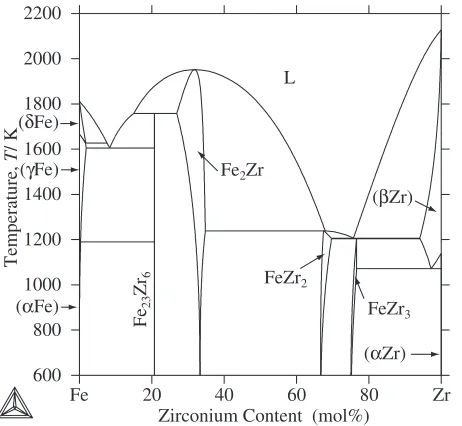
The Fe-Zr binary system is composed of a liquid (L), bcc ((Fe), (Fe), and (Zr)), fcc ((Fe)), hcp ((Zr)), and four intermetallic compounds, Fe23Zr6, Fe2Zr, FeZr2, and
FeZr3.16) The Fe-Zr phase diagram has been updated
recently,17) including new experimental results,18) where Fe2Zr was found to exist rather than Fe23Zr6. However, for
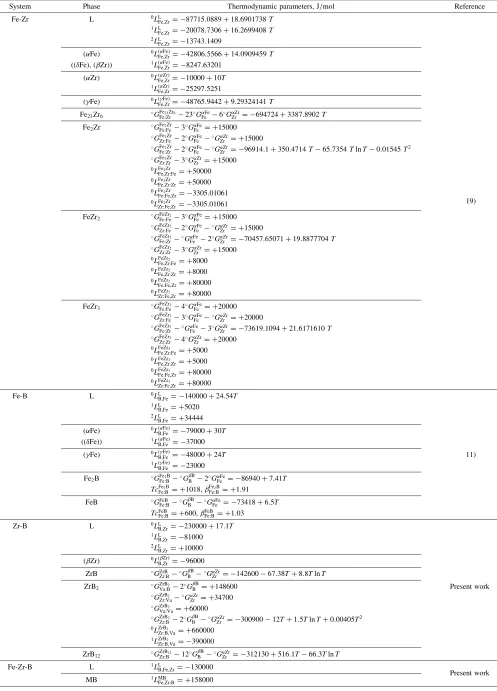
this binary system, the thermodynamic parameters assessed by Jiang et al.,19) based on Ref. 16), were adopted in this
study and are listed in Table 1. The calculated Fe-Zr binary phase diagram is shown in Fig. 1.
3.2 The Fe-B binary system
The equilibrium phases in the Fe-B binary system are: a liquid (L), bcc ((Fe), (Fe)), fcc ((Fe)), rhombohedral ((B)), Fe2B, and FeB.20) Thermodynamic analyses have
been performed by several researchers,20–27) assuming a
substitutional solid solution and/or an interstitial solid solution of boron. More recently, our group has carried out a thermodynamic assessment by combining the first-principles and CALPHAD methods.11) In this study, the
thermodynamic parameters assessed by our group, which reproduced first-principles results as well as available ex-perimental data, were adopted and are listed in Table 1. The calculated Fe-B binary phase diagram is shown in Fig. 2.
3.3 The Zr-B binary system
Table 1 The evaluated thermodynamic parameters of the Fe-Zr-B ternary system.
System Phase Thermodynamic parameters, J/mol Reference
Fe-Zr L 0LL
Fe,Zr¼ 87715:0889þ18:6901738T 1LL
Fe,Zr¼ 20078:7306þ16:2699408T 2LL
Fe,Zr¼ 13743:1409 (Fe) 0LðFeÞ
Fe,Zr¼ 42806:5566þ14:0909459T ((Fe), (Zr)) 1LðFeÞ
Fe,Zr¼ 8247:63201 (Zr) 0LðZrÞ
Fe,Zr¼ 10000þ10T 1LðZrÞ
Fe,Zr¼ 25297:5251 (Fe) 0LðFeÞ
Fe,Zr¼ 48765:9442þ9:29324141T Fe23Zr6 GFe23Zr6
Fe:Zr 23GFeFe6GZrZr¼ 694724þ3387:8902T Fe2Zr GFe2Zr
Fe:Fe3GFeFe¼ þ15000 GFe2Zr
Zr:Fe2GFeFeGZrZr¼ þ15000 GFe2Zr
Fe:Zr2GFeFe GZr
Zr ¼ 96914:1þ350:4714T65:7354TlnT0:01545T 2 GFe2Zr
Zr:Zr3GZrZr¼ þ15000 0LFe2Zr
Fe,Zr:Fe¼ þ50000 0LFe2Zr
Fe,Zr:Zr¼ þ50000 0LFe2Zr
Fe:Fe,Zr¼ 3305:01061 0LFe2Zr
Zr:Fe,Zr¼ 3305:01061 19) FeZr2 GFeZr2
Fe:Fe3GFeFe¼ þ15000 GFeZr2
Zr:Fe2GFeFeGZrZr¼ þ15000 GFeZr2
Fe:ZrGFeFe2GZrZr¼ 70457:65071þ19:8877704T GFeZr2
Zr:Zr3GZrZr¼ þ15000 0LFeZr2
Fe,Zr:Fe¼ þ8000 0LFeZr2
Fe,Zr:Zr¼ þ8000 0LFeZr2
Fe:Fe,Zr¼ þ80000 0LFeZr2
Zr:Fe,Zr¼ þ80000 FeZr3 GFeZr3
Fe:Fe4GFeFe¼ þ20000 GFeZr3
Zr:Fe3GFeFeGZrZr¼ þ20000 GFeZr3
Fe:ZrGFeFe3GZrZr¼ 73619:1094þ21:6171610T GFeZr3
Zr:Zr4G
Zr
Zr ¼ þ20000 0LFeZr3
Fe,Zr:Fe¼ þ5000 0LFeZr3
Fe,Zr:Zr¼ þ5000 0LFeZr3
Fe:Fe,Zr¼ þ80000 0LFeZr3
Zr:Fe,Zr¼ þ80000
Fe-B L 0LL
B,Fe¼ 140000þ24:54T 1LL
B,Fe¼ þ5020 2LL
B,Fe¼ þ34444 (Fe) 0LðFeÞ
B,Fe ¼ 79000þ30T ((Fe)) 1LðFeÞ
B,Fe ¼ 37000 (Fe) 0LðFeÞ
B,Fe ¼ 48000þ24T 11)
1LðFeÞ
B,Fe ¼ 23000 Fe2B GFe2B
Fe:BG
B
B 2GFeFe¼ 86940þ7:41T
TcFe2B
Fe:B¼ þ1018, Fe2B Fe:B¼ þ1:91
FeB GFeB
Fe:BG
B
B GFeFe¼ 73418þ6:5T
TcFeB
Fe:B¼ þ600,FeBFe:B¼ þ1:03
Zr-B L 0LL
B,Zr¼ 230000þ17:1T 1LL
B,Zr¼ 81000 2LL
B,Zr¼ þ10000 (Zr) 0LðZrÞ
B,Zr ¼ 96000
ZrB GZrB
Zr:BG
B
B GZrZr¼ 14260067:38Tþ8:8TlnT ZrB2 GZrB2
Va:B2G
B
B ¼ þ148600 Present work
GZrB2
Zr:VaGZrZr¼ þ34700 GZrB2
Va:Va¼ þ60000 GZrB2
Zr:B2G
B
B GZrZr¼ 30090012Tþ1:5TlnTþ0:00405T2 0LZrB2
Zr:B,Va¼ þ660000 1LZrB2
Zr:B,Va¼ 390000 ZrB12 GZrB12
Zr:B 12G
B
B GZrZr¼ 312130þ516:1T66:3TlnT
Fe-Zr-B L 1LL
B,Fe,Zr¼ 130000
Present work
MB 1LMB
diagram indicates that the Zr-B system is composed of: a liquid (L), hcp ((Zr)), bcc ((Zr)), rhombohedral ((B)), ZrB, ZrB2, and ZrB12. According to the experimental results,
ZrB has a NaCl-type cubic structure,29,30,32)and its thermal
stability is in the temperature range 1073–1523 K.29)
Re-garding ZrB2 with an AlB2-type hexagonal structure, the
congruent melting temperature has been reported to be either 3313 K29)or 3523 K,34)and its homogeneity range is <1mol%.31,34,35)ZrB
12 with an UB12-type cubic structure
was formed by the peritectic reaction atT¼2303K.34)The
eutectoidal decomposition of this phase was reported to be around 1983 K.31)The solubility of boron in bothZr andZr appears to be <1mol%.31)Concerning the thermodynamic properties of this binary system, both the enthalpy of formation37–39)and the heat capacity40)of ZrB2are available
in the literature. Thermodynamic assessment of this binary system has been carried out by Rogl and Potter,41) where
the allotropic transformation of Zr and the formation of ZrB were not taken into account.
In this study, the thermodynamic parameters were re-evaluated using the formation enthalpies of the borides obtained from our first-principles calculations, as well as available experimental data. It was assumed that Zr was insoluble in rhombohedral B because of its negligible solubility.
The enthalpy of formation data of the borides obtained from our first-principles calculations is listed in Table 2. Although the stable state of pure B was taken as being rhombohedral B in the SGTE data,9)each value listed in Table 2 is referred to as hcpZr and rhombohedralB. As discussed in a previous paper,11)we regarded the calculated values relative toZr andB as being the formation enthalpy relative to Zr and B because of the small difference in phase stability between B and B (17.4 meV/atom
800 1200 1600 2000 2400 2800 3200 3600
20 40 60 80
Temperature,
T
/ K
ZrB
12
ZrB
2
ZrB (βB)
(αZr) (βZr) L
Zr B
Boron Content (mol%)
(a)
800 1200 1600 2000 2400 2800 3200 3600
Zr 20 40 60 80 B
Temperature,
T
/ K
Boron Content (mol%)
ZrB
12
ZrB
2
ZrB βB
(αZr) (βZr) L
(b)
Fig. 3 (a) Assessed28)and (b) calculated Zr-B binary phase diagrams.
1000 1200 1400 1600 1800 2000 2200 2400
Fe 20 40 60 80 B
FeB
Fe
2
B
(δFe)
(γFe)
(αFe)
βB L
Temperature,
T
/ K
Boron Content (mol%)
Fig. 2 The calculated Fe-B binary phase diagram.11)
600 800 1000 1200 1400 1600 1800 2000 2200
Fe 20 40 60 80 Zr
Temperature,
T
/ K
Zirconium Content (mol%) (αFe)
(βZr) (δFe)
(γFe)
(αZr)
Fe
23
Zr
6
Fe2Zr
FeZr2
FeZr3
L
[image:4.595.302.542.68.540.2] [image:4.595.57.288.72.285.2] [image:4.595.58.286.324.540.2](1.68 kJ/mol)42)) compared with the formation enthalpies
of the borides. According to the results, the calculated enthalpy of formation of ZrB2 is in good agreement with
the experimental values.37–39)For ZrB, although this boride
has been reported to have a NaCl-type cubic structure, our first-principles calculations showed that ZrB with an FeB-type structure was energetically more stable than the NaCl-type ZrB, where the total energy of the FeB-NaCl-type ZrB was calculated using information on the atomic positions for an FeB-type TiB. Thus, we adopted the calculated enthalpy of formation for the FeB-type ZrB in this analysis. It is noteworthy that although there is no experimental informa-tion on the formainforma-tion of the FeB-type ZrB, an FeB-type monoboride forms in both the Ti-B and the Hf-B binary systems. Furthermore, the calculated enthalpy of formation of the FeB-type ZrB was close to the estimated value (79:3kJ/mol41)) using information on the experimental
isothermal section diagram of the Hf-Zr-B system43)and the
description of the Gibbs energy of HfB.44) The evaluated
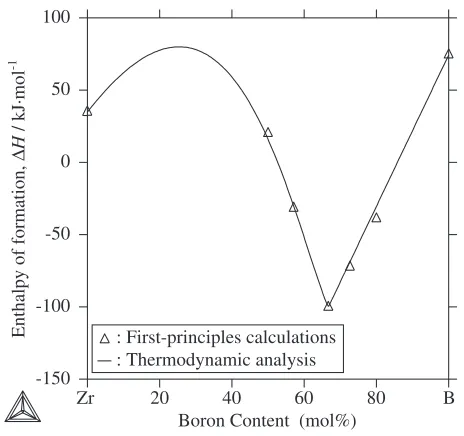
thermodynamic parameters are listed in Table 2. The calculated results reproduce the experimental phase diagram nicely, along with the enthalpy of formation obtained from our first-principles calculations, as shown in Fig. 3 and Table 2, respectively. Figure 4 shows the variation in the enthalpy of formation of ZrB2 with composition. The
symbols denote the values obtained from a ground state
analysis on this boride by constructing superstructures derived from an AlB2-type structure, following the same
procedures as described in a previous paper.11) The solid line denotes the results evaluated by fitting the thermody-namic parameters corresponding to the excess enthalpy terms in eq. (8) to the formation enthalpy obtained from the first-principles calculations. The calculations indicate that the phase stability of this boride substantially decreases as the composition deviates from the stoichiometric point, resulting in a steep change in the enthalpy of formation of ZrB2 around the stoichiometric point. This may be
responsible for the limited homogeneity range of<1mol%. It is noteworthy that according to a previous result,11) the
change in the enthalpy of formation of NbB2 with the same
structure as that of ZrB2 around the stoichiometric point
was gradual, in contrast to the case of ZrB2, and this may
correspond to this boride exhibiting a homogeneity range of about 5 mol%.15)
3.4 The Fe-Zr-B ternary system
In the Fe-Zr-B ternary system, the isothermal section diagram at T ¼1123K has been reported over the entire composition range,45) and the phase boundaries at the
Fe-ZrB2 section have been investigated using thermal
analy-sis.46) According to the experimental results, there is no
information on the ternary compound in this ternary system. The binary borides, except for FeB and ZrB, were treated as being pure binary phases because of the negligible solubility of a third element. In this modelling, the crystal structure of ZrB was assumed to be an FeB-type structure, following our results obtained from first-principles calculations, as already mentioned in Section 3.3, and thus, the Gibbs energies of FeB and ZrB were described by a single expression using the two-sublattice model with the formula (Fe,Zr)1B1 (which are hereafter denoted as the MB phase).
The ternary thermodynamic parameters were evaluated in such a way that the calculated phase diagrams would reproduce the experimental phase boundaries,45,46) and the
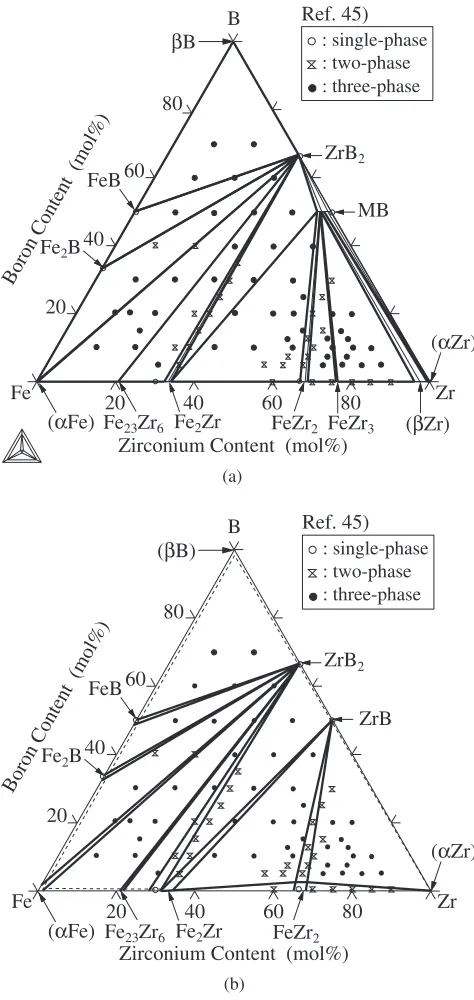
evaluated parameters are listed in Table 1. The calculated isothermal section diagram at T ¼1123K is shown in Fig. 5, together with the experimental phase diagram.45)
Although there are no experimental data available, a low solubility of Fe in ZrB was introduced to obtain the phase equilibria between ZrB and Fe2Zr. The calculated results are
in agreement with the experimental phase equilibria, except for the absence of those relevant to FeZr3in Fig. 5(b), which
[image:5.595.54.549.84.187.2]has been included in the assessed Fe-Zr phase diagrams.16,17) Figure 6 shows the calculated vertical section diagram along Table 2 The calculated enthalpy of formation of various borides in the Zr-B system.
Phase Space group This study Experimental
First-principles Thermodynamic analysis
ZrB(NaCl-type) Fm33m 39:6 — —
ZrB(FeB-type) Pnma 67:1 72:6 79:341Þ
ZrB2 P6=mmm 100:3 100:6 107:71:737Þ
108:92:138Þ 9339Þ
ZrB12 Fm33m 24:1 22:5 —
Estimated value
-150 -100 -50 0 50 100
Enthalpy of formation,
∆
H
/ kJ·mol
-1
Zr 20 40 60 80 B
: First-principles calculations : Thermodynamic analysis
Boron Content (mol%)
[image:5.595.53.285.221.439.2]the Fe-ZrB2 join, for comparison with the experimental
data determined using thermal analysis.46) The calculated
results are consistent with the experimental data.
4. Conclusions
A thermodynamic analysis of the Fe-Zr-B ternary system has been carried out using the CALPHAD method, mainly based on available experimental data. Among the three binary systems relevant to this ternary phase diagram, the thermodynamic descriptions of the Fe-Zr and Fe-B binary systems were taken from previous studies. For the Zr-B binary system, the thermodynamic parameters were eval-uated by incorporating thermodynamic properties of the
borides into the CALPHAD approach. The results obtained are summarized as follows:
(1) Our first-principles calculations showed that ZrB with an FeB-type structure was energetically more stable than that with a NaCl-type structure.
(2) The thermodynamic parameters of the Zr-B binary system enabled us to obtain reproducible calculations of the formation enthalpies obtained from our first-principles calculations, as well as the experimental data on phase boundaries.
(3) The calculated Fe-Zr-B ternary phase diagrams agree well with the available experimental results.
Acknowledgement
The authors acknowledge financial support from Core Research for Evolutional Science and Technology (CREST), Japan Science and Technology Agency.
REFERENCES
1) K. Suzuki, N. Kataoka, A. Inoue, A. Makino and T. Masumoto: Mater. Trans. JIM31(1990) 743–746.
2) K. Suzuki, A. Makino, N. Kataoka, A. Inoue and T. Masumoto: Mater. Trans. JIM32(1991) 93–102.
3) K. Suzuki, M. Kikuchi, A. Makino, A. Inoue and T. Masumoto: Mater. Trans. JIM32(1991) 961–968.
4) K. Suzuki, A. Makino, A. Inoue and T. Masumoto: J. Appl. Phys.74
(1993) 3316–3322.
5) e.g., Y. Zhang, K. Hono, A. Inoue, A. Makino and T. Sakurai: Acta
Mater.44(1996) 1497–1510.
6) P. Blaha, K. Schwarz, G. K. H. Madsen, D. Kvasnicka and J. Luitz: WIEN2k, An Augmented Plane Wave Plus Local Orbitals Program for Calculating Crystal Properties, (Techn. Universita¨t Wien, Austria, 2002) ISBN 3-9501031-1-2.
7) J. P. Perdew, K. Burke and Y. Wang: Phys. Rev. B54(1996) 16533– 16539.
8) P. Villars:Pearson’s Handbook, Crystallographic Data for Interme-tallic Phases, Desk Edition, (ASM International, Materials Park, Ohio, USA, 1997).
9) A. T. Dinsdale: Calphad15(1991) 317–425.
10) O. Redlich and A. T. Kister: Ind. Eng. Chem.40(1948) 345–348. 80
60
40
20
ZrB2
MB FeB
Fe2B
Fe23Zr6 Fe2Zr FeZr2 FeZr3
Fe Zr
B
20 40 60 80
(βZr) (αZr) : single-phase
βB
Zirconium Content (mol%)
Boron Content (mol%)
Ref. 45)
: three-phase : two-phase
(αFe)
(a)
80
60
40
20
Zirconium Content (mol%)
Boron Content (mol%)
ZrB2
ZrB FeB
Fe2B
Fe23Zr6 Fe2Zr FeZr2
Fe Zr
B
20 40 60 80
: single-phase : two-phase : three-phase (βB)
(αZr)
(αFe)
Ref. 45)
(b)
Fig. 5 (a) Calculated and (b) experimental45)isothermal section diagrams
of the Fe-Zr-B ternary system at 1123 K.
1000 1200 1400 1600 1800 2000
Fe 5 10 15 20
(δFe)
(γFe)
(αFe)
(γFe)+ZrB
(αFe)+ZrB
L+ZrB : Ref. 46)
L+(γFe)
L+(γFe)+ZrB2
2
2
2
800
L
Temperature,
T
/ K
Boron Content (mol%)
[image:6.595.50.287.72.572.2] [image:6.595.314.543.72.286.2]11) K. Yoshitomi, Y. Nakama, H. Ohtani and M. Hasebe: ISIJ Int. 48
(2008) 835–844.
12) G. Inden: Proc. CALPHAD V, Du¨sseldorf, 1976, III-(4)-1. 13) M. Hillert and M. Jarl: Calphad2(1978) 227–238.
14) M. Hillert and L.-I. Staffansson: Acta Chem. Scand.24(1970) 3618– 3626.
15) C. A. Nunes, D. Kaczorowski, P. Rogl, M. R. Baldissera, P. A. Suzuki, G. C. Coelho, A. Grytsiv, G. Andre´, F. Bouree´ and S. Okada: Acta Mater.53(2005) 3679–3687.
16) H. Okamoto: J. Phase Equilib.18(1997) 316.
17) H. Okamoto: J. Phase Equilib. Diffusion27(2006) 543–544. 18) F. Stein, G. Sauthoff and M. Palm: J. Phase Equilib. 23 (2002)
480–494.
19) M. Jiang, K. Oikawa, T. Ikeshoji, L. Wulff and K. Ishida: J. Phase Equilib.22(2001) 406–417.
20) P. K. Liao and K. E. Spear:Phase Diagrams of Binary Iron Alloys, ed. by H. Okamoto (ASM International Metals Park, OH, USA, 1993) pp. 41–47.
21) T. G. Chart: Comm. Comm. Eur., 7210-CA/3/303 (1981).
22) L. Kaufman, B. Uhrenius, D. Birnie and K. Taylor: Calphad8(1984) 25–66.
23) H. Ohtani, M. Hasebe, K. Ishida and T. Nishizawa: Trans. Iron Steel Inst. Jpn.28(1988) 1043–1050.
24) L.-M. Pan: In B. Sundman, ed., Scientific Group Thermodata Europe (SGTE) Solution Database Ver.2, Division of Computational Thermo-dynamics, (Royal Institute of Technology, Stockholm, Sweden, 1994). 25) B. Hallemans, P. Wollants and J. R. Roos: Z. Metallkd.85(1994)
676–682.
26) M. Palumbo, G. Cacciamani, E. Bosco and M. Baricco: Calphad25
(2001) 625–637.
27) T. Van Rompaey, K. C. Hari Kumar and P. Wollants: J. Alloy. Compd.
334(2002) 173–181.
28) H. Okamoto: J. Phase Equilib.14(1993) 261–262.
29) F. W. Glazer and B. Post: Trans. AIME197(1953) 1117–1118. 30) H. Nowotny, E. Rudy and F. Benesovsky: Monatsh. Chem.91(1960)
963–974.
31) E. Rudy:Ternary Phase Equilibria in Transition Metal-Boron-Carbon-Silicon Systems, Part V, (Air Force Materials Laboratory, Air Force Systems Command, Wright-Patterson Air Force Base, OH, USA, 1960) p. 689.
32) O. I. Shulishova and I. A. Shcherbak: Inorg. Mater.3(1967) 1304– 1306.
33) J. S. Haggerty, J. L. O’Brien and J. F. Wenckus: J. Cryst. Growth
3/4(1968) 291–294.
34) K. I. Portnoi, V. M. Romashov and L. N. Burobina: Sov. Powder Metall. Met. Ceram.9(1970) 577–580.
35) K. I. Portnoi and V. M. Romashov: Sov. Powder Metall. Met. Ceram.
11(1972) 378–384.
36) Y. Champion and S. Hage`ge: J. Mater. Sci. Lett.11(1992) 290–293. 37) E. J. Huber, E. L. Head and C. E. Holley: J. Phys. Chem.68(1964)
3040–3042.
38) G. K. Johnson, E. Greenberg, J. L. Margrave and W. N. Hubbard: J. Chem. Eng. Data12(1967) 137–141.
39) E. P. Kirpichev, Yu. I. Rubtsov, T. V. Sorokina and V. K. Prokudina: Russ. J. Phys. Chem.53(1979) 1128–1130.
40) R. H. Valentine, T. F. Jambois and J. L. Margrave: J. Chem. Eng. Data
9(1964) 182–184.
41) P. Rogl and P. E. Potter: Calphad12(1988) 191–204.
42) S. Shang, Y. Wang, R. Arroyave and Z.-K. Liu: Phys. Rev. B75(2007) 092101-1–092101-4.
43) D. P. Harmon: Techn. Rept. No. AFML-TR-65-2, Part II, Vol. VI, (Wright Patterson Air Force Base, OH, USA, 1966) pp. 1–64. 44) P. Rogl and P. E. Potter: Calphad12(1988) 207–218.
45) Yu. B. Kuz’ma, V. I. Lakh, Yu. V. Voroshilov, B. I. Stadnyk and V. Ya. Markov: Russ. Metall.6(1965) 88–90.