ISSN Online: 2161-1211 ISSN Print: 2161-1203
Demystification of Vedic Multiplication
Algorithm
Manohar Mathur1, Aarnav2
1Metro Railway Electrical Engineering Expert, Lucknow, India 2DPS, Lucknow, India
Abstract
The Vedic multiplication algorithm is a very fast way of oral calculation. However, the basis of the algorithm is not available so far. The present paper demystifies the general Vedic algorithm for multiplication by establishment of foundation of the Vedic algorithm of product finding through end results of conventional multiplication. This novel approach, i.e., finding algorithm from the end results of conventional calculations may be useful in devising algo-rithms similar to Vedic in cases of other calculations. Though the availability of cheap calculators made the Vedic Method obsolete, the present trend res-urrected Vedic algorithms by their use in the design of computer processors for enhancing speed and performance.
Keywords
Vedic, Demystification, Multiplication, Vertically, Crosswise, Urdhvak, Tiryak, Computer, Processor
1. Introduction
Vedic mathematics [1]-[6] is undeniably a faster way of doing oral calculations. It deserves all applause. However, due to provision of cheap calculators for common people and students today, Vedic Mathematics started losing its sheen and it ap-peared that it would be finally rejected. Nonetheless, the speciality of Vedic Mathematical algorithms is now well recognized as per survey [7] and nowadays it is extensively used in computer processor designs [8][9][10] for speeding up per-formance. It has also been recommended for use in High-Per- formance FIR filter implementation [11], image compression [12], area and speed of wisely superior multiplier and unit multiplier [13], reduced-bit multiplication algorithm [14], multipliers as the integral components in the design of many high performance
How to cite this paper: Mathur, M. and Aarnav (2017) Demystification of Vedic Multiplication Algorithm. American Jour-nal of ComputatioJour-nal Mathematics, 7, 94-101.
https://doi.org/10.4236/ajcm.2017.71008
Received: December 15, 2017 Accepted: March 28, 2017 Published: March 31, 2017
Copyright © 2017 by authors and Scientific Research Publishing Inc. This work is licensed under the Creative Commons Attribution International License (CC BY 4.0).
http://creativecommons.org/licenses/by/4.0/
FIR filters, image and digital signal processors [15][16]. In spite of its so many al-luring benefits and awesome speed, the Vedic Multiplication Algorithm remains mystical as the basics of these are still unknown. The natural curiosity to get the basis of Vedic algorithm has given birth to the objective of this research to remove the veil of mysticism from Vedic Multiplication Algorithm. This research institutes the very foundation and logic of Vedic Multiplication Procedure for general multiplication.
There are several Vedic algorithms for multiplication including a general one, which is universal, whereas each of other Vedic algorithms for multiplication suits a special situation.
Scope of this research is confined to finding the logic of Vedic Multiplication Algorithm for multiplication of general type as it has universal application and this finds product of a several-digit multiplicand and several-digit multiplier.
Interestingly, this research is purely based on end results of conventional mul-tiplication procedure and this approach may be used in cases of other complicated mathematical procedures for finding shortcut-algorithms like the Vedic approach.
Results of this avant-garde research are very encouraging and verifiable. Besides, it may be path finder.
2. Basis of Vedic Multiplication Algorithm
It may be interesting to note that the Vedic algorithm is based on the reorganiza-tion of convenreorganiza-tional multiplicareorganiza-tion method only. In Vedic jargon, the algorithmic procedure is described in terms of urdhvak (vertical multiplication) and tiryak (crosswise multiplication) operations. The purpose of this work is to handover the very basis of the Vedic formulae to the users which can be a very valuable asset to them for clear understanding.
The ordinary multiplication method is used here as a vehicle in evolving the Vedic Sutra (Algorithm) starting with multiplication of 2-digit multiplicand and 2-digit multiplier. Also, alphabetical symbols shall be used to represent digits in doing so. This will be extended later for finding products of a several-digit multi-plicand by another several-digit multiplier.
3. Evolution of Vedic Algorithm
3.1. Evolution of Vedic Algorithm of Multiplication of a 2-Digit Multiplicand and 2-Digit Multiplier
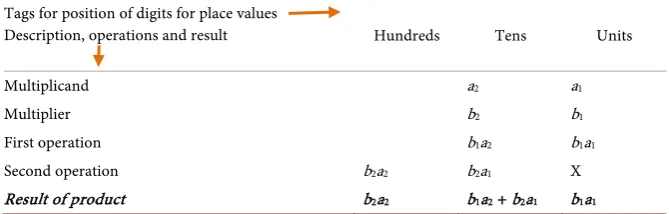
Let a1 and a2 be digits at units and tens of multiplicand. Similarly, let b1 and b2
represent the digits at units and tens of multiplier. With these assumptions, the conventional multiplication is performed to evolve the algorithm for such product finding tasks. A conventional multiplication table is given below in Table 1.
Critical observation of the result row of Table 1 is the basis of evolution of Vedic Sutras or Vedic Formulae for multiplication shortcut. For this reason, Table 2 is made without showing the operations of multiplication.
Result at units b1a1 prompts that this is the result of vertical multiplying the
dig-its positioned at undig-its for both multiplier and multiplicand (b1 and a1). In Vedic
means upward or rising up or vertically up. Here a1 is vertically up or urdhvak to
b1. This is the Vedic formula to get quickly the digit of product at units. This is
marked by arrows here for better understanding.
Observation of result at Tens b2a1 + b1a2 points out that the sum of crosswise
multiplication 1) of digit at Units of multiplier with digit at Tens of multiplicand and crosswise multiplication 2) of digit at Tens of multiplier with digit at Units of multiplicand. The result at Hundreds, i.e., b2a2 indicates that this is vertical or
urdhvak multiplication of digits at the tens for both multiplier and multiplicand. This is similar to getting result at units.
Lemma: In all product finding cases, the result of first place, i.e., units and last place (depending on number of digits) are vertical (urdhvak) products.
It may be noted that like conventional multiplication, carry, if any, is to be car-ried forward for addition to next higher place value.
Example 1: find product 34 and 67. The above problem is tabulated in Table 3.
Table 1. Table of conventional multiplication of a 2-digit variable number with another
2-digit variable number.
Tags for position of digits for place values
Description, operations and result Hundreds Tens Units
Multiplicand a2 a1
Multiplier b2 b1
First operation b1a2 b1a1
Second operation b2a2 b2a1 X
Result of product b2a2 b1a2+ b2a1 b1a1
Table 2.Table 1 after deletion of operations.
Tags for position of digits for place values
Description, operations and result Hundreds Tens Units
Multiplicand a2 a1
Multiplier b2 b1
[image:3.595.205.540.337.444.2]Result of product b2a2 b2a1 + b1a2 b1a1
Table 3. Tabular form of the above multiplication problem.
Tags for position of digits for place values
Description, operations and result Hundreds Tens Units
Multiplicand 3 4
Multiplier 6 7
Vedic operations
6 * 3 = 18 Add carry 4 to it: 18 + 4 = 22
7 * 3 + 6 * 4 = 45
Add carry 2, it is 47 7 * 4 = 28
Resulting Digit at place 22 7 8
So, 34 * 67 = 2.278. Example 2: Find 78 * 59.
Orally 9 * 8 = 72. 2 is kept as result at units whereas 7 is carry. 9 * 7 + 5 * 8 = 63 + 40 = 103. Adding carry 7 to it, it is 110. So, 0 is retained as answer digit at tens and 11 is carry. Lastly 7 * 5 = 35. Adding carry 11 to it, it is now 46. This goes to hundreds. Therefore the final answer is 4602.
3.2. Evolution of Vedic Algorithm of Multiplication of a 3-Digit Multiplicand with Another 3-Digit Multiplier
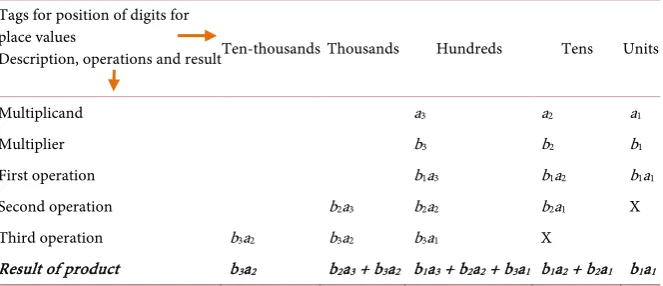
Let a1, a2 and a3 be digits at units, tens and hundreds respectively of
multipli-cand. Similarly, let b1, b2 and b3 be digits at units, tens and hundreds respectively
of multiplier. With these assumptions, the conventional multiplication is per-formed to evolve the Vedic algorithm for product finding tasks. Conventional multiplication table is given in Table 4.
From the result row in Table 4, it can be visualized that the Vedic formulae for finding product’s digits at units and ten-thousands would be same as in case of multiplication of 2-digit variable number by another 2-digit variable number. Here ten-thousandth place is the last position and hence the last digits of multi-plicand and multiplier will be multiplied vertically (urdhvak). As in previous case, Table 5 is made after deleting the rows for operations and keeping result at only hundreds.
Observations of results at hundreds:
1) b1a3 is found after multiplying multiplier’s digit at tens with multiplicand’s
digit at hundred. This is shown by slant arrow i.e. crosswise or tiryak of Vedic
Table 4. Table of conventional multiplication of a 3-digit variable number with another
3-digit variable number.
Tags for position of digits for place values
Description, operations and result Ten-thousands Thousands Hundreds Tens Units
Multiplicand a3 a2 a1
Multiplier b3 b2 b1
First operation b1a3 b1a2 b1a1
Second operation b2a3 b2a2 b2a1 X
Third operation b3a2 b3a2 b3a1 X
[image:4.595.208.540.474.617.2]Result of product b3a2 b2a3 + b3a2 b1a3 + b2a2 + b3a1 b1a2 + b2a1 b1a1
Table 5. Table 4 after deletion of operations.
Tags for position of digits for place values
Description, operations and result Ten-thousands Thousands Hundreds Tens Units
Multiplicand a3 a2 a1
Multiplier b3 b2 b1
multiplication.
2) b3a1 is also obtained by multiplying multiplier’s digit at hundreds by
multi-plicand’s digit at units crosswise or tiryak way.
3) b2a2 is the result of finding product of digits at tens for both multiplicand
and multiplier vertically or in urdhvak way.
Table 5 is now made after deleting all results save result at thousands to find Vedic algorithm to get product’s digit at this place. Also, forget the digits at units now and onwards for the sake of calculations. Therefore, the column for units has been deleted.
Observations of result at thousands are in Table 4.
1) b2a3 is crosswise or tiryak product of multiplier’s digit at tens and
multipli-cand’s digit at hundred. This is shown by arrow in Table 6.
2) Similarly, b3a2 is also crosswise or tiryak product of multiplier’s digit at
hundreds and multiplicand’s digit at tens. This is shown by arrow in Table 6.
Table 3 is reproduced below as Table 7 to observe result at ten-thousands. Digit at ten-thousands is b3a2, which is nothing but vertical multiplication of
digits at hundreds for both multiplier and multiplicand. It is noteworthy to keep in mind that results at extreme places (here units and ten-thousands) are always vertical multiplications. This rule is universally applicable to multiplication of any-digit number by other any-digit number.
Example 1: Find product of 467 and 235.
The above problem is tabulated below in Table 8. Therefore, 467 * 235 = 109,745.
Proceeding this way, one can find formulae for getting the result of multipli-cation of an n-digit multiplicand by n-digit multiplier. As an example, an 8-digit
Table 6. Table showing crosswise or Tiryak multiplications to get result at the thousands position.
Tags for position of digits for place values
Description, operations and result Ten-thousands Thousands Hundreds Tens
Multiplicand a3 a2
Multiplier b3 b2
Result of product b2a3 + b3a2
Table 7. Reproduced Table 3 for result at ten-thousand.
Tags for position of digits for place values
Description, operations and result Ten-thousands Thousands Hundreds Tens Units
Multiplicand a3 a2 a1
Multiplier b3 b2 b1
First operation b1a3 b1a2 b1a1
Second operation b2a3 b2a2 b2a1 X
Third operation b3a2 b3a2 b3a1 X
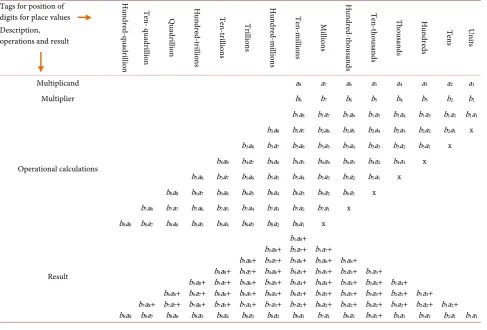
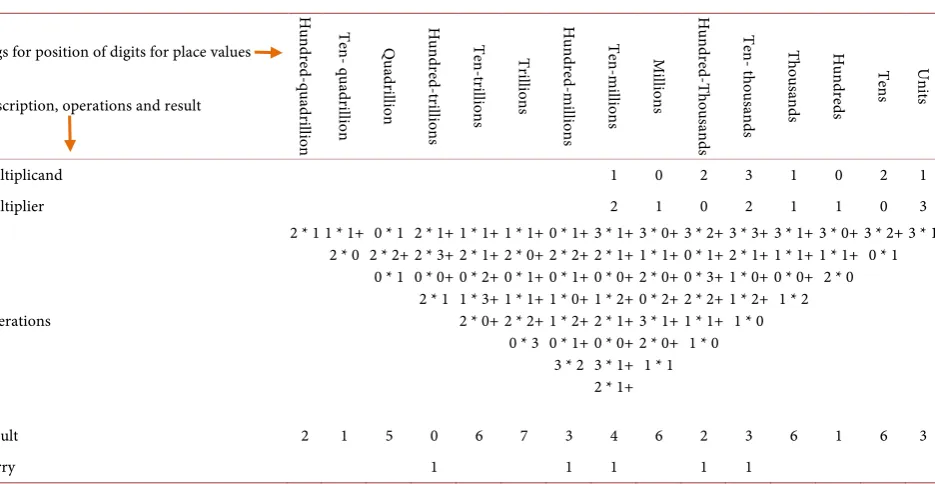
multiplicand is multiplied by 8-digit multiplier in order to show the efficacy of the findings of this research. The Vedic formulae are worked out on the basis of con-ventional multiplication output. Table 9 shows the conventional multiplication of an 8-digit multiplicand by 8-digit multiplier. From this conventional multiplica-tion result, the product of any two 8-digit numbers can be orally found. The end results of conventional product finding in Table 9 is used to get the Vedic formu-lae for such product finding. The next table, Table 10, uses this algorithm to find the product of 8-digit multiplicand and 8-digit multiplier orally.
[image:6.595.56.548.237.377.2]Example: Find the product of 10,231,021 and 21,021,103.
Table 8. Table for Vedic multiplication of above problem.
Tags for position of digits for place values
Description, operations and result Ten-thousands Thousands Hundreds Tens Units
Multiplicand 4 6 7
Multiplier 2 3 5
Operations Adding 2 carry it is 10 4 * 2 = 8 Adding 5 carry it is 29 4 * 3 + 2 * 6 = 24 5 * 4 + 2 * 7 + 6 * 3 = 52. Adding 5 carry it is 57 Adding 3 carry it is 54 7 * 5 = 35 5 * 6 + 3 * 7 = 51
Resulting Digit 10 9 7 4 5
Carry 2 5 5 3
Table 9. Table of conventional multiplication of an 8-digit number by another 8-digit number.
Tags for position of digits for place values
Hu nd red -q ua drilli on Ten - q ua drillio n Qu adril lio n Hu nd red -trillio ns Ten -trillio ns Tril lio ns Hu nd red -m illio ns Ten -m illio ns M illio ns Hu nd red -th ousa nd s Ten -th ousa nd s Th ousa nd s H un dre ds Te
ns Units Description,
operations and result
Multiplicand a8 a7 a6 a5 a4 a3 a2 a1
Multiplier b8 b7 b6 b5 b4 b3 b2 b1
Operational calculations
b1a8 b1a7 b1a6 b1a5 b1a4 b1a3 b1a2 b1a1
b2a8 b2a7 b2a6 b2a5 b2a4 b2a3 b2a2 b2a1 x
b3a8 b3a7 b3a6 b3a5 b3a4 b3a3 b3a2 b3a1 x
b4a8 b4a7 b4a6 b4a5 b4a4 b4a3 b4a2 b4a1 x
b5a8 b5a7 b5a6 b5a5 b5a4 b5a3 b5a2 b5a1 x
b6a8 b6a7 b6a6 b6a5 b6a4 b6a3 b6a2 b6a1 x
b7a8 b7a7 b7a6 b7a5 b7a4 b7a3 b7a2 b7a1 x
b8a8 b8a7 b8a6 b8a5 b8a4 b8a3 b8a2 b8a1 x
Result
b8a8
b7a8+
b8a7
b6a8+
b7a7+
b8a6
b5a8+
b6a7+
b7a6+
b8a5
b4a8+
b5a7+
b6a6+
b7a5+
b8a4
b3a8+
b4a7+
b5a6+
b6a5+
b7a4+
b8a3
b2a8+
b3a7+
b4a6+
b5a5+
b6a4+
b7a3+
b8a2
b1a8+
b2a7+
b3a6+
b4a5+
b5a4+
b6a3+
b7a2+
b8a1
b1a7+
b2a6+
b3a5+
b4a4+
b5a3+
b6a2+
b7a1
b1a6+
b2a5+
b3a4+
b4a3+
b5a2+
b6a1
b1a5+
b2a4+
b3a3+
b4a2+
b5a1+
b1a4+
b2a3+
b3a2+
b4a1
b1a3+
b2a2+
b3a1
b1a2+
[image:6.595.57.545.409.739.2]Table 10. Table of Vedic multiplication for above problem.
Tags for position of digits for place values
Hu nd red -q ua drilli on Ten - q ua drillio n Qu adril lio n Hu nd red -trillio ns Ten -trillio ns Tril lio ns Hu nd red -m illio ns Ten -m illio ns M illio ns Hu nd red -T housa nd s Ten - th ousa nd s Th ousa nd s H un dre ds Te
ns Units Description, operations and result
Multiplicand 1 0 2 3 1 0 2 1
Multiplier 2 1 0 2 1 1 0 3
Operations
2 * 1 1 * 1+ 2 * 0 2 * 2+ 0 * 1
0 * 1 2 * 1+ 2 * 3+ 0 * 0+ 2 * 1
1 * 1+ 2 * 1+ 0 * 2+ 1 * 3+ 2 * 0+
1 * 1+ 2 * 0+ 0 * 1+ 1 * 1+ 2 * 2+ 0 * 3
0 * 1+ 2 * 2+ 0 * 1+ 1 * 0+ 1 * 2+ 0 * 1+ 3 * 2
3 * 1+ 2 * 1+ 0 * 0+ 1 * 2+ 2 * 1+ 0 * 0+ 3 * 1+ 2 * 1+
3 * 0+ 1 * 1+ 2 * 0+ 0 * 2+ 3 * 1+ 2 * 0+ 1 * 1
3 * 2+ 0 * 1+ 0 * 3+ 2 * 2+ 1 * 1+ 1 * 0
3 * 3+ 2 * 1+ 1 * 0+ 1 * 2+ 1 * 0
3 * 1+ 1 * 1+ 0 * 0+ 1 * 2
3 * 0+ 1 * 1+ 2 * 0
3 * 2+ 0 * 1 3 * 1
Result 2 1 5 0 6 7 3 4 6 2 3 6 1 6 3
Carry 1 1 1 1 1
This example problem is tabulated in Table 10. Therefore, 10,231,021 * 21,021,103 = 21,506,734,623.
4. Conclusions
1) The basis of the Vedic general multiplication algorithm can be found from the end results of ordinary multiplication. This demystifies the Vedic algorithm for general multiplication.
2) The approach of this paper may be used to find algorithm shortcuts for other types of arithmetical calculations.
3) A Vedic algorithm for the multiplication of a n-digit multiplicand by n-digit multiplier can be easily obtained by using alphabetic variables in lieu of numerals in the general conventional multiplication.
4) Vedic mathematics will continue in spite of the availability of electronic calculators or other calculating gadgets.
Acknowledgements
The authors express their sincere gratitude to the editor and his team for valu-able guidance. Further, the authors are indebted to Mr. Prakash Atul, Director High Radius Corporation, Houston, Texas (US), Mrs. Apoorva Mathur, Mrs Richa, Mr. Nitish and Mrs. Reeta Mathur for encouraging them to conduct re-search in this field and for providing assistance in verification as well as com-puterization of this paper.
References
[2] Guthrie, G. (1997) Vedic Computation: Redefining Computer Science in the Light of Maharishi Vedic Science, Fiarfield, 195, 210.
[3] John M. (1998) Muehlman Maharishi’s Vedic Mathematics in Elementary Educa-tion: Developing All Knowingness to Improve Affect, Achievement, and Mental Computation,Fiarfield, 58.
[4] Dhivyadeepa, E. (2014) International Multidisciplinary E-Journal. Vedic Activities
in the Skills of Arithmetic, Coimbatore, 9214.
[5] Kavita and Goyal, U. (2013) Performance Analysis of Various Vedic Techniques for Multiplication. International Journal of Engineering Trends and Technology, 4, 232. http://www.internationaljournalssrg.org
[6] Benjamin, A. and Shermer, M. (2006) Secrets of Mental Math: The Mathemagician's Guide to Lightning Calculation and Amazing Math Tricks, Three Rivers Press, New York, 138-145.
[7] Jain, S. and Jagtap, V.S. (2014) Vedic Mathematics in Computer: A Survey.
Interna-tional Journal of Computer Science and Information Technologies, 5, 7458-7459.
[8] Nishant, G.D. and Mahajan, R. (2017) Ancient Indian Vedic Mathematics Based Multiplier Design for High Speed and Low Power Processor. International Journal
of Advanced Research in Electrical, Electronics and Instrumentation Engineering,
95, 2320-3765.
[9] Saha, P., Banerjee, A., Dandapat, A. and Bhattacharyya, P. (2011) Vedic Mathemat-ics Based 32-Bit Multiplier Design for High Speed Low Power Processors.
Interna-tional Journal on Smart Sensing and Intelligent Systems, 4, 272-274.
[10] Fernandes, C. and Borkar, S. (2013) Application of Vedic Mathematics in Computer Architecture. International Journal of Research in Engineering and Science, 1, 40-45. [11] Jayakumar, S. and Sumathi, A. (2016) High-Performance FIR Filter Implementation
Using Anurupye Vedic Multiplier. Scientific Research Publishing-Circuits and Sys-tems, 7, 3723-3733. http://www.scirp.org/journal/cs
[12] Kamal, S. and Toor, C.K. (2015) Implementation of Vedic Multiplier in Image Com-pression Using Discrete Wavelet Transform (DWT) Algorithm. IJSRD—International
Journal for Scientific Research & Development, 3, 2259, 2261.
[13] Magar, V.B. (2013) Area and Speed Wise Superior Multiply and Accumulate Unit Based on Vedic Multiplier. Journal of Engineering Research and Applications, 3, 994-999.
[14] Vyas, D. and Jain, N. (2015) New Robust Reduced-Bit Multiplication Algorithm by using Vedic Mathematics. International Journal of Engineering Technology and Ap-plied Science, 1, 2.
[15] Pokhriyal, N., et al. (2013) Compressor Based Area-Efficient Low-Power 8 × 8 Vedic Multiplier. Journal of Engineering Research and Applications, 3, 1469-1472.
[16] Kavita, H.D. and Mrs. Dharmambal (2015) The Application of Vedic Mathematics for High Speed Multiplier in FIR Filter Design. International Journal of Engineering
Submit or recommend next manuscript to SCIRP and we will provide best service for you:
Accepting pre-submission inquiries through Email, Facebook, LinkedIn, Twitter, etc. A wide selection of journals (inclusive of 9 subjects, more than 200 journals)
Providing 24-hour high-quality service User-friendly online submission system Fair and swift peer-review system
Efficient typesetting and proofreading procedure
Display of the result of downloads and visits, as well as the number of cited articles Maximum dissemination of your research work
Submit your manuscript at: http://papersubmission.scirp.org/