Bayesian Estimation for GEV-B-Spline Model
Bouchra Nasri1*, Salaheddine El Adlouni2, Taha B. M. J. Ouarda1,3 1Center Eau Terre Environnement, Institut national de la Recherche Scientifique
Québec, Canada
2Département de Mathématique et de Statistique, Université de Moncton, Moncton, Canada 3Masdar Institue of Science and Technology, Abu Dhabi, UAE
Email: [email protected], [email protected], [email protected]
Received December 10,2012; revised January 11, 2013; accepted January 25, 2013
Copyright © 2013 Bouchra Nasri etal. This is an open access article distributed under the Creative Commons Attribution License, which permits unrestricted use, distribution, and reproduction in any medium, provided the original work is properly cited.
ABSTRACT
The stationarity hypothesis is essential in hydrological frequency analysis and statistical inference. This assumption is often not fulfilled for large observed datasets, especially in the case of hydro-climatic variables. The Generalized Ex- treme Value distribution with covariates allows to model data in the presence of non-stationarity and/or dependence on covariates. Linear and non-linear dependence structures have been proposed with the corresponding fitting approach. The objective of the present study is to develop the GEV model with B-Spline in a Bayesian framework. A Markov Chain Monte Carlo (MCMC) algorithm has been developed to estimate quantiles and their posterior distributions. The methods are tested and illustrated using simulated data and applied to meteorological data. Results indicate the better performance of the proposed Bayesian method for rainfall quantile estimation according to BIAS and RMSE criteria especially for high return period events.
Keywords: GEV; Bayesien; B-Spline; Nonlinearity; Covariate; Non-Stationarity
1. Introduction
Many fields of modern science and engineering have to deal with rare events with significant consequences. Ex- treme value theory (EVT) allows to providing the basis for the statistical modeling of such extremes. The main result of EVT shows that the maxima, of Independent and Iden- tically Distributed (i.i.d.) events, are asymptotically Gen- eralized Extreme Value (GEV) distributed [1]. In practice, the hypotheses of the EVT are, generally, not fulfilled, and a classical frequency analysis, of independent, ho- mogeneous and stationary samples, is considered with a large range of probability distributions to estimate the oc- currence of extreme events. A number of methods have been proposed to estimate GEV distribution’s parameters; such as the method of moments (MM) [2,3], maximum likelihood (ML) [4] and the method of probability wei- ghted moments [5].
The Stationarity assumption is essential to carry out a statistical frequency analysis. However, in many fields, such as hydroclimatology, observed data series are not stationary [6,7]. For hydrological datasets, two main types of non-stationarity have been observed due to temporal trends or cycles corresponding to the effect of other co-
variates. The second kind of non-stationarity, has been largely studied during the last decade through the GEV model with covariates [8-14] for local frequency analysis and [15,16] for regional analysis.
Taking into account the effect of a covariate can be considered in a polynomial form [9,11,17]. These poly- nomial forms for estimating the GEV parameters were developed by the introduction of covariates in a polyno- mial form such as a linear or quadratic function. However, the dependence between covariates and variables of in- terest can take different structures.
[18] suggested the use of semi-parametric functions such as smoothing splines to estimate the relationship between the parameters and covariates. The smoothing splines are based on the minimization of the penalized sum of the squared errors and the choice of the smoothing parameter [19]. The main disadvantages of this type of function are that inference, often through the confidence bands, is not straightforward and that a smoothing which parameter needs to be specified at the beginning [20]. A smoothing-based B-spline function resolves these prob- lems and presents several others advantages.
B-spline functions are linear combinations of non negative piecewise-polynomial real functions. A B-spline function does not depend on the response variable, or the
variable of interested, but depend only on: 1) the support of the covariates, 2) the number and position of knots and 3) the degree of B-Spline function [19]. The above ad- vantages of B-Spline functions make it an appropriate option to be used in the GEV model with covariates to estimate the quantiles conditionally to given factors. The GEV model with B-spline called mixed GEV-B-Spline model, is rigorous and flexible and allows to fit a large number of dependence structures [18,21]. [18] describes smooth non-stationary generalized additive modeling for sample extremes, in which spline smoothers are incorpo- rated into models for exceedances over high thresholds with the Generalized Pareto distribution. They developed the maximum penalized likelihood estimation approach with uncertainty assessed by using differences of devi- ances and bootstrap simulation.
The main objective of the present study is to develop the Generalized Extreme Value model with covariates where the dependence structure is represented by B-spline functions in a Bayesian framework. Prior distributions have been proposed and the posterior distribution is simulated through the Metropolis Hasting (MH) algorithm based on the Monte Carlo Markov Chain (MCMC) me- thod.
In the next section, the theoretical development of the Bayesian method of parameter estimation is discussed. A case study is then presented in Section 3. A comparison between of the proposed Bayesian approach with classical estimation methods such as the method of moments and the maximum likelihood method is presented in the third section. The last section corresponds to the conclusions and recommendations for future work.
2. Bayesian GEV-B-Spline Model
2.1. GEV DistributionThe extreme value theory introduced by [22] shows that the limiting distribution of the maximum is one of the following distributions: Gumbel, Frechet or Weibull. These three distributions can be grouped in a single Gen- eralized Extreme Value (GEV) distribution:
1
, 0
, 0
, , , exp 1
, , , exp exp
y F y
y F y
(1)
The Gumbel distribution has two parameters defined on R, the distribution function is obtained by tendering
0
.
The Fréchet distribution has three parameters defined on the interval ,
, obtained for 0
The Weibull distribution has three parameters defined on the interval
.
,
, obtained for 0. Considering a random variable following the GEV distribution and t the time before the event Y T . Then is distributed according to a Geometric distribu- tion with a parameter .
Y
y
t
p P Y yT
Let
1 2 n
be i.i.d. random variables from theGEV distribution. The probability that , , ,
Y Y ΛY
0
t k k
1; 1, 2,3,
1
i T k T
i k k
P t k P Y y P Y y k
p p
is given by:
Ι
Λ
(2)
with:
1
T E t
p
(3)
Since the variable Y follows the GEV distribution with
F as a repartition function. Equation (3) becomes:
1 1
1
T T
E t
P Y y F y
T y
(4)
So the quantile of the GEV distribution is:
1 1 1 1 log 1 1
T
y F
E t T
y
(5)
In the non-stationary case, the parameters of the GEV are functions of time or other covariates. Consequently the quantile T depends on these covariates. In the pre-
sent study, the parameters an d are supposed constant. Let Y be a random variable that follows the
, , ,
GEV x, , , and X X X1 2 Λ Xp a vector of
covariates. The location parameter of the GEV model is a function of covariates:
1
1 1 2 2
p
x i i
i
p p
f X
f X f X f X
Λ
(6)
where fi represents the function that describes the rela-
tionship between the parameter and the covariate Xi.
In the classical GEV model with covariates, depend- ence is represented through polynomial functions of lin- ear or quadratic forms. In the following paragraph, we present the GEV model with covariates where the de- pendence structure is given by B-Splines. This model will be called GEV-B-Spline.
2.2. The GEV-B-Spline Model
The function fi can be decomposed in the form of basic
i ij
0 ,
1
m
j j d i
f x B x
(7)where
1
r 0, 2
j x x B x j m
, , 1 1; 1 1 1 1 ,0for 0, 2
1,if
fo 0, otherwise
j d j d
j d j
j d
j d
j d j
j j
j
B x B x
x x
x x
x x
j m d
x x x
B x (8)
,j d is a polynomial of degree d on each interval and m is the number of control points.
B x
Hence, the Equation (6) becomes
,01 1
x i i i
i i
, , 1
p p m
i j j d i j
f x B x
1,0 1,1 , ,1 1, , , p mp p m
p p m
x Μ Μ
(9)The matrix form of Equations (8) and (9) gives
0
,0 ,1
1,1 1 , , ,
p
p m
B x B
β β B Λ (10)
1
0x
j β Bβ (11)
where 1 is the unit vector of size p.
2.3. The GEV-B-Spline Model in Bayesian Framework
The GEV-B-Spline is considered in a fully Bayesian framework. For a given parameter prior distribution,
π , the Bayes theorem allows to define the posterior distribution:
f y
π
f y
f y
, ,
, , ,
where 0(12) where t
β β
is the vector of the parameters, and β0 and β are the
hyper-parameters of the location parameter.
[23] proposed the Beta
6,9 distribution as a prior distribution for the shape parameter of a stationary GEV model, in order to avoid irrational estimations of the shape parameter. In the present study, we considered an equi- valent prior for the shape parameter; it is the normal dis- tribution with mean 0.1 and variance 0.12.[11] adopted this prior distribution for the GEV model with covariates with polynomial dependence. Other stud- ies have suggested adopting the normal distribution to model the hyper parameters of the location parameter for the GEV model with covariates and B-Spline dependence [21,24].
0,
N I (13)
β
For the scale parameter, we used a non informative prior distribution 1/σ
The posterior distribution of is written as follows:
ππ π *π
f y f y f y f y f y β (14) then
1 1 0 1 0 2 2 2 2 2 1 * 1 1 1 * exp 1 1 2πdet exp2 2π
0.1 1 exp 2* j j k y B f y y B
β (15)The posterior distribution f
y, , , , , .
is a function of the hyperparameters 0
Considering a simple case of one covariate and m = 1 and d = 1, Equation (15) becomes:
1 11,0 1,1 1,1
1
1,0 1,1 1,1
2 2 1,0 1,1 2 2 2 2 * 1 1 * exp 1
2πdet exp
2
0.1 1
exp *
2*
k
y B x
f y
y B x
where
0, ,
i i i
x , are computed using the inverse of
1
2,0
3 2
* x x
B x
x
1
1,1 1,0
2 1
* x x
B x B x
x x x
(17)
and are the parameter set by the prior distribu- tion. To estimate the above function, initial values of the parameters , , then should be given in order to simulate their joint posterior distribution by a MCMC al- gorithm. The marginal distributions of the parameters can be deduced by integrating Equation (15), with re- spect to the rest of the parameter vector:
f y f
y|
*f N
0
N
(18) The following section presents the details of the pro- posed MCMC algorithm to estimate the GEV-B-Spline parameter and quantile distributions.2.4. MCMC Algorithm for the GEV-B-Spline Model
The MCMC method constitutes an alternative to the nu- merical methods, especially in Bayesian statistical analy- sis. The basic idea of the MCMC method is, for each parameter, to construct a Markov chain with the posterior distribution being a stationary and ergodic distribution. After running the Markov chain, of size , for a given burn-in period , one obtains a sample from the poste- rior distribution π
x15,000
N
0
N
7000
. One popular method for con- structing a Markov chain is via the Metropolis-Hastings (MH) algorithm [25,26]. For the GML method, we si- mulated realizations from the posterior distribution by way of a single-component MH algorithm [27]. Each parameter was updated using a random-walk Metropolis algorithm with a Gaussian proposal density centered at the current state of the chain. Some methods to assess the convergence of the MCMC methods make it possible to determine the length of the chain and the burn-in time such as Raftery & Lewis and Subsampling methods [28]. In all cases, the convergence methods indicated that the Markov chains converged within a few iterations. In this study, we considered chains of size and a burn-in period of runs. In every case, a sam- ple of 0 values is collected from the pos-
terior of each of the elements of 8000
N N
. The GML corre- sponds to the mode of the empirical posterior distribution obtained from the values generated by the MCMC algorithm. 0
N N
The MCMC algorithm produces also the conditional quantile distribution for an observed value 0, of the co- variate t. Indeed, for each iteration i of the MCMC
algorithm , the quantiles with non-exceedance
y Y
1, ,
i ΛN
1p
0
, i p x
probability ,
vector
the cumulative distribution function of the GEV distribu- tion:
x corresponding to the parameter
0 0
, 1 log 1
i
i i
p x x i
y p
(19)
0
i y
where is the position parameter conditional on the particular value x0 of Xt. Several statistical character-istics of the conditional quantile distribution can be de- termined from the values x p xi,0,iN0, ,Λ N
u
, such as the mean, the mode or the confidence interval. Principal step of the MH algorithm can be summarized as follows [13]:
1) Choose a proposal distribution q;
from 2) Given the current state u , generate
q u ;
with probability
u
3) Accept
, min 1,π
π
u q u u
u u
u q u u
.
3. Case Study
3.1. DatasetThe proposed model is considered to model the maximum annual rainfall (MAR) at Randsburg station (047253), California for the period of 1938-2007. The Randsburg station is located in the south east of the state of Califor- nia
35.37οN,117.65 Wο
. Figure 1 illustrates the geo- graphic location of the Randsburg station. Figure 2120.0°W California
[image:4.595.310.534.500.716.2]*047253
19300 1940 1950 1960 1970 1980 1990 2000 2010 5
10 15 20 25 30 35 40 45
Years
R
a
inf
a
ll
(m
m
[image:5.595.58.541.86.285.2])
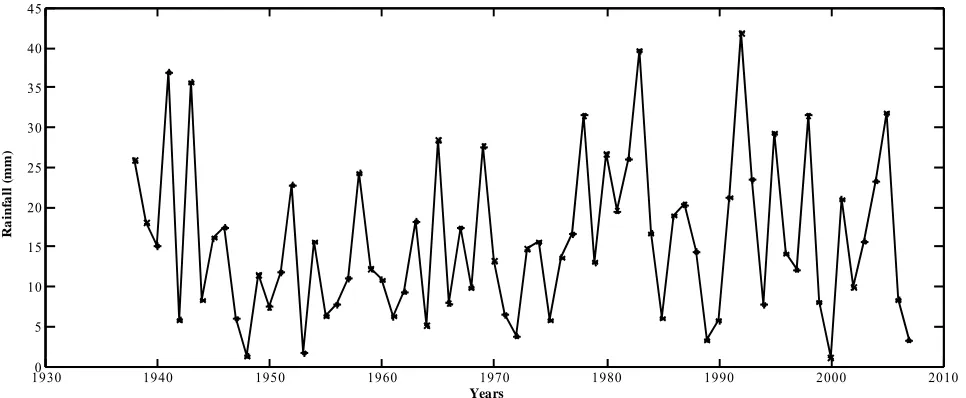
Figure 2. Variation of maximum annual rainfall.
shows the 70-year variation of MAR at Randsburg Sta- tion.
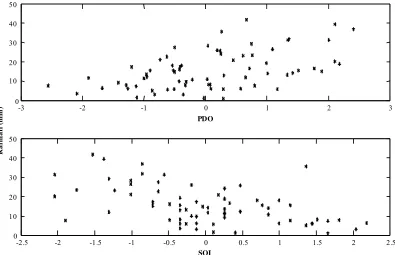
We consider the 70-year Southern Oscillation Index (SOI) and Pacific Decadal Oscillation (PDO) time series as covariates for MAR non-stationary quantile estimation. The SOI and PDO describe the pressure and temperature anomalies over the Pacific Ocean and have a clear impact on water systems in North America [14,29]. By using SOI and PDO as covariates in estimating the parameters of the GEV-B-Spline model, we will take into account the effect of multiannual climate fluctuations on extreme rainfall events. We first apply the Mann Kendall test to examine the existence of non-stationarity (Trend) in MAR time series. The result shows that the MAR is not stationary at 1% significant level. The Spearman’s rho correlation coefficient between the covariates and MAR is −0.52 and 0.51 for SOI and PDO respectively. These values are significant at the 5% level. Figure 3 shows the variation of maximum annual rainfall against SOI and PDO.
3.2. Model Development
For model development, the following function is first fitted:
GEV-B-Spline
MAR GEV f1 SOI f2 PDO , ,
1, 2
f f are independent spline functions, for which the degree and the number of nodes should be determined. In this application the number of nodes and the degree of the function are both chosen to take the value 3.
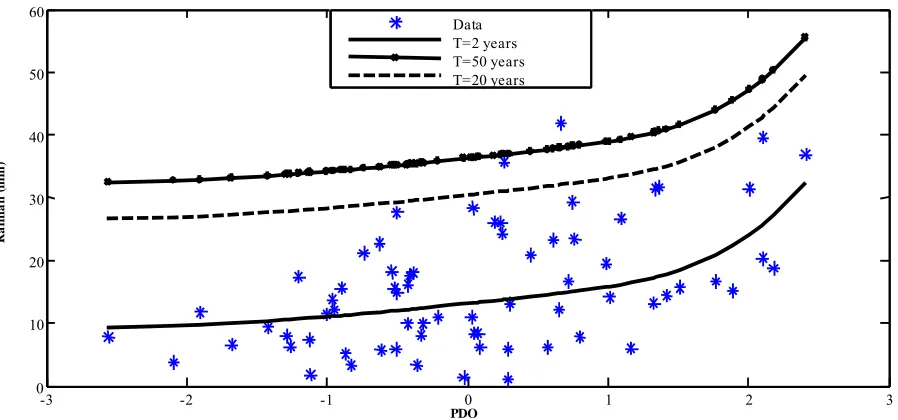
Table 1 shows the GEV-Spline parameters fitted to SOI and PDO time series using a Bayesian method. Fig- ures4 and 5 show the estimated 2, 20 and 50-year return period maximum rainfall quantiles as function of the
covariates (SOI and PDO). It can be seen that, generally, the SOI has a negative correlation with precipitation, while PDO is positively correlated with precipitation. The negative values of SOI (e.g. El Nino phase) and positive values of PDO (Warm Phase of PDO) coincide with the relatively high MAR observations. MAR quan- tiles increase slowly with increasing PDO values and then increase exponentially for PDO values greater than 1. On the other hand, different inflexion points, in the relationship between SOI and MAR are observed (for example at SOI = −1.5, SOI = 0 and SOI = 1.5), indicat- ing a more complex relationship between SOI and MAR than between PDO and MAR.
4. Parameter Estimation Comparison
In this section, we propose a comparison of the Bay- esian parameter estimation method for the GEV-B-Spline model (BAYES) and other estimation methods such as the conventional method of moments (MM) and the me- thod of maximum likelihood (ML). The theoretical back- grounds of these two methods for the GEV-B-Spline model are presented in Appendices 1 and 2, respectively. The comparison of these methods is carried out based on a simulation of MAR-SOI relationship only. The quantile with a non-exceedance probability 1 −p is computed for the maximum SOI using the parameters given by the Bayesian method (Table 1). The objective is to compare the quantile estimation methods for the quantiles esti- mated from 1000 samples of size generated from each estimation method. The parameter values cho- sen for simulation are
70
n
0 44.8, 1 2.6, 2 81.6, 3 53.6, 4 54.4 ;
7.2; 0.17 .
-2.5 -2 -1.5 -1 -0.5 0 0.5 1 1.5 2 2.5 0
10 20 30 40 50
SOI
-3 -2 -1 0 1 2 3
0 10 20 30 40 50
PDO
Rai
n
fa
ll
[image:6.595.102.497.86.341.2](mm)
[image:6.595.56.287.400.559.2]Figure 3. Annual maximum rainfall against SOI and PDO index.
Table 1. Bayesian estimation of the parameters of the mo- del.
Climate Index Parameter
SOI PDO
0
−114.728 11.355
1
48.112 44.616
2
147.695 0
3
116.138 4.556
4
158.933 7.932
5
0 −30.110
5.678 7.566
−0.124 0.145
The comparison is carried out using the bias and the root mean square error (RMSE) of quantile estimations at non-exceedance probabilities, 1 − p = 0.5, 0.8, 0.9, 0.99 corresponding to return periods of 2, 5, 10, 100. The re- sults are given in Table 2.
Results show that the Bayesian estimation for the GEV-B-Spline model in all cases represents the best re- sults. However, this estimation method requires large time-consuming numerical calculations and does not meet a convergence point easily. For our case, the MCMC me- thod details, such as the choice of numerical method burning period and number of iterations are the key points to the convergence of the MCMC algorithm. On the other
hand, even if the method of moments is the easiest method to implement, the corresponding results are largely un- satisfactory. The method of maximum likelihood, how- ever, is a compromise between the other two methods. It is interesting to note that for the case of low return periods,
i.e. T 2,T 5 and T 10 years, the maximum like- lihood method gives almost comparable results with the Bayesian estimation. However, the error of the ML me- thod increases rapidly with the increase in the return pe- riod and the method becomes increasingly less effective. Therefore, the Bayesian method leads to a superior per- formance for the estimation of the extreme rainfall quan- tiles for all return periods. The Bayesian method offers also a general framework to combine observed and sub- jective information and the possibility to estimate the entire predictive distribution of the parameters and quan- tiles.
5. Conclusions and Recommendations
-2.5 -2 -1.5 -1 -0.5 0 0.5 1 1.5 2 2.5 0
5 10 15 20 25 30 35 40 45
SOI
Data T=2 years T=50 years T=20 years
R
a
inf
a
ll
(
m
m
[image:7.595.70.523.88.294.2])
Figure 4. GEV-B-Spline estimators of the 2, 20 and 50-year return period quantiles conditional upon SOI.
-3 -2 -1 0 1 2 3
0 10 20 30 40 50 60
PDO Data T=2 years T=50 years T=20 years
R
a
in
fa
ll
[image:7.595.75.524.324.534.2](mm)
Figure 5. GEV-B-Spline estimators of the 2, 20 and 50-year return period quantiles conditional upon PDO.
Table 2. Comparison of estimation methods.
Probability BIAS RMSE
BAYES MM ML BAYES MM ML
0.5 0.020 −0.075 0.052 0.403 0.715 0.435
0.8 −0.060 −0.094 0.090 0.418 0.901 0.514
0.9 −0.148 0.249 −0.177 0.450 1.847 1.525
0.99 −0.182 −0.655 −0.448 0.826 3.128 2.879
B-spline model for hydro-meteorological variables. The Bayesian approach is general, flexible and connected with the decision theory. It combines observed and prior information, estimates the entire posterior distribution of the parameters and quantiles and thus allows to estimate
the credibility intervals.
[image:7.595.62.539.576.663.2]The evaluation for the quantile uncertainty using BIAS and RMSE criteria also indicated the superiority of the proposed method in comparison to other estimation me- thods, especially for high return period quantile estima- tion. However, the uncertainty of quantile estimation of low return periods does not show a significant difference between the bayesian and the maximum likelihood me- thod. On the other hand, one can see that the numerical calculation is the main disadvantage of these types of models when the number of covariates increases which may lead to divergence problem. The quantile regression model can be a good alternative to overcome this prob- lem [30,31]. Therefore, future work can focus on the comparison of extreme value models with regression quantiles in order to use different covariates in quantile estimations.
REFERENCES
[1] A. F. Jenkinson, “The Frequency Distribution of the An- nual Maximum (or Minimum) of Meteorological Ele- ments,” Quarterly Journal of the Royal Meteorological Society, Vol. 81, No. 348, 1955, pp. 158-171.
doi:10.1002/qj.49708134804
[2] T. N. Thiele, “Theory of Observations,” C. and E. Layton, London, 1903, pp. 165-308.
[3] R. A. Fisher, “Moments and Product Moments of Sam- pling Distributions,” Proceedings of the London Mathe- matical Society, Vol. 30, No. 1, 1929, pp. 199-238. doi:10.1112/plms/s2-30.1.199
[4] R. L. Smith, “Maximum Likelihood Estimation in a Class of Non-Regular Cases,” Biometrika, Vol. 72, No. 1, 1985, pp. 67-90. doi:10.1093/biomet/72.1.67
[5] J. Hosking, “L-Moments: Analysis and Estimation of Distributions Using Linear Combinations of Order Statis- tics,” Journal of the Royal Statistical Society, Series B, Vol. 52, No. 1, 1990, pp. 105-124.
[6] D. J. Dupuis, “Modeling Waves of Extreme Temperature: The Changing Tails of Four Cities,” Journal of the Amer- ican Statistical Association, Vol. 107, No. 497, 2012, pp. 24-39. doi:10.1080/01621459.2011.643732
[7] P. C. D. Milly, J. Betancourt, M. Falkenmark, R. M. Hirsch, Z. W. Kundzewicz, D. P. Lettenmaier and R. J. Stouffer, “Stationarity Is Dead: Whither Water Manage- ment?” Science, Vol. 319, No. 5863, 2008, pp. 573-574. doi:10.1126/science.1151915
[8] J. R. Olsen, J. R. Stedinger, N. C. Matalas and E. Z. Stakhiv, “Climate Variability and Flood Frequency Esti- mation for the Upper Mississippi and Lower Missouri Rivers,” Journal of the American Water Resources Asso- ciation, Vol. 35, No. 6, 1999, pp. 1509-1524.
doi:10.1111/j.1752-1688.1999.tb04234.x
[9] S. Coles, “An Introduction to Statistical Modeling of Ex- treme Values,” Springer, London, 2001.
[10] J. M. Cunderlik, V. Jourdain, T. B. M. J. Ouarda and B. Bobée, “Local Non-Stationary Flood-Duration-Frequency Modeling,” Canadian Water Resources Journal, Vol. 32,
No. 1, 2007, pp. 43-58. doi:10.4296/cwrj3201043
[11] S. El Adlouni, T. B. M. J. Ouarda, X. Zhang, R. Roy and B. Bobee, “Generalized Maximum Likelihood Estimators for the Nonstationary Generalized Extreme Value Mod- el,” Water Resources Research, Vol. 43, No. 3, 2007, W03410. doi:10.1029/2005WR004545
[12] Y. Hundecha, T. B. M. J. Ouarda and A. Bárdossy, “Re- gional Estimation of Parameters of a Rainfall-Runoff Model at Ungauged Watersheds Using the Spatial Struc- tures of the Parameters within a Canonical Physiographic- Climatic Space,” Water Resources Research, Vol. 44, No. 1, 2008, W01427. doi:10.1029/2006WR005439
[13] S. El Adlouni and T. B. M. J. Ouarda, “Joint Bayesian Model Selection and Parameter Estimation of the Gener- alized Extreme Value Model with Covariates Using Birth-Death Markov Chain Monte Carlo,” Water Re- sources Research, Vol. 45, No. 6, 2009, W06403. doi:10.1029/2007WR006427
[14] A. Cannon, “A Flexible Nonlinear Modelling Framework for Nonstationary Generalized Extreme Value Analysis in Hydroclimatology,” Hydrological Process, Vol. 24, No. 6, 2010, pp. 673-685. doi:10.1002/hyp.7506
[15] J. M. Cunderlik and T. B. M. J. Ouarda, “Regional Flood- Duration—Frequency Modeling in a Changing Environ- ment,” Journal of Hydrology, Vol. 318, No. 1-4, 2006, pp. 276-291. doi:10.1016/j.jhydrol.2005.06.020
[16] M. Leclerc and T. B. M. J. Ouarda, “Non-Stationary Re- gional Flood Frequency Analysis at Ungauged Sites,” Journal of Hydrology, Vol. 343, No. 3-4, 2007, pp. 254- 265. doi:10.1016/j.jhydrol.2007.06.021
[17] S. El Adlouni and T. B. M. J. Ouarda, “Comparison of Methods for Estimating the Parameters of the Non-Sta- tionary GEV Model,” Revue des Sciences de l’Eau, Vol. 21, No. 1, 2008, pp. 35-50.
[18] V. Chavez-Demoulin and A. Davison, “Generalized Ad- ditive Modeling of Sample Extremes,” Applied Statistics, Vol. 54, No. 1, 2005, pp. 207-222.
doi:10.1111/j.1467-9876.2005.00479.x
[19] C. De Boor, “A Practical Guide to Spline,” Springer, London, 2001, 208 pp.
[20] H. G. Müller and J. L. Wang, “Density and Failure Rate Estimation,”In: F. Ruggeri, R. Kenett and F. W. Faltin, Eds., Encyclopedia of Statistics in Quality and Reliability, Wiley, Chichester, 2007, pp. 517-522.
[21] S. A. Padoan and M. P. Wand, “Mixed Model-Based Ad- ditive Models for Sample Extremes Statistics and Prob- ability,” Letters, Vol. 78, No. 17, 2008, pp. 2850-2858. [22] R. A. Fisher and L. H. C. Tippett, “Limiting Forms of the
Frequency Distribution of the Largest or Smallest Mem- ber of a Sample,” Proceedings of the Cambridge Philos- ophical Society, Vol. 24, No. 2, 1928, pp. 180-190. doi:10.1017/S0305004100015681
[23] E. S. Martins and J. R. Stedinger, “Generalized Maximum Likelihood GEV Quantile Estimators for Hydrologic Data,” Water Resources Research, Vol. 36, No. 3, 2000, pp. 737-744. doi:10.1029/1999WR900330
Extreme Value Geoadditive Model Analysis via Mean Field Variational Bayes,” Australian and New Zealand Journal of Statistics, Vol. 53, No. 3, 2011, pp. 305-330. doi:10.1111/j.1467-842X.2011.00637.x
[25] N. Metropolis, A. Rosenbluth, M. Rosenbluth, A. Teller and E. Teller, “Equation of State Calculations by Fast Computing Machines,” The Journal of Chemical Physics, Vol. 21, No. 6, 1953, pp. 1087-1092.
[26] W. K. Hastings, “Monte Carlo Sampling Methods Using Markov Chains and Their Applications,” Biometrika, Vol. 57, No. 1, 1970, pp. 97-109. doi:10.1093/biomet/57.1.97 [27] W. R. Gilks, S. Richardson and D. J. Spiegelhalter, “Mar-
kov Chain Monte Carlo in Practice,” Chapman and Hall, London, 1996.
[28] S. El Adlouni, A. C. Favre and B. Bobée, “Comparison of Methodologies to Assess the Convergence of Markov
Chain Monte Carlo Methods,” Computational Statistics and Data Analysis, Vol. 50, No. 10, 2006, pp. 2685-2701. doi:10.1016/j.csda.2005.04.018
[29] D. P. Brown and A. C. Comrie, “Sub-Regional Seasonal Precipitation Linkages to SOI and PDO in the Southwest United States,” Atmospheric Science Letters, Vol. 3, No. 2-4, 2002, pp. 94-102. doi:10.1006/asle.2002.0057 [30] M. Buchinsky, “The Dynamics of Changes in the Female
Wage Distribution in the USA: A Quantile Regression Approach,” Journal of Applied Econometrics, Vol. 13, No. 1, 1998, pp. 1-30.
Appendix 1: GEV-B-Spline Moment
Let Y be a random variable that follows a GEV distribu- tion therefore:
GEV x, ,
Y (A1) With x f X
0 1
n n
i i
i i
is a parameter that depends on a covariate X.
i i
0f x
B x B x
0iB xi
(A2)
B is a spline basis function. Where
1
n
i
f x
(A3) And thus
0x iB xi
1 n i
0
V , ,
(A4) Then
1 GE n i i iZ Y B x
(A5)The following equations are used to estimate the pa- rameters 0, , :
2 2.9554 c c
ˆ 7.8590 (A6)
2 ˆ ˆ ˆ 1 l ˆ 1 2
(A7)
0 1
ˆ ˆ
l 1 1 ˆ
(A8) With
3 3 1 2 1 0 1 2 log 2 2 ,3 log 3
, 1 2 6 1 2 1 , 2 1 1
n i i
i i n j j c t y c y n t l i i c
n n n
l b y
n j l y n n
2 1 1 6 1 1 n n i i j j i n n y n
(A9)The other i
Appendix 2: GEV-B-Spline Maximum
Likelihood
Let Y be a random variable that follows a GEV distribu- tion therefore:
values are estimated using the linear regression between Y and the basis matrix B of the B-spline corresponding to the covariates.
GEV x, ,
Y (A10)
fWith x X
0
0 1
n n
i i i i
i i
is a parameter that depends on a covariate X.
x B x B x
f (A11)
B is a spline basis function.
The maximum likelihood (ML) function is written as
1 1 1 1 1 1 1 , , 1 exp 1 1 1exp exp exp
n x n t t t t t n
t t t t
t n L y y y y y
n 0 (A12) 1 is the number of observations when
0
.
, the log-likelihood function is: In the case of
1 1 1 ; , , log 1 1 1 log 1n x n t t t n t t t l y y n y
1, 1m p
(A13)
The ML estimators are the solution of an equation system formed by setting to zero the partial derivates of (A13) with respect to each parameter.
In the case of one covariate and , we have 4 parameters to estimate
0, , ,1
1
0 1,1 1
1
0 1,1 1
1
; , ,
log 1
1
1 log 1
n x n t t t n t t t l y
y B x
n
y B x
0, , ,1
1 1
0 1,1
1
1
0 1,1 1
1
1
1 0
1
1,1 1
1
0 ln 1
1
0 0
1
0 0
1 0
n
t t
n t
t t
t t
n
t t
n t
t t
n
n t
t t
n t
t t
y B
l w
w w
w
y B x
l w
n
w
l w
w
l w
B x
w
1
0
n
t
1 0 x
(A15)
where
1
1 xt 1 0 1,
1 t
t
y B
w
(A16)