Munich Personal RePEc Archive
The Power Performance of Fixed-T
Panel Unit Root Tests allowing for
Structural Breaks
Karavias, Yiannis and Tzavalis, Elias
University of Nottingham, Granger Centre for Time Series
Econometrics, Athens University of Economics and Business
9 April 2013
Online at
https://mpra.ub.uni-muenchen.de/46012/
The power performance of …xed-
T
panel unit root
tests allowing for structural breaks
Yiannis Karavias
aand Elias Tzavalis
bAbstract
The asymptotic local power of least squares based …xed-T panel unit root tests allowing for a structural break in their individual e¤ects and/or incidental trends of the AR(1) panel data model is studied. These tests correct the least squares estimator of the autoregressive coe¢cient of this panel data model for its inconsistency due to the individual e¤ects and/or incidental trends of the panel. The limiting distributions of the tests are analytically derived under a sequence of local alternatives, assuming that the cross-sectional dimension of the tests (N) grows large. It is shown that the considered …xed-T tests have local power which tends to unity fast only if the panel data model includes individual e¤ects. For panel data models with incidental trends, the power of the tests becomes trivial. However, this problem does not always appear if the tests allow for serial correlation of the error term.
JEL classi…cation: C22, C23
Keywords: Panel data, unit root tests, structural breaks, local power, serial corre-lation, incidental trends
a:School of Economics and Granger Centre for Time Series Econometrics, Univer-sity of Nottingham.Corresponding author. UniverUniver-sity Park, Nottingham NG7 2RD, UK. Tel: +441159515480. E-mail: [email protected].
b:Department of Economics, Athens University of Economics & Business. E-mail: [email protected]
1
Introduction
There is recently growing interest in developing panel data unit root tests allowing for a break
in their deterministic components, namely in their individual e¤ects and/or individual linear
trends (see, Carrion-i-Silvestre et al. (2005),Harris et al (2005), Karavias and Tzavalis (2012,
2013),Chan and Pauwels (2011), Bai and Carrion-i-Silvestre (2012), Hadri et al. (2012) and
Pauwels et al. (2012)). As is aptly noted by Perron (1989) in the single time-series literature,
not accounting for a break point in the level and/or deterministic trend of economic series
can lead to a unit root test which can hardly reject the null hypothesis of unit roots from
its alternative of stationary series. Panel unit root tests su¤er from this problem too.
This paper investigates the power properties of …xed-T panel unit root tests that allow
for structural breaks. These tests are appropriate for panels with few time series
observa-tions and many cross-section units, often met in practice (see, e.g., Arellano (2003)). The
asymptotic theory employed consider the time dimension (T) as …xed and its cross section
dimension (N) as going to in…nity. In particular, the paper studies the asymptotic local
power of Harris’ and Tzavalis (1999) and Karavias’ and Tzavalis (2012) panel unit root tests
allowing for a structural break in their deterministic components. The …rst (denoted asHT)
was extended by Karavias and Tzavalis (2013) to allow for structural breaks. The second
(denoted as KT) allows, in addition to structural breaks, for serial correlation in the error
term of the individual series of the panel.1 Both the above tests are based on the least
squares (LS) estimator of the autoregressive coe¢cient of the AR(1) panel data model. This
estimator is corrected for its inconsistency due to the individual e¤ects (both individual
in-1Note that a version of the KT test for the case of no structural breaks has been suggested by Kruiniger
tercepts and individual intercepts along with incidental trends are considered) of the panel.
In the case that the error term is serially correlated, the LS estimator must be also corrected
for its inconsistency due to the serial correlation of the error term. The latter can be easily
done in the framework considered by Karavias and Tzavalis (2012) (see KT test), which
adjusts the LS estimator of the autoregressive coe¢cient of the AR(1) panel data model
only for the inconsistency of its numerator.
The paper makes a number of contributions into the literature of panel data unit root
tests, which have important practical implications. First, it shows that, for the standard
panel data model with individual intercepts, theHT test has higher asymptotic local power
than the KT test. This happens because theHT does not require a consistent estimator of
the variance of the error term, compared to the KT test. The HT test is invariant to this
nuisance parameter, as it adjusts the LS estimator for its inconsistency of both its numerator
and numerator. Second, the paper shows that, as with panel unit root tests that do not allow
for a break, the HT and KT tests have trivial asymptotic local power if incidental trends
are included in the deterministic components of the AR(1) panel data model. The allowance
for a break in the deterministic components of this model does not save the tests from this
problem. Third, the tests can increase their power if they allow for serial correlation of the
error term. In this case, the KT test can have non-trivial asymptotic local power, even
for the panel data model with incidental trends. The increase of the power of this test in
this case can be attributed to the serial correlation e¤ects on the inconsistency correction
of the LS estimator. The above results are con…rmed through a Monte Carlo exercise. This
exercise also provides interesting small sample results on the power performance of the tests
and shows the usefulness of the asymptotic approximation.
generat-ing process required by the two tests considered. Section 3 derives the limitgenerat-ing distributions
of the tests. For the KT test allowing for serial correlation e¤ects, this is done in Section
4. Section 5 carries out the Monte Carlo exercise. Section 6 concludes the paper. All proofs
are given in the appendix.
2
Models and Assumptions
Consider the following AR(1) dynamic panel data models allowing for a common structural
break in their deterministic components (individual e¤ects and/or individual linear trends)
at time pointT0, for all individual units of the paneli:
M1: yi =a(1)i e(1)+a(2)i e(2)+ i; i= 1;2; ::; N,
M2: yi =a(1)i e(1)+a(2)i e(2)+ (1)i (1)+ (2)i (2)+ i; i= 1; :::; N
where
i =' i 1+ui;
' 2 ( 1;1], yi = (yi1; :::; yiT)0 and yi = (yi0; :::; yiT 1)0 are (T X1) vectors, ui = (ui1; :::; uiT)
is the (T X1) vector of error terms uit, ai and i denote the individual e¤ects and slope
coe¢cients of the linear (incidental) trends of the panel. In particular, ai is de…ned as
ai = a(1)i if t T0 and ai = ai(2) if t > T0, while e(1) and e(2) are (T X1)-column vectors
de…ned as follows:e(1)t = 1 if t T0 and 0 otherwise, and e(2)t = 1 if t > T0 and 0 otherwise.
Slope coe¢cients i are de…ned as i = (1)i if t T0 and i =
(2)
i if t > T0, while (1) and (2) are (T X1)-column vectors de…ned as follows: (1)
(2)
t =t if t > T0, and zero otherwise. Throughout the paper, we will denote the fraction of
the sample that the break occurs as , i.e. = T0
T 2I =
2
T;
3
T; :::::; T 1
T .
The above models nest in the same framework both the null hypothesis of unit roots in
', i.e., '= 1, and its alternative of stationarity,' < 1. They can be written in a nonlinear
form as follows:
yi = 'yi 1 + (1 ')(a(1)i e(1)+a
(2)
i e(2)) +ui; i= 1;2; :::; N and yi = 'yi 1 +' (1)i e(1)+'
(2)
i e(2)+ (1 ')(a
(1)
i e(1)+a
(2)
i e(2)) + (1 ')(
(1)
i (1)+
(2)
i (2)) +ui;
respectively. The "within group" least squares (LS) (known also as least squares dummy
variables (LSDV)) estimator of autoregressive coe¢cient ' of the models can be written as
follows:
^
'( )m =
N
X
i=1
y0
i 1Q( )m yi 1
! 1 N
X
i=1
y0
i 1Q( )m yi
!
, m =f1;2g;
where Q( )m is the (T XT) “within” transformation (annihilator) matrix of the individual
series of the panelyit. Q( )m is de…ned asQ( )m =I Xm( ) Xm( )0Xm( )
1
Xm( )0, for m=f1;2g,
whereX1( ) = e( ); e(1 ) for modelM1andX( )
2 = e( ); e(1 ); ( ); (1 ) for modelM2.
This estimator is inconsistent due to the within transformation of the data, which wipes o¤
the individual e¤ects and/or incidental trends of the panel, as well as its initial conditions
yi0. Thus, …xed-T panel unit root tests based on it must rely on a correction of estimator
^
'( )m for its inconsistency (asymptotic bias) (see, e.g., Harris and Tzavalis (1999, 2004)). To
study the asymptotic local power of these tests, de…ne the autoregressive coe¢cient ' as
'N = 1 pc
N. Then, the hypotheses of interest become
where c is the local to unity parameter. The limiting distributions of the tests based on
LSDV estimator'^( )m will be derived under the sequence of local alternatives'N, by making
the following quite general assumption:
Assumption 1: (b1) fuig constitutes a sequence of independent normally distributed
random vectors of dimension (T X1) with means E(ui) = 0 and variance-autocovariance
matrices E(uiu0
i) = [ ts], 8 i 2 f1;2; :::; Ng, where ts = E(uituis) = 0 for s = t+pmax+ 1; :::; T and t < s. (b2) tt >0 for at least one t= 1; :::; T: (b3) The4 + th
population moments of yi; i = 1; :::; N are uniformly bounded. That is, for every l 2
RT such that l0l = 1; E(jl0 yij4+ ) < B < +1 for some B, where is the di¤erence
operator. (b4) l0V ar(vec( yi y0
i)l > 0 for every l 2 R0:5T(T+1) such that l0l = 1. (b5) E(uityio) = E uita(1)i = E uita(2)i = 0 and 8 i 2 f1;2; :::; Ng; t 2 f1;2; :::; Tg: (b6)
E uit (1)i = E uit (2)i = 0; 8 i 2 f1;2; :::; Ng; t 2 f1;2; :::; Tg; E(a( )it ( )it ) = 0; 8
i2 f1;2; :::; Ng.
Assumption 1 enables us to derive the limiting distribution of the …xed-T panel data unit
root tests of Harris and Tzavalis (1999, 2004) (denoted as HT), based on LS estimator'^( )m
(denoted as HT), as was extended by Karavias and Tzavalis (2012) to allow for a common
break in the deterministic components of modelsM1 and M2. It also allows the derivation
of this limiting distribution for Karavias’ and Tzavalis (2012) …xed-T panel data unit root
tests (denoted asKT), based on'^( )m , allowing for a structural break under heteroscedasticity
and/or serial correlation of error term uit. Condition (b1) of the assumption permits the
variance matrix of error termsuit, =E(uiu0
i), to have general form heteroscedasticity and
serial correlation. The latter is assumed to have maximum order pmax; which is less than
Assumption 1 is consistent with the assumptions of Harris and Tzavalis (1999) panel data
unit root tests, considering the simpler case ofuit IID(0; 2
u).
Conditions (b2)-(b4) qualify application of the Markov LLN and the Lindeberg -Levy
central limit theorem (CLT) to derive the limiting distribution of the HT and KT tests, as
N ! 1, under the assumptions of condition (b1). More speci…cally, conditions (b2) and
(b4) guarantee regularity so that the variance of the errors and its estimator will not be
zero. Condition (b3) implies that V ar(yi0) < +1, which is consistent with assumptions
like constant, random and mean stationary initial conditions yi0. Covariance stationary of
yi0, implying V ar(yi0) =
2
1 '2
N (see Kruiniger (2008) and Madsen (2010)) is not considered.
This is because, as is also aptly noted by Moon et al. (2007), this assumption implies that
V ar(yi0)! 1when'N !1, which means that the variance of the initial condition increases
with the number of cross-section units. This is not meaningful for cross-section data sets.
Finally, (b5)-(b6) constitute weak conditions under which the limiting distribution of the
tests can be derived when c >0; (b5) is required for Model M1, while (b6) for modelM2.
Under these two conditions, the limiting distribution of the tests under Ha: c >0 becomes
invariant to nuisance parametersai and i, as well as the initial conditions yi0 of the panel.
To study the asymptotic local power of the tests, we will rely on the slope parameter,
denoted as k;of local power functions of the form
(za+ck),
where is the standard normal cumulative distribution function andza denotes the -level
percentile. Since is strictly monotonic, a largerk means greater power, for the same value
trivial power, which is equal to a, and if it is negative they will be biased.
3
The limiting distribution of the tests if
u
itN IID
(0
;
2)
This section presents the limiting distribution of the HT and KT test statistics under the
sequence of local alternatives 'N = 1 pc
N. The HT test corrects both the numerator
and denominator of LS estimator '^( )m for its inconsistency, while the KT corrects only
the numerator of '^( )m . This enables the KT test to be easily extended to allow for serial
correlation in error termsuit. But, in contrast toHT, this test statistic requires a consistent
estimator of the variance of uit, 2
u, to adjust for the inconsistency of estimator '^( )m .
3.1
Model
M
1
For model M1, the HT test allowing for a break is based on the following statistic:
VHT;( ) 11 =2pN(^'( )1 1 B1( )),
where B1( ) = plim(^'( )1 1) =
tr( 0Q( )
1 )
tr( 0Q( )
1 )
is the inconsistency of LS estimator '^( )1 under
H0: c = 0, VHT;( )1 =
2tr(A( )2HT ;1)
tr( 0Q( )
1 )2
, with A( )HT;1 = 12( 0Q( )
1 +Q ( )
1 ) B1( )( 0Q( )1 ), is the
variance of the limiting distribution of the corrected for its inconsistency estimator '^( )1 , i.e.
(^'( )1 1 B1( )). The KT test is based on statistic
VKT;( ) 11 =2^1( )pN '^( )1 ^b
( ) 1
^( )
1
1
!
where ^b( )1
^( )1
^2utr( 0Q
( ) 1 ) 1
N
PN i=1y0i; 1Q
( ) 1 yi 1
is also consistent estimator of the inconsistency of '^( )1 ,
which relies on a consistent estimator of its numerator, ^( )1 = N1 PNi=1y0
i; 1Q ( )
1 yi; 1 is the
denominator of '^( )1 scaled by N, VKT;( )1 = 2 4
utr(A
( )2
KT;1), with A ( )
KT;1 = 12( 0Q ( ) 1 +Q
( ) 1
( ) 1
( )0
1 ), is the variance of the limiting distribution of '^ ( ) 1
^b( ) 1
^( )1 1 , where ( ) 1 is a
(T XT)-dimension matrix having in its main diagonal the corresponding elements of matrix
0Q( )
1 , and zeros elsewhere, implying tr( ( )
1 ) = tr( 0Q ( )
1 ). This matrix is designed so as,
in adjusting the numerator of estimator'^( )1 for its inconsistency, to subtract from it sample
moments of it which capture its inconsistency e¤ects due to the within transformation of the
individual series yit of the panel. This means that the following sum of population moments
are left for inference about null hypothesis H0: c= 0:
Ehu0
i( 0Q
( ) 1
( ) 1 )ui
i
= 0, for all i.
For modelM1, this sum of moments implies a consistent estimator of variance 2
u under null
hypothesis H0: c= 0, which can be taken as ^2u =
PN i=1 y0i
( ) 1 yi
N tr( ( )1 ) , where is the di¤erence
operator.2
In the next theorem, we give the limiting distribution of the HT and KT statistics,
de…ned above for model M1, under the sequence of local alternatives'N = 1 pc N.
Theorem 1 Let conditions (b1)-(b5) of Assumption 1 hold and uit N IID(0; 2). Then,
2It can be easily seen that, underH0: c= 0, we haveplim ^2
u=plimtr( 1( ) 1 )N
PN i=1tr(
( )
1 yi y0i) =
2
u
tr( 0Q( )
1 ) tr( ( )1 )
= 2
u, sincetr(
( )
under 'N = 1 pc
N, we have
VHT;( ) 11 =2pN(^'( )1 1 B1( ))
d
!N( ckHT;1;1)
and VKT;( ) 11 =2^( )pN '^( )1 ^b
( ) 1
^( )
1
1
!
d
!N( ckKT;1;1);
as N ! 1, where
kHT;1 =
T(T 2) T2(3 2 3 + 1) 1
4T2(2 2 2 + 1) 8
s
T4
1+T2 2+ 240
T6R
1+T5R2 +T4R3+T2R4+ 216T 136
and kKT;1 =
p
3(T 2)
q
T2(2 2 2 + 1) + 6T + 10 4( T1+2( 1) T)
( 1)
;
where R1; R2; R3; R4 and 1; 2 are polynomials of de…ned in the appendix (see proof of
the theorem).
The limiting distributions given by Theorem 1 imply that the asymptotic local power
function of test statistics HT and KT depend on the values of slope parameters kHT and
kKT, respectively. In Table 1, we present values of these parameters, for di¤erent values of
T and . The results of these tables indicate that the asymptotic local power behavior of
the two tests is di¤erent. The HT test has much higher power than the KT. The power of
the test is much bigger when the break is in the beginning or towards the end of the sample,
i.e. = f0:25;0:75g:3 On the other hand, the power of the KT test reaches its maximum
point when the break is in the middle of the sample, = f0:50g. The power of the HT
test increases with T, i.e. kHT;1 = O(T). The power of the KT test increases with T for
3Analogous evidence is provided for single time series unit root tests allowing for breaks, based on a model
relatively small T. As T grows large, the test has no power gains. This can be seen from
limT kKT;1 =
p
3
p
2 2 2 +1; which is independent ofT. These results can be more clearly seen
by the three-dimension Figures 1 and 2, presenting values of kHT;1 and kKT;1, for di¤erent
values of and T.
The above di¤erences between the HT and KT tests can be attributed to the way that
each test corrects for the inconsistency of the LS estimator '^( )1 . As mentioned before,
the HT test is based on a correction of LS estimator '^( )1 for the inconsistency of both its
numerator and denominator. On the other hand, the KT test is based on an adjustment
of estimator '^( )1 only for the inconsistency of its numerator, which additionally requires a
consistent estimator of the variance of error term uit, 2
u. The later reduces the local power
of the test. Finally, another interesting result of Theorem 1 is that, under the sequence of
local alternatives considered, the break function parameters do not enter the asymptotic
distribution of both tests. Thus, the magnitude of the break does not a¤ect local power
of the tests. Furthermore, local power is also robust to the initial condition asymptotically,
which means that its magnitude also does not a¤ect the power of the test (see also Harvey
and Leybourne (2005) and Harris et al. (2010)).
Scaling appropriately theHT andKT test statistics byT and assuming thatT,N ! 1,
with pTN ! 0, it can be shown (see appendix) that, under 'N;T = 1 TpcN, the limiting
distributions of the large-T versions of the tests are given as follows:
under 'N;T = 1 Tpc
N, we have
VHT;( ) 11 =2TpN(^'( )1 1 B1( ))
L
!N ckHT;1;1 ;
and VKT;( ) 11 =2^( )TpN '^( )1 ^b
( ) 1
^( )
1
1
!
d
!N ckKT;1;1 ;
as T,N ! 1, with
p
N
T !0, where
kHT;1 = 3
2 3 + 1
4(2 2 2 + 1)
r 1
R1
and kKT;1 = 0, (1)
and
VHT;( )1 = 36R1
1(2 2 2 1)2
and VKT;( )1 = 36(2
4
4 3+ 3 2 ) 12( 1) (2 2 2 + 1)2
respectively denote the local power slope coe¢cients and the variances of the limiting
distri-butions of the large-T versions of the HT and KT test statistics.
Values of power slope coe¢cients kHT;1 and kKT;1, for di¤erent values of , are reported
in Table 2. These indicate that, in contrast to the HT test, the large-T extension of the
KT test does not have asymptotic local power.4 This test can be thus thought of as more
appropriate for short panels. The results of the table also indicate that the large-T extension
of theHT test has less power than its …xed-T version. It is also found that power takes its
highest values in the beginning and towards the end of the sample, i.e., for =f0:10,0:90g,
as for its …xed-T version. The smaller power of the large-T versions of the tests, compared
to their …xed-T ones can be attributed to the faster rate of convergence of the alternative
hypotheses to the null, i.e. 'N;T = 1 Tpc
N compared to 'N = 1 c
N (see also Harris et al.
(2010)).
3.2
Model
M
2
For model M2, which additionally considers incidental trends in the deterministic
compo-nents of individual panel series yit, the HT and KT test statistics are de…ned analogously
to those for model M1: The HT test admits the same formulas, but with Q( )2 instead of
Q( )1 , B2( ) = plim(^'( )2 1) =
tr( 0Q( )
2 )
tr( 0Q( )
2 )
denotes the inconsistency of LS estimator '^( )2 ,
VHT;( )2 = 2tr(A
( )2
HT ;2)
tr( 0Q( )
2 )2
, withA( )HT;2 = 1 2( 0Q
( ) 2 +Q
( )
2 ) B2( )( 0Q( )2 ), is the variance of the
limiting distribution of (^'( )2 1 B2( )). However, for the KT test, ^2u =
PN i=1 y0i
( ) 1 yi
N tr( ( )1 )
is no longer a consistent estimator of 2
u in the case of model M2, due to the presence of
individual coe¢cients (e¤ects) i under null hypothesis H0: c= 0 implying
1
N N
X
i=1
E( yi y0i) =
(1)
N e
(1)e(1)0 + (2)
N e
(2)e(2)0+ 2
uI; (2)
where (1)N = N1 PNi=1E(( (1)i )2) and (2)
N = N1
PN i=1E((
(2)
i )2): To render theKT test
statis-tic invariant to these e¤ects, Karavias and Tzavalis (2012) suggested the following estimator
of 2
u:
^2u =
PN i=1 yi0
( ) 2 yi
N tr( ( )2 ) ;
with
( )
2 =
( )
2 +
tr( 0Q( )
2 M(1))
trace(M(1)J 1)
M(1)+ tr(
0Q( )
2 M(2))
trace(M(2)J 2)
M(2), (3)
where ( )2 is a diagonal matrix of (T XT)-dimension having in its main diagonal the elements
of the main diagonal of the matrix 0Q( )
2 , J1 = e(1)e(1)0 and J2 = e(2)e(2)0 and M(1) =
J1 diagfe(1)g and M(2) =J2 diagfe(2)g, where diagfe(r)g, r =f1;2g, are matrices that
e(r). Matrix ( )
2 plays the same role as ( )
1 , for theKT test statistic in the case of modelM1.
It provides an estimator of 2
u which enables us to correct the numerator of LS estimator'^
( ) 2
for its inconsistency, due to the within transformation of the individual series of the panel,
while in parallel providing a number of sample moments upon which inference about unit
roots can be drawn. This implies that the variance of the limiting distribution of the adjusted
for its inconsistency estimator '^( )2 1 ^b( )2
^( ) 2
will be given as VKT;( )2 = 2 4
utr(A
( )2
KT;2), with
A( )KT;2 = 1 2( 0Q
( ) 2 +Q
( ) 2
( ) 2
( )0
2 ).
The next theorem derives the limiting distribution of the HT and KT statistics under
the sequence of local alternatives local alternatives'N = 1 pc
N.
Theorem 2 Let conditions (b1)-(b6) of Assumption 1 hold and uit N IID(0; 2). Then,
under 'N = 1 pc
N, we have
VHT;( ) 12 =2pN(^'( )2 1 B2( ))
L
!N( ckHT;2;1) and
VKT;( ) 12 =2^( )2 pN '^( )2 1 ^b
( ) 2
^( )
2 !
d
!N( ckKT;2;1);
as N ! 1, where
kHT;2 = 0 and kKT;2 = 0.
The results of the theorem indicate that the well known incidental trends problem of
panel data unit root tests (see e.g. Moon et al. (2007)) also exists even if the tests allow for
break and T is …xed. Both the HT and KT test statistics have trivial power. This result
4
Power of the
KT
tests if error terms
u
itare serially
correlated
In this section, we consider the case that the variance-covariance matrix of error termsuit has
a more general form than = 2
uI, assumed in the previous section. That is, we assume that
= [ ts], where ts =E(uituis) = 0 fors=t+pmax+ 1; :::; T andt < s. This means thatuit
allow for heteroscedasticity and serial correlation of maximum lag order pmax. Our analysis
enables us to investigate the combined e¤ects of a structural break and serial correlation in
uit on the asymptotic local power of panel unit roots. As only the KT test is extended to
allow for serially correlated errors uit (see, e.g., Karavias and Tzavalis (2012)), our analysis
will be focused on this test.
For both models M1and M2, the KT test statistic under the above assumptions about
uit has analogous forms to those presented in the previous section. What changes is that,
in order to take into account for an p-order serial correlation in uit which will be appeared
in the p-upper and p-lower secondary diagonals of matrix , selection matrices ( )1 and
( )
2 now are de…ned as (T XT)-dimension matrices having in their main diagonals and their
p-lower andp-upper diagonals the corresponding elements of matrices of 0Q( )
1 and 0Q ( ) 2 ,
respectively, Thus, they will be henceforth denoted by the subscript "p", as ( )p;1 and ( )p;2.
Furthermore, in the same reasoning, matrix Mp(1) has elements m(1)ts = 0 if ts 6= 0, and
m(1)ts = 1 if ts = 0, matrix Mp(2) has elements mts(2) = 0 if ts 6= 0, and m2ts = 1 if ts = 0.
For modelM2, the corresponding matrix to ( )2 now will be denoted with the subscript "p"
as
( )
p;2 = ( )
p;2 +
tr( 0Q( )
2 M (1)
p ) trace(Mp(1)J1)
Mp(1)+tr(
0Q( )
2 M (2)
p ) trace(M(2)J
2)
where matrix Mp(1) selects the elements of matrix (1)N e(1)e(1)0 + (2)N e(2)e(2)0 + consisting
only of individual slope coe¢cient e¤ects (1)N , for t; s T0. For t or s > T0, all elements
of Mp(1) are set to m(1)ts = 0. On the other hand, matrix M
(2)
p selects the elements of matrix
(1)
N e(1)e(1)0 +
(2)
N e(2)e(2)0+ consisting only of e¤ects
(2)
N ; for t; s > T0.
For both models M1 and M2, the consistent estimator of the inconsistency of the LS
estimator '^( )m for the KT test is de…ned as
^b( ) 1
^( )
1
= tr(
( )
p;1^) 1
N
PN
i=1yi;0 1Q ( ) 1 yi; 1
and ^b
( ) 2
^( )
2
= tr(
( )
p;2^) 1
N
PN
i=1yi;0 1Q ( ) 1 yi; 1
respectively, where ^ = 1
N
PN
i=1 yi yi0 constitutes an estimator of variance-covariance
ma-trix under null hypothesis H0: c = 0. This is consistent for model M1. For model M2,
it is premultiplied by matrix ( )p;2 to become net of the individual e¤ects (1)N and (2)N . The
variance of the limiting distribution of the adjusted for its inconsistency estimator '^( )m ,
^
'( )m
^b( )
m
^( )
m
1 , is given as VKT;( )1 = 2tr (A( )KT;1 )2 , with A( )
KT;1 = 12( 0Q ( ) 1 +Q
( ) 1
( )
p;1
( )0
p;1), for modelM1, andV ( )
KT;2 = 2tr (A ( )
KT;2 )2 , withA ( )
KT;2 = 12( 0Q ( ) 2 +Q
( ) 2
( )
p;2
( )0
p;2 ), for modelM2. 5
In the next theorem, we provide the limiting distribution of the KT test under the
sequence of local alternatives'N = 1 pc
N, for model M1allowing for serial correlation in uit. As shown in Karavias and Tzavalis (2012), the limiting distribution of the test for this
model can be derived assuming that the maximum order of serial correlation of uit,pmax, is
given as
pmax = [T =2 2] ;
5Note that, for notation simplicity, subscript "p" is suppressed from the notation of^b( )
where [:] denotes the greatest integer function.
Theorem 3 Let conditions (b1)-(b5) of Assumption 1 hold. Then, under 'N = 1 pcN, we
have
VKT;( ) 11 =2^1( )pN '^( )1 ^b
( ) 1
^( )
1
1
!
d
!N( ckKT;1;1), for model M1,
as N ! 1, where
kKT;1 =
tr(F0Q( )
1 ) +tr( 0Q ( )
1 ) tr(
( )
p;1 ) tr( 0 ( )
p;1 ) q
2tr((A( )KT;1 )2)
.
The results of the theorem indicate that the asymptotic local power of the KT test now
depends also on the values of the variance-covariance parameters ts, a¤ecting the power
slope parameter kKT;1. This can increase, or reduce, the local power of the test depending
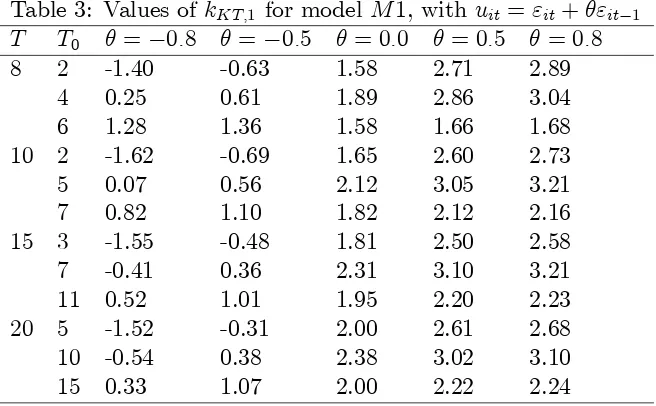
on the sign of ts. To see this more clearly, in Table 3, we present estimates of the power
slope parameterkKT;1 assuming that error terms uit follow a MA(1) process:
uit="it+ "it 1,
where "it N IID(0; 2
"). Note that the table also considers the case that = 0 (i.e., there
is no serial correlation), but the KT test allows for serial correlation of order p = 1. This
case can show if the KT test loses signi…cant power if a higher order of serial correlation p
is assumed than the correct one. The results of the table also show that the KT test has
always power if 0 or the break point T0 is at the middle of the sample (i.e., = 0:5),
as in the case of no serial correlation (see Table 1). The …nding that the test has power
for unit roots even if higher than the correct order of serial correlation is assumed.6 As was
expected, the power of the test in this case is always less compared to that when the correct
lag order p = 0 is considered. This can be attributed to the fact that the test exploits less
moment conditions in drawing inference about unit roots, by assuming p= 1 when = 0.
Another interesting conclusion that can be drawn from the results of the table is that,
when > 0, the power of the KT test becomes bigger than that of its version which does
not allow for serial correlation uit, presented in the previous section (see Table 2). We have
found that this result can be mainly attributed to the presence of terms tr( ( )p;1 ) and
tr( 0 ( )
p;1 ) in the function of slope coe¢cient kKT;1, given by Theorem 3. These have a
positive e¤ect onkKT;1 (i.e., tr( ( )p;1 ) +tr( 0 ( )
p;1 )<0)when >0and a negative e¤ect
when <0 (i.e., tr( ( )p;1 ) +tr( 0 ( )
p;1 )> 0).7 As T increases, the above sign e¤ects of
the sign of on the KT test are ampli…ed. These power gains of the KT test for model
M1, when > 0, may be also attributed to the fact that a positive value of adds to the
variability of individual panel seriesyit, driving further away the limiting distributions of the
test under the null and alternative hypotheses.
For model M2, the limiting distributions of the KT test under'N = 1 pc
N and serially
correlated error terms uit are given in the next theorem. Note that, for this model, the
maximum order of serial correlation allowed by theKT test is given as
pmax = 8 > > <
> > :
T
2 3;if T is even andT0 =
T
2
minfT0 2; T T0 2g otherwise;
6We have found that this is true even forp >1. 7The sum of tracestr(F0Q( )
1 ) +tr( 0Q ( )
1 )a¤ects the power of theKT test, too. However, because this constitutes a parabola function which opens upwards, its e¤ect on kKT ;1 is almost symmetrical with respect to the sign of . Thus, the relationship betweenkKT ;1 and is mainly determined bytr( ( )p;1 ) +
tr( 0 ( )
see Karavias and Tzavalis (2012).
Theorem 4 Let conditions (b1)-(b6) of Assumption 1 hold. Then, under 'N = 1 pcN, we
have
VKT;( ) 12 =2^( )2 pN '^( )2 1 ^b
( ) 2
^( )
2 !
d
!N( ckKT;2;1), for model M2,
as N ! 1, where
kKT;2 =
tr(F0Q( )
2 ) +tr( 0Q ( )
2 ) tr(
( )
p;2 ) tr( 0 ( )
p;2 ) q
2tr((A( )KT;2 )2)
.
The results of the theorem indicate that, if it allows for serial correlation inuit, the KT
test can have non-trivial power even in the case of incidental trends. Table 4 presents values
of kKT;2 for the case that uit follows M A(1) process: uit = "it + "it 1. This is done for
di¤erent values of and T. As in Table 3, we also consider the case that = 0.
The results of Table 4 indicate that, for model M2, the KT test has non-trivial power
only if <0. If = 0, the test has trivial power while for >0, the test is biased. For <0,
the power of the test increases with T. For a given T; it becomes bigger if the break point
T0 is located towards the end of the sample, i.e. = 0:75. These results are in contrast to
those for model M1, presented in Table 3, where the KT test is found to have more power
if >0. This can be attributed to the interaction between matrix and annihilator matrix
Q( )2 , entering the trace terms tr(:), on the power slope parameter kKT;2 and, in particular,
on terms tr( ( )p;2 )and tr( 0p;( )2 ). Evaluations of these terms show that negative values
of reverse the power reduction e¤ects coming from detrending of the individual panel series
through matrix Q( )2 . In contrast to model M1, this now happens only when <0. As for
the reduction in the variability of series yit, which a negative value of implies. The series
behave more like being generated from a model with a common trend. As shown by Moon
et al. (2007), in this case the incidental parameter problem disappears.
5
Monte Carlo results
In this section, we conduct a Monte Carlo study to examine if the asymptotic local power
functions of the HT and KT tests, implied by the results of the previous section, provide
good approximations of their small sample ones. This is done based on 5000 iterations.
For each iteration, we calculate the size of the tests at 5% level (i.e., for c = 0) and their
power (i.e., for c = 1). This is done separately for the cases that uit N IID(0;1) and
uit = "it+ "it 1, with 2 f 0:8; 0:5;0;0:5;0:8g. The N and T-dimensions of the panel
data models are assumed as follows: N 2 f100;300;1000gand T 2 f8;10;15;20g, while the
break fraction is taken to be 2 f[0:25T];[0:5T];[0:75T]g, where [ ] denotes integer part.
The nuisance parameters of the models are set to the following values: yi0 = 0,a( )i = 0 and
( )
i = 0; for all i, as they do not a¤ect the limiting distribution of the tests.
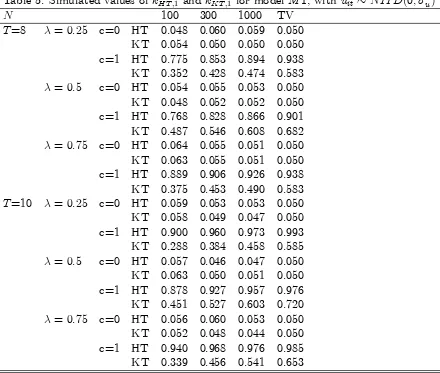
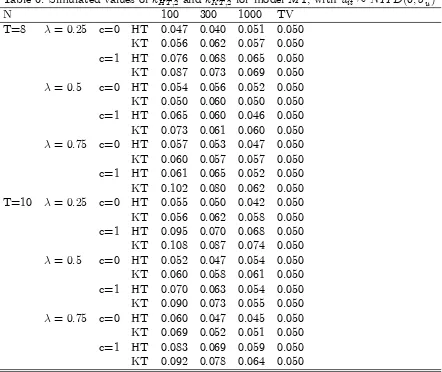
Tables 5 and 6 present the results of our simulation study for the case that uit
N IID(0;1). The last column of the tables gives the theoretical values (T V) of the power
function and the nominal size of the tests, at a= 5%. For model M1, the results of Table 6
indicate that both the HT and KT tests have size and power values which are very close to
their theoretical ones. Furthermore, the results con…rm that the HT test has more power
towards the beginning and the end of the sample while the KT test has more power in the
middle. As was also predicted by the theory, the HT test has higher power than the KT
local power function (see column T V) even for small N (e.g., N=100). However, this is
not always true for the KT test, which needs very high N in order its power to converge
to its theoretical value. For model M2, the results of Table 6 indicate that, for large N,
both HT and KT tests have trivial power, as it was expected. However, in small samples
(e.g., N = 100), both tests have some non-trivial power. This can be obviously attributed
to second, or higher, order e¤ects of the true power function, which cannot be approximated
by the …rst-order approximation considered in our analysis. Note that, for model M2, the
KT test has slightly higher small sample power than theHT.
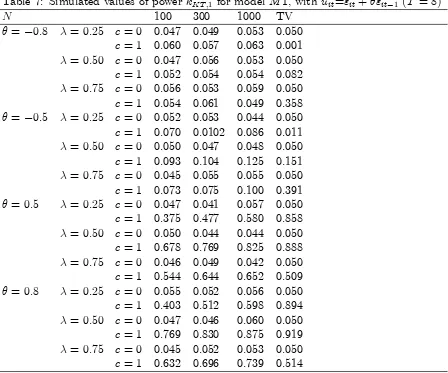
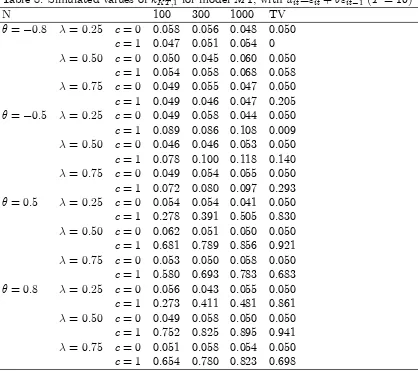
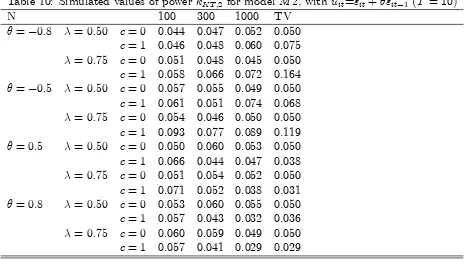
Tables 7, 8, 9 and 10 present the results of our simulation study for theKT test allowing
for serial correlation in error terms uit, assuminguit ="it+ "it 1. This is done for models
M1 and M2, and T 2 f8;10g. The maximum order of serial correlation allowed by the
KT test is set to p = 1, which matches that of the MA process of uit. The results of these
tables are also consistent with theory. For model M1, the KT test has signi…cant power
when >0. This converges to its theoretical value, reported in the last column of the table,
quite fast as N increases. For negative values of , the test has also signi…cant power. This
happens for =f0:75g, as was predicted by the theory. Note that both the theoretical and
small sample values of the power function of the KT are higher than their corresponding
values in the absence of serial correlation (see Table 5). This is also consistent with the
theory and can be attributed to the serial correlation e¤ects of uit on the power function of
the test, discussed in the previous section.
For modelM2, the results of Tables 9 and 10 indicate that theKT test has smaller power
than for model M1. As was expected by the theory, the power of the test is non-trivial if
< 0. The KT test has also some small sample power if > 0, which quali…es its use in
e¤ects of the true power function, which are not approximated e¢ciently by our asymptotic
approximations. Finally, another interesting conclusion which can be drawn from the results
of our simulation study reported in Tables (7)-(10) is that, when <0, a break towards the
end of the sample increases the power of theKT test. When >0, the power of the test is
maximized at the middle of the sample. These results apply to both models M1 and M2.
They are also consistent with the theoretical results reported in Table 4.
6
Conclusions
This paper analyzes the asymptotic local power properties of least-squares based …xed-T
panel unit root tests allowing for a structural break in the deterministic components of the
AR(1) panel data model, namely its individual e¤ects and/or slope coe¢cients of its
indi-vidual linear (incidental) trends. This is done by assuming that the cross-section dimension
of the panel data models (N) grows large. Thus, the results of our analysis concern mainly
applications of the above tests to short panels, often used in empirical microeconomic studies.
The paper derives the limiting distributions under the sequence of local alternatives of
extensions of Harris and Tzavalis (1999) panel unit root tests (denoted as HT) allowing for
a structural break (see Karavias and Tzavalis (2013)) and Karavias’ and Tzavalis (2012)
recently developed panel data unit root tests (denoted as KT). In addition to a structural
break, the last test also allows for serial correlation in the error terms of the AR(1) panel
data model. Both of these tests are based on the least squares dummy variables estimator
of the autoregressive coe¢cient of the AR(1) panel data model which is corrected for its
inconsistency due to the deterministic components of the panel and/or serial correlation
The results of the paper lead to a number of interesting conclusions. First, they show
that, for the standard AR(1) panel data model with white noise error terms and individual
e¤ects, both the HT and KT tests have signi…cant asymptotic local power. The HT test
has much higher power than theKT. The power of this test increases withT, in contrast to
theKT test. The latter is found to be more appropriate for smallT. This happens because,
to adjust for the inconsistency of the least squares estimator, theKT test requires consistent
estimation of the variance of the error term, which leads to a reduction of its power. TheHT
test does not depend on this nuisance parameter, as it adjusts the least squares estimator
for both the inconsistency of its numerator and denominator, and thus the variance of the
error term is cancelled out. The HT test is found to have more power when the break is
towards the beginning or the end of the sample, while the KT test has more power when
the break is towards the middle of the sample.
Second, both the HT and KT tests have asymptotically trivial power in the case that
the AR(1) allows also for incidental trends. The allowance for a common break in the slope
coe¢cients of the incidental trends does not change the behavior of the tests. This problem
does not always exist for theKT test extended for serial correlation of the error term. In this
case, the paper presents circumstances that theKT test has non-trivial power. In particular,
this happens when the error term follows a MA(1) procedure with negative serial correlation.
The power of theKT in this case can be attributed to the e¤ects of the serial correlation of
error term on the adjustment of the least squares estimator of the autoregressive coe¢cient
for its inconsistency, upon which the KT test is based on. In contrast to large-T panel
data unit root tests, the power function of …xed-T tests depend on the values of nuisance
parameters capturing serial correlation e¤ects which can a¤ect the asymptotic (overN) power
This exercise has shown that the empirical probabilities of rejection are very close to their
theoretical values, which means that the asymptotic theory provides a good approximation
of small sample results of …xed-T panel data unit roots.
References
[1] Arellano, M., 2003, Panel data econometrics, Oxford University Press, UK
[2] Bai J., Carrion-I-Silvestre, J.L., 2009. Structural Changes, Common Stochastic Trends,
and Unit Roots in Panel Data. Review of Economic Studies, vol. 76(2), 471-501.
[3] Carrion-i-Silvestre, J.L., Del Barrio-Castro, T., Lopez-Bazo, E., 2005. Breaking the
panels: An application to real per capita GDP. Econometrics Journal, 8, 159-175.
[4] Chan, F., Pauwels, L.L., 2011. Model speci…cation in panel data unit root tests with an
unknown break. Mathematics and Computers in Simulation. 81, 1299–1309.
[5] Hahn, J., Kuersteiner, G., 2002. Asymptotically unbiased inference for a dynamic panel
model with …xed e¤ects when both n and T are large. Econometrica. 70, 1639-1657.
[6] Hadri K., Larsson, R., Rao, Y., 2012. Testing for stationarity with a break in panels
where the time dimension is …nite. Bulletin of Economic Research, 64, s123-s148.
[7] Harris D., Harvey D., Leybourne S., and Sakkas N., 2010. Local asymptotic power of the
Im-Pesaran-Shin panel unit root test and the impact of initial observations. Econometric
[8] Harris, D., Leybourne, S., and McCabe, B., 2005. Panel Stationarity Tests for
Purchas-ing Power Parity with Cross-Sectional Dependence. Journal of Business & Economic
Statistics, vol. 23, 395-409.
[9] Harris, R., Tzavalis, E., 1999. Inference for unit roots in dynamic panels where the time
dimension is …xed. Journal of Econometrics, 91, 201-226.
[10] Harris, R., Tzavalis, E., 2004. Inference for unit roots for dynamic panels in the
pres-ence of deterministic trends: Do stock prices and dividends follow a random walk ?
Econometric Reviews 23, 149-166.
[11] Harvey, D.I., Leybourne S.J., 2005. On testing for unit roots and the initial observation.
Econometrics Journal 8, 97–111.
[12] Karavias, Y., and Tzavalis, E., 2012. Generalized …xed-T Panel Unit Root Tests
Allow-ing for Structural Breaks. Granger Centre Discussion Paper Series, No 12/02.
[13] Karavias, Y., and Tzavalis, E., 2013. Testing for unit roots in short panels
allow-ing for structural breaks. Computational Statistics and Data Analysis. (In press).
http://dx.doi.org/10.1016/j.csda.2012.10.014
[14] Kruiniger, H., 2008. Maximum Likelihood Estimation and Inference Methods for the
Covariance Stationary Panel AR(1)/Unit Root Model. Journal of Econometrics 144,
447-464.
[15] Kruiniger, H., and E., Tzavalis, 2002. Testing for unit roots in short dynamic panels
with serially correlated and heteroscedastic disturbance terms. Working Papers 459,
[16] Madsen E., 2010. Unit root inference in panel data models where the time-series
dimen-sion is …xed: a comparison of di¤erent tests. Econometrics Journal 13, 63-94.
[17] Meligkotsidou, L., Tzavalis, E., Vrontos I.D., 2011. A Bayesian analysis of unit roots
and structural breaks in the level, the trend and the error variance of autoregressive
models of economic series. Econometric Reviews, 30 (2), 208-249.
[18] Moon, H.R., Perron, B., 2008. Asymptotic local power of pooled t-ratio tests for unit
roots in panels with …xed e¤ects. Econometrics Journal 11, 80-104.
[19] Moon, H.R., Perron, B., Phillips, P.C.B., 2007. Incidental trends and the power of panel
unit root tests. Journal of Econometrics, 141(2), 416-459.
[20] Pauwels, L.L., Chan, F., Mancini, G.T., 2012. Testing for Structural Change in
Hetero-geneous Panels with an Application to the Euro’s Trade E¤ect. Journal of Time Series
Econometrics, 4(2), Article 3.
[21] Perron, P., 1989. The great crash, the oil price shock, and the unit root hypothesis.
Econometrica, 57, 1361-1401.
[22] Schott, J.R., 1996. Matrix Analysis for Statistics, Wiley-Interscience.
6.1
Appendix
In this appendix, we provide proofs of the theorems and the corollary presented in the main
text of the paper.
Proof of Theorem 1: First, we derive the limiting distribution of theHT test statistic,
under the sequence of local alternatives'N = 1 pc
N. De…ne vectorw= (1; 'N; '
2
and matrix
=
0
B B B B B B B B B B B B B B B B B B B B B B @
0 : : : : : 0
1 0 :
'N 1 : :
'2
N 'N : : :
: : : : :
: : 1 0 :
'TN 2 'TN 3 : : 'N 1 0
1
C C C C C C C C C C C C C C C C C C C C C C A
Under null hypothesis H0: c = 0; we have = : The …rst order Taylor expansions of
and w yields
= +F('N 1) +op(1) and (5)
w = e+f('N 1) +oP(1), (6)
respectively, whereF = d'd
N jc=0 and f =
dw
d'N jc=0. Based on the above de…nitions ofw and
, vectoryi 1 can be written as
yi 1 =wyi0+ X1( ) ( )
i + ui, (7)
where ( )i = (a(1)i (1 'N); a(2)i (1 'N))0 = (1 '
N)(a
(1)
i ; a
(2)
yi 1, the HT test statistic for model M1 can be written under'N = 1 pcN as follows:
p
N(^'( )1 'N B1( )) (8)
= pN
0 B B B B @ 1 N N X i=1 y0
i 1Q ( )
1 ('Nyi 1+X1( ) ( )
i +ui)
1 N N X i=1 y0
i 1Q ( ) 1 yi 1
'N B1( ) 1 C C C C A ;
= pN
0 B B B B @ 1 N N X i=1 y0
i 1Q ( ) 1 ui 1 N N X i=1 y0
i 1Q ( ) 1 yi 1
B1( ) 1 N N X i=1 y0
i 1Q ( ) 1 yi 1
1 N N X i=1 y0
i 1Q ( ) 1 yi 1
1 C C C C A ; = 1 p N N X i=1 y0
i 1Q ( )
1 ui p1NB1( )
N
X
i=1
y0
i 1Q ( ) 1 yi 1
1 N N X i=1 y0
i 1Q ( ) 1 yi 1
= (A) (B)
(C) : (9)
Next, we derive asymptotic results of each of quantities (A); (B) and (C), de…ned by (9).
Substituting (7) in(A), we have
(A) p1
N N
X
i=1
y0
i 1Q ( ) 1 ui =
1 p N N X i=1
yi0w0+ ( )i 0X
( )0
1 0+u0i 0 Q
( ) 1 ui
= p1
N N
X
i=1
yi0w0Q( )1 ui+ ( )i 0X
( )0
1 0Q ( )
1 ui+u0i 0Q
( ) 1 ui
Using relationships (5)-(6), we can …nd the following limits of the summands entering into
the last relationship of (A). First, it can be shown that
1 p N N X i=1
yi0w0Q( )1 ui =
1 p N N X i=1
yi0(e0+f0('N 1))Q
( )
1 ui+oP(1);
= p1
N N
X
i=1
yi0e0Q( )1 ui+
c N
N
X
i=1
yi0f0Q( )1 ui+oP(1);
since e0Q( )
1 = 0 and E(yi0ui) = 0 by assumption (b5), and
1 p N N X i=1 ( )0
i X
( )0
1 0Q ( ) 1 ui
= p1
N N
X
i=1 ( )0
i X
( )0
1 ( 0+F0('N 1) +op(1))Q
( ) 1 ui;
= p1
N N
X
i=1 ( )0
i X
( )0
1 0Q ( ) 1 ui+
c N
N
X
i=1 ( )0
i X
( )0
1 F0Q ( )
1 ui+op(1);
= c
N N
X
i=1
(a(1)i ; a(2)i )0X1( )0 0Q( )
1 ui+
c2
N3=2
N
X
i=1
(a(1)i ; a(2)i )0X1( )0F0Q( )
1 ui+op(1);
= op(1); (11)
since E(a( )i ui) = 0 by assumption (b5). Finally, we have
1 p N N X i=1 u0
i 0Q
( ) 1 ui =
1 p N N X i=1 u0
i( 0 +F0('N 1) +op(1))Q
( ) 1 ui;
= p1
N N
X
i=1
u0
i 0Q
( ) 1 ui c N N X i=1 u0
iF0Q
( )
1 ui+op(1);
where c N N X i=1 u0
iF0Q
( ) 1 ui
p
!c 2utr(F0Q
( )
1 ) and (12)
p N 1 N N X i=1 u0
i 0Q
( )
1 ui 2utr( 0Q
( ) 1 )
!
d
!N(0; VHT;A); (13)
whereVHT;Ais the variance of the last limiting distribution. Based on the asymptotic results
given by equations (10)-(13), we can show that
(A) p1
N N
X
i=1
y0
i 1Q ( ) 1 ui
d
!N c 2utr(F0Q( )
To derive asymptotic results for summand (B), write it as follows:
(B) p1
NB1( ) N
X
i=1
y0
i 1Q ( ) 1 yi 1
= p1
NB1( ) N
X
i=1
yi0w0+ ( )i 0X
( )0
1 0+u0i 0 Q
( )
1 yi0w+ X1( ) ( )
i + ui :
By similar arguments to those applied to derive results (10)-(13), we can prove the following
asymptotic results: 1 p N N X i=1
yi20w0Q( )
1 w+yi0w0Q( )1 X ( ) 1
( )
i +yi0w0Q( )1 ui = op(1);(15)
1 p N N X i=1 ( )0
i X
( )0
1 0Q ( ) 1 wyi0+
( )0
i X
( )0
1 0Q ( )
1 X
( ) 1
( )
i + X
( ) 1
( )
i ui) = op(1);(16)
1 p N N X i=1 u0
i 0Q
( )
1 wyi0+u0i 0Q
( )
1 X
( ) 1
( )
i = op(1);(17)
1 p N N X i=1 u0
i 0Q
( ) 1 ui =
1 p N N X i=1 u0
i( 0+F0('N 1))Q
( )
1 ( +F('N 1))ui +op(1); (18)
where p N 1 N N X i=1 u0
i 0Q
( )
1 ui 2utr( 0Q
( )
1 )
!
d
!N(0; VHT;B); (19)
c N N X i=1 u0
iF0Q
( ) 1 ui
p
! 2utr(F0Q
( )
1 ); (20)
c N N X i=1 u0
i 0Q
( ) 1 F ui
p
! 2utr( 0Q
( )
1 F) and (21)
c2
N3=2
N
X
i=1
u0
iF0Q
( )
Based on the above results, given by equations (15)-(22), it can be shown that
(B) p1
NB1( ) N
X
i=1
y0
i 1Q ( ) 1 yi 1
d
! (23)
N c 2uB1( )[tr(F0Q( )1 ) +tr( 0Q ( )
1 F)]; B12( )VHT;B :
Finally, following similar arguments to the above, we can easily show that, for quantity (C),
the following asymptotic result holds:
(C) 1
N N
X
i=1
y0
i 1Q ( ) 1 yi 1
p
! 2utr( 0Q
( )
1 ): (24)
Using asymptotic results (14), (23) and (24), equation (9) implies that
p
N(^'( )1 'N B1( ))!d N ctr(F
0Q( )
1 ) 2B1( )tr(F0Q( )1 )
tr( 0Q( )
1 )
; VHT;( )1
!
; (25)
orpN(^'( )1 1 B1( ))!d N c
tr(F0Q( )
1 ) +tr( 0Q ( )
1 ) 2B1( )tr(F0Q( )1 )
tr( 0Q( )
1 )
; VHT;( )1
!
;
sincetr( 0Q( )
1 ) B1( )tr( 0Q( )1 ) = 0. Note that the analytic formula of varianceV ( )
HT;1 of
the last limiting distribution is the same with that of the HT test under null hypothesisH0:
c= 0, given byVHT;( )1 = 2tr(A
( )2
HT ;1)
tr( 0Q( )
1 )2
. This does not depend on local parameterc. It remains
the same under the null and sequence of local alternative hypotheses (see, e.g., Madsen
(2010) and Karavias and Tzavalis (2013)), given as VHT;( )1 = 2tr(A
( )2
HT ;1)
tr( 0Q( )
1 )2
the above limiting distribution yields
VHT;( ) 11 =2pN(^'( )1 1 B1( ))
d
!N( ckHT;1;1), with (26)
kHT;1 =
tr(F0Q( )
1 ) +tr( 0Q ( )
1 ) 2B1( )tr(F0Q( )1 ) q
2tr(A( )HT;21)
.
Substituting into the above formula ofkHT;1 the following identities:
tr(F0Q( )
1 ) = tr( 0Q ( )
1 F) = (27)
= 6 144(3
2
3 + 1)T3 1
12(2
2
2 + 1)T2 1
24T + 1 6
tr( 0Q( )
1 ) +tr(F0Q ( )
1 ) +tr( 0Q ( )
1 ) = 0; (28)
tr(F0Q( )
1 ) =
T2
6 (2
2 2 + 1) + T
2 4
6; (29)
tr( 0Q( )
1 ) =
T 2
2 ; (30)
tr( 0Q( )
1 ) =
T2
6 (2
2 2 + 1) 2
6; (31)
tr(A( )HT;21) = tr
"
1 2(
0Q( )
1 +Q ( )
1 ) B1( )( 0Q( )1 ) 2#
;
(32)
tr 0Q( )
1 +Q ( ) 1 2 = T 2 6 (2 2
2 + 1) +T 7
3; (33)
tr 0Q( )
1 2
= 1 90(2
4 4 3+ 6 2 4 + 1)T4 (34)
+ 1 36(2
2 2 + 1)T2 7
90;
tr 0Q( )
1 +Q ( )
1 0Q
( )
1 =
T 2
2 ; (35)
analytically written as
2tr(A( )HT;21) = D
S, where
D = T6R1 +T5R2+T4R3+T2R4+ 216T 136;
S = T4 1+T2 2+ 240;
R1 = 40 6 120 5+ 204 4 208 3+ 162 2 78 + 17;
R2 = 216 4+ 432 3 528 2+ 312 78;
R3 = 216 4 432 3 + 588 2 372 + 108;
R4 = 120 2+ 120 144;
1 = 240 4 480 3 + 480 2 240 + 60and
2 = 480 2+ 480 240.
To derive the limiting distribution of theKT test under the sequence of local alternatives
'N = 1 pc
N, write
^( )
1
p
N '^( )1 ^b
( ) 1 ^( ) 1 'N !
= ^( )1 pN
0 B B B B @
'N +
1 N N X i=1 y0
i 1Q ( ) 1 ui 1 N N X i=1 y0
i 1Q ( ) 1 yi0 1
^b( ) 1 ^( ) 1 'N 1 C C C C A ;
= pN 1 N
N
X
i=1
y0
i 1Q ( )
1 ui ^2utr( 0Q
( ) 1 )
!
;
= pN 1 N
N
X
i=1
y0
i 1Q ( ) 1 ui 1 N N X i=1 y0 i ( ) 1 yi ! ;
= p1
N N
X
i=1
y0
i 1Q ( ) 1 ui 1 p N N X i=1 y0 i ( )
where yi can be written as
yi =ui+ ('N 1)yi 1+X1( ) ( )
i : (37)
The limiting distribution of the KT test under 'N = 1 pc
N can be proved by obtaining
asymptotic results for the two summands entering into equation (36), i.e., p1
N N
X
i=1
y0
i 1Q ( ) 1 ui
and p1
N N
X
i=1
y0
i
( )
1 yi, following analogous to the proof of (26) steps. The formula of slope
power parameter kKT;1 is given as
kKT;1 =
tr(F0Q( )
1 ) +tr( 0Q ( )
1 )
q
2tr(A( )KT;21)
: (38)
Substituting the following identities into the above formula of kKT;1:
tr(A( )KT;21) = tr 1
2(
0Q( )
1 +Q ( ) 1
( ) 1
( )0
1 ) 2!
; (39)
tr( ( )1 ) = tr( 0 ( )
1 ) = 0; (40)
2tr(A( )KT;21) = 2tr(P( )) 2tr(Z( )2); with Z( ) = 1 2(
( )0
1 +
( )
1 ) (41)
and P( ) = 1 2(
0Q( )
1 )2+
1 2
0Q( )
1 ; (42)
tr ( 0Q( )
1 )2 =
T2
12(2
2 2 1) + T
2 5
6 and (43)
tr(Z( )2) =
1
T + 2( 1) T
6( 1) 1 (44)
yields the results of Theorem 1, for the KT statistic.
(1) can be derived based on analogous arguments to those applied for the proof of Theorem
1.
To obtain the analytic formula ofkHT;1, given by equation (1), scale (8) byT, replace'N
with 'N;T, and apply asymptotic theory forN ! 1, as in Theorem 1. Then, we will have
TpN(^'( )1 'N;T B1( ))
d
!N ctr(F
0Q( )
1 ) 2B1( )tr(F0Q( )1 )
tr( 0Q( )
1 )
; T2VHT;( )1
!
:
Multiplying with T2V( )
HT;1 1=2
and using = 1 Tpc
N, the last limiting distribution can be
written as
T T2VHT;( )1 1=2pN(^'( )1 1 B1( ))
d
!N c1
TkHT;1;1 (45)
where kHT;1 = tr(F
0Q( )
1 )+tr( 0Q ( )
1 ) 2B1( )tr(F0Q( )1 )
r
2tr(A( )2HT ;1)
(see proof of Theorem 1). By taking the
limit for T ! 1 of kHT;1 and T2VHT;( )1; (45) can be written as
T VHT;( )1 1=2pN(^'( )1 1 B1( ))
d
!N ckHT;1;1 , where
kHT;1 lim
T
1
TkHT;1 =
3 2 3 + 1 4(2 2 2 + 1)
r 1
R1
and
VHT;( )1 lim
T T
2V( )
HT;1 =
36R1
1(2 2 2 1)2
:
The analytic formulas of the last two limits are derived based on the results of identities
(27)-(35). The above results have been derived by taking limits sequentially, …rst forN ! 1and
then for T ! 1. Joint convergence in N; T requires the extra assumption that pTN ! 0,
see also Moon and Perron (2008). However, forc= 0 there is no need to specify the relative
Tzavalis (2013)).
The formulas of kKT;1 and VKT;( )1, given by the corollary for the large-T version of the
KT test, can be derived by following similar steps to the above. Then, using the results of
identities (39)-(44), we can obtain
kKT;1 lim
T
1
TkKT;1 = 0 and V
( )
KT;1 lim
T T
2V( )
KT;1
36(2 4 4 3+ 3 2 ) 12( 1) (2 2 2 + 1)2:
Proof of Theorem 2: To prove the theorem, we will follow analogous steps to those for
the proof of Theorem 1. We now will rely on relationships (7) and (37), where now vector
( )
i is de…ned as
( )
i =
0
B B B B B B B B B B @
(1 'N)a(1)i +'N (1)i
(1 'N)a
(2)
i +'N
(2)
i
(1 'N) (1)i
(1 'N) (2)i
1
C C C C C C C C C C A
=e i+ (1 'N) i,
due to the presence of individual trends under'N;T = 1 TpcN, where i = (
(1)
i
(1)
i ;
(2)
i
(2)
i ;
(1)
i ;
(2)
i )0; e =
0
B B @
1 0 0 0
0 1 0 0
1
C C
A and i = ( (1)i ;
(2)
statistic for model M2 can be written as follows:
p
N(^'( )2 'N B2( ))
= pN
0 B B B B @ 1 N N X i=1 y0
i 1Q ( )
2 ('Nyi 1+X2( ) ( )
i +ui)
1 N N X i=1 y0
i 1Q ( ) 2 yi 1
'N B2( ) 1 C C C C A = 1 p N N X i=1 y0
i 1Q ( )
2 ui p1NB2( )
N
X
i=1
y0
i 1Q ( ) 2 yi 1
1 N N X i=1 y0
i 1Q ( ) 2 yi 1
= (A
0
) (B0)
(C0
) ,
where(A0) p1
N N
X
i=1
y0
i 1Q ( ) 2 ui,(B
0
) p1
NB2( ) N
X
i=1
y0
i 1Q ( )
2 yi 1and(C
0
) N1
N
X
i=1
y0
i 1Q ( ) 2 yi 1.
As in the proof of Theorem 1, next we derive asymptotic results of(A0),(B0)and (C0), using
( )
i =e i+ (1 'N) i. The most important ones are the following:
p N 1 N N X i=1 0
ie0X
( )0
2 0Q ( )
2 X
( )
2 e i tr(e0X2( )0 0Q ( )
2 X
( )
2 e E( i 0i))
!
d
!N(0; VHT;4)
c N N X i=1 0
ie0X
( )0
2 F0Q ( )
2 e i
p
!ctr(e0X( )0
2 F0Q ( )
2 e E( i 0i))
c N N X i=1 0
ie0X
( )0
2 0Q ( ) 2 F X
( ) 2 e i
p
!ctr(e0X( )0
2 0Q ( )
2 F e E( i 0i))
c N N X i=1 0 iX
( )0
2 0Q ( )
2 X
( ) 2 e i
p
!ctr(X2( )0 0Q ( )
2 X
( )
2 e E( i 0i))
c N N X i=1 0
ie0X
( )0
2 0Q ( )
2 X
( ) 2 i
p
!ctr(e0X( )0
2 0Q ( )
2 X
( )
2 E( i 0i))
after using the following identities:
tr(e0X( )0
2 0Q ( )
2 X
( )
2 e E( i 0i)) = 0
tr(e0X( )0
2 F0Q ( )
2 e E( i 0i)) tr(e0X
( )0
2 0Q ( )
2 F e E( i 0i)) = 0
and tr(X2( )0 0Q( )
2 X
( )
2 e E( i 0i)) tr(e0X
( )0
2 0Q ( )
2 X
( )
2 E( i 0i)) = 0.
The proof of the second result of the theorem, i.e., kKT;2 = 0, can be proved by following
analogous steps to the above and using the following identities:
tr(e0X( )0
2 ( )
2 X
( )
2 e E( i 0i)) tr(e0X
( )0
2 0
( ) 2 X
( )
2 e E( i 0i)) = 0
and tr(X2( )0 ( )2 X2( )e E( i 0i)) tr(e0X
( )0
2 ( ) 2 X
( )
2 E( i 0i)) = 0.
Proof of Theorem 3: This can be proved by following analogous steps to the proof of
Theorem 1, for the KT test statistic, by setting E(uiu0
i) = instead of 2uIT:
Proof of Theorem 4: This can be proved by following analogous steps to the proof of
7
Tables
Table 1: Values ofkHT;1 and kKT;1 for model M1
kHT;1 kKT;1
nT 8 10 15 20 8 10 15 20 0.25 3.18 4.12 6.11 7.75 1.85 1.86 1.96 2.10 0.50 2.93 3.62 5.32 6.99 2.12 2.23 2.34 2.39 0.75 3.18 3.81 5.78 7.75 1.85 2.04 2.09 2.10
Table 2: Values of slope parameters kHT;1 and kKT;1
0.10 0.20 0.30 0.40 0.50 0.60 0.70 0.80 0.90
kHT 0.433 0.394 0.360 0.338 0.332 0.338 0.360 0.394 0.433
[image:40.612.143.471.334.537.2]kKT 0 0 0 0 0 0 0 0 0
Table 3: Values ofkKT;1 for model M1, withuit ="it+ "it 1
T T0 = 0:8 = 0:5 = 0:0 = 0:5 = 0:8
8 2 -1.40 -0.63 1.58 2.71 2.89
4 0.25 0.61 1.89 2.86 3.04
6 1.28 1.36 1.58 1.66 1.68
10 2 -1.62 -0.69 1.65 2.60 2.73
5 0.07 0.56 2.12 3.05 3.21
7 0.82 1.10 1.82 2.12 2.16
15 3 -1.55 -0.48 1.81 2.50 2.58
7 -0.41 0.36 2.31 3.10 3.21
11 0.52 1.01 1.95 2.20 2.23
20 5 -1.52 -0.31 2.00 2.61 2.68
10 -0.54 0.38 2.38 3.02 3.10
[image:40.612.141.470.571.733.2]15 0.33 1.07 2.00 2.22 2.24
Table 4: Values ofkKT;2 for model M2, withuit ="it+ "it 1
T T0 = 0:8 = 0:5 = 0:0 = 0:5 = 0:8
8 4 0:08 0:070 0 0:09 0:11 10 5 0:20 0:15 0 0:12 0:14 7 0:66 0:46 0 0:21 0:24
15 3 0 0 0 0 0
Table 5: Simulated values ofkHT;1 and kKT;1 for model M1, with uit N IID(0; 2u)
N 100 300 1000 TV
T=8 = 0:25 c=0 HT 0.048 0.060 0.059 0.050 KT 0.054 0.050 0.050 0.050 c=1 HT 0.775 0.853 0.894 0.938 KT 0.352 0.428 0.474 0.583
= 0:5 c=0 HT 0.054 0.055 0.053 0.050 KT 0.048 0.052 0.052 0.050 c=1 HT 0.768 0.828 0.866 0.901 KT 0.487 0.546 0.608 0.682
= 0:75 c=0 HT 0.064 0.055 0.051 0.050 KT 0.063 0.055 0.051 0.050 c=1 HT 0.889 0.906 0.926 0.938 KT 0.375 0.453 0.490 0.583
T=10 = 0:25 c=0 HT 0.059 0.053 0.053 0.050 KT 0.058 0.049 0.047 0.050 c=1 HT 0.900 0.960 0.973 0.993 KT 0.288 0.384 0.458 0.585
= 0:5 c=0 HT 0.057 0.046 0.047 0.050 KT 0.063 0.050 0.051 0.050 c=1 HT 0.878 0.927 0.957 0.976 KT 0.451 0.527 0.603 0.720
Table 6: Simulated values ofkHT;2 and kKT;2 for model M1, with uit N IID(0; 2u)
N 100 300 1000 TV T=8 = 0:25 c=0 HT 0.047 0.040 0.051 0.050
KT 0.056 0.062 0.057 0.050 c=1 HT 0.076 0.068 0.065 0.050 KT 0.087 0.073 0.069 0.050
= 0:5 c=0 HT 0.054 0.056 0.052 0.050 KT 0.050 0.060 0.050 0.050 c=1 HT 0.065 0.060 0.046 0.050 KT 0.073 0.061 0.060 0.050
= 0:75 c=0 HT 0.057 0.053 0.047 0.050 KT 0.060 0.057 0.057 0.050 c=1 HT 0.061 0.065 0.052 0.050 KT 0.102 0.080 0.062 0.050 T=10 = 0:25 c=0 HT 0.055 0.050 0.042 0.050 KT 0.056 0.062 0.058 0.050 c=1 HT 0.095 0.070 0.068 0.050 KT 0.108 0.087 0.074 0.050
= 0:5 c=0 HT 0.052 0.047 0.054 0.050 KT 0.060 0.058 0.061 0.050 c=1 HT 0.070 0.063 0.054 0.050 KT 0.090 0.073 0.055 0.050