Munich Personal RePEc Archive
Why space matters for collaborative
innovation networks. On designing
enabling spaces for collaborative
knowledge creation
Peschl, Markus F. and Fundneider, Thomas
2014
Online at
https://mpra.ub.uni-muenchen.de/66541/
This is a penultimate draft/manuscript. You may obtain the original from [email protected]
Why space matters for collaborative innovation networks
On designing Enabling Spaces for collaborative knowledge creation
Markus F. Peschl | University of Vienna | Cognitive Science Research Platform | Vienna,
Austria
[email protected] | http://www.univie.ac.at/knowledge/peschl/
Thomas Fundneider | theLivingCore, Vienna, Austria
[email protected] | http://www.theLivingCore.com
Version: 4.2 | September 10, 2015
Abstract. As opposed to managing or controlling innovation processes, this paper proposes
the notion of enabling as a more suitable approach to innovation. As a consequence, the concept of Enabling Spaces is introduced as a space that is designed in such a way that it
enables and facilitates processes of collaborative knowledge creation and innovation. In that
context a rather broad notion of space is applied: It goes far beyond architectural/physical
space by integrating social, cognitive, emotional, organizational, and epistemological
dimensions in an interdisciplinary manner. Both the theoretical background and the
methodological approach and design process will be presented. Furthermore, we will discuss
a case for an Enabling Space which functions as a collaborative innovation network. It will
turn out that Enabling Spaces and Collaborative Innovation Networks (COINs) share a lot of
characteristics, attitudes, and values.
Keywords: cognition, collaboration, design, Enabling Space, extended cognition, innovation,
1 Introduction
How do “new insights” and innovations come about? What are the conditions and contexts
that enable these processes of knowledge creation? What is the role of the social system
and the epistemological conditions for these processes? What are the enabling factors for
successful processes of knowledge creation on an epistemological, social, technological, as
well as cognitive and emotional level?
Although knowledge creation and innovation are at the heart of any knowledge driven
organization, economy, or even society, there are only a few approaches taking seriously the
holistic nature of innovation processes; i.e., the fact that innovation is not only about a small
hand-picked group of persons in an organization, about an isolated and abstract process of
innovation taking place in a remote R&D-lab, or about a rule-based innovation process
IT-tool, etc. We are proposing that innovation is about attitudes, skills, and an epistemological
perspective on products, services, or business models, which have to be adopted by most
members of an organization or even society. More generally, innovation is about creating a
multidimensional space in order to provide an environment that enables processes of
knowledge creation and innovation—they are referred to as Enabling Spaces.
Collaborative Innovation Networks (COINs) (Gloor, 2006; Gloor et al., 2004) are good
examples for such environments for collaborative knowledge creation. According to Gloor
(2006) one can find the following characteristic features in COINs: they allow for innovation in
a highly collaborative setting. Furthermore, this collaboration is embedded in a social
environment that is characterized by direct-contact networks which are based on high ethical
standards. Both the communication and the knowledge work of these networks of
collaboration for innovation are supported by sophisticated information and communication
technology (ICT). Gloor (2006, p55) stresses the fact that these technologies, and more
specifically, the tools provided by the internet, have brought about an unmatched level of
transparency into collaboration processes—and, as one consequence, true meritocracy.
In this paper we will develop the concept of Enabling Spaces and show how it is related to the COINs approach, as COINS realize and illustrate very well many aspects of the more
general approach of Enabling Spaces. One of the main objectives is to develop both a
conceptual and theoretical framework for the questions stated above—not primarily for giving final answers, but for providing a basic understanding and framework, design principles, as
well as a suggestion for a design process, of how one could come up with a theoretically
informed and practically functioning innovation environment in the sense of Krippendorff’s
“ecology of artifacts” (Krippendorff, 2006; Krippendorff, Butter, 2007, p5). It will be shown that
Enabling Spaces provide an interesting conceptual perspective on COINs and that share a
This paper is organized as follows: In the first part this paper has a strong theoretical focus. Section 2 develops the notion of enabling as opposed to classical approaches in
management and leadership which are based on the regime of control and “mechanistic
production” (of new knowledge). It will be shown that, in the context of innovation, and more
specifically, collaborative knowledge creation, this managerial mechanistic approach fails
and has to be replaced by the regime of enabling. The concept of enabling and its
relationship to innovation will be developed in detail. Furthermore, we will focus on the
epistemological consequences of the “enabling approach”. The focus of this paper is on the
front-end of innovation, namely on the processes of knowledge creation although the authors are aware of the fact that for newly created knowledge to be an innovation it necessary to be
successful in the market and in the domain of exploitation of this knowledge (Schumpeter,
1934; Corso et al., 2009; Gupta et al., 2006; March, 1991).
The second part of this paper develops the concept of Enabling Spaces and their relationship to COINS as an implication of the theoretical considerations of part one. Enabling Spaces
(Section 3) are multidimensional spaces facilitating and supporting knowledge- and
innovation work by providing a “container” in the form of a well balanced set of constraints
and interventions enabling (and not forcing) these processes. In Section 4 the design
process for such Enabling Spaces and a concrete case study will be presented. Finally, the
implications and the relationship between COINs and Enabling Spaces will be discussed
(Section 5).
Terminological remarks
This paper stresses the epistemological, cognitive, as well as social processes and
structures as being essential for most innovation processes. That is why we give a short
terminological introduction to these terms:
§ Epistemology: is a subfield of philosophy which is concerned with the study of
knowledge in general and with knowledge as “justified true belief” in particular (Churchland, 1981; Steup, 2012). It focuses on the questions of what is knowledge,
what are necessary and sufficient conditions of knowledge, what is its source, how
does knowledge come about, how is it created and how is it disseminated. In our
approaches we will go far beyond these classical notions of knowledge taking a more
dynamic, process and constructivist oriented perspective (Varela et al., 1991;
Maturana, Varela, 1980; Glasersfeld, 1984, 1995; Nishida, 1999).
§ Cognition and cognitive processes: In general cognition is considered to be a mental process that transforms perceptual input into motor behavior by making use of
knowledge/representations. Cognitive processes comprise perception, reasoning and
cultural and social processes. Cognitive Science is the interdisciplinary field in
science studying cognitive processes (Bechtel, Graham, 1998; Bechtel, Abrahamsen,
2002; Clark, 2001, 2008; Friedenberg, Silverman, 2006; Thagard, 2005; Wilson, Keil,
1999). It comprises both human and animal cognition. Recent approaches in
cognitive science also take into consideration the dimensions of emotions, the body
(embodied cognition”; e.g., Clark, 1999; Varela et al., 1991), and cultural and social
phenomena (e.g., Tomasello, 1999; Tomasello et al., 2005).
§ Social or collective processes: Social phenomena are processes emerging from cooperation and interaction between single cognitive systems (and the natural and
artifact environment). They comprise small groups and teams up to whole societies
and cultural systems. As collective emergent phenomena they follow their own
(social) dynamics which is completely different form the dynamics of single
participating cognitive systems; it opens up completely new behavioral and epistemic
spaces. That is why it is so important to consider this level in the context of
innovation, because—due to its emergent character—it may contribute to the creation
of new knowledge.
2 Collaborative innovation work as socio-epistemological
process—conceptual backgrounds for the paradigm of
enabling
As is shown in the COINs approach (Gloor et al., 2004) it is not sufficient to study the
phenomenon of innovation by only taking into account economic or technological issues.
Rather, Gloor and many others point at social as well as ethical aspects as being at least as
important. We suggest going one step further by shifting towards an understanding that any
kind of innovation activity—in its very core—is based on epistemological, cognitive,and
social processes. They are the foundation for the economic and market dynamics, for any kind of interaction between people, artifacts, and technology, as well as for organizational
processes and structures. This implies that, if we want to understand, what profound, sustainable, and at the same time game-changing innovation is and how it can be brought about and facilitated, we have to start our investigations on the level of these essential
cognitive, epistemological, as well as social processes. The goal of this section is to give a
Consequently, if we want to develop a sound concept of enabling innovation be it in COINs
or in any other Enabling Space, we have to tackle at least the following questions on a
theoretical level, before we can go into more practical issues: (a) what kind of knowledge
processes do we have to consider for bringing forth (radically) new knowledge?—and,
closely connected with this question, (b) what are the value systems as well as epistemic
attitudes which have to be applied in that context. These questions have direct implications
on the way, how conventional approaches of management, organization, and leadership
have to change, if one wants to be successful in the field of game-changing profound
innovation.
2.1 The attitude of enabling or on the importance of giving up
control
Deterministic production of new knowledge?
COINS are about self-organization, emergence, offering and sharing information, and
openness. Contrary to these characteristics classical management approaches to innovation
consider predicting things and keeping them—at least to some degree—under control among
their key success factors. From that perspective, innovation, and even more so COINS,
seem to be an “enemy” for organizations as they aim—on an superficial level—at destroying
or destabilizing established, predictable, as well as controllable routines and structures. As
an implication, in most organizations one can find a “domesticated” version of innovation in
the form of incremental regimes of innovation, CIPs (continuous improvement processes;
e.g., Dodgson, Gann, 2010), or Kaizen (e.g., Nonaka 2008) processes. In these approaches,
innovation is reduced to a more or less mechanistic process producing new insights, knowledge, and, finally, new products, services, business models, etc. on the basis of
applying rules and algorithms.
These approaches are based on the assumption that, if one applies these rules faithfully, this
will lead to new knowledge in a deterministic manner. Such a perspective has several advantages: employees just have to follow the given rules and procedures in order to come
up with successful innovations; furthermore, innovation could get rid of its unpredictable
nature and, thus, become a well calculable and controllable factor. Both experience and
logical reasoning show that the opposite is true. Controlling, making, or “managing”
innovation by applying rules or recipes turn out to be a contradiction in itself. Looking more closely from the perspective of logic reveals that knowledge resulting from such a process of
applying rules cannot be really new in a more profound sense. In a formal system applying
rules, running an algorithm, or following a recipe only makes explicit what is already implicitly
Enabling—an alternative for a deterministic view on innovation
What is an alternative for using rule-based innovation processes? First of all, one has to see
that bringing forth new knowledge does not imply that there are no rules allowed at all for
structuring and organizing these processes. As will be shown the difference lies in the
attitude towards the role of these rules and how these rules are applied. While in the
classical perspective the attitude of control and making was in the fore, the authors suggest
to replace this position with an attitude of enabling.
What does “enabling” mean in the context of generating new knowledge and innovation? The
answer covers two aspects that are crucial: (i) On the one hand we have to give up on the
regime of control, determinism, and making. (ii) On the other hand enabling means to provide a set of constraints or a facilitating framework supporting the processes of bringing forth new knowledge. The challenge is to theoretically identify the necessary dimensions of this
framework of constraints, to integrate these dimensions into a unified concept, as well as to
develop a design process for creating such frameworks. Before we will do that one has to
understand what kind of knowledge processes are involved in the enabling approach.
2.2 Enabling and a new type of knowledge
Facilitating the breaking forth of new potential qualities
Behind an approach of enabling to knowledge creation and innovation one can find an
important epistemological assumption. It is based on the premise that there is something
latent in reality or in the domain of knowledge which wants to break forth. This is closely related to a rather old concept from metaphysics, namely Aristotle’s concept of “potentia” and “actus” (Aristotle’s Metaphysics [2007], De anima [2000] or Stein (1986)), where “potentia” means potentiality, an aptitude to change, a possibility which is dormant in a
phenomenon/object, to act or to be acted upon, something that might change or emerge (into
a new form). We refer to this type of knowledge “in potentia-knowledge”. “Actus”, on the other hand, can be translated as actuality and means the actualization, completion, or
fulfillment of such a capacity.
Why are these concepts of interest for our context of innovation and enabling? If we are
interested in radical, yet “organic” and sustainable innovation we have to think about it in
terms of something, which is “in potentia”, something which is not directly visible or obvious yet, which is hidden, but which is already there as a germ. Something that wants to break forth, but which is highly fragile and which is too weak to break forth by itself in most cases. This is also closely related to what C.O.Scharmer refers to as self-transcending knowledge
(e.g., Scharmer, 2001, 2007; Senge et al., 2004; Kaiser, Fordinal, 2010). Therefore, it is
“in potentia” into being “in actu”. This process of shifting is what we refer to as enabling: facilitating the process of breaking forth of (new) latent qualities and dynamics, facilitating to
“give birth“ to a new form, new knowledge, etc.
Comparing this process to traditional approaches of innovation and knowledge creation, it is
clear that this goes far beyond classical “out-of-the-box thinking” or creative tools (e.g.,
Kelley, 2004; DTI, 2005; Shneiderman, 2007). Peschl and Fundneider have developed a
whole innovation paradigm and a systematic innovation process around this approach which
is reffered to as Emergent Innovation (Peschl, Fundneider, 2008a, 2008b; Peschl et al., 2010).
Enabling entails an alternative set of attitudes and values in innovation work
As a consequence, the enabling approach requires an alternative set of attitudes, values,
habitus/habits, as well as epistemic practices: first of all we have to (re-)acquire
“epistemological virtues“ of openness, being able to reflect, to radically question ourselves,
and to let go. Furthermore, we have to (re-)learn to listen and observe closely; to let im-press
ourselves, meaning that we are open to something that is changing us (even if it means that
we have to give up on well established and dear patterns of thinking). We have to cultivate
our patience, our ability to wait for the “right moment” (“kairos”), to listen to weak and fragile
signals and cultivate/incubate them, to let come, to follow the flow of reality. Finally, we have
to learn how to provide an ecosystem or “living ambiences” of cultivation, facilitation,
incubation, and enabling, rather than a regime of control and forced change.
In conclusion enabling requires a high level of humbleness giving reality priority (for a
process of innovation “from within”) over one’s own projections and ideas. From these
considerations it is clear that many of these epistemological attitudes are not only important
for Enabling Spaces, but have to be considered to be the epistemological background for
COINs as well. Gloor (2004, 2006) stresses trust, for instance, as a premise in the social
dimension of a network or team; however—on a more fundamental level—trust is based in
an epistemological understanding which is close to many of the attitudes having been
developed in the enabling approach (e.g., joint knowledge construction processes,
negotiation of meaning, jointly developing standards and criteria for the validity of knowledge,
etc.).
2.3
Cognitive foundations of Enabling Spaces: the extended
cognition approach
As far as the cognitive processes being involved in innovation activities goes, we cannot
enter deeply into these questions in this paper. From a cognitive science perspective
many others) it has become clear that an adequate understanding of innovation and
knowledge creation processes can only be achieved by following the approaches of situated
and extended cognition (Clark, 1997, 2008; Hutchins, 1995; Menary, 2010; Varela et al., 1991): namely, by limiting cognition not to the brain, but by extending the notion of cognition to the body as well as to its environment (“mind leaks into the environment”). Hence,
cognition is understood as a process of interaction between internal cognitive/neural processes and the cognitive system’s environment—there is a closed feedback-loop
between processes of perception, (internal) cognition, action, and the environmental
dynamics. The environment includes other cognitive systems, and, by that, the whole social
dimension is introduced as well. Furthermore, it comprises the whole world of artifacts. An artifact is an environmental (physical) structure which is the result of a cognitive activity. In
other words a cognitive system changes the environment in some aspect according to
his/her plans or knowledge by using his/her motor systems or other tools. Hence these
environmental changes are stable or transient manifestations of this knowledge. The
interesting property of artifacts is that they are influencing (other) cognitive systems. The
notion of artifacts is crucial for our understanding of innovation (compare Krippendorff, 1989,
2006; Krippendorff, Butter, 2007; Norman, 1991). In our context of innovation artifacts play at
least a twofold role: (a) innovations themselves are artifacts and (b) artifacts are necessary in
order to create innovations (e.g., Enabling Spaces).
As an implication, studying innovation processes cannot be limited to only investigating
cognitive processes within the brain, but we have to understand how these cognitive
processes are embedded in the physical and social environment and, through that
interaction, bring forth (radically) new knowledge leading to innovations. Hence, both
Enabling Spaces and COINs have to consider this physical and social environment as an
essential factor for successful innovation processes. In the context of Enabling Spaces, what
we are looking for are “enabling structures” facilitating these processes. These structures
are, of course, themselves artifacts: i.e., enabling artifacts facilitating the creation of new
knowledge themselves leading to innovation artifacts. That is why we are speaking of socio-epistemological technologies: Enabling Spaces are social, physical, as well as technological
spaces enabling processes of knowledge creation.
3 Enabling Spaces: a framework of enabling constraints
and interventions/facilitators
concept of Enabling Spaces takes the following issue very seriously: for successful
innovation work it is necessary to provide specific enabling environments in order to satisfy
this need for supporting the cognitive and knowledge processes being involved in this kind of
work. In this section we are going to take a brief look at the most important conceptual roots
of Enabling Spaces and develop their dimensions.
3.1 Conceptual roots of Enabling Spaces
The concept of Enabling Spaces has many roots, which can be traced back even to ancient
times: whenever spaces were needed where some kind of knowledge work (be it intellectual,
educational, philosophical, religious, practical, artisanal, etc.) took place, people were
considering the specific design of such a space (e.g., a liturgical space, a space for
philosophizing, educational settings, workshops, ateliers, etc.). In the philosophical context,
for instance, Nishida’s (1999) work on the logic of place had a strong influence on
understanding the role of place and space on processes of thinking and knowing.
Similar concepts have been developed in the context of knowledge management: for
instance, Nonaka´s et al. (1998; 2003; 2008) concept of “ba”; it has been developed further by Krogh et al. (2000) who have utilized it in the context of knowledge creation; Moultrie et al.
(2007), Lewis et al. (2005), and Kristensen (2004) have come up with theoretical as well as
practical results in the field of theory and technology for spaces for creativity. There are
several examples in the field of architecture (e.g., Allen, Henn, 2007) and designing
educational settings (e.g., Oblinger, 2006; Peschl, 2006a).
Enabling Spaces are multi-dimensional spaces (architectural space, social space, emotional
space, epistemological space, etc.) that are orchestrated in an integrated manner in order to
best possibly support innovation activities with a focus on game-changing, profound (Peschl,
Fundneider, 2008a) or radical innovations.
The concept of Enabling Spaces follows a rather broad understanding of space: space is understood as a container providing a set of constraints which is responsible for holding this container together as well as giving it a minimal structure, interventions, and dynamics. It is a
space providing enabling structures, elements that facilitate and smoothly intervene, as well
as constraints allowing knowledge processes to flow and to develop their own dynamics in
such a way that radically new knowledge may break forth in the sense of brining in-potentia
knowledge into act (see section 2.2).
Enabling Spaces are interdisciplinary: It is necessary to consider constraints and forms of
enabling interventions from many different disciplines, such as social, emotional, cognitive, cultural, technological, epistemological, organizational, and, of course architectural
ensemble which functions as an Enabling Space. It is the interdisciplinary interaction between these elements that brings about a seamless flow of knowledge and interaction
between the participating cognitive systems and their environment. This is a typical design process/task which does not have one “best solution”, but has to be approached in a “designerly manner” (Dorst, 2003, 2006; Glanville, 1998, 2007; Cross, 1982, 2001).
As opposed to many other approaches the USP (unique selling point) of Enabling Spaces is
to integrate (knowledge/innovation) processes and structures/constraints in a highly consistent manner. This can only be achieved, if one assumes a radical epistemological
perspective: namely, if one starts with studying the knowledge- and innovation processes, which are involved in the prospective Enabling Space. Beyond that it is necessary to dive
into the culture and the internal structures of an organization in order to gain a profound
understanding of its core. This can be achieved by a design process which will be described after having taken a closer look at the dimensions of Enabling Spaces.
3.2 Dimensions of Enabling Spaces
The framework of Enabling Spaces acts as a container holding innovation processes and
activities. The Enabling Space is designed as a multi-dimensional space, in which
architectural/physical, social, cognitive, technological, epistemological, cultural, intellectual,
emotional and other factors are considered and integrated, aiming to support innovation
activities.
Roots of dimensions of Enabling Spaces
These dimensions have their roots in several areas—they have been extracted form a
comprehensive survey of these fields as well as from practical work: field of innovation
studies (e.g.,
Fagerberg et al., 2006; Fagerberg, Verspagen, 2009; Tsoukas, 2005; Dodgson, Gann, 2010;
Schnetzler, 2005, theory of creativity (e.g.,
Amabile, 1996; Sternberg, 1999; Shneiderman, 2007; Kelley, 2004), from the field of
technology supported education, knowledge management and organizational learning (e.g.,
Nonaka, Konno, 1998; Nonaka, Toyama, 2003; Nonaka et al., 2008;
Easterby-Smith, Lyles, 2003; Krogh et al., 2000), from the fields of office design and creative space
design (e.g.,
Allen, Henn, 2007; Lewis, Moultrie, 2005; Moultrie et al., 2007; Kristensen, 2004; Fayard, We
eks, 2007).
Architectural and physical space
This dimension refers to the physical space, or the Euclidean space in which the innovation-
and knowledge processes are taking place. It is an intentionally designed and built physical
environment that surrounds the users with its concrete physical structure(s). These
structures comprise all elements in the space and its context, be it walls, furniture, windows,
etc. This space is mainly characterized by two elements: architecture (as built structures) and
design. Examples of what the authors see as architectural spaces are: offices, spaces for
creative and knowledge work, workshops, (knowledge) ateliers, concrete physical places for
COINs, urban places, or urban settlements, etc.
The challenge is to design this space in such a way that the flow of knowledge and social
interaction is supported in the best possible way for the specific (knowledge or innovation)
task at stake. In most cases the today’s architecture leads to “disabling spaces” rather than
enabling or even actively supporting knowledge and innovation processes. Allen and Henn
(2007), Krogh et al. (2000), and many others give good examples of how to solve this
architectural design challenge.
Social, cultural, and organizational space
Knowledge (creation) processes are always embedded in social processes; social interaction
is a conditio sine qua non for the emergence of (radically) new knowledge in a collaborative setting. As is shown in the field of, for instance, science and technology studies (e.g., House,
2003; Latour, 1987; Cole, Derry, 2005) or of creativity (Kelley, 2004; Peschl, 2009;
Sternberg, 2005) and by many others social groups are essential for bringing forth innovation
and new knowledge. From an epistemological perspective we know that the knowledge
processes, which are involved in the course of radical/game-changing innovation are highly
fragile—the new is unknown, it cannot be planned, there is lot of intuitive knowledge
involved, in many cases one expresses very personal and existential thoughts and intuitions
during such a process. Therefore, there has to be a “social container”, a (social) atmosphere,
in which these processes can develop their own dynamics, can gain their own strength. Apart
from other aspects, trust and openness are key enablers for the social dimension, which
have to be established before any kind of innovation work can start. That is why it is
necessary to spend much energy in selecting the “right” members of an “innovation team”
and to find a socially as well as functionally well-balanced constellation.
Above that, innovation is always embedded into the culture and organizational structures of
an organization. They heavily influence the enabling or disabling effects on innovation- and
Cognitive space
Every innovation has its origin in the individual brain and in cognitive processes. Cognition
(and its interaction with the environment; cf. Clark’s (2008) extended cognition approach;
(Varela et al., 1991)) is the source of new knowledge. Hence, it is the cognitive space which
has to be taken into account when thinking about Enabling Spaces. What are the key
cognitive enablers among the cognitive activities which are provided by our brain? The
capability to observe closely, to “listen to what wants to emerge” (cf. Scharmer 2007), to
reflect one’s premises, to sense and to understand one’s own patterns of thinking and
perception, to enter into a “real” dialogue (Bohm, 1996; Isaacs, 1999b), practical
intelligence/phronesis (φρόνησις) (e.g., Nonaka et al., 2008), learning processes in a
prototyping setting, etc.
Emotional space
Cognition is always embedded into emotional states (e.g., Gazzaniga, 2000; James, 1884; LeDoux, 2000; Damasio, 1994, 1995; Bechara et al., 2000; and many others). An Enabling
Space has to take into consideration this dimension and offer features triggering emotional
states supporting processes of knowledge creation, such as security, protection, openness,
etc. However, the emotional dimension of Enabling Spaces is not only about “feeling well”. In
some cases it is necessary to push oneself into an emotionally uncomfortable situation in order to leave behind one’s well-established and dear patterns of thought and perception.
Epistemological space
Besides behavioral action cognitive processes bring forth knowledge: both internal and external knowledge (i.e., in the form of artifacts). Dealing with innovation processes always
involves a wide spectrum of different types, categories, styles, or genres of knowledge
processes: there is a huge difference between the knowledge being involved and created in
a process of ideation, of close observation, of intuitive reasoning, of deep understanding, of
sense making, of prototyping, of letting-come, of reflecting, of implementing, of executing a
routine, etc.
Hence, in order to establish an epistemologically enabling eco-system, one has to first
identify the knowledge processes, which are relevant for the particular phase of the
innovation process (compare also the organizational epistemology approach by Tsoukas
2005). One has to understand the very nature of these processes. Finally, it is necessary to
create an enabling environment in the sense of boundary conditions, constraints, attractors,
etc., in which this knowledge dynamics can develop, can grow and flow. From these
considerations it becomes clear that the resulting spaces will look very differently according
Technological and virtual space
Innovation processes are always embedded in a technological environment. This comprises
a wide range of technological means ranging from “low-tech” tools, such as white boards, flip
charts, light ambiences, etc. to high-tech tools such as computers, the internet, social media,
(knowledge) visualization tools, simulations, complex software, knowledge displays, etc.
(Shneiderman, 2007).
In most innovation processes, technological support from the area of design (thinking) has turned out to be highly productive (e.g., Brown, 2009; Sanders, Stappers, 2008). These tools
comprise mapping technologies, knowledge technologies, observation technologies, or
simulation and prototyping technologies.
Innovation and knowledge creation does not necessarily have to take place always in a
face-to-face setting. Much of the work can be done in the virtual realm, such as in COINs (Gloor,
2006). Hence, virtual tools enabling these processes may support the process of
observation, collecting and ordering data and knowledge (e.g., electronic journal and work
[image:14.595.156.440.412.723.2]spaces), documenting, prototyping, simulating, collaborative knowledge creation, etc.
Figure 1: Integrating the dimensions of the Enabling Space creates an emergent space with
4 Integration and interdisciplinarity as design principles
for Enabling Spaces
From what has been said above, it follows that these dimensions cannot be seen separately
from each other—rather, the very goal of Enabling Spaces consists in integrating these aspects in a radically interdisciplinary manner into an integrated design (see Figure 1), into a whole, like a composition, a piece of art (a “Gesamtkunstwerk” in German). In this section we
will show (i) the necessity of integrating knowledge processes and structures, (ii) present a
well-proven design process leading to such an integration and to creating a concrete
Enabling Space, and (iii) finally, present a case study.
4.1 Necessity of interdisciplinary integration of knowledge
processes and structures
Especially in the context of collaborative processes of knowledge creation and innovation it is
necessary to integrate social, cultural, emotional, physical/architectural, as well as
epistemological issues: bringing forth new knowledge is a highly fragile knowledge process,
which is about intuition, listening to weak signals, deep thinking and understanding,
incubating vague knowledge, prototyping, etc. Due to the fragility and vulnerability of these
processes it is necessary to create a kind of container, an Enabling Space, providing
qualities like offering an environment of protection, of being able to hold and cultivate epistemological and social fragility, of enabling the free flow of knowledge, of silence, of
openness for error, openness for change, etc.
These design qualities have to be translated into integrated and interdisciplinary concepts,
which—in their wholeness—form a concrete Enabling Space. In this context this means that,
for instance, trust is a major issue: trust not only between the team members (i.e., in the concrete social domain), but also as a cultural value in the organization, which does not only
exist on paper, but is practiced in every routine and social interaction, such as meetings or
decision making processes. Furthermore, there has to be established a shared
epistemological understanding that the knowledge and processes that the team is dealing
with here are highly fragile and need completely different mindsets and attitudes: a different
mode of operating, of talking, “negotiating” meaning, dialoguing, and interacting with each
other, novel criteria of evaluating and judging, etc. The (interior) design of this space has to
reflect this vulnerability and fragility on the one hand and the openness on the other hand.
semitranslucent glass walls, etc.) towards the inside of the organization and with big windows
to the outside. The interior design of this space has to be characterized by a relaxed
atmosphere and non-hierarchical layout enabling the free flow of knowledge.
Apart from these elements one has to consider the corporate/organizational culture as a key constraint as well as potential enabler. Enabling Spaces receive their “flavor” by the
organization’s culture and might differ considerably according to these constraints. From
these considerations, one can see clearly that the creation of Enabling Spaces is a real
design challenge; it has to be done for each organization individually and there do not exist standard solutions and simple rules which one just has to follow in order to come up with a
ready-made and fully functioning Enabling Space fitting organically into the organization.
Hence, it was necessary to develop a design process translating these rather abstract innovation-, knowledge-, and core processes of an organization along with its culture into
design qualities/patterns and, in a next step, into concrete elements integrating above
dimensions into an Enabling Space.
4.2 Designing and realizing Enabling Spaces for collaborative
knowledge creation
This integration and orchestration of various space-dimensions is one of the most
challenging problems, yet powerful features of the Enabling Space approach. One has to
follow a design process for achieving this integration. The design process being proposed in
this section is the result of five years of the authors’ interdisciplinary research (in the fields of
cognitive science, theory of innovation, epistemology, and innovation spaces) and of a large
number of applied projects that have been realized in different industrial and cultural contexts
(for examples see Peschl and Fundneider (2012b, 2012a; 2010) and
http://www.theLivingCore.com).
The staring point of such a design process is always the identification of the core knowledge and innovation processes of an organization; they are embedded and—most of the time— hidden in its organizational and cultural context and in its systemic environment. The
objective is that these core processes represent the essence of the organization. They are a
common foundation for the design of the Enabling Space; in other words, they act as the
source for the unity in the diversity of concrete realizations in the diverse dimensions of the
Enabling Space. This “unifying source” has to be developed and tapped during the design
Methodological foundations
First of all, one has to differentiate between the methods applied in the design process and
the methods that were used in the accompanying research process developing, observing
and, documenting the concrete projects and the design process, although there are some
methodological overlaps between these two domains. In this section we are going to focus
on the methods being applied in the design process itself.
The proposed design process has roots in several fields, mainly from design approaches,
“designerly way of doing things” (Cross, 1982, 2001; Dorst, 2006; Gedenryd, 1998) and
design theory/thinking (e.g., (Brown, 2008, 2009; d.school, 2010; Glanville, 2006, 2007;
Krippendorff, 2006; Laurel, 2003)). Furthermore, the observation phase applies mostly
methods from qualitative and participative research, such as qualitative interview approaches
(Kawulich, 2005; Spradley, 1980; Jaworski et al., 2004; Scharmer, 2007b; Hoepfl, 1997) and
mostly ethnographic techniques (Laurel, 2003; Spradley, 1979, 1980; Tedlock, 2005).
C.O.Scharmer’s (Scharmer, 2007a, 2007b) Theory-U or “Presencing”-approach is one of the
key methodological sources for the development of this design process. Scharmer offers a
framework for a genuine innovation process in which he focuses on the issue of “learning
from the future as it emerges” which he describes as follows: “…learning from the future as it
emerges is based on the process and practice of presencing (suspending, redirecting, letting
go, letting come, envisioning, enacting, embodying)” (Scharmer, 2007a: S. 467). Furthermore
he writes: “…I began to call this operating from the future as it emerges “presencing.”
Presencing is a blending of the words “presence” and “sensing.” It means to sense, tune in,
and act from one’s highest future potential—the future that depends on us to bring it into
being.” (p8) Without going into the details, it is evident that the complexity of the design
process, as we are confronted with in the context of Enabling Spaces, can be treated very
much like an innovation process. An Enabling Space is not so much about an esthetical
creation, a “design” or a purely functional structure which just depicts the status quo. Rather,
it is about an entity that is deeply rooted in the very core of an organization and at the same
time has not only to anticipate what will emerge in the future, but also has to provide the
necessary enabling structures and processes for coping with and even co-creating these
emerging future issues (be it new services, markets, social structures, business models,
etc.). One can clearly see that it is necessary to integrate design and innovation approaches
in order to successfully meet this highly challenging task of creating Enabling Spaces.
The Enabling Space design process took several elements from Scharmer’s (2007a) which
will be explained in detail below: two key elements in this approach are precise observation
this is a highly challenging task, because it does not suffice to just closely observe and
describe, but one has to reflect one’s own observations in order to discover patterns, the
essence, and—most importantly—future potentials.
Furthermore, the concept for this design process has been developed by bringing together
theoretical research results, methodological considerations, and practical experience from
the following fields: (a) Interdisciplinary research in the above mentioned areas and
dimensions of an Enabling Space (e.g., the relationship between space and cognitive, social,
and emotional processes (Fayard, Weeks, 2007; Harvey, 2010), the relationship between
space and creative processes (Kristensen, 2004; Moultrie et al., 2007; Lewis, Moultrie,
2005), space syntax (Sailer, 2011; Sailer, et al., 2010), etc.); (b) Design patterns for
innovation- and knowledge processes (e.g., Scharmer, 2007; Verganti, 2006; Kelley, 2004;
Brown, 2009); (c) the action research or action science approach has been applied as a main
tool for developing and doing research on this design process (compare Argyris et al., 1985;
Ballantine, 2004; Senge, Scharmer, 2001; Scharmer, 2007); (d) Finally, experience from a
large number of applied projects helped to shape and adjust the details of this design
process.
The Enabling Space design process
The Enabling Space design process is carried out by an interdisciplinary team having
competences and experience in the fields of innovation- and knowledge work, cognitive
science, organizational studies, sociology, philosophy, ethnographic studies, information and
communication technologies, as well as architecture and design. Generally speaking, the
whole process is divided into three large phases: (i) research and sense making, (ii) concept
creation, and (iii) designing, planning, and realizing.
In the very beginning the interdisciplinary design team is primarily responsible for doing the
research, for the sense-making process, for creating the conceptual design for the Enabling
Space, as well as for facilitating the knowledge dynamics of this interdisciplinary design
process and team. Although architects are involved from the beginning, their role is minor in
this initial phase, because this phase is primarily concerned with studying and understanding
issues concerning the knowledge-, innovation-, and core processes of the organization
and—on this basis—developing conceptual designs in the form of design patterns.
Architects, designers, and technology people are playing a leading role at a later point in time
when it comes to translating these abstract concepts into concrete designs and realizations.
The whole process is designed as a multi-stakeholder and participative approach having a
strong focus on closely observing and “listening” to what is there and to “what wants to
applied with a clear emphasis on qualitative methods in the beginning. In short, the design
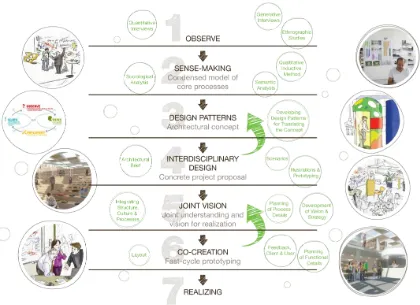
process comprises the following steps (see also Fig. 2):
Fig 2: Overview of the Enabling Space design process.
1 | Deep observation and going out into the field
The first phase of the design process is referred to as “Deep Observation”. In this phase, the design team conducts an in-depth research and observation process; it comprises various
mostly qualitative, ethnographic, and participative observation techniques (Denzin, Lincoln,
2005; Kawulich, 2005; Hoepfl, 1997; Spradley, 1979, 1980), such as qualitative interviews
with a wide spectrum of relevant stakeholders of the collaborative process of knowledge
creation. These interviews aim at establishing deeper insights into the organization and its
systemic environment in order to develop a profound understanding of its core processes.
These interviews are valuable as they do not only generate a lot of information and
[image:19.595.74.494.164.469.2]Besides the interviews it is necessary to make on-site observations by visiting the
organization several times and conducting ethnographic studies observing and investigating
the context, urban setting, cultural issues, etc. (Laurel, 2003; Spradley, 1979, 1980; Tedlock,
2005). This is done by observing people in their concrete working environments, in meetings,
in various communication contexts, in collaboration settings, in cooperation with clients and
external stakeholders, etc. Methods from participant observation approaches (Kawulich,
2005; Spradley, 1980; Senge, Scharmer, 2001; Tedlock, 2005; Denzin, Lincoln, 2005) are
applied by taking and analyzing field notes, videos, and audio data. Above that the design
and research team collects artifacts and takes cultural probes (Graver et al., 1999).
Furthermore, these observations are complemented by quantitative surveys and data.
Depending on the concrete project these quantitative data concern communication patterns
and communication frequencies between emploees (and external stakeholders), means and
culture of communication, patterns in work-processes, patterns of using different physical
spaces and knowledge technologies, satisfaction with the offerings of the particular office
space, patterns of innovation, etc. Apart from these human-centered quantitative data “hard
facts”, such as financial data, office space designs and square footage data, data about the
organization and its structure, etc. are collected.
The overall goal is to gain a picture of the organization which is as comprehensive as
2 | Sense making & deep understanding
Fig 3: Example for structure and interactions of the core knowledge, collaboration, and
innovation processes of a knowledge driven university campus.
The next phase of the design process consists in “Sense-making”: here it is necessary to handle and order these vast amounts of information collected in the field. The aim of this step
is to identify patters within this information in order to come up with the most important processes or activities (“core processes”) that define the organization. This is a highly
challenging inductive process with several feedback “hermeneutic” loops of interpreting and
re-interpreting, re-arranging, and reflecting the observation results. Methodologically, content
analysis tools are applied for analyzing the interview data in a first step (Krippendorff, 2004;
Zhang, Wildemuth, 2009). By that relevant semantic categories and thematic issues and
recurring patterns are identified. Furthermore, it is possible to uncover hidden premises, which are not directly visible in the interview data. These premises are extremely important
as they point to the interviewees’ mental models that are responsible for their attitudes and
behaviors. This analysis serves as a basis for integrating the results with the rest of the
[image:21.595.85.513.108.425.2]In most cases, it is necessary to work on big tables and literally/physically move items
around, arrange them physically, (re-)group, develop semantic fields, and relate them.
Furthermore the design team identifies polarities in the observation material; these polarities
span a field of topics which acts as a semantic container in which the identified topics,
themes, and potentialities are ordered and negotiated. The result is a highly condensed
model of the core processes of the organization or the issue at stake; an example is depicted
in Figure 3.
3 | Design patterns
A detailed description of each core process and the relations between each other is the start
of the next phase of the process: “Design Patterns”. This is done by means of a sophisticated
form of mind maps, since these allow a quick grasp of the relevant issues. These maps have
the format of design patterns (Alexander et al., 1977). Design patterns have several functions in the Enabling Space approach: (a) they provide a comprehensible representation of the
design qualities and basic functionalities for the Enabling Space; (b) they are responsible for
the unity in the diversity of the various dimensions of the Enabling Space and its concrete
realizations; (c) finally, design patterns serve as a kind of language for bridging the (cognitive/language) gap between the relatively abstract and highly condensed research results (e.g., core processes) and the involved partners (e.g., architects, designers, trainers for specific skills, etc.); they translate and transform the concepts into concrete constraints and suggestions forarchitecture, social interventions, organizational changes, etc.
Developing this “translating language” was a key for the interdisciplinary collaboration with
the architects. Furthermore, scenarios, illustrations, as well as story-telling/-boarding tools
(Truong et al., 2006) are used to support the comprehension and communication of the
concepts.
4 | Interdisciplinary design
The design patterns are transformed into an interdisciplinary design in this phase: the results
of this step are concrete plans, designs, views, and concepts for organizational interventions.
This is achieved by a series of interdisciplinary workshops in an atelier-like setting. The aim of these workshops is to use the core-process model and the design patterns as a basis for
developing concrete concepts, designs, and realizations for the Enabling Space. This step
requires intense communication, prototyping (Houde, Hill, 1997; Coughlan et al., 2007), and
adjustments between the Enabling Space team and the architects, urban/landscape
planners, designers, ICT specialists, etc.—the configuration of the “executive team” depends
5-7 | Joint Vision, Co-Creation & Realizing
In the subsequent phases the client(s) are (re-)involved in a process of co-creating a joint
vision out of the proposed design. After several feedback-loops the project is transferred to
the realization phase.
In the joint vision phase the interdisciplinary design is condensed and developed into a vision
expressing the goals and the deeper purpose of the project. This vision reflects both the core
processes and the concrete interdisciplinary design and concepts. These steps are looped
through in a process of co-creation including the design & research team, the architects and
designers, as well as the client(s) (and other relevant stakeholders, if necessary). The
function of the resulting joint vision is not only to keep together the project (ad intra), but also
to ac as a means for communicating this Enabling Space project to the outside world.
All these products (joint vision, interdisciplinary design, etc.) are the basis for entering into
the phase of realizing the Enabling Space: this means that the architects start with the
detailed plans, technology people set up their hard- and software, human resources people
start their interventions and organizational change processes, etc.
Designing Enabling Spaces vs. classical architectural design processes
Enabling Spaces are primarily about supporting knowledge and innovation processes.
Hence, these processes act as the starting point for the Enabling Space design process. It is
this knowledge oriented staring point and the goal of an overall holistic organizational change
which differs profoundly form the classical architectural design approach. The Enabling Space design process goes much deeper with respect to what is the “meaning” and the core
of the work being done in an organization and to explore the innovation potentials whereas in
classical architectural approaches purely functional analyses or studying psychological
issues are used as the conceptual basis for the design. The goal of an Enabling Space is not
only to shape the architectural space, but also to deeply integrate these physical changes
with changes in the organization, in its social structures, (working) processes, IT-structures,
as well as in its cultural atmosphere. It is a much broader and more holistic approach to
architecture as compared to classical architects. It is about knowledge-, innovation, and
organizational architecture with an implication on physical architecture.
Realized projects and accompanying scientific research (methods)
Several projects in various industries and organizational settings have shown that both the
Enabling Space approach and design process are sound and stable. They have turned out to
be quite generic and can be applied to a variety of fields and industries. Among others the
authors (and their team) applied the Enabling Space approach, for instance, in a large Swiss
architectural and organizational changes), for developing a master plan for a university
campus in the southern part of Germany (a knowledge creating campus; see also (Peschl,
Fundneider, 2012b)), for a radical organizational and architectural change process in an IT
division of a worldwide operating engineering and automotive supplier company, or for
developing an urban innovation concept for a creative settlement in Russia.
All of these projects have been accompanied by research activities in which the authors have
been involved. The research has been done in order to validate and to improve the design
process in a feedback-loop between theory, applying this theory in real world projects,
observing the processes and results and changing or improving the theoretical foundations.
The authors were present in two roles: (a) moderating and leading the design process and
(b) with the help of a small research team, observing this process. That is why, mostly
participatory methods from the field of action research were applied (Reason, Bradbury, 2001; Rapoport, 1970; Argyris et al., 1985; Lewin, 1946; Susman, Evered, 1978). In brief,
action research “aims to contribute both to the practical concerns of people in an immediate
problematic situation and to the goals of social science by joint collaboration within a
mutually acceptable ethical framework.”(Rapoport, 1970: S. 499). Action Research [AR]
methodology is “open-ended and iterative. ...AR utilizes cycles of inquiry that include
planning, action, and reflection, in which the action being undertaken is continually designed
and evaluated with research results emerging throughout these cycles. AR can incorporate
multiple methods and welcomes the use of both qualitative and quantitative methods. The
only methods not applicable to an AR approach are those that distance the researchers from
problems and questions of inquiry to ensure “objectivity” or avoid “contamination.”” (Hayes,
2011: S. 15:4).
We are following the reflection-in-action approach propagated by D. Schön (1983, 1984) in
which the researcher is both intervening in the system and studying it by applying mostly
participatory research tools (Susman, Evered, 1978; Senge, Scharmer, 2001; Kawulich,
2005; Reason, Bradbury, 2001). As suggested by Susman and Evered we are understating
our action research approach as a “cyclical process with five phases: diagnosing, action
planning, action taking, evaluating, and specifying learning” (Susman, Evered, 1978: S. 588)
A continuous process of reflection is accompanying this research process—reflection on
premises, observations, on our tools of observations, interventions and tools of interventions.
Above that, we are applying pre- and post-occupancy evaluations/studies (Sailer, Et al., 2010) in order to achieve a more profound understand of the effects of the interventions by
comparing conditions at the beginning and after the end of our interventions and change
4.3 Case Study: A1-InnovationDays
Besides the Enabling Space projects mentioned above, we present a case of an innovation
process which has taken place in a semi-virtual network-setting, because it has some
similarities with a COIN. The architectural dimension is not developed so prominently in this
case; as one can see from the example to come, this low focus on architecture shows the
strength of the Enabling Space approach, which is normally covered and drowned by the
visibility of architecture and design (of offices, etc.). The focus of this example will be on the
enabling qualities of an appropriate innovation- and social architecture.
Context
Being inspired and alarmed by recent technological and sociological developments as well
as changes in the WWW and the challenges the telecommunication industry is facing as an
implication of these transformations, the leading Austrian mobile carrier (mobilkom
Austria/A1) intended to organize an open innovation process (compare also Chesbrough,
2003; Chesbrough et al., 2006). Moreover, this initiative, which is referred to as “A1
InnovationDays“, aimed at better understanding the value systems, behaviors, and needs of
the so-called “digital natives”, since they are the most active and avant-garde users of the
company’s technologies and services. “A1 InnovationDays” is an innovation-format that was
designed as an Enabling Space in the form of an international innovation and software
developer contest comprising both virtual and physical spaces and processes. The grand
theme of the open innovation project was "Open Communication by Open Standards“: as we
are becoming increasingly connected, communicate faster, are independent of time and
place, the various means of communication (phone, email, instant messaging, etc.) are not
yet integrated well—the challenge was to enable a space and process for coming up with
innovations for integration on various levels.
In a period of six weeks open-source software programmers, concept developers, and
designers submitted—mediated through an internet platform—more than 50 high-quality
ideas on the topic of the open innovation challenge. During this period, the ideas were
publicly discussed and evaluated by this community on the platform. This led to the invitation
of the 5 best-ranked ideas for a 3-day prototyping sprint (a format that brings together
programmers and designers to very quickly realize functional software prototypes) in a
former monastery. It was a precondition for participation that for each idea a team of at least
5 people had to be built. After three days of working, conceptualizing, and programming, 5
functional prototypes have been developed and presented with one team winning the
innovation prize. After the initiative officially ended further talks between representatives of
the mobile telephone company and the developers took place aiming at transferring the
business cases. One result of this collaboration is a 3rd place in the RCS Developer
Challenge 2010 in Madrid (one of the most important conferences in this domain).
The “A1 InnovationDays” Enabling Space approach and design process
“A1 InnovationDays” were realized as an innovation ecosystem for digital natives following
the Enabling Space approach: a well orchestrated set of activities, process innovations,
technologies, social interventions, as well as physical and virtual locations was applied in
order to explore potentialities that build on the technologies of the mobile carrier. Although—
superficially—one could quickly conclude that this initiative was primarily about technology, it
turned out that for the design of the Enabling Space social, epistemological and physical
spaces are paramount. The following sections give a comprehensive overview of the design
process and how the Enabling Space was realized in its diverse dimensions:
1 | Deep observation and going out into the field
Before starting the innovation and design process the team comprising the authors, one
manager from the telecom company, and an expert for interior and communication design
was arranged. In a first phase 10 qualitative in-depth interviews were conducted with
stakeholders in order to achieve a profound understanding of the relevant issues of the
relationship between a big corporation and so-called “digital natives”. These interviews were
conducted by members of the design team with a selected group of stakeholders
representing the relevant players in this systemic context: so-called digital natives, experts
from the mobile telecom industry and university, management people from the mobilkom/A1
(from various departments: research and development/innovation, customer relationship,
human resources, and marketing), social and technology trend people, as well as customers
and an expert for spin-offs from big corporations. As discussed in the section about methods,
mainly qualitative interview techniques were applied, in-depth interviews leading into
generative and dialogue-like conversations (Senge et al., 2004; Scharmer, 2007a; Isaacs,
1999b; Bohm, 1996).
These interviews led to insights that were specific with respect to the topic of the developer
contest; for example, a high level of distrust of the digital natives and the corporate world.
Hence, before the official start of the initiative, partnerships and relationships with the most
important stakeholders have been established (universities, technology providers, media,
etc.). This led to an increase in the trust-level and a vivid participation right from the
beginning resulting in high quality content. This is important as the quality of the contributed
content is often a major issue with public participation processes which was also uttered in
the interview process: as soon as low quality content is posted, the quality of the subsequent
about this issue and leave the scene in the moment they have discovered low quality
content.
Besides the interviews and the prior knowledge, ethnographic studies have been conducted:
at several major (semi-)public places in Vienna, the handling and usage of technology
among young people has been observed. One key insight from these observations was the
dual nature of technological devices: on the one hand, they enable communicating with
remote friends, looking up information that serves as input for face-to-face communication,
on the other hand, these devices hinder face-to-face communication, since individuals are
permanently distracted.
2 & 3 | Sense making & deep understanding & design patterns
In the sense-making phase it is necessary to handle and order the vast amounts of collected
information and integrate them into coherent patterns and a systems design. The focus in
this phase is not so much on details, but rather on the relationships between the different
parts and designing an integrated model. Questions that we dealt with were: what does it
mean to the digital natives to be valued and appreciated (monetary prizes, media exposure,
non-monetary recognition, etc.)? What are differences in value systems between a big
corporation and digital natives? How could we transfer the results of the contest into the
sometimes rigid and purely business driven structures of a telecom-organization? How could
the observed topics be brought to the digital natives community?
These questions had to be answered first, and then—like a red thread—be woven into the
design of the Enabling Space (structure, processes, spaces, etc.) for the developer contest.
Take the following example: appreciation has been identified as one of the core qualities in the sense-making process. For the Enabling Space design team the challenge was to break
down this core quality into design patterns for being able to implement it in every detail as an
enabler for fostering innovation, cooperation, and openness. As an implication, for instance,
the developers were invited and accommodated in a 4-stars design hotel for the prototyping
sprint; they were welcomed by top-managers from the initiator; several employees from the
mobile carrier company attended the prototyping sprint during the weekend since they
wanted to learn and engage with the digital natives; the working spaces were stunning—a
former monastery; at first, only the opening and the award show were planned to be hosted
in the chapel, leaving the developers only small rooms for prototyping; however, we
convinced the client to also host the working sessions in the chapel; this led not only to
overwhelming feedback regarding appreciation, but also contributed to a social place of
cooperation in a competitive setting: i.e., the teams competed against each other, but also
helped each other throughout the entire three days. Here one can see the importance of how
Enabling Space: social welcome by the management, emotional atmosphere of appreciation,
architectural support by a very special place, etc. It is the combination of these interventions
which brings about the overall quality of enabling innovation processes.
4 | Interdisciplinary design & realization
A detailed description of the whole design and its realization would be out of scope for this
paper. Rather, we want to highlight two important issues. The first one relates to teams and
team building. In the sense-making phase, we found out that interdisciplinarity is one of the
core qualities/processes. Hence, the whole competition requires an interdisciplinary
approach. While all ideas were about some kind of technological solutions, it should also be
possible, for example, for a business student to propose an interesting idea without
necessarily being equipped with the technical programming skills required to realize the idea
in the form of a (software) prototype. For this reason, we demanded that at least 5 people
with different backgrounds joint as a team in order to be qualified for invitation for the
prototyping sprint. Based on this, we implemented a special functionality on the Internet
platform that allowed for team-building: a software developer could search for a designer, a
compelling idea from a non-programmer could be joined by a programmer, etc. This function
was semi-automatic: it showed the status of expertise already attached to an idea (are we
complete or are we looking for someone?) and triggered automatic requests; after that, the
potential team members communicated directly via their preferred means of communication.
The second issue, which was crucial for the success of the “A1 InnovationDays”, was the
combination and balance between the virtual platform and face-to-face working settings.
During the preparation phase the online platform supported the objective of the competition,
to generate five functional prototypes, very well: collecting ideas and discussions about them,
ranking them, etc. However, when it came to collective design and co-creation processes,
another mode of cooperation was needed: a creative field, where a person's performance is
the condition for the creativity of another person. I.e., one has to see, feel, smell each other!
Here architecture is an important part for establishing such an Enabling Space, but other
dimensions are at least as important: trust (to allow intuitive understanding), mutual
recognition, a culture of "gift economy", etc. All these issues were taken into account for an
integrated design allowing an atmosphere of openness within the boundaries of a
competition. This social environment shares the same foundations as COINs, as both are
based on high ethical standards: issues of trust and coherence are more important than a
quick personal gain or a purely competitive attitude. Any violation of these ethical standards
would very quickly exclude members from the community.
A quote from a journalist of the Austrian Broadcasting Corporation, who attended a full day