accomplished by trapping these compounds on adsor-bents, followed by extraction with organic solvents.
Future Developments
GC will continue to be the main chromatographic technique used in herbicide residue analysis in the near future, due to the high sensitivity and selectivity given by the detectors that can be coupled with this technique. In particular, the use of less expensive and more robust and sensitive GC-MS equipment will keep growing in the routine determination and
con-Rrmation of herbicide residues.
The time needed for sample processing is expected to be reduced as a consequence of the continuation in the development of automatic processes for sample preparation, extraction and clean-up. These processes will use less sample and lower volumes of organic solvents in the analytical procedure.
New improvements in the gas chromatographic equipment to allow higher injection volumes of less puriRed extracts can also be expected.
See Colour Plate 85.
See also: II/Chromatography: Gas: Detectors: Mass Spectrometry; Detectors: Selective. Insecticides: Gas Chromatography. Pesticides: Supercritical Fluid Chroma-tography; Gas Chromatography. Solid-Phase Matrix Dispersion: Extraction. III/Sorbent Selection for Solid-Phase Extraction.
Further Reading
BarceloH D and Henion MC (1997)Trace Determination of Pesticides and their Degradation Products in Water. Amsterdam: Elsevier.
Blau K and King GS (eds) (1978)Handbook of Derivatives for Chromatography. London: Heyden.
Dobrat W and Martijn A (eds) (1998)CIPAC Handbook: Vol.H Analysis of Technical and Formulated Pesticides. Cambridge: Black Bear Press.
Hutson DH and Roberts TR (eds) (1987)Progress in Pesti-cide Biochemistry and Toxicology, vol. 6 Herbicides. New York: Wiley.
Milne GWA (1995)CRC Handbook of Pesticides. Boca Raton: CRC Press.
Nollet LML (ed.) (1996)Handbook of Food Analysis. New York: Marcel Dekker.
Sherma J (ed.) (1989)Analytical Methods for Pesticides and Plant Growth Regulators: vol. XVII.Advanced Analyti-cal Techniques. San Diego: Academic Press.
Tadeo JL, SaHnchez-Brunete C, GarcmHa-Valcarcel AI et al. (1996) Review: determination of cereal herbicide resi-dues in environmental samples by gas chromatography. Journal of Chromatography A754: 347.
Tekel’ J and Kovac\ic\ovaH J (1993) Review: chromatographic methods in the determination of herbicide residues in crops, food and environmental samples. Journal of Chromatography643: 291
Zweig G (ed.) (1972)Analytical Methods for Pesticides and Plant Growth Regulators: vol. VI. Gas Chromato-graphic Analysis. New York: Academic Press.
Solid-Phase Extraction
Y.PicoH, Universitat de Vale%ncia, Vale%ncia, Spain
Copyright^ 2000 Academic Press
Solid-phase extraction (SPE) methods, using bonded-silicas, wereRrst introduced in 1971 as an alternative to liquid partitioning. The method combines extrac-tion and preconcentraextrac-tion of organic compounds in water by adsorption on proper solid material fol-lowed by desorption with a small quantity of an organic solvent. In comparison with liquid}liquid extraction, the following advantages are offered: the amount of solvent required for the clean up is greatly reduced, thus saving time for the evaporative concentration step and minimizing exposure of the analyst to the toxic solvent; the Rnal eluate has less interfering material, and it could be analysed using any of a variety of detection, separation and
identi-Rcation techniques, including high performance
liquid chromatography (HPLC) or gas chromatogra-phy (GC); accuracy and precision are improved; and it is rapid and easily automated.
Another impressive feature of SPE is the commer-cial availability of sorbents in small and inexpensive cartridges. C18-bonded silica cartridges,
styrene-divinylbenzene Empore威 extraction discs and Car-bopack威cartridges have been extensively used for the extraction of organic molecules from water samples. Automated column switching systems and on-line SPE coupled to determination devices have also been often reported for determination of pollutants in drinking and surface water.
chloroacetamides, dinitroanilines and substituted phenols are examples of herbicides usually extracted and isolated by this technique.
It is undeniable that SPE is gaining in importance and, today, is a well-established and validated method, since the Environmental Protection Agency (EPA) in the United States currently offers one SPE procedure for the analysis of organic compounds (including neutral herbicides) and two for the analysis of acid herbicides.
Solid-Phase Extraction
Analyte Characteristics
The determination of herbicide residues is an intricate problem because of the large number of chemicals involved. As a general rule, to classify them into a wide variety of classes depending on their chemical structure results in a lot of groups that barely provide enough information in order to select the best SPE procedure.
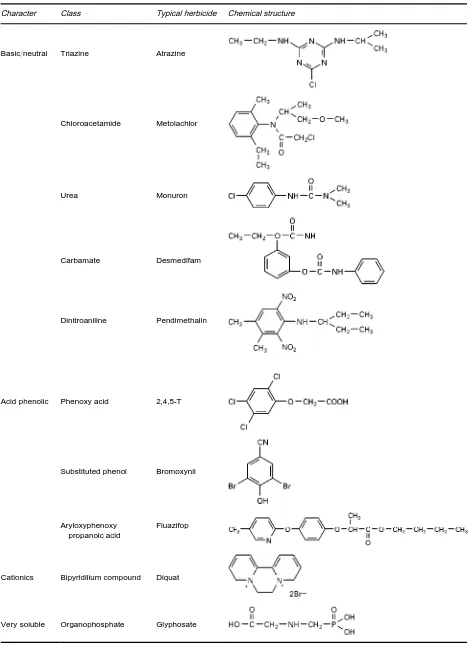
In this way, the most practical approach is to or-ganize the herbicides according to their acid/base character or other properties that condition the pro-tocol following by SPE.Table 1shows these charac-teristics for the major classes of herbicides and some examples of the structures included in each group.
Disposable Solid Phases
The modern SPE technique began in 1978 with the introduction of Sep-Pack cartridges, theRrst compact silica-based solid-phase extraction device for sample preparation on the market. Present-day, disposable prepacked columns or cartridges are available from more than 30 manufacturers, who offer phases such as C18, C8, cyano and amino. The containers are
generally made of polypropylene. The sorbent bed varies from 100 to 1000 mg and is retained between two porous frits.
The use of Empore威 discs are described in more recent studies. These devices include Sat discs with large cross-sectional areas that provide advantages for preconcentration and clean-up methods with re-spect to the sorption, capacity, back pressure and stability after repeated use.
Reversed-phase silica-based sorbents, especially C8and C18bonded-silicas, are the most widely used
packings for SPE. A typical SPE requires a previous sorbent activation step (wetting), usually with meth-anol, and removal of activation solvent excess (condi-tioning), usually with water.
Neutral herbicides can be extracted from 1 L sam-ples with an average amount of sorbent (500 mg).
The sample is extracted under neutral or slightly alkaline conditions, and the pH is adjusted before the extraction to between 6 and 8. Under these condi-tions, salts of humic acids, which generally cause considerable interference in herbicide determination, are unlikely to be adsorbed during enrichment. As acid herbicides are highly polar, they are soluble in water and in aqueous solutions and are less soluble (in their dissociated form) in apolar sorbents. To overcome this difRculty, the aqueous phase has to be acidiRed before extraction to suppress the dissocia-tion of this class of herbicides and to facilitate the transfer of the undissociated molecular species to the solid phase.
The recoveries and the relative standard deviation of the performance of different devices and solid phases are compared in Tables 2 and 3 for basic/neutral and acid/phenolic herbicides, respec-tively. The C18 cartridges showed good recoveries
with most of the basic/neutral and acidic/phenolic herbicides. Compounds having a small (deiso-propylatrazine, tribensulfuron-methyl) or a very high (beta-cySuthrine) afRnity to the C18 material gave
the worst recoveries. In comparison with Empore威 discs a lower breakthrough of polar metabolites of atrazine was reported, possibly due to the fact that Empore威 discs contain only half the quantity of C18 material. However, lower recoveries were
achieved for medium polar and non-polar pesticides except triSuralin and trialate.
As reported in the literature on the subject, the bonded-silicas, in cartridge or in disc conRguration, are the most commonly used supports, but they also have some limitations:
E For polar analytes, the retention is weak and often results in breakthrough during the loading step.
E Basic analytes interact strongly with the residual silanols, which in turn cause low recovery.
E The sorbent must remain wet prior to sample load-ing. (If one accidentally lets the cartridges run dry, the recovery is low and variable.)
E Poor stability in very acidic and basic media, which limits their use to the pH range of between 2 and 8.
These limitations have led to a search for new materials with improved characteristics. For example, the styrene-divinylbenzene resins have been extensively checked for their use in the extraction of pesticides. These polymers show higher retention of analytes and a wider pH range than C18 silicas. The
Table 1 Chemical structure of major classes of herbicides according to the character that determines the SPE procedure used
Character Class Typical herbicide Chemical structure
Basic/neutral Triazine Atrazine
Chloroacetamide Metolachlor
Urea Monuron
Carbamate Desmedifam
Dinitroaniline Pendimethalin
Acid phenolic Phenoxy acid 2,4,5-T
Substituted phenol Bromoxynil
Aryloxyphenoxy propanoic acid
Fluazifop
Cationics Bipyridilium compound Diquat
Ta bl e 2 Re la ti v e s tan d a rd d e v iat io n (R S D) , re c o v er ie s (Re c .) a n d d e te rm in at io n lim it s (D L , P 95 % ) for th e p re c o n c e n tr a tio n o f basic / ne u tral p est icid es fr o m 10 0 0-m L M illi -Q-wa te r Co ncentr a tion ra ng e (n g L \ 1) P re c o nc en tr at io n o n Bo nd Elu t C18 ca rt rid g e s E m p o re
威
C18 di s c s E m p o re
威
SD B d is c s EN V I-C a rb c a rt ri d g e s RS D ( % ) Re c . ( % )
DL (ng
L \ 1) RS D ( % ) Re c . ( % )
DL (ng
L \ 1) RS D ( % ) Re c . ( % )
DL (ng
L \ 1) RS D ( % ) Re c . ( % )
DL (ng
Ta bl e 3 Re la ti v e s tan d a rd d e v iat io n (R S D) , re c o v er ie s (Re c .) a n d d e te rm in at io n lim it s (D L , P 95 % ) for th e p re c o n c e n tr a tio n o f a ci d ic p he n o lic p e st ic id es fr o m 1 0 0 0 -m L M illi-Q-wa te r Co ncentr a tion ra ng e (n g L \ 1) P re c o nc en tr at io n o n Bo nd Elu t C18 ca rt rid g e s E m p o re
威
C18 d isc s E m p o re-SDB d is c s E NVI -C a rb car tridg es RS D ( % ) Re c . ( % )
DL (ng
L \ 1) RS D ( % ) Re c . ( % )
DL (ng
L \ 1) RS D ( % ) Re c . ( % )
DL (ng
L \ 1) RS D ( % ) Re c . ( % )
DL (ng
L \ 1) T rif e n s u lf u ro n -me thyl 5 2 } 2 5 8 5 .3 38 71 7 .4 9 3 9 9 5 .2 68 67 5. 3 7 6 6 9 M e ts u lfu ro n -me th y l 5 3 } 2 6 3 6 .7 43 92 4 .8 8 5 6 6 5 .0 71 66 9. 5 7 7 1 26 Dicamb a 9 1 } 4 6 4 3 .9 63 96 3 .8 4 6 9 3 4 .9 1 1 5 1 16 6. 5 9 7 1 53 MCPA 9 6 } 4 8 7 8 .5 98 2 0 8 6 .5 99 1 6 4 1 2. 8 5 9 3 00 1 0 .7 1 2 4 2 52 Br om o x ynil 11 0 } 56 1 3 .9 76 1 1 9 6 .1 65 1 7 7 3 .8 67 1 1 1 7 .1 89 2 0 6 Dichlor p rop 10 5 } 53 3 4 .1 99 1 1 8 4 .2 94 1 1 9 3 .0 83 84 2. 4 1 04 67 Io x y n il 8 8 } 4 4 6 6 .6 1 0 0 1 51 4 .7 9 5 1 10 6. 3 7 6 1 40 7. 0 9 1 1 56 MCPB 9 1 } 4 6 4 8 .7 88 2 0 2 5 .0 94 1 2 1 9 .9 1 0 6 2 20 3. 6 8 8 8 0 B if e n o x ac id 70 } 3 5 7 5 .6 88 1 0 4 4 .5 1 0 3 8 5 4 .4 97 80 3. 8 9 6 6 9 Ha lo xyfop 1 0 4 } 52 8 6 .1 1 0 0 1 66 4 .3 9 9 1 21 4. 7 1 04 1 2 7 4 .2 91 1 1 3 (R ep rod uce d w it h p e rm is sion fr om S c hu K le in J, Ma rt e n s D , S pizau e r P a n d Kert ru p A (19 9 5 ) C o m p a rison o f dif fe re n t solid p h ase e x tr a c ti o n m a te ri a ls a nd te ch n iqu es b y ap p licat io n o f mu lt ir esidu e m et h o d s fo r th e d e te rmina ti on of p e st icide s in wat e r. F re s e n iu s J ou rna l o f A n a lyti c a l C h e m is tr y 35 2 : 56 5 } 57 1 .)
they are too expensive for use in disposable SPE cartridges. Empore威 extraction discs have recently become available, with styrene divinylbenzene (SDB) copolymer sorbents enmeshed in the matrix.
Recoveries of acid herbicides from water samples have been compared by using C18and SDB discs; the
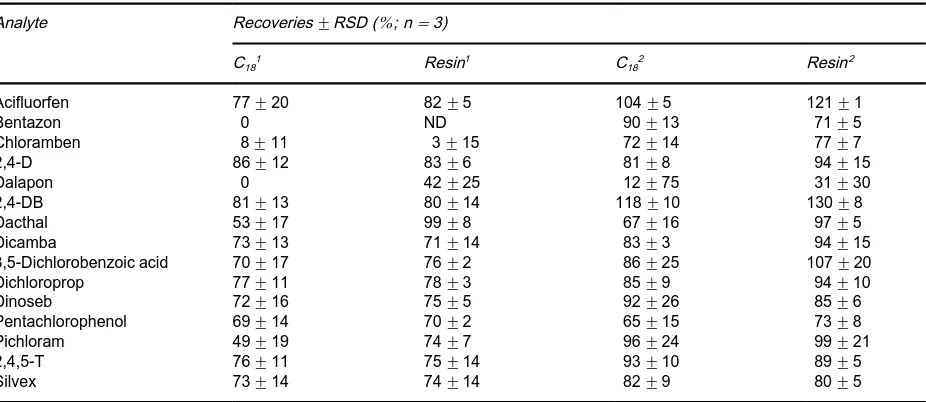
results of this comparison are controversial. Some authors documented an improvement in the recove-ries of phenoxycarboxylic acid and phenols on SDB discs for the enrichment of samples down to 500 mL (see Table 4). The addition of salt considerably en-hances the recovery and decreases the differences between the extraction efRciency of C18 and resin
discs. However, other authors reported that SDB discs showed worse recovery rates under acidic condi-tions, in comparison with C18 when
preconcentra-tions were carried out with 1-L samples (see Table 3). In any case, salting out the water sample enhances the retention of substances on both materials; this in-creases recovery rates for hydrophilic substances. However, salting out is avoided as it may introduce impurities into the samples. The addition of a small quantity of methanol or other organic solvent also enhances the recovery by the so-called ‘dynamic sol-vation’. However, it is not recommended, as it pro-duces a relatively early breakthrough of hydrophilic substances.
Graphitized carbon black (GCB) has been
con-Rrmed to be a valuable adsorbing material for SPE of pesticides in aqueous environmental samples. GBC cartridges proved to be more efRcient than the more commonly used C18bonded-silica cartridges for
the SPE of polar herbicides, whereas the extraction of non-polar compounds showed inferior results (see Table 3). Although GCB is known to behave as a natural reversed phase, it contains chemical hetero-geneities on its surface, which are able to bind anions via electrostatic forces. GBC can behave as both a re-versed-phase sorbent and an anion exchanger, retain-ing the acidic pesticides in their ionic form under acidic conditions. In this situation, the base} neutral/acid fractionation can be achieved by using solvent mixtures at different pHs.
Silica-based ion exchangers are found in disposable SPE cartridges. They are not widely used for the preconcentration of environmental samples owing to their low capacity. Strong anion exchanger discs have been used for the analysis of chlorinated acid and phenoxy acid herbicides. The main problem with these comes from the fact that environmental waters contain high amounts of inorganic ions, which over-load the capacity of the sorbent.
Table 4 C18and resin recoveries and effect of salting water
Analyte Recoveries$RSD (%; n"3)
C181 Resin1 C182 Resin2
Acifluorfen 77$20 82$5 104$5 121$1
Bentazon 0 ND 90$13 71$5
Chloramben 8$11 3$15 72$14 77$7
2,4-D 86$12 83$6 81$8 94$15
Dalapon 0 42$25 12$75 31$30
2,4-DB 81$13 80$14 118$10 130$8
Dacthal 53$17 99$8 67$16 97$5
Dicamba 73$13 71$14 83$3 94$15
3,5-Dichlorobenzoic acid 70$17 76$2 86$25 107$20 Dichloroprop 77$11 78$3 85$9 94$10
Dinoseb 72$16 75$5 92$26 85$6
Pentachlorophenol 69$14 70$2 65$15 73$8 Pichloram 49$19 74$7 96$24 99$21
2,4,5-T 76$11 75$14 93$10 89$5
Silvex 73$14 74$14 82$9 80$5
1Fortified, unsalted reagent water.
2Fortified reagent water with 20%(w/w) Na 2SO4.
ND, no data.
(Reproduced with permission from Hodgeson J, Collins J and Bashe W (1994) Determination of acid herbicides in aqueous samples by liquidIsolid disk extraction and capillary gas chromatography.Journal of Chromatography A 659: 395}401.)
Table 5 Recovery of herbicides from 200-mL groundwater samples by using one cartridge containing GCB and anion exchanger compared with that from two other extraction methods
%Recovery1
C18 Anion
exchanger
GCB#anion exchanger
pH 2 pH 7.9
Dicamba 94.2 (10 23.0 97.3 2,4-D 96.1 (10 78.3 98.4 MCPA 96.4 (10 77.7 97.6 2,4-DP 97.7 (10 76.8 96.4 MCPP 94.4 (10 82.0 97.3 2,4,5-T 93.5 (10 81.4 95.4 2,4-DB 96.0 (10 82.3 98.9 MCPB 95.8 (10 81.5 96.5 2,4,5-T 93.1 (10 77.3 95.2
1Mean values were calculated for two determinations.
(Reproduced with permision from Di Corcia A, Marchetti M and Sampieri R (1989) Extraction and isolation of phenoxyacid herbi-cides in environmental waters using two adsorbents in one mini-cartridge.Analytical Chemistry 61: 1363}1367.)
One of the sorbents is non-speciRc, such as GCB, which traps the analytes of interest and many other compounds, while the other is more speciRc, such as a cation or anion exchanger, which retains and recon-centrates the analytes of interest.Table 5shows the recoveries of nine phenoxy acid herbicides extracted by one miniaturized cartridge containing 50 mg of GCB at the top and 70 mg of a silica-based strong anion exchanger (SAX) at the bottom, compared with C18 and anion exchanger extraction. A large loss of
dicamba and incomplete recovery of phenoxyacids were obtained by using the resin-based exchanger material.
Ammonium quaternary compounds and gly-phosate constitute a special and complicated case. Their determination is very important because they are among the top herbicides used in the world. An important drawback in the preconcentration of such compounds from water is their high polarity. Several efforts have been made to analyse them in envir-onmental samples.
SPE of ammonium quaternary herbicides has been mainly performed with silica, which is a well-known example of the solid phase using adsorption and ionic interaction mechanisms with the silanol groups. Recoveries are rather acceptable in the pH range 7.5}9. Taking into account that at pH values higher than 7 the silanol groups of the stationary phase are ionized, at these pH values the cation-exchange capa-city of the solid-phase will be increased.
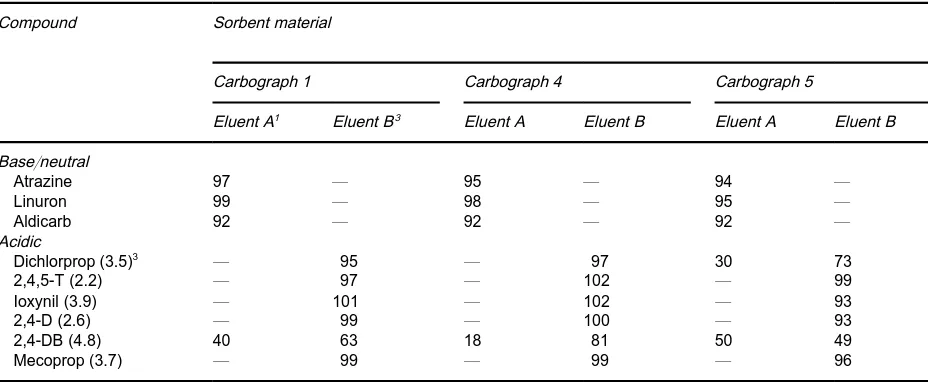
[image:6.568.290.517.487.658.2]Table 7 Base}neutral/acid fractionation by differential elution of selected compounds with cartridges containing three different types of GCB at two eluents
Compound Sorbent material
Carbograph 1 Carbograph 4 Carbograph 5
Eluent A1 Eluent B3 Eluent A Eluent B Eluent A Eluent B
Base/neutral
Atrazine 97 * 95 * 94 *
Linuron 99 * 98 * 95 *
Aldicarb 92 * 92 * 92 *
Acidic
Dichlorprop (3.5)3 * 95 * 97 30 73
2,4,5-T (2.2) * 97 * 102 * 99
Ioxynil (3.9) * 101 * 102 * 93
2,4-D (2.6) * 99 * 100 * 93
2,4-DB (4.8) 40 63 18 81 50 49
Mecoprop (3.7) * 99 * 99 * 96
Extraction from 1 L of Aldrich humic acid-spiked drinking water (spiked level, 10g L\1). Mean recovery values obtained from three
measurements.
1Eluent phase: CH
2Cl2}CH3OH (80 : 20). 2Eluent phase: CH
2Cl2}CH3OH (80 : 20)#10 mmol L\1tetrabutylammonium chloride (TBACI). 3Reported pK
avalues of the acidic compounds are given in parentheses.
(Reproduced with permission from Crescenzi C, Di Corcia A, Passariello G, Samperi R and Turnes MI (1996) Evaluation of two new examples of graphitized carbon blacks for use in solid-phase extraction cartridges. Journal of Chromatography A 733: 41}55.)
It can be concluded that C18material is
inappropri-ate for some herbicides, especially more polar and very non-polar herbicides. In these cases, the SDB polymers and GCB offer a valuable alternative. The appropriate choice of solid phase for application to a separation problem will vary from case to case and must be adapted accordingly.
Elution of the Target Analytes
Desorption of the compounds from the concentration columns is mainly performed with a small volume of liquid. The partition coefRcient in a given solid-phase eluent system should favour the shift of the studied herbicides. On the other hand, SPE is not a separate step, but it is part of a process that includes subsequent determination and so it should be taken into account that some determination systems, such as GC, are incompatible with the presence of water. In this way, the selection of the eluting solvent de-pends on the selected sorbent, the analytes and the detection method. Air-drying is often applied before analyte elution in order to remove residual water.
Methanol and acetonitrile are recommended sol-vents for the elution of herbicides adsorbed to C8or
C18 silicas. Dichloromethane and ethyl acetate have
also been extensively used, especially when the pres-ence of water is undesirable. Table 6 presents the
results obtained when herbicides were eluted from a cartridge using different solvents, such as meth-anol, ethyl acetate, acetone, hexane and dichloro-methane following acetone.
Desorption of acid herbicides from the sorbents can also be performed using a solution adjusted to a pH where the analytes are in their ionic form (two units below or above the pKa). The uniqueness of
GCB is that acid compounds are retained in their ionic forms and neutral compounds are adsorbed by unspeciRc mechanisms. In this situation, base} neu-tral/acid fractionation can be easily achieved byRrst eluting base}neutral species with a neutral organic solvent mixture and then passing a basiRed or
acidi-Red solvent system to desorb acidic compounds.
Table 7reports the results obtained using base} neu-tral/acid fractionation in three kinds of GCB. In all cases, there was some carryover of 2,4-DB, which is the weakest compound included in this table.
With ion exchange sorbents, the analytes can be eluted from the SPE column by either adjusting the pH in order to neutralize the charge on the analyte or by using a buffer of high ionic strength.
Sample Requirements
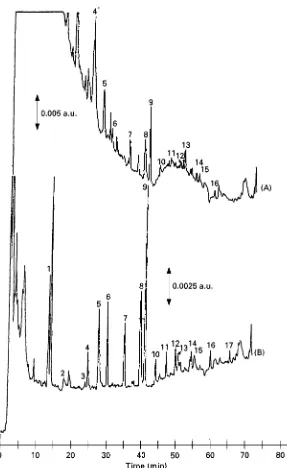
Figure 1 Effect of the pH of the sample on the preconcentration of 500 mL of drinking water spiked at 0.1g L\1. Sample (A)
adjusted to pH 3 with perchloric acid and (B) not adjusted (pH 7). Analytical conditions: flow-rate, 1 mL min\1, loop, 50L; mobile
phase, acetonitrile gradient with 0.005Mphosphate buffer acidified to pH 3 with HClO4, gradient from 10 to 30%acetonitrile from 0 to
10 min, and from 30 to 77%from 10 to 80 min; UV detection at 220 nm. Peaks: 1, chloridazon; 2, dicamba; 3, aldicarb; 4, methoxuron; 5, simazine; 6, cyanazine; 7, bentazone; 8, atrazine; 9, carbaryl; 10, isoproturon; 11, ioxynil; 12, MCPP; 13, difenoxuron; 14, 2,4-DB; 15, 2,4,5-T; 16, metolaclor; 17, dinoterb. (Reproduced with permission from Pichon V, Cau Dit Coumes C, Chen L, Guenu S and Henion MC (1996) Simple removal of humic and fulvic acid interferences using polymeric sorbents for the simultaneous solid-phase extraction of polar acidic, neutral and basic pesticides.Journal of Chromatography A 737: 25I33.)
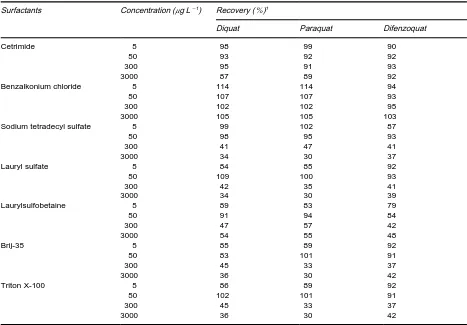
often advisable for extraction of ground water to avoid blocking up the cartridge material. However, waters from different sources are very dif-ferent in chemical composition. Matrix effects from the water itself can cause errors in quantitation and determination. The presence in waters of com-mon contaminants (natural or xenobiotics), such as
Table 8 Recoveries of cationic herbicides (4g L\1) from 0.25 L of water samples containing various concentrations of different
surfactants
Surfactants Concentration (g L\1) Recovery (%)1
Diquat Paraquat Difenzoquat
Cetrimide 5 98 99 90
50 93 92 92
300 95 91 93
3000 87 89 92
Benzalkonium chloride 5 114 114 94
50 107 107 93
300 102 102 95
3000 105 105 103
Sodium tetradecyl sulfate 5 99 102 87
50 98 95 93
300 41 47 41
3000 34 30 37
Lauryl sulfate 5 84 85 92
50 109 100 93
300 42 35 41
3000 34 30 39
Laurylsulfobetaine 5 89 83 79
50 91 94 84
300 47 57 42
3000 54 55 48
Brij-35 5 85 89 92
50 83 101 91
300 45 33 37
3000 36 30 42
Triton X-100 5 86 89 92
50 102 101 91
300 45 33 37
3000 36 30 42
1Average recovery calculated from four determinations.
(Reproduced with permission from IbaHnez M, PicoH Y and Manes J (1996) Influence of organic matter and surfactants on solid-phase extraction of diqua, paraquat and difenzoquat from waters.Journal of Chromatography A 727: 245}252.)
co-extracted and co-eluted, which generates a large, unresolved peak in the chromatogram when HPLC with UV detection is used (chromatogram A). At pH 7, humic and fulvic acids are not co-extracted, as can be seen by theSat baseline from the beginning to the end of chromatogram (B).
Organic matter and anionic or non-ionic surfac-tants have demonstrated negative effect on the recovery of any class of herbicides. Although these undesirable effects are well known, only a few analytical studies have focused on ways in which to avoid them. The proposed methods for removing interferences are based on the use of chemical re-agents, such as sulRte or cationic surfactants. In these cases, the recovery values after chemical treatment were similar to those when a Milli-Q-quality water standard was analysed. The recoveries reported in
Table 8 show that the quantitative SPE of diquat, paraquat and difenzoquat is affected by the pres-ence of anionic, zwitterionic and non-ionic surfac-tants when they are present in water at a level of up to 50g L\1.
Table 9 Recovery (n"6) of triazines from fortified (50 ng mL\1) skimmed milk using the proposed method and that
of Hajs\lova` et al.
Compounds Recovery%(mean$RSD)
SPE method Hajs\lova% et al.
Simazine 89.7$4.1 86.1$5.2 Atrazine 89.3$3.9 84.3$4.7 Prometon 90.4$4.0 92.4$4.3 Ametryn 89.5$3.5 90.0$4.7 Propazine 93.4$3.6 88.6$4.2 Terbutylazine 91.6$3.4 87.3$4.2 Prometryn 87.2$3.8 85.5$4.0 Terbutryn 77.8$3.2 80.9$3.9
(Reproduced with permission from Lagana A, Marino A and Fago C (1995) Evaluation of double solid-phase extraction system for determining triazine herbicides in milk. Chromatographia 41: 178}182.)
Table 10 Comparison of the extraction procedures for tribenuron methyl analysis
Extraction Efficacy Precision Selectivity Operation time Affecting factors Detection limit
Solvent # ## ### ## No data No data
Solid-phase ## ### ### ## Concentration ### Supercritical fluid ## ### ### ### Concentration ###
#, Bad;##, regular;###, good.
(Reproduced with permission from Berna JL, JimeHnez JJ, Herguedas A and Atienza J (1997) Determination of chlorsulfuron and tribenuron-methyl residues in agricultural soils.Journal of Chromatography A 778: 119}125.)
basic and acid environments, used a partition with chloroform followed by a sample clean up using a silica cartridge. There were no signiRcant dif-ferences in the triazine recovery using the two methods.
Solid matrices can also be extracted by SPE with cartridge or disc devices but require a separate hom-ogenization step and other laborious processes. The reported recoveries are lower than those obtained with water, and the addition of methanol or acetonit-rile as organic modiRer is necessary. However, these recoveries are comparable to those obtained by other well known extraction methods for solid matrices.
Table 10gives a comparison of the features of three extraction procedures for tribenuron methyl analysis in soil. Solid-phase and supercriticalSuid extractions are the most adequate in terms of recovery percentage and precision, with acceptable detection limits; never-theless, the recovery is affected by the amount of herbicide present in soil. SPE can also be performed by blending directly a homogenized sample with C18 sorbent, transferring the mixture to a glass
chromatography column and eluting the analytes with appropriate solvent.
The SPE of matrices other than water requires further investigation.
On-line and Off-line Procedures
Nowadays, SPE methods using off-line proced-ures can be converted into on-line SPE methods by direct connection of the precolumn to the analytical column via switching valves. The concentrated analytes are then directly desorbed and transferred to the analytical system. Such systems often involve microprocessor control of the stages for sample switching andSushing of solvents and eluents through the concentration and chromatographic columns.
On-line procedures have gained popularity since European Union (EU) guidelines were introduced which limited the maximum amount allowed for a single pesticide in drinking water to 0.1g L\1and
for several pesticides to 0.5g L\1, including toxic
transformation products. Very sensitive methods are required for monitoring herbicide residues in drink-ing water at such low concentrations. Furthermore the recent commercialization of automatic devices has certainly helped in the development of on-line trace enrichment methods in environmental analysis, because the sequence can be totally automated using systems such as the Prospect module (Spark Holland) or the OSP-2 system (Merck).
On-line SPE-LC is the most common procedure used because it is easily performed in any laboratory. The extracted compounds are eluted directly from the precolumn to the analytical column by a suitable mobile phase, which permits the separation of the trapped compounds. It is well established that on-line procedures enable lower concentrations of pesticides to be determined, and most compounds can be kept within EU limits. Table 11 illustrates the improve-ment in detection limits obtained for triazine and phenylurea herbicides using on-line procedures when compared with off-line ones.
Breakthrough is the key parameter in on-line SPE because it indicates the sample volume and the amount of analyte that can be preconcentrated. Two factors can be responsible for breakthrough:
[image:11.568.51.518.619.679.2]Table 11 Range of linearity,r2and detection limit (LOD) for the on-line method
Pesticide Off-line method On-line method Range of linearity
(g L\1)
r2 LOD (g L\1) Range of linearity
(g L\1)
r2 LOD (g L\1)
Simazine 0.5}50 0.9985 0.1 0.1}8 0.9990 0.03 Cyanazine 0.5}50 0.9973 0.1 0.1}8 0.9987 0.03 Chlortoluron 0.5}50 0.9960 0.1 0.2}8 0.9956 0.05 Atrazine 0.5}50 0.9980 0.1 0.1}8 0.9999 0.03 Isoproturon 1.0}50 0.9990 0.1 0.2}8 0.9993 0.05 Ametryn 0.5}50 0.9985 0.05 0.1}8 0.9993 0.03 Prometryn 0.5}50 0.9989 0.05 0.1}8 0.9995 0.03 Terbutryn 0.5}50 0.9980 0.05 0.1}8 0.9985 0.03 Chlorpyriphos-methyl 2.0}50 0.9962 0.5 0.5}8 0.9980 0.20 Fenitrothion 2.0}50 0.9983 0.5 0.5}8 0.9993 0.20 Fenchlorphos 5.0}50 0.9950 1.0 1.0}8 0.9927 0.30 Parathion-ethyl 5.0}50 0.9944 1.0 1.0}8 0.9995 0.30
(Reproduced with permission from Aguilar C, Borrull F and MarceH RM (1996) On-line and off-line solid-phase extraction with styrene-divenylbenzene-membrane extraction disks for determining pesticides in water by reversed-phase liquid-chromatography-diode array detection.Journal of Chromatography A 754: 77}84)
Table 12 Average recoveries and RSDs (%) of the analytes by the proposed on-line SPE-LC-DAD procedures in environmental water samples spiked at different levels
Compound C18pre-column PRP-1 pre-column
Drinking water Surface water Drinking water Surface water 0.5g L\1 4g L\1 0.5g L\1 4g L\1 0.2g L\1 1g L\1 0.2g L\1 1g L\1
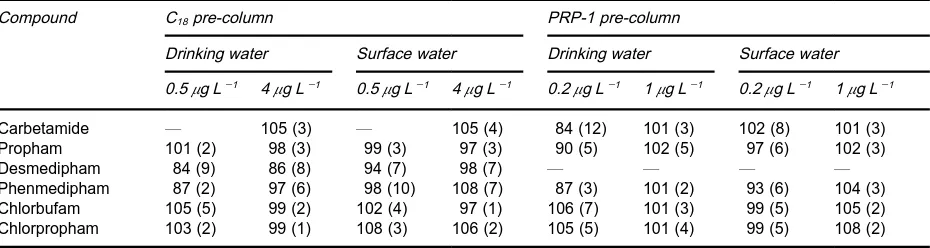
Carbetamide * 105 (3) * 105 (4) 84 (12) 101 (3) 102 (8) 101 (3) Propham 101 (2) 98 (3) 99 (3) 97 (3) 90 (5) 102 (5) 97 (6) 102 (3) Desmedipham 84 (9) 86 (8) 94 (7) 98 (7) * * * * Phenmedipham 87 (2) 97 (6) 98 (10) 108 (7) 87 (3) 101 (2) 93 (6) 104 (3) Chlorbufam 105 (5) 99 (2) 102 (4) 97 (1) 106 (7) 101 (3) 99 (5) 105 (2) Chlorpropham 103 (2) 99 (1) 108 (3) 106 (2) 105 (5) 101 (4) 99 (5) 108 (2)
(Reproduced with permission from Hidalgo C, Sancho JV, LoHpez FJ, and HernaHndez F (1998) Automated determination of phenylcar-bamate herbicides in environmental water by on-line trace enrichment and reversed-phase liquid chromatography-diode array detection.Journal of Chromatography A 823: 121}128.)
sorbent, which must allow a convenient break-through of the analytes.Table 12shows a compari-son of SPE sorbents for analysis of phenyl carbamate herbicides. The results were unsatisfactory with some herbicides. GCB is not used much in online SPE because it is not sufRciently pressureresistant.
Another factor in the procedure is to evaluate the maximum sample volume that can be precon-centrated without breakthrough of analytes, thus avoiding peak broadening. Generally, 50 mL was considered as optimum, but it could be increased for a particular kind of herbicide.
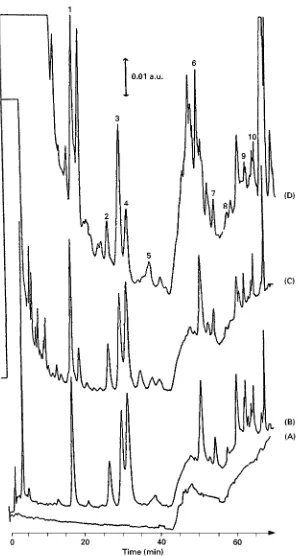
It should be taken into account that sorbents used in on-line SPE are not selective and numerous com-pounds from the matrix of natural samples are pre-concentrated and can be eluted with the analytes of interest. Interferences depend on the nature of the water. They have an effect on both detection
limits and quantiRcation. Figure 2 shows some chromatograms obtained with different waters. In spite of the presence of interference peaks, it can be seen that making a good choice of preconcentration parameter and analytical conditions, allows low levels of many pesticides to be determined, even in highly contaminated surface waters.
[image:12.568.52.517.555.679.2]Figure 2 On-line analysis of 150 mL of different water samples spiked with 0.3g L\1of (1) simazine, (2) methabenzthiazuron, (3)
atrazine, (4) carbaryl, (5) isoproturon, (6) propanil, (7) linuron, (8) fenamiphos, (9) fenitrothion and (10) parathion. Precolumn, PRLP-S. (A) Blank gradient; (B) Milli-Q-purified water; (C) drinking water; (D) surface water from the Seine (28 June 1993). (Reproduced with permission from Pichon V and Henion MC (1994) Determination of pesticides in environmental water by automated on-line trace-enrichment and liquid chromatography.Journal of Chromatography A 665: 269I281.)
On-line SPE-GC is another interesting approach that has gained popularity over the last few years. The SPE-GC coupled techniques generally use an
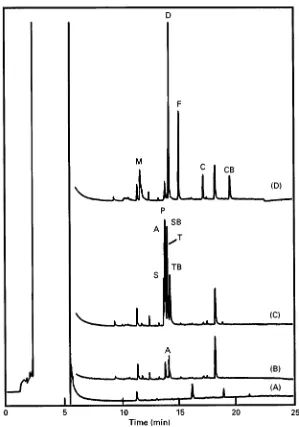
Figure 3 SPE-GC-NPD chromatograms obtained after preconcentration of 10 mL of (A) HPLC grade water, (B) Amsterdam drinking water, and drinking water spiked with (C) triazines (0.1g L\1) and (D) OPPs (0.03g L\1). Peak assignment for the herbicides: S,
simazine; A, atrazine; P, propazine; SB, secbumeton; T, trietazine; and TB, terbutylazine. GC programme: 753C during sample introduction, then to 3003C at 153C min\1; held at 3003C for 5 min. (Reproduced with permission from PicoH Y, Louter AJH, Vreuls JJ
and Brinkman UATh (1994) On-line trace-level enrichment gas chromatography of triazine herbicides, organophosphorus pesticides, and organosulfur compounds from drinking and surface waters.Analyst 119: 2025I2031.)
solute preconcentration. Figure 3 shows typical re-sults for the SPE-GC-nitrogen phosphorus detector (NPD) analysis of triazines. The most striking obser-vation is the good baseline stability, because NPD is a very selective detector. The drawback of this tech-nique is the high cost involved, which makes it unaf-fordable by most of the laboratories involved in herbicide analysis.
The analysis of herbicides, using an automated on-line solid-phase extraction device results in:
E a reduction in error
E a more efRcient use of time
E savings in amount of solvent used
E an improved chromatographic separation
E a reduction of sample volume needed to achieve good results (up to 200 mL)
was derived, and is therefore more suitable for long-term storage. Also, the off-line approach allows the processing of many samples at one time, an ap-proach which is generally more productive in lab-oratories that are not fully automated.
Both off-line and on-line techniques are not mutually exclusive. The possibility of employing both methods gives the analyst more tools at his/her dis-posal for performing the analysis adequately.
Future Developments
Today, SPE has become generally accepted as the analytical method of choice for determination of all major herbicide groups in water. It is suitable for detecting approximately 300 pesticides and pesticide-related compounds and has undergone rigorous multi-laboratory calibration studies. SPE is also the backbone of residue analysis protocols for govern-ment agencies such as the EPA in the US. However, there is still much to be done. The development of new, more selective supports for SPE, its coupling with high separation power techniques, such as capil-lary electrophoresis (CE), and its application to extract herbicide residues from solid samples, may further reduce the detection limit and will represent an exciting challenge for researchers working in the area of herbicide residue analysis.
Looking to the future, it is interesting to note that new SPE sorbents involving antigen}antibody in-teraction, so-called immunosorbents, have been described. Due to their high afRnity and high selectivity for these interactions, extraction and clean up of complex aqueous environmental samples is achieved in the same step. Their application to ex-tracts from solid samples is solvent-free and simpler than any other clean-up procedure. Two class-selec-tive immunosorbents have been optimized up to now that enable the trapping of two groups of widely used herbicides, phenyl urea and triazines.
Experiments have been recently designed to ex-plore the possibility of recovering herbicide residues from food, soil, biological liquid and tissue samples by SPE. For liquid matrices, such as plasma, urine, fruit juice or milk, acceptable residue recovery may be obtained almost without clean up. Before SPE can be used with solid matrices (e.g. muscle, vegetables or soil) a separate homogenization step and often mul-tiple Rltration, sonication and centrifugation are required. Despite these drawbacks, SPE has been used a few times to extract residues of triazines, carba-mates, ureas and other herbicides. More work is needed to further develop SPE for use with the many different types of matrices that may contain her-bicide residues.
Capillary electrophoresis (CE) is very much suited for those analytes that are not amenable to GC or when existing LC methods do not offer sufR -cient separation power. Many impressive CE separ-ations, including the separation of triazines and sulfonylureas, have been demonstrated in the last few years. The main disadvantages of these techniques are its inadequate detection limits and lack of selective detectors for the determination of residues in environ-mental matrices. As a result of coupling with SPE, use of CE has become competitive in trace analysis, and the door has been opened to environmental applica-tions in real matrices. Thus, the potential of CE is very good indeed.
See also: II/Extraction: Solid-Phase Extraction. III/Im-munoaffinity Extraction. Porous Graphitic Carbon: Liquid Chromatography. Solid-Phase Extraction with Cartridges. Sorbent Selection for Solid-Phase Extrac-tion.
Further Reading
BarceloH D (ed) (1993)Environmental Analysis.Techniques, Applications and Quality Assurance. Amsterdam: Elsevier.
BarceloH D and Hennion MC (eds) (1997)Trace Determina-tion of Pesticides and Their DegradaDetermina-tion Products in Water. Amsterdam: Elsevier.
Berrueta LA, Gallo B and Vicente F (1995) A review of solid-phase extraction: basic principles and new devel-opments.Chromatographia40: 474}483.
CsarhaHrti T and ForgaHcs E (1998) Phenoxyacetic acids: separation and quantitative determination. Jour-nal of Chromatography A717: 157}178.
Dean JR, Wade G and Barnabas IJ (1996) Determination of triazine herbicides in environmental samples.Journal of Chromatography A733: 295}335.
Font G, Manes J, MoltoH JC and PicoH Y (1993) Solid phase extraction in multi-residue pesticide analysis of water. Journal of Chromatography A642: 135}161.
International Union of Pure and Applied Chemistry (1994) Analyte isolation by solid-phase extraction (SPE) on silica-bonded phases. ClassiRcation and recommended practices.Pure and Applied Chemistry62: 277}304. Liska I, Kupcik J and Leclercq PA (1989) The use of solid
sorbents for direct accumulation of organic compounds from water matrices. A review of solid-phase extraction techniques.Journal of High Resolution Chromatogra-phy12: 577}590.
Nollet LML (ed.) (1996)Handbook of Food Analysis. New York: Marcel Dekker.
Pichon V (1998) Multiresidues solid-phase extraction for trace analysis of pesticides and their metabolites in en-vironmental waters.Analusis26: M91}M98.