Abstract — The Tokyo Olympic Games and the Paralympic Games will be held in 2020. Many Muslim people have stayed in and travelled to Japan recently, and more are expected to do so during the games. As such, food integrity is important in Japan from an inbound perspective, especially for Muslim people because they need safe and reliable food, which conforms to their religion – that is, halal food. Halal means "permissible" in the teachings of Islam, and halal food types are those obtained in accordance with these teachings. Halal food is not widely available for Muslim people in Japan at present. Therefore, the focus of this paper is halal food integrity, which is investigated by studying halal certification systems and through interviews of 20 Japanese companies that handle halal food. The purpose of this study is to suggest how we could ensure high integrity of halal food in Japan. The companies interviewed are classified by the arc of integration theory. The findings indicate that a periphery-facing policy – meaning moderate integration from suppliers to customers – has been adopted by 17 companies. However, their management strategy depends on either halal certification or on a Muslim friendly policy. The companies with a Muslim friendly policy have adopted a strategy of information integration, rather than delivery integration. The companies with halal certification have adopted both directions of supply chain integration.
Index Terms— arc of integrity, halal certification, Muslim friendly, supply chain integrity
I. INTRODUCTION
HEAD of the Tokyo Olympic Games and the Paralympic Games in 2020, it is expected that the number of foreign tourists to Japan will increase. In fact, the number of Muslim tourists will increase, and a safe and reliable food supply for them will be necessary [1]. Furthermore, the ASEAN (Association of South-East Asian Nations) region has recently displayed economic growth and market expansion, and Japanese companies aim to export Japanese food, mainly to
Manuscript received January 5, 2018; revised January 30, 2018. Daisuke Kitayama is the master student with the Graduate School of Engineering, Kanagawa University, Kanagawa-ku, Yokohama 221-8686 Japan (e-mail: [email protected]).
Masato Takanokura is with the Faculty of Engineering, Kanagawa University, Kanagawa-ku, Yokohama 221-8686 Japan (corresponding author to provide phone: +81-45-481-5661; fax: +81-45-413-6565; e-mail: takanokura@ kanagawa-u.ac.jp).
Mitsuharu Ogiya is with the Faculty of Engineering, Kanagawa University, Kanagawa-ku, Yokohama 221-8686 Japan (e-mail: [email protected]. jp).
Siti Hawa Radin Eksan is with the Faculty of Management and Muamalah, Kolej Universiti Islam Antarabangsa Selangor, Selangor Darul Ehsan, Malaysia
Mohd Helmi Ali is with the Faculty of Economics and Management, Universiti Kebangsaan Malaysia, Selangor Darul Ehsan, Malaysia
Southeast Asia, in line with the boom in popularity of Japanese cuisine there. The Muslim population in the ASEAN region is about 40% and many Muslim people have stayed in and travelled to Japan recently. Therefore, halal food has become more important for Muslim people in Japan from an inbound perspective.
Halal is the Arabic word meaning "permissible" in the teachings of Islam. We study food produced in accordance with this teaching, defining it as halal food. A certification system, which is named “halal certification,” has been established to ensure that food is produced according to halal. The food supply chain has been defined as series of supply processes, from food production to storage, distribution, processing, sales and consumption [2]. Similarly to non-halal food, the halal food supply chain and its management are important in Japan.
Tan et al. [3] proposed a framework of the halal food supply chain. They established a conceptual model for investigating the relationship between the supply chain integration and halal food supply chain integrity in a Malaysian context. Their results indicated that internal integration and strategy had a positive influence on the halal food supply chain integrity. Strategic cooperation should be undertaken with suppliers that focus on the quality and safety of raw materials for halal food. Ali et al. [4] also investigated the impact of external integration on compliance with halal standards, as an example of product integrity within the food industry. Their study extended existing research on food integrity to examine not only food quality and safety, but also the food supply chain from production, procurement, and distribution for Malaysian halal foods. They found a clear influence on customer integration in two aspects: product quality and cost, but no definite impact on supplier integration. IntanMarzitaSaidon et al. [5] investigated supply chain integration of Japanese food and beverage companies in Malaysia. They proposed a short and succinct supply chain regardless of the size of the company. The Japanese companies had short and concise supply chains and procured raw materials from farms in Malaysia, which enhanced time efficiency. Most companies had not signed contracts with suppliers, indicating that they had established a long-term relationship with suppliers based on mutual agreements.
In addition to halal food, the safety and reliability of all supplied foods should be improved for all the stakeholders world-wide. That is the concept of “food integrity.” Ali et al. [6] proposed how halal food integrity of focal companies could be improved through supply chain integration from a Malaysian perspective. They discussed halal integrity
A Study on the Halal Food Supply Chain in
Japan from an Inbound Perspective
Daisuke Kitayama, Masato Takanokura, Mituharu Ogiya,
Siti Hawa Radin Eksan, and Mohd Helmi Ali
A
management and supply chain relationship by using the arc of integration theory. Frohlich and Westbrook [7] suggested that there are two types of supply chain integration: the forward physical flows of deliveries and the backward coordination of data from customers to suppliers. They graphically illustrated both types of supply chain integration as “arc of integration.” The direction of the segment shows whether the firm was supplier- or customer-leaning. The degree of arc indicates the extent of the integration. They also suggested
five types of supply chain integration: inward-facing, periphery-facing, supplier-facing, customer-facing, and outward-facing. For halal food integrity of focal companies in Malaysia, Ali et al. [6] provided evidence for four hypotheses concerning the applicability of supply chain integration for halal foods. For example, focal companies’ adoption of a more extensive supply chain integration strategy influenced the quality of halal food.
Halal foods have not been widely available for Muslim people in Japan, although they are safe and reliable for Muslim people, and can be consumed by other residents and visitors to the country. However, there are few studies on halal foods and their supply chain in Japan. The aim of this study is to investigate halal food integrity by studying certification systems and interviews of Japanese companies handling halal foods, as well as to suggest how we could ensure the production of high integrity of halal food in Japan.
II. METHOD
The halal food supply chain depends on culture and certification systems in Japan. First, we surveyed the literature to investigate the current state of halal food in Japan. Second, we conducted an interview survey with a questionnaire completed by 20 companies handling halal products, as well as a halal expert involved in the Japanese halal food. The companies included suppliers, manufactures, retailers, and restaurants. Table 1 shows the business categories of the companies. These companies all made some effort to supply halal food in Japan.
The questionnaire was based on Ali et al. [6]. They investigated halal food integrity in Malaysia through in-depth interviews from the viewpoint of supply chain integration. In this study, we adapted their questions to a Japanese context, leading to a questionnaire composed of 18 questions. The obtained data were examined from the perspective of arc of integration theory.
III. HALAL CERTIFICATION IN JAPAN
A. Muslim Friendly
Companies in Japan should obtain a halal certification to provide halal food to stakeholders including customers. However, even if they do not obtain a halal certification, they can provide "Muslim Friendly" foods and places, in accordance with Muslim teachings [8].
B. Certification Body Halal Certification
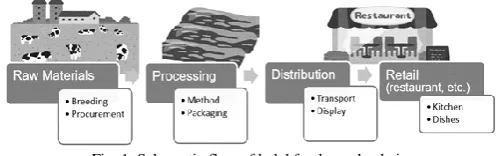
The halal certification system has the concept of “from farm to fork.” All stages in the food supply chain, through raw materials, processing and distribution should be halal. As shown in Fig 1, the flow of halal food is the same as the general food supply chain.
For halal certification, there are several regulations based on Islamic teachings at all stages of the food supply chain. A company gains certification by satisfying halal food regulations from a halal certification organization, which is described later. To obtain halal certification, a company must fulfil standards such as
✓Avoiding all parts from animals with fangs, such as pigs and dogs, additives including pig extracts and pig ingredients extracted from them.
✓Processing any animals by the Islamic method.
✓Avoiding meat not processed by the Islamic method, as well as animal blood and the meat of dead animals. ✓Avoid alcohol, alcoholic ingredients, and alcoholic-based
seasoning. However, a very small proportion of alcoholic components depends on the school of Islamic law. ✓Avoid chemical seasoning in processing and cooking.
At the stage of preparing raw materials, livestock in farms should be isolated from pigs and bred by using feeds corresponding to halal rules. At the processing stage, animal oils and fats are not used for processing and packaging materials at a facility. Processed materials should be isolated from non-halal products such as pork. Fragrance and seasoning should be halal. At the stage of distribution, halal products should be isolated from non-halal products in containers and warehouses. They should be stored and displayed separately from non-halal products. The halal certification system has district dependency. For example, in Malaysia, the factory manufacturing halal products should be facing to Mecca and be more than 5 km away from pig farms and sewage treatment facilities [1].
Halal Certification Organizations320
Currently, there are nine halal certification organizations in Japan as listed in Table 2. The six organizations have mutual certification from the Malaysian Government's Halal TABLE1
BUSINESS CATEGORY OF SAMPLED COMPANIES
Category Number of companies
Supplier + Manufacture + Retailer 2
Supplier + Manufacture 1
Manufacture + Retailer 6
Retailer 6
[image:2.595.311.562.172.250.2]Restaurant 5
Certification Organization (JAKIM). JAKIM allows mutual certification to 67 organizations in 49 countries. Japan Muslim Association (JMA) and Japan Halal Association (JHA) have been certified previously by JAKIM. The other four organizations (NAHA, MPJA, JHUA, JIT) have recently been certified since February 2017. The three organizations have not received mutual certification from JAKIM; therefore, they have local halal authentication.
Examples of Halal Certification Guidelines in Japan 1) Nippon Asia Halal Association (NAHA) [9]
NAHA has obtained mutual certification from JAKIM in Malaysia and MUIS in Singapore. Muslim experts engage as auditors for halal certification. They certify unprocessed vegetables without additives (cereals, eggs, milk, rice, etc.) and processed foods and beverages. The certification cost is 100,000 yen (about 885 USD) or less, and the validity period is 2 years.
NAHA also promotes a “Muslim friendly” policy. They define it as "facilities or environments that are partially satisfied for halal food preparation." The auditing items are (1) raw materials, (2) dishes, cooking utensils, (3) the role of employees, (4) the responsibility of managers, (5) conditions for restaurants, (6) conditions for hotels, and (7) washing, hygiene and safety of food.
2) Japan Islamic Trust (JIT) [10]
JIT has obtained mutual certification from Malaysia (JAKIM), United Arab Emirates, Qatar, and Thailand. They suggest a philosophy of three Hs (Halal, Hygiene, Healthy). Certification is carried out through inspection and discussion at manufacturing and processing facilities. If there is any improvement required in the raw materials and manufacturing processes, they give advice for obtaining halal certification. In any case, they ask experts for detailed advice on Islamic legal views. The certification cost is 300,000 yen (about 2,655 USD) if five products are produced in the same facility. A further cost of 20,000 yen (about 117 USD) is required per additional product. The validity period is one year.
3) Kyoto Halal Council [11]
They are a local halal authentication body, but they have obtained mutual certification from Qatar and Thailand. Their certification is classified into several stages with a distinct perspective to JAKIM.
(1) Restaurant/shop authentication. They can certify a restaurant or shop as halal. (2) Menu authentication. They advise on the composition of menus to provide food that is halal for Muslims. If a menu satisfies the required conditions,
it will be certified as halal. For example, a restaurant or shop providing alcohol is not certified as halal. But, its menu is certified as halal if it offers food on the menu for Muslim. (3) Halal-stay authentication. They can certify a hotel or conference hall as halal for Muslim visitors. For example, a hotel or conference hall that provides prayer mats, halal amenities, prayer’s room, and so on would be certified. (4) Product authentication. They can certify that a particular product is halal (e.g., crafts made by Japanese historical technology). (5) Zabuhu support. “Zabuhu” means suitable processing of meat for halal food according to the Islamic method. A Zabuhu expert with appropriate knowledge and experience is dispatched to perform the certification. (6) “Qibra” arrangement.
Current Situation of Halal Certification in Japan
As described above, certification guidelines are somewhat different depending on which certification organization is considered. Some organizations have strict regulations of Islamic teaching. The others have a Muslim friendly policy. It is also important whether the organization has mutual certification with JAKIM in Malaysia. All stakeholders for halal foods (suppliers, manufactures, retailers, etc.) should choose the certification organization according to their management strategy.
IV. HALALFOODSUPPLYCHAININJAPAN A. Interview of Halal Expert
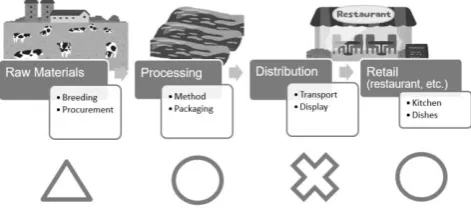
We interviewed the halal expert who promotes halal foods and engages in inbound business on the current situation in Japan. We found a critical problem in the distribution stage within the halal food supply chain as shown in Fig. 2. It is difficult to secure halal in logistics from manufactures to retailers or restaurants because almost all products are delivered with non-halal products. A few distributors take actions to ensure the correct delivery of halal foods, but most do not due to additional costs to satisfy the regulations of halal foods.
In processing and retail, many manufacturers, retailers, and restaurants satisfy the regulations of halal certification, for example, the engagement of Muslim workers, and certified machines in the processing of halal foods [2]. However, only a few farms are certified at the raw material stage in Japan. The others are not certificated because they are not far away enough from pig farms and sewage treatment facilities. TABLE2
HALAL CERTIFICATION ORGANIZATIONS IN JAPAN
Organizations
Mutual certification of
JAKIM Japan Muslim Association (JMA) Yes
Japan Halal Association (JHA) Yes Nippon Asia Halal Association (NAHA) Yes Muslim Professional Japan Association (MPJA) Yes Japan Halal Unit Association (JHUA) Yes Japan Islamic Trust (JIT) Yes Malaysia Halal Corporation No
Islamic Center Japan No
[image:3.595.317.553.365.472.2]Kyoto Halal Council No
Fig. 2. The current status of the four stages in the halal food supply chain.
B. Interview Results from 20 Companies Classification by Arc of Integration Theory
We conducted the interview survey on 20 companies. According to the arc of integration theory [7], 17 are classified as periphery-facing, two as supplier-facing, and one as customer-facing. Among the periphery-facing companies, there are seven manufacturing-centered companies, five restaurant-centered companies, and five retail-centered companies.
Periphery-facing (1) Manufacturing-centered companies Periphery-facing means moderate integration from suppliers to customers
, as shown in Fig. 3. They include the supplier (raw materials) and retailer or have a relationship to retailers/restaurants. The first manufacturer provides and sells organic vegetables directly to consumers or distributes them to retailers. It does not have halal certification, but organic vegetables are safe and reliable for consumption by Muslim people as they are Muslim friendly.
The second manufacturer, which provides fish pastry products (Satsuma fried), has not obtained halal certification. However, they intend to establish a brand so that Muslims in Japan can eat Satsuma fried as a safe and reliable food, through the disclosure of food information. It is a Muslim friendly policy. To achieve this policy, they check that lard and alcohol are not used in raw materials at procurement. The production line of Muslim friendly (Satsuma fried) food is separated from lines for non-halal products. They do not use pesticides or chemical seasonings. In addition to basic inspection, they check food documentation for standard product regulation, as well as from which fishing boat the raw materials are provided. Furthermore, they emphasize a trust relationship between stakeholders, which is established by providing information disclosure, and direct communication. They also provide information for consumers through the website and a social network service (SNS) and advise on cooking methods at restaurants that are acceptable for Muslims.
The third manufacturer provides and sells roux and spices for curries and stews. However, they obtain only pepper made in Indonesia, which is halal certified. They do not use animal raw materials to provide roux for curry, as part of their Muslim friendly policy. They have also established a consultation counter and page on their website for information on their halal products.
The fourth manufacturer provides homebred chickens from breeding to processing. They have obtained halal certification from NAHA. Based on the feed safety law in Japan, homebred chickens are bred by using vegetable-only feeds. Muslim employees engage in the processing of
homebred chicken through an Islamic method using carbon dioxide anesthesia. They disclose all information on the halal process, including the breeding and processing of chicken. They intend for homebred chickens to be well-known as halal food in Japan. Furthermore, they can suggest menus to restaurants and details on how to display processed chicken to retailers, which are in accordance with halal foods.
The fifth manufacturer, which provides bread and frozen food, has obtained halal certification from JIT. They pay attention to hygiene standards for handling raw materials, and their manufacturing line is halal-certified. In distribution, they partly use private containers to deliver halal foods to consumers. They also give restaurants and retailers an instruction on dealing with storing methods of halal foods. Periphery-facing (2) Restaurant-centered companies
Five restaurants are also regarded as periphery-facing. First, a curry-restaurant group recently opened a halal curry shop. This group company has obtained halal certification from NAHA. All the raw materials for the curry sauce (beef, chicken, vegetables, spices, etc.) are procured in Indonesia. Curry sauce is also made and packaged there, and it is imported to Japan. Information on ingredients and halal certification of the curry sauce is disclosed on the company’s website.
Second, the Japanese Tendon (Tempura on rice) restaurant in Tokyo is Muslim friendly and has not obtained halal certification. However, this restaurant uses halal-certified raw materials such as seafoods, chicken, and vegetables. They pay attention to supplier selection and procurement of raw materials. Information such as the ingredients of Tendon is disclosed by SNS as being Muslim friendly.
Third, the local café in Kobe has a local halal certification from Kyoto Halal Council. Most of the raw materials (beef, vegetables, etc.) in this café are obtained with a halal certification, and the others are cooked according to a Muslim friendly policy. The manager directly procures halal food materials from a manufacturer to prevent the delivery of halal food with non-halal products. The café house, which has a prayer room, “Qibra,” and a foot washing area, has also obtained halal certification.
Periphery-facing (3) Retail-centered companies
[image:4.595.90.262.175.291.2]There are five retailers classified as periphery-facing. They control supermarkets or department stores in Japan. One of the retailers has a supermarket chain and handles a variety of halal foods such as beef, chicken, and spices. This retailer has not obtained halal certification, but they procure and sell halal certified foods. They do not have a criterion for the selection of certificated food organizations, but halal supervisors select and procure halal foods according to their quality and price. Fig. 3. Periphery-facing
[image:4.595.338.520.679.790.2]Supplier-facing
Supplier-facing indicates that a company integrates its supply chain with suppliers, while not much with consumers as shown in Fig. 4. Two companies are regarded as supplier-facing. The first manufacturer has obtained halal certification from JMA. And they provide only halal-certified products (bread, noodles, seasoning, etc.). When they select raw materials, they check not only the halal certification of the products, but also ingredients, process charts, and machines which process halal foods. They sell their food to retailers and consumers, but they do not give them any information about the halal food.
Second, the town in the Shikoku district is regarded as supplier-facing. This town supplies wild deer, which are processed at a factory in this town. Venison and their processing are certified by NAHA. Processed venison is consumed in this town and is not distributed to markets because of the early stage of the certification of halal food.
Customer-facing
Contrary to the meaning of supplier-facing, customer- facing means the integration of the supply chain towards consumers, as shown in Fig. 5. A manufacturer which processes and sells frozen foods, corresponds to customer- facing.They have not obtained halal certification, but, based on a Muslim friendly policy, alcohol is not used in processing. To prevent contamination with non-halal foods, they manufacture frozen foods for Muslims in the early morning before processing non-halal foods. Ingredients in English and pictograms are displayed for all consumers.
V. DISCUSSION
Halal foods are not wide-spread yet in Japan, but they will become more important from an inbound perspective in Japan, with increasing numbers of Muslim tourists to the country. However, some companies have stated that they do not wish to obtain halal certification because of the high cost of certification. Such companies establish their own Muslim friendly policies, or may have obtained local halal authentication with relatively low cost.
Seventeen companies are regarded as periphery-facing and are classified as halal-certified or having a Muslim friendly policy. Nine companies (5 manufactures and 4 restaurants) have obtained halal certification. They have maintained supply chain integrity of halal foods by selecting suppliers and customers. Another eight companies (2 manufactures, 5 retailers, and 1 restaurant) have adopted Muslim friendly policies by disclosing information to customers such as whether food materials (meats, vegetables, etc.) and/or ingredients are certified as halal, or from which country they
are procured. Restaurants and retailers emphasize whether food materials are halal at the point of supplier/manufacturer selection. Muslim friendly policies also maintain supply chain integrity through disclosure of information.
Frohlich and Westbrook [7] proposed two types of supply chain integration. One is delivery integration from suppliers to customers: the forward physical flows of deliveries. The other is information integration from customers to suppliers: the backward coordination of data. The companies with Muslim friendly policies have adopted a strategy of information integration rather than delivery information. For example, some companies provide information for consumers through their websites and a social network services (SNS) on their food integrity. The companies with halal certification adopt both directions of supply chain integration. For delivery integration, one company partly uses private containers to deliver halal foods to consumers. The manager directly procures halal food materials from a manufacturer to avoid halal food delivery with non-halal foods. However, it is difficult in Japan to achieve fully conformant halal food delivery because most transportation companies in Japan deliver halal products with non-halal ones. As for information integration, some manufacturers give retailers/restaurants and consumers some information about halal foods, such as food materials and ingredients, manufacturing and storing methods of halal foods.
Supplier-facing companies maintain the integrity of halal food with high quality regarding the procurement and processing of raw materials [6]. However, they do not have any relation to consumers. One consumer-facing company has not obtained certification, but provides high quality information on halal food for Muslims.
The current status of halal certification and Muslim friendly policies in Japan does not preclude the possibility that halal foods are processed, manufactured, delivered, and sold together with non-halal products in the supply chain. We should improve the halal food supply chain and its integration in every category to ensure high food integrity.
VI. CONCLUSIONS
We investigated halal food integrity by analyzing certification systems and interviewing 20 to Japanese companies handling halal foods. Moreover, we discussed how we could establish the high integrity of halal foods in Japan. As result, 17 companies were regarded as periphery-facing. Halal certification and Muslim friendly policies have spread gradually in Japan. The companies with a Muslim friendly policy have adopted a strategy of information integration rather than delivery information. The companies with halal certification have adopted both directions of supply chain integration.
ACKNOWLEDGMENT
[image:5.595.74.254.274.391.2]We are grateful to the halal expert and 20 companies for their cooperation with interviews and their valuable comments for our study.
Fig. 5. Customer-facing.
REFERENCES
[1]. Ministry of Agriculture, Forestry and Fisheries Japan. Efforts relating to "Halal" in Japan [Online]. Available: http://www.maff.go.jp/j/ kokusai/kokkyo/food_value_chain/pdf/list2_1.pdf
[2]. Ministry of Agriculture, Forestry and Fisheries Japan. Guideline towards to exportation of halal foods (revised version) [Online]. http://www.maff.go.jp/j/wpaper/w_maff/h23_h/trend/part1/chap2/c2 _3_02.html
[3]. K. H. Tan, M. H. Ali, Z. M. Makhbul, and A. Ismail, “The Impact of External Integration on Halal Food Intrgrity,” Supply Chain
Management: An International Journal, vol. 22, no. 14, pp. 186-199,
2017.
[4]. M. H. Ali, Y. Zhan, S. S. Alam, Y. K. Tse, and K. H. Tan, “Food Supply Chain Integrity: the Need to Go Beyond Certification,”
Industrial Management and Data Systems, vol. 117, no. 8,
pp.1589-1611, 2017.
[5]. IntanMarzitaSaidon, R. M. Radzi, and N. A. Ghani, “Food Supply Chain Integration: Learning from the Supply Chain Superpoer,”
International Journal of Managing Value and Supply Chains, vol. 6,
no. 4, pp. 1-15, 2015.
[6]. M. H. Ali, Z. M. Makhbul, K. H. Tan, and A. H. Ngah, “Augmenting Halal Food Integrity through Supply Chain Integration,” Jurnal
Pengurusan, Vol. 48, pp. 21-31, 2016.
[7]. M. T. Frohlich and R. Westbrook, “Arc of Integration: an International Study of Supply Chain Strategies,” Journal of Operations
Management, vol.19, pp. 185-200, 2001
[8]. Japan Halal Association (JHA). JHA Standard - Muslim Friendly Reception - [Online]. http://jhalal.com/wp-content/uploads/2cb61 e09f07cf1322d22aa4b9c6372f5.pdf
[9]. Nippon Asia Halal Association (NAHA). Service Introduction[Online]. http://web.nipponasia-halal.org/service [10]. Japan Islamic Trust (JIT). Halal Certification [Online].
http://www.islam.or.jp/halalfood/