R E S E A R C H A R T I C L E
The potential for Assemblage thinking in population geography:
Assembling population, space, and place
Paula Duffy
|
Tim Stojanovic
School of Geography and Sustainable Development, University of St Andrews, St Andrews, Fife, UK
Correspondence
Paula Duffy, School of Geography and Sustainable Development, University of St Andrews, Irvine Building, North Street, St Andrews, Fife KY16 9AL, UK.
Email: pd49@st‐andrews.ac.uk
Funding information
Marine Scotland; Economic and Social Research Council, Grant/Award Number: 150643
[Correction added on 01 February 2018 after first online publication: The legal statement of this article was previously incorrect and has been corrected in this version.]
Abstract
This study explores“Assemblage”thinking as an approach to population geography research. The paper highlights the recent prominence of Assemblage thinking in human geography, before
exploring the potential opportunities for engagement by population geographers. In particular,
we focus on the production of place as co‐constituted by the material (space) and the discursive (knowledge, process, and practice). Considering the Assemblage practice of“Rendering Techni-cal,” we reflect on the role that population geography plays in authorising knowledge and supporting policy. This is investigated through a critical taxonomic analysis of recent Scottish
demographic data. It is argued on the one hand that this captures key economic and population
characteristics of“place,”while on the other hand, it offers a limited technical knowledge. We conclude that a reflexive approach to research using Assemblage thinking may challenge the
inti-mate relationship between population geographers and the state.
K E Y W O R D S
Assemblage, coastal communities, emergence, geodemographics, migration
1
|I N T R O D U C T I O N
This paper explores“Assemblage”thinking as an approach to research in population geography. A very basic description of Assemblage
think-ing might be that it is a relational approach to research, which seeks to
understand how traits of population spaces emerge. A key starting
point is to take persistent configurations as relatively stable
assem-blages and then examine the contingent conjunction of different
com-ponents. This is done by analysing the processes and practices of these
population spaces, deploying concepts (such as territorialisation– deterritorialisation) to understand the relative roles that social and
demographic processes play and encouraging critical reflection on
these processes, drawing on the resources of relational and critical
the-ory. The paper critically discusses the benefits of engaging with
Assemblage thinking for the field of population geography, thereby
opening up discussion of how relational thinking can be incorporated
into the tools of a policy relevant subdiscipline.
Facing an increasingly impact‐driven future, population geography brings a strong disciplinary foundation of engaging with those outside
of academia. The ways of knowing in population geography have
tradi-tionally aligned to policymaking and planning. The relationship has
been mutually beneficial. The field has had access to an abundance
of data rarely seen elsewhere in human geography, and by the nature
of the data available, the technical knowledge we produce feeds back
into policy systems (Abram, Murdoch, & Marsden, 1998; Bailey,
2005; White & Jackson, 1995).
It is instructive to consider a series of “turns”—linguistic, narra-tive, and relational (Little, 2016)—drawing on different philosophical frameworks and assumptions, which have guided the practice of
social sciences. These“turns”in social science have also been part of the subdiscipline's recent history, with calls for population
geogra-phy to engage with social theory and conceptual developments,
which could shape“new” population geographies (Findlay & Boyle, 2007; Findlay & Graham, 1991; Graham & Boyle, 2001) by seeking
out the population issues at the heart of new social theory (Findlay,
2003). The relational“turn”and its ontologies were set out by Bailey (2005) as part of population geography's theorised future. This
pro-vides the potential to broaden the conceptual understanding of
-This is an open access article under the terms of the Creative Commons Attribution License, which permits use, distribution and reproduction in any medium, provided the original work is properly cited.
© 2017 The Authors Population, Space and Place Published by John Wiley & Sons Ltd DOI: 10.1002/psp.2097
Popul Space Place. 2018;e2097. https://doi.org/10.1002/psp.2097
place/space whilst continuing to stay relevant to the demographic
questions that matter to society. Yet Population,Space,and Place's
engagement over the last 10 years shows limited evidence of
embracing this vision despite claiming to be the flagship journal of
population geography.
The paper begins with an introduction to the Assemblages
litera-ture and its use within social sciences in general and human geography
in particular. The paper then reflects on population geography's limited
engagement with Assemblage thinking and explores its potential.
Through our impact‐driven typology of Scottish coastal demographies, we explore how traditional demographic knowledge has something to
offer to relational thinking, as well as its limitations. We draw on ideas
from assemblage thinking to critique the knowledge practices of
population geography—particularly how population spaces are conceptualised; and finally, we reflect on the opportunity for
Assemblage thinking and relational approaches more generally to
enhance population geography.
2
|A S S E M B L A G E T H I N K I N G A N D
P O P U L A T I O N G E O G R A P H Y
There have been notable advances in opening up the dialogue
between population geographers and social theory. For example,
Shubin (2015) explores the space–time aspect of the life course, drawing on Heidegger and notions of time consciousness. Other
population geographers have applied the thinking of Foucault to
population geography (Crampton & Elden, 2012; Legg, 2005; Tyner,
2009). Noteworthy is the use of Foucault within the work of Philo
(2001) and more recently Legg (2005), in retheorising the slippery
relationship between population, space, and place. We argue in this
paper that Assemblage thinking has potential to extend and enrich
population geographers' conversations involving social theory.
“Assemblage”is a term that has been used to describe how things are grouped together. Specifically,“assemblage”is used when there is recognition that multiple drivers of change are taking place and
interacting with one another. Assemblage“theory”(in contrast with the
“term”assemblage) goes well beyond a description. It has been deployed by researchers attempting to offer explanations through an analytic
approach that seeks to capture the complexity of the world (Anderson,
Kearnes, McFarlane, & Swanton, 2012b; Anderson & McFarlane, 2011;
Dewsbury, 2011). The origin of Assemblage thinking in social science
has been attributed to the French philosophers, Latour, Deleuze and
Gauttari, and has been characterised by philosophers of social science
as part of the“relational turn”within social science. DeLanda is also credited for the growing significance of the discourse, notably reworking
Deleuze and Gauttari into Assemblage theory (DeLanda, 2006, 2016).
DeLanda's writings on Assemblage ontology have engaged scholars
beyond relational approaches, in particular, those from critical realist
and speculative realist traditions (Allen, 2012; Anderson, Kearnes,
McFarlane, & Swanton, 2012a; DeLanda, 2016; Harman, 2008).
There is a clear progression in relational thinking and network
con-cepts; networks that were “closed” in a structuralist approach became
“open”through the introduction of post‐structuralism and relational think-ing (Murdoch, 2005; Yeung, 2005). The theories that used open networks
also became more comprehensive over time moving from social network
theory to actor network theory (ANT; Bosco, 2006). Latour's ANT
repre-sented the layers of socialisation built‐up through linked networks to illus-trate the complexity of the modern world and, as such, is often
considered a form of Assemblage thinking (Farias & Bender, 2012; Müller
& Schurr, 2016). However, critics of ANT highlighted that the concept
fails to sufficiently address the capacities of the environment and space
outside of the network, or lack thereof (Ingold, 2008; Lai, 2016; Murdoch,
2005). Despite these drawbacks, most human geographers welcome the
new insights that Assemblage thinking provides (McFarlane, 2009).
The so‐called “modern population geography” (Rossini, 1984) defined population spaces and places as a passive context within
which demographic events were recorded. Frequently, this
geographic perspective treated “space” as a “container” bounding the statistical occurrence of births, deaths, and migration, allowing
a progression to the comparison of population spaces through the
classification of demographic measures (Clarke, 1965). In other
pop-ulation geographies of this era, space was treated as“codex”(Bailey, 2005, p 27). By space‐as‐codex, we refer to research that uses prox-imity and structure of objects in spaces as code for analysis, with
physical distance between locations (and the imagined physical
prop-erties associated with distance) used to define “population spaces.” This deals with both absolute space (characteristics of place) and
relative location (spatial structure of settlements) to analyse patterns
of change across space (as well as in time), for example, spatial
dis-tributions of disease or populations (Bailey, 2005, p. 30–31). Holistic interpretations of the interdependence of population, society, and
environment also led to narratives discussing the similarities and
dif-ferences between“population places”and sometimes to the identifi-cation of“essential”characteristics of populations found in particular kinds of places (Noin, 1979). Although there has been a dramatic
improvement in the sophistication of analyses, many contemporary
assessments of population change continue to be based on this
way of thinking about space and place as passive contexts. Examples
include the classifications of space and place, based on decennial
census reports published by government statistical agencies. By
con-trast, relational approaches in human geography have unleashed new
visions of space and place as actively“answering back”(Bailey, 2005, p. 164) through the socio‐spatial relations of actors and networks at various scales (Heley & Jones 2012; Yeung, 2005). These
develop-ments in human geography must be situated in the ongoing
concep-tualisation of space and place, in particular, the theoretical insights of
relationality, power, actors, and space–time, which have built on rela-tional thinking (Bosco, 2006; Murdoch, 2005). The production of
place as co‐constituted by the material (space) and the discursive (knowledge, process, and practice) breaks down the structuralist
dichotomies of agency/structure and nature/society (Anderson &
Wylie, 2009; Bailey, 2005; Bosco, 2006).
The adoption of “Assemblage” within the field of human geography has been a more recent conversation. Scholars have
inves-tigated how this approach can contribute to discussions of scale and
address questions of emergence, including concerns of governance
and practice, to refocus on the “how” questions (Anderson & McFarlane, 2011). The 2011 special section of Area dedicated to
Assemblage thinking even in its infancy (Allen, 2011; Anderson &
McFarlane, 2011; Greenhough, 2011; Legg, 2011; McCann, 2011;
McFarlane & Anderson, 2011). Many of these developments seem to
be concentrated within the subfields of political and urban geography.
2.1
|Population geography: Space for assemblage
thinking?
There is a noticeable absence of population geographers in the
growing “Assemblage” discourse. Although Stockdale (2016) more broadly discusses the need for relational approaches in population
geography that deal with the complexity and messiness of migration
issues, there have only been two papers that explicitly mention
Assemblage thinking currently published within population
geogra-phy journals (Bilecen & Barglowski, 2015 and Bork‐Huffer, 2016: both inPopulation,Space,and Place). Readers should find this
surpris-ing given that Assemblage thinksurpris-ing rsurpris-ings true to Bailey's (2005)
understanding of how knowledge and power might operate within
a relational population geography.
However, the limited engagement of social theory in its various
guises is not a new observation in population geography. Indeed,
20 years ago, White and Jackson (1995) called for us to (re)theorise
pop-ulation geography, given a concern that the subdiscipline was seen to be
drifting away from other parts of human geography. Their paper
sug-gested this was in part due to the data abundance enjoyed by population
geography in contrast to other subdisciplines. This was seen by White
and Jackson (1995) to have encouraged traditions of quantitative
meth-odological rigour and advancement, but lack of attention to broader
social theory. This bold piece of work set the tone forIJPG, now
Popula-tion,Space,and Place(PSP) as it set out to address this imbalance.
In the following 20 years, the abundance of data has continued to
grow, as has the array of techniques for visualising and analysing
demographic data sets. Notably, there was a celebration of such data
at the recent International Conference on Population Geographies
2015 in Brisbane. The plenaries included themes on “Big Data” (Swanson, 2015) and international data projects such as the“Global Burden of Disease”study (Lopez, 2015). So has population geography
been able to get out of its“intellectual ghetto”? (a term used by White and Jackson, 1995, p. 112).
In 2004, the journal made a semantic leap away from“geography” and“space‐as‐codex” to a journal that in the new title focused on
“space and place.”A (re)focus on social relations, highlighted in Bailey's (2005) work, now became evident in the journal. Boyle (2014; then
co‐editor of PSP) reflected on taking this“risk”as follows:“The use of‘Place’as well as‘Space’was designed to encourage more qualitative researchers to engage with the journal”(Boyle, 2014, p. 677). How-ever, one might question the focus on methodology rather than theory,
when the pace of progress made to achieve the goal of a retheorised
population geography has remained slow within PSP, despite the
change in its name. For example, in PSP's 2015 issues (excluding
spe-cial issues), the majority of papers engage with population spaces as
codex: across both qualitative and quantitative papers (Table 1).
The challenge remains to put into practice Bailey's (2005) vision
for a reshaped population geography. Thus,
Relational views of knowledge had particular salience for
a geography project long committed to a Kantian search
for meaning in proximity and context. As order and
disorder could make each other, space (and time) lost
ontological primacy and were no longer“out there, then” but“here, and now.”Contingency and context mattered. Bailey (2005, p. 111)
Reflecting on the above quote, we propose that Assemblage thinking
is a relational approach that has promise to contribute to the subdiscipline's
development beyond space‐as‐codex. DeLanda (2006, 2009) talks of per-sons and networks as the most quintessential Assemblage. He
conceptual-ises social Assemblages, stating they must“at the very least involve a set of human bodies properly orientated towards one another (physically or
psy-chologically)” (DeLanda, 2006, p. 12). They are multiscalar: individuals, households, communities, towns, cities, regions, and nations (DeLanda,
2009; Farias & Bender, 2012). In this way, Assemblage thinking provides
an example of new social theory, which has population at its core and, as
Findlay (2003) suggests, offers the greatest potential to increase the pace
of progress. Assemblage thinking recognises that populations are
inher-ently involved with the practices and knowledge systems embedded within
TABLE 1 Population, Space, and Placearticles 2015 addressing space‐as‐codex: By methodological approach
n= 33
Conceptualisation and understandings of space and place
Space‐as‐codex Use of social theory (including life‐course) Other
Quantitative approaches 13a 3b 5d
Qualitative and mixed method approaches 0 4c 8e
Total 13 7 13
Note. Articles from PSP special issues (issues 3, 5, and 7) were not included in this review.
References:
a
(Amcoff & Niedomysl, 2015; Bell et al., 2015; Camara & Garcia‐Roman, 2015; Clark, Duque‐Calvache, & Palomares‐Linares, 2017; Johnston, Poulsen, & Forrest, 2015; Mberu & Mutua, 2015; Mezger Kveder & Beauchemin, 2015; Midouhas & Flouri, 2015; Snel, Faber, & Engbersen, 2015; Svensson, Lundholm, De Luna, & Malmberg, 2015; Wang, Guo, & Cheng, 2015; Wilson, 2015; Yang, Noah, & Shoff, 2015)
b(Argent & Tonts, 2015; Coulter & Scott, 2015; Schapendonk, 2015)
c(Jöns, 2015; Newbold, Watson, & Ellaway, 2015; Pásztor, 2015; Wang, Tang, & Li, 2015)
d(Barakat, 2015; Charles‐Edwards & Bell, 2015; Christopher & Leslie, 2015; Hochstenbach, Musterd, & Teernstra, 2015; Wesolowski, 2015) e
the spaces and places that they occupy. Populations and their social
pro-cesses come together at each level, individuals in each Assemblage and
indeed the Assemblages themselves often belong within other scales
(McFarlane, 2009). Assemblage thinking's use of contingency and
emer-gence may offer ways to show how such social processes shape each other
in a non‐linear way and create heterogeneous populations spaces and places that are trans‐scalar.
2.2
|Engaging population geography
—
A starting
point
One starting point to apply these ideas from assemblage thinking is to
consider“population places”as both material and discursive, as we have argued. In this way, both the processes and practices of Assemblage
offer potential for population geographers to better understand and
respond to the material spaces we research. We therefore now provide
examples of what we as authors understand as key processes and
practices of Assemblage and their relevance to population geography.
We begin by providing a short summary of four key
conceptualisations related to process within assemblage thinking:
emer-gence, de‐/territorialisation, de‐/coding, and contingency. First, Assem-blage thinking is a social theory driven towards understanding
emergence as the process of maintaining and shaping the identity of
any given Assemblage, including population spaces. Emergence is
differ-ent from change in the planned form. Emergence is recurrdiffer-ent, a slow
replacement where the capacities of the whole are realised through the
mobilisation of relations and resources. (DeLanda, 2006; Dittmer, 2014).
The second set of processes is territorialisation and
deterritorialisation. Territorialisation is conceptualised as a process
that serves to stabilise the Assemblage and its identity. This can be
achieved by either increasing the homogeneity of the parts or
reinforc-ing the sharpness of the assemblage's boundaries (DeLanda, 2006). In
regard to spatial territorialisation and clarifying the boundaries of any
assemblage, this aspect is inherently geographical (Anderson &
McFarlane, 2011; Müller, 2015). By beginning to spatialise Assemblage
as a social theory, it highlights the importance of places and their
internal processes and therefore validates Assemblage as an
appropri-ate means of enquiry for population geographers as“Settled places and regions however arbitrary are the essence of human geography
enquiry”(Pred, 1984, p. 279). We can view populations as inhabiting spatial territories where the boundaries are defined by both the
administrative bodies and natural landscapes. The boundaries
prescribed by administrative bodies have often been shaped by a
his-torical co‐evolution of place and population, but are not fixed or defined by those that occupy them. They are therefore more likely to
be contested. This brings us to “deterritorialisation,” which is any process that destabilises and works towards dismantling boundaries
and creating further heterogeneity within the Assemblage.
Next, we consider the concepts of coding and decoding, which
provide a tool to analyse the roles that are played by social and
demo-graphic processes, in order to reach a causal analysis. A process which
is“coding”will consolidate and increase the rigidity of an Assemblage, whereas a process with a“decoding”role will allow for a certain degree of flexibility within the Assemblage operations. Explanations from
cod-ing and decodcod-ing axis will often involve reasons and motives, which are
recurrent and can drive emergence (DeLanda, 2006). It is here that the
fourth concept, contingency becomes important. Assemblage thinking
discards the assumption that a particular cause will always have the
same effect, or will always produce the same outcome. Causes are
understood as events (that are necessary but not sufficient for change).
They are disturbed by other contingent internal and external
happen-ings (Anderson et al., 2012b; Bear, 2013). Therefore, it is important
to consider how these processes take shape. How this occurs in
populations over space–time is determined by the nature of the prac-tices and parts of the Assemblage.
The focus on practice/s is important when considering Assemblage
as a relational approach, often praised for its strength in addressing a
somewhat Foucauldian focus on“the how”(Anderson et al., 2012b; Li, 2007). This in many ways has helped the increasing prominence of
assemblage thinking in social science writings, yet there are few who
have theorised a set of practices for place‐based assemblage thinking as well as Li (2007). Li (2007, p. 265) describes six practices of
Assem-blage: (a) Forging Alignments, (b) Rendering Technical, (c) Authorising
Knowledge, (d) Managing Failures and Contradictions, (e) Anti‐Politics, and (f) Reassembling. Li sees these practices as one way of advancing
the analytic basis of Assemblage thinking. These practices have been
developed alongside political–spatial and governance discourses. However, we argue that these practices apply to other
place‐based assemblages relevant to population geography and related research fields (Prince, 2014). A key strength of the practices theorised
by Li is that they are able to draw out the relationality of research—in particular, the role that knowledge creation and dissemination have in
the processes of an Assemblage, particularly emergence, or lack
thereof. These are practices with the ability to reveal power and
agency in population geography (Legg, 2011).
We argue that “Rendering Technical” and the closely related practice of “Authorising Knowledge” resonate within population geographer's impact‐driven collaborations, in particular, those that utilise traditional approaches.“Rendering Technical”is described by Li (2007, p. 265) as“extracting the messiness of the social, with all the processes that run through it, a set of relations that can be formulated
as a diagram in which problem (a), plus intervention (b), will produce (c)
a beneficial result.”Technical knowledge creation, where information about society is often quantified and presented as scientific or statistical
through the methods used to process it (increasingly the use of ICT
soft-ware to compute advanced quantitative approaches), is a practice that is
“Rendering Technical.”Technical knowledge practices have the potential to distance the knowledge from“most people”and feed into the intellec-tual and political hierarchies of a knowledge society (Abram et al., 1998;
Böhme & Stehr, 1986). These practices are embedded in the planning
and policy systems and use technical processes to engage specific actors
in the network. This conceptualisation was deployed by Prince (2014) to
understand how cultural assemblages have been rendered technical— where the increasing use technical knowledge was practiced as a way
of taking a complex issue and creating control, standardisation, and
reproduction by reducing participation in culture to numbers. The
techni-cal knowledge, produced by“experts,”is then framed as evidence rather than recommendation; in doing so, it can depoliticise issues and provide a
selective focus for intervention. When Brown, Craddock, and Ingram
frame rendering technical as a way of inhibiting emergence. They
demon-strate how the practices of policymakers can frame emergence as risk,
which must be contained through other knowledge practices in order
to maintain health security.
These examples provoke reflection on how practices of rendering
technical could exist within traditional approaches in population
geogra-phy. This links back to Bailey (2005) and where populations have too
often in the past been reduced to numbers and characteristics, detached
from the discussions of space (material, economic, and social) and place.
Likewise,“Authorising Knowledge”and the nature in which knowledge practices can confirm enabling assumptions and contain conflicts and
cri-tiques of an Assemblage results in an inhibited process of emergence
(Brown et al., 2012); this links into debates about the path dependence
of population spaces. Lastly, in highlighting this work, we also hope we
can lead our readership to see the ties with Foucauldian social theory
more frequently used to frame the work of population geographers. Legg
(2011, p. 131) has highlighted that Li's six practices blur the divide
between Assemblage thinking and Foucault'sapparatus, which he then
(re)frames as an assemblage approach stating that the two
conceptualisations“emerge as one and part of each other.”
Population geographers using Assemblage thinking (whether
incrementally or radically) need to recognise the practice of producing
technical knowledge and consider the complex impact our research
has. Greenhough (2011, p. 135) highlights the strength of Assemblage
approaches to do this stating: “The importance of studying such relations and Assemblages is not (as some critiques of relativism
suggest) to celebrate complexity but ‘to become worldly and respond.’” This may be interpreted as a call to engage deeply with complexity, through the recognition of how our own knowledge
prac-tices impact the social worlds we research. Reflecting on the concepts
above, researchers doing Assemblage research can enhance a
critically reflexive position within population geography.“Rather than reduce‘geography’to passive context, critical thinking urged scholars to explore how space, place and environment ‘answered back’ and shaped the kinds of knowledge that were produced as researchers
encountered the objects of research. Relational views of the world
challenged what is meant by geography, what was meant by
population”Bailey (2005, p. 164).
Beginning with a traditional approach of composing a typology
using a statistical clustering technique, the paper now addresses the
social processes and practices of the Assemblage to understand
popu-lation space/place. Through implementing the conceptual tools above
and our self‐critical reflection on the technical knowledge produced, we show the power that social theory has to enhance the significance
of population geography.
3
|A N E M P I R I C A L E X A M P L E O F
T E C H N I C A L K N O W L E D G E S
3.1
|A typology of Scottish coastal population
spaces
We have argued for an Assemblage approach in population geography,
which would incorporate the technical knowledges of the subdiscipline
and therefore present a population example using a typology—a tradi-tional method for classifying population spaces. Classifying
populations using geodemographics is the basis for the production of
spatial population knowledges for a variety of commercial, political,
and planning applications (Singleton & Spielman, 2013). The design of
our typology was multilevel. Level 1 followed a similar design to past
examples of sociodemographic and economic typologies used in
plan-ning and policy. This allowed us to understand the limitations of these
approaches in a real world example. Level 2 of the typology provided
the opportunity to begin to incorporate two key themes from
Assemblage thinking—emergence and contingency. This was achieved by completing a second analysis, which focussed on the social and
dynamic characteristics of population spaces.
3.1.1
|Coastal localities and the policy context
The empirical lens for this study is the Scottish coast and its population
spaces. This is currently an active context in policymaking. The Scottish
Parliament (2010) promulgated the Marine (Scotland) Act 2010
along-side the implementation of HM Government (2011) UK Marine Policy
Statement in line with the European Union (2014) Directive on
Maritime Spatial Planning 2014/89/EU. These policy drivers have
implications for how Scotland manages and plans coastal areas. There
is an increasing demand for a social evidence base for coastal regions
to which this typology will contribute. Other demographic studies of
UK towns, particularly in coastal policy contexts, have used a
typolog-ical approach (Fothergill, 2008; Hindle, Salthouse, & Shorten, 2011;
McElduff, Peel, & Lloyd, 2013; Scotland's Towns Partnership, 2015b;
Shepherd, 2009; Tym & Partners and OCSI, 2011a, 2011b). There
are therefore many precedents for using typologies to produce
techni-cal knowledges of population spaces.
This study used “localities” data as the “geography” for analysing Scottish population. These localities corresponded to the 629 recognisable
settlements of Scotland (National Records of Scotland, 2015). The
population criterion was set as places with 1,000 to 49,999 people and
used to exclude large cities and populations under 1,000. Geographic
information system analysis identified localities where the boundary either
intersected or was within 2 km of the mean high water mark, based on
precedent from other coastal studies (Hynes & Farrelly, 2012; Post &
Lundin, 1996). This process produced a subsample of 149 localities.
4
|M E T H O D O L O G Y
4.1
|Creating a typology
The typology was primarily created through K‐means clustering analysis. This is a data‐driven clustering technique, which maximises differences between clusters. The resulting clusters have cases as
sim-ilar as possible to one‐an‐other and are as dissimilar to cases in other clusters, based upon numerical distance between cases as represented
by scores on the variables. The number of clusters dictates the number
of centroids, and the distances are measured from these. The cases are
grouped by minimising the distances to the centroids. The process is
iterative and ends when all cases have been allocated to an optimal
clustering technique involved repeating the process for different
num-bers of potential clusters. A judgement between too many
particulari-ties (clusters wheren= 1) and too much generality, was made for each
level of the typology.
The first level of the typology used variables from the 2011
Scottish Census data, where appropriate composite category inputs
were created, for example, the categories “Married with Children” and“Co‐habiting with Children”were combined to form“Couples with Children.”This produced the final 15 variables with 60 category level inputs (Table S1, see URL). A K‐means analysis was then run based on the Z‐score for each variable, as this produced cluster groups in relation to the coastal average.
The second level of the typology also used the K‐means clustering method described above. At this level, new variables were extracted
from the 2001 and 2011 Scottish censuses, and an isolation variable
was also introduced. Composite variables were used to counter the
disaggregation in the 2011 Scottish census response categories. These
allowed change variables to be calculated for the 10‐year period. The change variables were calculated using a proportional change measure.
Nine variables were formed from 62 category inputs (Table S2, see
URL). This level addresses critiques of typologies as static methods:
building on the precedent of both McElduff et al. (2013), who used a
single dynamic variable of overall population change, and Crawford,
Bradley, and Marcucci (2013), where a classification was the starting
point to quantitatively explore the impacts of in‐migration in the coastal South Carolina over time.
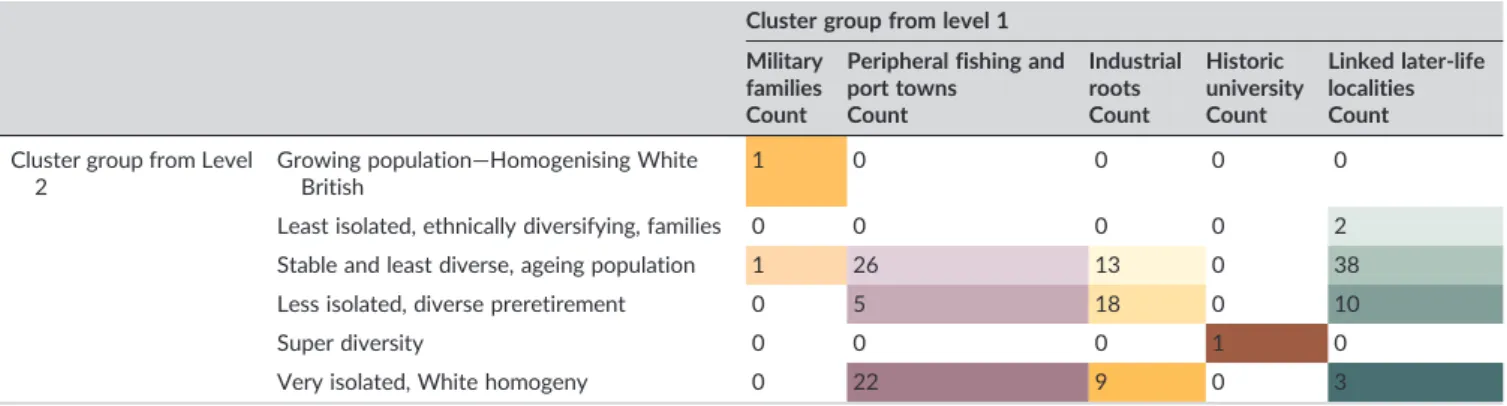
The final output was a cross tabulation of the Levels 1 and 2
clusters (Table 2). This provided a breakdown of the Level 1 cluster
groups by the Level 2 social and dynamic profile of localities and
cre-ated the final 13 subgroups (Figure 1). Table 2 provides an example
of the data‐driven descriptions produced for the five Level 1 clusters. The final 13 subgroup descriptions included proportional change
variables and were analysed in comparison with the coastal average
(149 localities) rather than a rate of statistically significant change. This
is an example of how an incremental approach to Assemblage thinking
can inform the method of analysis by examining change as
‘contingency’.
4.2
|Testing the typology
—
Community dependence
measure
The typology thus far provides a means of data consolidation for the
different demographic and socio‐economic characteristics of“place”
in relation to how these characteristics are changing. Yet there is little
indication of why these differences in“place”matter to a relational population geography. If the population spaces are to be treated as
an Assemblage, as we have suggested, then there is an assumption that
they have the emergent properties of the whole. The technical
knowl-edge created in Figure 1 fails however to adequately capture either
emergence or potentially emergent properties such as agency. Agency,
in terms of population spaces, matters in order to address how
powerful or powerless a place is in dealing with demographic and
socio‐economic challenges. Indeed, the differential capabilities identified by the typology come together within population spaces in
different ways, thus affecting the capacity for emergent properties.
In this study, we suggest that such independence/dependence can
be seen as an emergent property of population spaces related to
agency discourses. If a typology represents real differences in the
demographic and social profile of“place,” then we would expect to observe different levels of agency and therefore different levels of
in/dependence.
In order to investigate this assumption, the final step in our
methodology was to test whether the different categories in the
typol-ogy were shown to differ in relation to the in/dependence of the
places they represented. This was done using a one‐way analysis of variance (ANOVA) (Marsh & Elliott, 2008). This is not a directional
measure. The independent variable was the cluster group. This was
tested against“community dependence.”The community dependence measure is a score developed by Scotland's Towns Partnership (2015b)
to measure in/dependence of places relative to the number of assets,
diversity of business, and employment base of Scottish places using
seven indicators. A key strength of this multivariate measure is that it
captures a number of factors, but it generates less understanding of
how the provision of these services is negotiated and maintained.
Finally, a test of the homogeneity of variance was also completed to
ensure the validity of the ANOVA. A significant difference between
groups is expected in order to validate this assumption.
5
|A C R I T I C A L A N A L Y S I S
The Scottish coastal typology (Figure 1) presented here is an example
of technical knowledge of particular use within the practice of Marine
Planning, where understanding coastal population spaces is crucial to
achieving the policy goals of a“strong, healthy and just society” in HM Government (2011) UK Marine Policy Statement and the EU
TABLE 2 Creating a multilevelled typology—Cross‐tabulation
Cluster group from level 1
Military families
Peripheral fishing and port towns
Industrial roots
Historic university
Linked later‐life localities
Count Count Count Count Count
Cluster group from Level 2
Growing population—Homogenising White British
1 0 0 0 0
Least isolated, ethnically diversifying, families 0 0 0 0 2
Stable and least diverse, ageing population 1 26 13 0 38
Less isolated, diverse preretirement 0 5 18 0 10
Super diversity 0 0 0 1 0
Directive 89/89/EU (2014). We focus on what can be known from
technical knowledges produced within the tradition of
geodemographics and also on how this type of knowledge,
paradoxi-cally, may inhibit an adequate understanding of key aspects of
popula-tion spaces.
The first level of k‐means analysis produced five clusters (Table S3, see URL). The five clusters were compatible with the dominant
Scottish coastal town types evident in the contemporary literature
(Scottish Excecutive, 2002). Some 146 of the 149 localities make
up the three main groups:“Peripheral Port and Fishing Towns,” “ Indus-trial roots,” and “Linked Later‐life localities.” These 146 localities account for 83.4% of the coastal population (or 22.4% of Scotland's
total population). There were also two outlying groups:“Military Fam-ilies”and “Historic University Town.”The labels given to the Level 1 cluster groups were constructed from data‐driven descriptions (Table S3). Reflecting on this process, we understand that the
vari-ables have labelled groups of places in a manner, which coincides
predominantly with economic narratives explaining Scotland's coastal
population. In contrast, the Level 2 groupings related much more
closely to dynamic demographic processes and are of greater interest
to Assemblage thinking.
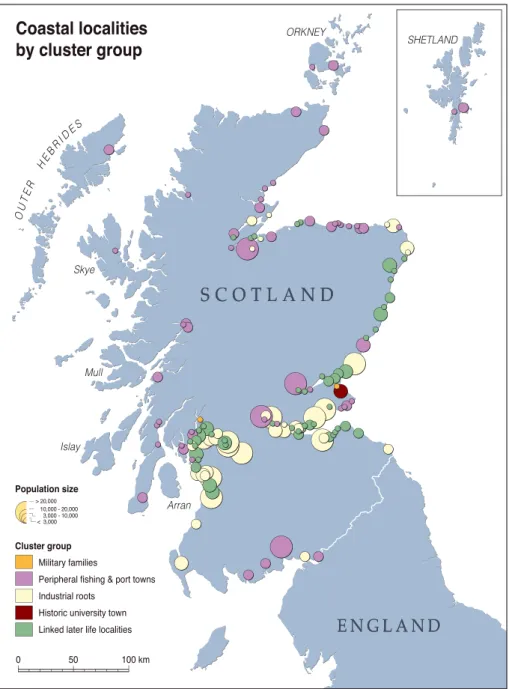
Considering the“geography”of Scotland, there are some highly suggestive patterns in the Level 1 typology. In Figure 2, it can be
observed that the West Highlands, the North Coast, and Islands
com-munities feature prominently withinPeripheral Fishing and Port towns;
the high concentration ofIndustrial Rootsaround the central belt; and
the Linked Later‐life Localities coalesce around Scotland's four main cities: Aberdeen, Dundee, Edinburgh and Glasgow. Therefore, the
geographies of context play a role in the static socio‐economic and demographic profiles of place. The dynamic and social characteristics
of Level 2 also have a strong link to local contexts within Scotland.
The paper now explores this further through examining three
demo-graphic themes: overall population change, ageing, and mobility.
5.1
|Overall population change
Demographic change is a key characteristic distinguishing the
Periph-eral Fishing and Port Towns cluster, from other communities
(Figure 3). Localities around Inverness, the North‐West Highlands, and the Scottish island populations are growing but have socially
homogenous populations. In contrast, stretches of the coast with
tradi-tional fishing localities have experienced overall population decline.
Examples include the East Neuk of Fife and the Firth of Clyde.
Demo-graphic change has impacted the social and economic sustainability of
these population spaces. FIGURE 1 A typology of 149 Scottish coastal
5.2
|Ageing
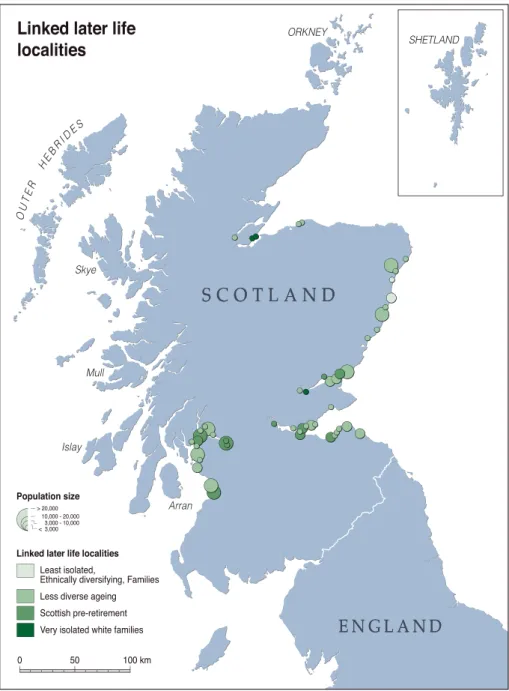
Ageing appears to be a key population dynamic in Cluster 5 (Later‐life linked localities—Figure 5). This cluster group has the largest proportion of older people, particularly those over 65 years. However, this is
unlikely to cause concern within the policy and planning sectors due
to the low levels of deprivation within many of these localities. In
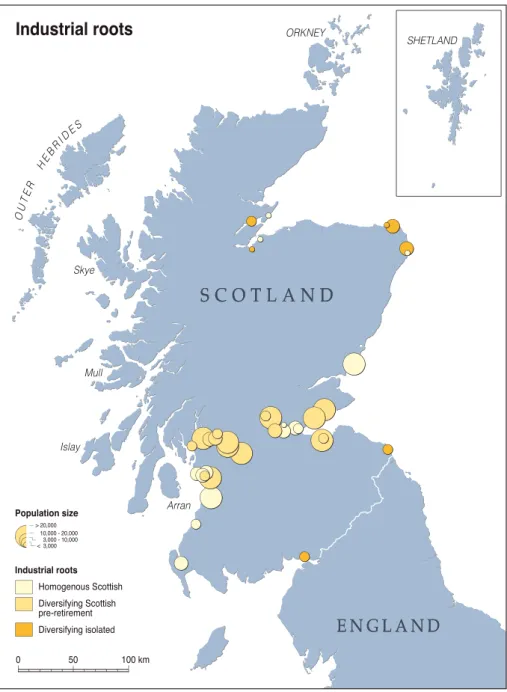
con-trast, in the more deprived localities of Industrial Roots(Figure 4),
growth in the preretirement age groups is coupled with greater social
diversity, indicating that the population faces potential social and
eco-nomic planning challenges in the future.
5.3
|Mobility
The subgroup “Diversifying and Isolated communities” (Figure 4) highlights that both mobility and economic processes shape and
are shaped by place. These localities are those that often have a
stronger tie to marine industries, including, for example,
industrial‐scale fishing or offshore energy. Over the period 2001–2011, the Diversifying and isolated subgroup experienced a significant level of immigration of White Eastern Europeans following
the 2004 expansion of the EU, illustrating how global processes
(international migration) connected to local economic opportunity
shape the character of place.
In other clusters and subgroups, everyday mobility (commuting)
can be seen to characterise place. The Linked Later‐life localities (Figure 5) are all concentrated within commuting distance of the four
main cities in Scotland, as well as around Inverness. For example,
within this cluster, 83.65% of households have at least one car or
van, and amongst the economically active, 62.01% travel to work by
car. Some 68.11% of households reported travel to work distances of
5.4
|Scottish coastal communities
Exploration of the patterning of the typology makes evident that place
and space are related to the social and economic geographies of
Scot-tish coastal communities (Figures 2-6). By (re)focusing on population
within technical knowledge, we have illustrated that the demographic
is shaping place in these spaces. This is important as it highlights the
demographic challenges that coexist alongside wider economic
chal-lenges of coastal spaces.
Clusters 1 and 4 are outliers (Figure 6). The Military Families
cluster consists of two localities with military bases. Finally, the
Historical University Town cluster is located and shaped within the
historical and educational contexts of the university town of St
Andrews. Assemblage thinking and ideas of the trans‐scalar would encourage us to look to other scales of explanation for
understand-ings of the demographic trends in these locations (for example, in
the case of St Andrews from examination of its context relative to
the global differentiation of universities in an international hierarchy
of higher education).
We must remember through the use of K‐means that this empirical example is limited to using a tool that does not privilege
statements of directionality or causality. It does not provide evidence
of“the how.”In particular, how population spaces/places are produced from the relationship between demographic processes and context.
We reflect more on this in the conclusions.
5.5
|Testing the typology: Adding agency
In Assemblage thinking, a place's capacity for agency would differ
based on the potential relationships that could take shape (DeLanda,
2006). The demographic, economic, and social profiles of places
(represented by the clusters) promote or inhibit relations that shape
these capacities. However, technical knowledge fails to capture the
analytical coding that determines which relations make a place, where
values and motives are shaping relations of these profiles in context.
Further to this, the relations that exist between population spaces/
places and their proximate networks also affect the potential for
agency to emerge within place. Therefore, testing the understanding
of the similarities and differences produced by the K‐means clusters against a measure of collective agency (the community dependence
score) adds an additional dimension to understanding Scotland's
coastal communities. This provides a means to explore to what extent
these population spaces have capacity, as Bailey (2005:164) suggests,
to“answer back.”
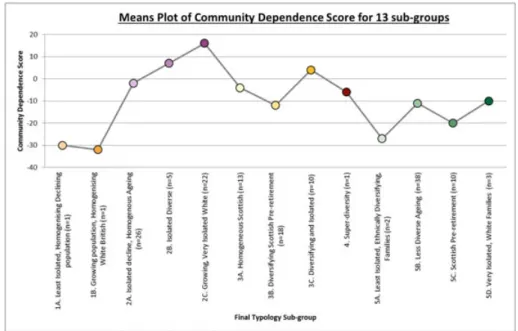
The difference in means (shown in Figure 7) was tested using a
one‐way ANOVA to see to what degree this observed difference was reliable and was statistically significant (Table S4, see URL).
Importantly, the reliability of these results as measured by the
homo-geneity of variance is improved by the integration of the second level
of the analysis (Sig = 0.001).
The importance of looking at in/dependence that incorporates
the material infrastructure of place to our understanding is to show
that these places do not exist in isolation from each other or the
broader network of towns and population spaces in Scotland
(Sparks, 2015). The results from the ANOVA show that these places
have varying levels of independence. The most dependent cluster
was Military Families. This outcome was expected due to the
strategic location of the facilities and the nature of the population
of military personnel with their strong social ties to external
population spaces.
In contrast, the highest level of independence was found in the
Peripheral fishing and ports towns. These populations are distant in both
commuting and isolation variables). Therefore, there is a demand for
essential services to be provided“in place.”Networks within this clus-ter are both economically and culturally rooted in the local traditions of
the coastal spaces that they occupy. This can also be seen in subgroup
3c (Diversifying and Isolated), which feature larger localities linked to
industrial scale fishing and offshore activities.
Most other sub groups for Industrial RootsandLater‐life Linked Localities are represented as below “0” on the community depen-dence score showing a tendency towards dependepen-dence. This shows
the importance of their proximity to urban centres. However,
indi-vidual variation between groups is significant, indicating a need for
the context of the demographic and social profile to be taken into
account. This would enhance understandings of “how” in/depen-dence is lived out beyond the infrastructure variables that the
mea-sures focus on. This is particularly relevant when considering places
that have an ageing population as measures could be designed to
build context‐specific understandings of what dependence means (e.g., substituting primary/secondary education indicators for primary
care provision). Sparks (2015) reflects on the Scotland's Towns
Part-nership (2015a) and Scotland's Towns PartPart-nership (2015b) typology
as requiring such context‐specific knowledge in order to meet the needs of these towns. He adds that there is a need to supplement
the typology with local knowledge. Sparks (2015) title that draws
from Robert Burns'To a Louse:“O wad some pow'r the giftie gie us to see oursels as ithers see us” provides a useful reflection of where agency is found within a typological approach. He argues that
agency and power (which is initially missing from this top‐down quantitative approach) can be regained from the knowledge it
pro-duces. For example, a local population can harness agency from
knowing how those“in power”view“place”and take action to meet the needs of a community. With this in mind, we would argue that it
knowledge as“practices”—practices that can be negotiated to allow a place“to answer back”(Bailey, 2005; Li, 2007).
5.6
|Limitations of a typology
We now reflect on the practice of creating technical population
knowl-edge. In this study, the typology has served mainly as a form of data
consolidation: one that reaffirms existing understandings of coastal
places and their similarities and differences (Table S3). The static
nature of typologies makes it challenging to represent the shifting
nature of population spaces over time. The multilevel design
imple-mented in this paper has demonstrated that current understandings
of Scottish coastal context are incomplete. Although many of the
existing understandings are supported by the Level 1 evidence, the
diversity of localities is determined by the demographic and social
change taking place. This is key for policy‐relevant research, as it
encourages planning for what places will become or indeed are
becom-ing, rather than what they have been.
We first reflect on the practice of“labelling places”as part of the typology's creation. Through this, we, as researchers, can be seen to
participating in the Assemblage practice of “Rendering Technical.” Labels are often the point of engagement with users of technical
knowledge because they convey “take‐home messages.”Population geographers have often sought for labels to be driven by the
postpositivist truths of the data. This practice inevitably reflects the
knowledges already encountered in the academy and in relevant policy
fields. This is unsurprising, as researchers select appropriate data for
policy or in relation to a perceived gap in knowledge. Therefore, we
recognise that this typology is already subject to the linguistics of
policymaking, through the ways in which data are organised and
tools and narratives to disseminate“new”state‐produced knowledge. Labelling places as a practice can therefore lead to path dependent
understandings of population spaces.
In addition, we are acutely aware that these labels may change
through the process of dissemination within government. Tym &
Part-ners and OCSI (2011a, 2011b) reflect on their typology of England's
East Marine plan area and the consultation process. Labels were
sub-ject to negotiation and driven by policymakers. Policymakers avoided
any negative language around economic or social deprivation and
instead focused on what was missing from their data, the future of
these places. The Scotland's Towns Partnership (2015a) typology
equally found that labelling became politicised and opted to have
neu-tral, a‐descriptive labels (just letters and numbers). These are clear examples of how knowledge practices code or decode population
spaces as Assemblages: Political knowledge shapes wider society
through the use of specialist knowledges of people and place.
There are other examples of“Rendering Technical”that we found when reflecting on the typology through the lens of Assemblage. The
practice of using of state‐produced knowledge, such as the census, is common within population geography, for reasons already mentioned
in the paper. State‐produced knowledge can be seen to strengthen the impact potential of the discipline's research through the familiarity
of data sets within policymaking and a clear alignment to policy needs.
However, it also brings with it other limitations that are worthy of
note when considering how this example adds to a relational
population geography. First, state‐produced knowledge has exhibited an inability to move away from space‐as‐codex. Space‐as‐codex is embedded into the practice of creating the knowledge; the data
available at each of the geographical boundaries is determined by
organisations (e.g., The National Records of Scotland). They are not
flexible; indeed, to capture change over time, we must establish these
spaces, aggregating datazones for comparison. Second, the nature of
smaller coastal populations resulted in this empirical example's
reliance on the Scottish census data. In this case, the level detail of
the data was privileged over frequency and access lags. This further
limits findings of the typology in an Assemblage approach, where
emergence and contingency understand that the relations and power
that these communities command will often be rapidly changing.
Lastly, these examples also contribute to the political assumptions
about place and space (that have been key to debates in geography,
see Massey, 2005). The above limitations allow us to reflect on
work-ing with data or a fixed set of scales produced by the state and their
role in reinforcing the spatial reach of the power, which often
encour-ages path dependency and narratives of a“natural history of place” (Brown, 2011; Lai, 2016; Pierson, 2000).
Considering these practices and the importance of emergence, we
avoided labels of unrealised futures, mindful of the inability of this
methodology to capture emergence of the capacity of Scottish coastal
Assemblages. Instead, we used a multilevel design and labelled places
to reflect both data‐driven descriptions and the demographic and social processes that were driving change from 2001 to 2011. Overall,
the practices involved in technical population knowledge creation tend
to privilege the state as an audience and, as a result, may exclude
certain groups or individuals from mobilising the knowledge of
popula-tion spaces within the Assemblage. This is due to their limited
understanding of the technical aspects of its creation. The top‐down nature of this classification will therefore likely inhibit the capacities
of population spaces (Abram et al., 1998).
6
|D I S C U S S I O N
We now consider the ways which Assemblage thinking can advance
how population geographers deal with technical knowledges and the
understandings they produce through the conceptualisation of
Assem-blage practices and in particular“Rendering Technical”(Li, 2007). We consider how to implement the conceptual tools of Assemblage
6.1
|Rendering Technical: A practice of population
geographers
Many population geographers use advanced quantitative methods.
Even seemingly less complex methods such as the clustering technique
used within our research involve the researcher participating in socially
constructed knowledge practices, practices that have implications for
those we research. This is particularly important where population
geographers seek to produce evidence for planning practice.“ Render-ing Technical” involves extracting relations from the complexity to problematise and create an intervention. This is often practiced by
those in government who have appropriate technical expertise to
advise on the benefit scenarios for the uptake of recommended
inter-ventions. This is closely linked to the third practice described by Li
(2007) of “Authorising Knowledge,”which seeks to understand how assumptions are confirmed and critiques are contained in order to
smooth over conflicting processes. It is with these two practices that
population geographers' traditional knowledges contribute, not as
absolute understandings but as practices within the Assemblage.
This typology adds to existing examples (Brown et al., 2012; Li,
2007; Prince, 2014) where technical knowledge practices reveal
emer-gence by reproducing behaviours and relations within an Assemblage,
often in order to meet the motives of some of its parts. This is an
example of coding. The perception of this knowledge is often that it
is expert based, which creates a social expectation and performance
as this flows through the Assemblage (McCann, 2011; Prince, 2014).
The labelling and grouping‐together of places that share characteristics is often motivated by government organisations desiring to mobilise
policies in multiple places based on similarities. In turn, the government
organisations or the “state”contribute to path dependency through these practices being recurrent in nature, whilst also limiting
alterna-tive capacities of place.
This can shape the agenda for intervention, by determining what
“problems”we study and what demographic processes we politicise through knowledge creation (such as segregation or international
migration). This results in “stickiness” (Boettke, Coyne, & Leeson, 2008; Lai, 2016), where the knowledge practices of policymakers and
planners become embedded over the longer term. These practices
can lead to processes that either territorialise or deterritorialise
depending on how“population spaces”answer back to technically‐ pro-duced knowledge, or to the policy and planning solutions that the
tech-nical knowledge supports.
6.2
|Potential for assemblage thinking
Assemblage always exist within populations, however
small, the population is generated by the repeated
occurrence of the same processes. As the assemblages
making up these collectives interact with one another,
exercising a variety of capacities, these interactions
endow the populations with some properties of their
own, such as a certain rate of growth or certain average
distributions of assemblage properties. DeLanda (2006,
p. 16–17) (emphasis is DeLanda's)
Populations as Assemblages transcend scale; individuals interact
with kin to create households, who interact with each other to form
neighbourhoods and so on. The relations of exteriority and the
possi-bility to take part in neighbouring and larger Assemblages allow for
for-mation of social entities. However, they are determined by how the act
of“coming‐together”is territorialised and coded.
The impact agenda has raised the profile of population spaces
such as localities or the “community” as an appropriate scale at which to govern through. Such an approach, utilising the
Assemblage's coding (the motives, desires, and beliefs of a
popula-tion) can be mobilised to meet the objectives of those seek“impact” (Harris, 2014; Li, 2007). Therefore, whilst recognising the
contribu-tions of technical knowledges and how the practice of creating it is
an important role for population geographers to reflect upon, we
also should complement these with the strengths of relational
approaches to capture the“people”and the relations that shape pop-ulation geographies, for example, building on the work of residential
mobility and moving desires (Coulter, 2013; Coulter & Scott, 2015;
Coulter, Van Ham, & Findlay, 2013).
However, the appropriate scale for any particular population
space or place‐based Assemblage may not be accounted for in our traditional comprehensions of scale as geographers. As suggested by
Bailey (2005), we would argue a (re)theorised population geography
needs to be open to new conceptualisations of scale such as
translocal (McFarlane, 2009). It is worthy of note that
conceptualisations of the translocal and trans‐scalar thinking has become prominent within recent issues ofPopulation,Space,and Place
(Bork‐Hüffer, Rafflenbeul, Li, Kraas, & Xue, 2016; Etzold, 2016; Faist, 2016; Fauser & Nijenhuis, 2016). By opening up analysis to multiple
scales through mixed‐methods understandings, we may place a popu-lation space within other Assemblages and uncover the mechanisms
and power relations that shape the possibilities. We have considered
how the St Andrews assemblage, which is unique within this typology
(Figure 6), may be better understood as continually emerging through
processes and practices of international student migration, global
sporting, and commercial investment: in a global context rather than
the Scottish one.
A relational population geography would have to focus on both
human and non‐human action, relations, association, and emergence. The population classification presented shows that this cannot be
eas-ily captured by technical knowledges. We need to examine the
prac-tices of people and organisations in place and develop deeper
understandings of the contextofplace. It is understanding“how”the interaction of populations, space, and place play out that the
Assem-blage ontology shows great potential to uncover the complexity of
processes and practice.
Population geography, as a subdiscipline renowned and respected
for its rigour, is in a position to shift relational knowledges towards the
impact agenda. The opportunity is greatest where relational
knowl-edges created by population geographers are valued as of equal worth
to technical knowledges. To do so would open up the potential for
planners to make use of the emerging capacities of population
spaces/places and the relevant power structures that enable place to
the wider discourses around resilience and spatiality, and Massey's
(2005) challenge for policy to practice space differently.
7
|C O N C L U S I O N S
This paper, and the sociodemographic typology presented, shows the
limitations of technical knowledges using secondary data when trying
to understand how population places are constructed. Technical
knowledges are alone, limited, as space remains codex, fixed in scale
and time. This is demonstrated in our example of how“geographies” and data‐based approaches are shaped by those who are collecting the data and for what purpose they are“Rendering Technical.”This has prevented a full understanding of the importance of context and
the internal relationship between the characteristics of place and the
capacity to“answer back.”
Bailey's (2005) interpretation of space and place in population
geography was visionary in identifying the need for population
geogra-phers to interpret how “emergence” might be identified from tradi-tional demographic data (even before the assemblage thinking
became a key theme in human geography). However, in this paper,
the typology alone could not deal with emergence. We suggested that
places show evidence of emergence but were unable to link this to the
contingency in social and demographic phenomena as they were
mea-sured. Perhaps a study that looks at longitudinal data could do this
bet-ter. Yet there are other practices and processes which shape space/
place in complex ways, beyond practices of rendering technical that
feedback to communities, policy, and planning. Therefore, we have
concluded that in order to properly respond to emergence and
contin-gency in Scottish coastal communities, a second phase of qualitative
fieldwork is needed in order to provide the in‐depth, placed‐based understanding.
Finally, alongside Stockdale (2016), we call population
geogra-phers to recognise the messiness and complexity in population issues.
We hope that Assemblage thinking may be a starting point for
popu-lation geographers to get at the practices and repopu-lationships from
which agency emerges to achieve a truly relational understanding.
This leads us to perhaps the greatest challenge facing the relational
turn in population geography. This is to identify emergence rather
than technical projection. The social at any scale of population is
not complete. The relationship to space–time means that there are social processes specific to context that are not yet theorised (Little,
2008). Provocatively, this frames our relational understandings as
emerging alongside the societies and populations we look to research.
Although this opens the field up to knowledge collaboration with
populations, this would ultimately challenge the “intimate relation-ship”and intellectual standing that population geographers have with the state and state‐produced knowledge (Bailey, 2005, p. 193; White & Jackson, 1995).
A C K N O W L E D G E M E N T S
This paper is output from an Economic and Social Research Council
Award (Reference 1506438) funded in partnership with Marine
Scot-land, The Scottish Government. We would like to extend our thanks
to both Allan and Anne Findlay for invaluable conversations during
the development of this paper. We are also extremely grateful to the
Editor and anonymous reviewers for their insightful suggestions in
improving our argument throughout the drafts of this paper.
O R C I D
Paula Duffy http://orcid.org/0000-0001-9427-064X
Tim Stojanovic http://orcid.org/0000-0002-8936-2299
R E F E R E N C E S
Abram, S., Murdoch, J., & Marsden, T. (1998). Planning by numbers. In P. Boyle, & K. Halfacree (Eds.),Migration into rural areas: Theories and issues(pp. 236–251). Chichester, UK: John Wiley.
Allen, J. (2011). Powerful assemblages?Area,43(2), 154–157. https://doi. org/10.1111/j.1475‐4762.2011.01005.x
Allen, J. (2012). A more than relational geography?Dialogues in Human Geography, 2(2), 190–193. https://doi.org/10.1177/20438206124 49295
Amcoff, J., & Niedomysl, T. (2015). Is the tied returnee male or female? The trailing spouse thesis reconsidered.Population, Space and Place,21(8), 872–881. https://doi.org/10.1002/psp.1969
Anderson, B., Kearnes, M., McFarlane, C., & Swanton, D. (2012a). Material-ism and the politics of assemblage.Dialogues in Human Geography,2(2), 212–215. https://doi.org/10.1177/2043820612449298
Anderson, B., Kearnes, M., McFarlane, C., & Swanton, D. (2012b). On assemblages and geography. Dialogues in Human Geography, 2(2), 171–189. https://doi.org/10.1177/2043820612449261
Anderson, B., & McFarlane, C. (2011). Assemblage and geography.Area, 43(2), 124–127. https://doi.org/10.1111/j.1475-4762.2011.01004.x Anderson, B., & Wylie, J. (2009). On geography and materiality.
Environ-ment and Planning. A,41(2), 318–335. http://doi.org/10.1068/a3940 Argent, N., & Tonts, M. (2015). A multicultural and multifunctional
country-side? International labour migration and Australia's productivist heartlands. Population, Space and Place, 21(2), 140–156. https://doi. org/10.1002/psp.1812
Bailey, A. J. (2005).Making population geography. London, UK: Hodder.
Barakat, B. (2015). A‘recipe for depopulation’? School closures and local population decline in Saxony. Population, Space and Place, 21(8), 735–753. https://doi.org/10.1002/psp.1853
Bear, C. (2013). Assembling the sea: materiality, movement and regulatory practices in the Cardigan Bay scallop fishery. Cultural Geographies, 20(1), 21–41. https://doi.org/10.1177/1474474012463665
Bell, M., Charles‐Edwards, E., Kupiszewska, D., Kupiszewski, M., Stillwell, J., & Zhu, Y. (2015). Internal migration data around the world: Assessing contemporary practice. Population, Space and Place, 21(1), 1–17. https://doi.org/10.1002/psp.1848
Bilecen, B., & Barglowski, K. (2015). On the assemblages of informal and formal transnational social protection. Population, Space and Place, 21(3), 203–214. https://doi.org/10.1002/psp.1897
Boettke, P. J., Coyne, C. J., & Leeson, P. T. (2008). Institutional stickiness and the new development economics.American Journal of Economics and Sociology, 67(2), 331–358. http://doi.org/10.1111/j.1536-7150.2008.00573.x
Böhme, G., & Stehr, N. (1986).The knowledge society. Dordrecht, Nether-lands: Springer.
Bork‐Huffer, T. (2016). Migrants' agency and the making of transient urban spaces.Population, Space and Place,22(2), 124–127. https://doi.org/ 10.1002/psp.1891